
A complete issue · 20 pages · 1900
Life — May 31, 1900
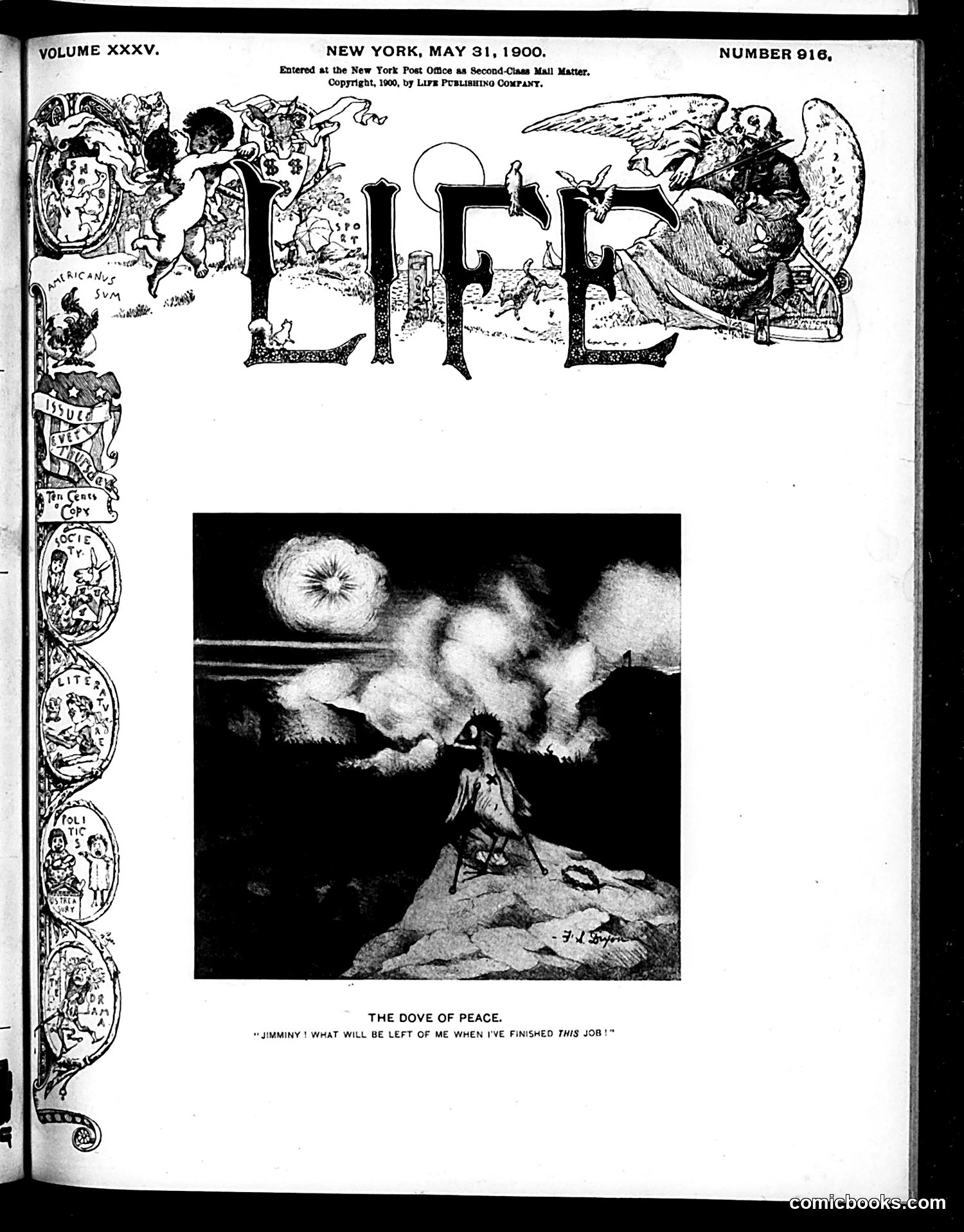
This political cartoon depicts a dove being destroyed by explosions and warfare, with the caption "JIMMY! WHAT WILL BE LEFT OF ME WHEN I'VE FINISHED THIS JOB!" The satire appears to reference the Boer War in South Africa, which was ongoing in 1900. The "dove of peace" symbolizes peaceful ideals being obliterated by the violence of warfare. The figure "Jimmy" likely refers to a political leader associated with the conflict, though the specific reference is unclear without additional context. The cartoon critiques how military campaigns, despite claims of justified purpose, utterly destroy the possibility of peace. It's a stark visual commentary on the contradiction between stated peacekeeping goals and the devastation of actual warfare.
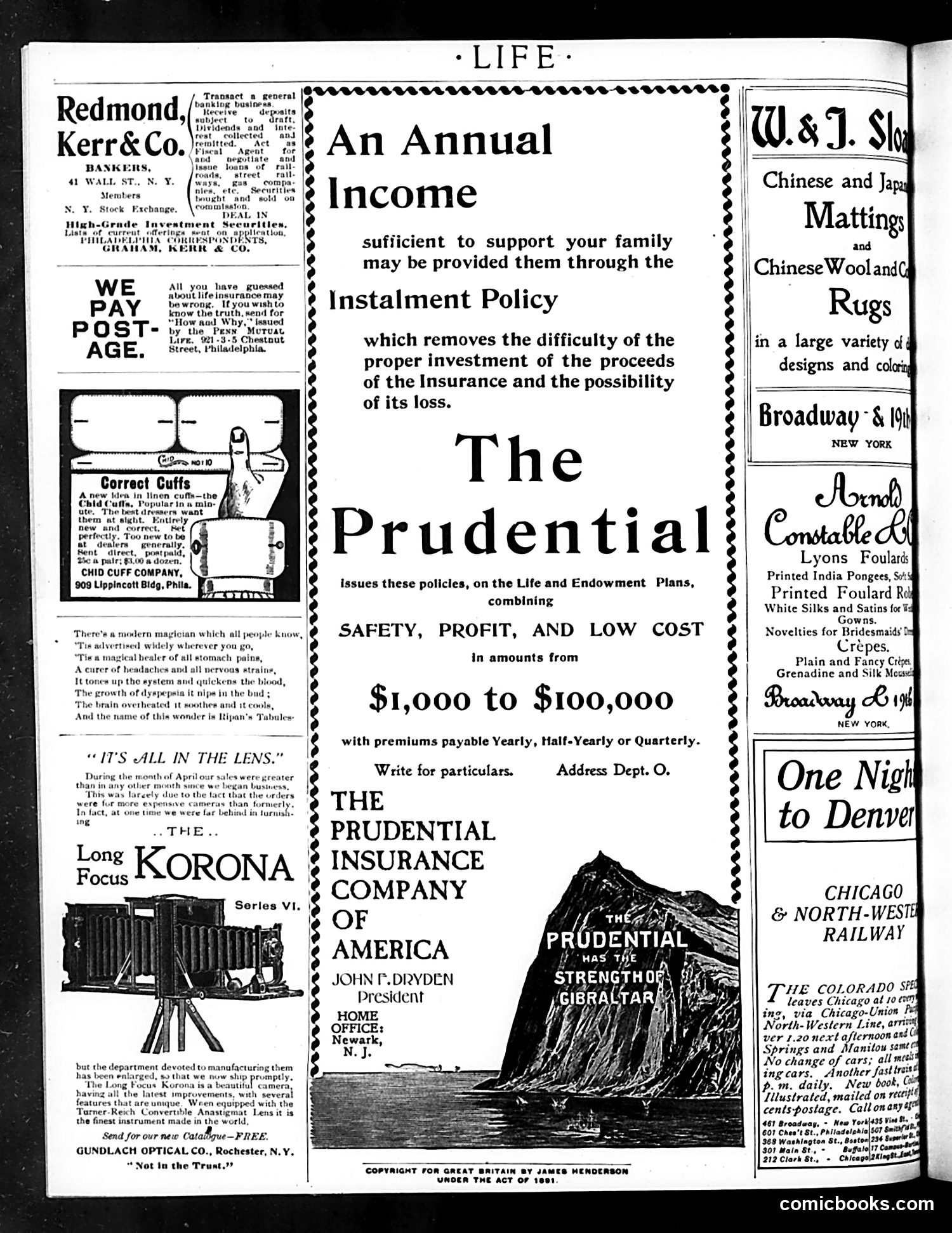
This page is primarily **advertising**, not political satire. It contains four distinct advertisements: 1. **Redmond, Kerr & Co.** (top left): A banking/investment firm ad 2. **"Correct Cuffs"** (center left): A product advertisement with instructional illustration 3. **The Prudential Insurance Company** (center): A large insurance policy advertisement featuring the company's famous Gibraltar Rock logo, promoting life and endowment plans ranging from $1,000 to $100,000 4. **Right side ads**: Travel and textile advertisements (Chinese rugs, railway service to Denver) The only potentially satirical content is a brief poem about "a modern magician" (Hijan's Tabulator), but it's minor. The page reflects early 20th-century Life magazine's mixed editorial/advertising format, with insurance and financial services being prominent industries of the era.
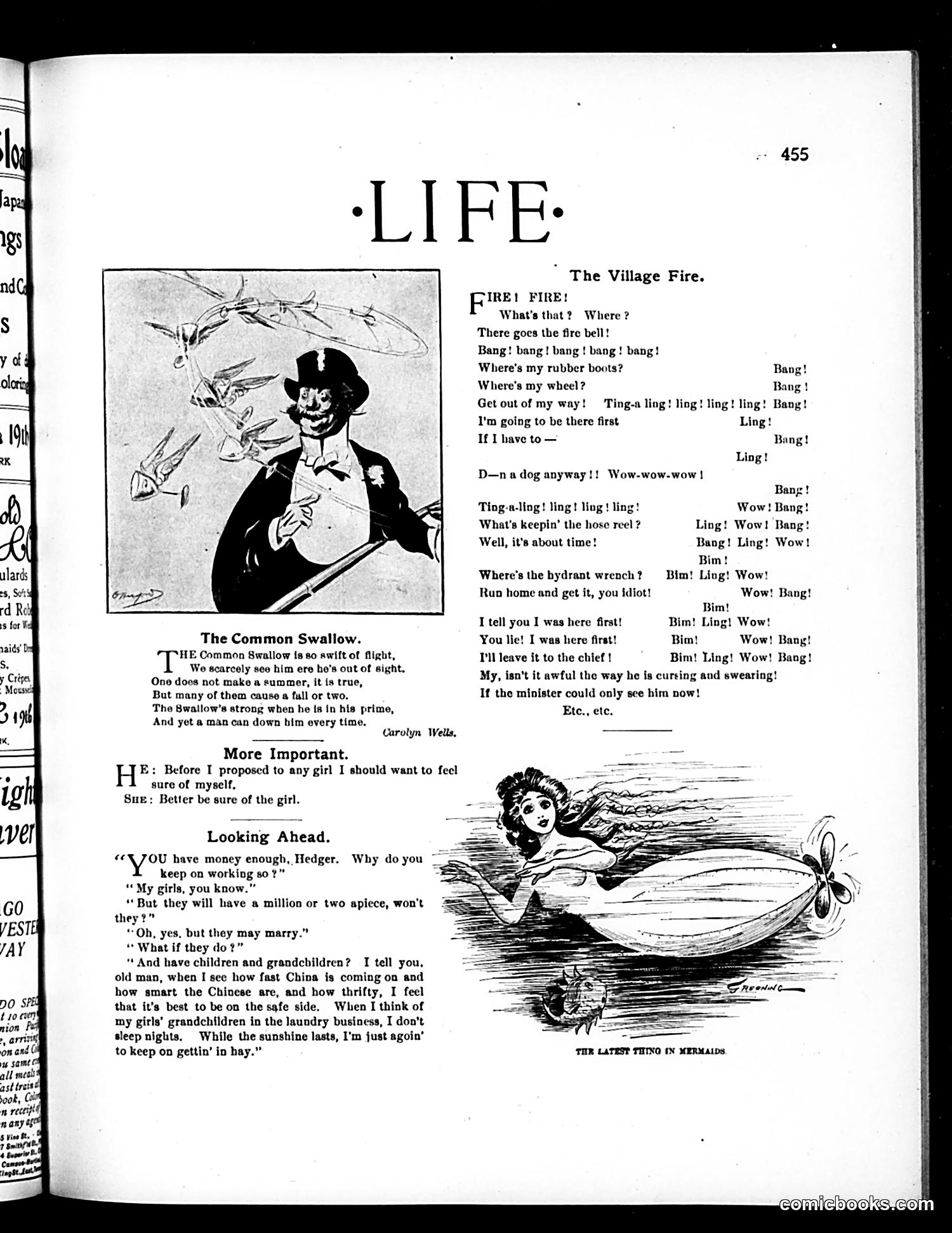
**"The Village Fire"** depicts a chaotic firefighting scene. The illustration shows a frantic firefighter surrounded by onomatopoeia ("Bang!", "Ling!", "Wow!") capturing the noise and confusion of an emergency response. The humor appears satirical, mocking the disorganization and incompetence of volunteer or small-town fire brigades—a common subject for American satire of this era. **"The Common Swallow"** is a nature poem by Carolyn Wells, straightforward descriptive verse about the bird's flight characteristics. **"More Important"** and **"Looking Ahead"** are brief comic dialogues. The latter depicts class anxiety about marriage and economic security, with a working-class character worried about supporting a family given China's economic competition—likely reflecting early-20th-century economic anxieties. The bottom illustration, "The Latest Trend in Mermaids," shows a fashionable woman in water—a lighthearted commentary on women's fashion trends.
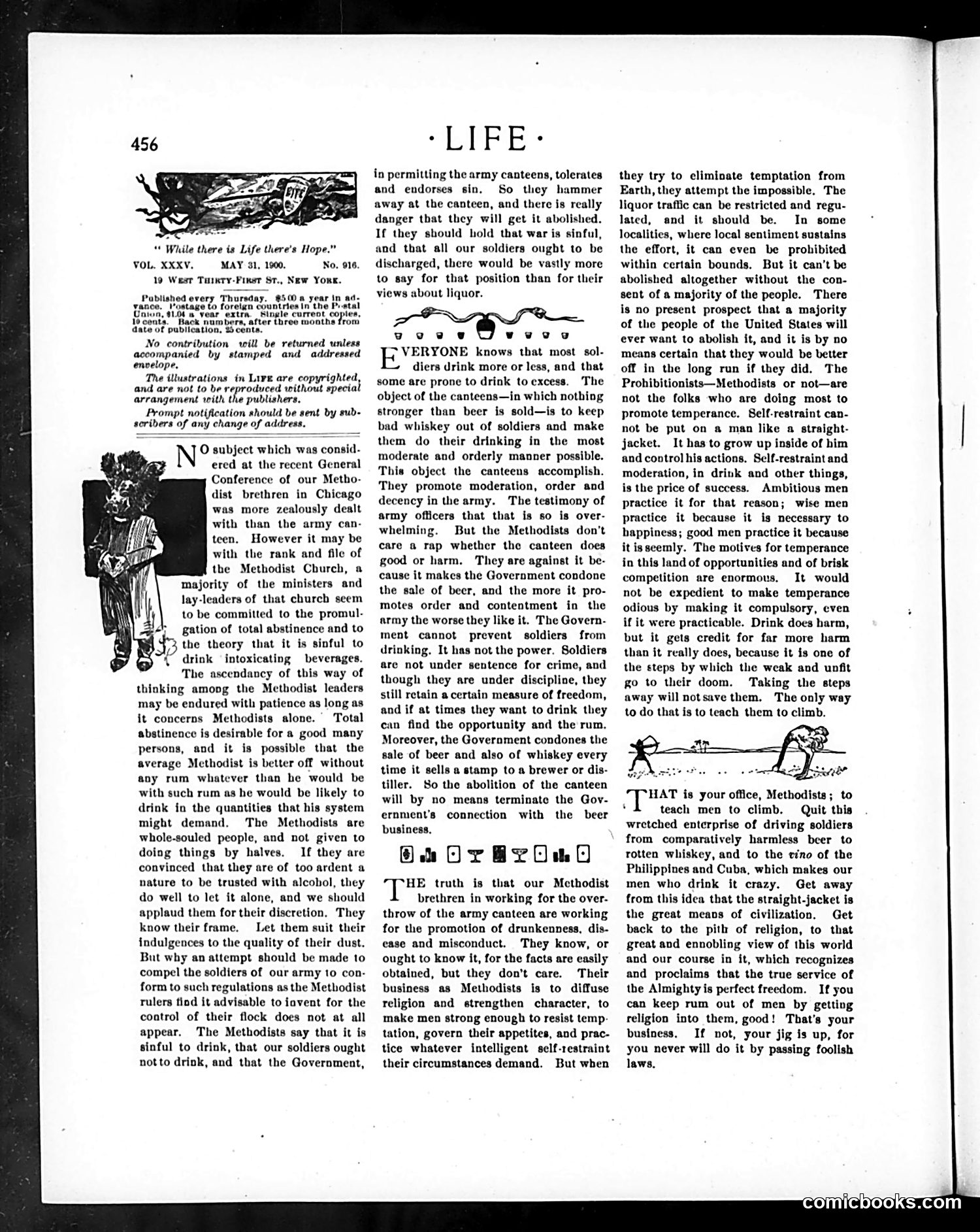
This page addresses Methodist church opposition to army canteens serving alcohol to soldiers. The text debates whether the military should prohibit beer and whiskey sales to troops. The small illustrated figures (appearing in margins) show soldiers in casual poses, likely reinforcing the human element of the debate. **The satire's point:** The article mocks Methodist leaders for their temperance crusade, arguing they want to eliminate canteen alcohol to promote "morality" among soldiers. The author counters that soldiers will drink regardless, and that teaching self-restraint matters more than prohibition. The piece suggests Methodist reformers are naive—attempting to legislate morality through blanket bans rather than addressing human nature. This reflects early 20th-century debates between religious temperance movements and pragmatists who believed such restrictions were unenforceable.
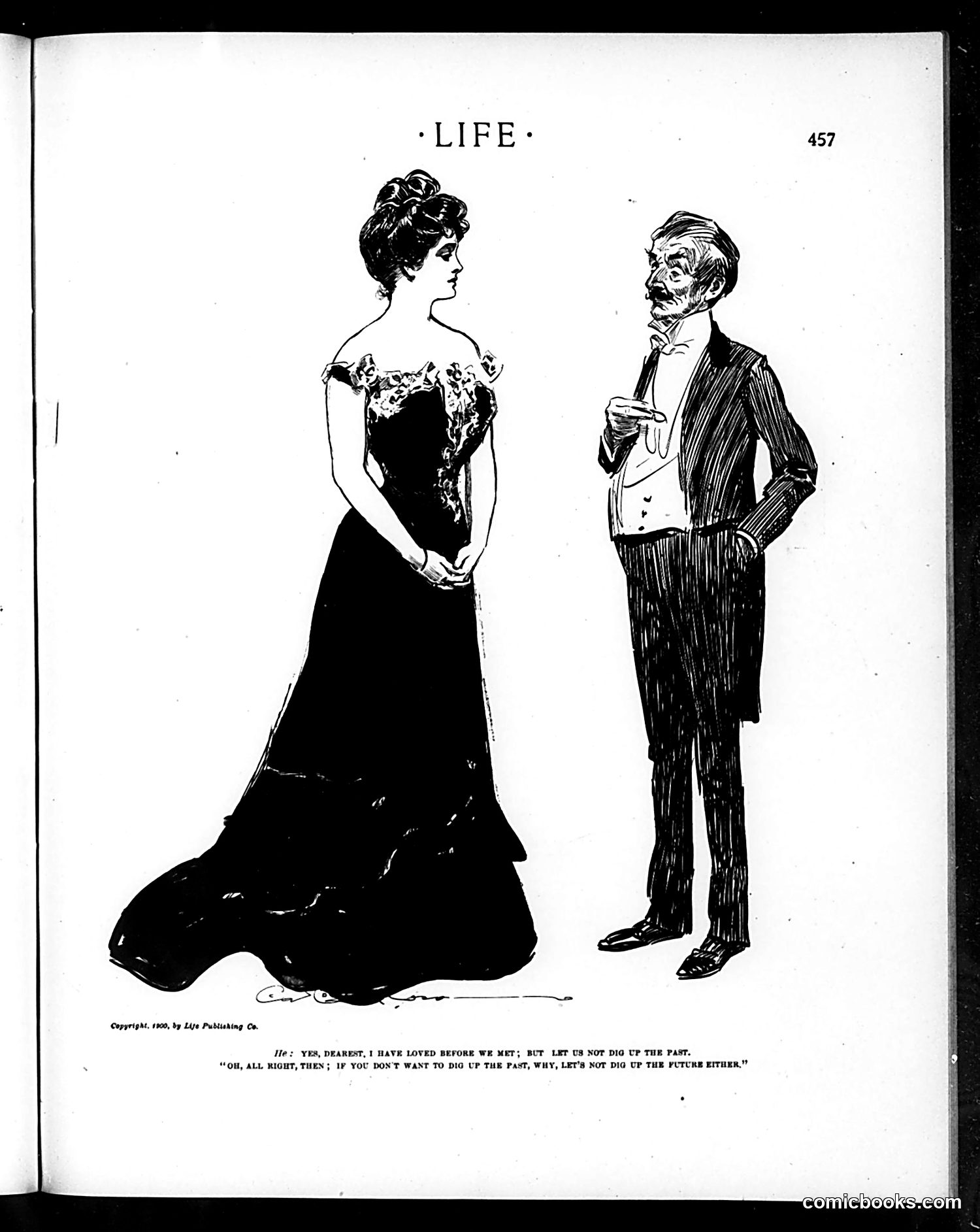
This illustration depicts a romantic dialogue between a well-dressed man in formal evening wear and an elegantly dressed woman in a black gown with a train. The caption captures their conversation about past relationships. The satire critiques early 20th-century romantic conventions, specifically the tension between acknowledging past lovers while avoiding uncomfortable discussions. The woman's refined appearance and the formal setting suggest upper-class courtship norms. The joke centers on the man's philosophical attempt to dismiss the past entirely—arguing that neither party should dwell on previous romantic entanglements. This reflects period anxieties about discussing premarital romantic history among the wealthy, presenting the tension between Victorian discretion and modern frankness as comedic fodder for Life's educated readership.
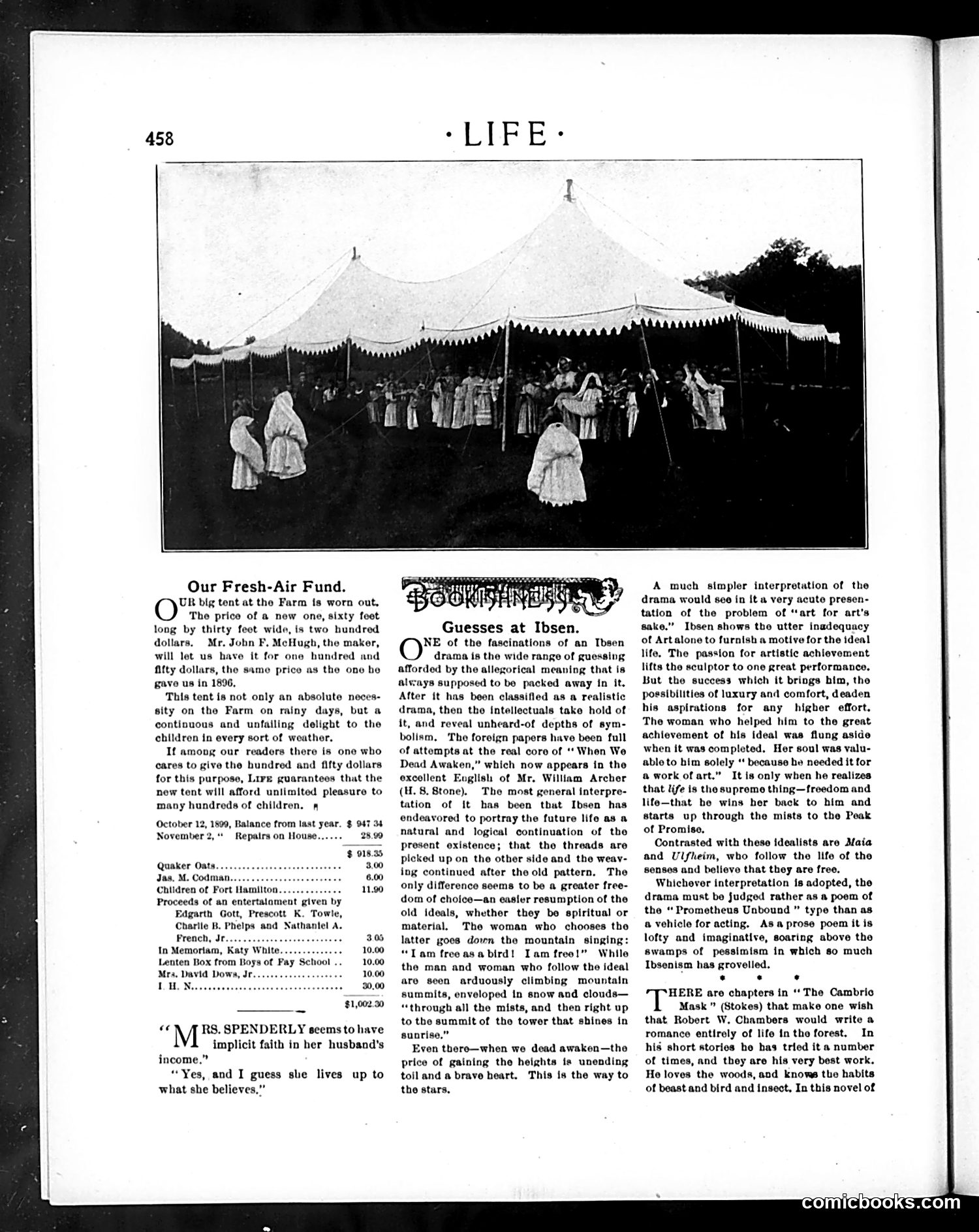
The page contains three distinct articles rather than political cartoons: 1. **"Our Fresh-Air Fund"**: Reports on fundraising for a children's fresh-air initiative, listing donations and repair costs for a tent. 2. **"Guesses at Ibsen"**: Discusses interpretations of Henrik Ibsen's drama "When We Dead Awaken," exploring how different audiences—intellectuals, the general public, and idealists—interpret the play differently. The piece critiques both realistic and overly symbolic readings. 3. **"The Cambrio Mask"**: References Robert W. Chambers's short stories, praising his detailed knowledge of nature and animal behavior. The image shows what appears to be a tent gathering or outdoor event, likely related to the Fresh-Air Fund mentioned in the text.
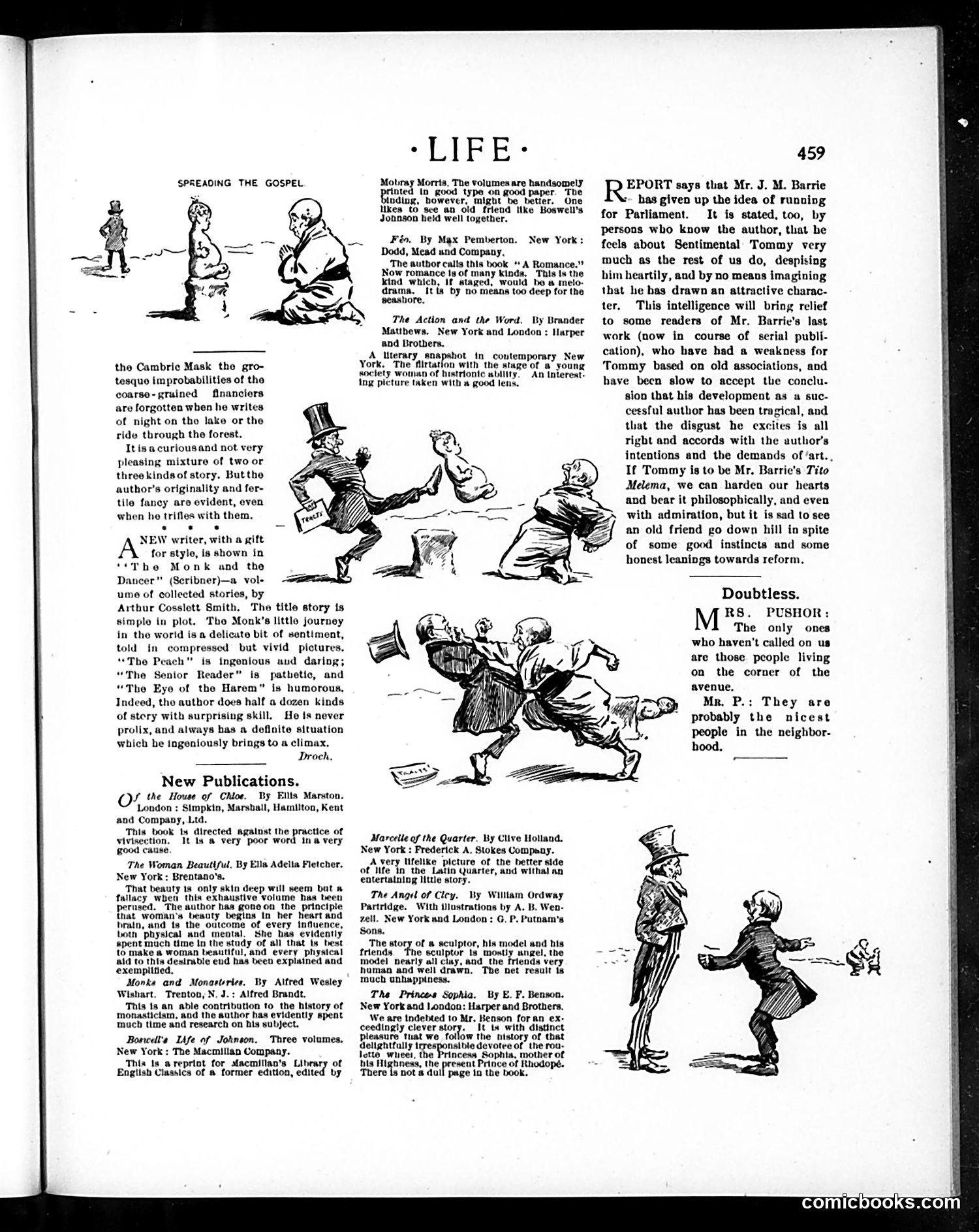
This page contains book reviews with accompanying satirical illustrations. The cartoons depict various characters engaged in physical comedy—figures falling, jumping, and tumbling in exaggerated poses typical of early 20th-century humor illustration. The reviews discuss several works including titles about monks, dancers, and social commentary. One review critiques "Vivipsection" as "a very poor word in a very good cause." Another praises a story about a sculptor and his model. The largest illustrated section ("Spreading the Gospel") shows multiple figures in chaotic motion, likely satirizing the enthusiastic but awkward promotion or dissemination of ideas—hence "spreading." Without identifying specific individuals in the caricatures, the overall tone is one of gentle mockery toward literary pretension and social earnestness, typical of *Life* magazine's satirical approach to contemporary culture and publishing.
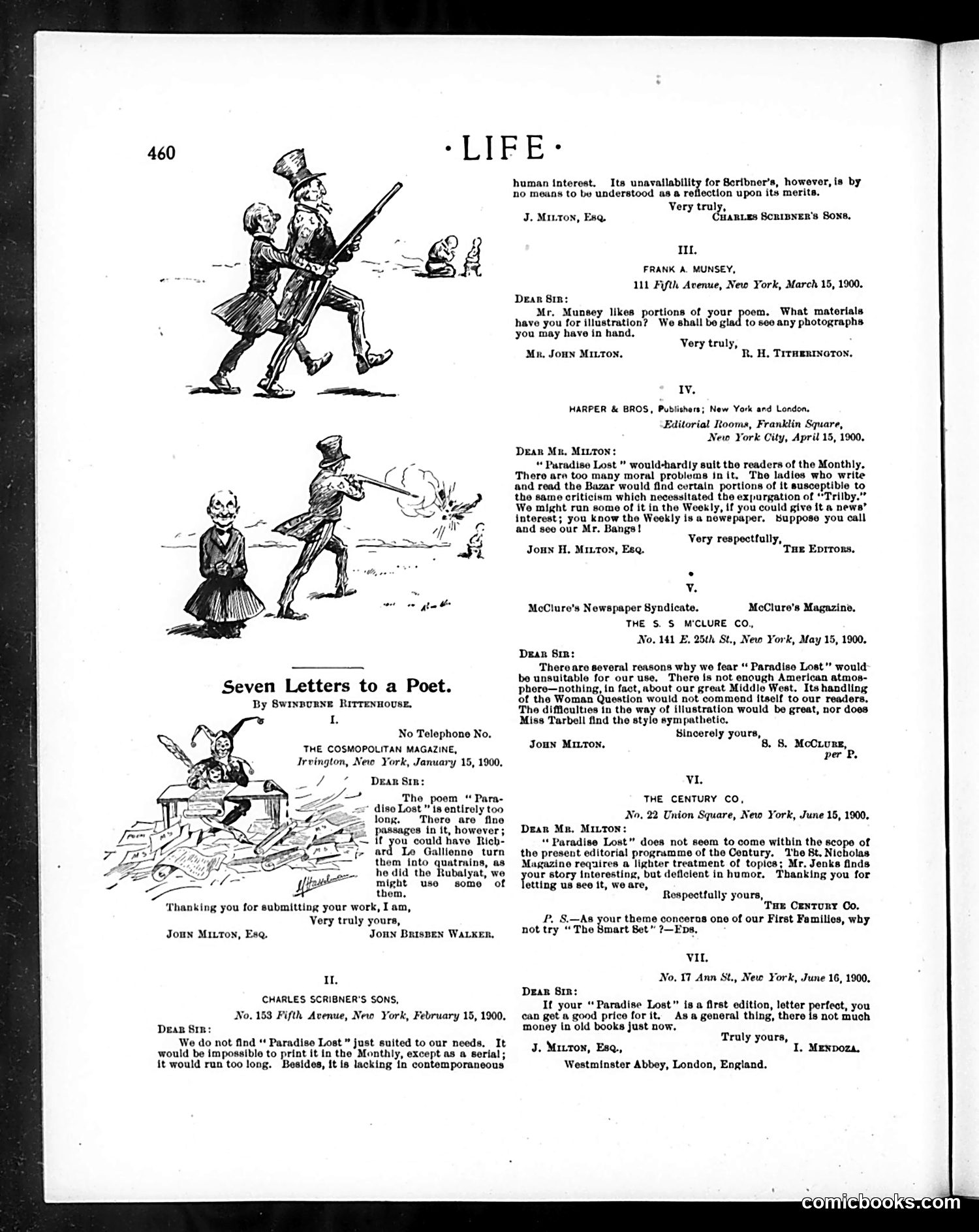
This page reproduces correspondence about a poem titled "Paradise Lost" submitted by poet John Milton (the pseudonym used by the submitting writer). Various magazine editors and publishers reject the work, offering different reasons: it's too long, lacks contemporary relevance, unsuitable for their readership, or concerns about illustration difficulties. The satire mocks the gatekeeping practices of early 1900s publishing. By using the famous name of John Milton (author of the actual *Paradise Lost*), the piece ironically suggests that even canonical literature might be rejected by contemporary editors fixated on commercial viability. The accompanying illustrations show figures engaged in literary pursuits, reinforcing the theme of artistic struggles against editorial bureaucracy.
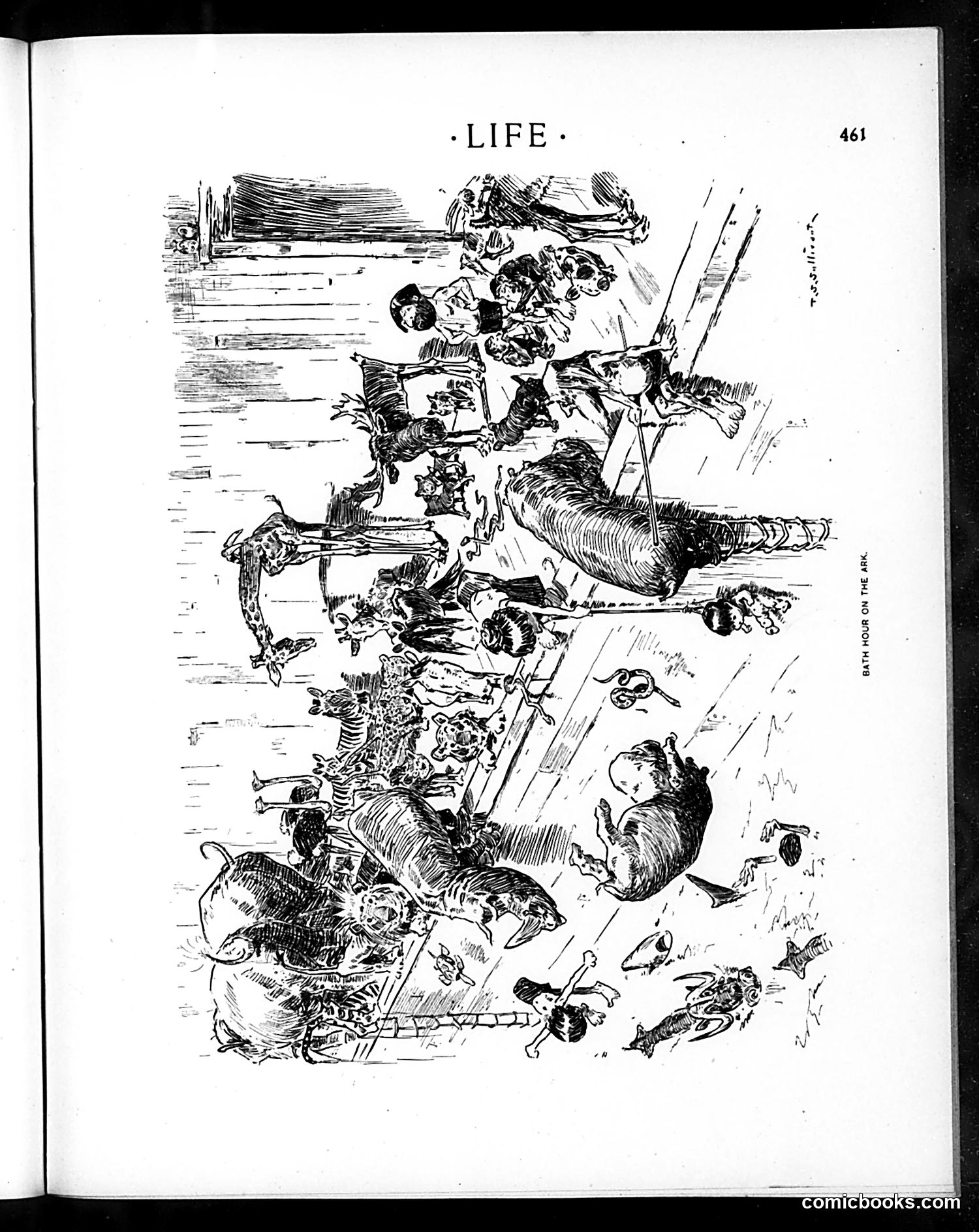
This is a satirical cartoon from Life magazine (page 461) depicting a chaotic birth scene. The image shows multiple figures attending to what appears to be a difficult childbirth, with medical personnel, attendants, and onlookers crowded around a bed. The style suggests late 19th or early 20th century. The satire likely comments on the confusion, overcrowding, or incompetence surrounding medical care during childbirth in this era. The exaggerated, frantic positioning of the figures and the sheer number of people present suggests mockery of obstetrical practices or the social spectacle that childbirth could become. However, without additional text identifying specific political figures or clearer caption, I cannot definitively determine which particular medical or social controversy this targets. The cartoon's specific point remains unclear from the image alone.
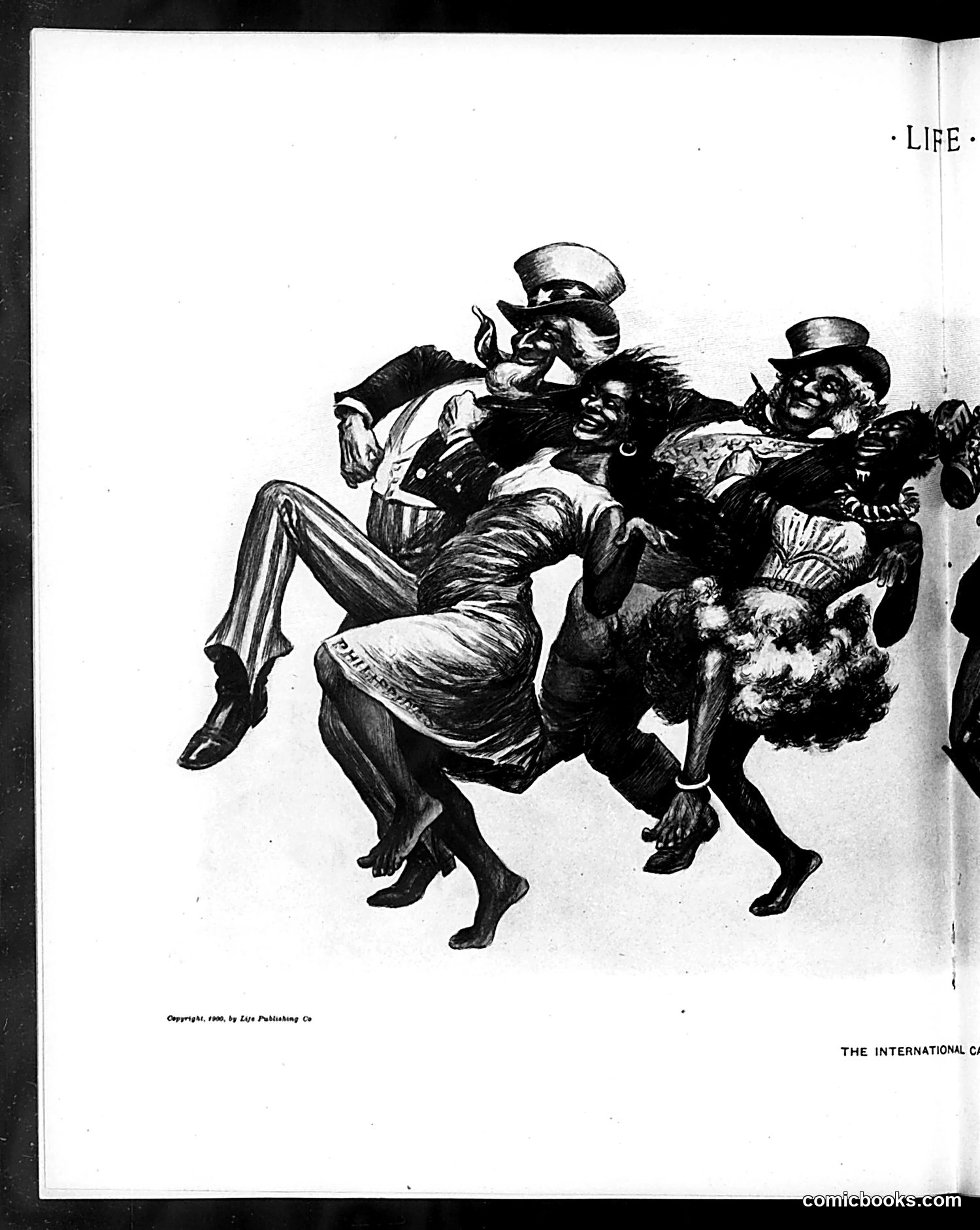
This is a satirical illustration from *Life* magazine (copyright 1908, by Life Publishing Co.). The cartoon depicts a caricatured figure in top hat and formal wear being lifted or carried by what appears to be exaggerated caricatures of other figures. The style employs grotesque, distorted features typical of early 20th-century political satire. The specific identities and political context are unclear from the visible text alone. The image likely comments on corruption, political maneuvering, or social hierarchy—common *Life* magazine themes of the era. The figure being hoisted may represent a politician or public figure being supported (or exploited) by various constituencies or corrupt interests. Without additional caption text, the precise historical reference cannot be definitively determined.
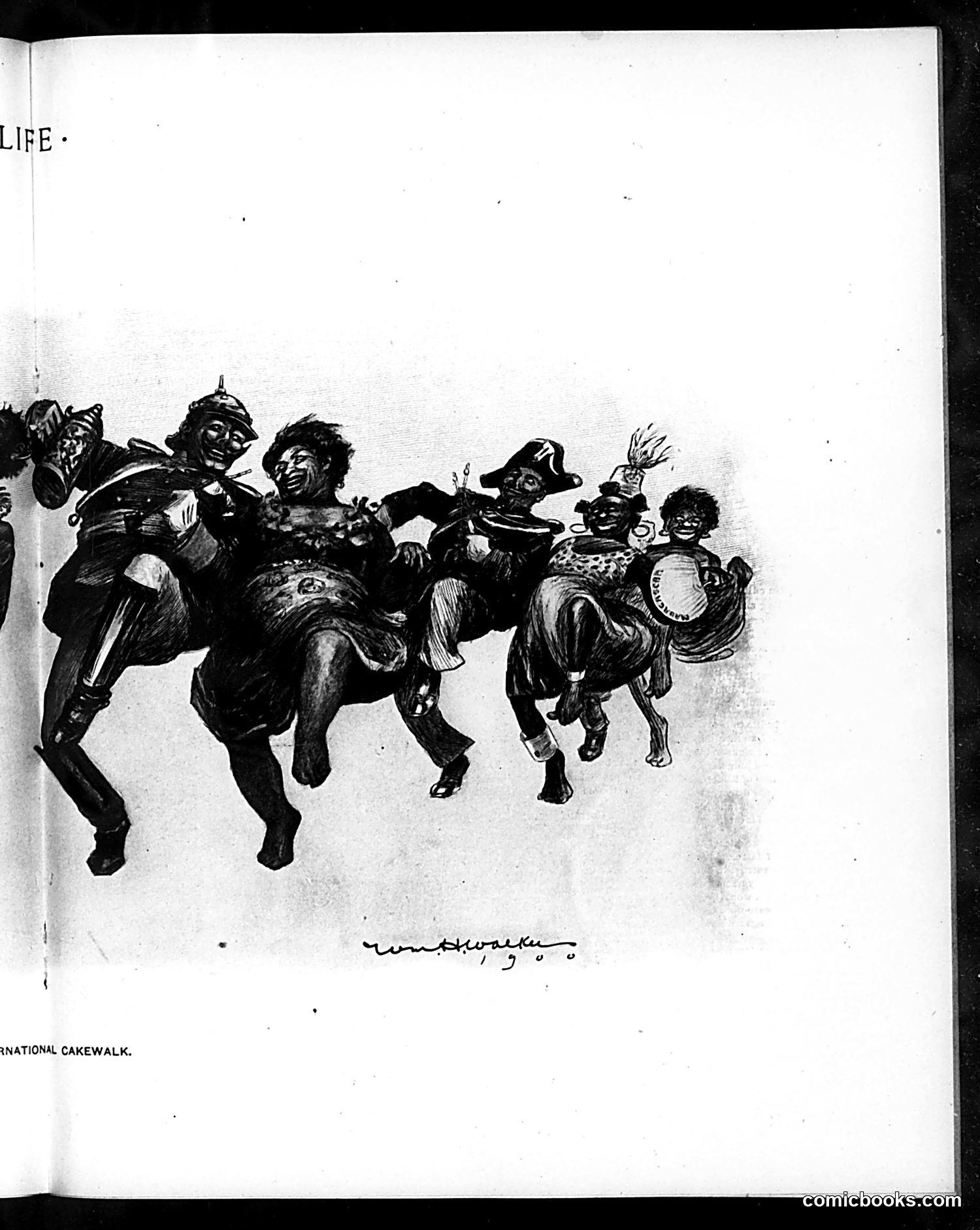
This illustration depicts a satirical scene of figures performing a "cakewalk"—a dance style originating in African American culture that became a popular entertainment form. The cartoon shows what appears to be caricatured international political or military figures in exaggerated poses, dressed in military uniforms and formal attire, dancing together in a line. The "cakewalk" reference suggests mockery of international diplomatic posturing or political maneuvering, presenting world leaders as performing a frivolous spectacle. The art style and composition indicate this is early 20th-century satire, likely critiquing international relations or political theater of that era, though the specific historical context and identities of the figures remain unclear from the image alone.
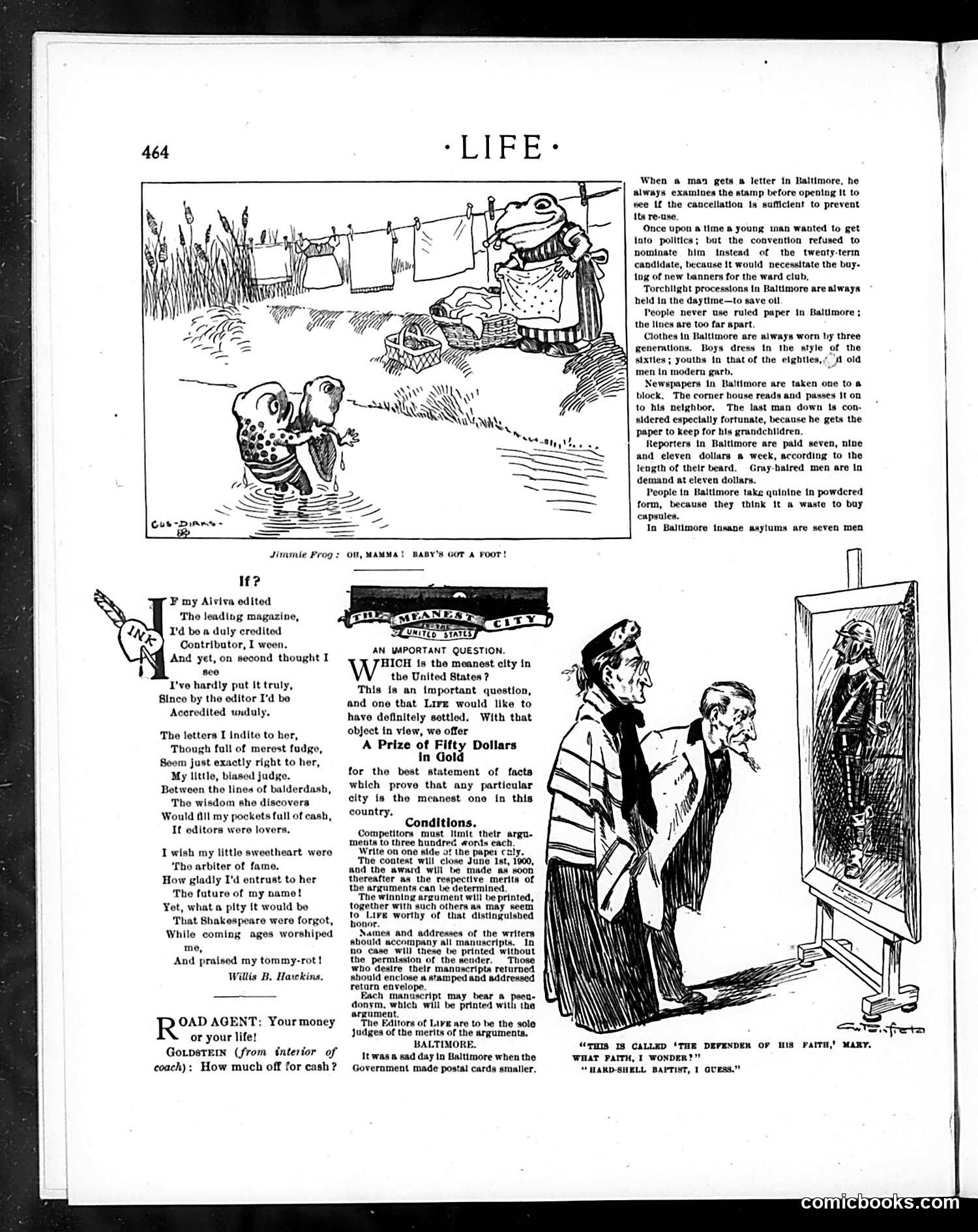
**Top Cartoon:** Titled "Jimmie Frog: Oh, Mamma! Baby's Got a Foot!" This appears to be a humorous domestic scene showing a frog family doing laundry. The joke seems to play on the anthropomorphization of animals and domestic concerns—the mother frog is alarmed that the baby has acquired a foot, treating it as an unusual development. This is likely satirizing either parenting anxieties or absurdist humor popular in the era. **Lower Section:** Contains a contest announcement titled "An Important Question," asking readers to identify the meanest city in the United States. Life offers fifty dollars in gold as a prize for the best factual argument. The accompanying illustration shows two men in conversation, with one appearing skeptical. This satirizes civic pride and invites readers to humorously criticize American cities. The page represents Life's mix of humor, reader engagement, and social commentary.
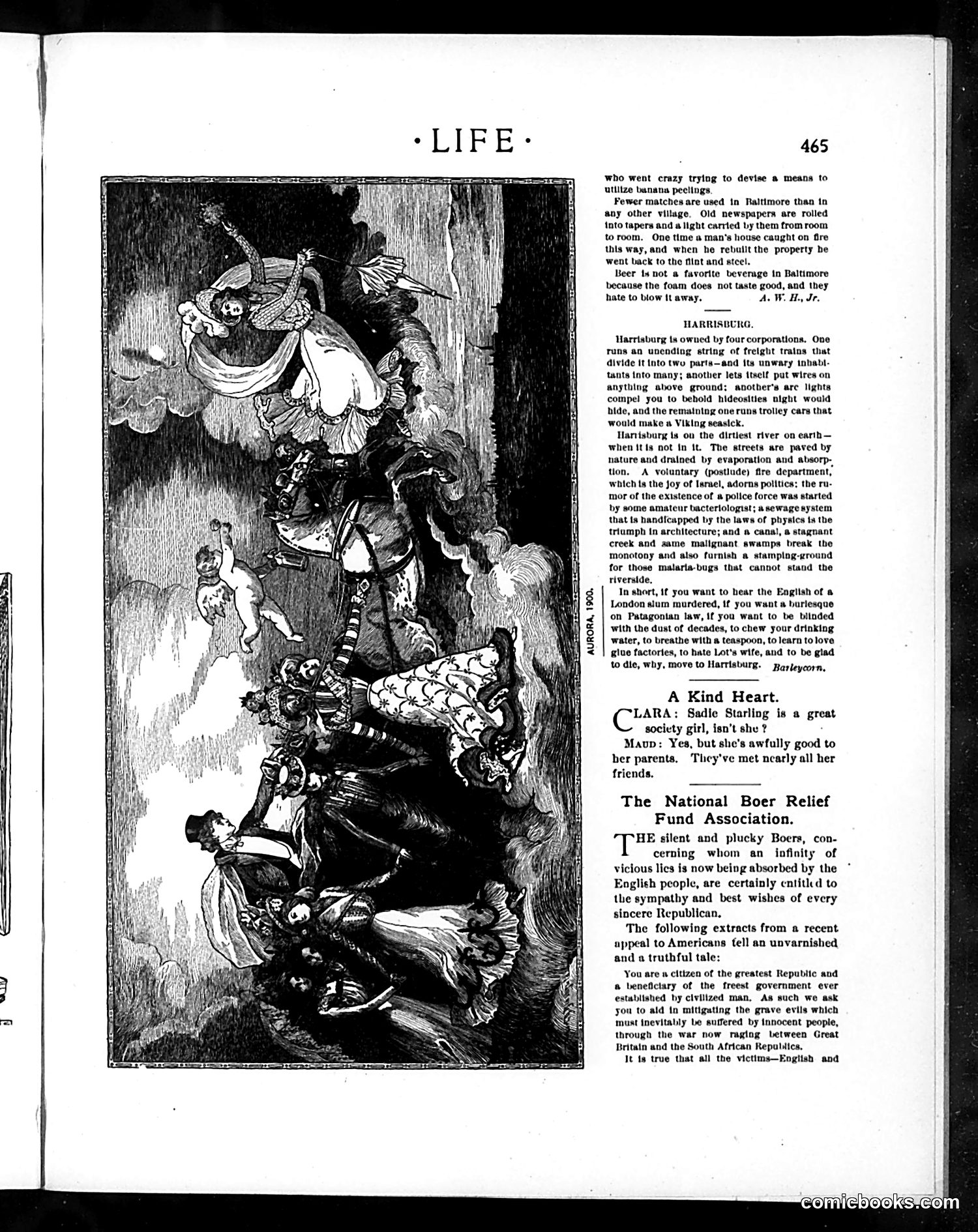
This *Life* magazine page contains satirical commentary on American cities and a serious appeal for the Boer Relief Fund. **The Cartoon/Illustration:** The large engraving depicts various urban problems as grotesque figures—appears to represent personified vices of industrial American cities (pollution, corruption, poor infrastructure). The style suggests late 19th-century social satire. **City Descriptions:** The text mocks specific American towns (Baltimore, Harrisburg) for absurd local conditions: Baltimore's obsession with economy (using newspapers as candles), Harrisburg's corporate ownership creating environmental disaster, poor infrastructure, and disease. **The Boer Relief Section:** A serious call for American sympathy toward the Boers in their war against Britain (1899-1902). The passage frames Britain as the aggressor and appeals to American Republican values of liberty and self-determination. **The Irony:** A Republican-leaning magazine criticizes American cities' failures while championing the Boers' resistance to British imperialism—both reflecting anti-establishment sentiment of the era.
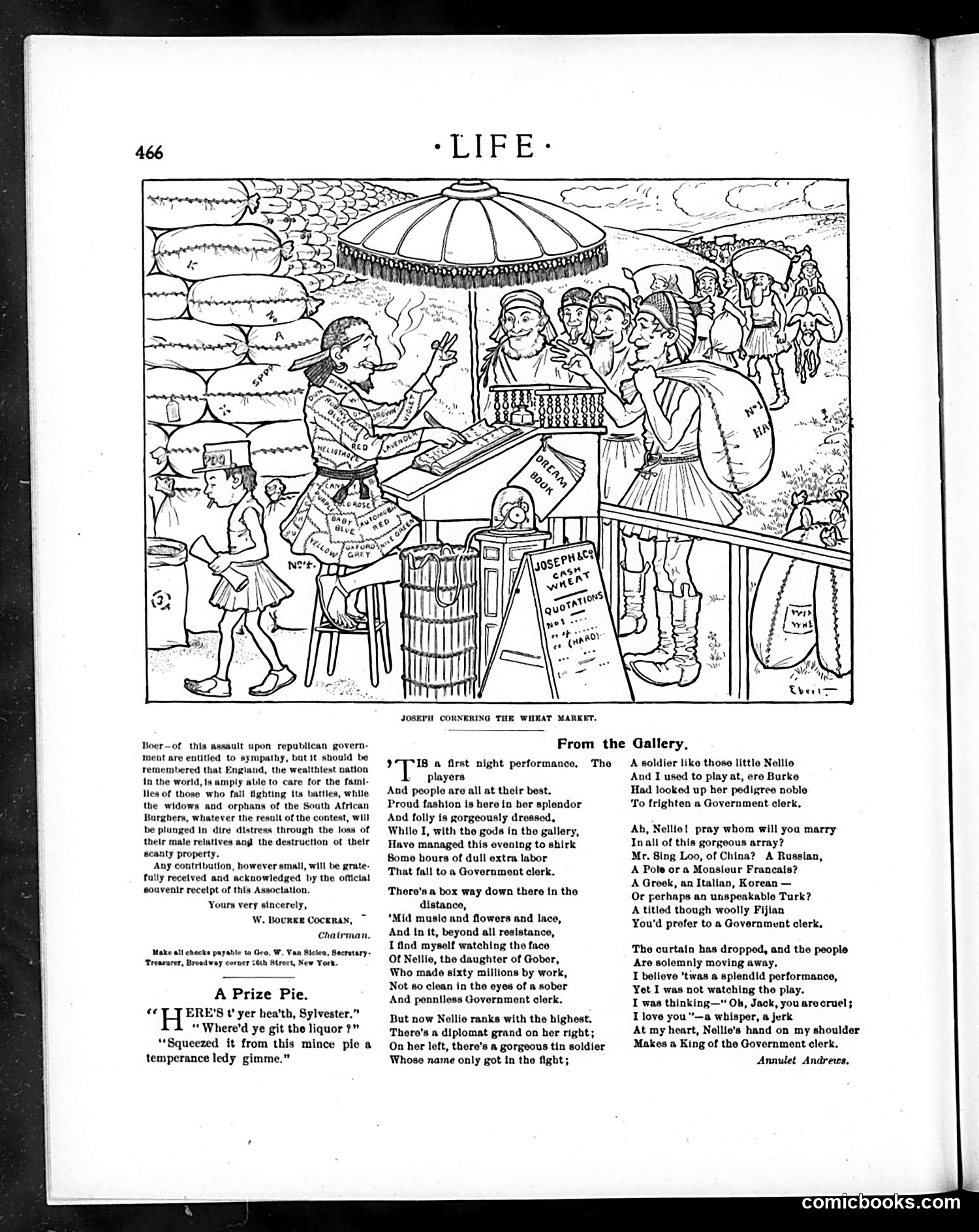
This page contains two distinct pieces of satirical content: **Top Section:** A letter soliciting donations for Boer War relief, signed by W. Bourke Cockran. It appeals for support for families of South African Boers (Dutch settlers) devastated by the ongoing Boer War against Britain, contrasting wealthy England's ability to support its own casualties against the Boers' destitution. **Cartoon ("Joseph Cornering the Wheat Market"):** A marketplace scene depicting speculation or market manipulation—likely referencing biblical Joseph's grain-hoarding strategy, used here as satire about financial manipulation. **Poetry Section ("From the Gallery"):** A romantic narrative about a government clerk observing an theater from the gallery, watching an heiress named Nellie surrounded by wealthy suitors (diplomats, soldiers, foreign nobility). The satirical point: despite her elevated social status through wealth, she chooses the humble clerk, suggesting true love transcends class. This mocks both social pretension and the fantasy of romantic rescue across class lines. The "Prize Pie" section is a brief joke about liquor extraction.
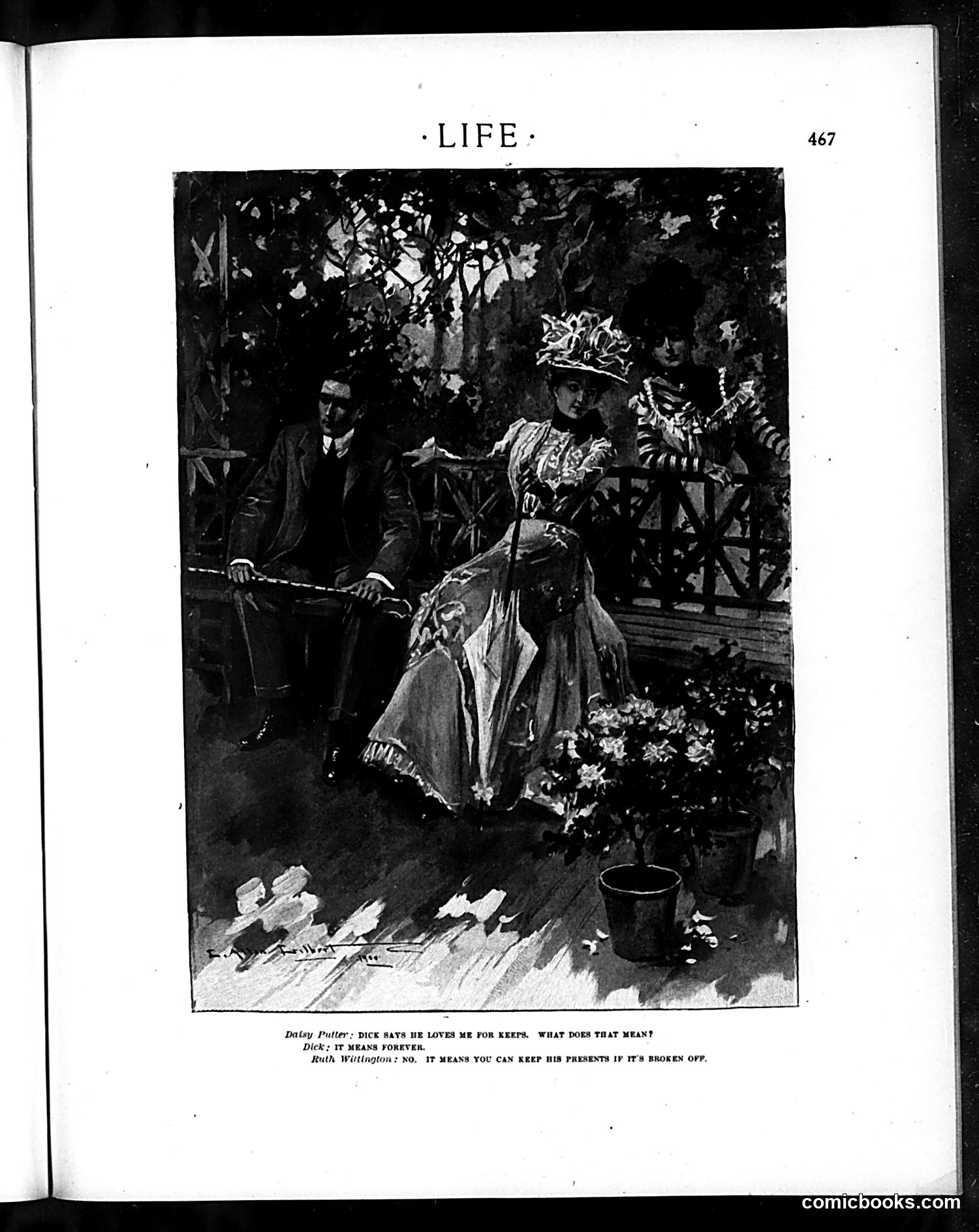
This is a satirical cartoon about romantic promises and material expectations in courtship. A woman named Daisy Putter asks what "loves me for keeps" means. A man named Dick claims it means "forever." However, Ruth Wittington delivers the punchline: it actually means the woman can keep his gifts if the relationship ends. The joke critiques the transactional nature of romantic relationships and gift-giving among the upper classes—suggesting that men's professions of eternal love are hollow, and the real "agreement" is that expensive presents are non-returnable. It's satirizing both male insincerity and female materialism in early 20th-century courtship rituals.
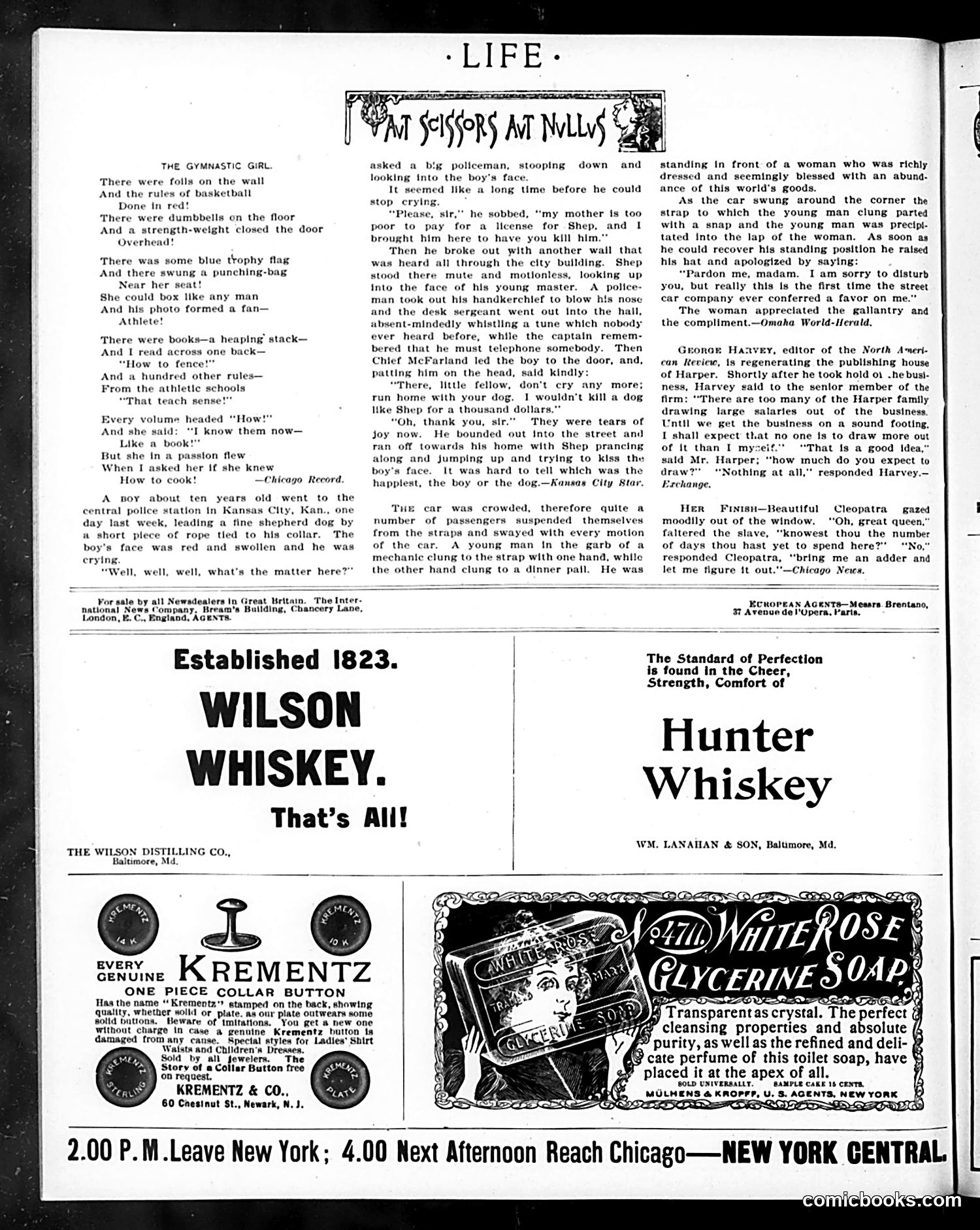
This is primarily a **short-story and anecdote page** from *Life* magazine, not political satire. It contains three touching human-interest stories: 1. **"The Gymnastic Girl"**: A poem mocking an athletic woman who masters every sport and academic subject but cannot cook—poking fun at the "New Woman" of the era who pursued education and athletics. 2. **The Police Station Story**: A genuinely sentimental anecdote about a poor boy forced to surrender his dog for lacking a license. Kansas City police chief compassionately refuses to kill the animal, moving readers emotionally. 3. **The Streetcar Incident**: A working-class mechanic accidentally falls into a wealthy woman's lap and jokes gracefully about it—rewarded with her appreciation for his wit and manners. The page also features **period advertisements** for Wilson Whiskey, Hunter Whiskey, Krementz collar buttons, and Winter Rose Glycerine Soap—typical early-1900s commerce. These stories reflect *Life*'s formula: mixing humor, sentiment, and social observation for middle-class readers.
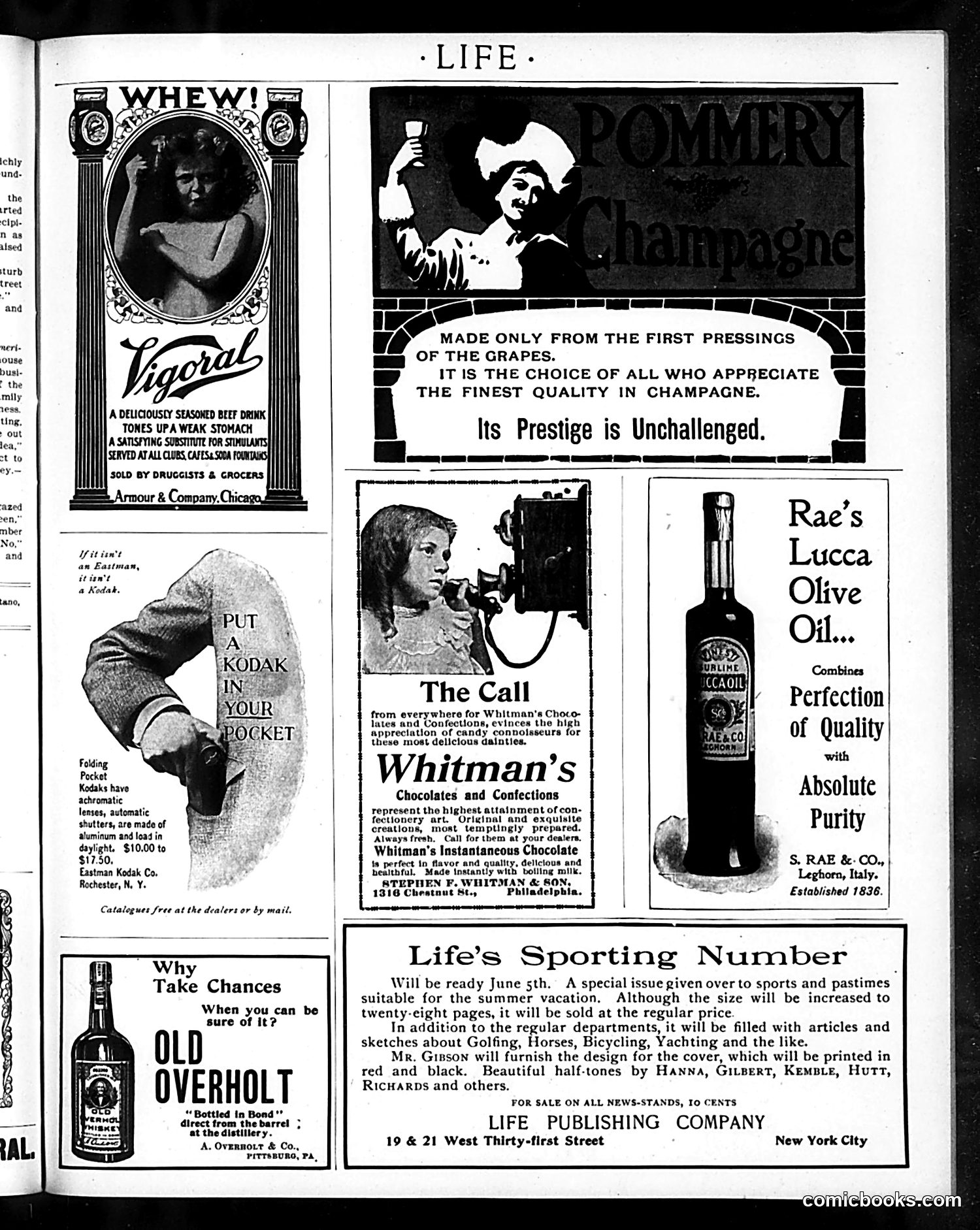
This is primarily an **advertising page** from Life magazine with no political cartoons or satire. The page contains period product advertisements typical of early 20th-century magazines: Viogral (a beef tonic), Rommery Champagne, Kodak cameras, Whitman's chocolates, Old Overholt whiskey, and Rae's olive oil. These ads reflect consumer goods marketed to middle and upper-class readers. The only non-advertisement content is an announcement for Life's upcoming "Sporting Number" special issue (June 5th), featuring articles and illustrations about golf, horses, bicycling, and yachting—leisure activities for affluent readers. There are no identifiable political figures, caricatures, or satirical commentary visible. The page functions as commercial filler typical of magazine publishing at the time.
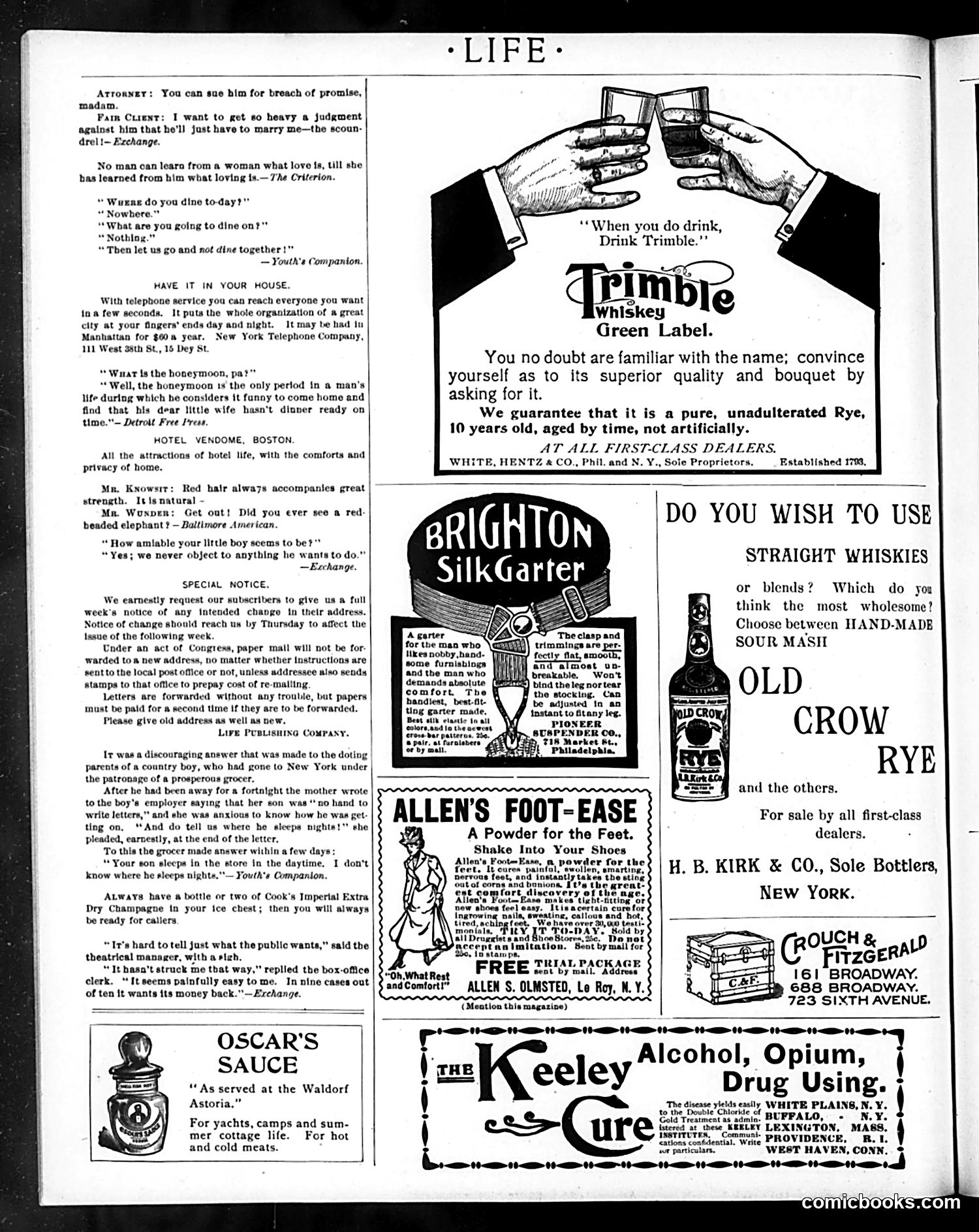
This page is primarily **advertising**, typical of early 20th-century magazines. The small text items at the top are humorous quips rather than editorial content. The jokes touch on period social concerns: a woman threatening to sue for breach of promise (marriage was legally enforceable), honeymoon expectations about dinner-readiness, and a country boy's mysterious sleeping arrangements in the city—reflecting anxieties about rural migrants in urban environments. The dominant content is **liquor advertising**: Trimble Whiskey, Brighton Silk Garter, and Old Crow Rye compete for readers' attention with guarantees of purity and quality. Also advertised: telephone service, Allen's Foot-Ease powder, and—most notably—the Keeley Cure, a commercial treatment for alcohol and drug addiction. The juxtaposition is darkly ironic: whiskey ads surround an ad for addiction treatment, reflecting Prohibition-era tensions about alcohol's social costs and the existence of private "cure" clinics marketing solutions to drinking problems.
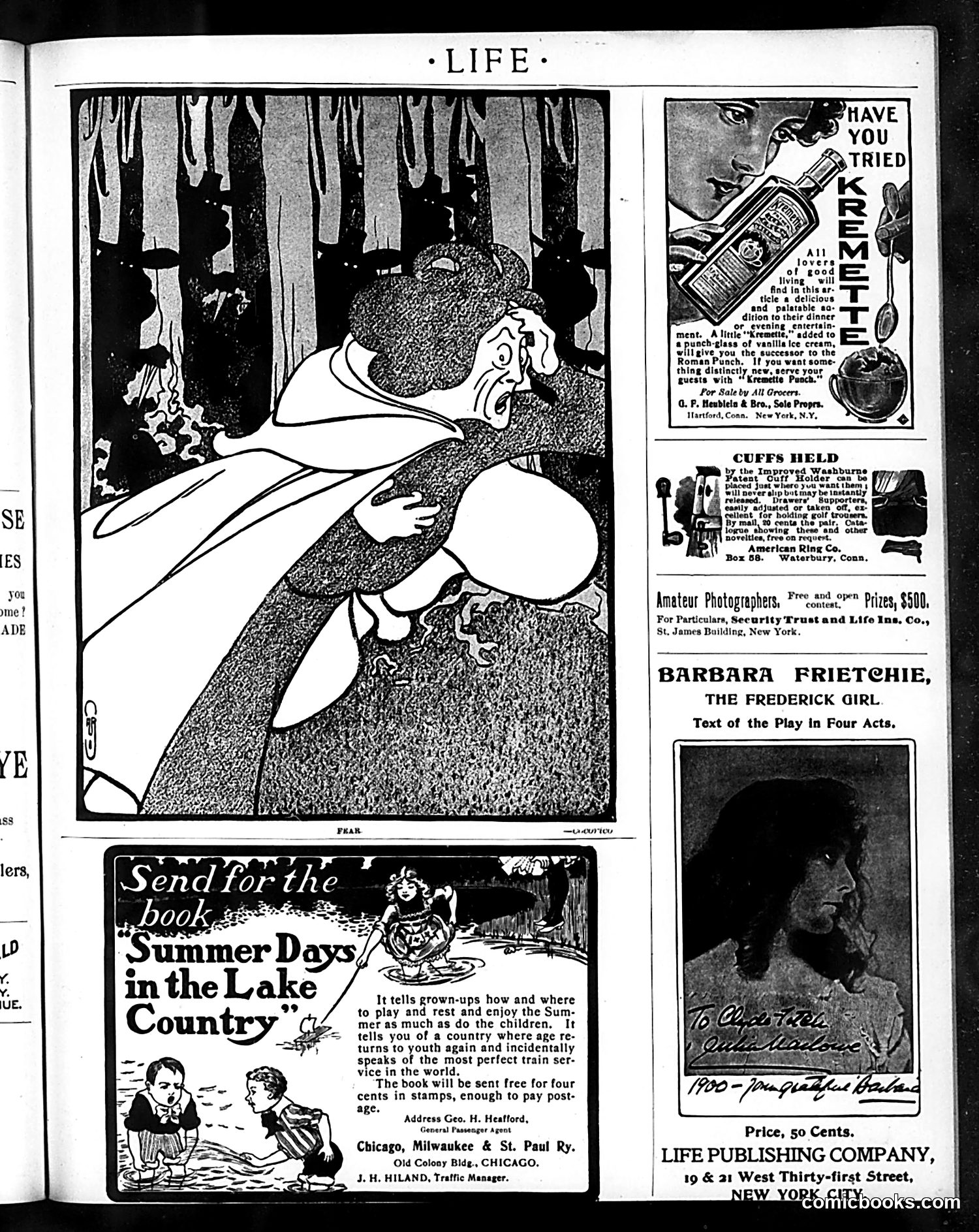
The large cartoon on the left, titled "FEAR," depicts a woman in bed recoiling in terror from what appears to be a large, hairy creature or ape looming over her. This is characteristic of early 20th-century "horror" imagery exploiting racial anxieties—likely referencing either King Kong-style anxieties or reflecting period racist stereotypes about threat and danger. The page is primarily **advertising**, featuring product ads (Kremette condiment, cuff holders, ring holders) and promotional material for a play based on Barbara Frietchie, the Civil War-era patriotic figure. There's also an advertisement for a travel book about the Lake Country and a photography contest. The cartoon's satirical target remains somewhat unclear without more context, but the exaggerated "fear" imagery was a common period trope for selling products or entertainment by playing on audience anxieties.
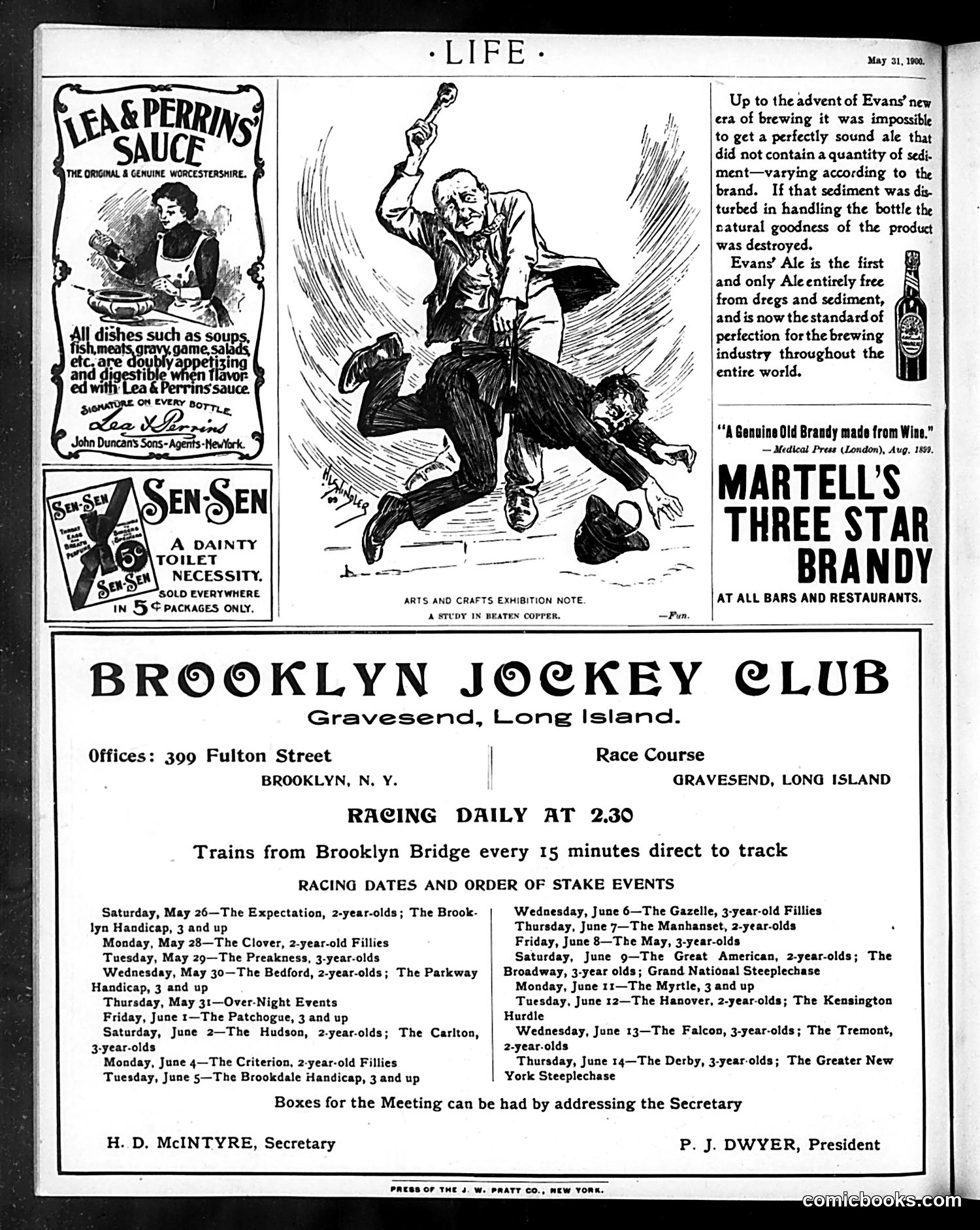
**Central Cartoon:** The page features a satirical illustration labeled "A Study in Beaten Copper," captioned "Arts and Crafts Exhibition Note." It depicts a man energetically beating copper with a mallet, his body twisted in an exaggerated, contorted pose. The figure appears to be a caricature of Arts and Crafts movement aestheticism—likely mocking the pretentious posturing and physical excess of craftspeople claiming artistic superiority. **Context:** The early 1900s Arts and Crafts movement emphasized handmade goods over industrial production. This cartoon satirizes the movement's self-importance and theatrical affectation, suggesting that behind the lofty artistic rhetoric lies merely strenuous, ungraceful manual labor. The humor targets educated readers familiar with contemporary art debates about "authenticity" versus mechanization. **Surrounding Content:** The page is otherwise filled with product advertisements (Lea & Perrins sauce, Evans' Ale, Martell's brandy) and racing information for Brooklyn Jockey Club—typical Life magazine content mixing social satire with commercial interests.