
Life, 1900-05-31 · page 7 of 20
Life — May 31, 1900 — page 7: what you’re looking at
What you’re looking at
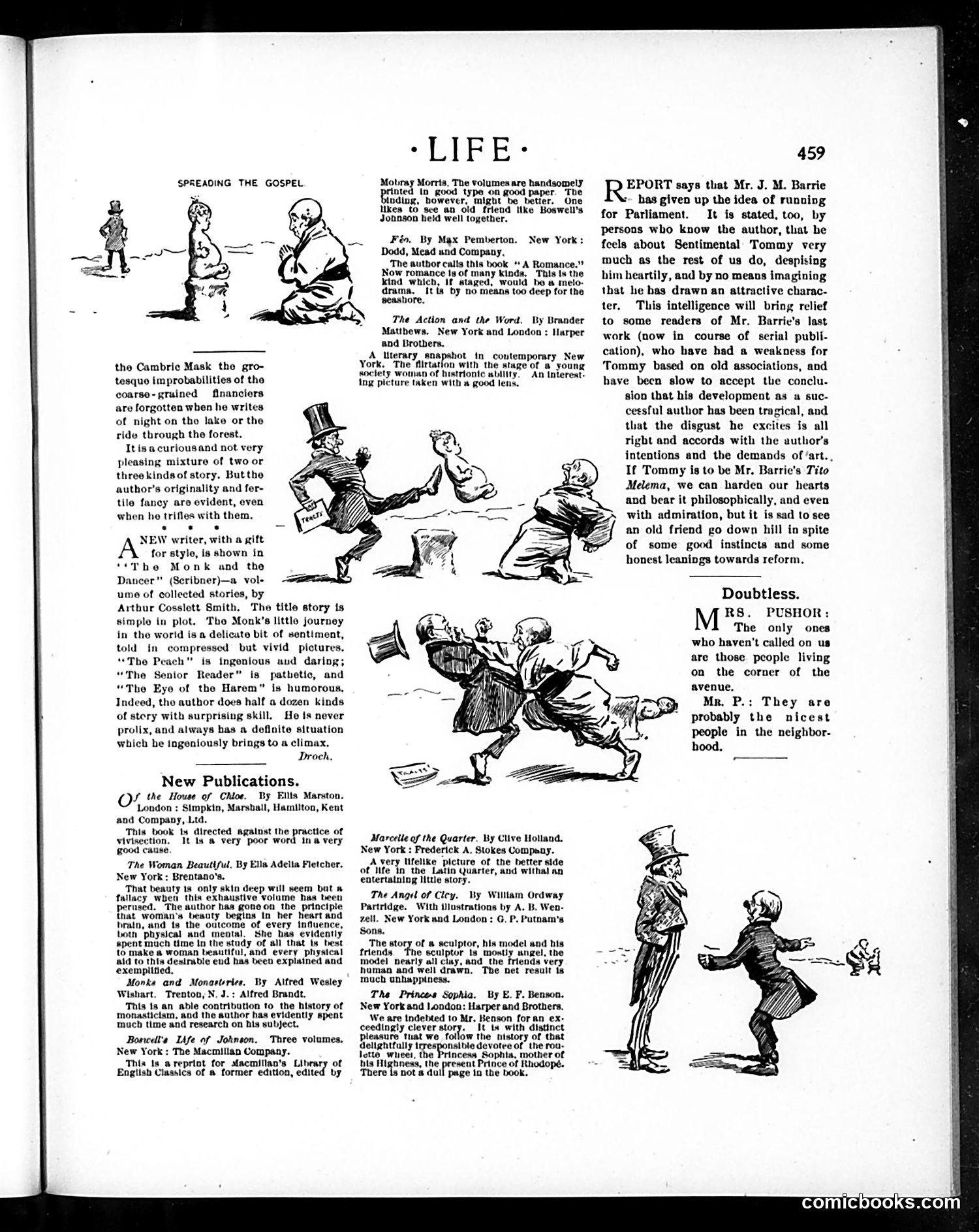
This page contains book reviews with accompanying satirical illustrations. The cartoons depict various characters engaged in physical comedy—figures falling, jumping, and tumbling in exaggerated poses typical of early 20th-century humor illustration. The reviews discuss several works including titles about monks, dancers, and social commentary. One review critiques "Vivipsection" as "a very poor word in a very good cause." Another praises a story about a sculptor and his model. The largest illustrated section ("Spreading the Gospel") shows multiple figures in chaotic motion, likely satirizing the enthusiastic but awkward promotion or dissemination of ideas—hence "spreading." Without identifying specific individuals in the caricatures, the overall tone is one of gentle mockery toward literary pretension and social earnestness, typical of *Life* magazine's satirical approach to contemporary culture and publishing.
📄 Transcribed text from this page (OCR, searchable)
Machine-transcribed from the original scan — historical spelling and the odd misread are preserved.
SPREADING THE GOSPEL. the Cambric Mask the gro- tesquo improbabilities of tho coarse-grained financiers are forgotten when he writes of night on the lake or the ride through the forest. It is acuriousand not very pleasing mixture of two or three kinds of story. But the author's originality and fer- tile fancy are evident, even when he trif_es with them. ee W writer, with a gift for style, is shown in The Monk and the Dancer" (Scribner)}—a vol- ume of collected stories, by Artbur Cosslett Smith, The title story ts simple in plot. The Monk’s little journey in the world {8 a dolicato bit of sentiment, told in compressed but vivid pictures. “Tbe Peach” is ingenious aud daring; “The Sentor Reader” 1 pathetic, and “The Eyo of the Harem” is humorous. Indeed, the author does half a dozen kinds of story with surprising skill. He ts never prolix, and always bas a defloite situation which be tngoniously brings to a climax. Droch. New Publications. Of the House of Chloe. By Ellts Marston. Londo Simpkin, Marshall, Hamilton, Kent and Company, Ltd. This book ts directed against the vivisection. It 14 @ very poor word good cause. The Woman Beautiful, By Ella Adeita Fletcher. New York : Brentano's, ‘That beauty 1s only skin deep will seem bat » fallacy when this exhaustive volume has been perused. The author has gone on the principle that woman's beauty begins In her heart and brato, and 18 the outcome of every influence, Uotn ‘physical and mental, She has evidently spent mach time In the study of all that ts best to make & woman beautiful, and every physical aid to this desirable eud has been explained and exempittied, Monks and Monasteries. By Alfred Wesley Wishart. Trenton, N, J.: Alfred Brandt. This ts an able contribution to the history of monasticism, and the author has evidently spent much time and research on his subject. Boncdt's Life of Johnson. Three volumes, New York : The Macmillan Company. Thia 1s a repriot for slacmillan’s Luprary of English Classics of a former edition, edited by ractice of ina very *EIRE* beoterha | Morris. The volumes are handsomely Printed tn good type on good paper. The nding, however, might be One Ukes (6 see an old friend like Boswell's Jonnson held well together. Féo. By Max Pemberton. Dodd, Mead und Company, . The author calls this book ‘A Romance." Now romance is of many Kinds. This ts the kind which, If staged, would be # meto- drama. itis by no means too deep for the ‘seashore, New York : The Action and the Word. By Brander Matthews. New York and London : Harper and Brothers, A Uterary snapshot in coutemporary New York. “the hirtatton with the atagerot S young soctety woman of histriontc ability An interest- Ang picture taken with a good lens. Marcelle of the Quarter. By Clive Holland. New York : Frederick A. Stokes Company. A very lifelike picture of the better side of life in the Latin Quarter, and withal an entertatning little story. The Angil of Ciey. By William Ordway Partridge. With tilustrations by A. B. Wen- 1, New York and London : G. P. Putnam's ‘The story of a sculptor, hix model and bis friends. The sculptor 1s moxtly angel, the model nearly all clay, and_the friends very human and well drawn, The net result is much unhappiness. The Princes Sophia. By E. F. Benson. New York and London: Harper and Brothers. We are indebted to Mr. Benson for an ex- ceedingly clever story. It tx with distinct pleasure tuat we follow the nistory of that delightfully irresponsible devotee of the rou- Jette wueel, the Princess Sophia, mother of his Highness, the present Prince of Rhodope. ‘There is not a dull page In the book. 459 EPORT says that Mr. J. M. Barrie has given up the idea of running for Parliament. It is stated, too, by persons who know the author, that he feels about Sentimental Tommy very much as the rest of us do, despising him heartily, and by no means imagining that he bas drawn an attractive charac- ter, This intelligence will bring relief to some readers of Mr. Barrie's last work (now in course of serial publi- cation), who have had a weakness for ‘Tommy based on old associations, and have been slow to accept the conclu. sion that his development as a suc- cessful author has been tragical, and that the disgust he excites is all right and accords with the author’s intentions and the demands of ‘art. , If Tommy is to be Mr. Barrie's Tito Melema, we can harden our hearts and bear it philosophically, and even with admiration, but it is sad to see an old friend go down hill in spite of some good instincts and some honest leanings towards reform. Doubtless. RS. PUSHOR: The only ones who haven't called on us are those people living on the corner of the avenue. Mr. P.: They are probably the nicest people in the neighbor. hood.