
Life, 1900-05-31 · page 6 of 20
Life — May 31, 1900 — page 6: what you’re looking at
What you’re looking at
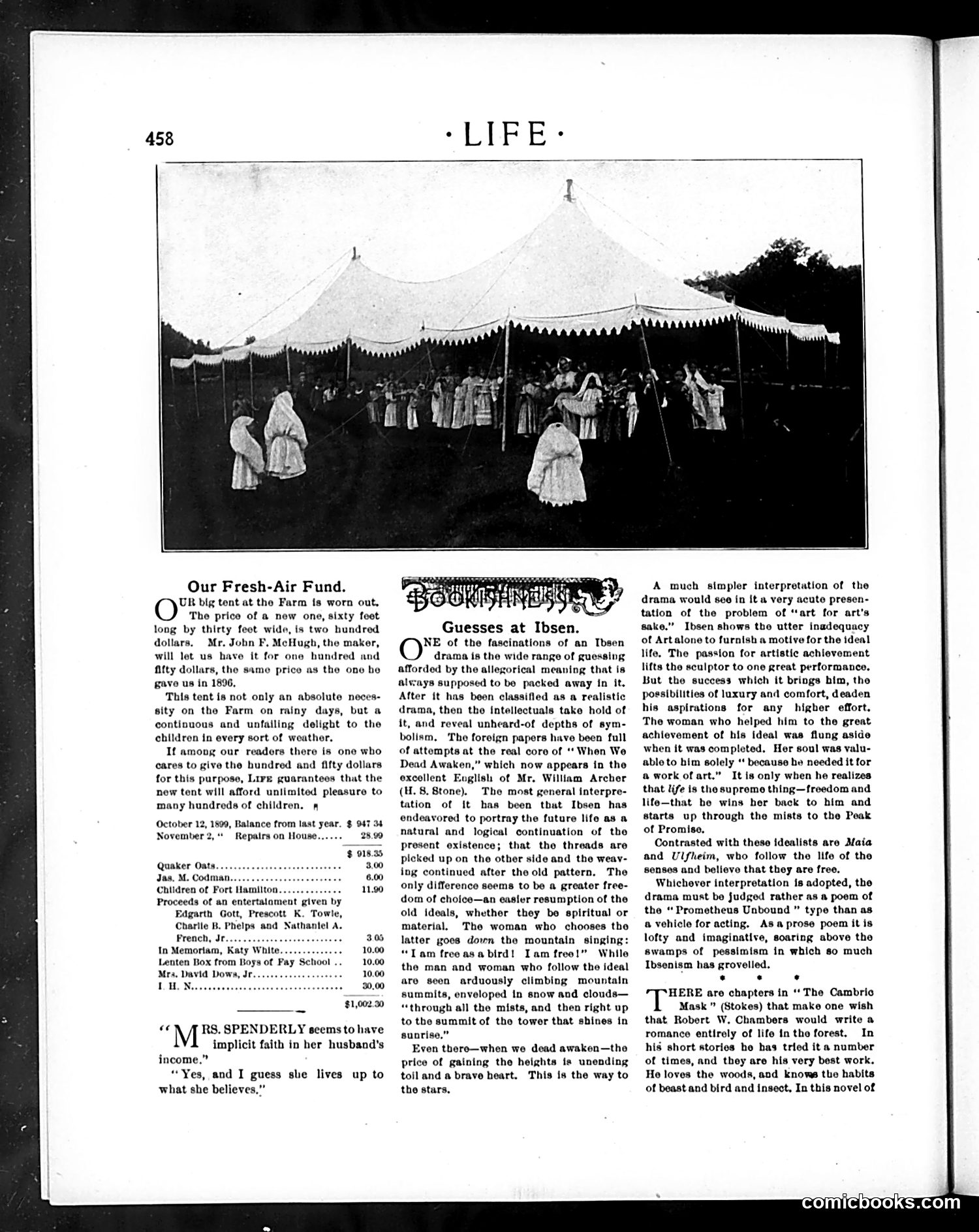
The page contains three distinct articles rather than political cartoons: 1. **"Our Fresh-Air Fund"**: Reports on fundraising for a children's fresh-air initiative, listing donations and repair costs for a tent. 2. **"Guesses at Ibsen"**: Discusses interpretations of Henrik Ibsen's drama "When We Dead Awaken," exploring how different audiences—intellectuals, the general public, and idealists—interpret the play differently. The piece critiques both realistic and overly symbolic readings. 3. **"The Cambrio Mask"**: References Robert W. Chambers's short stories, praising his detailed knowledge of nature and animal behavior. The image shows what appears to be a tent gathering or outdoor event, likely related to the Fresh-Air Fund mentioned in the text.
📄 Transcribed text from this page (OCR, searchable)
Machine-transcribed from the original scan — historical spelling and the odd misread are preserved.
Our Fresh-Air Fund. UR big tent at the Farm ts worn out, The price of a new one, sixty feet long by thirty feet wide, is two hundred dollars. Mr, Jobn F, McHugh, the maker, will let us have it for one hundred and fifty dollars, the same price as the one he gave us in 1896, This tent is not only an absolute neces- sity on the Farm on rainy days, but a continuous and unfailing delight to the children in every sort of weather. If among our readers there is one who cares to give the hundred and fifty dollars for this purpose, Lire guarantees that the new tent will afford unlimited pleasure to many hundreds of children. October 12, 1899, Balance from last year. $ 947 34 November 2,‘ Repairs on House...... Quaker Oats Jas. M. Codmal Children of Fort Hamilton. Proceeds of an entertalament given by Edgarth Gott, Prescott K. Towle, Charile B. Phelps and Nathantel A. French, Jr In Memoriam, Katy White. Lenten Box from Boys of Fay Mra. David Dows, Jr... LHL 10.00 10.00 10.00 30,00 $1,002.20 RS. SPENDERLY seems to have implicit faith in her husband's “ } income.” “Yes, and I guess sue lives up to what she believes.’ Guesses at Ibsen. NE of the fascinations of an Ibsen drama is the wide range of guessing afforded by the allegorical meaning that is alscays supposed to be packed away in it. After it has been classified as a realistic drama, then tho Intellectuals take hold of it, and reveal unheard-of depths of sym- bolism, The foreign papers have been full of attempts at the real core of ‘* When We Dead Awaken,” which now appears in the excellent Evglish of Mr. William Archer (H. 8. Stone). The most general interpre- tation of It has been that Ibsen has endeavored to portray the future life as a natural and logical continuation of the Present existence; that tho threads are picked up on tho other side and the weav- ing continued after the old pattern, The only difference seems to be a greater free- dom of choice—an easter resumption of the old ideals, whether they be spiritual or material. The woman who chooses tho lattor goes down the mountain singing: “Tam freeasa bird! Iam free!” While the man and woman who follow the ideal are seen arduously climbing mountain summits, enveloped in snow and clouds— “through all the mists, and then right up to the summit of the tower that shines in sunrise,” Even there—when we dead awaken—tho price of gaining the heights is unending toil and a brave heart. This is the way to tho stars. A much simpler interpretation of the drama would seo in it a very acute presen- tation of the problem of “art for art's sake.” Ibsen shows tbe utter inadequacy of Artalone to furnish a motive for the ideal life. The passion for artistic achievement lifts the sculptor to one great performance, But the success which it brings bim, tho possibilities of luxury and comfort, deaden his aspirations for any higher effort. The woman who helped him to the great achievement of his ideal was flung aside when it was completed. Her soul was valu- able to bim solely * because be needed it for & work of art.” It is only when he realizes that life is the supreme thing—freedom and life—that be wins her back to him and starts up through the mists to the Peak of Promise, Contrasted with these idealists are Maia and Ulfheim, who follow the life of the senses and believe that they are free. Whichovor interpretation {s adopted, tho drama must be judged rather as a poem of the “Prometheus Unbound ” type than as a vehicle for acting. AS a prose poem it is, lofty and imaginative, soaring above the swamps of pessimism in which 80 much Tbsenism has grovelled. . . . HERE are chapters in ‘The Cambrio Mask” (Stokes) that make one wish that Robert W. Chambers would write a romance entirely of life in tho forest. In his short stories ho has tried it a number of times, and they are his very best work. He loves the woods, and knows tbe habits of beast and bird and insect, In this novel of