
Life, 1900-05-31 · page 4 of 20
Life — May 31, 1900 — page 4: what you’re looking at
What you’re looking at
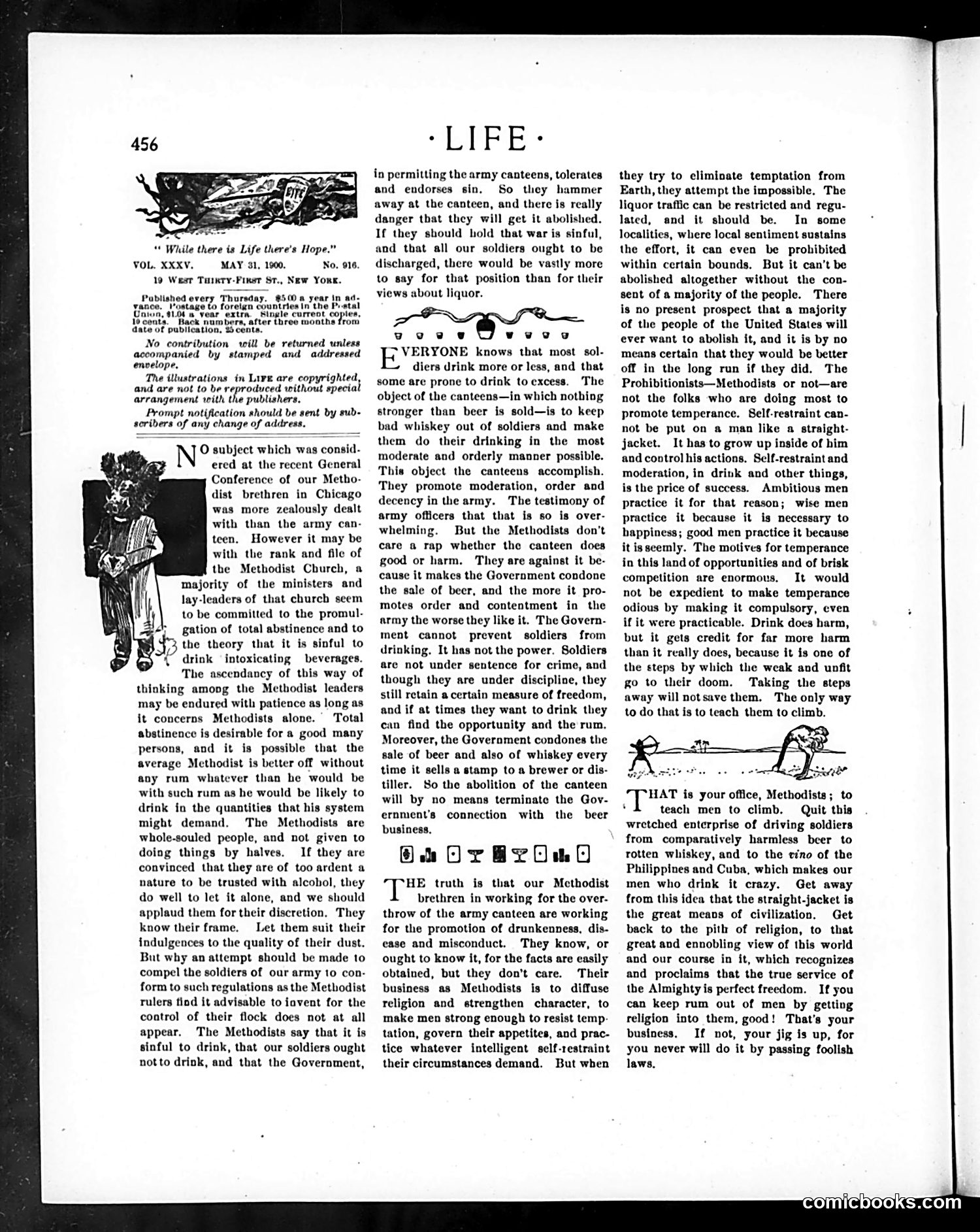
This page addresses Methodist church opposition to army canteens serving alcohol to soldiers. The text debates whether the military should prohibit beer and whiskey sales to troops. The small illustrated figures (appearing in margins) show soldiers in casual poses, likely reinforcing the human element of the debate. **The satire's point:** The article mocks Methodist leaders for their temperance crusade, arguing they want to eliminate canteen alcohol to promote "morality" among soldiers. The author counters that soldiers will drink regardless, and that teaching self-restraint matters more than prohibition. The piece suggests Methodist reformers are naive—attempting to legislate morality through blanket bans rather than addressing human nature. This reflects early 20th-century debates between religious temperance movements and pragmatists who believed such restrictions were unenforceable.
📄 Transcribed text from this page (OCR, searchable)
Machine-transcribed from the original scan — historical spelling and the odd misread are preserved.
* While there is Life there's Hope.” VOL. XXXV. MAY 31, 1900. No, 916. 19 West Tarety-Finst St., New Your. #500 a year in ad~ ‘tries In the Psstal publication, 25 cents. No contribution will be returned unless accompanied by stamped and addressed envelope. The illustrations in Live are copyrighted and are not to be reproduced without special arrangement with the publishers. Prompt notification should be sent by sub- scribers of any change of address. O subject which was consid- ered at the recent General Conference of our Metho- dist brethren in Chicago was more zealously dealt with than the army can- teen. However it may be with the rank and file of the Methodist Church, a majority of the ministers and lay-leaders of that church seem to be committed to the promul- gation of total abstinence and to yD the theory that it is sinful to 4 drink intoxicating beverages. The ascendancy of this way of thinking among the Methodist leaders may be endured with patience as long as it concerns Methodists alone. Total abstinence is desirable for a good many persons, and it is possible that the average Methodist is better off without any rum whatever than he would be with such rum as he would be likely to drink in the quantities that his system might demand. The Methodists are whole-souled people, and not given to doing things by halves. If they are convinced that they are of too ardent a nature to be trusted with alcohol, they do well to let it alone, and we should applaud them for their discretion, They know their frame, Let them suit their indulgences to the quality of their dust. But why an attempt should be made to compel the soldiers of our army to con- form to such regulations as the Methodist rulers find it advisable to iavent for the control of their flock does not at all appear. The Methodists say that it is sinful to drink, that our soldiers ought notto drink, and that the Government, “LPB in permitting the army canteens, tolerates and endorses sin, So they hammer away at the canteen, and there is really danger that they will get it abolished. If they should hold that war is sinful, and that all our soldiers ought to be discharged, there would be vastly more to say for that position than for their views about liquor. 7 VERYONE knows that most sol- diers drink more or less, and that some are prone to drink to excess. The object of the canteens—in which nothing stronger than beer is sold—is to keep bad whiskey out of soldiers and make them do their drinking in the most moderate and orderly manner possible. This object the canteens accomplish. They promote moderation, order and decency in the army. The testimony of army officers that that is so is over- whelming. But the Methodists don't care a rap whether the canteen does good or harm. They are against it be- cause it makes the Government condone the sale of beer, and the more it pro- motes order and contentment in the army the worse they like it. The Govern- ment cannot prevent soldiers from drinking. It has not the power. Soldiers are not under sentence for crime, and though they are under discipline, they still retain a certain measure of freedom, and if at times they want to drink they can find the opportunity and the rum. Moreover, the Government condones the sale of beer and also of whiskey every time it sells a stamp to a brewer or dis- tiller. So the abolition of the canteen will by no means terminate the Gov- ernment’s connection with the beer business, Os Or aroun HE truth is that our Mcthodist brethren in working for the over- throw of the army canteen are working for the promotion of drunkenness, dis- ease and misconduct. They know, or ought to know it, for the facts are easily obtained, but they don’t care. Their business as Methodists is to diffuse religion and etrengthen character, to make men strong enough to resist temp: tation, govern their appetites, and prac- tice whatever intelligent self-restraint their circumstances demand. But when they try to eliminate temptation from Earth, they attempt the impossible, The liquor traffic can be restricted and regu- lated, and it should be. In some localities, where local sentiment sustains the effort, it can even be prohibited within certain bounds. But it can’t be abolished altogether without the con- sent of a majority of the people. There is no present prospect that a majority of the people of the United States will ever want to abolish it, and it is by no means certain that they would be better off in the long run if they did. The Prohibitionists—Methodists or not—are not the folks who are doing most to promote temperance. Self-restraint can- not be put on a man like a straight- jacket. It has to grow up inside of him and control his actions. Self-restraint and moderation, in drink and other things, is the price of success. Ambitious men practice it for that reason; wise men practice it because it is necessary to happiness; good men practice it because it isseemly. The motives for temperance in this land of opportunities and of brisk competition are enormous. It would not be expedient to make temperance odious by making it compulsory, even if it were practicable. Drink does harm, but it gets credit for far more harm than it really does, because it is one of the steps by which the weak and unfit go to their doom. Taking the steps away will notsave them, The only way to do that is to teach them to climb. teach men to climb. Quit this wretched enterprise of driving soldiers from comparatively harmless beer to rotten whiskey, and to the tino of the Philippines and Cuba, which makes our men who drink it crazy. Get away from this idea that the straight-jacket is the great means of civilization. Get back to the pith of religion, to that great and ennobling view of this world and our course in it, which recognizes and proclaims that the true service of the Almighty is perfect freedom. If you can keep rum out of men by getting religion into them, good! That's your business. If not, your jig is up, for you never will do it by passing foolish laws.