
A complete issue · 20 pages · 1900
Life — May 10, 1900
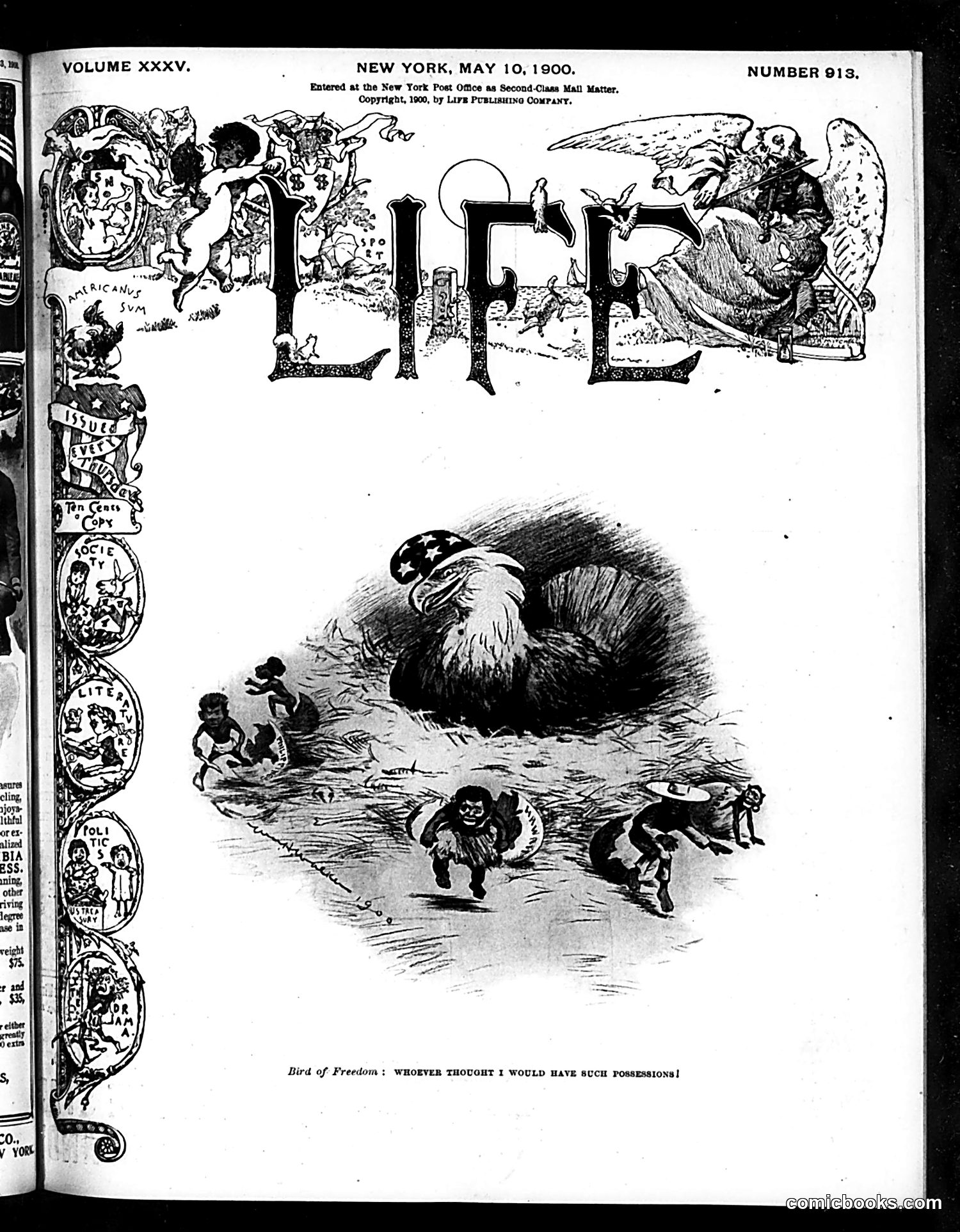
The main cartoon, titled "Bird of Freedom: Whoever Thought I Would Have Such Possessions!" depicts Uncle Sam (identifiable by his starred headband) as a large bird surrounded by smaller figures that appear to be caricatured as non-white peoples or colonial subjects. This satirizes American imperial expansion around 1900—specifically the recent Spanish-American War (1898) and subsequent acquisitions of territories like Puerto Rico, Guam, and the Philippines. The "possessions" referenced are these newly acquired colonies and their populations. The cartoon critiques American imperialism through irony: Uncle Sam expresses surprise at his new colonial holdings, suggesting either the unexpected consequences of American foreign policy or satirizing the notion that the U.S. had become an imperial power contrary to its founding principles.
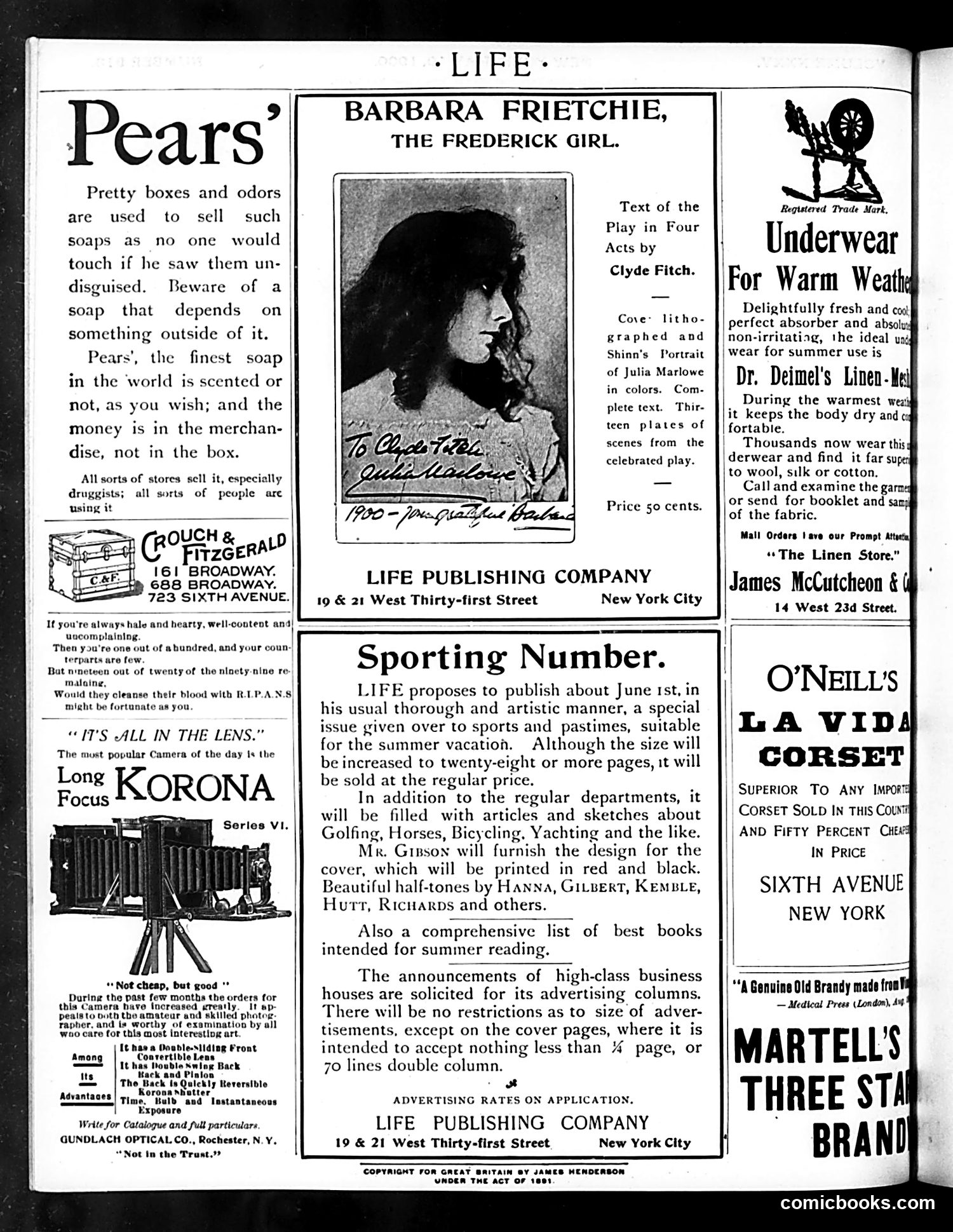
This page is primarily **advertising and promotional content** rather than political satire. The main feature is an announcement for a play called "Barbara Frietchie, The Frederick Girl" by Clyde Fitch, with a portrait photograph of what appears to be the lead actress. The bulk of the page consists of **commercial advertisements** for products including Pears' soap, Korona cameras, Dr. Deimel's underwear, James McCutcheon & Co., O'Neill's corsets, and Martell's brandy. There is **no political cartoon or satirical content** visible. The "Sporting Number" section merely announces an upcoming special sports issue of Life magazine planned for June 1st, detailing its proposed editorial features and advertising rates. This appears to be a standard magazine page from the early 1900s mixing entertainment promotion with period advertising.
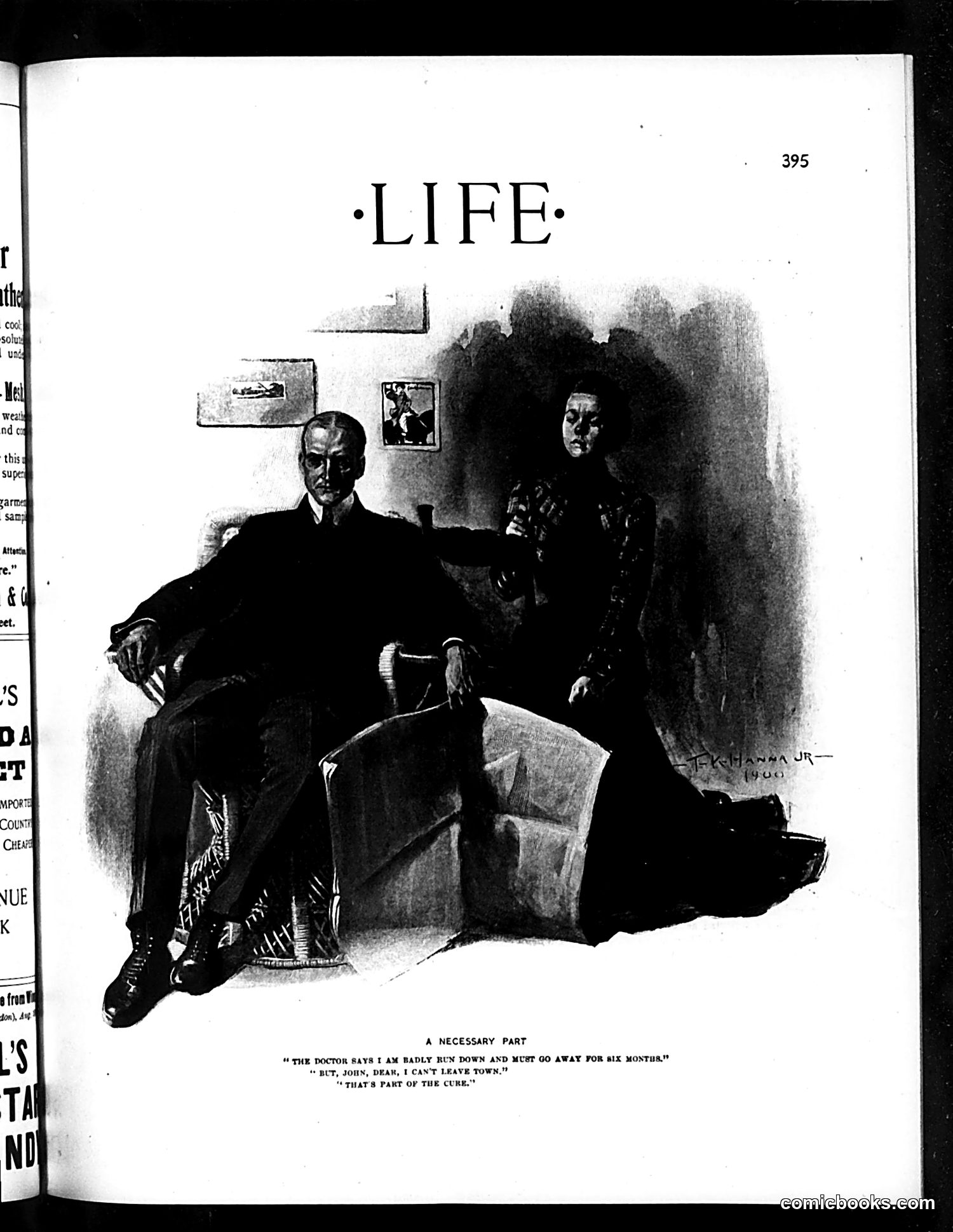
This cartoon depicts a domestic conflict between a man and woman, likely a husband and wife. The man sits reading while the woman stands beside him. The caption quotes the man saying the doctor ordered him to "run down and must go away for six months," but he protests: "But, John, dear, I can't leave town" and adds "That's part of the cure." The satire mocks the common excuse husbands used to escape domestic life by claiming medical advice required travel. The woman's protest—that she cannot leave town—suggests she sees through this transparent excuse. The joke targets both masculine avoidance of family responsibilities and the dubious medical justifications men invented to justify leisure trips away from home.
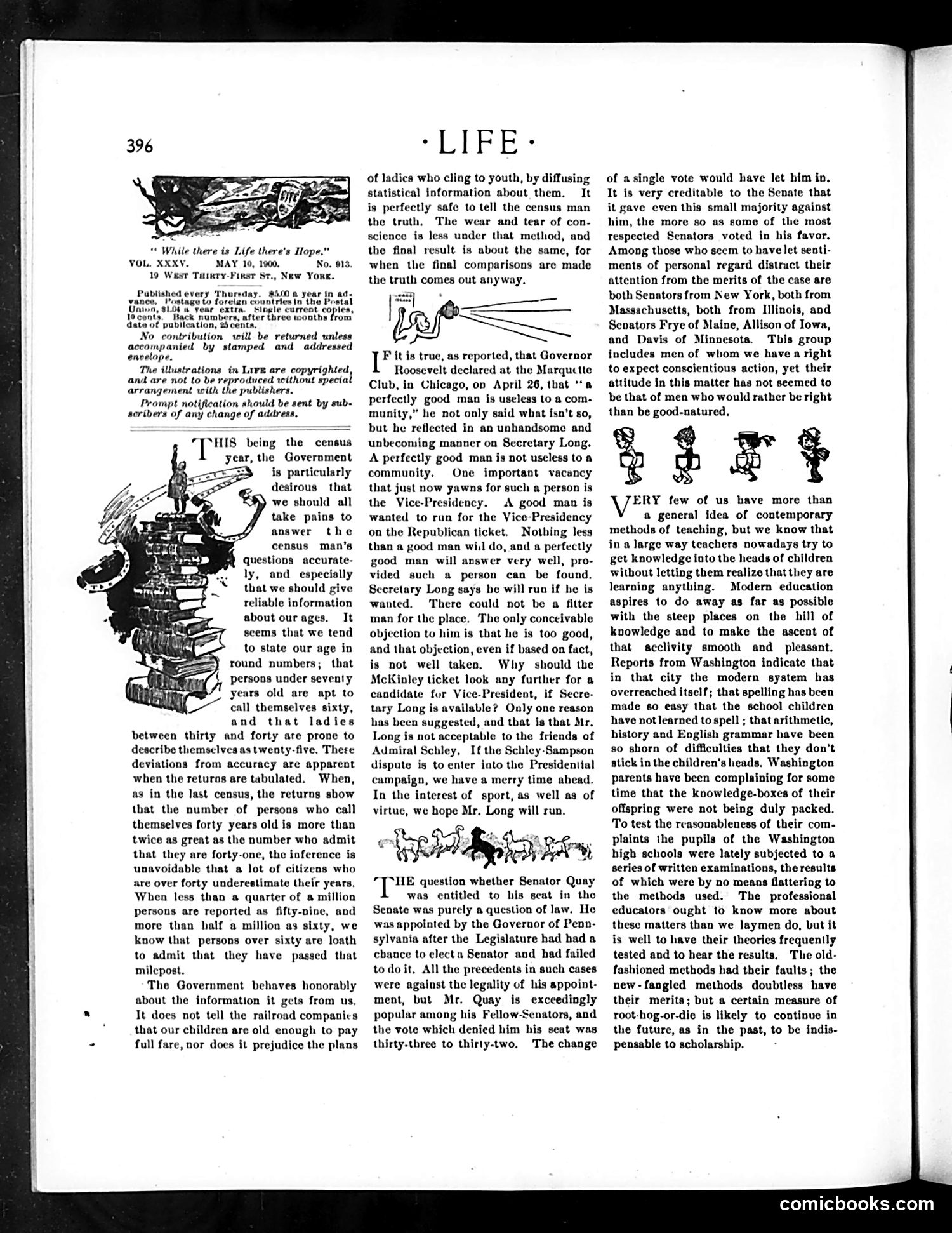
This page contains political commentary on the 1900 U.S. census and Vice-Presidential succession rather than traditional cartoons. The main text discusses Governor Roosevelt's declaration that "a perfectly good man is useless to a community," critiquing his unsuitability for Vice-President. The article argues Roosevelt is too good—too principled and idealistic—to occupy that largely ceremonial role, which requires political accommodation. A secondary section examines Senator Quay's disputed Senate seat (appointed by Pennsylvania's Governor, challenged on legality grounds). The author notes Quay remains popular despite the controversy, unlike other appointees who lost their seats 33-32. The decorative header contains small illustrated figures but no clear satirical caricatures are distinctly identifiable in this text-heavy page.
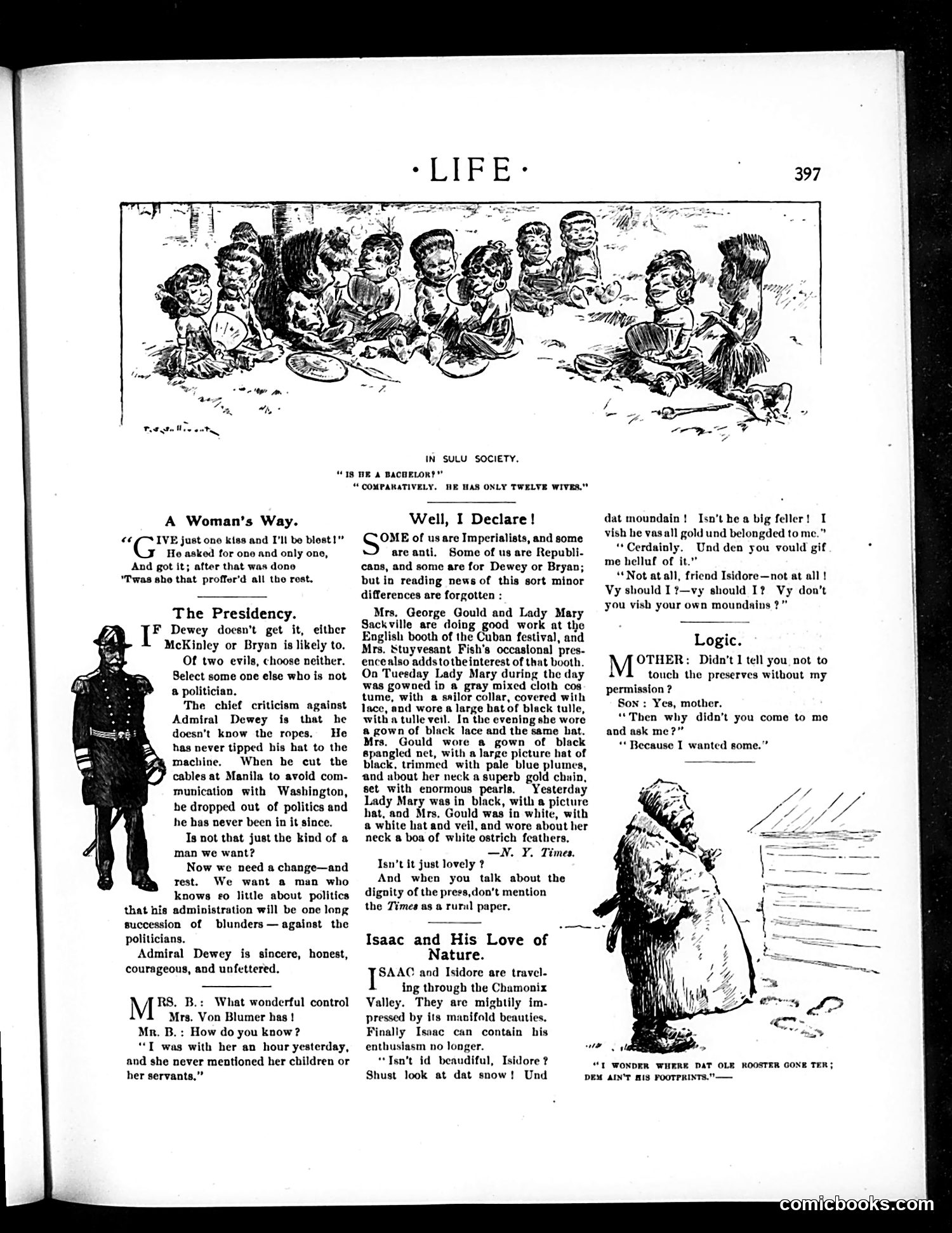
This page contains several satirical pieces from early 20th-century American political commentary: **"The Presidency"** section mocks the selection of a presidential successor, mentioning McKinley and Bryan as potential candidates. The satire suggests the chosen candidate will be someone unknown to politics—a criticism of political machines selecting unqualified figures. **"Well, I Declare!"** discusses imperialist policies, referencing debates over American imperialism and mentions of figures like Dewey and Bryan, likely relating to Philippine-American War era politics. The cartoon illustrations appear to satirize high society and social pretension through exaggerated character drawings. The specific historical context (dates, exact political figures referenced) would require additional verification, but the page clearly engages contemporary political debates about imperialism and presidential succession.
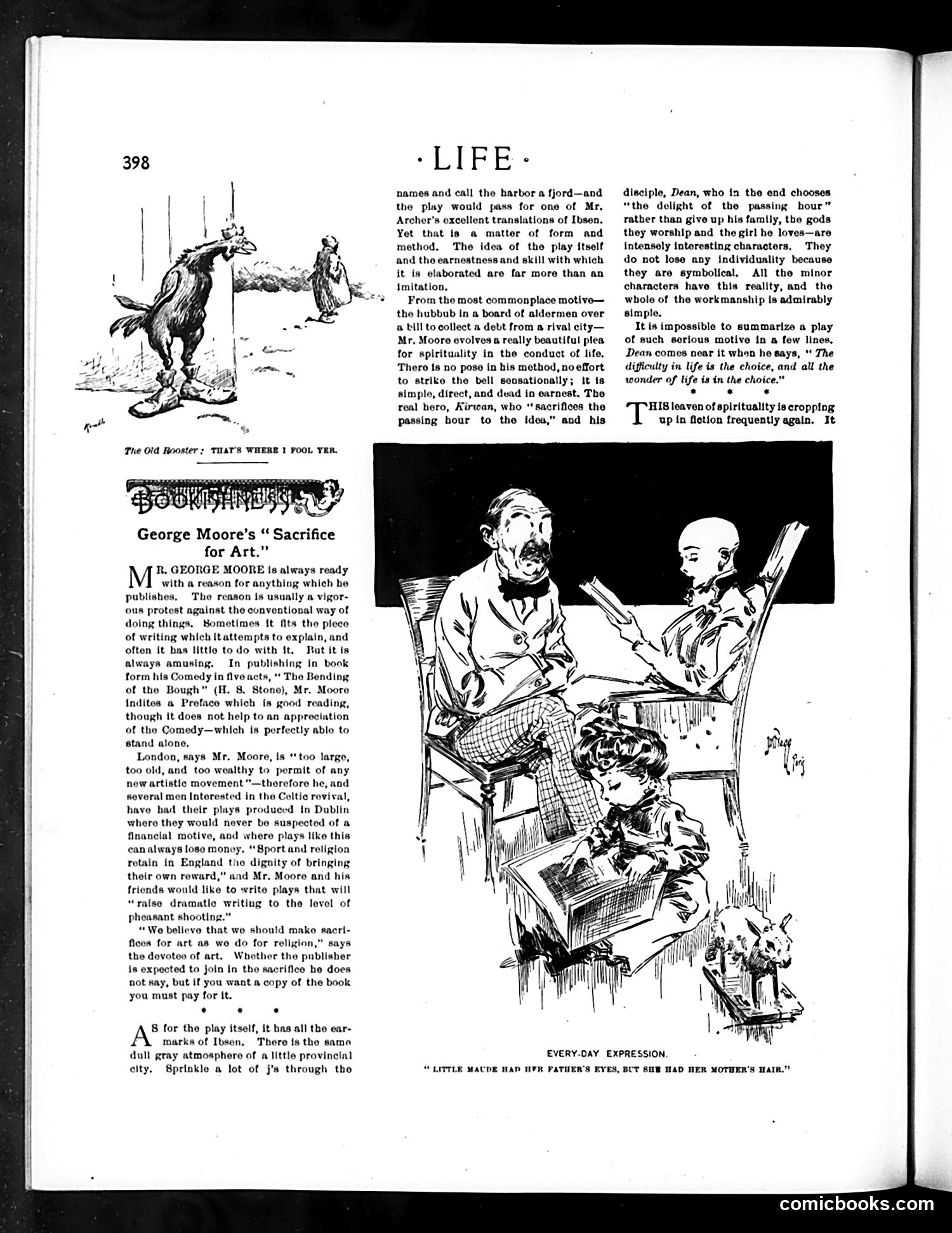
This page discusses George Moore's play "Sacrifice for Art," praising Moore's willingness to sacrifice financial success for artistic integrity. The text argues Moore and friends want to elevate dramatic writing beyond "pheasant shooting"—suggesting contemporary theater prioritized entertainment over substance. **The two cartoons:** 1. **Top**: "The Old Heckler—That's Where I Fool Yer" depicts a man heckling, satirizing audience disruption of performances. 2. **Bottom** ("Everyday Expression"): Shows a man and woman viewing art, captioned "Little Mattie had her father's eyes, but she had her mother's hair." This jokes about inherited traits, likely mocking sentimental Victorian art commentary or the gap between artistic pretension and everyday banality. Both cartoons employ gentle satire about art, audience, and society's relationship to culture.
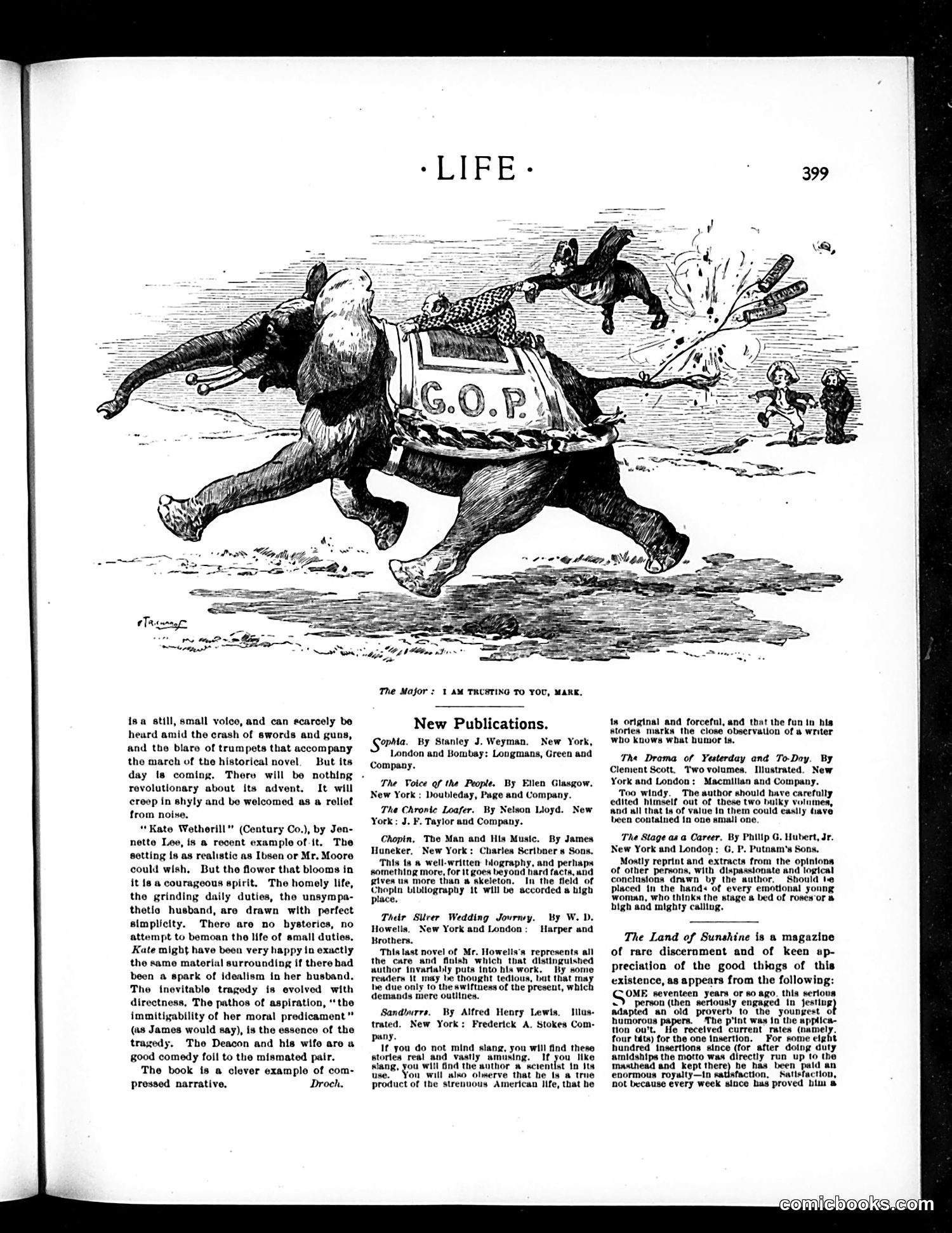
This cartoon depicts a figure labeled "G.O.P." (Republican Party) as an elephant-like character in military dress, appearing to stumble or lose control while carrying supplies. The caption indicates someone named "the Major" is entrusting responsibility to "Mark" (likely a political figure). The satire appears to comment on Republican Party leadership during a period of political chaos or military conflict—the "crash of swords and guns" mentioned in the accompanying text suggests wartime or crisis conditions. The elephant's loss of balance symbolizes the GOP's instability or inability to manage its duties effectively. Without seeing the publication date, the specific historical context remains unclear, though the military imagery suggests coverage of early 20th-century American political turmoil.
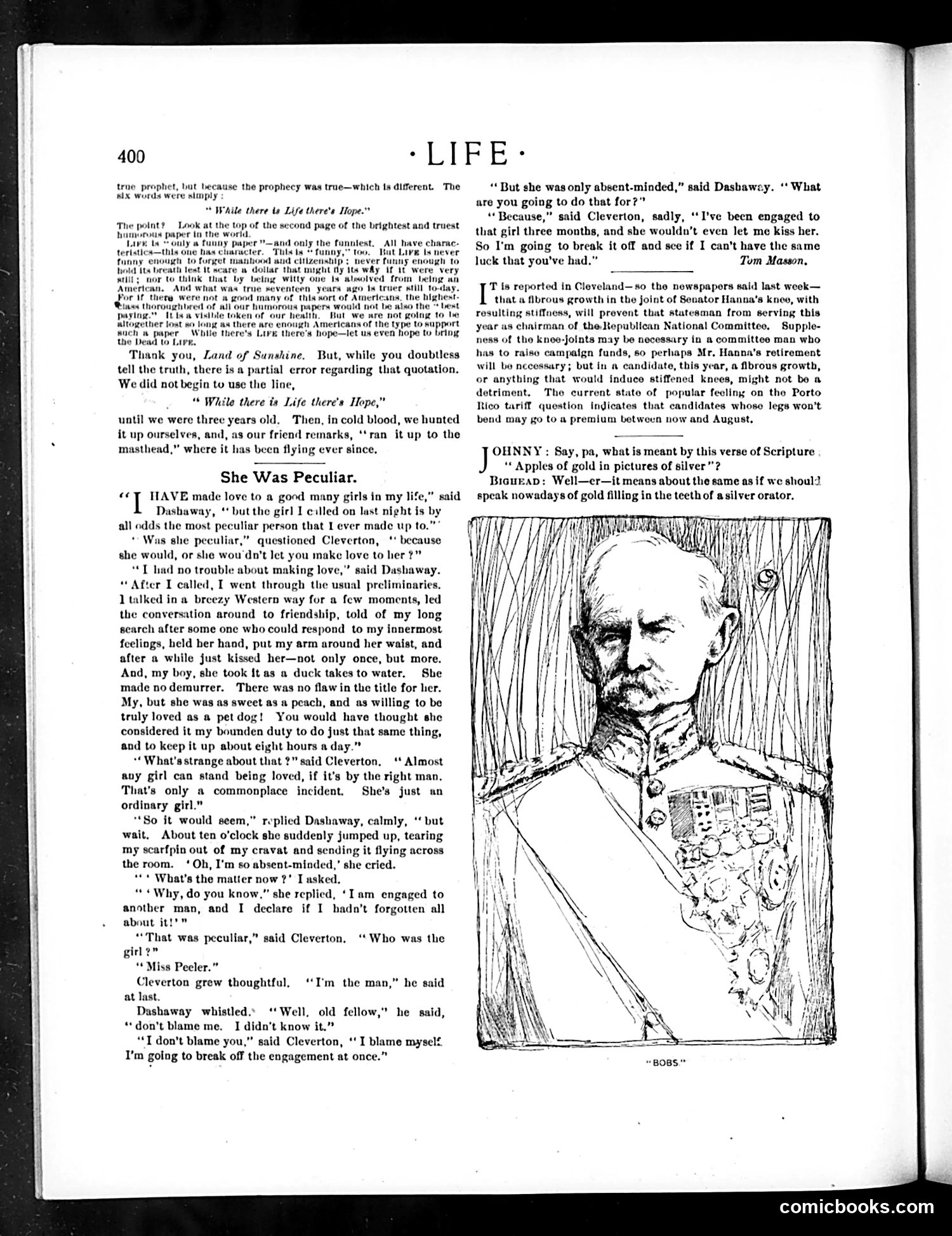
This page contains a narrative fiction piece titled "She Was Peculiar," featuring dialogue between characters named Dashawy and Cleverton about a girl named Miss Peeler. The story involves romantic entanglement and broken engagements. The accompanying illustration labeled "BOBS" shows a caricatured elderly man's face in profile, drawn in an exaggerated style typical of *Life*'s satirical artwork. The page is primarily literary content rather than political satire. The "peculiar" girl referenced in the story appears to be the subject of gentle social commentary—the humor derives from domestic romantic complications rather than broader political or social critique. Without additional context about Miss Peeler or the story's original publication date, the specific satirical target remains unclear.
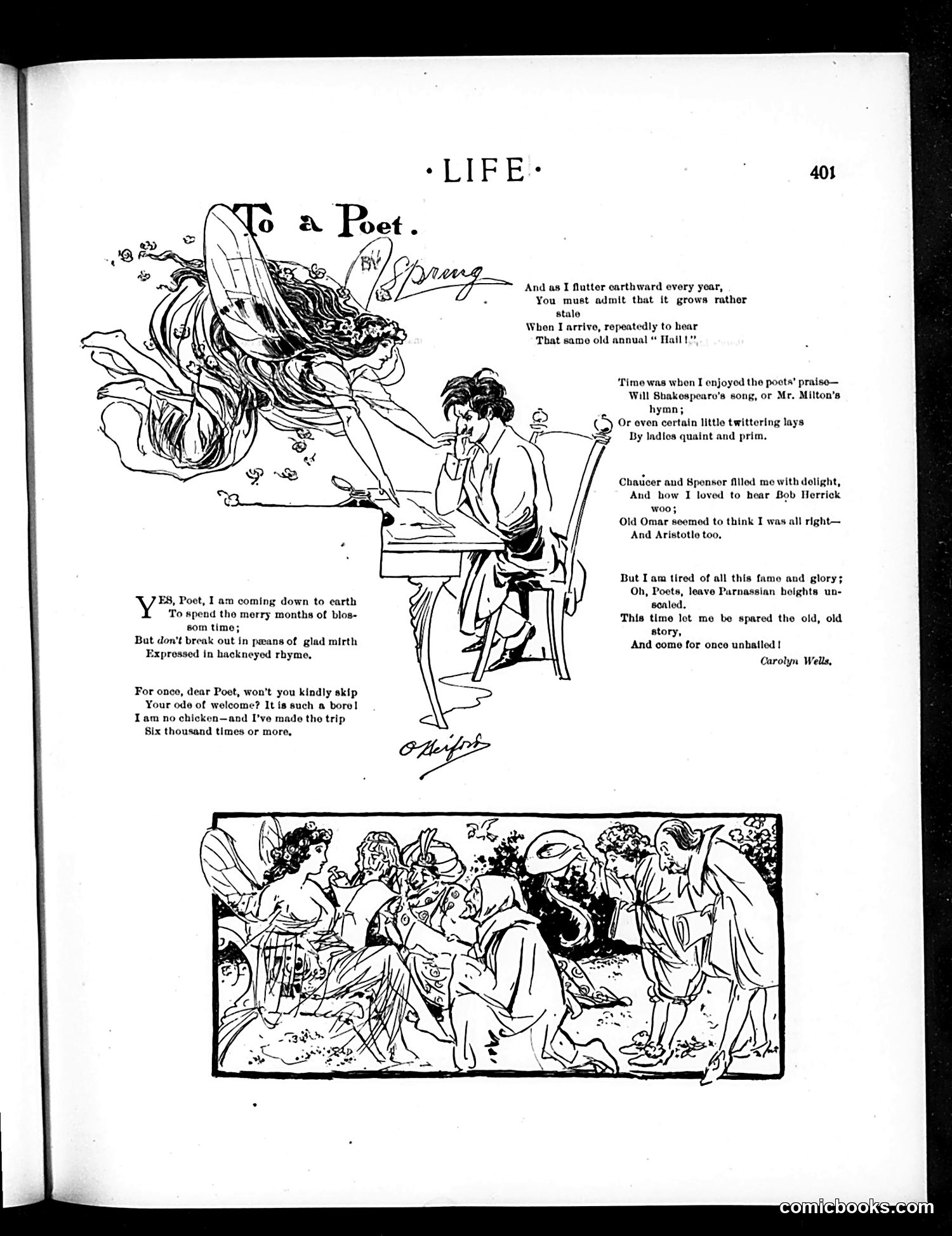
This satirical poem mocks the tired clichés of poetic convention. The speaker, personified as Spring descending to Earth, complains that poets endlessly celebrate her arrival with worn-out praise—the same "Hall!" exclamation repeated annually. The poem references classical literary figures (Shakespeare, Milton, Chaucer, Spenser, Omar Khayyam, Aristotle) to illustrate how poets blindly imitate historical precedents. The speaker is exhausted by this predictable adulation and begs to be spared "the old, old story." The accompanying illustrations show Spring arriving and poets at work, visualizing the poem's critique of uninspired, derivative verse. Wells's satire targets poets who rely on worn literary traditions rather than original expression—a common early-20th-century criticism of Romantic and Victorian poetry.
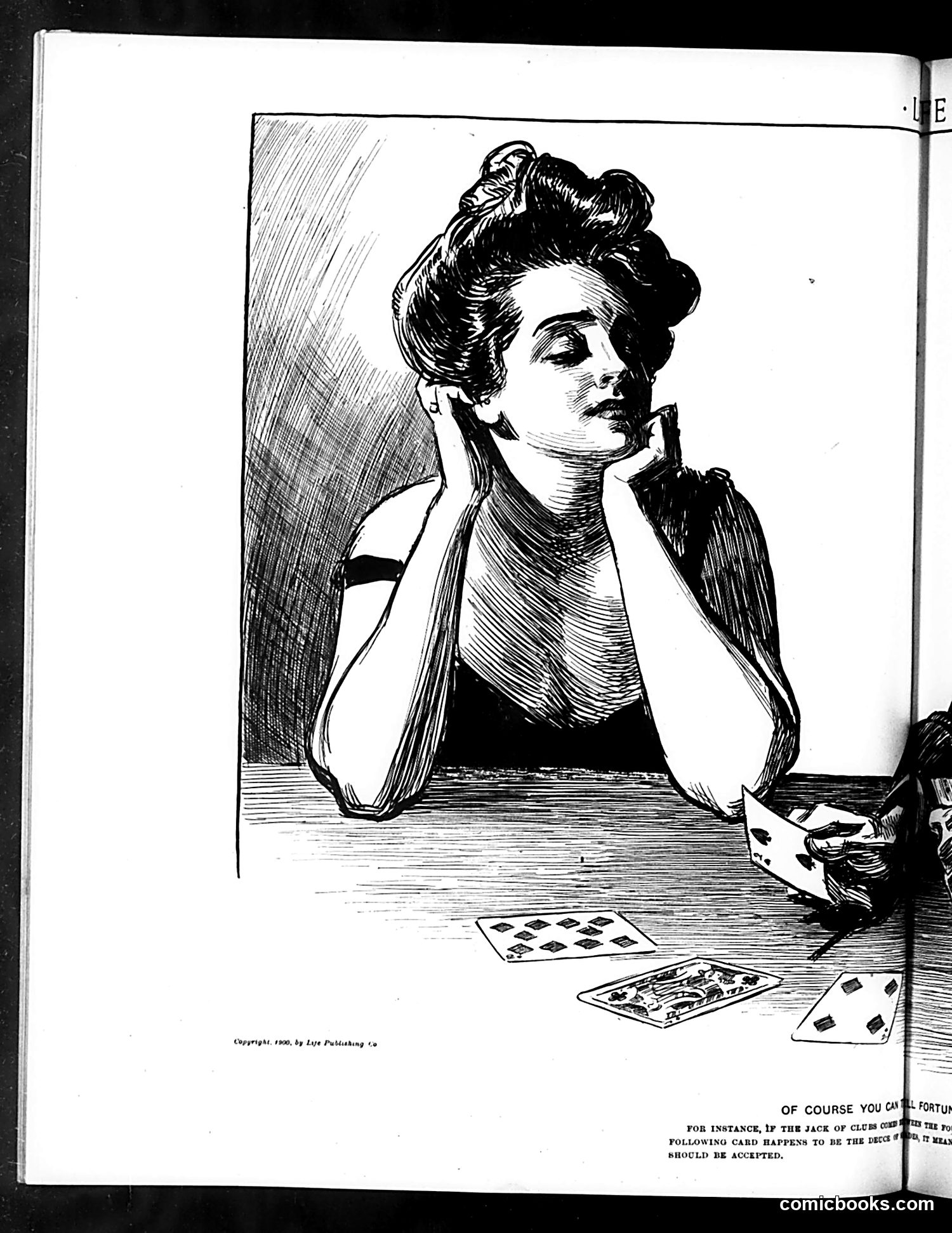
This appears to be a fortune-telling or card-reading scene from *Life* magazine (copyright 1908, per the visible credit). The illustration shows a well-dressed woman in profile, seated at a table with playing cards spread before her, in a contemplative pose with hand to chin. The partially visible text at bottom references fortune-telling through cards, specifically mentioning "the jack of clubs" and suggesting certain cards should be "accepted" as meaningful omens. The satire likely mocks the popular early-20th-century craze for fortune-telling and spiritualism among the upper classes—presenting it as frivolous superstition. The woman's refined appearance contrasts with the absurdity of seeking guidance from playing cards, highlighting the era's fascination with pseudoscientific divination practices.
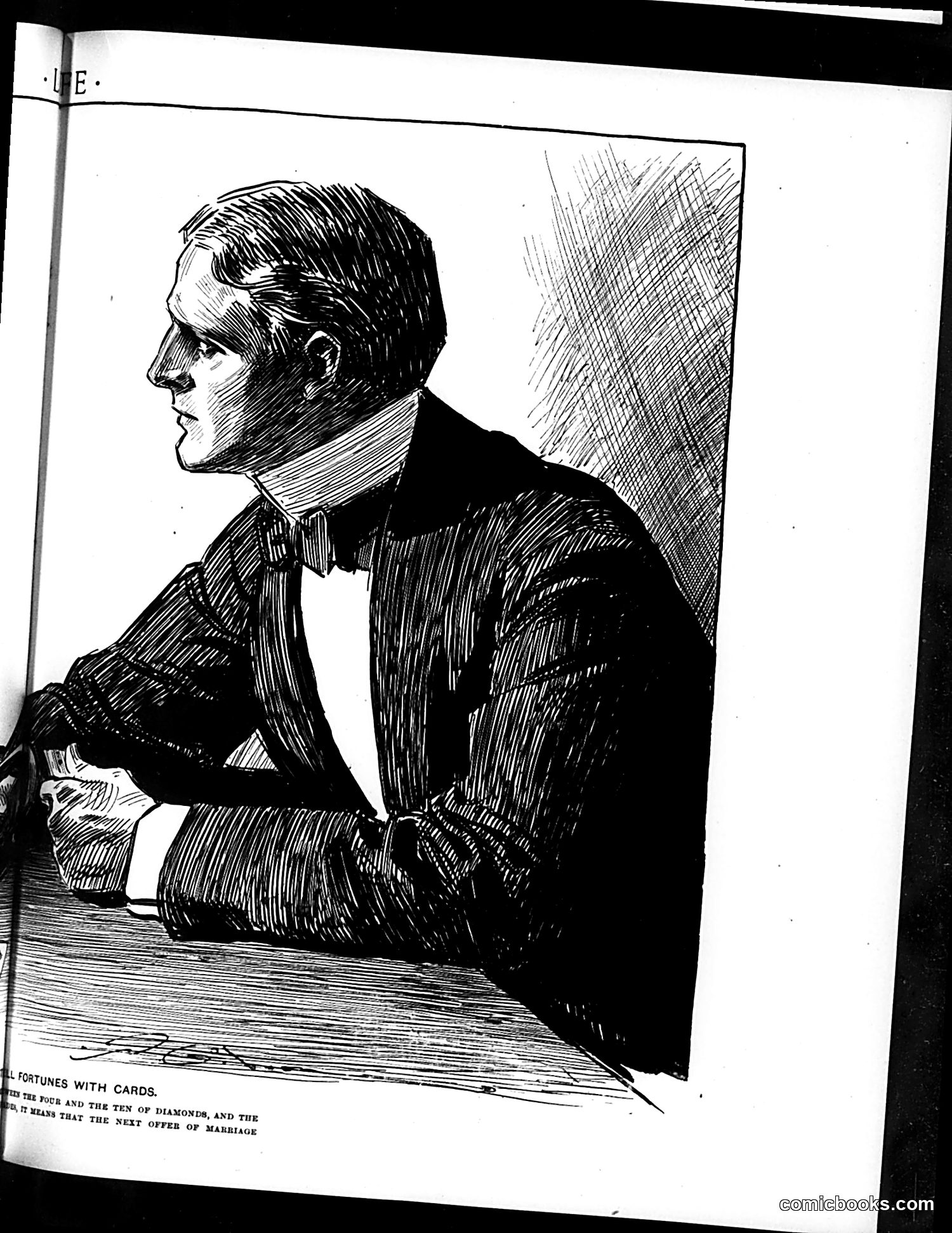
This satirical illustration depicts a well-dressed gentleman in formal attire (tuxedo, bow tie) consulting what appears to be a fortune teller or card reader. The caption references "fortunes with cards" and mentions "the rose and the ten of diamonds, and the next offer of marriage." The satire targets a specific social practice: wealthy men of the era consulting fortune tellers or tarot readers, presumably seeking guidance on romantic prospects and marriage opportunities. The gentleman's formal dress and composed demeanor suggest this was a genuine concern among the upper classes, making the practice a ripe target for Life magazine's social commentary. The illustration mocks both the credulity of fortune-seeking and the superficiality of using cards to guide matters of the heart.
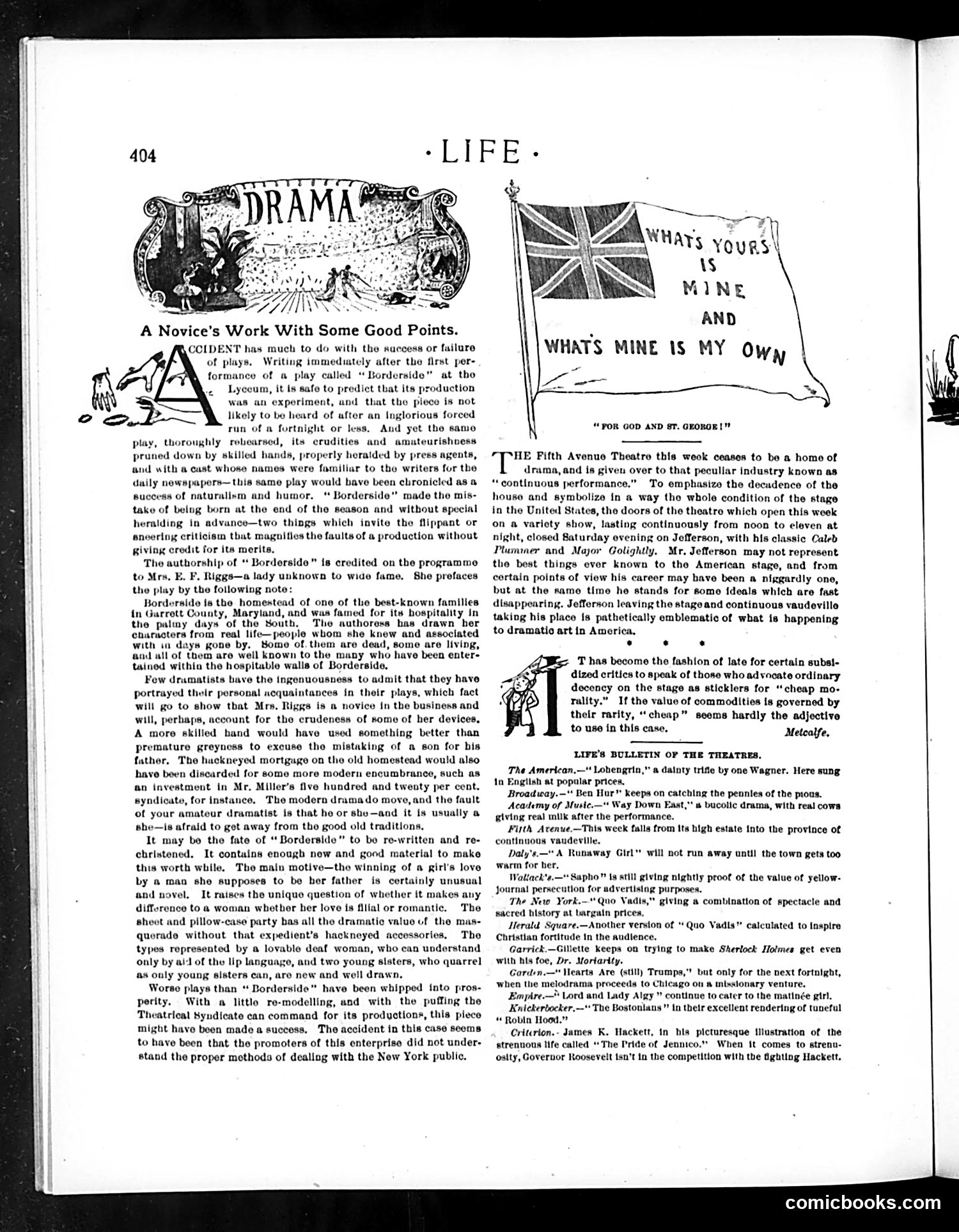
This page contains theatrical criticism and drama commentary rather than political cartoons. The main feature, "A Novice's Work With Some Good Points," reviews a play called "Borderside." The text criticizes the production's amateur quality while acknowledging some merit in the writing. The British flag illustration with the caption "WHAT'S YOURS IS MINE AND WHAT'S MINE IS MY OWN" appears to satirize British colonial or imperial attitudes—likely referencing British foreign policy or economic practices of the era. Below is "Life's Bulletin of the Theater," listing current Broadway productions with brief reviews. The page focuses on theatrical criticism rather than political satire, offering commentary on contemporary New York stage productions and their artistic merit.
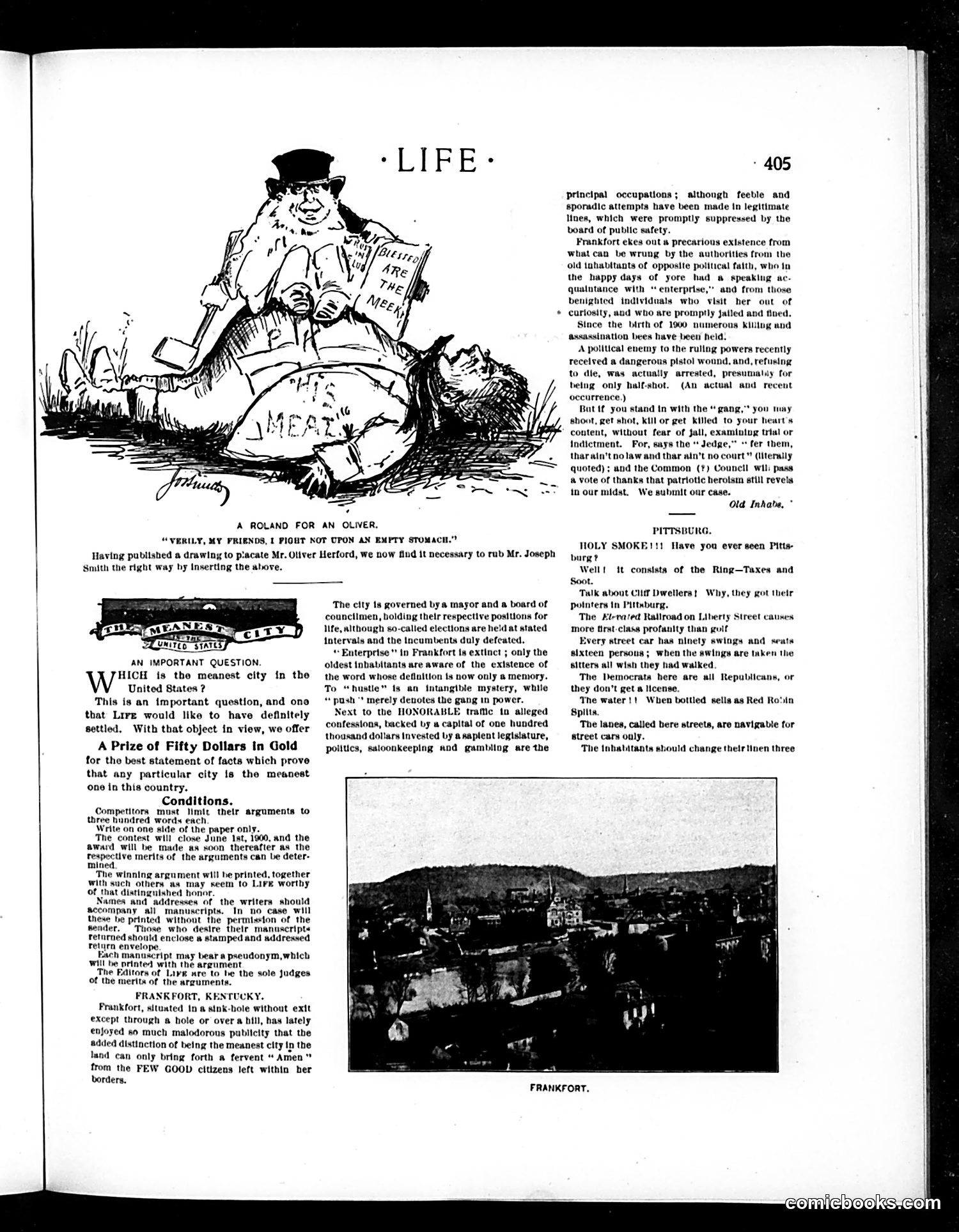
This page contains Life magazine's contest soliciting readers to identify "the meanest city in the United States," offering $50 in gold for the best essay. The featured entries attack **Frankfort, Kentucky** and **Pittsburgh**. The Frankfort cartoon depicts a corpulent politician lounging atop a prone citizen labeled "MEAT," satirizing local government corruption and exploitation. The accompanying text describes Frankfort's governance as controlled by a permanent political "gang" who operate outside law, arrest political enemies arbitrarily, and suppress enterprise and economic development. Pittsburgh's entry mocks the industrial city as consisting entirely of "the Ring—Taxes and Soot," attacking both corrupt political machines and industrial pollution. These pieces reflect Progressive Era anxieties about urban corruption, boss politics, and municipal mismanagement—common targets of Life's satirical crusades.
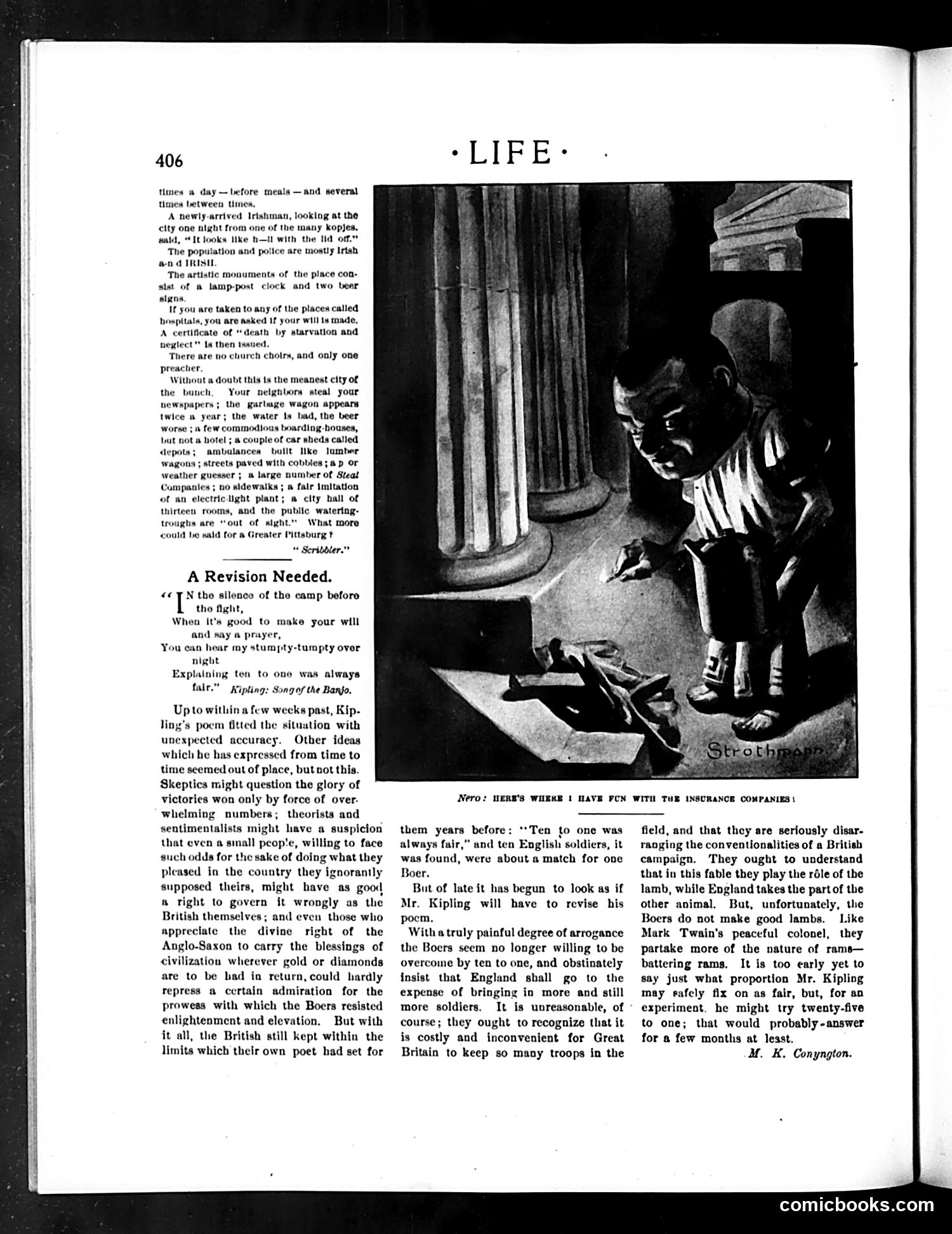
This page contains two separate pieces of satire about the Second Boer War (1899-1902), when Britain fought against Dutch settlers in South Africa. **The cartoon** (bottom right) shows an insurance agent or businessman examining a figure, captioned "Here's where I have fun with the insurance companies"—likely mocking how the war's unexpected costs and casualties were disrupting British financial calculations. **The main article** critiques Rudyard Kipling's famous poem *"Song of the Banjo,"* which claimed "ten to one was always fair" regarding British military superiority. The satirist argues that the Boers—stubbornly refusing to play their assigned role as helpless victims—are forcing Britain to deploy vastly more troops than expected. The piece sardonically suggests Kipling should revise his poem to claim "twenty-five to one" is fair, mocking both British arrogance and the war's escalating, costly reality. The reference to Mark Twain's "peaceful colonel" adds another layer of ironic commentary on the supposed civilizing mission.
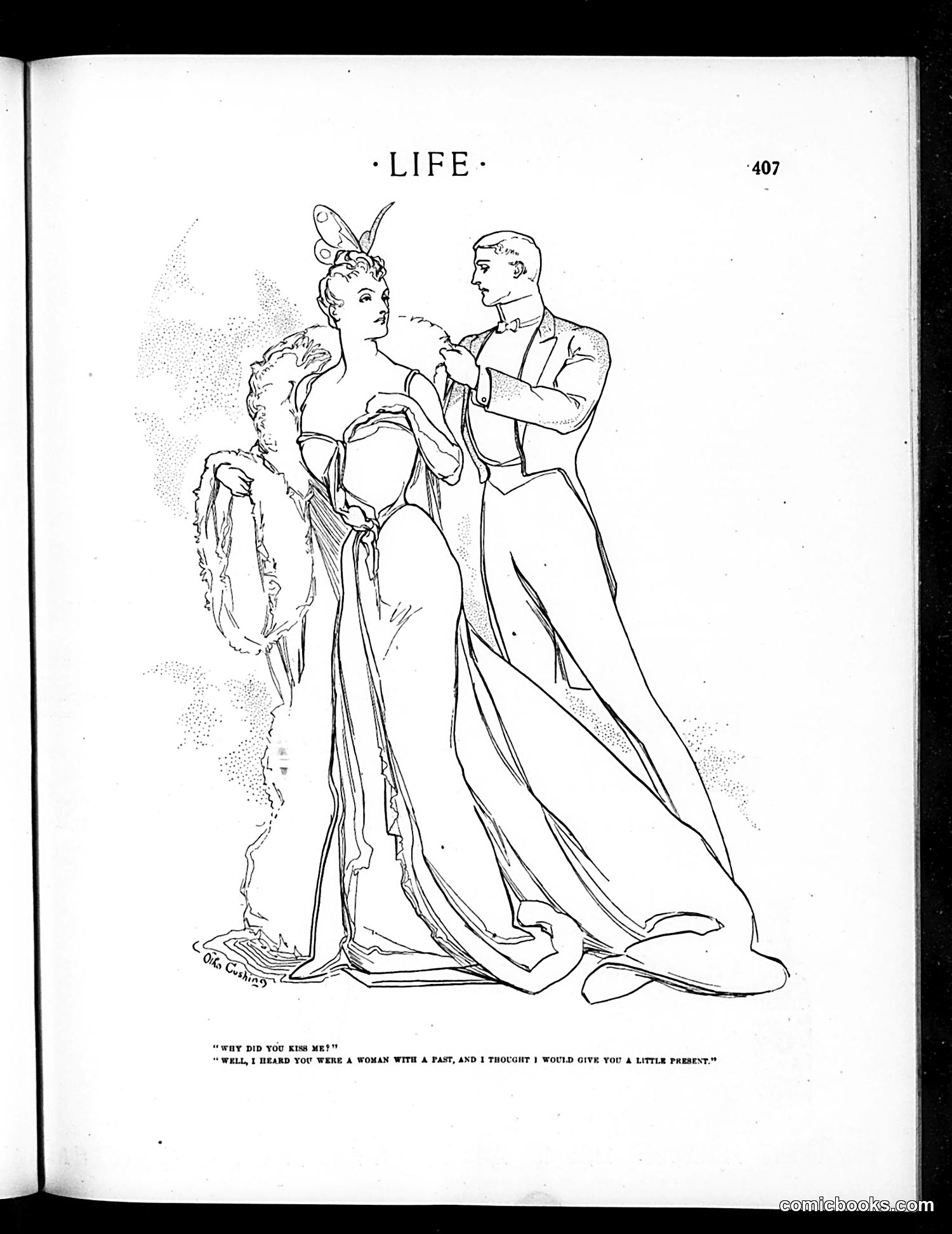
This is a single-panel cartoon depicting a man in formal attire kissing or about to kiss an elegantly dressed woman wearing an elaborate feathered headpiece and flowing gown. The dialogue reveals the joke's meaning: the man kisses her because he's heard she's "a woman with a past"—implying she has a romantic or scandalous history. The humor relies on a double meaning. The phrase "woman with a past" was period slang for a woman of loose morals or questionable reputation. The man's logic—that this reputation makes her worthy of a "present" (a gift, also suggesting his romantic advances)—satirizes both male assumptions about such women and the social gossip that creates and perpetuates these reputations. This reflects early 20th-century attitudes about female sexuality and social class.
This page contains three humorous anecdotes rather than political cartoons: 1. **"Tiny" Waterman story**: A practical joke on an inexperienced hunter at a shooting club who, when asked how many pellets are in a shotgun shell, proposes a betting proposition—winning thirty dollars by correctly guessing the exact number. The joke is on the "experienced" hunters who don't know the answer. 2. **General Lawton anecdote**: During the Spanish-American War (El Caney referenced), a tall Black corporal from the 25th Infantry Regiment marches exhausted while carrying his company's dog because "the dog's tired." The humor lies in the soldier's misplaced priorities and the general's amused reaction. 3. **Australian bushranging tale**: Incomplete on this page, but appears to involve a man tied to a tree calling for help during Australia's bushranging era. The page is primarily advertising (Wilson Whiskey, Esterbrook Pens, Putman Boots, New York Central Railway), with these brief humorous sketches as filler content typical of early 1900s magazines.
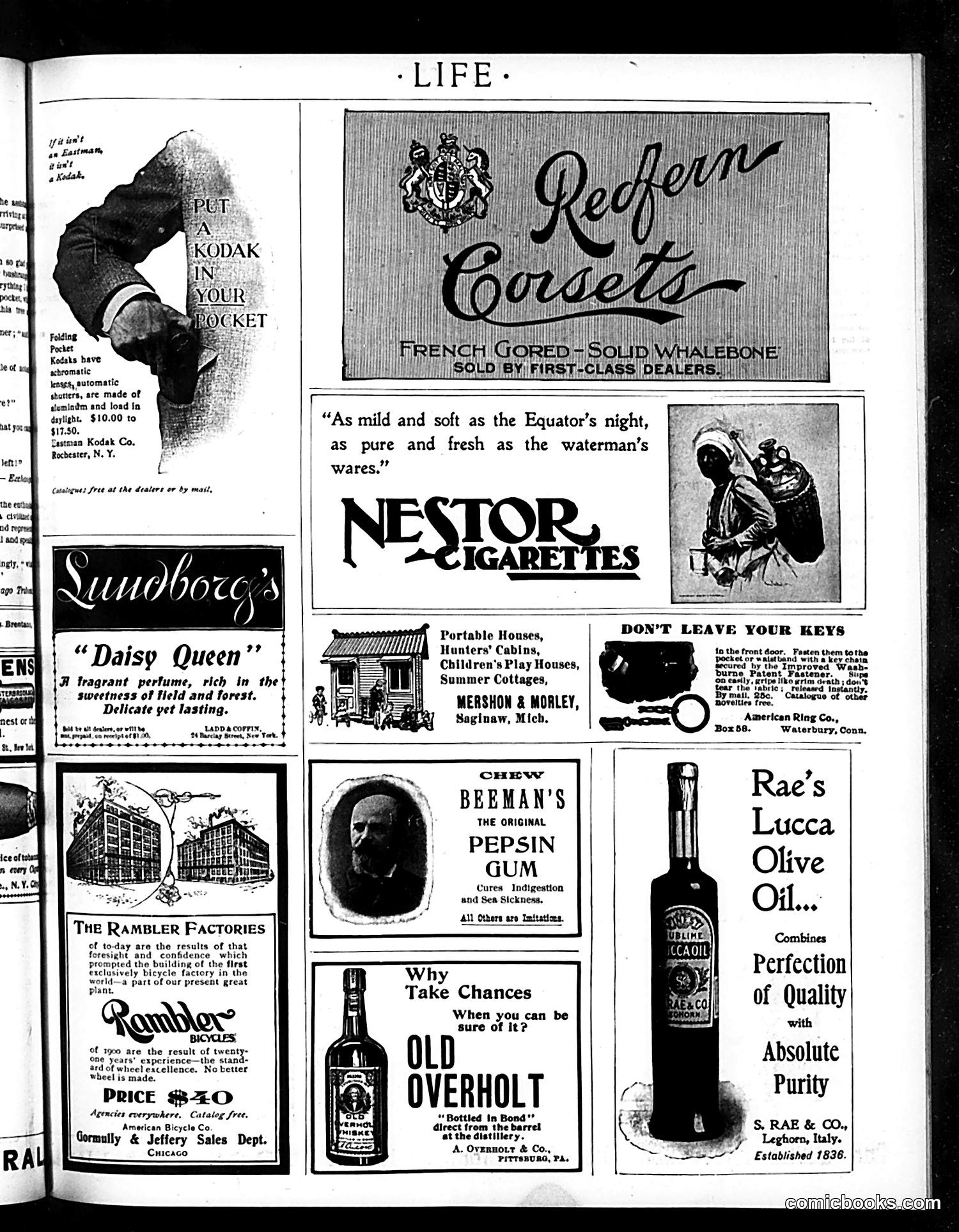
This is primarily an **advertising page** from an early 20th-century American magazine, containing no political cartoons or satire requiring historical context. The page features period product advertisements including: - **Kodak cameras** (Eastman Kodak Co.) — emphasizing automatic features - **Rambler bicycles** — promoting 20+ years of manufacturing experience - **Perfume, chewing gum, whiskey, and olive oil** from various manufacturers - **Portable houses and cabins** by Mershon & Morley - **A key-fastening device** (American Ring Co.) — a practical home security product The advertisements use typical early-1900s marketing language ("mild and soft," "perfection of quality") and appeal to consumer confidence in brand reliability and established manufacturing traditions. There is **no satirical content, political commentary, or caricature** visible on this page—it represents straightforward commercial messaging from the era.
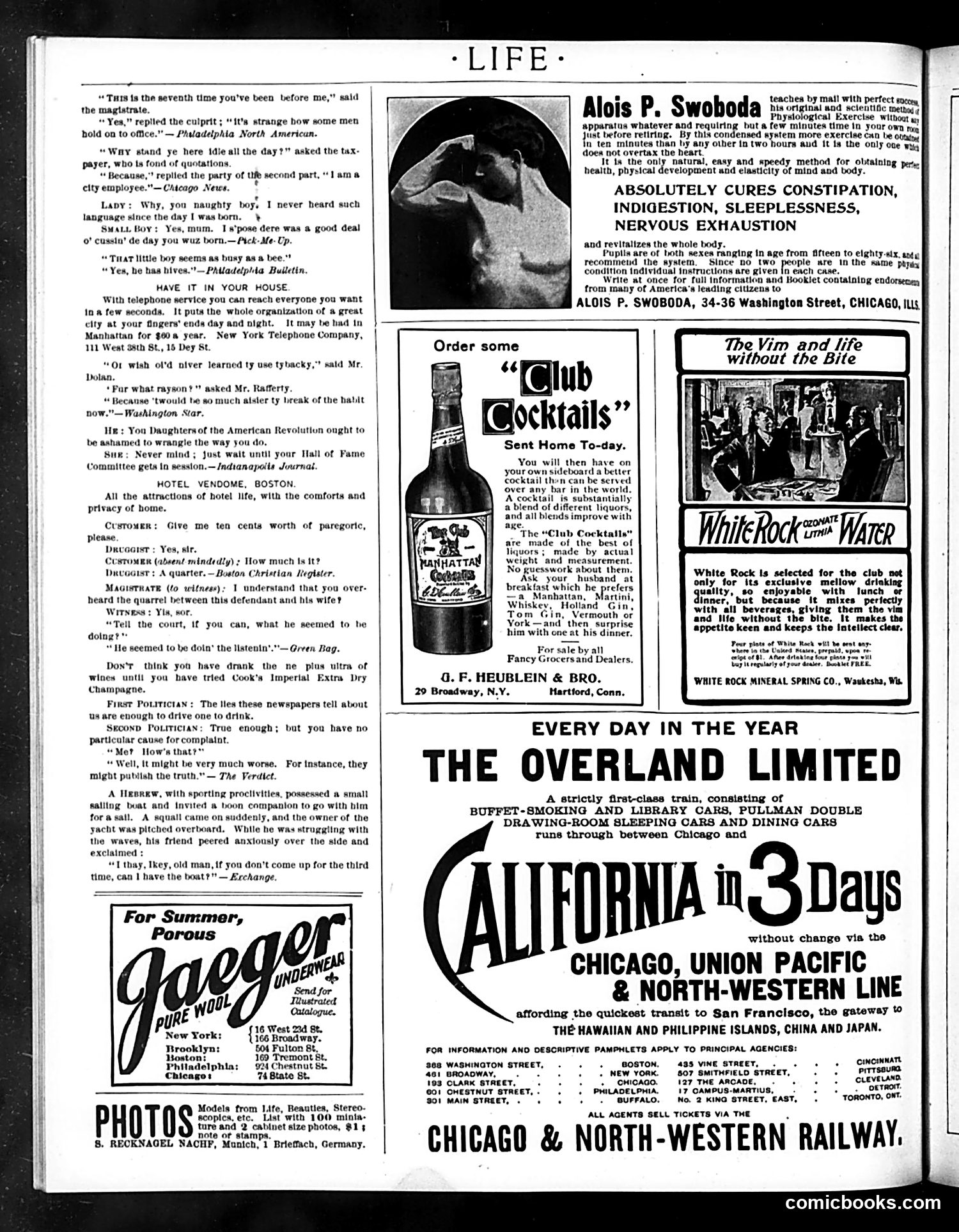
This page is primarily **advertisements and brief humorous anecdotes** rather than political cartoons. The text contains short jokes exploiting wordplay and bureaucratic absurdity—a magistrate noting a repeat offender "holds on to office," a child's crude logic about his mother's swearing at his birth, and a woman's complaint about her husband's breakfast preferences. These reflect early-20th-century working-class humor and domestic comedy. The advertisements reveal period concerns: Alois P. Swoboda's mail-order exercise system claims to cure constipation and nervousness; "Club Cocktails" by Heublein marketed as conveniently bottled drinks; White Rock mineral water; and the Chicago & North-Western Railway advertising California travel in three days. The humor is gentle satire on everyday life—bureaucratic inefficiency, marital discord, and consumer culture—without targeting specific political figures or events. This represents Life's general approach: social commentary through everyday scenarios rather than direct political attack.
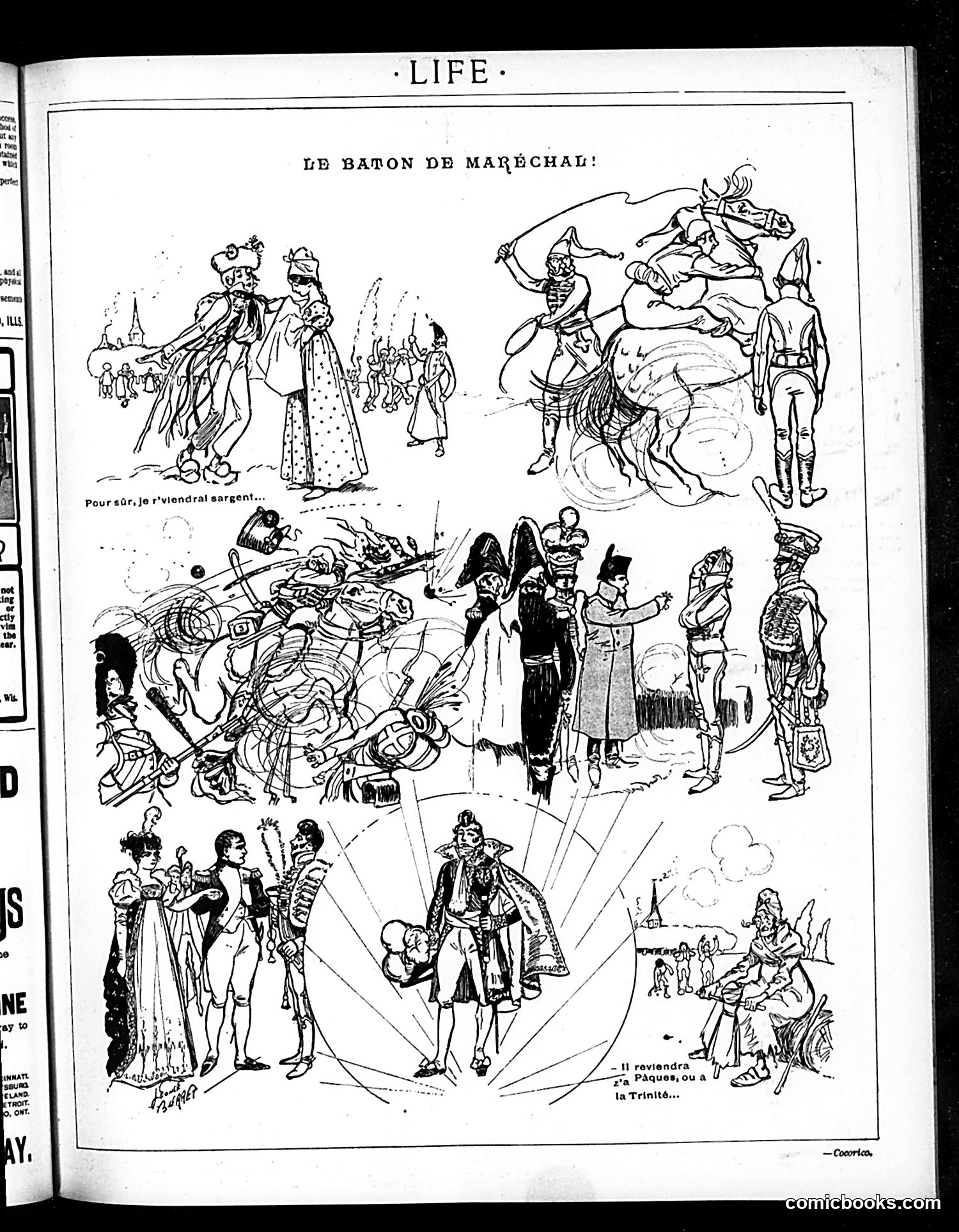
This French-language satirical cartoon from *Life* magazine depicts various figures and scenes arranged around a central military marshal figure holding a baton of command. The title "Le Baton de Maréchal!" (The Marshal's Baton!) plays on the phrase meaning supreme military authority. The composition shows different social classes and military figures reacting to or seeking this symbol of power. The scenes appear to mock the pursuit of authority and status, with caricatured nobles, soldiers, and officials surrounding the central marshal. The satirical point seems to critique ambition for power and the pretensions of the military establishment, though the specific historical context and which marshal is referenced remains unclear without additional dating information.
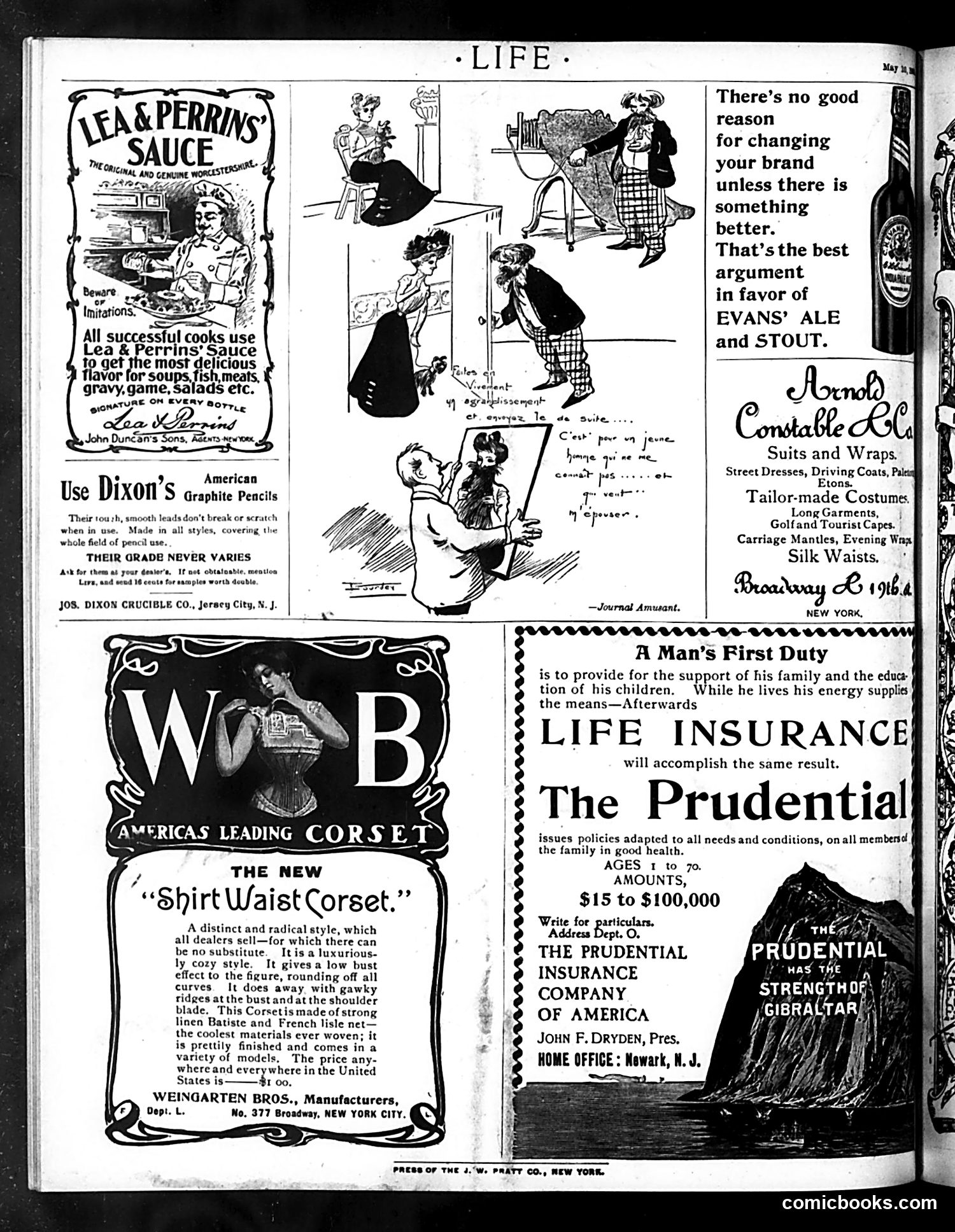
This is primarily an **advertisement page**, not editorial content, from an early 20th-century *Life* magazine. The central cartoon—credited to *Journal Amusant*—depicts a French domestic scene of a woman scolding or gesturing animatedly at a man, likely illustrating marital discord or household drama (a common comic trope of the era). The surrounding ads reveal period concerns: **Lea & Perrins sauce** appeals to "successful cooks"; **Dixon pencils** promise reliability; **Evans' ale** argues brand loyalty; **Arnold Constable** advertises women's fashions (corsets, wraps, waists); and the **W.B. corset** promotes a new "shirt waist" style that claims to eliminate unflattering silhouettes. Most notably, **The Prudential Insurance** ad frames life insurance as fulfilling "a man's first duty"—supporting family and children's education. This reflects Victorian ideals of masculine responsibility and emerging middle-class anxieties about providing financial security. The page captures early 1900s consumer culture, gender roles, and commercial messaging to established readers.