
Life, 1900-05-10 · page 6 of 20
Life — May 10, 1900 — page 6: what you’re looking at
What you’re looking at
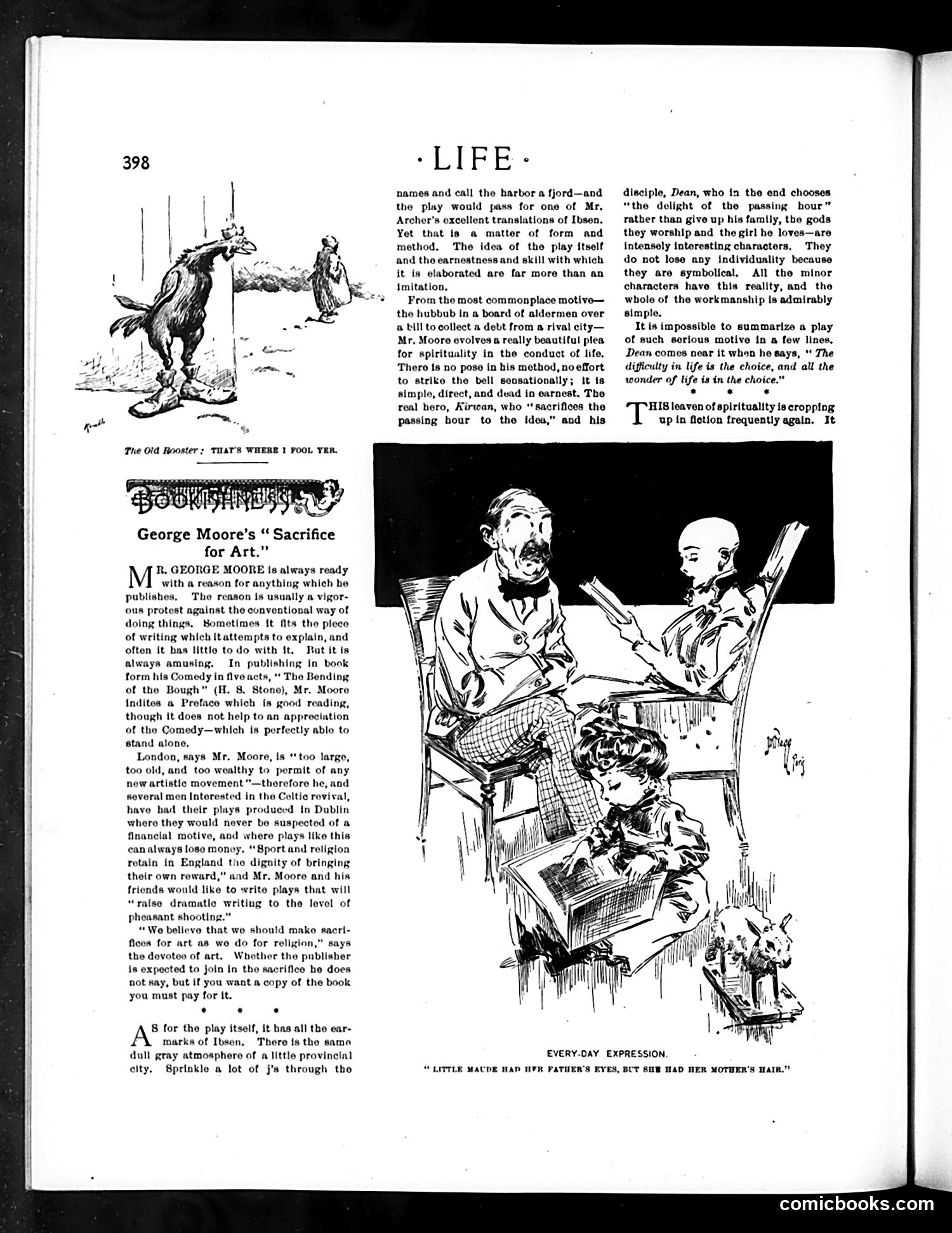
This page discusses George Moore's play "Sacrifice for Art," praising Moore's willingness to sacrifice financial success for artistic integrity. The text argues Moore and friends want to elevate dramatic writing beyond "pheasant shooting"—suggesting contemporary theater prioritized entertainment over substance. **The two cartoons:** 1. **Top**: "The Old Heckler—That's Where I Fool Yer" depicts a man heckling, satirizing audience disruption of performances. 2. **Bottom** ("Everyday Expression"): Shows a man and woman viewing art, captioned "Little Mattie had her father's eyes, but she had her mother's hair." This jokes about inherited traits, likely mocking sentimental Victorian art commentary or the gap between artistic pretension and everyday banality. Both cartoons employ gentle satire about art, audience, and society's relationship to culture.
📄 Transcribed text from this page (OCR, searchable)
Machine-transcribed from the original scan — historical spelling and the odd misread are preserved.
George Moore's “ Sacrifice for Art.” R. GEORGE MOORE Is always ready with a reason for anything which he publishes, Tho reason is usually a vigor- ous protest against the conventional way of doing things, Sometimes It fits the pleco of writing which it attempts to explain, and often it bas little todo with It, Bat it is always amusing. In publishing in book form his Comedy in fve acts, ** The Bending of the Bough” (H. 8. Stone), Mr. Moore indites a Profaco which is good reading, though It does not help to an appreciation ot the Comedy—which is perfectly ablo to stand alone, London, says Mr. Moore, is “too large, too old, and too wealthy to permit of any new artistic movement "—therefore he, and several mon Interested in the Celtic revival, have had their plays produced tn Dublin where they would never be suspected of a financial motive, and where plays like this can always lose money, “Sport and religion rotain in England tho dignity of bringing their own reward,” and Mr. Moore and his friends would like to write plays that will “raise dramatic writing to the level of pheasant shooting.” “We believe that we should mako sacri- fices for art as wo do for religion,” says the devotes of art. Whether the publisher is expected to join in tho sacrifice he does not say, but if you want a copy of the book you must pay for it. . . . 8 for tho play itself, it bas all the ear- marks of Ibsen, Thero {s tho samo dull gray atmosphere of a little provincial city. Sprinkle a lot of j’s through tho -LIFE- names and call the harbor a fjord—and the play would pass for one of Mr. Archor’s excellent translations of Ibsen. Yet that is a matter of form and method, The idea of the play itself and tho earnestness and skill with which it is claborated are far more than an imitation, From the most commonplace motivo— the hubbub In a board of aldermen over a bill to collect a debt from a rival city— Mr, Moore evolves a really beautiful plea for spirituality in the conduct of life. Thero ts no poso in his method, noeffort to strike the bell sensationally; it is simplo, direct, and dead in earnest. Tho real horo, Kirwan, who “sacrifices the passing hour to tho idea,” and his disciple, Dean, who tn the ond chooses “the delight of the passing hour” rather than givo up his family, the gods they worship and the girl he loves—are intensely interesting characters, They do not lose any individuality because they are symbolical, All tho minor characters havo this reality, and tho whole of tho workmanship {s admirably elmple. It is impossible to summarize a play of such serious motive in a few lines. Dean comes near it when ho says, “ The difficulty in life is the choice, and all the wonder of life is in the choice.” * . « HIS leaven of spirituality is cropping up in fiction frequently again. It EVERY-DAY EXPRESSION “LITTLE MAUDE HAD HYR PATUER'S EYES, BCT SHB HAD HER MOTHER'S HAIR.” comicbooks.com