
Life, 1900-05-10 · page 7 of 20
Life — May 10, 1900 — page 7: what you’re looking at
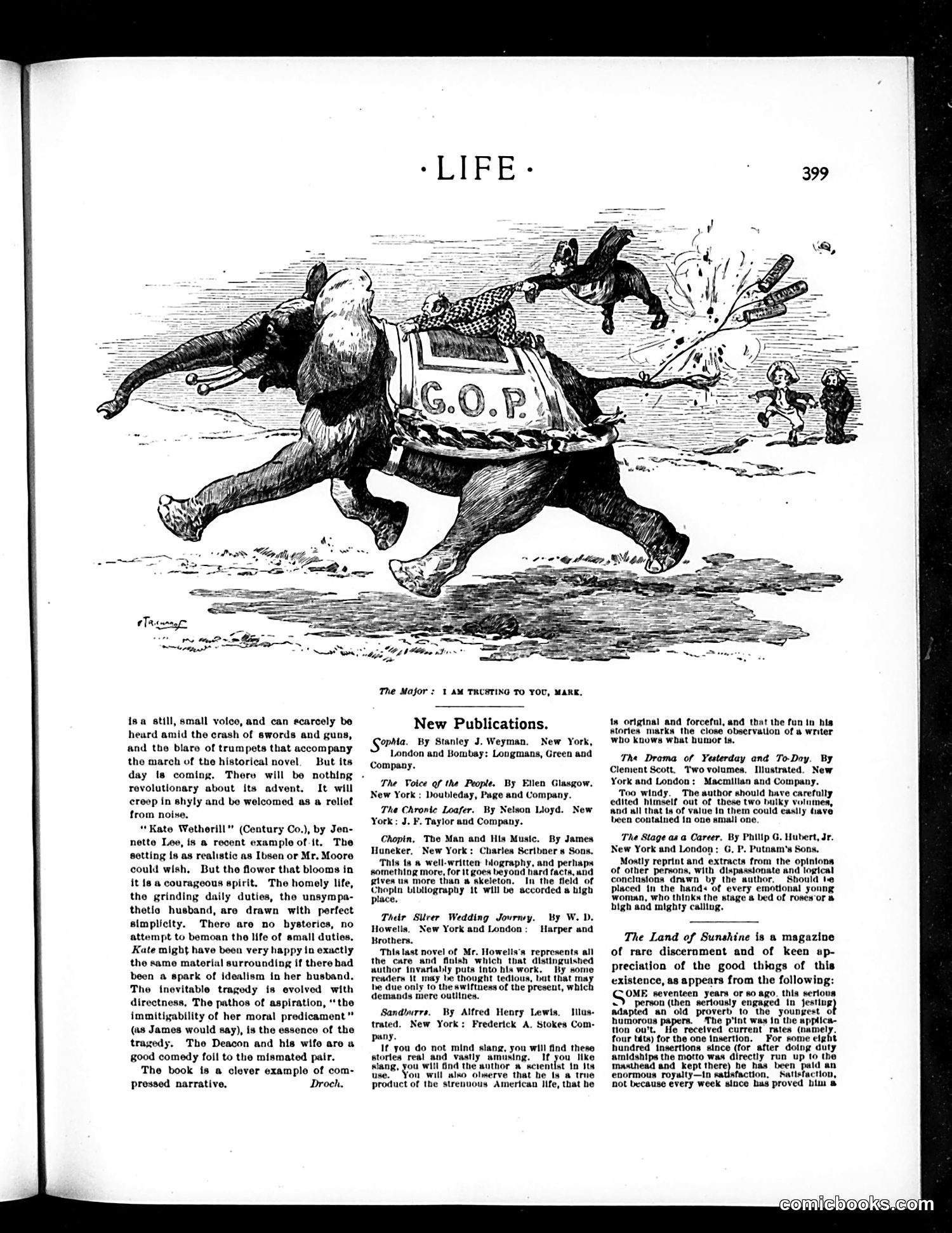
What you’re looking at
This cartoon depicts a figure labeled "G.O.P." (Republican Party) as an elephant-like character in military dress, appearing to stumble or lose control while carrying supplies. The caption indicates someone named "the Major" is entrusting responsibility to "Mark" (likely a political figure). The satire appears to comment on Republican Party leadership during a period of political chaos or military conflict—the "crash of swords and guns" mentioned in the accompanying text suggests wartime or crisis conditions. The elephant's loss of balance symbolizes the GOP's instability or inability to manage its duties effectively. Without seeing the publication date, the specific historical context remains unclear, though the military imagery suggests coverage of early 20th-century American political turmoil.
📄 Transcribed text from this page (OCR, searchable)
Machine-transcribed from the original scan — historical spelling and the odd misread are preserved.
isa still, small volco, and can scarcely be heard amid the crash of swords and guns, and the blaro of trumpets that accompany the march of the historical novel. But its day {8 coming. There will be nothing revolutionary about its advent. It will creep in shyly and be welcomed as a relief from noise, “Kate Wetherill” (Century Co.), by Jen- netto Lee, is a recent example of it. The setting {8 a8 realistic as Ibsen or Mr. Moore could wish, But the flower that blooms in it 18 a courageous spirit, The homely life, the grinding daily duties, the unsympa- thetic husband, are drawn with perfect simplicity. Thero are no bystorics, no attempt to bemoan tho life of small duties. Kate might have been very happy in exactly the same material surrounding if there had been a spark of idealism in her husband. Tho inevitable tragedy is evolved with directness, The pathos of aspiration, “the immitigability of her moral predicament” (as James would say), is the essence of the tragedy. Tho Deacon and his wifo are a good comedy foil to the mismated pair. The book is a clever example of com- pressed narrative, Droch. The Major : 1 AM TRUSTING TO YOU, MARK, New Publications. Sepia. By Stanley J. Weyman, New York, London and Bombay: Longmans, Green and Company. The Votce of the People, By Ellen Glasgow. New York ; Doubleday, Page and Company. The Chronte Loafer. By Nelson Lioyd. New York: J. F. Taylor and Company. Chopin, The Man and His Music. By James Huneker, New York: Charles Scribner s Sons, ‘This ts 8 well-written Mography, and perhaps something more, for tt goes beyond hard facts, und giver us more than # skeleton. In the fleld of Chopla uibtlogesphy tt will be accorded a high ce, Ther Sutrer Wedding Journy. Howells, New York and London : Brothers. ‘This last novel of Mr. Howells’ represents all the care and fuish which that distinguished author Invartably puts {nto his work. By some readers it may te thought tedious, bat that may he due only to the swiftness of the present, whic demands mere outitnes. Sandiurre. By Alfred Henry Lewis, Illus: trated. New York: Frederick A, Stokes Com- pany. If you do not mind slang, yon will find these stories real and vastly amusing. If you Ike slang, you will find the author # scientist tn ita Use. You will alxo olmerve that he ts a true product of the strenuous American life, that be By W. D. Harper and 1s original and forcefal, and that the fun tn his stories marks the close observation of a writer who knows what humor ts, Tha Drama of Yesterday and To-Doy. By Clement Scott, Two volumes. Illustrated. New York and London: Macmilian and Company. Too windy. ‘The author should have carefully edited himself out of these two bulky volumes, 6 ‘and ull that ts of value In them could easlly been contained in one small one. The Stage as a Career, By Philip G. Hubert, Jr. New York and London; G, P. Putnam's Sons, Mostly reprint and extracts from the opinions of other persons, with dispasstonate and logical conclustona drawn by the author, Should be placed in the hands of every emotional young woman, who thinks the stage a bed of rosesor a bigh and mighty calling. The Land of Sunshine is a magazine of rare discernment and of keen ap- preciation of the good things of this existence, as appears from the following: Ome seventeen years or so ago, this serious person (then seriously engaged In jesting adapted an old proverb to the youngest o| humorous papers. ‘The p'int was to the appilca- ton ou't. received current rates (namely. four tats) for the one insertion. For some elght hundred insertions since (for after doing duty amidships the motto was directly run up to the Taxthead and kept there) he has been pald an enormous royulty—tn satisfaction, Satlsfaction, not because every week since hus proved bim ®