
Life, 1900-05-10 · page 4 of 20
Life — May 10, 1900 — page 4: what you’re looking at
What you’re looking at
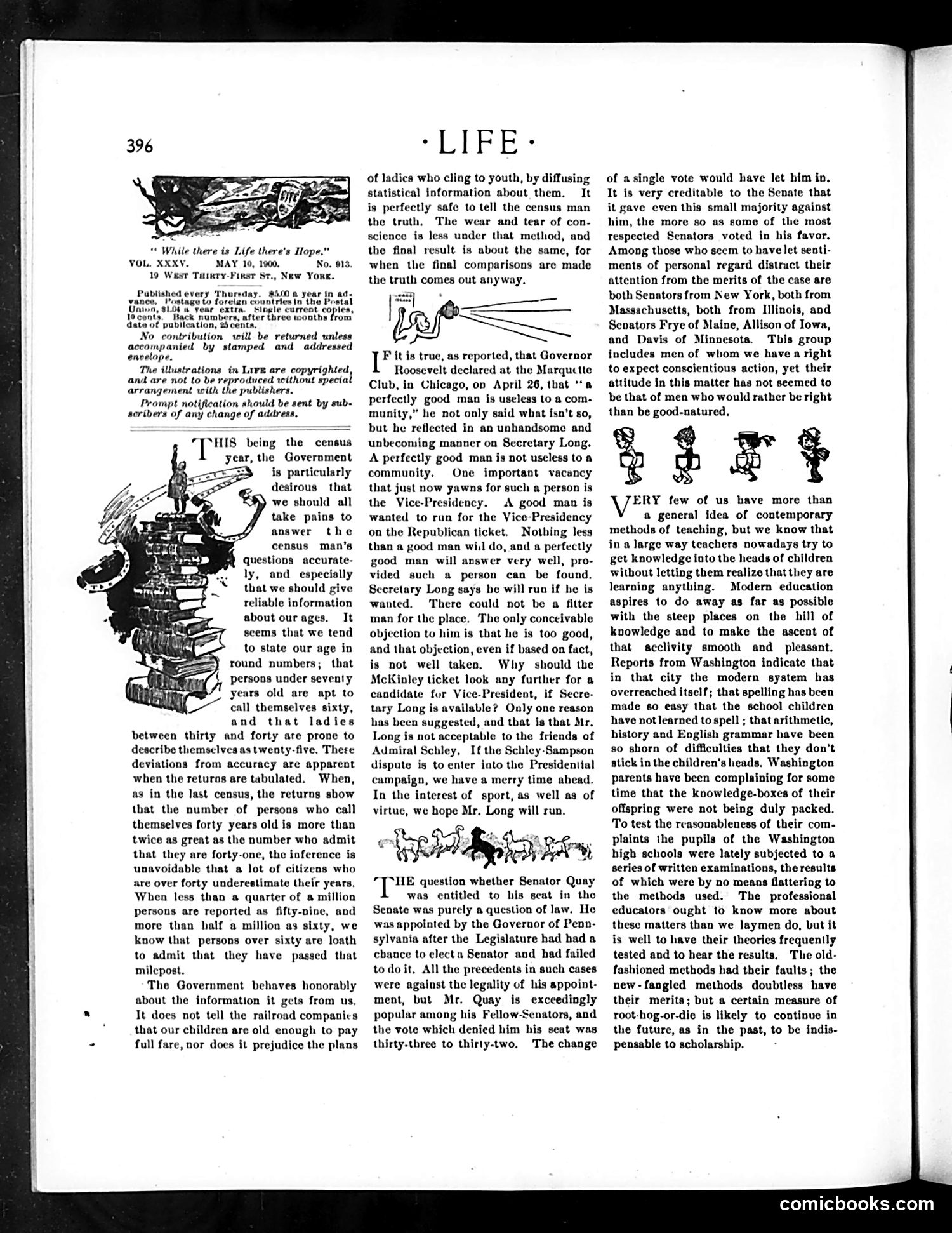
This page contains political commentary on the 1900 U.S. census and Vice-Presidential succession rather than traditional cartoons. The main text discusses Governor Roosevelt's declaration that "a perfectly good man is useless to a community," critiquing his unsuitability for Vice-President. The article argues Roosevelt is too good—too principled and idealistic—to occupy that largely ceremonial role, which requires political accommodation. A secondary section examines Senator Quay's disputed Senate seat (appointed by Pennsylvania's Governor, challenged on legality grounds). The author notes Quay remains popular despite the controversy, unlike other appointees who lost their seats 33-32. The decorative header contains small illustrated figures but no clear satirical caricatures are distinctly identifiable in this text-heavy page.
📄 Transcribed text from this page (OCR, searchable)
Machine-transcribed from the original scan — historical spelling and the odd misread are preserved.
“* While there is Life there's Hope.” VOL. XXXV. MAY 10, 1900. No. 913. 19 West Turery-Fixst St., New Yor. devery Thursday. #5.00 a year in ad~ age to foreign countries in the Postal Single current copies, er three wonths from ts Df publication, 25cents. No contribution will be returned unless accompanied by stamped and addressed envelope. The illustrations in Live are copyrighted and are not to be reproduced without special arrangement with the publishers, Prompt notification should be sent by sub- soribers of any change of address, Tas being the census year, the Government is particularly desirous that we should all take pains to answer the census man’s questions accurate- ly, and especially that we should give reliable information about ourages. It seems that we tend to state our age in round numbers; that persons under seventy years old are apt to call themselves sixty, and that ladies between thirty and forty are prone to describe themsclves as twenty-five. There deviations from accuracy are apparent when the returns are tabulated. When, as in the last census, the returns show that the number of persons who call themselves forty years old is more than twice as great as the number who admit that they are forty-one, the inference is unavoidable that a lot of citizens who are over forty underestimate their years. When less than a quarter of a million persons are reported as fifty-nine, and more than half a million as sixty, we know that persons over sixty are loath to admit that they have passed that milepost. The Government behaves honorably about the information it gets from us. It does not tell the railroad companics that our children are old enough to pay full fare, nor does it prejudice the plans “LIPE * of ladies who cling to youth, by diffusing statistical information about them. It is perfectly safe to tell the census man the truth, The wear and tear of con- science is less under that method, and the final result is about the same, for when the final comparisons arc made the truth comes out anyway, 4 ———— R ieee F it is true, as reported, that Governor Roosevelt declared at the Marquette Club, in Chicago, op April 26, that "a perfectly good man is useless to a com- munity,” he not only said what isn’t so, but he reflected in an unhandsome and unbecoming manner on Secretary Long. A perfectly good man is not useless to a community. One important vacancy that just now yawns for such a person is the Vice-Presidency. A good man is wanted to run for the Vice-Presidency on the Republican ticket. Nothing less than a good man wil do, and a perfectly good man will answer very well, pro- vided such a person can be found. Secretary Long says he will run if he is wanted. There could not be a fitter man for the place. The only conceivable objection to him is that he is too good, and that objection, even if based on fact, is not well taken, Why should the McKinley ticket look any further for a candidate fur Vice-President, if Secre- tary Long is available? Only one reason has been suggested, and that is that Mr, Long is not acceptable to the friends of Admiral Schley, Ifthe Schley-Sampson dispute is to enter into the Presidential campaign, we have a merry time ahead. In the interest of sport, as well as of virtue, we hope Mr. Long will run. ‘ eae. Satey ‘TPHE question whether Senator Quay was entitled to his seat in the Senate was purely a question of law. He was appointed by the Governor of Penn- sylvania after the Legislature had had a chance to clect a Senator and had failed to doit, All the precedents in such cases were against the legality of his appoint- ment, but Mr. Quay is exceedingly popular among his Fellow-Senators, and the vote which denied him his seat was thirty-three to thirty-two, The change of asingle vote would have let him in. It is very creditable to the Senate that it gave even this small majority against him, the more so as some of the most respected Senators voted in his favor. Among those who seem to have let senti- ments of personal regard distract their attention from the merits of the case are both Senators from New York, both from Massachusetts, both from Illinois, and Senators Frye of Maine, Allison of Iowa, and Davis of Minnesota. This group includes men of whom we have a right to expect conscientious action, yet their attitude in this matter has not seemed to be that of men who would rather be right than be good-natured. go FF ERY few of us have more than a general idea of contemporary methods of teaching, but we know that in a large way teachers nowadays try to get knowledge into the heads of children without letting them realize thatthey are learning anything. Modern education aspires to do away as far as possible with the steep places on the hill of knowledge and to make the ascent of that acclivity smooth and pleasant. Reports from Washington indicate that in that city the modern system has overreached itself; that spelling has been made 80 easy that the school children have not learned to spell ; that arithmetic, history and English grammar have been so shorn of difficulties that they don't atick in the children’s heads. Washington parents have been complaining for some time that the knowledge-boxes of their offspring were not being duly packed. To test the reasonableness of their com- plaints the pupils of the Washington high schools were lately subjected to a series of written examinations, the results of which were by no means flattering to the methods used. The professional educators ought to know more about these matters than we laymen do, but it is well to have their theories frequently tested and to hear the results. The old- fashioned methods had their faults; the new-fangled methods doubtless have their merits; but a certain measure of root-hog-or-die is likely to continue in the future, as in the past, to be indis- pensable to scholarship. comicbooks.com