
Life, 1900-05-10 · page 14 of 20
Life — May 10, 1900 — page 14: what you’re looking at
What you’re looking at
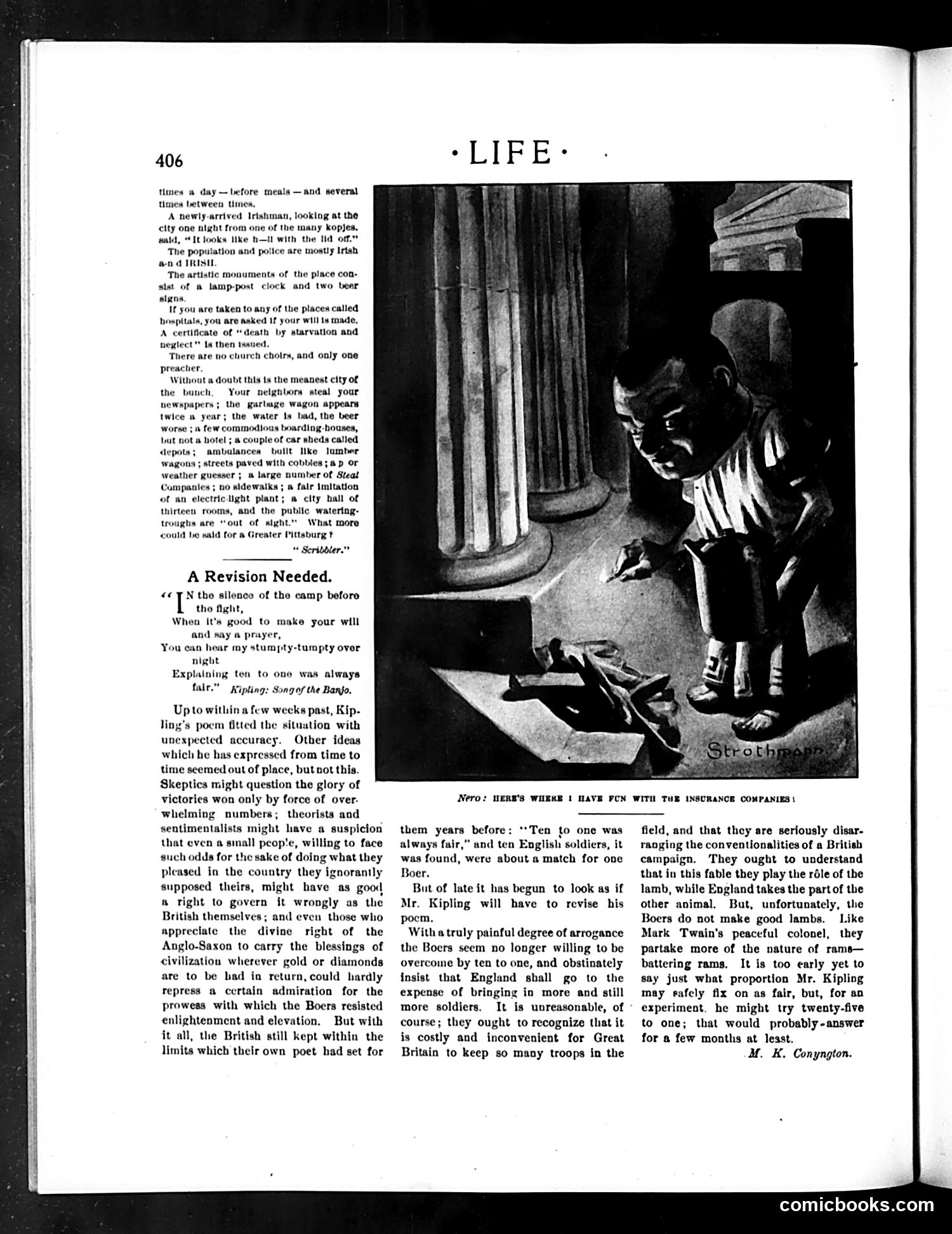
This page contains two separate pieces of satire about the Second Boer War (1899-1902), when Britain fought against Dutch settlers in South Africa. **The cartoon** (bottom right) shows an insurance agent or businessman examining a figure, captioned "Here's where I have fun with the insurance companies"—likely mocking how the war's unexpected costs and casualties were disrupting British financial calculations. **The main article** critiques Rudyard Kipling's famous poem *"Song of the Banjo,"* which claimed "ten to one was always fair" regarding British military superiority. The satirist argues that the Boers—stubbornly refusing to play their assigned role as helpless victims—are forcing Britain to deploy vastly more troops than expected. The piece sardonically suggests Kipling should revise his poem to claim "twenty-five to one" is fair, mocking both British arrogance and the war's escalating, costly reality. The reference to Mark Twain's "peaceful colonel" adds another layer of ironic commentary on the supposed civilizing mission.
📄 Transcribed text from this page (OCR, searchable)
Machine-transcribed from the original scan — historical spelling and the odd misread are preserved.
406 tlmes a day—before meals —and several Umes between Unnea, A hewly-arrived Irishman, looking at the city one night from one of the inany kopjea, ald, “It looks like b—ll with the lid off" ‘The population and police are mostly Irish and IRISIL ‘The artistic monuments of the place con- slat of a lamp-post clock and two beer signs, If you are taken to any of the places called hospitals, you are asked If your will ts made, A certificate of “death by starvation and neglect” ts then tssued. There are no chureh cholrs, and only one preacher. Without a doubt this ts the meanest city of the bunch, Your nelghbors steal your newspapers ; the garbage wagon appears twice a year; the water is bad, the beer worse ; 4 few commodious boarding-houses, Lut not @ hotel ; a couple of car sheds called depots; ambulances built lke lumber wagons ; streets paved with cobbles; ap or weather guesser ; large number of Steat Companies ; no aidewalks ; @ fale Imitation ‘of an electric-ght plant; a city ball of thirteen rooms, and the public watering- troughs at out of aight. What more could be sald for a Greater Pittsburg t A Revision Needed. “e Ll the silence of the camp before tho fight, When it's good to make your will and say a prayer, You can hear my stumpty-tumpty over night Explaining ten to one was always fale.” Kipling: Songof the Banjo, Upto within a few weeks past, Kip- ling’s poem fitted the situation with unexpected accuracy. Other ideas which he has expressed from time to time seemed out of place, but not this. Skeptics might question the glory of victories won only by force of over. whelming numbers; theorists and sentimentalists might have a suspicion that even a small peopte, willing to face such odds for the sake of doing what they pleased in the country they ignorantly supposed theirs, might have as good a right to govern it wrongly as the British themselves; and even those who appreciate the divine right of the Anglo-Saxon to carry the blessings of civilization wherever gold or diamonds are to be had in return,could hardly repress a certain admiration for the prowess with which the Boers resisted enlightenment and elevation. But with it all, the British still kept within the limits which their own poet had set for Nero: NERE'S WHEKE | HAVE PCN WITH THE INSURANCE COMPANIES | them years before: **Ten to one was always fair,” and ten English soldiers, it was found, were about a match for one Boer. But of late it has begun to look as if Mr. Kipling will have to revise his pocm. With a truly painful degree of arrogance the Boers seem no longer willing to be overcome by ten to one, and obstinately insist that England shall go to the expense of bringing in more and still more soldiers. It is unreasonable, of course; they ought to recognize that it is costly and inconvenient for Great Britain to keep so many troops in the field, and that they are seriously disar- ranging the conventionalities of a British campaign. They ought to understand that in this fable they play the réle of the lamb, while England takes the part of the other animal. But, unfortunately, the Boers do not make good lambs. Like Mark Twain's peaceful colonel, they partake more of the nature of rams— battering rams. It is too early yet to say just what proportion Mr. Kipling may eafcly fix on as fair, but, for ap experiment. he might try twenty-five to one; that would probably-answer for a few months at least. M. K. Conyngton. comicbooks.com