
A complete issue · 20 pages · 1900
Life — April 5, 1900
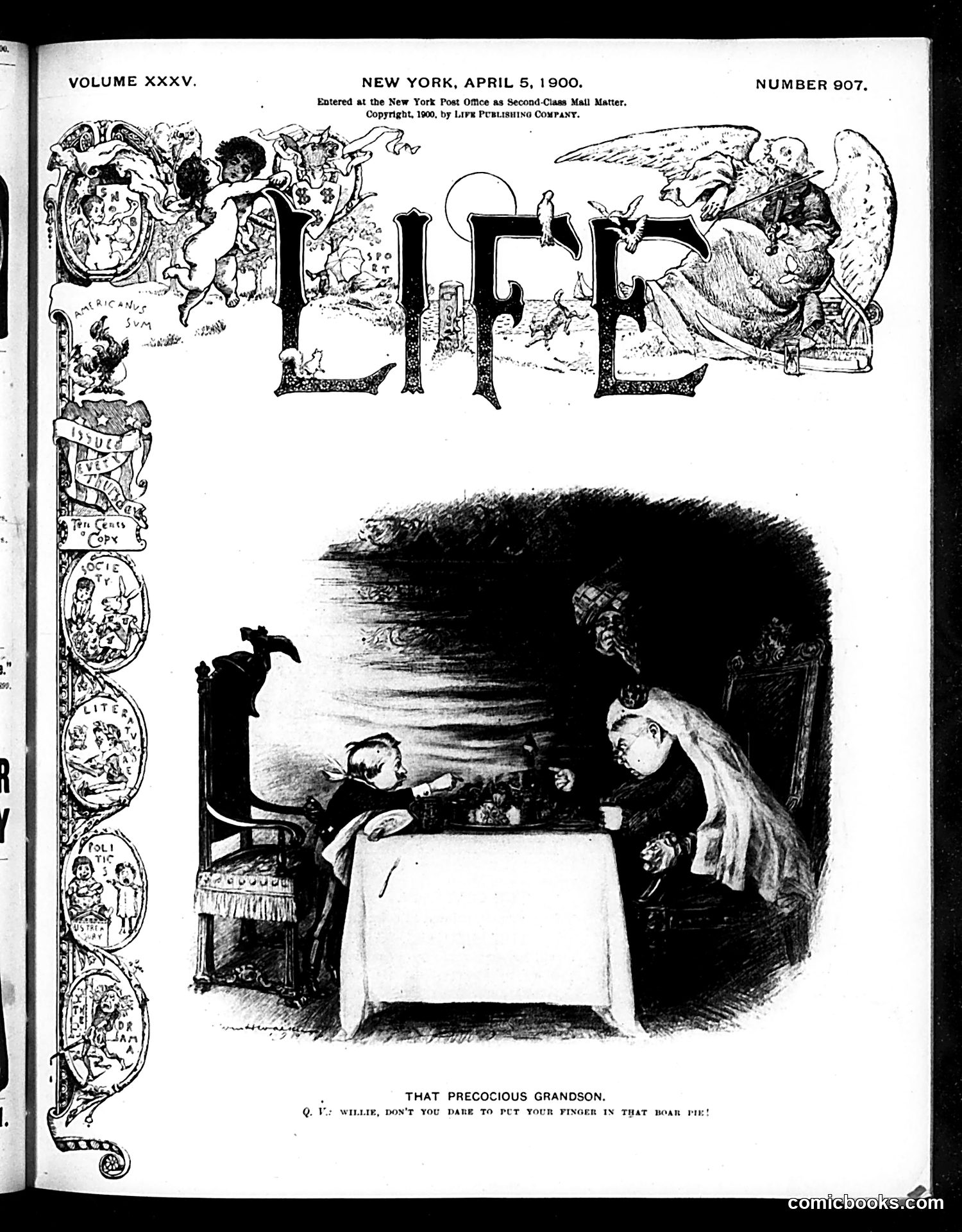
This 1900 Life magazine cartoon satirizes a child's misbehavior at a formal dinner. The caption reads: "O U: Willie, don't you dare to put your finger in that boar pie!" The humor targets upper-class social pretension. A well-dressed woman (likely the grandmother, given the title) scolds a young boy who is reaching toward food on the table during what appears to be an elegant meal. The joke relies on the contrast between refined dining expectations and a child's natural impulses—the grandmother's exasperation at Willie's breach of etiquette, and the "precocious" (inappropriately forward) nature of his behavior. The elaborate decorative border suggests this was a prominent feature in the magazine.
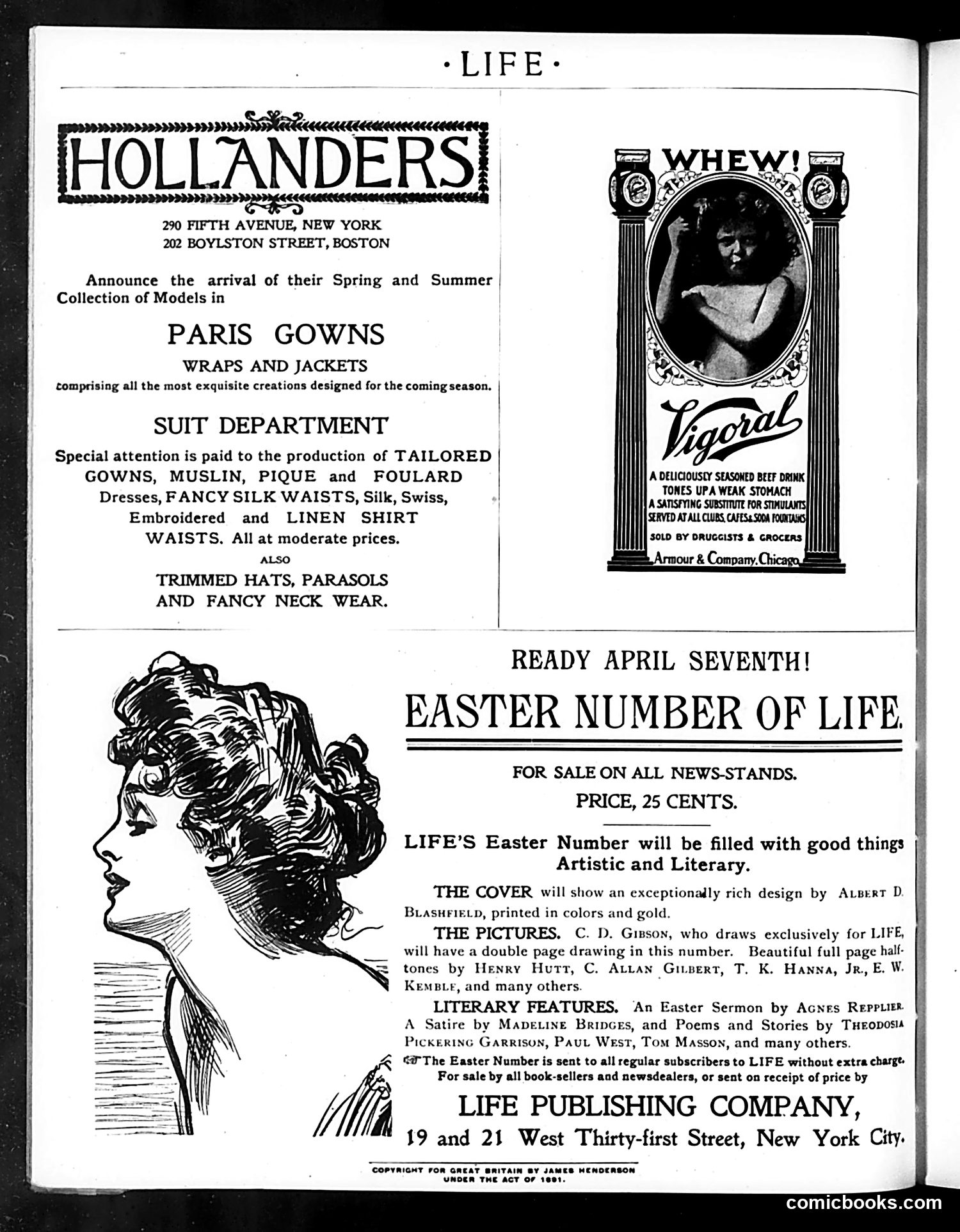
This page is primarily **advertising and announcements**, not political satire. The top half contains two advertisements: Hollanders (a clothing retailer in New York and Boston) announcing spring/summer Paris gowns and suits, and Vigoral, a beef drink marketed as a stomach tonic. The bottom half announces the upcoming **Easter Number of Life magazine** (April 7th), priced at 25 cents. The illustration is a stylized profile sketch of a woman's head, typical of early 20th-century decorative art—not a caricature of any particular figure. The announcement lists artistic contributors (C.D. Gibson, Henry Hutt, others) and literary features including an Easter sermon and poems. This represents Life's positioning as a magazine combining humor, art, and literary content. There is **no political cartoon or satirical commentary** on this particular page.
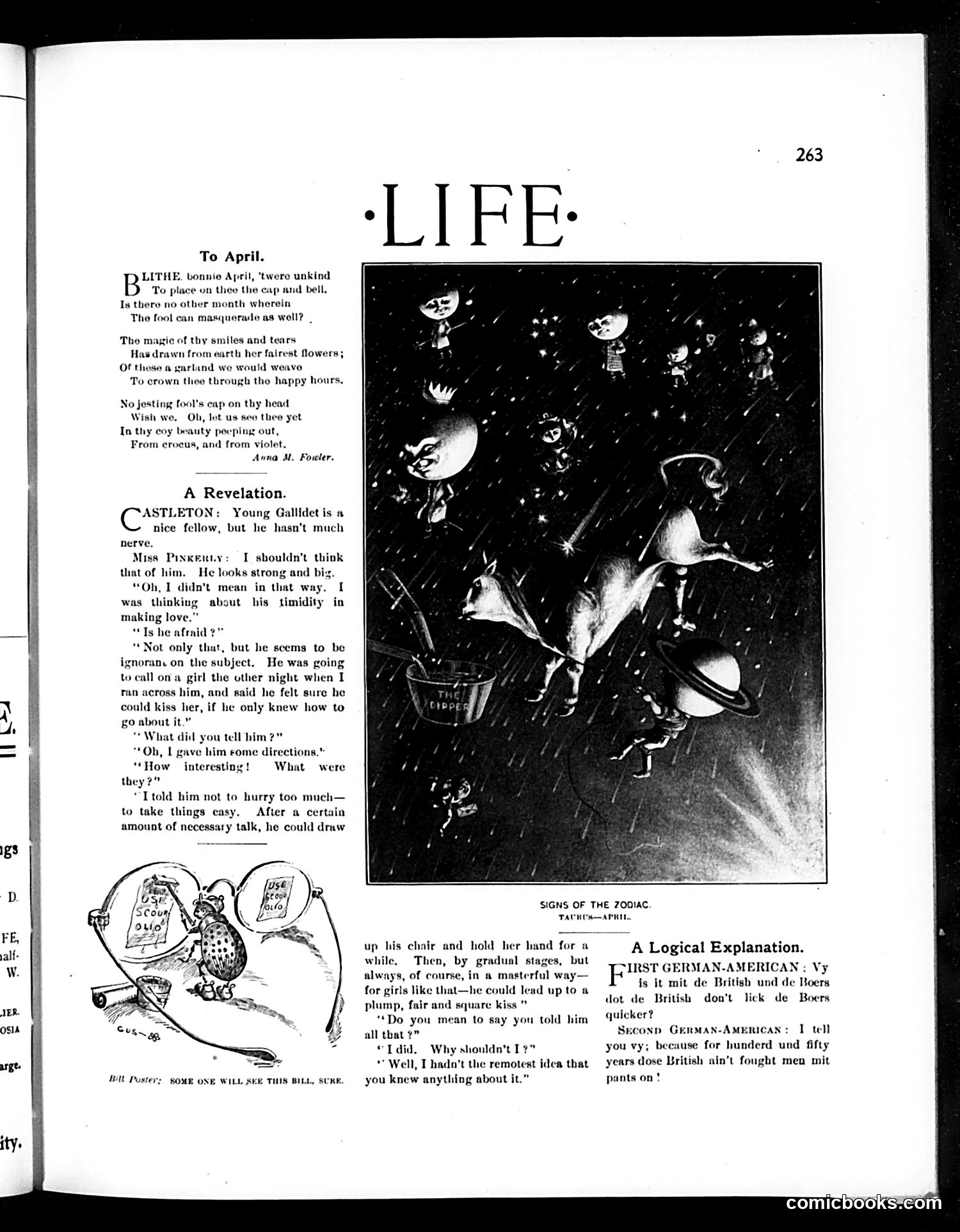
This page contains satirical content from Life magazine's April issue. The main illustration depicts "Signs of the Zodiac: Taurus—April," showing zodiac-themed figures in a nighttime scene with celestial elements. The text sections include a poem "To April" and a dialog titled "A Revelation" between characters Castleton and Miss Pinkerly, discussing a young man named Gallidet who lacks romantic knowledge. The humor satirizes male inexperience in courtship. Below is "A Logical Explanation," a brief comic exchange between a First German-American and Second German-American about British fighting capability, likely referencing World War I tensions and immigration debates of the era. The small cartoon features anthropomorphic animals with speech bubbles about bills, typical of Life's humorous filler content.
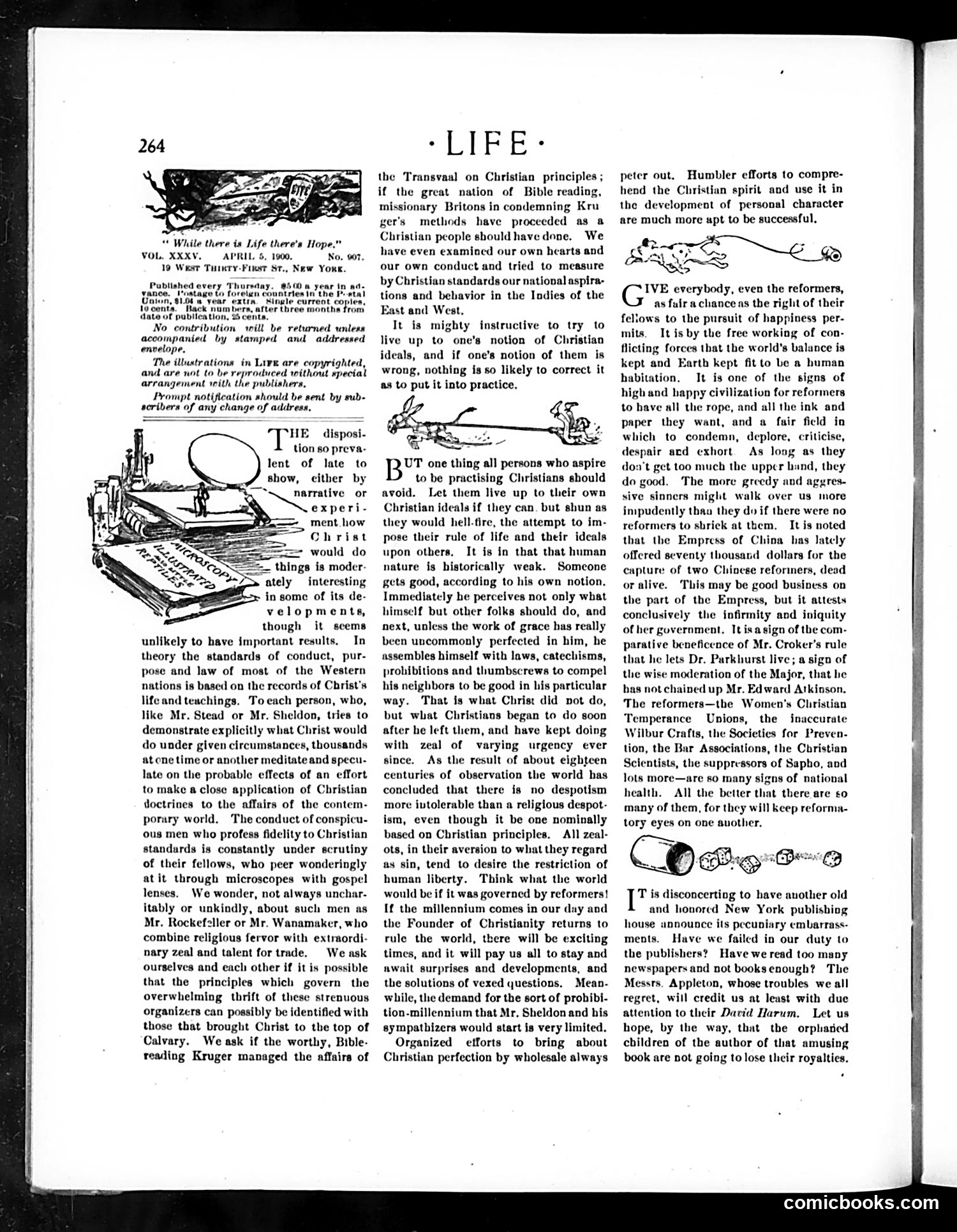
The page contains two editorial illustrations critiquing Christian reformers and their methods. The left cartoon depicts a printing press or similar mechanical device, illustrating the text's concern about how Western Christian standards are being mechanically imposed on other cultures, particularly "the ladies of the East and West." The right cartoon shows what appears to be a cylindrical object (possibly a telescope or similar device) with scattered circular objects, likely satirizing the scattershot, ineffective approach of reformers. The editorial attacks the hypocrisy of Christian reformers—particularly referencing figures like Kruger and Sheldon—arguing they fail to live by Christian ideals themselves while attempting to impose them on others. The piece criticizes religious despotism and suggests that reformers' efforts, while well-intentioned, are misguided and likely counterproductive to genuine Christian practice.
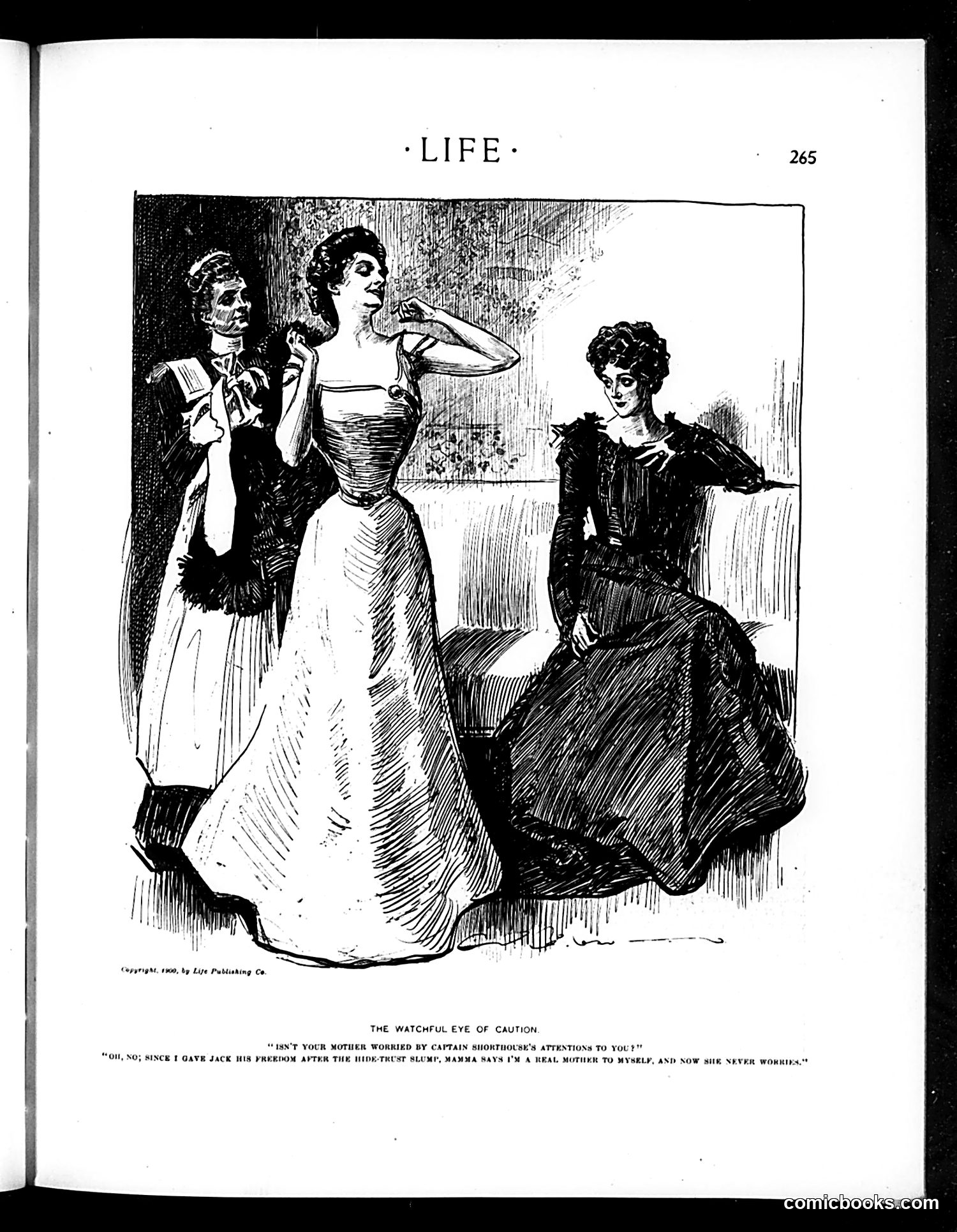
This cartoon depicts a social scene from the Gilded Age era (likely early 1900s based on the illustration style). A well-dressed woman in an elegant gown stands while a military officer whispers to her. A seated woman observes their interaction carefully. The caption reveals the joke's concern: the seated woman represents the mother, who no longer worries about her son "Jack" making improper advances toward the woman, because Jack has given his word as a gentleman. The satire mocks both male honor codes and maternal anxiety—suggesting that a mere promise provides comical reassurance against genuine romantic or sexual risks. The cartoon critiques social pretense and the false security of "gentlemanly" behavior as protection for unmarried women.
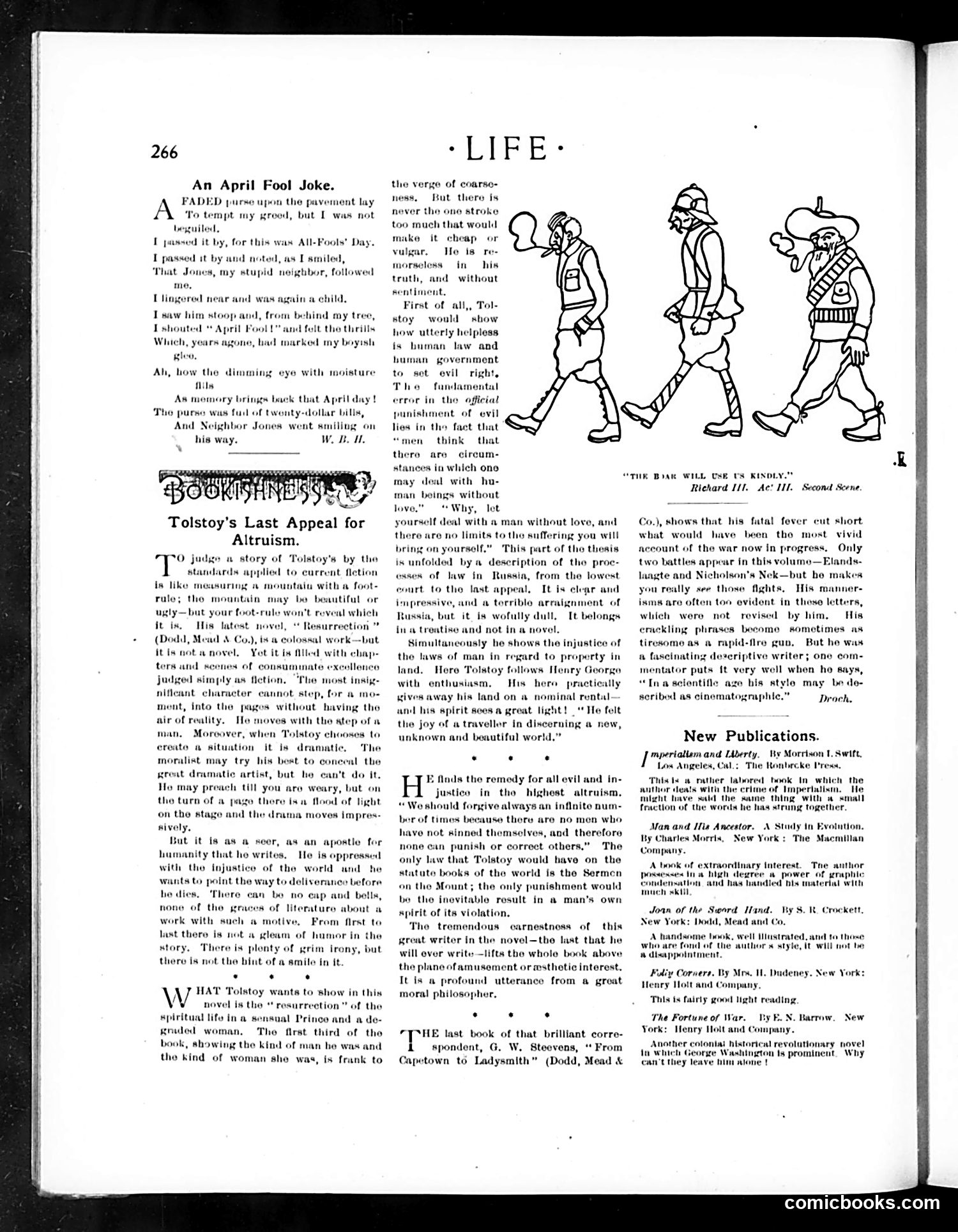
This political cartoon depicts three military figures marching in step, with the caption referencing Shakespeare's Richard III. The satire appears to comment on military uniformity and obedience to authority—specifically how soldiers follow orders without question, regardless of moral implications. The accompanying text discusses Tolstoy's philosophy on altruism and justice, arguing that punishment and coercion cannot create moral behavior. The cartoon likely illustrates this point: the synchronized soldiers represent how institutions (military, legal systems) enforce conformity through authority rather than genuine ethical conviction. The historical context and specific political figures remain unclear from the image alone, but the overall message critiques blind institutional obedience.
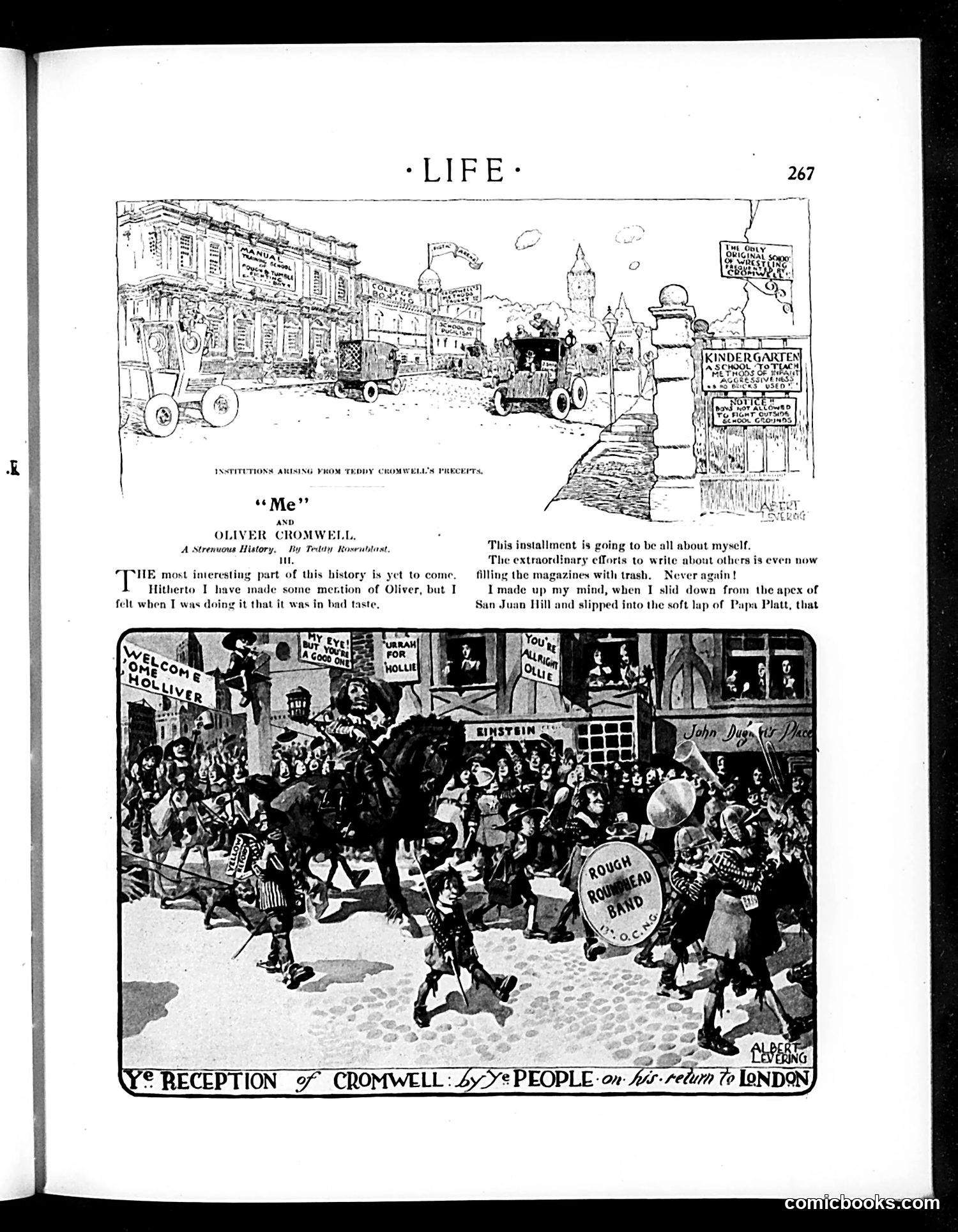
This page features two cartoons about Oliver Cromwell, the 17th-century English military and political leader. The top illustration depicts a modern cityscape with early automobiles and buildings labeled with contemporary institutions—a satirical contrast showing how Cromwell's historical precepts have shaped modern society. The bottom cartoon, captioned "Ye Reception of Cromwell by ye People on his return to London," shows a massive crowd celebration with horses, a brass band (labeled "Rough Rider Band"), and dense crowds welcoming Cromwell. The illustration uses period costume styling but appears to reference a contemporary historical commemoration or pageant. The text indicates this installment focuses on Cromwell himself, with the author noting the "most interesting part" of his history remains to come. The satire appears to examine how historical figures are remembered and celebrated in modern times.
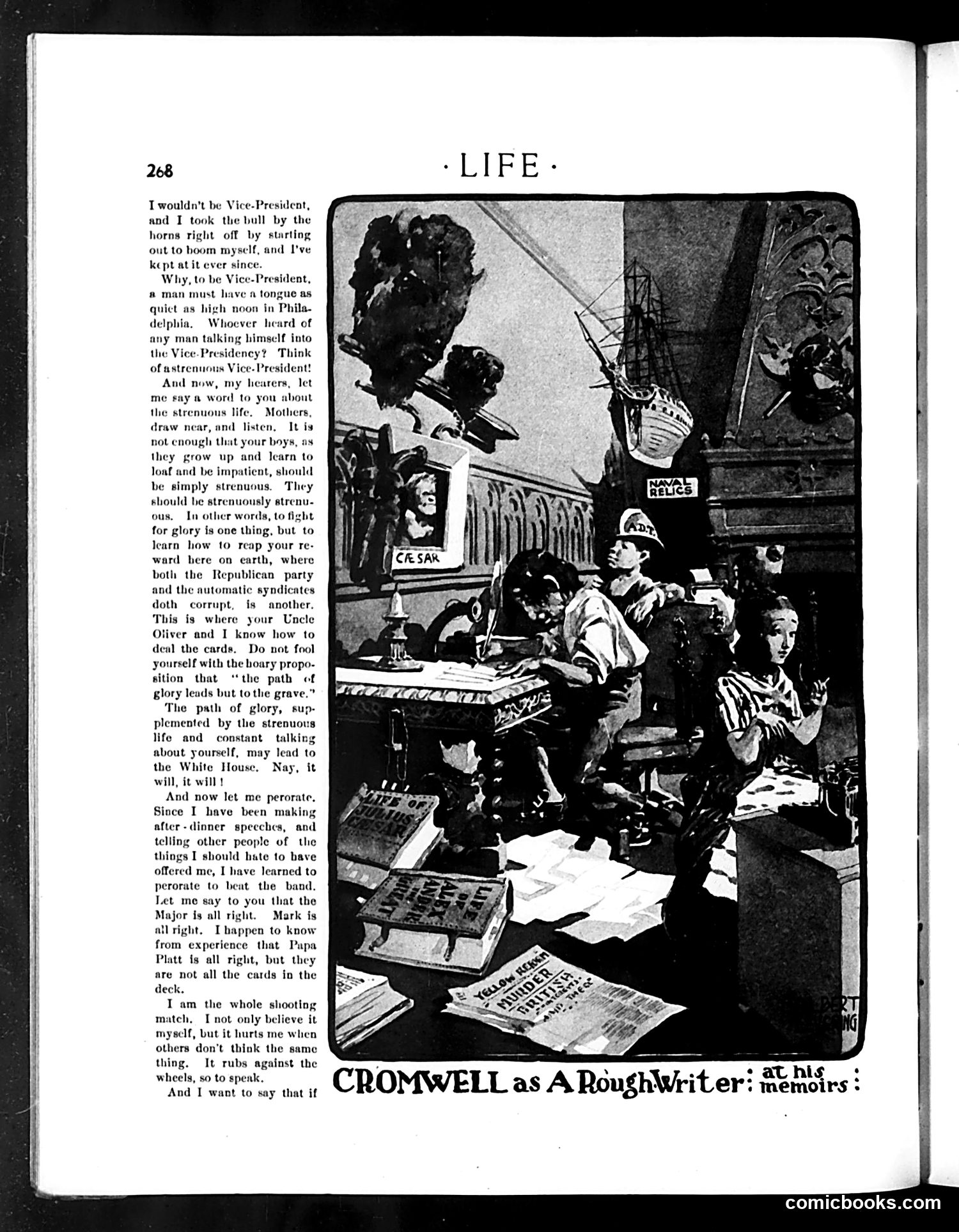
This page from *Life* magazine features a satirical piece titled "CROMWELL as A Rough Writer: at his memoirs," depicting Oliver Cromwell (the 17th-century English military/political leader) reimagined as a modern newspaper writer or journalist at work. The text on the left is a political speech or monologue criticizing the Vice-Presidency, advocating for "strenuous" youth and robust civic virtue. It references corruption, the Republican and Democratic parties, and warns against false promises of glory leading to the White House. The illustration shows Cromwell-as-writer in what appears to be a newspaper office, surrounded by papers, typewriters, and other workers. The satire likely comments on how historical figures' legacies are rewritten or reinterpreted through modern media and political discourse—using Cromwell as an archetype of forceful, uncompromising leadership being filtered through contemporary American political rhetoric.
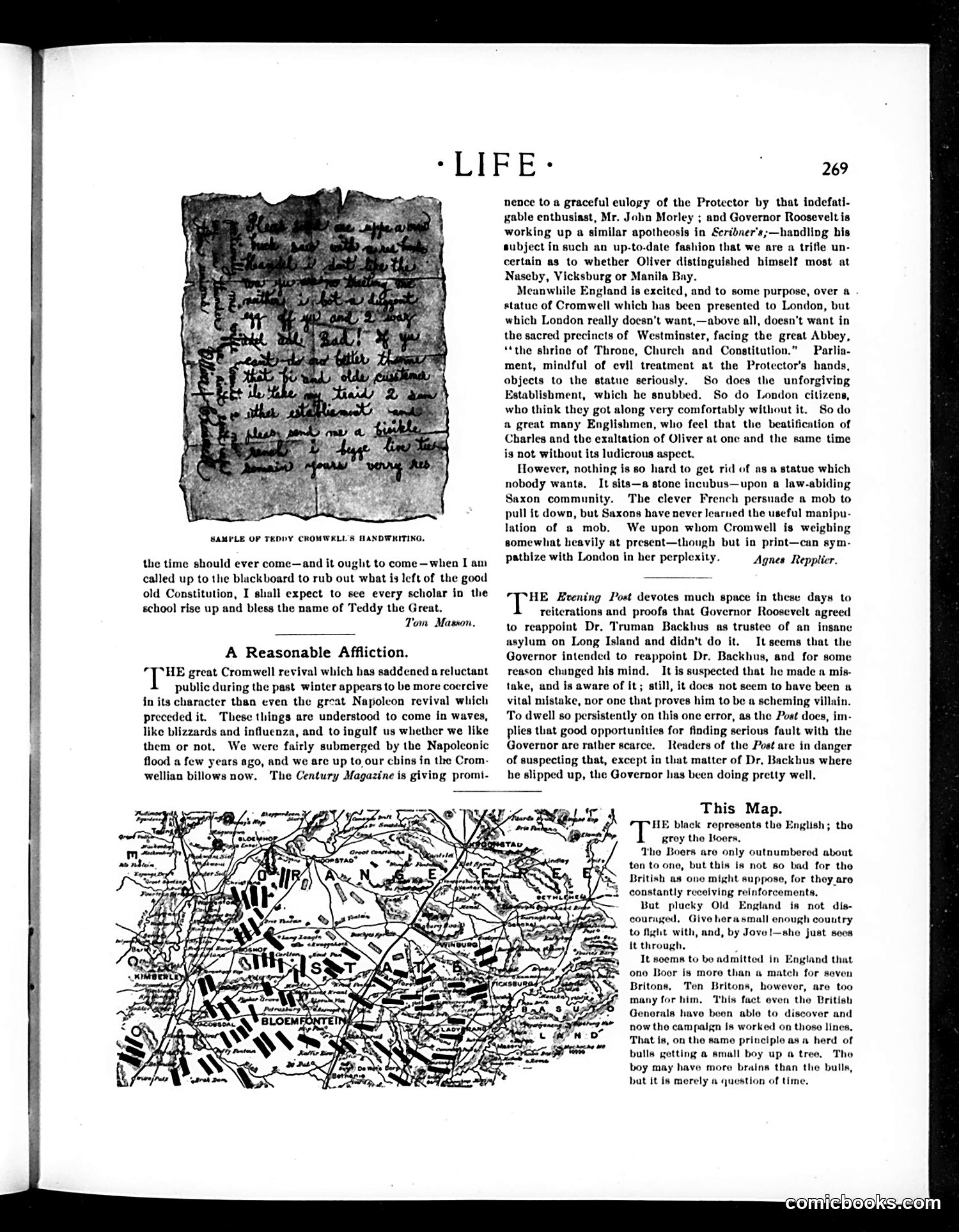
**Main Content:** This page features three distinct articles with an accompanying handwritten document facsimile and map. **The Handwriting Sample:** Labeled "Sample of Teddy Cromwell's Handwriting," this appears to reference Theodore Roosevelt in a satirical context, though the specific joke is unclear from the image quality. **"A Reasonable Affliction":** This article discusses a "Cromwell revival" compared to the Napoleonic revival, suggesting contemporary political figures are being compared to historical ones. The text references "blizzards and influenza" and mentions the "Cromwellian billows." **"This Map":** Discusses English military operations, mentioning "plucky Old England" and comparing soldiers' capabilities to animals—apparently satirizing British military assessments. The page mixes political commentary with social observation typical of Life's satirical approach.
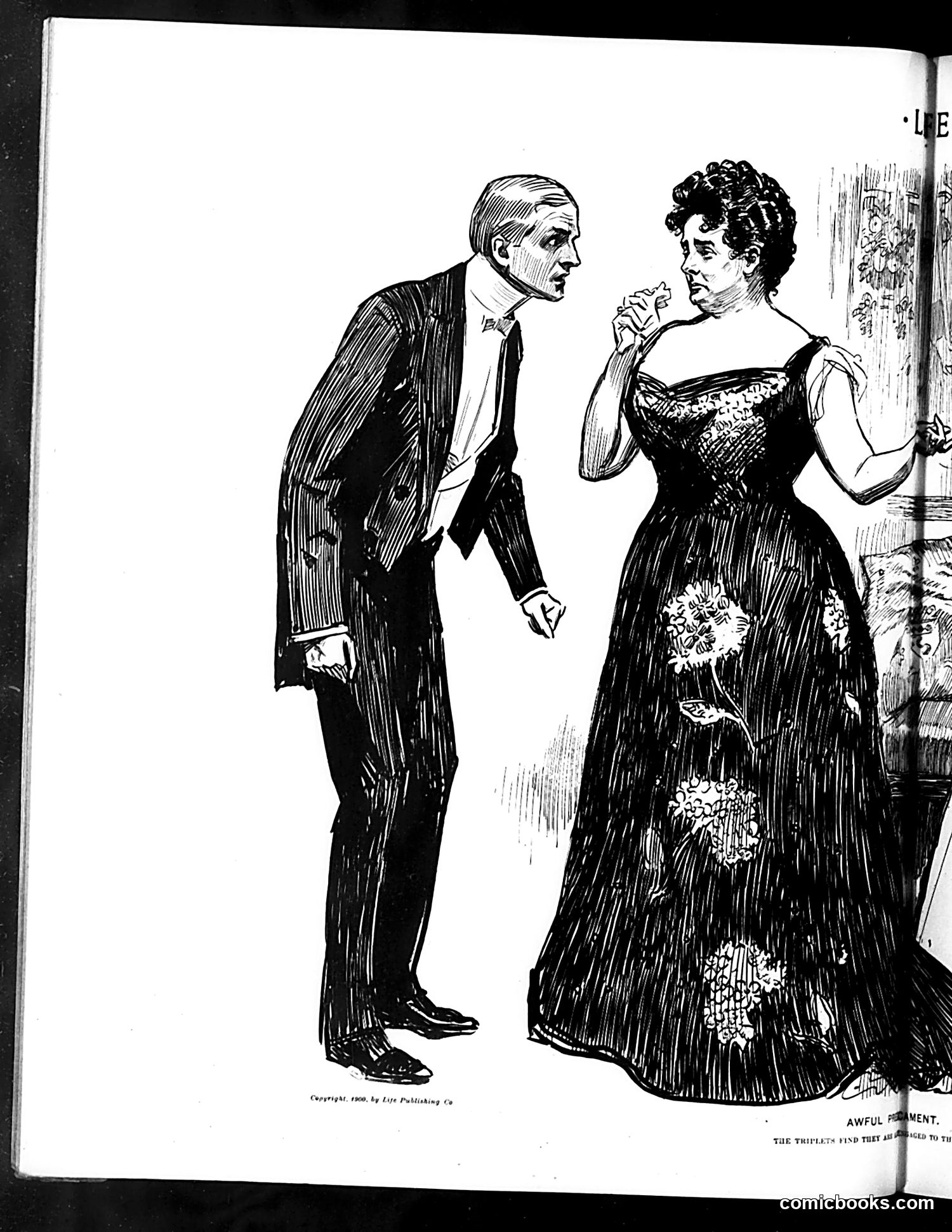
This page shows a single ink illustration depicting a man in formal evening wear (tuxedo and tie) speaking with a woman in an elaborate, floor-length gown decorated with floral patterns. The woman appears to be responding or gesturing as they converse. The caption reads "AWFUL PREDICAMENT" with a subtitle mentioning "THE TRIFLES FUSS THEY ARE OBLIGED TO SH[...]" (text cut off). The cartoon satirizes social awkwardness in high society. The "awful predicament" likely refers to the social discomfort of polite conversation at formal events—the man's posture suggests discomfort or constraint, while the woman seems animated. The joke appears to target the superficiality and tedium of upper-class social obligations, where people must engage in forced, trivial conversation despite obvious reluctance or difficulty.
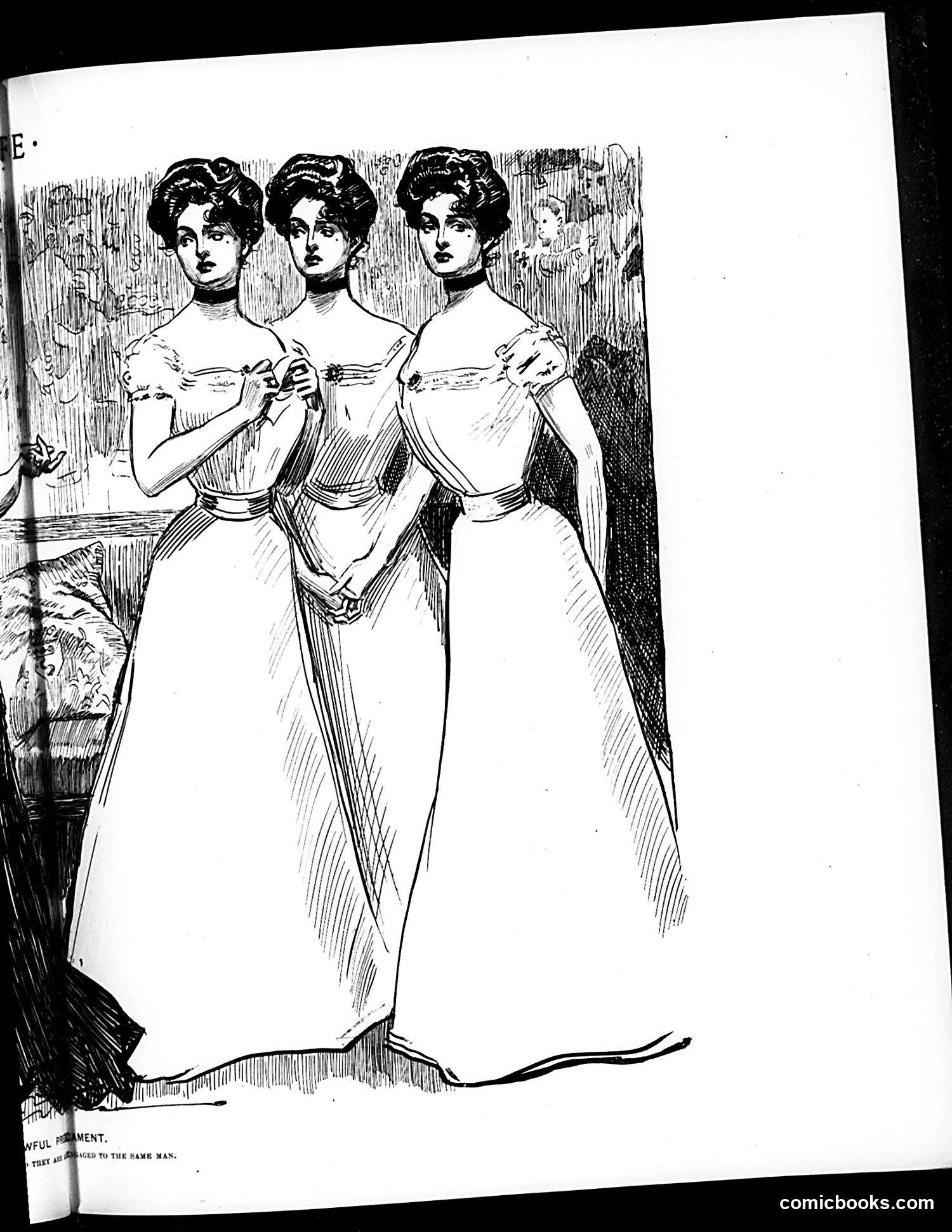
This illustration depicts three identical women in elegant Edwardian-era dress, shown from the front in a formal pose. The drawing style is characteristic of early 20th-century satirical art. The visible OCR text is fragmentary and unclear, mentioning "EFUL" and "THEY ALL GO TO THE SAME MAN," though the complete caption is cut off. This suggests the cartoon satirizes a social commentary about women's behavior or relationships—likely mocking the idea that multiple women are pursuing or interested in the same man, presenting them as interchangeable or superficial. Without the complete caption and given the formal fashion illustration style, the satire appears to critique either women's romantic choices, social conformity, or possibly marital/courtship customs of the era. The identical poses emphasize the satirical point about uniformity or lack of individuality.
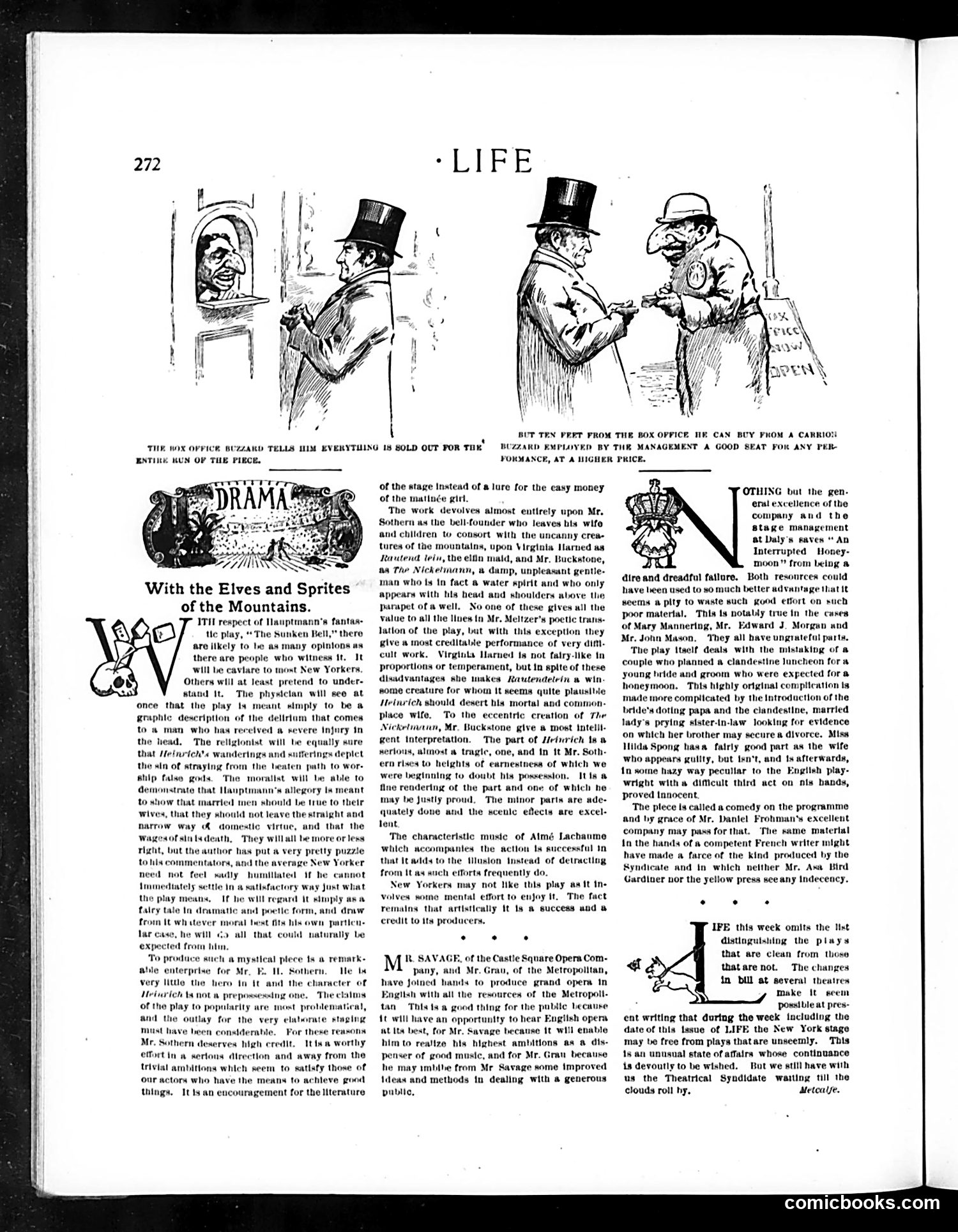
This page contains theatrical reviews rather than political cartoons. The top illustrations show scenes from plays, with captions referencing a box office manager and a theatrical beat. The main content reviews "Heideidelberg," a drama adapted from a German play. The text criticizes the production's reliance on scenic effects over substance, noting the plot involves a soldier abandoning his family. The review praises the lead actress (Virginia Harned) despite the weak material. A second review discusses grand opera productions at the Metropolitan Opera Company, mentioning Mr. Savage and Mr. Grati's collaboration. The page concludes with commentary on theatrical writing quality for New York stages that week. This is primarily a **theater criticism page**, not a satirical commentary on current events or politics.
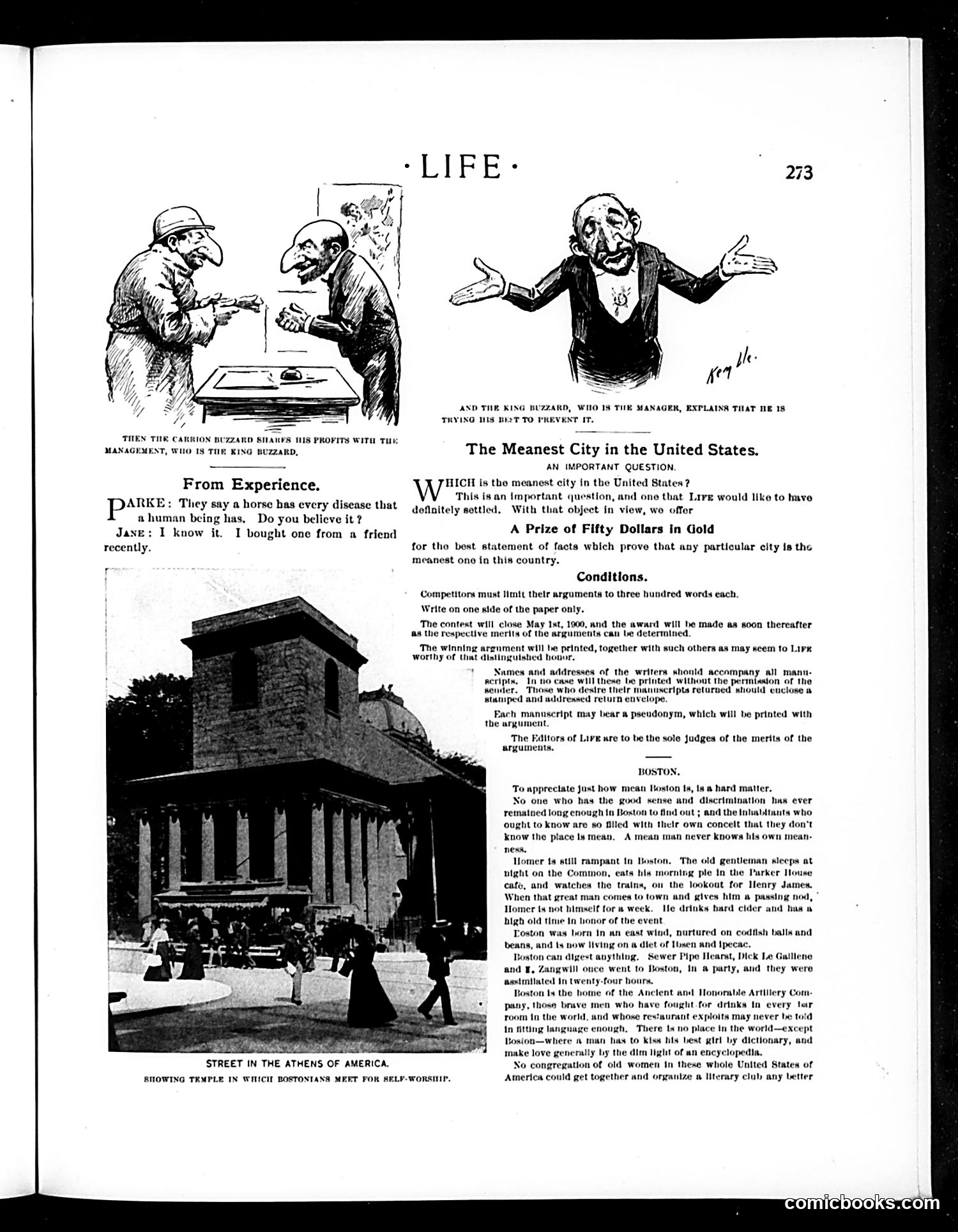
This page from *Life* magazine contains two satirical pieces mocking American cities, particularly Boston. **Top cartoons:** The "King Buzzard" trio depicts corrupt municipal management. The first panel shows a "carrion buzzard" (corrupt official) dividing profits with "the management"—likely referencing graft and kickback schemes common in Gilded Age city politics. The right panel shows the "King Buzzard" (the manager himself) gesturing defensively, claiming he's "trying his best to prevent it"—satire of officials denying obvious corruption. **Main contest:** *Life* offers $50 in gold for the best essay proving which U.S. city is "meanest" (most unpleasant/petty). **Boston section:** A withering attack on Boston's smugness and cultural pretension. It mocks Bostonians' obsession with literary celebrities (Homer watching for Henry James), their bean-and-codfish diet, and their affectation of intellectual superiority ("kiss his best girl by dictionary"). The "Athens of America" reference (the photograph's caption) ironically compares Boston to classical civilization while depicting it as provincial and self-deluded.
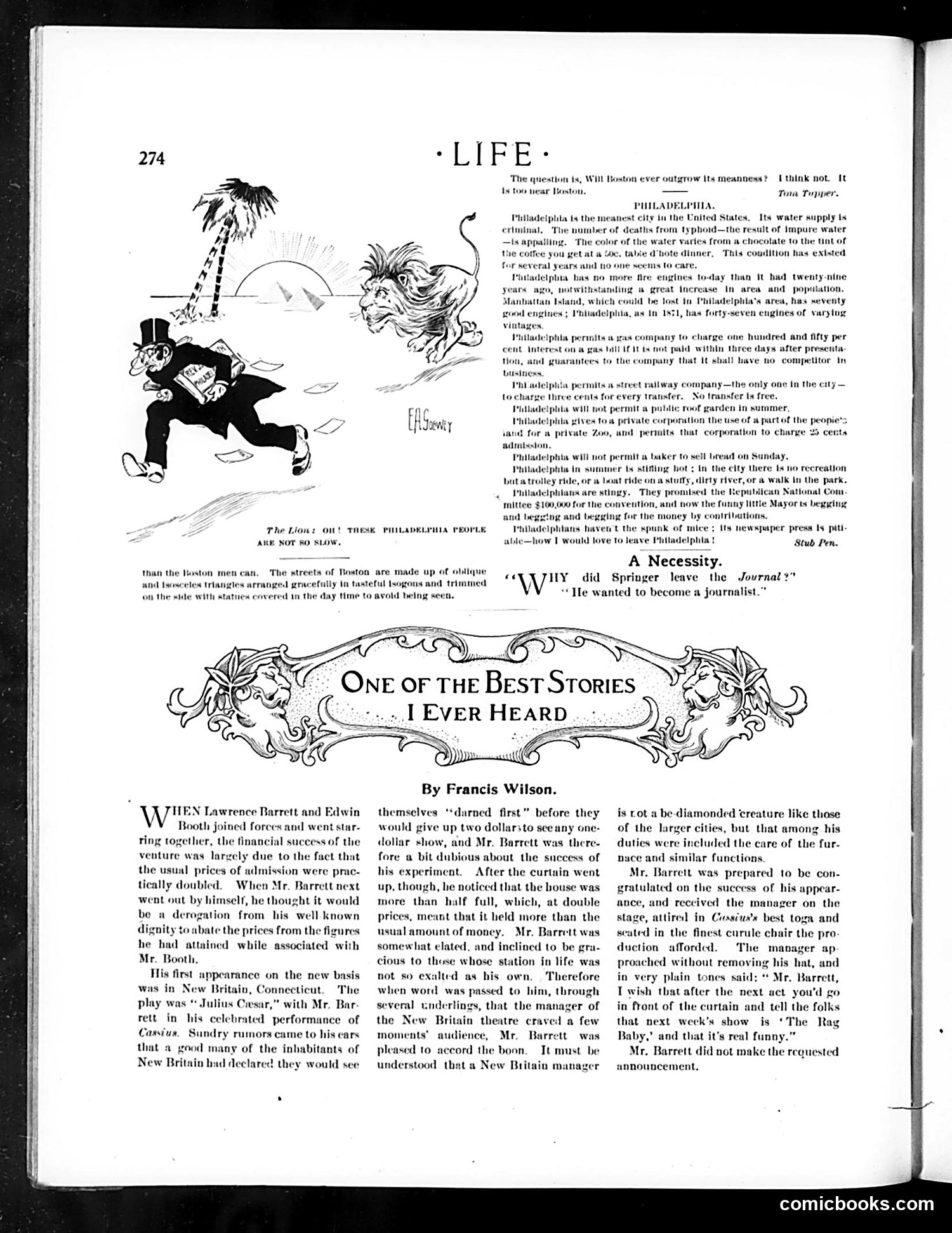
The main cartoon depicts a caricatured lion chasing fleeing Philadelphia residents, illustrating the page's scathing critique of Philadelphia as "the meanest city in the United States." The satire targets Philadelphia's civic failures: contaminated water causing typhoid deaths, outdated fire engines (forty-seven versus Manhattan's seventy), a gas monopoly charging excessive rates with no competition permitted, prohibition of public roof gardens and Sunday bread sales, and stingy civic leadership (the "funny little Mayor" begging for promised Republican Convention donations). The cartoon's lion represents Philadelphia's problems literally attacking its citizens. The opening text mockingly compares Boston unfavorably, suggesting Boston is similarly mean but less hypocritical about it. Below is an unrelated short story by Francis Wilson about actors Lawrence Barrett and Edwin Booth—not political satire, but period entertainment content. The "A Necessity" joke about a journalist appears incidental filler.
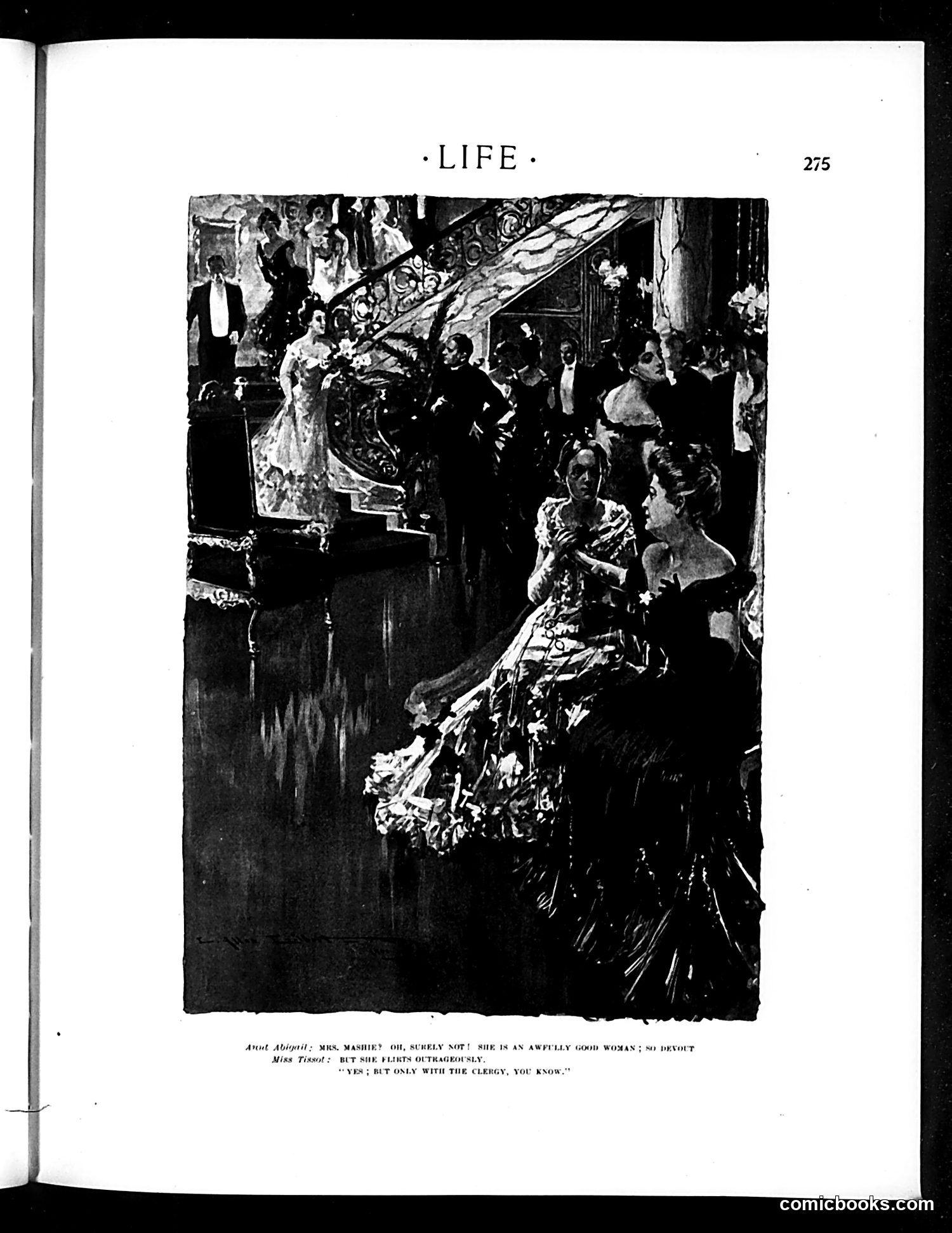
This illustration depicts an elegant ball scene satirizing hypocrisy among the upper classes. The dialogue suggests Mrs. Mashery is "an awfully good woman" who behaves impeccably in society—except she "flirts outrageously." The punchline reveals the specific target of her impropriety: "only with the clergy." The satire mocks both the woman's selective morality and implicitly critiques the clergy's vulnerability to flattery. For a Gilded Age audience, this highlighted the tension between the pious public image expected of "respectable" society women and their actual behavior, while also suggesting that clergymen were susceptible to worldly temptations despite their vows. The joke relies on the audience understanding that such behavior was considered scandalous but somewhat tolerated if confined to "appropriate" targets.
This page features a humorous narrative about a mischievous freckled boy who plays a prank on his father during church services. The boy secretly places a grasshopper in a pill box and slips it to his stern, religious father (described as "the Strenuous Parent"). The father, distracted and habitually chewing cloves during worship, absentmindedly bites off the grasshopper's head and spits out the body—creating chaos in the church aisle. The joke targets the hypocrisy of the father: despite his stern, "high-minded" public religiosity, his actual behavior (spitting insects into the aisle) undermines his pretense of piety. The satire mocks both paternal pomposity and performative religiosity—common Life magazine themes. The moral sardonically warns that freckles can only be cured by suicide, a characteristic period humor touch. The remaining page content consists of period advertisements.
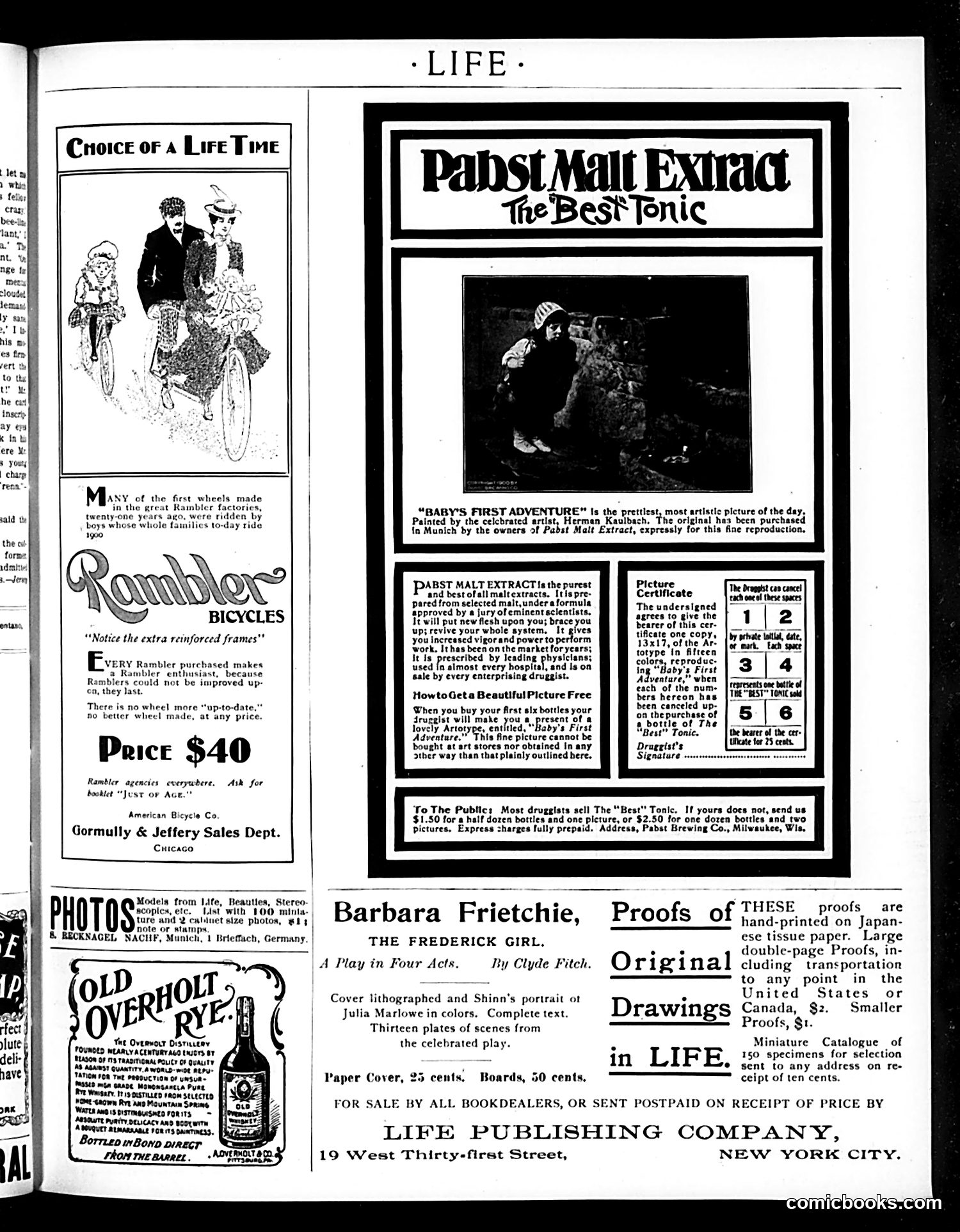
This page is primarily **advertising mixed with cultural content**, not political satire. The main features are: **Pabst Malt Extract advertisement** (center-right): Promotes a health tonic by reproducing "Baby's First Adventure," a sentimental painting by Herman Kaulbach. The ad promises the malt extract will give "increased vigor and power" and offers a free art reproduction to customers—a common early-1900s marketing tactic. This reflects the era's faith in patent medicines and mail-order premiums. **Rambler Bicycles advertisement** (left): Emphasizes durability and quality, noting these bikes have been manufactured for "twenty-one years." The $40 price point targets middle-class consumers. **Bottom section**: Announces theatrical and book products, including a play adaptation of "Barbara Frietchie" and art reproductions available through Life Publishing. The page shows how turn-of-the-century magazines mixed entertainment with consumer advertising, while products like malt tonics occupied a murky space between food, medicine, and dubious health claims—before FDA regulation.
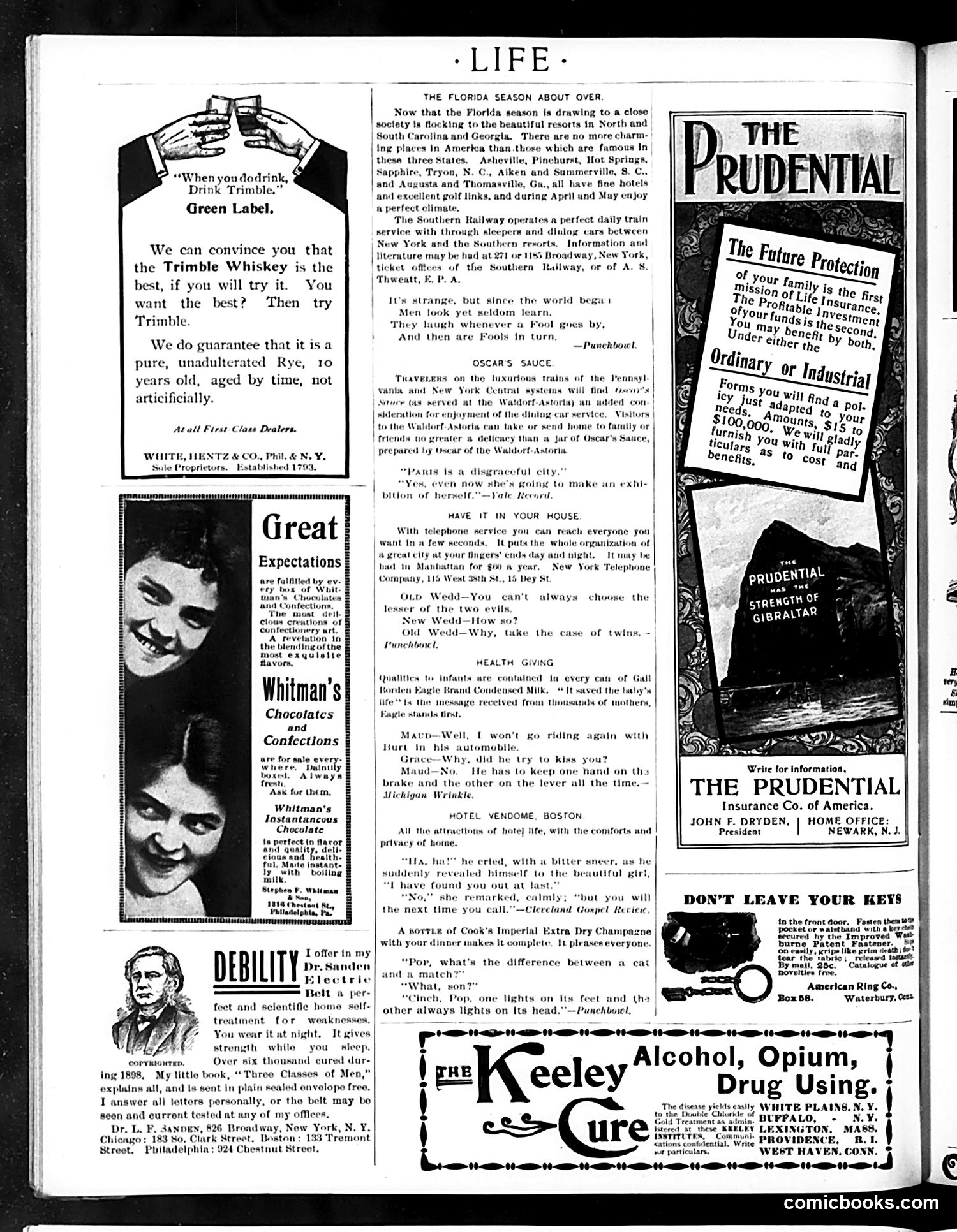
This page is primarily **advertising** with brief satirical content interspersed—typical of Life's format in this era. **Advertisements include:** - Trimble Whiskey (guaranteed pure rye) - Whitman's Chocolates - Dr. Sanden's "Debility Belt" (a quack medical device claiming to treat male weakness through electrical stimulation) - Southern Railway Florida travel - Oscar's Sauce - The Prudential Insurance Company - Keeley Cure (for alcohol and drug addiction) **Satirical content:** The small text snippets ("Punchbowl" column) contain brief jokes about romance and social situations—typical light humor of the period. One notable joke addresses automobiles as a new technology: a woman won't ride with a man because he must keep one hand on the brake and the other on the "lever" constantly. **Historical context for modern readers:** The Dr. Sanden Belt advertisement reflects turn-of-century medical quackery. The Keeley Cure represents actual addiction treatment facilities that existed. These ads reveal period attitudes toward health, masculinity, and emerging technologies like automobiles and telephones.
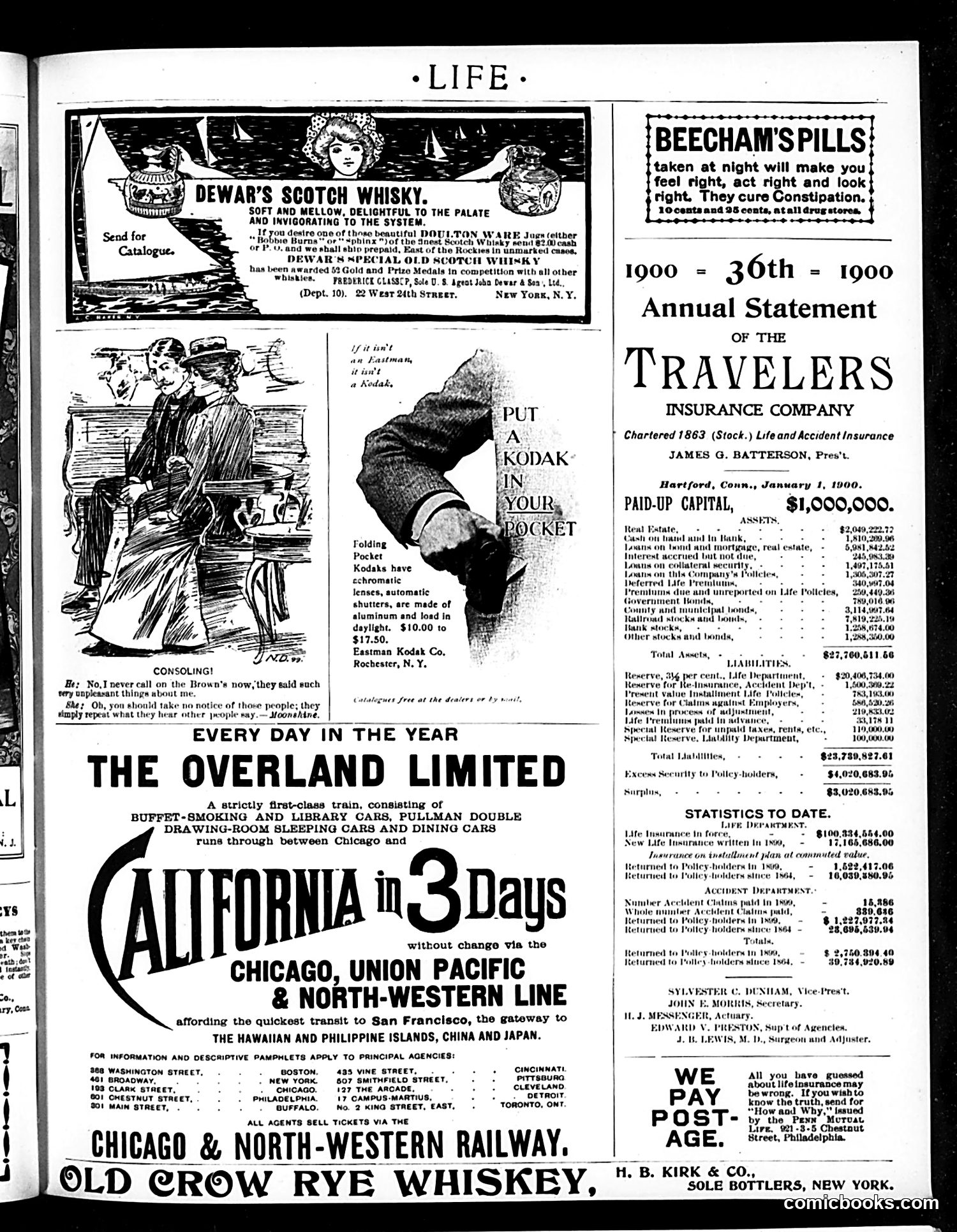
This Life magazine page is primarily composed of period advertising rather than satirical editorial content. The small cartoon labeled "CONSOLING!" depicts a domestic scene between a husband and wife: he claims he no longer visits the Browns because they spoke poorly of him; she dismissively tells him to ignore their gossip. The joke appears to rest on the wife's indifference to her husband's social grievances—a gentle comment on marital dynamics where one spouse dismisses the other's concerns. The page is otherwise dominated by ads for luxury goods (Dewar's Scotch whisky, Kodak cameras, Beecham's pills) and full-page advertisements for rail travel and insurance services. These represent the commercial content Life relied upon, rather than satire. The insurance company's "Annual Statement" occupies substantial space, reflecting the publication's mixed editorial-advertising model typical of 1900.
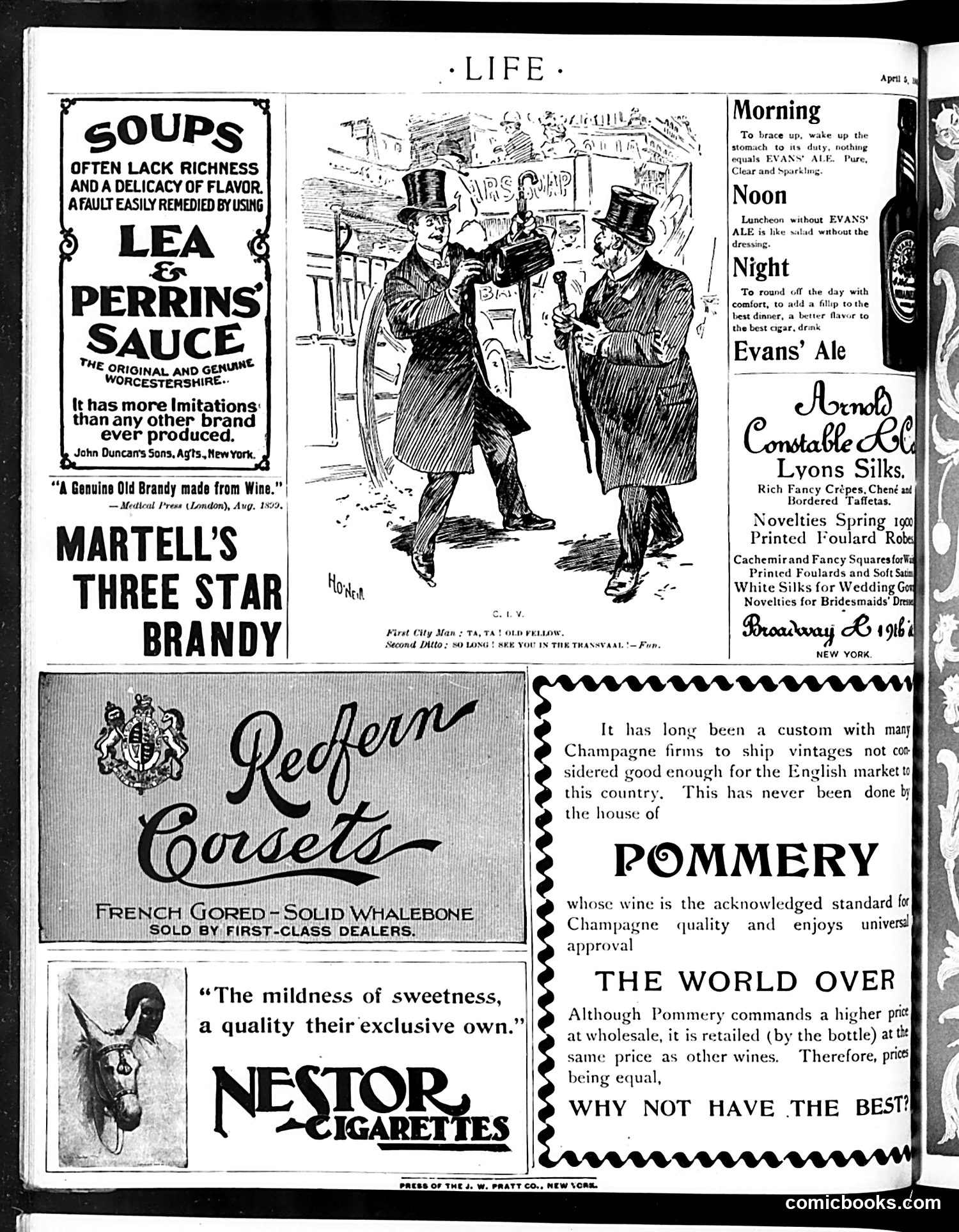
The central cartoon depicts two well-dressed gentlemen in top hats at what appears to be a bar or social establishment. The caption references "First City Man" and "Second Ditto," with dialogue about a transatlantic journey, suggesting this is satirizing American tourists abroad or international business dealings. The page is primarily **advertising**, not political satire. It showcases luxury goods marketed to affluent readers: Lea & Perrins sauce, Martell brandy, Evans' Ale (positioned as appropriate for morning, noon, and night consumption), Redfern corsets, Nestor cigarettes, silk goods, and Pommery champagne. The cartoon itself appears to mock or comment on social pretension and transatlantic commerce, though the specific reference is unclear without fuller context. The advertisements reflect Life's audience: wealthy consumers of imported European luxury items during the Gilded Age.