
Life, 1900-04-05 · page 4 of 20
Life — April 5, 1900 — page 4: what you’re looking at
What you’re looking at
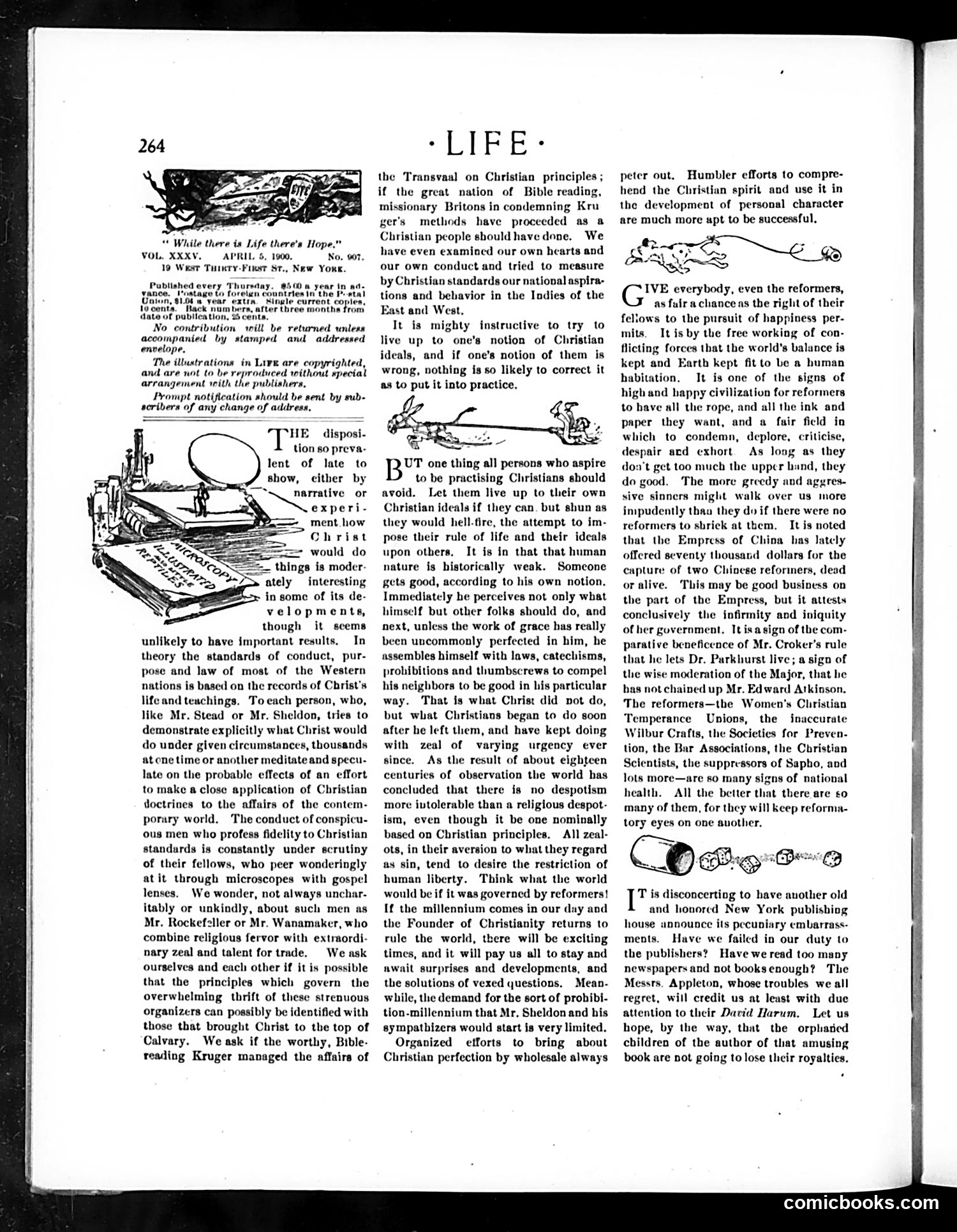
The page contains two editorial illustrations critiquing Christian reformers and their methods. The left cartoon depicts a printing press or similar mechanical device, illustrating the text's concern about how Western Christian standards are being mechanically imposed on other cultures, particularly "the ladies of the East and West." The right cartoon shows what appears to be a cylindrical object (possibly a telescope or similar device) with scattered circular objects, likely satirizing the scattershot, ineffective approach of reformers. The editorial attacks the hypocrisy of Christian reformers—particularly referencing figures like Kruger and Sheldon—arguing they fail to live by Christian ideals themselves while attempting to impose them on others. The piece criticizes religious despotism and suggests that reformers' efforts, while well-intentioned, are misguided and likely counterproductive to genuine Christian practice.
📄 Transcribed text from this page (OCR, searchable)
Machine-transcribed from the original scan — historical spelling and the odd misread are preserved.
“* While there is Life there’s Hope.” VOL. XXXV. APRIL 5, 1900. No, 907, 19 West Tuiery-Fikst St., New Yore. Published every Thursday. #500 a year in ad~ vance. age to foreign countries In the P-stal 8a year extra. Single current copies, Rack num bers, after three month from pubileation, % cents, No contribution twill be returned untess accompanied by stamped and addressed envelope, The illustrations in Live are copyrighted, and are not to be reproduced without special arrangement with the publishers, Prompt notification should be sent by sub- soribers of any change of address, HE disposi- tion so preva- lent of late to show, either by . narrative or ! experi- SS ==, ment. how = Christ = = would do =— things is moder- ately interesting in some of its de- velopments, though it scems unlikely to have important results, In theory the standards of conduct, pur- pose and law of most of the Western nations is based on the records of Christ's life and teachings, To each person, who, like Mr. Stead or Mr. Sheldon, tries to demonstrate explicitly what Christ would do under given circumstances, thousands at one time or another meditate and specu- late on the probable effects of an effort to make a close application of Christian doctrines to the affairs of the contem- porary world. The conduct of conspicu- ous men who profess fidelity to Christian standards is constantly under scrutiny of their fellows, who peer wonderingly atit through microscopes with gospel lenses. We wonder, not always unchar- itably or unkindly, about such men as Mr. Rockefeller or Mr. Wanamaker, who combine religious fervor with extraordi- nary zeal and talent for trade. We ask ourselves and each other if itis possible that the principles which govern the overwhelming thrift of these strenuous organizers can poasibly be identified with those that brought Christ to the top of Calvary, We ask if the worthy, Bible- reading Kruger managed the affaira of «LIPS * the Transvaal on Christian principles ; if the great nation of Bible reading, missionary Britons in condemning Kru ger's methods have proceeded as a Christian people should have done. We have even examined our own hearts and our own conduct and tried to measure by Christian standards our national aspira- tions and bebavior in the Indies of the East and West, It is mighty instructive to try to live up to one’s notion of Christian ideals, and if one’s notion of them is wrong, nothing is so likely to correct it ‘as to put it into practice. & UT one thing all persons who aspire to be practising Christians should avoid. Let them live up to their own Christian ideals if they can. but shun as they would hell-tire, the attempt to im- pose their rule of life and their ideals upon others, It is in that that human nature is historically weak. Someone gets good, according to his own notion. Immediately he perceives not only what himself but other folks should do, and next, unless the work of grace has really been uncommonly perfected in him, he assembles himself with laws, catechisms, prohibitions and thumbscrews to compel his neighbors to be good in his particular way. That is what Christ did not do, but what Christians began to do soon after he left them, and have kept doing with zeal of varying urgency ever since. As the result of about eightcen centuries of observation the world has concluded that there is no despotism more ivtolerable than a religious despot- ism, even though it be one nominally based on Christian principles. All zeal- ots, in their aversion to what they regard as sin, tend to desire the restriction of human liberty. Think what the world would be if it was governed by reformers! If the millennium comes in our day and the Founder of Christianity returns to rule the world, there will be exciting times, and it will pay us all to stay and await surprises and developments, and the solutions of vexed questions. Mean- while, the demand for the sort of probibi- tion-millennium that Mr, Sheldon and his sympathizers would start is very limited. Organized efforts to bring about Christian perfection by wholesale always peter out, Humbler efforts to compre- hend the Christian spirit and use it in the development of personal character are much more upt to be successful, Ge everybody, even the reformers, as fair a chance as the right of their feliows to the pursuit of happiness per- mits, It is by the free working of con- flicting forces that the world's balunce is kept and Earth kept fit to be a human habitation. It is one of the signs of high and happy civilization for reformers to have all the rope, and all the ink and paper they want, and a fair ficld in which to condemn, deplore, criticise, despair ard exhort As long as they don't get too much the upper bund, they do good. The more greedy and aggres- sive sinners might walk over us more impudently thao they do if there were no reformers to sbrick at them. It is noted that the Empress of China has lately offered seventy thousand dollars for the capture of two Chinese reformers, dead or alive. This may be good business on the part of the Empress, but it attests conclusively the infirmity and iniquity of her government, It isasign of the com- parative beneficence of Mr. Croker’s rule that he lets Dr. Parkhurst live; a sign of the wise moderation of the Major, that he has not chained up Mr. Edward Atkinson, The reformers—the Women's Christian Temperance Unions, the inaccurate Wilbur Crafts, the Societies for Preven- tion, the Bar Associations, the Christian Scientists, the suppressors of Sapho, and lots more—are so many signs of national health. All the better that there are so many of them, for they will keep reforma- tory eyes on one auother. COGi.qo~0 T° is disconcerting to have another old and honored New York publishing house announce its pecuniary embarrass- ments. Have we failed in our duty to the publishers? Have we read too many newspapers and not booksenough? The Messrs. Appleton, whose troubles we all regret, will credit us at least with due attention to their David Harum. Let us hope, by the way, that tbe orphated children of the author of that amusing book are not going to lose their royalties. comicbooks.com