
Life, 1900-04-05 · page 6 of 20
Life — April 5, 1900 — page 6: what you’re looking at
What you’re looking at
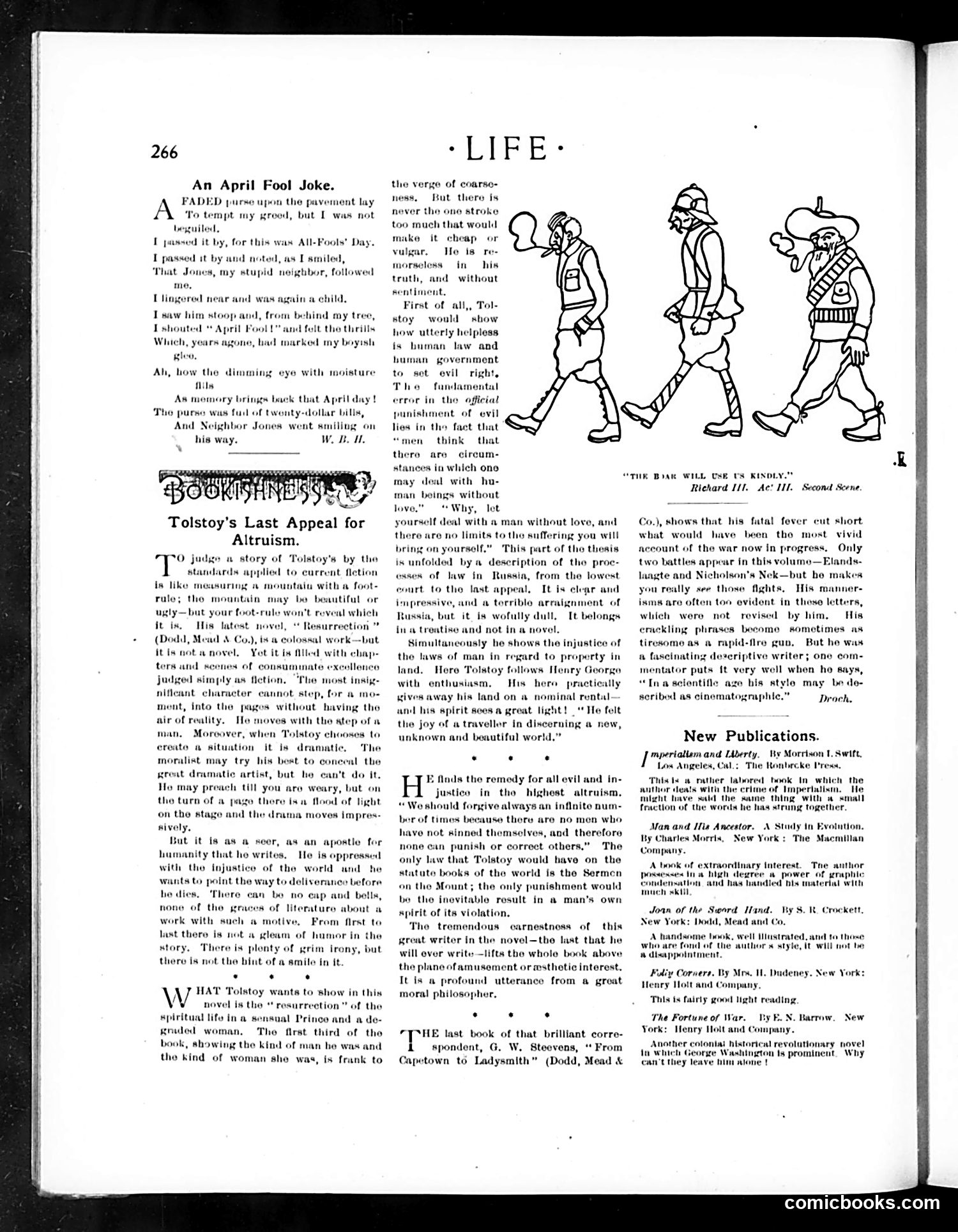
This political cartoon depicts three military figures marching in step, with the caption referencing Shakespeare's Richard III. The satire appears to comment on military uniformity and obedience to authority—specifically how soldiers follow orders without question, regardless of moral implications. The accompanying text discusses Tolstoy's philosophy on altruism and justice, arguing that punishment and coercion cannot create moral behavior. The cartoon likely illustrates this point: the synchronized soldiers represent how institutions (military, legal systems) enforce conformity through authority rather than genuine ethical conviction. The historical context and specific political figures remain unclear from the image alone, but the overall message critiques blind institutional obedience.
📄 Transcribed text from this page (OCR, searchable)
Machine-transcribed from the original scan — historical spelling and the odd misread are preserved.
266 An April Fool Joke. FADED purse upon the pavement lay A ‘To tempt my greod, but L was not besguiled, I passed it by, for this wax All-Fools’ Day. I passed it by und noted, as E smiled, That Jones, my stupid neighbor, followed me, Tlingored near and was again a child, I saw him stoop and, fre I shouted * April Fool !” Which, y 8 Ah, how the dimming fils As mo 1 bebind my tree, It the theil wl marked my boyish and Ars agono, with moisture ry brings back that April day! Tho purse wus full of twonty-dollar bills, And Neighbor his way. jones went smiling « W. BM. Tolstoy's Last Appeal for Altruism. O judge a story of Tolstoy's by the standards applied to current fletion measuring ® mountain with a f tho mountain may be beautiful or ugly—but your foot-rule y al which ft ix, His latest nove psurrection " (Dodi, Mead Co.) -but it is not an hap- tors sllenco judged simply as fiction, “Phe most insig- niflcant character cannot step, for a mo- lossal work itis Aled with nd Kes mont, into the pages without having the air of reality. Ho moves with the step of a man, Moreover, when Tolstoy chooses to erento a situation it is dramatic, The moralist may try his best to conceal the grout dramatic artist, but he can't do it. Ho may preach till you aro weary, but on tho turn of a page there isu flood of light on the stage and the drama moves impres- sively. But it is as a scer, as an apostle for humanity that ho writes, He is oppressed with the Injustice of the world und wants to point the way to ho dies. ‘There can be no cap and bells, none of the gies of literature about a work with such a motive, Prom first to ta gleam of humor tn a S is plonty of grim irony, but there is not the bint of a smile in it. \ HAT Tolstoy wants to show in this / is tho * resurrection” of the spiritual life ina sensual Prince and a de- gruded woman, Tho first third of the book, showing the kind of man he was and tho kind of woman she was, is frank to joliveranes before nove ‘LP E erge of coarse- But there is nover the one stroke too much that would make it vulgar. morseless truth, and sentiment. First of all,, Tol- stoy would show how utterly helpless is human law and human government to set evil right, fundamental the official it of evil lies in the fact that “men think that there are cireum- stances in which ono may deal with hu- man beings without "© Why, Ik yourself deal with a man without love, and there are no limits to the suffering you will bring on yourself." This part of the thesis is unfolded by a description of the proc- esses of Jaw in Russia, from the lowest art to tho last appeal, It is clear and impressive, and a terrible arraignment of Russia, but it is wofully dull, [t belongs ina treatise and not ina novel, Simultancously he shows the injustice of the laws of man in regard to property in land. Hore Tolstoy follows Henry Georgo with enthusiasm, His practically gives away his land on a nominal rental and his spirit sees a great light! "He felt the joy of a traveller in discerning a new, unknown and beautiful work th ness, cheap or Ho 18 re- in his without he error i punish here . . . finds the remedy for all evil and in- justice in the highest altruism, “Wo should forgive always an inflnito num- bor of times because thors are no men who have not sinned themselves, and therefore none can punish or correct others.” The only law that Tolstoy would have on the statute books of the world is the Sermen on the Mount; the only punishment would bo the inevitable result in a man’s own spirit of its violation, Tho tremendous carnestnoss of this t writer in the novel—the last that he will over write lifts the whole book above the plane of amusement or msthotic interest. It is a profound utterance from a great moral philosopher, . . . Te last book of that brilliant corre- spondent, G. W. Steevens, * From Capetown to Ladysmith” (Dodd, Mead & OTHE BoA WILL Se US KIND Richard 111. Ae! 111. Second Scene shows that his fatal fever cut short what would tho 1 vivid account of the war now in progress, Only two battles appear in this volume—Elands- luagte and Nicholson's Nek—but bo makes you really see those fights, His mani ixms are often too evident in those letters, which were not revised by him, His crackling phrases be sometimes as tiresome as a rapid-fire guo, But ho was a fascinating descriptive writer; one com- mentator puts It very well when ho says, “Ina selontifie his stylo may be de- scribed as cinematographic.” rach. have been xt ore no New Publications. mperialtam and LAberty. iy Morrison 1. Swit, Los Angeles, Cal.: The Ronbroke Press, THAI. & pither labored book In which the author deals with the crline of Inperhalixtn, He might have sald the une thing with « small fraction of the words he has strung together. Man and Mis Ancestor. Ry Charles Morris, Company. A Study In Evotntion, New York : The Macmilian A book of extraordinary Interest aes tia high degre set ieth catncd Maks Hate teh skUL Joan of the Sword Hand. Vy 8. i Crockett, dd and Co, 1 AHiustrated, a f the author « style, it will net be Faliy Corners, Dy Mrs. M1. Dudeney. New Henry Hott and Compan This is fairly good light reading. ork: The Fortune of War. York: Henry Holt and hy EN. Barrow, New pany. cal revolutionary fon 1s prominent ' comicbooks.com