
A complete issue · 18 pages · 1900
Life — March 29, 1900
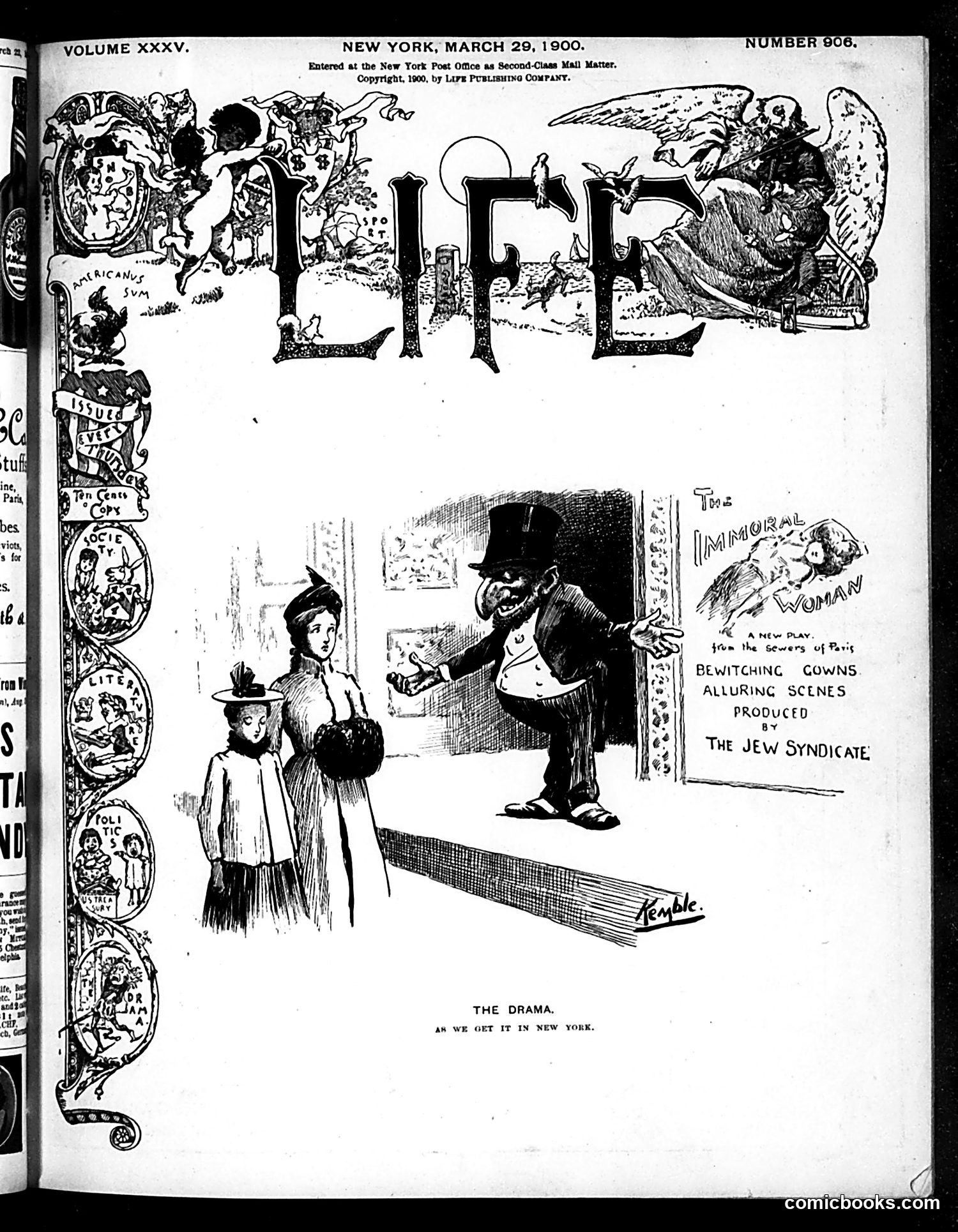
This page features a theatrical advertisement for "The Immoral Woman," a play advertised as drawn from Parisian sources and produced by "The Jew Syndicate." The accompanying cartoon by Temble illustrates a scene from the drama, showing what appears to be a seduction or illicit encounter between a well-dressed man in a top hat and a young woman, with another figure watching. The advertisement's reference to "The Jew Syndicate" reflects period antisemitic stereotyping common in 1900 American media, associating Jewish theatrical producers with morally questionable "imported" European content. The cartoon's title—"The Drama: As We Get It in New York"—suggests satirical commentary on theatrical imports and their perceived moral dangers to American audiences.
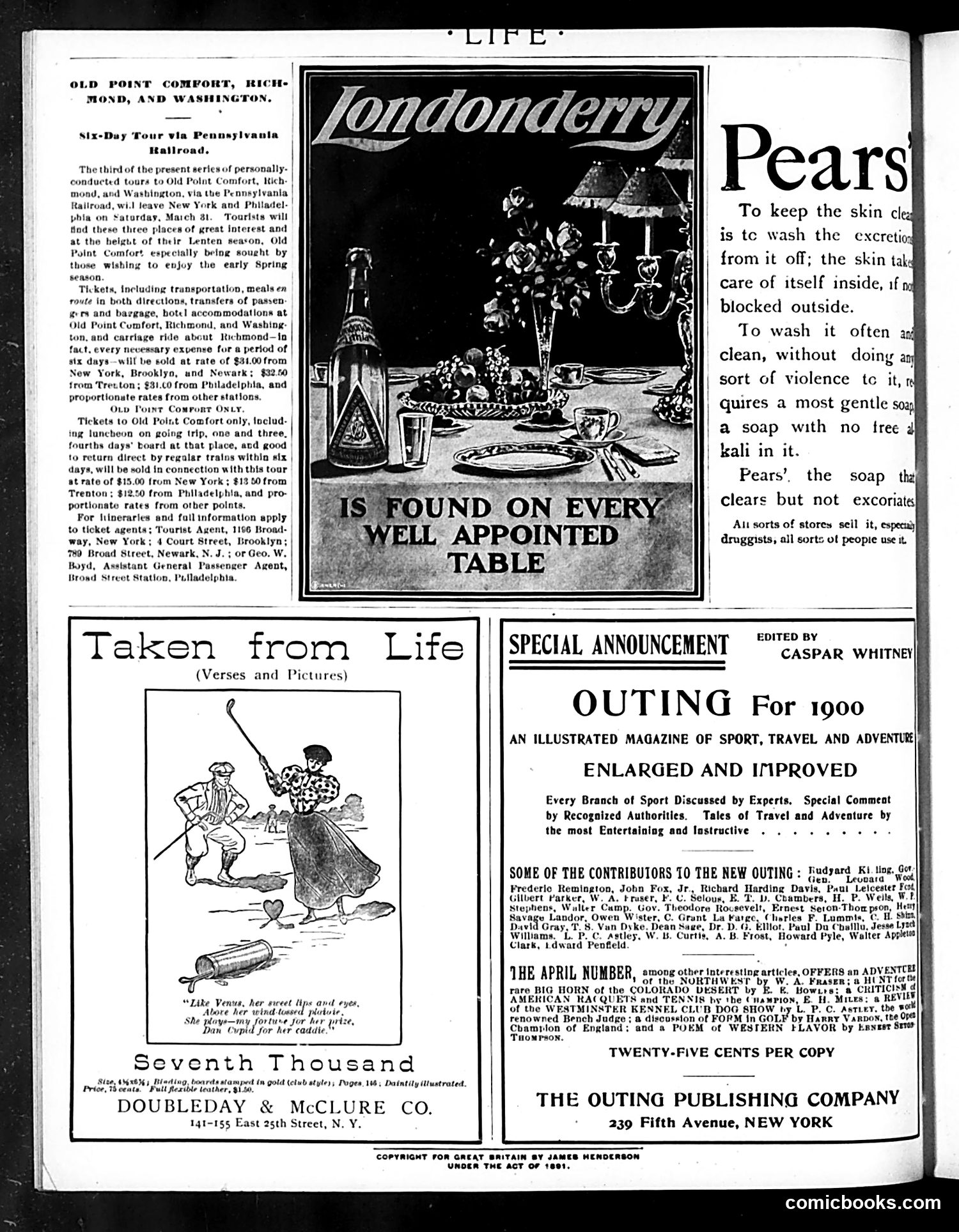
This page is **primarily advertising and announcements** rather than political satire or editorial cartoon content. The main visual element is a Londonderry whiskey advertisement featuring an elaborate table setting with bottles and decorative elements, claiming the product "IS FOUND ON EVERY WELL APPOINTED TABLE." Below that is a brief illustrated poem titled "Taken from Life" showing a couple fishing, published by Doubleday & McClure Co. The right side contains advertisements for Pears' soap and an announcement for *Outing* magazine (edited by Caspar Whitney), described as "AN ILLUSTRATED MAGAZINE OF SPORT, TRAVEL AND ADVENTURE." There is **no political satire or social commentary visible** on this page—it represents typical turn-of-the-century magazine advertising and publishing promotion.
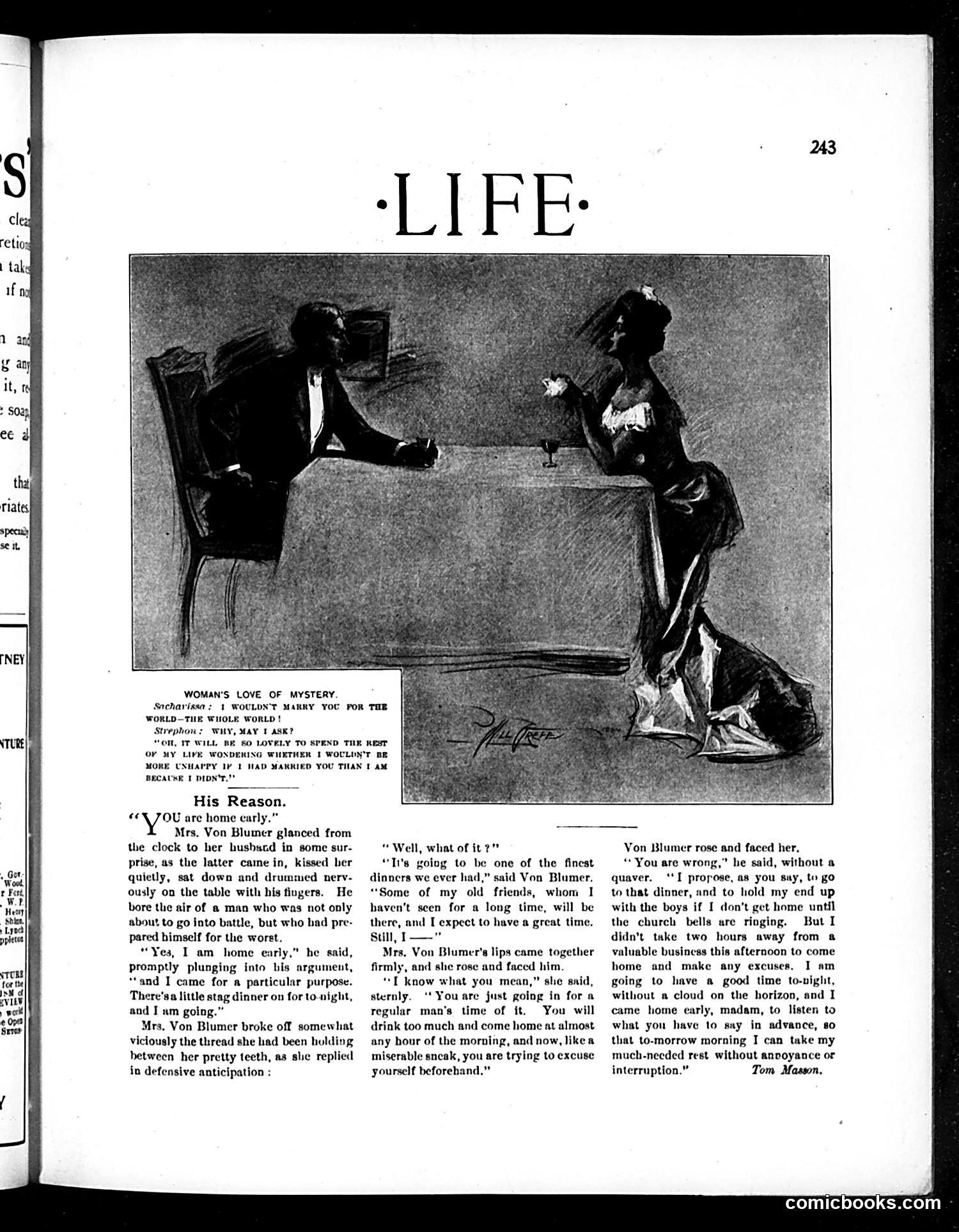
This page contains two pieces of satirical content about marriage and gender relations: **Top illustration ("Woman's Love of Mystery"):** A silhouetted couple at a dining table depicts a dialogue about marriage. The woman refuses the man, stating she won't marry him "for the world," claiming she'd be "more unhappy" than if unmarried. The satire targets Victorian-era courtship rituals and women's ambivalence toward matrimony—mocking both romantic conventions and the era's assumption that marriage was women's ultimate goal. **"His Reason" story:** A husband (Von Blumer) comes home early, disrupting his wife's expectations. He explains he's attending a dinner and will return late, attempting to justify his absence. The piece satirizes domestic tension and marital miscommunication regarding a husband's evening plans. Both items humorously explore early-20th-century marriage anxieties and gender dynamics.
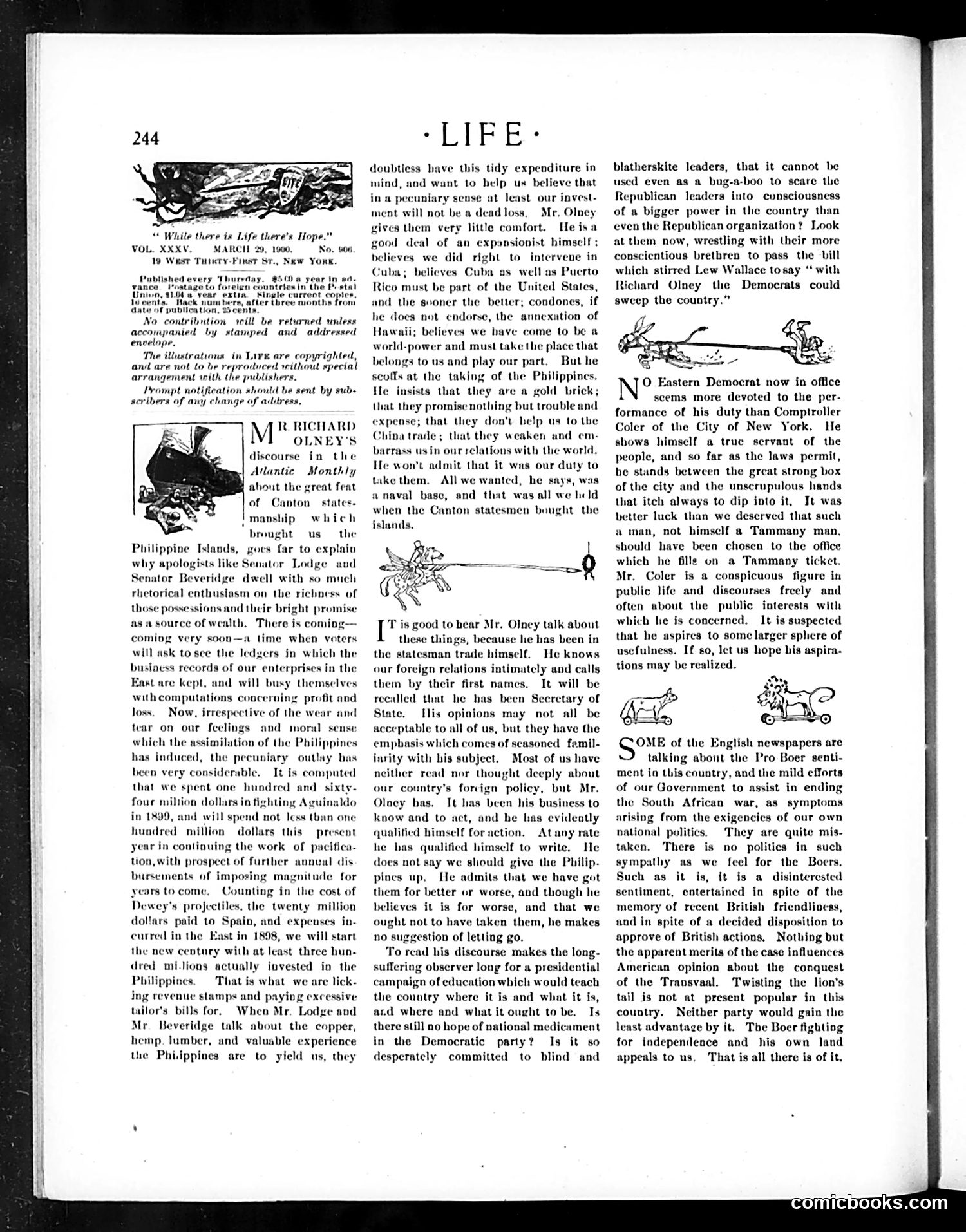
This page contains a political commentary piece on **Richard Olney**, identified as a Democratic official concerned with New York City politics. The text criticizes Olney for his involvement in city governance, suggesting he represents the "unscrupulous hands that itch always to dip into it" — a reference to corrupt municipal politics. The article discusses Olney's position on various political issues, including Philippine policy and foreign relations. It appears to debate whether Democratic leadership is committed to addressing national problems or remains blind to party interests. The decorative illustrations scattered throughout (appearing to be small animal sketches) are typical of *Life* magazine's visual style but don't represent specific political figures — they're ornamental elements common to the publication's design. The overall tone is critical commentary on Democratic Party leadership and urban political corruption.
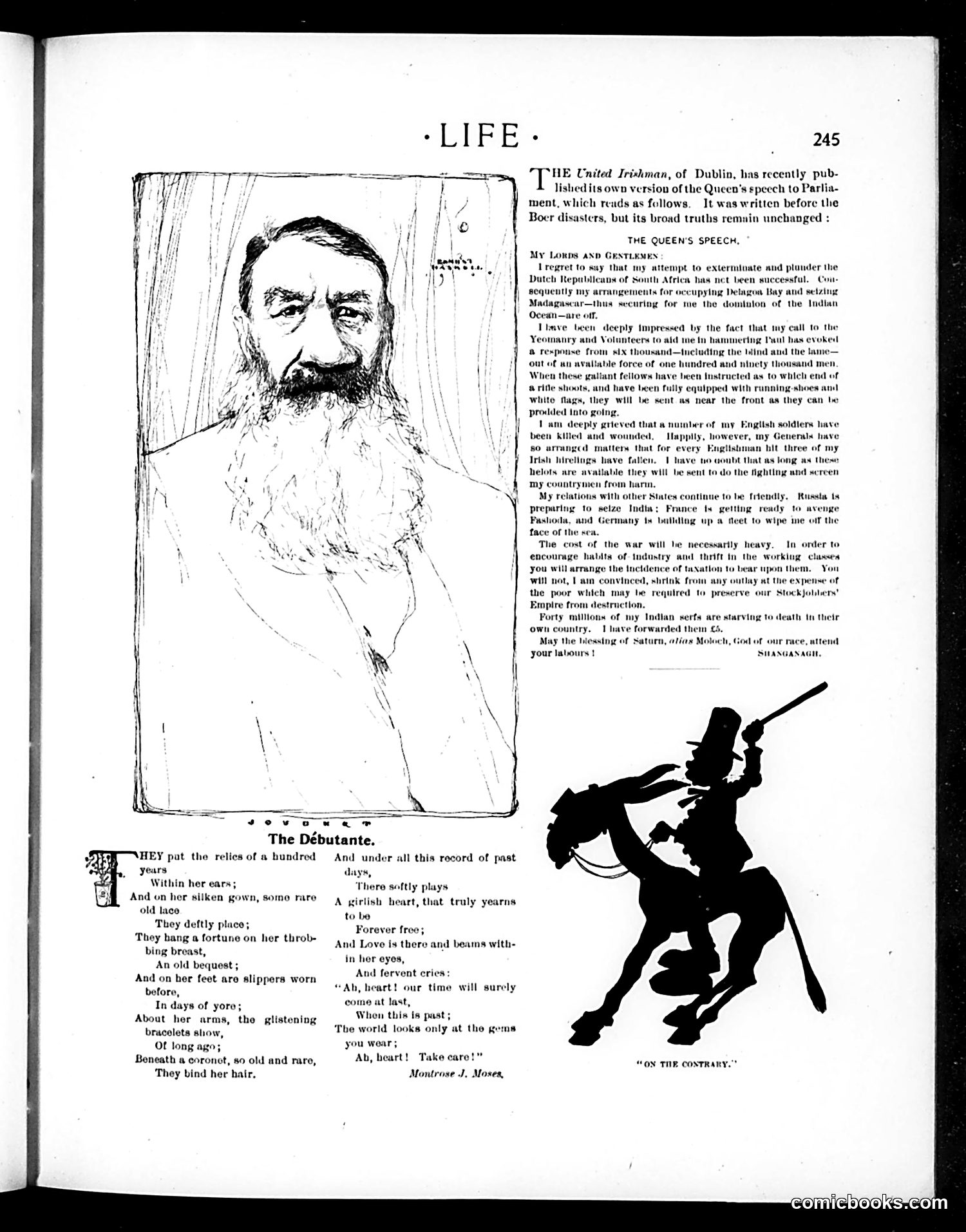
The page features a sketch titled "The Débutante" and reproduces "The Queen's Speech" from *The United Irishman* of Dublin, apparently responding to British war efforts in South Africa (the Boer War). The speech, attributed to "Shanganagh," is satirical propaganda from an Irish nationalist publication, expressing grievances about English soldiers killed and Irish suffering, while warning that India, France, and Germany prepare to seize the opportunity presented by Britain's military distraction. The cartoon at right, captioned "On the Contrary," appears to be a counter-response—a British satirical rejoinder mocking or ridiculing the Irish nationalist position. The page thus documents the Anglo-Irish political tensions surrounding Britain's Boer War involvement.
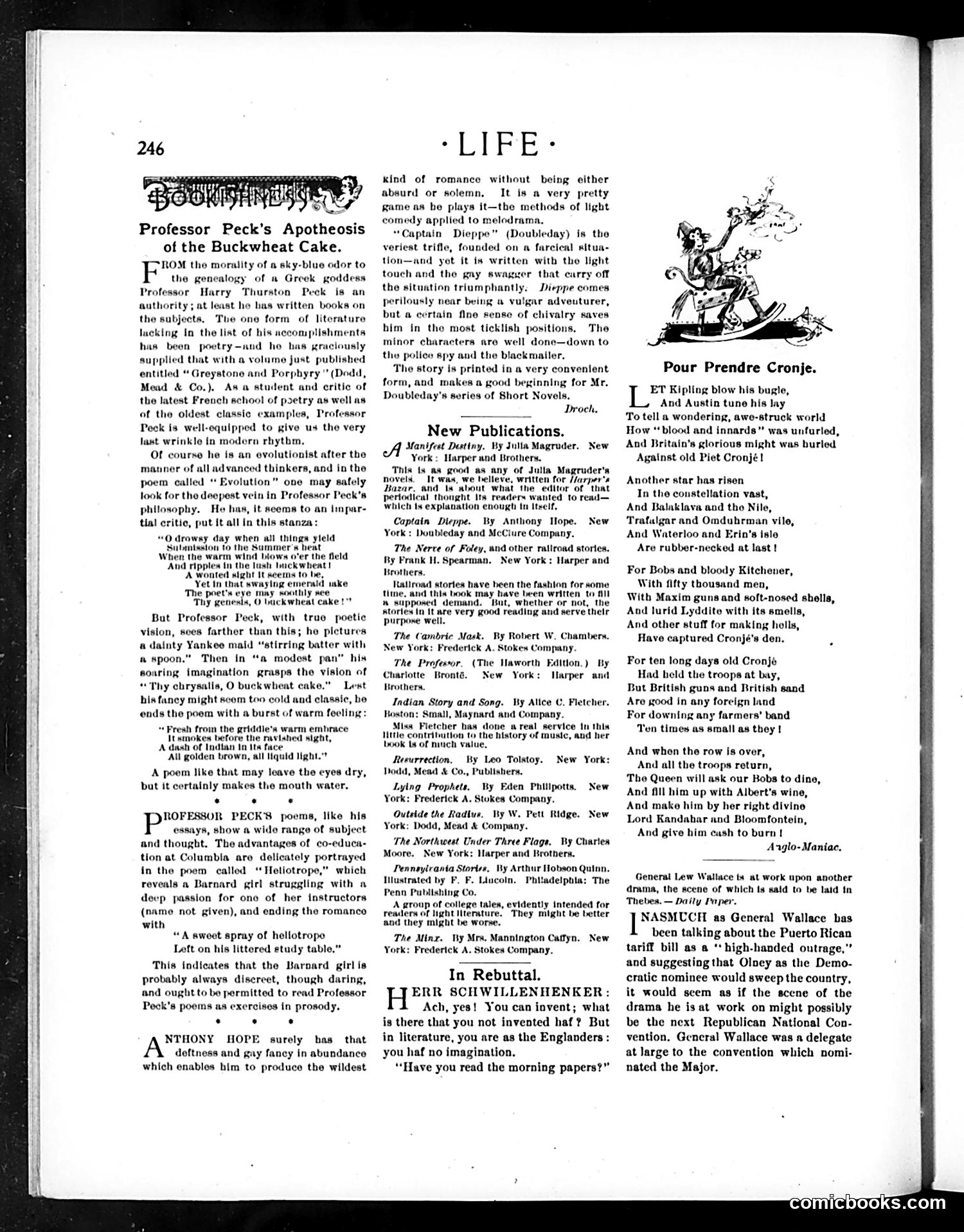
This page contains literary reviews and commentary rather than political cartoons. The main content discusses Professor Harry Thurston Peck's poetry collection "Greystone and Porphyry," praising his work while critiquing his philosophy. The page includes a decorative illustration titled "Pour Prendre Cronje" (To Capture Cronje)—likely referencing General Piet Cronjé from the Boer War, though the specific satirical point is unclear from the image alone. Below this is a poem mocking General Lew Wallace's involvement in Puerto Rican tariff debates and Republican National Convention politics. The satire suggests Wallace's political ambitions were transparent and potentially misguided. The page is primarily a book review section with light political commentary rather than visual satire.
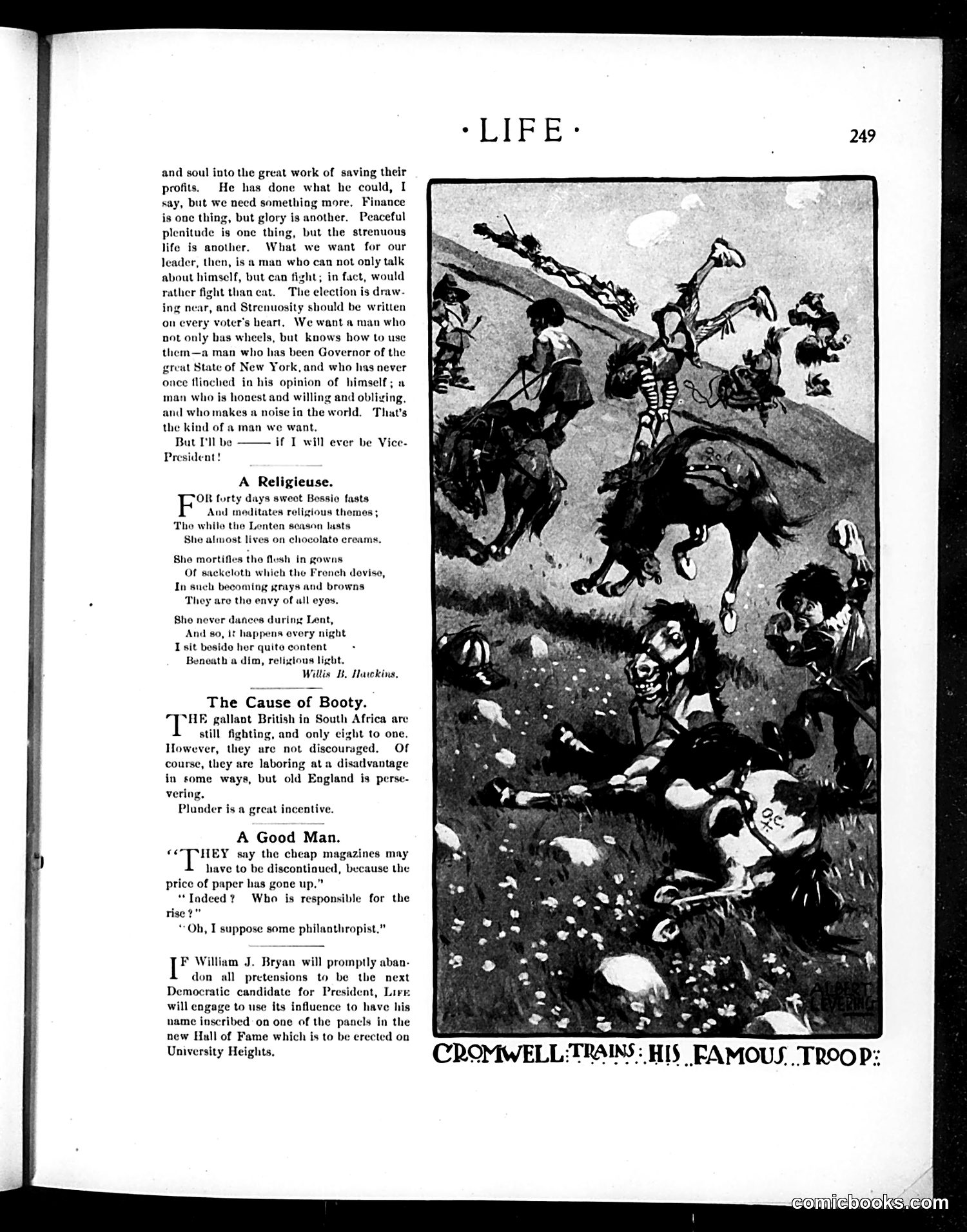
This satirical illustration depicts Oliver Cromwell (17th-century English military leader) training soldiers in a chaotic, slapstick manner. The cartoon mocks military discipline through exaggerated physical comedy—figures tumbling, falling, and colliding as they attempt drills. The satire appears to reference contemporary American politics. The accompanying text discusses desired leadership qualities and mentions William J. Bryan as a potential Democratic presidential candidate. The cartoon likely critiques inadequate political or military leadership through historical analogy, suggesting that like Cromwell's bumbling troops, certain contemporary leaders lack proper control or competence. The broader "Life" magazine page contains satirical commentary on governance, suggesting this visual joke reinforces themes about incompetent authority figures.
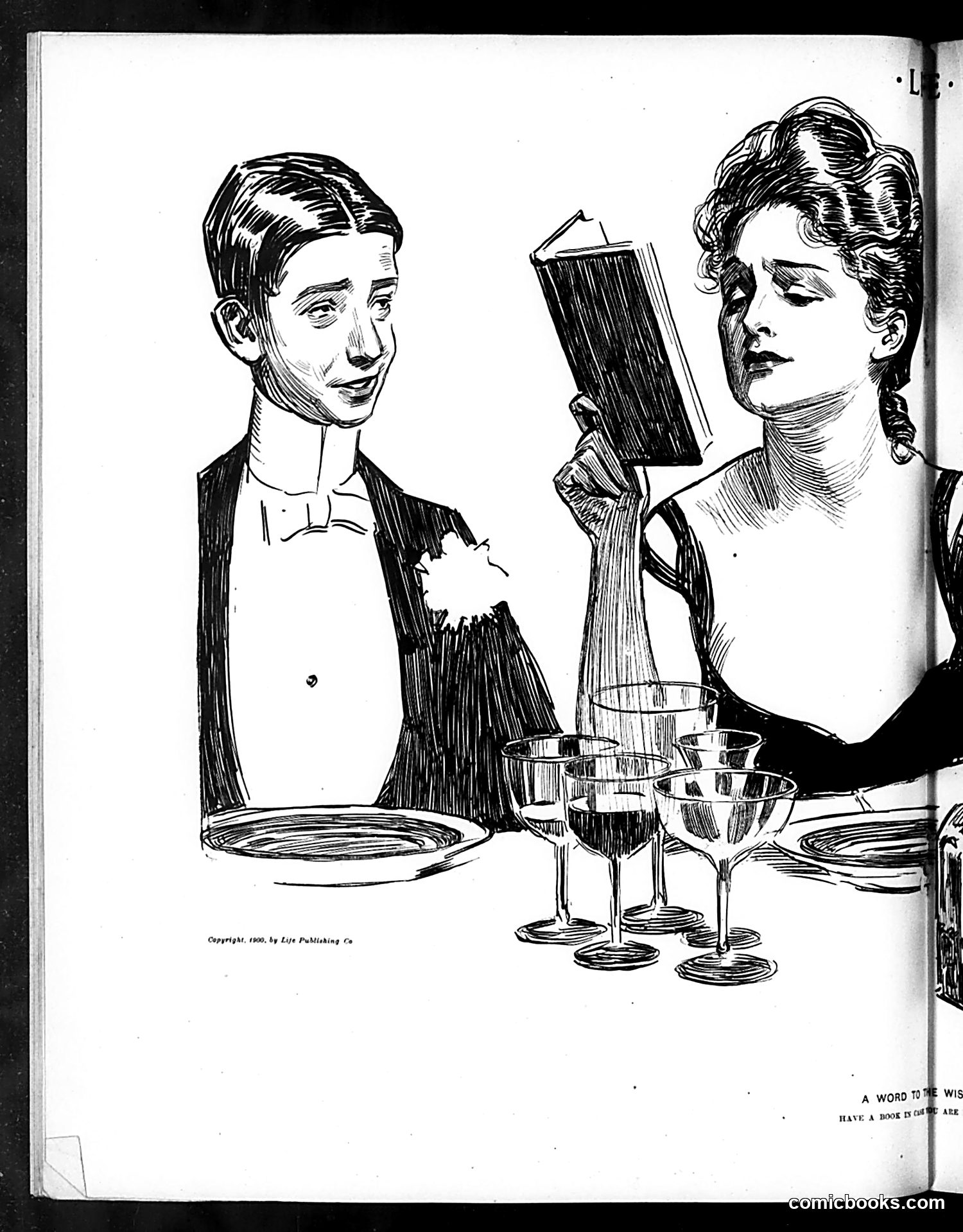
This is a satirical illustration depicting a formal dinner scene. A man in black tie sits across from a woman in evening dress holding a book. Between them are several cocktail glasses. The partially visible text at bottom reads "A WORD TO THE WISE" and "HAVE A BOOK IN CASE USE," suggesting the cartoon's point: the woman should keep a book handy during dinner conversation—implying the man is a dull or uninteresting dinner companion. The satire targets awkward social dynamics and perhaps masculine conversational inadequacy at formal occasions. The woman's focused attention on the book rather than her companion reinforces this critique of poor social engagement between the sexes at upper-class gatherings. The copyright indicates this is from Life magazine's 1906 publication.
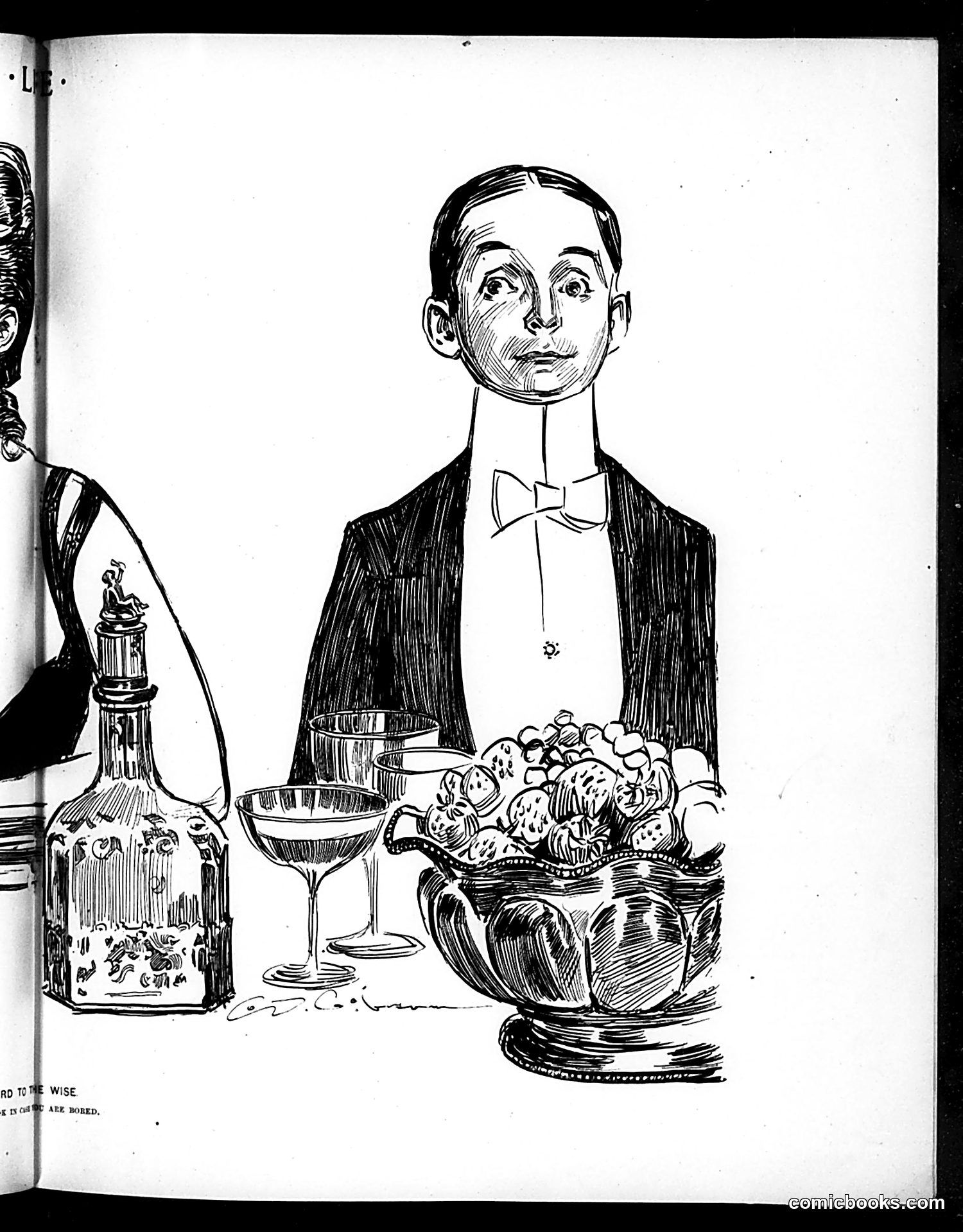
This appears to be a satirical illustration from *Life* magazine depicting a formally dressed man in a tuxedo with an elongated, somewhat vacant expression. He's surrounded by luxury items: an ornate wine bottle, champagne glasses, and a large bowl of strawberries. The satire likely mocks wealthy or elite social pretension—specifically the performative sophistication of fine dining and drinking culture among the upper classes. The man's exaggerated facial features suggest he's meant as a caricature of a particular social type: perhaps someone attempting to appear cultured or refined while engaging in hedonistic excess. The partial text visible references being "wise" and someone being "bored," suggesting commentary on ennui among the wealthy or the emptiness behind such displays of affluence. The exact historical context and intended target remain unclear without the full page text.
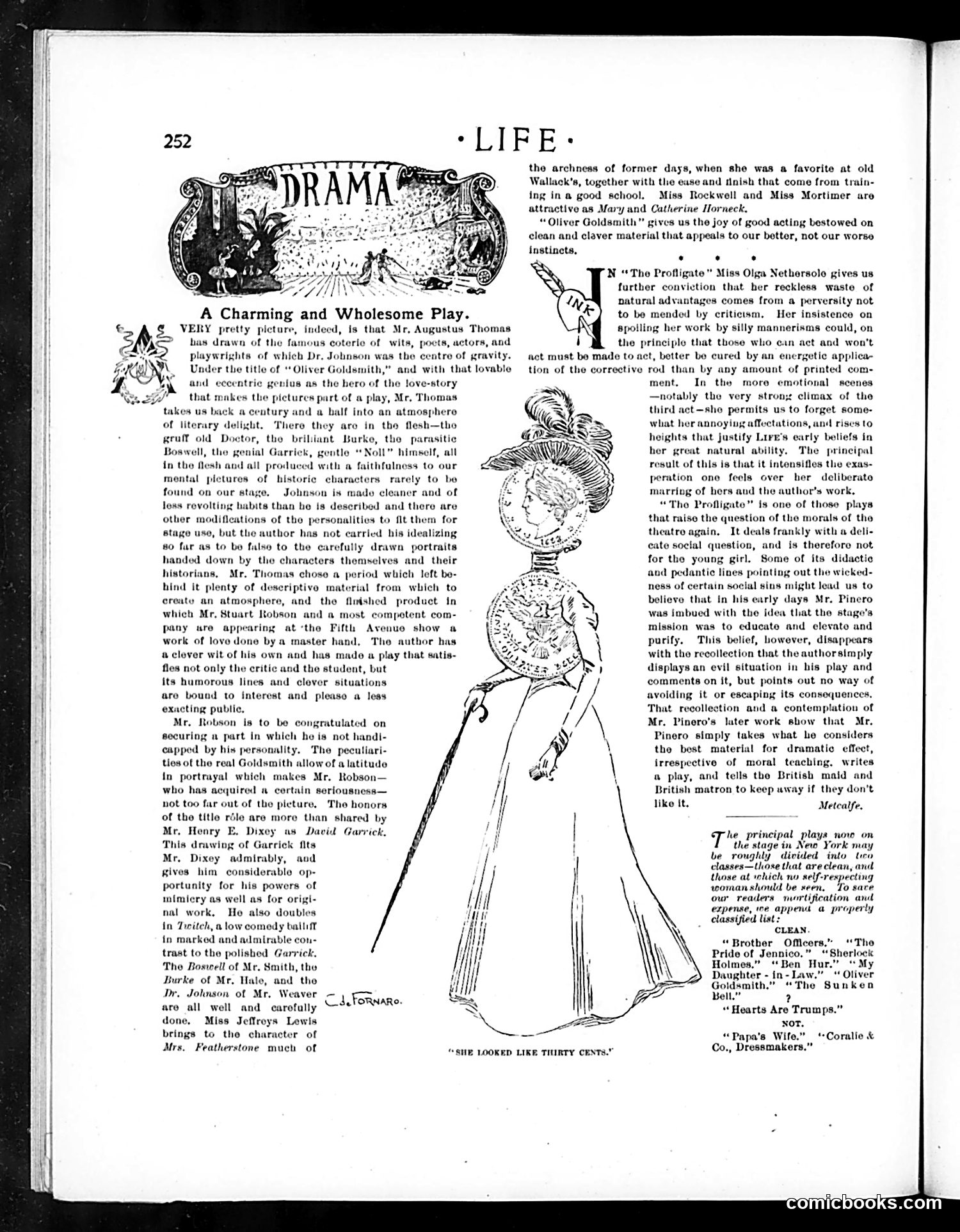
This page reviews theatrical productions, focusing on "Oliver Goldsmith" and "The Profligate." The main illustration depicts a woman in profile—labeled "SHE LOOKED LIKE THIRTY CENTS"—suggesting a caricature of an actress or theatrical character type. The reviews praise Mr. Thomas's skill in adapting Goldsmith's witty comedies, noting the play succeeds through clever dialogue and situation rather than moral instruction. "The Profligate" receives criticism for its moralistic preaching about social issues affecting young women, though the reviewer acknowledges the play raises legitimate theatrical questions about ethics. The page concludes with a list of other theatrical productions ("Brother Officers," "The Pride of Jennico," etc.), indicating this was a theater-focused column. The cartoon's caption humorously dismisses a character's appearance as shabby or worn-out.
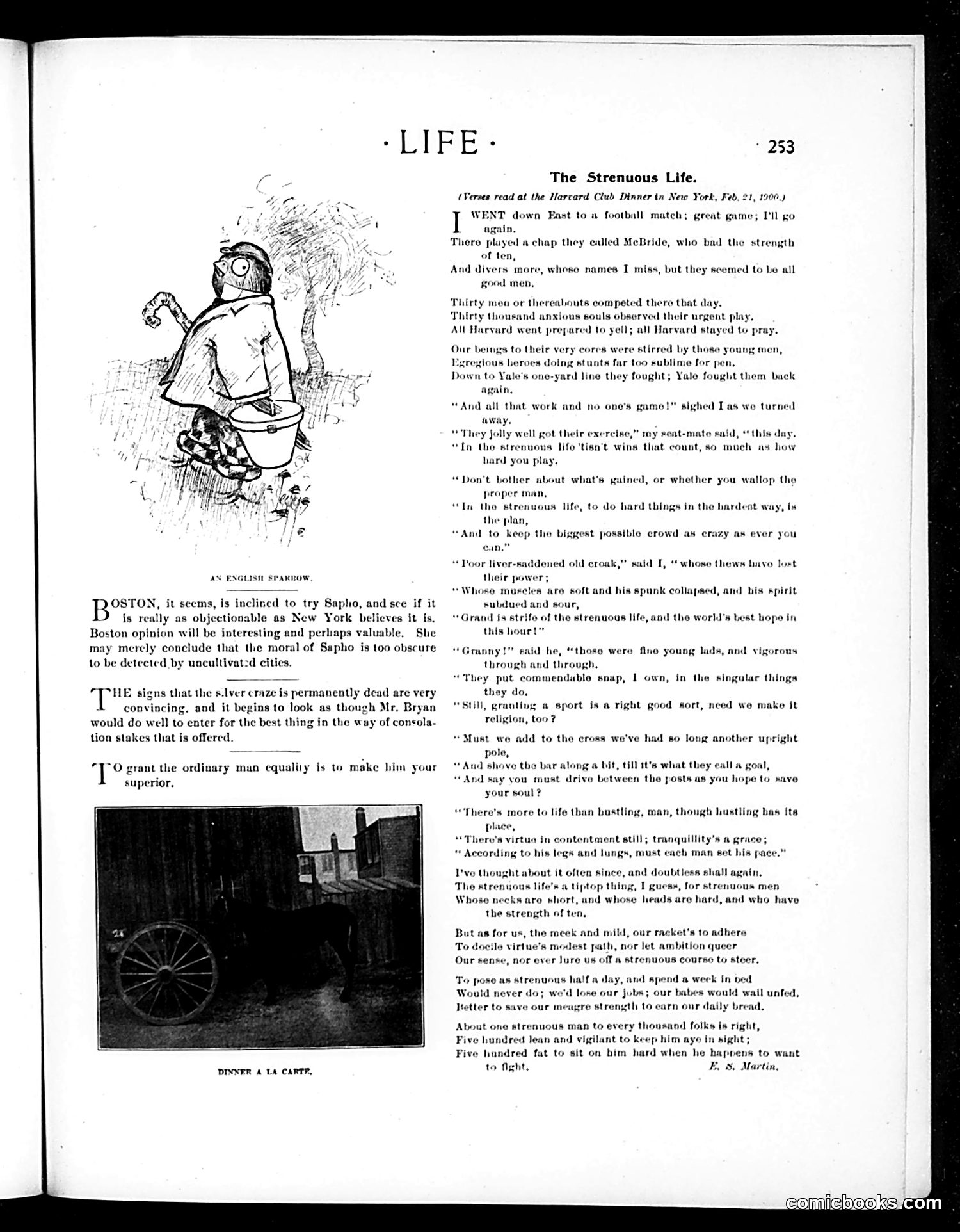
This page satirizes President Theodore Roosevelt's famous "Strenuous Life" philosophy, which he had promoted publicly. The poem, read at a Harvard Club dinner in February 1900, mocks the cult of masculine vigor and athletic competition that Roosevelt championed. The sketch of "An English Sparrow" (top left) appears unrelated—a separate item about Boston considering staging the play *Sapho*, deemed morally objectionable by New York audiences. The main satire contrasts Roosevelt's gospel of hard work, athletic prowess, and competitive struggle with ordinary working people's reality. The poem's speaker initially celebrates vigorous young football players, then his companion gently deflates the philosophy: most ordinary men lack "the strength of ten" and cannot afford the luxury of constant strenuousness. They must conserve energy for daily bread and their jobs. The satire's point: Roosevelt's ideology suits only the wealthy elite; ordinary citizens cannot live "strenuous lives"—they must be meek, mild, and dutiful simply to survive. The poem thus exposes the class bias in Roosevelt's celebrated philosophy.
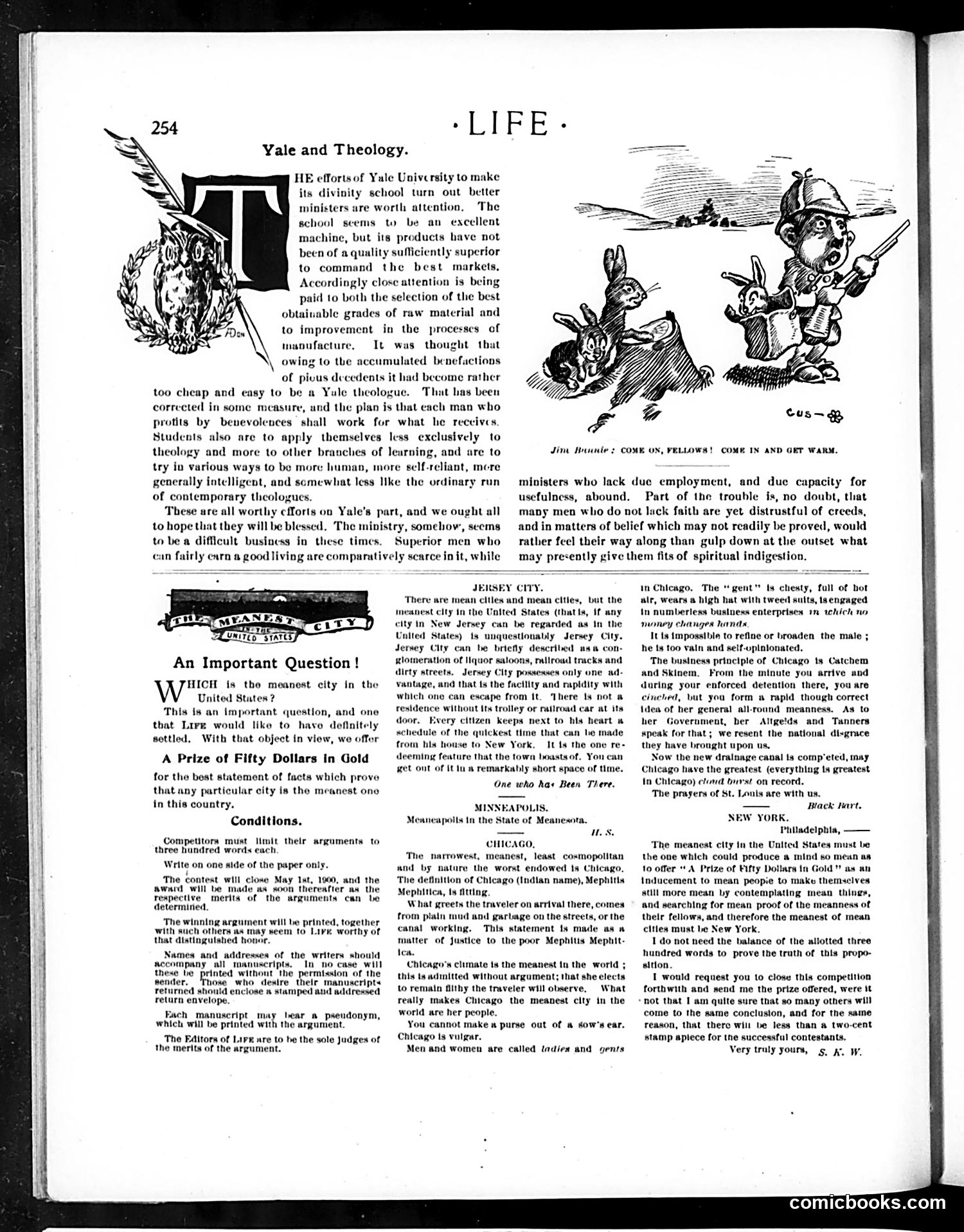
This page combines social satire with a reader contest. The top section mocks Yale Divinity School's efforts to improve ministerial training, suggesting the institution treats theology education like manufacturing—selecting better "raw material" and improving "processes." The satire critiques how commercialized and mechanized religious education had become. The main feature is a humorous contest asking readers: "Which is the meanest city in the United States?" *Life* offers $50 gold for the best argument proving a particular city is the "meanest" (most miserable/despicable). The cartoon illustrations show rabbits or similar creatures in action—likely accompanying the contest announcement. Submitted arguments attack **Jersey City** (described as saloons, railroad tracks, and dirty streets whose only virtue is easy escape to New York) and **Chicago** (deemed narrow, uncosmopolitan, plagued by mud and garbage). The Latin plant name *Mephitis Mephitica* (skunk) is used as a contemptuous joke about Chicago. This reflects *Life's* role as a satirical magazine using humor to critique urban American life and civic problems around 1900.
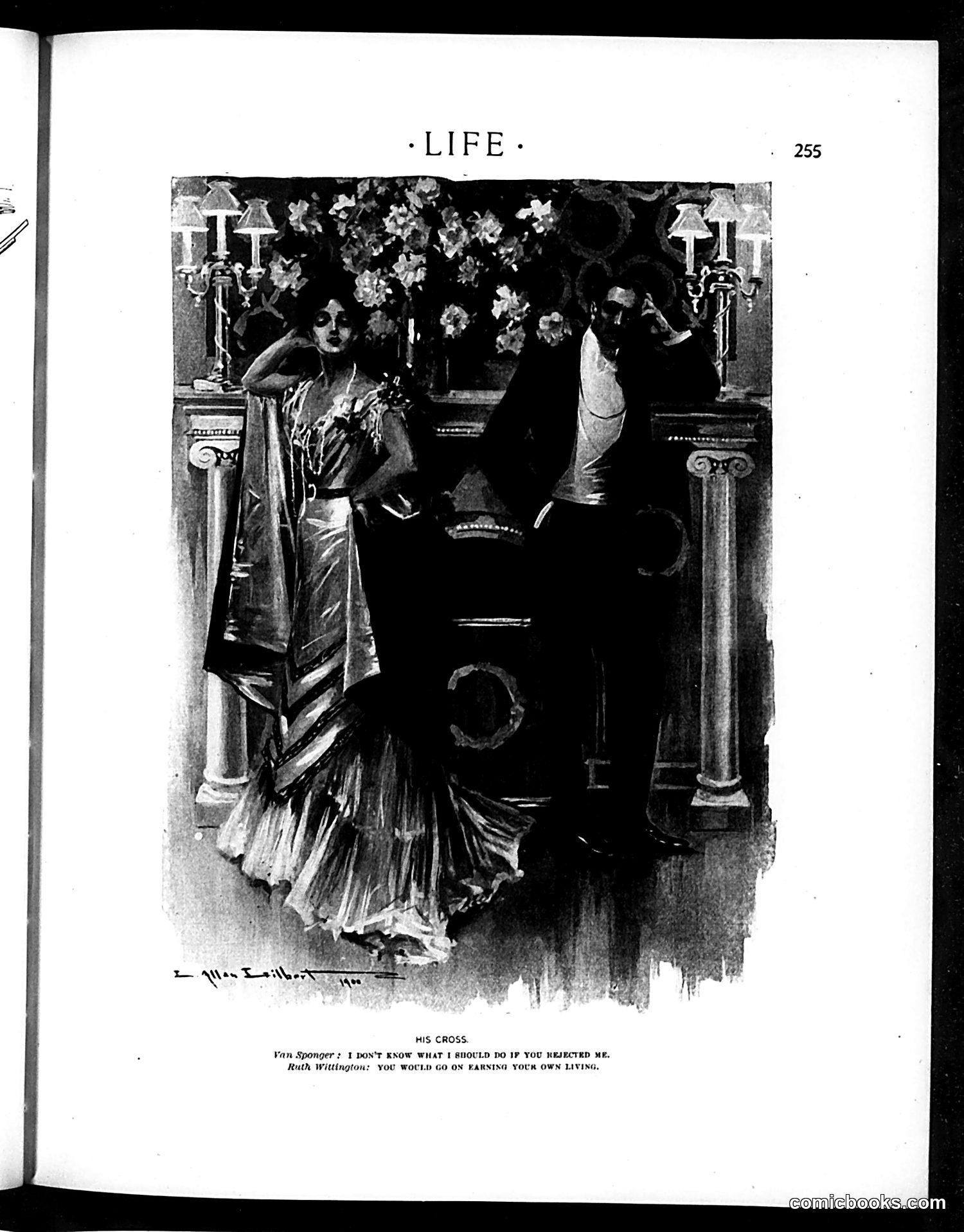
This Life magazine illustration depicts a domestic dispute between two characters: Van Sponger and Ruth Wittington. The satire centers on economic dependency in relationships. When Sponger threatens that rejection would devastate him, Wittington responds bluntly that he'd simply continue supporting himself—implying he's a financial burden relying on her income. The cartoon mocks men who present themselves as helpless without female financial support, a social critique relevant to early 20th-century gender economics when women increasingly entered the workforce. The elegant interior setting with columns and floral decorations contrasts sharply with the harsh reality being discussed. The title "His Cross" suggests Sponger views his dependence as an unbearable burden, though the joke frames his predicament as self-inflicted and ridiculous.
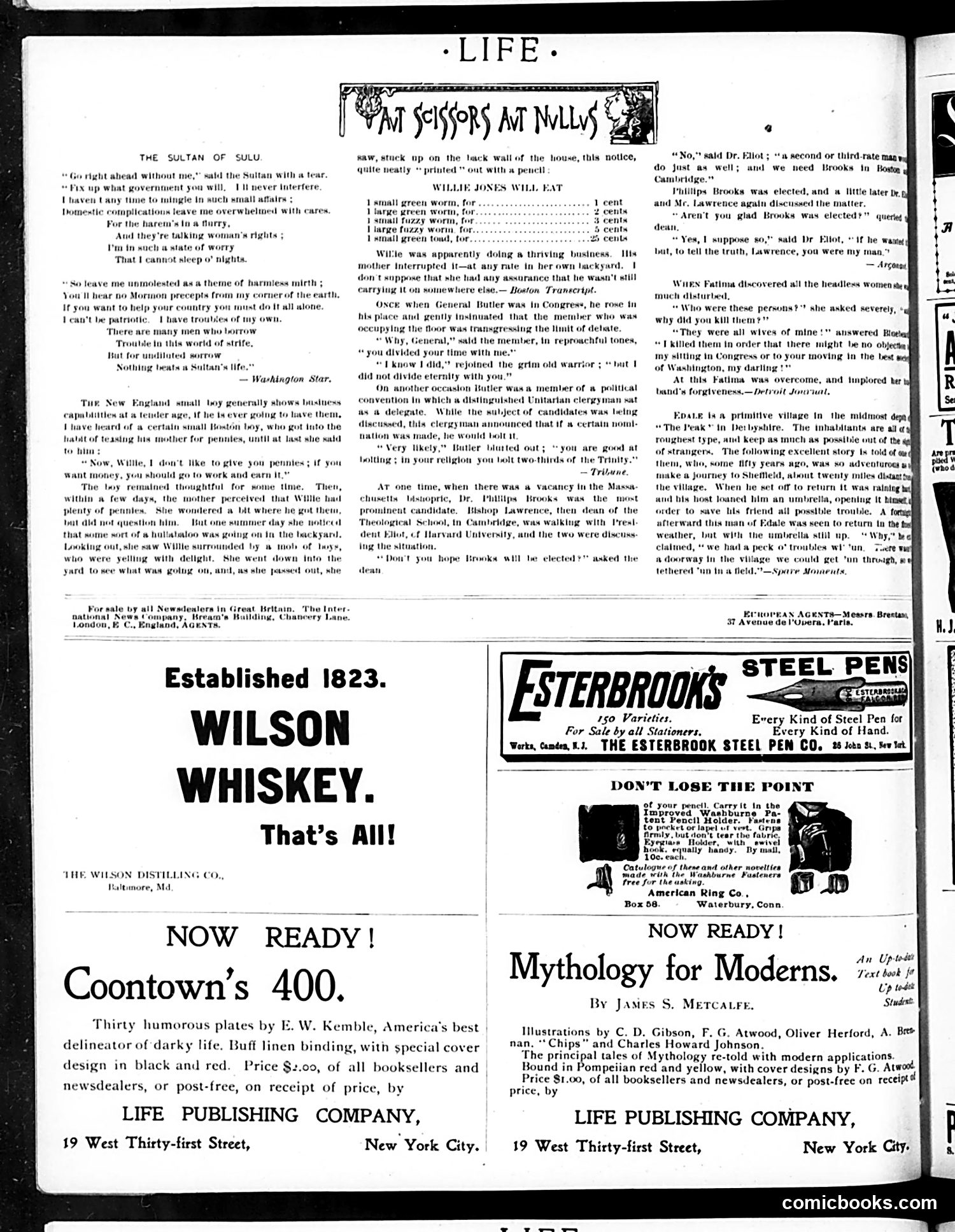
This page contains several humorous anecdotes rather than political cartoons. The main pieces satirize prominent 19th-century figures: **"The Sultan of Sulu"** mocks a foreign ruler overwhelmed by domestic troubles, particularly women's rights activism—a contemporary social issue. The Sultan's complaints about his harem and inability to sleep reflects anxieties about changing gender roles. **"Willie Jones Will Eat"** is a lighthearted children's story about a boy profiting from selling caterpillars. **The General Butler anecdotes** reference historical figure Benjamin Butler in Congress, depicting him as tactless and pompous when challenging colleagues' speaking time. The dialogue mocks his pretension. **The Fatima story** appears to be an Oriental tale playing on Western stereotypes about harems and spousal treatment. These pieces represent Life's satirical humor targeting social changes (women's rights), political figures (Butler), and foreign/exotic customs—typical of late 19th-century American humor. The magazine also advertises whiskey and publishing products.
This is primarily an **advertising page** with no political cartoons or satire. The content consists of period product advertisements and promotional notices from approximately 1900. The ads promote consumer goods typical of the era: Lundborg's "Daisy Queen" perfume, Putman boots (emphasizing durability), Ramblers bicycles (priced at $40), and Nestor cigarettes. A prominent advertisement features the "Overland Limited" train, highlighting its luxurious amenities and speed to California—reflecting the era's fascination with cross-country rail travel and the growing appeal of the American West. The page also advertises Life magazine itself (Vol. 34, $4.00 bound copy) and offers cabinet photograph reproductions. **No satire or political commentary is present.** This represents straightforward commercial advertising integrated into the magazine's pages—standard practice for early 20th-century publications.
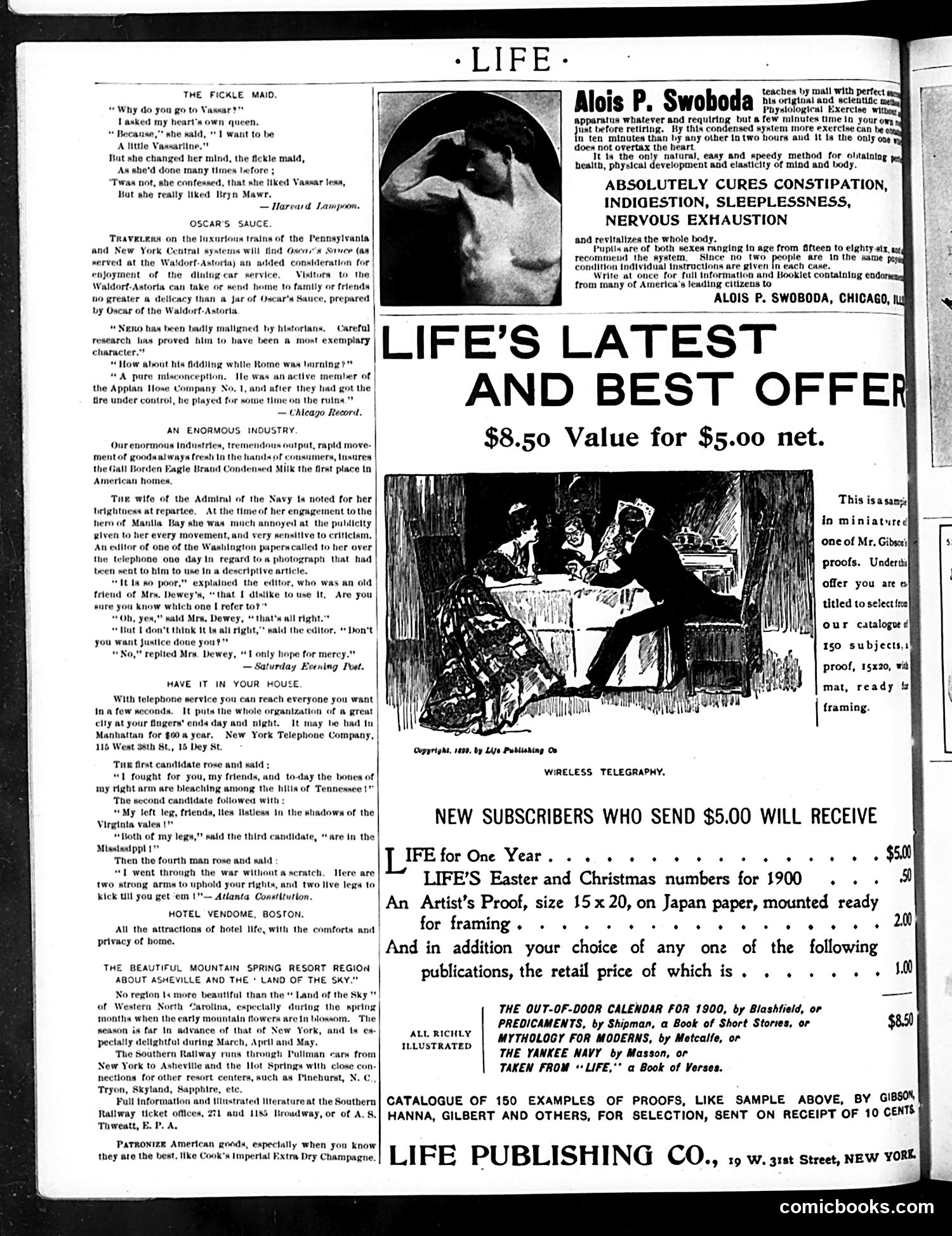
This page from Life magazine (circa 1900) contains mostly **humor and advertisements** rather than political cartoons. The textual humor includes: - **"The Fickle Maid"**: A college joke about a woman changing her mind between Vassar and Bryn Mawr—satirizing women's indecisiveness and the contemporary phenomenon of elite female education. - **"Oscar's Sauce"**: An advertisement-adjacent anecdote joking that Emperor Nero was actually a responsible firefighter, not a tyrant—a light reframing of history. - **War Veterans' Campaign**: A political joke where candidates boast of war wounds to gain votes, but the winning candidate has *no injuries*—satirizing how voters reward military service regardless of actual competence. The page is primarily filled with **period advertisements** for products like condensed milk, hotel services, and telephone companies—typical of Life's business model blending satire with commercial content. The small illustration shows a domestic scene, likely accompanying one of the jokes. Overall, this reflects early 1900s concerns: women's education, commercial prosperity, and political pandering.
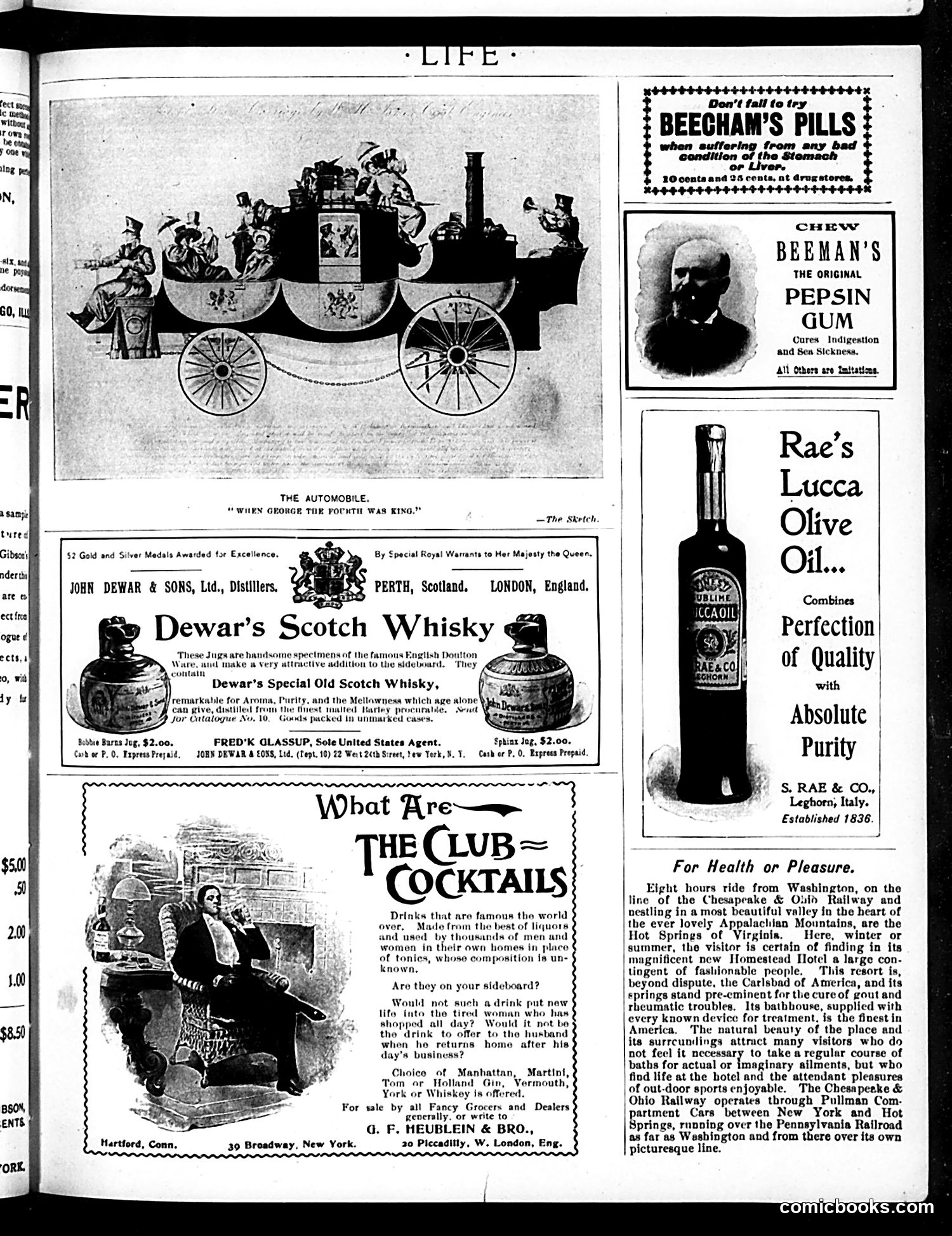
This satirical cartoon depicts an absurdly elaborate, steam-powered contraption masquerading as an "automobile" from the era of King George IV (ruled 1820-1830). The sketch mocks the primitive, fantastical notions of what early horseless carriages might look like—an overstuffed, ornate vehicle belching smoke with passengers perched precariously atop. The joke targets the gap between Victorian-era imagination and automotive reality. When this Life magazine was published, automobiles were still novel and largely theoretical to many readers. The cartoon ridicules how people envisioned these newfangled machines: impractical, dangerously unstable, and comically overcomplicated—basically a steam engine on wheels. The page is otherwise filled with period advertisements (Dewar's Scotch, cocktail recipes, patent medicines), typical of Life's revenue model. These ads reveal contemporary consumer culture: medicinal tonics, digestive remedies, and luxury goods marketed to affluent readers.
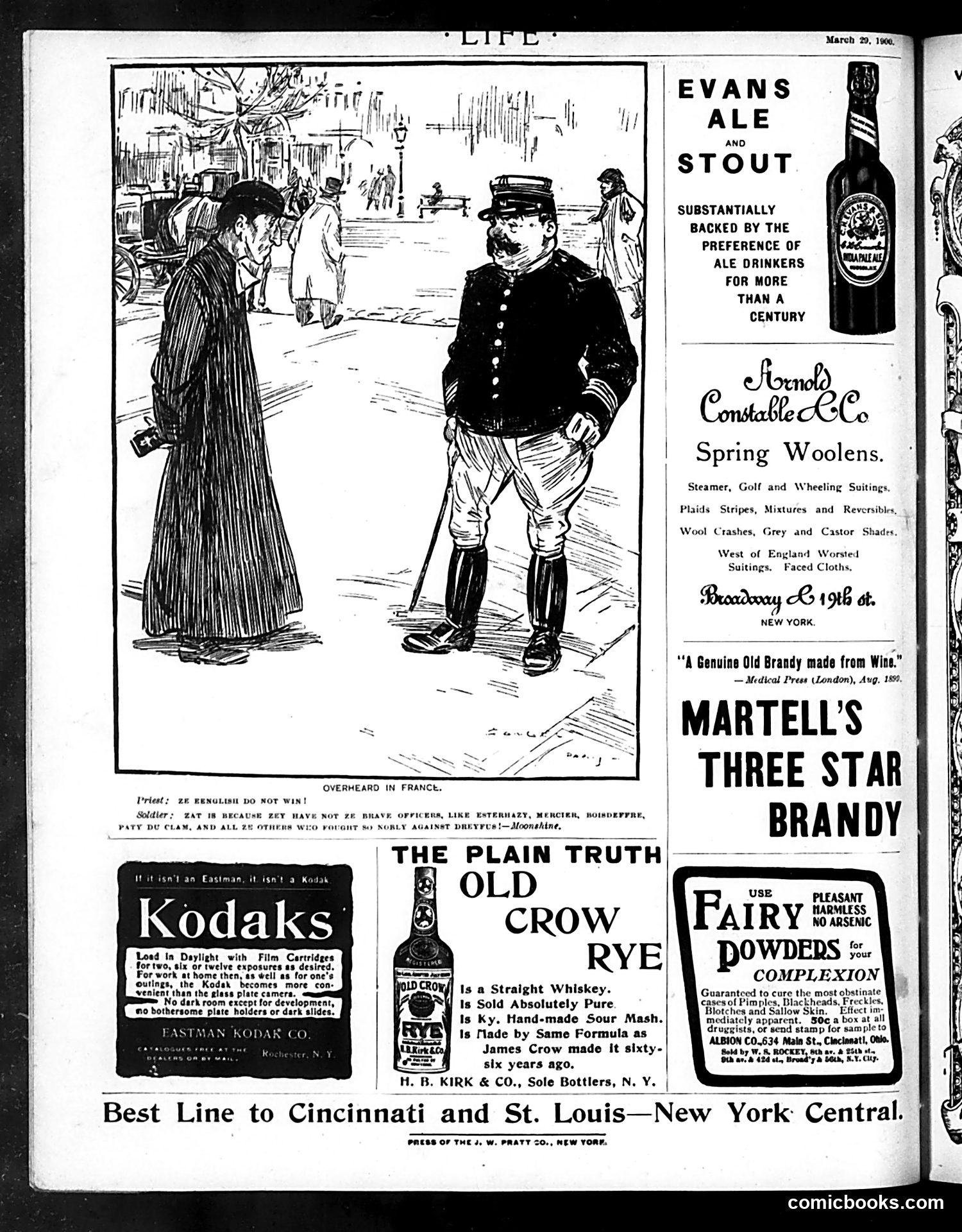
The main cartoon, titled "Overheard in France," satirizes the Dreyfus Affair's lingering impact on French military credibility. A French priest and soldier discuss why the English don't win wars. The soldier ironically credits French officers—naming real figures like Esterhazy and Mercier, who were implicated in the Dreyfus scandal—suggesting their involvement in that notorious miscarriage of justice has somehow strengthened France. The joke targets post-Dreyfus France: despite the scandal's exposure of military corruption and anti-Semitic injustice (Dreyfus was wrongly convicted), France ironically claims these same compromised officers as sources of military excellence. It's dark satire questioning French institutional integrity. The page is otherwise filled with period advertisements for ales, brandies, Kodak cameras, woolens, and powders—typical magazine filler of the era.