
Life, 1900-03-29 · page 4 of 18
Life — March 29, 1900 — page 4: what you’re looking at
What you’re looking at
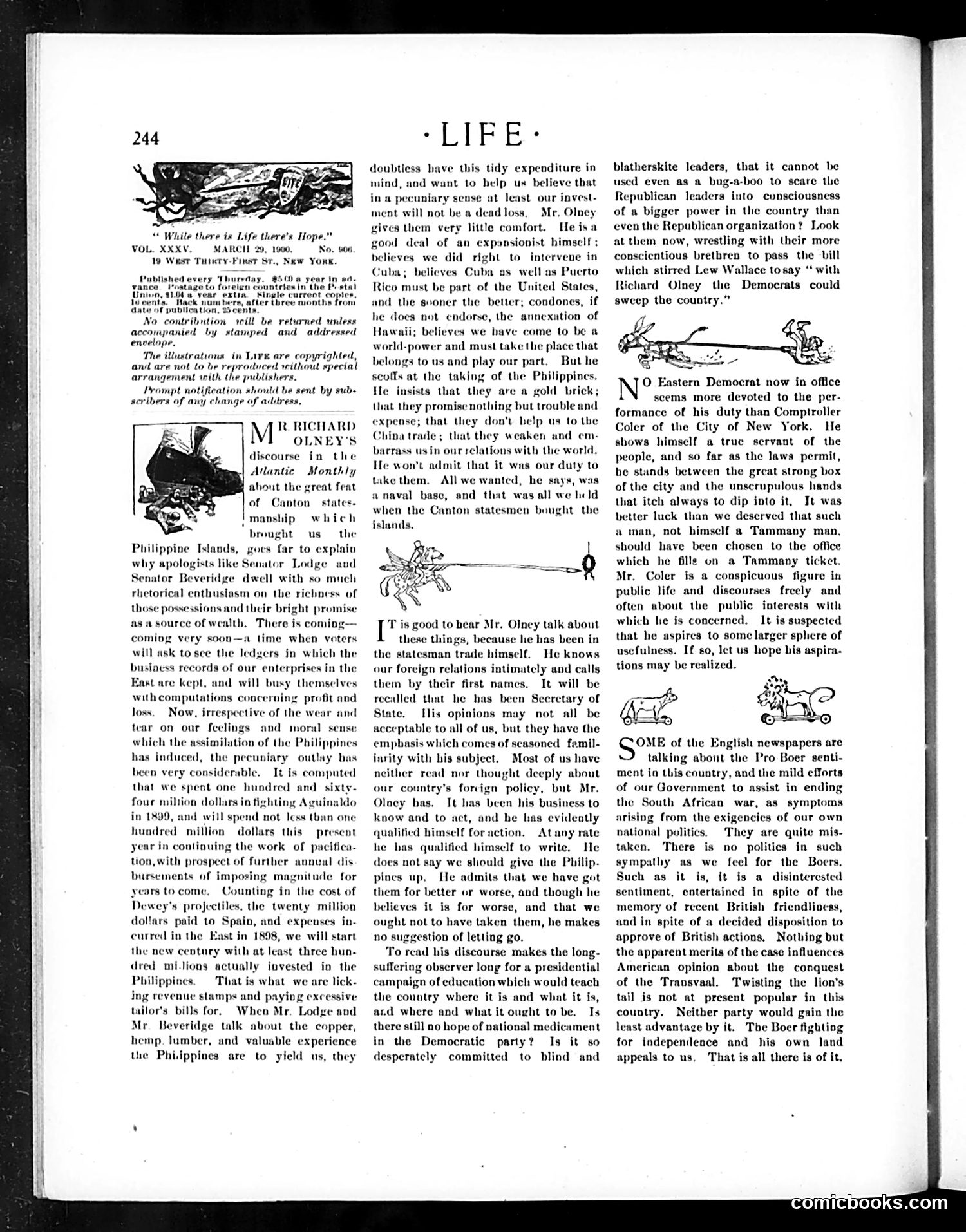
This page contains a political commentary piece on **Richard Olney**, identified as a Democratic official concerned with New York City politics. The text criticizes Olney for his involvement in city governance, suggesting he represents the "unscrupulous hands that itch always to dip into it" — a reference to corrupt municipal politics. The article discusses Olney's position on various political issues, including Philippine policy and foreign relations. It appears to debate whether Democratic leadership is committed to addressing national problems or remains blind to party interests. The decorative illustrations scattered throughout (appearing to be small animal sketches) are typical of *Life* magazine's visual style but don't represent specific political figures — they're ornamental elements common to the publication's design. The overall tone is critical commentary on Democratic Party leadership and urban political corruption.
📄 Transcribed text from this page (OCR, searchable)
Machine-transcribed from the original scan — historical spelling and the odd misread are preserved.
“ While there is Life there's Hop: VOL. XXXV. 0 MAK 19 West Tunery-Fiaer St., New Yor«. every Thursday. #500 a year No contribution will be returned unless accompanied by stamped and addressed envelope. The illustrations in Live are copyrighted, ant are not to be reproduced without special arrangement with the publishers, Prompt notification shantdl be sent by sub- scribers of any change of address, R. RICHARD l OLNEY'S discourse in the Atlantic Monthly about the great feat of Canton sta Imanship whieh Drought us the Philippine Islands, goes far to explain why apologists like Senator Lodge and Senator Beveridge dwell with so much rhetorical enthusiasm on the richness of those possessions and their bright promise as a source of wealth. There is comiog— coming very soon—a time when voters will ask tosce the ledgers in which the business records of our enterprises in the East are kept, and will busy themselves with computations concerning profit and loss. Now, irrespective of the wear and tear on our feelings and moral sense which the assimilation of the Philippines has induced, the pecuniary outlay has been very considerable. It is computed that we spent one hundred and sixty- four miltion dollars infighting Aguinaldo in 1899, and will spend not less than one huodred million dollars this present year in continuing the work of pacifi tion, with prospect of further annual dis bursements of imposing magnitude for Years tocome, Counting in the cost of Dewey's projectiles, the twenty million dollars paid to Spain, and expenses in- curred in the East in 1898, we will start the new century with at least three hun- dred mi-lions actually invested in the Philippines. That is what we are lick- ing revenue stamps and paying excessive tailor’s bills for. When Mr, Lodge and Mr Beveridge talk about the copper, hemp. lumber, and valuable experience the Phisippines are to yield us, they *LIPE« doubtless have this tidy expenditure in mind, and want to help us believe that in a pecuniary sense at least our invest- ment will not be a dead loss, Mr. Olney gives them very little comfort. He isa good deal of an expansionist himself ; belie we did right to intervene in Cuba; believes Cuba as well as Puerto Rico must be part of the United States, and the sooner the better; condones, if he does not endorse, the annexation of Hawaii; believes we bave come to be a world-power and must take the place that belongs to us and play our part. But he scoffs at the taking of the Philippines. He insists that they are a gold brick; that they promise nothing but trouble and expense; that they don’t help us to the China trade; that they weaken and em- barrass usin our relations with the world, Ife won't admit that it was our duty to take them. All we wanted, he says, anaval base, and that was all we leld when the Canton statesmen bought the islands, T is good to bear Mr. Olney talk about these things, because he has been in the statesman trade himself. He knows our foreign relations intimately and calls them by their first names. It will be recalled that he has been Secretary of State. His opinions may not all be acceptable to all of us, but they have the emphasis which comes of seasoned famil- iarity with his subject. Most of us have neither read nor thought deeply about our country’s forcign policy, but Mr. Olacy bas. It has been his business to know and to act, and he has evideotly qualiticd himself for action. At any rate he has qualified himself to write. Ie does not say we should give the Philip- pines up. He admits that we have got them for better or worse, and though he believes it is for worse, and that we ought not to have taken them, he makes no suggestion of letling go. To read his discourse makes the long- suffering observer long for a presidential campaign of education which would teach the country where it is and what it is, acd where and what it ought to be. Is there still no hope of national medicament in the Democratic party? Is it so desperately committed to blind and blatherskite leaders, that it cannot be used even as a bug-a-boo to scare the Republican leaders into consciousness of a bigger power in the country than even the Republican organization? Look at them now, wrestling with their more conscientious brethren to pass the vill which stirred Lew Wallace tosay ‘ with Richard Olney the Democrats could sweep the country.” O Eastern Democrat now in office scems more devoted to the per- formance of his duty than Comptroller Coler of the City of New York. He shows himself a true servant of the people, and so far as the laws permit, be stands between the great strong box of the city and the unscrupulous han that itch always to dip into it, It was better luck than we deserved that such a man, not himself a Tammany man, should have been chosen to the office which he fill on a Tammany ticket. Mr. Coler is a conspicuous figure in public life and discourses freely and often about the public interests with which he is concerned, It is suspected that he aspires to some larger sphere of usefulness. If so, let us hope his aspira- tions may be realized. lan ols OME of the English newspapers are talking about the Pro Boer senti- ment io this country, and the mild efforts of our Government to assist in ending the South African war, as symptoms arising from the exigencies of our own national politics. They are quite mis- taken, There is no politics in such sympathy as we feel for the Boers. Such as it is, it is a disinterested sentiment, entertained in spite of the memory of recent British friendliness, and in spite of a decided disposition to approve of British actions, Nothing but the apparent merits of the case influences American opinion about the conquest of the Transvaal. Twisting the lion’s tail is not at present popular in this country. Neither party would gain the least advantage by it. The Boer fighting for independence and his own land appeals to us, That is all there is of it. Past icbooks.com