
Life, 1900-03-29 · page 12 of 18
Life — March 29, 1900 — page 12: what you’re looking at
What you’re looking at
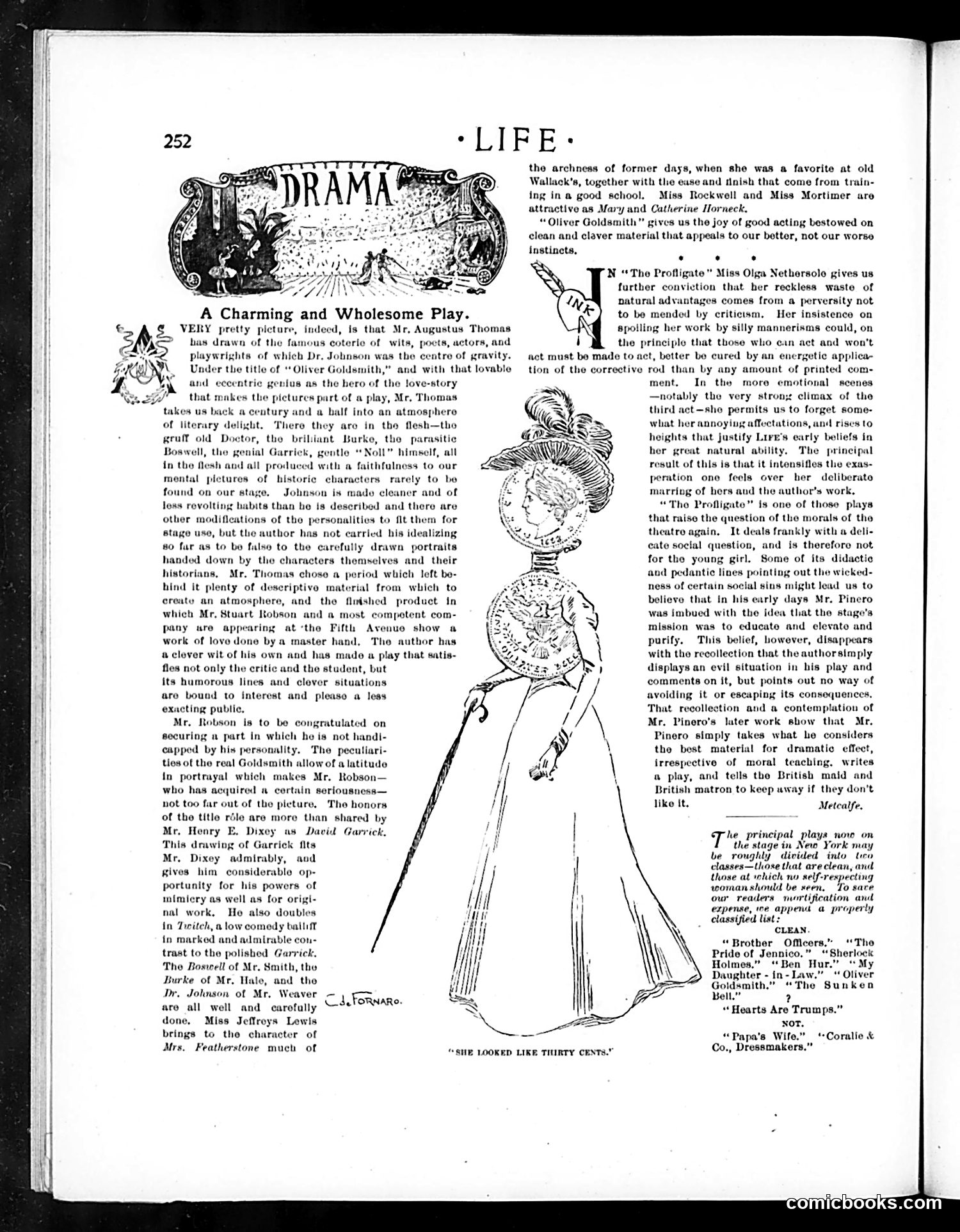
This page reviews theatrical productions, focusing on "Oliver Goldsmith" and "The Profligate." The main illustration depicts a woman in profile—labeled "SHE LOOKED LIKE THIRTY CENTS"—suggesting a caricature of an actress or theatrical character type. The reviews praise Mr. Thomas's skill in adapting Goldsmith's witty comedies, noting the play succeeds through clever dialogue and situation rather than moral instruction. "The Profligate" receives criticism for its moralistic preaching about social issues affecting young women, though the reviewer acknowledges the play raises legitimate theatrical questions about ethics. The page concludes with a list of other theatrical productions ("Brother Officers," "The Pride of Jennico," etc.), indicating this was a theater-focused column. The cartoon's caption humorously dismisses a character's appearance as shabby or worn-out.
📄 Transcribed text from this page (OCR, searchable)
Machine-transcribed from the original scan — historical spelling and the odd misread are preserved.
“LIFE the archness of former days, when she was a favorite at old Wallack’s, together with the ease and nish that come from train- ing ina good school, Miss Rockwell and Miss Mortimer aro attractive as Mary and Catherine Horneck, “Oliver Goldsmith” gives us the joy of good acting bestowed on clean and claver material that appeals to our better, not our worse instinets, . . . . N “Tho Profligate" Miss Olga Nethersolo gives us THINS 5 further conviction that her reckless waste of . 2 natural advantages comes from a perversity not A Charming and Wholesome Play. to be mended by criticism. Her insistence on & VERY pretty picture, indeed, is that Mr, Augustus Thomas spolling her work by silly mannerisms could, on — hus drawn of the famous coterie of wits, pocts, actors, and i the principle that those who ean act and won't playwrights of which Dr. Johnson was the centre of gravit act must be made to act, better be cured by an energetic applica Under the title of “Oliver Goldsmith,” and with that lovab! tion of the corrective rod than by any amount of printed com- and eccentric genius as the hero of the love-story that makes the pictures part of a play, Mr, Thomas takes us back a ceutury and a balf into an atmosphero of literary delixbt. There they aro in the flesh—tho gruff old Doctor, tho briliant Burke, tho parasitic Boswell, the genial Garrick, gentle “Noll” himself, all in the flesh and all produced with a faithfulness to our mental pictures of historic characters rarely to bo found on our sta Johnson is made cleaner and of Joss revolting habits than be is described and there are other modifications of the personalities to ft them for stago use, but the author has not carried his idealizing 80 fur as to bo fulso to the carefully drawn portraits handed down by the characters themselves and their historians, Mr. Thomas chose a period which left be- hind it plenty of descriptive material from which to create an atmosphere, and the finished product in which Mr, Stuart Robson and a most competent com- pany ure appearing at ‘tho Fifth Avenue show a work of love done by a master hand, The author has a clever wit of his own and has made a play that satis- fies not only the critic and the student, but its humorous lines and clever situations are bound to interest and pleaso a less exacting public, Mr. Robson is to be congratulated on securing a part in which he is not handi- capped by his personality, The peculiari- ties of the real Goldsmith allow of a latitude in portrayal which makes Mr. Robson— who has acquired a certain seriousness— not too far out of the picture. The honors of the title réle are more than shared by Mr. Henry E. Dixey as David Garr This drawing of Garrick fits Mr. Dixey admirably, avd gives him considerable op- portunity for his powers of mimicry as well as for origi- nal work, He also doubles in Twitch, a low comedy ballift in marked and admirable cou- trast to the polished Garrick, Tho Boswell of Mr. Smith, the Burke of Mr, Hale, and the Dr, Johnson of Mr, Weaver are all well and carofully done, Miss Jeffroys Lewis brings to the character of Mrs, Featherstone much of Cd FoRWaRe. “SHE LOOKED LIKE TIIRTY CENTS." ment. In the more emotional scenes Aes —notably the very stron; climax of the G =, bs third act—sho permits us to forget some- WE what her annoying affectations, and rises to DAES heights that justify Live's early beliefs in . her great natural ability, The principal result of this is that it intensifles the exas- peration ono feels over her deliberate marring of hers and the author's work. “Tho Profligate” is one of those plays that raise the question of the morals of the theatro again, It deals frankly with a deli- cate social question, and is thereforo not for the young girl. Some of its didactic and pedantic lines pointing out the wicked- ness of certain social sins might lead us to believe that in his early days Mr. Pinero was imbued with the idea that the stage's mission was to educate and clevato and purify, This belief, however, disappears with tho recollection that the author simply displays an evil situation in his play and comments on it, but points out no way of avoiding it or escaping its consequences. That recollection and a contemplation of Mr. Pinero's later work show that Mr. Pinero simply takes what he considers tho best material for dramatic effect, irrespective of moral teaching, writes a play, and tells tho British maid and British matron to keep away if they don't like It, Metcalfe, The principal plays nov on the stage in New York may be roughly divided into tro classes—those that areclean, and those at which no self-respecting woman should be ween. To sace our readers mortificat 1 expense, ine append ay classified list: CLEAN. “Brother OMcers.” “Tho Pride of Jennico.” “Sherlock Holmes.” “Ben Hur.” “My Daughter - in- Law.” “Oliver Goldsmith.” “The Sunken Bell.” ? “Hearts Are Trumps.” Nor. “Papa's Wile.” ‘Corali Co., Dressmakers.