
Life, 1900-03-29 · page 6 of 18
Life — March 29, 1900 — page 6: what you’re looking at
What you’re looking at
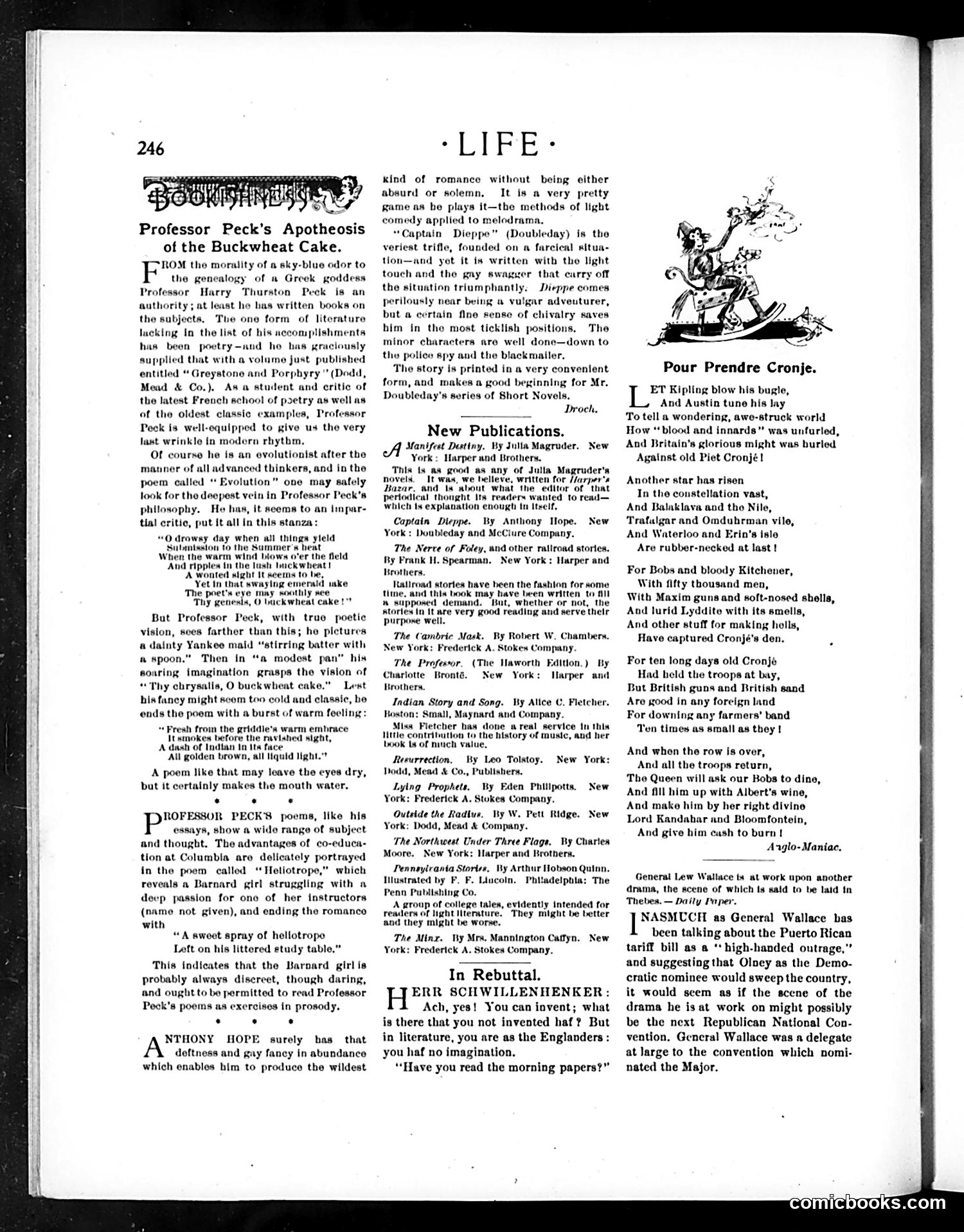
This page contains literary reviews and commentary rather than political cartoons. The main content discusses Professor Harry Thurston Peck's poetry collection "Greystone and Porphyry," praising his work while critiquing his philosophy. The page includes a decorative illustration titled "Pour Prendre Cronje" (To Capture Cronje)—likely referencing General Piet Cronjé from the Boer War, though the specific satirical point is unclear from the image alone. Below this is a poem mocking General Lew Wallace's involvement in Puerto Rican tariff debates and Republican National Convention politics. The satire suggests Wallace's political ambitions were transparent and potentially misguided. The page is primarily a book review section with light political commentary rather than visual satire.
📄 Transcribed text from this page (OCR, searchable)
Machine-transcribed from the original scan — historical spelling and the odd misread are preserved.
Professor Peck’s Apotheosis of the Buckwheat Cake. ROM the morality of a sky-blue odor to the genealogy of a Greek goddess Professor Harry Thurston Peck is an authority; at least he bas written books on the subjects, The one form of literature lucking In the list of his nccomplishments has been postry-und ho bas graciously supplied that with a volume just published entitled “ Greystone and Porphyry " (Dodd, Mead & Co.), Asa student and critic of the latest French achool of poetry as well as of the oldest classic examples, Professor Peck is well-equipped to give us the very last wrinkle in modern rhythm, Of course he is an evolutionist after the manner of all advanced thinkers, and in the poem called “ Evolution” one may safely look for the deepest vein in Professor Peck's philosophy. He has, it seems to an inpar- tial critic, put it all In this stanza: “O drowsy day when all things yleld Sutanisslon to the Summer's heat When the warm wind bi And ripples tn the lush A wonted sight It seems to be, Yet in that swaying emerald ike ‘The poet's eye may soothly nee Thy genesis, O buckwheat cake t But Professor Peck, with true poetic vision, sees farther than this; he pictures a dainty Yankee maid “stirring batter with a spoon.” Then In “a modest pan” his souring imagination grasps tho vision of “Thy chrysalis, O buckwheat cake,” Lest his fancy might scom too cold and classic, he ends the poom with a burst of warm fecling: ~ Fresh from the griddie’s warm embrace Itamokes before the nuvished sight, A dash of Indtan In Its face All golden brown, all iquid light."* A poom like that may leave the eyes dry, but it certainly makes the mouth water. * . . ROFESSOR PECK’S poems, like his essays, show a wido range of subject and thought. The advantages of co-educa- tion at Columbia aro dolicately portrayed in the poem called ‘ Heliotrope,” which reveals a Barnard girl struggling with a deep passion for ono of her instructors (name not given), and ending the romance with “A sweet apray of hellotropo Loft on his littered study table,” This indicates that the Barnard girl is probably always discreet, though daring, and ought to be permitted to read Professor Pock's poems as exercises in prosody. . . * NTHONY HOPE surely bas that doftness and gay fancy in abundance which enables him to produce the wildest LIFE kind of romance without being either absurd or solemn, It is a very pretty game as be plays it—the methods of light comedy applied to melodrama, “Captain Dieppe” (Doubleday) is the veriest trifle, founded on a farcical situa- tion—and yet it is written with tho light touch and the gay swagser that carry off the situation triumphantly. Dieppe comes perilously near being a vulgar adventurer, but a certain fine sense of chivalry saves him in the most ticklish positions, The minor characters aro well done—down to the police spy and the blackmailer, ‘The story is printed in a very convenient form, and makes a good beginning for Mr. Doubleday's series of Short Novels. Droch, New Publications. AA Manifest Destiny, By Julia Magroder. York: Harper and Brothers. This tx as good as any of Julla Magruder's novels. It was, we belleve, written for Marper's Bazar, and tx 'xbout what the editor of that periodical thought Its readers wanted to read Witch tv explanation enough ta lieelfs Captain Dieppe. By Anthony Hope. York: Doubleday and McClure Company, The Nerve of Foley, and other rallroad stories. Ry Frank H. Spearman. New York: Harper and Brothers. Iatiroad stories have been the fashlon for some tine, and thie took may have Leen written to Hi % supposed demand. But, whether or no Morton io tare Very good Feadiog and serve thelr Purpose well. The Cambric Mask, By Robert W. Chambers. New York: Frederick A. Stokes Company. The Profesor. (The Maworth Faltion.) By Charlotte Bronté. New York: Harper and Brothers. Indian Story and Song. Wy Alice ©. Fletel Hoston: Small, Maynard and Company. Mixa Fletcher hax done areal service tn this little contribution to the history of music, and her book ts of much value, By Leo Tolstoy. New New Resurrection, New York: Dodd, Mead & Co., Publishers. Lying Prophets, By Eden Philipotts. New York: Frederick A. Stokes Company, Outside the Radius, Wy W. Pett Ridge. York: Dodd, Mead & Company. The Northwest Under Three Flags. By Chariea Moore, New York: Harper and Brothers. Pennaylranta Storts, Wy Arthur Hobson Quinn, Illustrated by F. F. Lincoln, Phitadelphia: The Penn Publishing Co. A group of college tales, evidently intended for readers of light Iterature. They might be better and they might be worse. The Ming. By Mrs. Mannington Cattyn. York: Frederick A. Stokes Company, In Rebuttal. ERR SCHWILLENHENKER: Ach, yes! You can invent; what is there that you not invented haf? But in literature, you are as the Englanders : you haf no imagination. “Have you read the morning papers?” New New Pour Prendre Cronje. ET Kipling blow his bugle, And Austin tune his lay To tell a wondering, awo-struck world How “ blood and innards” was unfurled, And Britain's glorious might was burled Against old Piet Cronjé! Another star has risen In the constellation vast, And Balaklava and tho Nile, Trafalgar and Omdubrman vile, And Waterloo and Erin’s isle Are rubber-necked at last ! For Bobs and bloody Kitchener, With fifty thousand men, With Maxim guns and soft-nosed shells, And lurid Lyddite with its smells, And other stuff for making hells, Have captured Cronjé’s den. For ten long days old Cronjé Had held the troops at bay, But British guns and British sand Aro good in any foreign land For downing any farmers’ band ‘Ton times as small as they 1 And whon the row is over, And all the troops return, ‘Tho Queen will ask our Bobs to dine, And fill him up with Albert's wine, And make him by her right divine Lord Kandahar and Bloomfontein, And give him cash to burn f Aaglo-Maniac, General Lew Wallace ts at work upon another drama, the scene of which ts sald to be laid tn Thebes. — Daily Paper. NASMUCH as General Wallace bas been talking about the Puerto Rican tariff bill as a ‘*high-handed outrage,” and suggesting that Olney as the Demo- cratic nominee would sweep the country, it would seem as if the scene of the drama he is at work on might possibly be the next Republican National Con- vention. Gencral Wallace was a delegate at large to the convention which nomi- nated the Major. icbooks.com