
A complete issue · 20 pages · 1900
Life — January 11, 1900
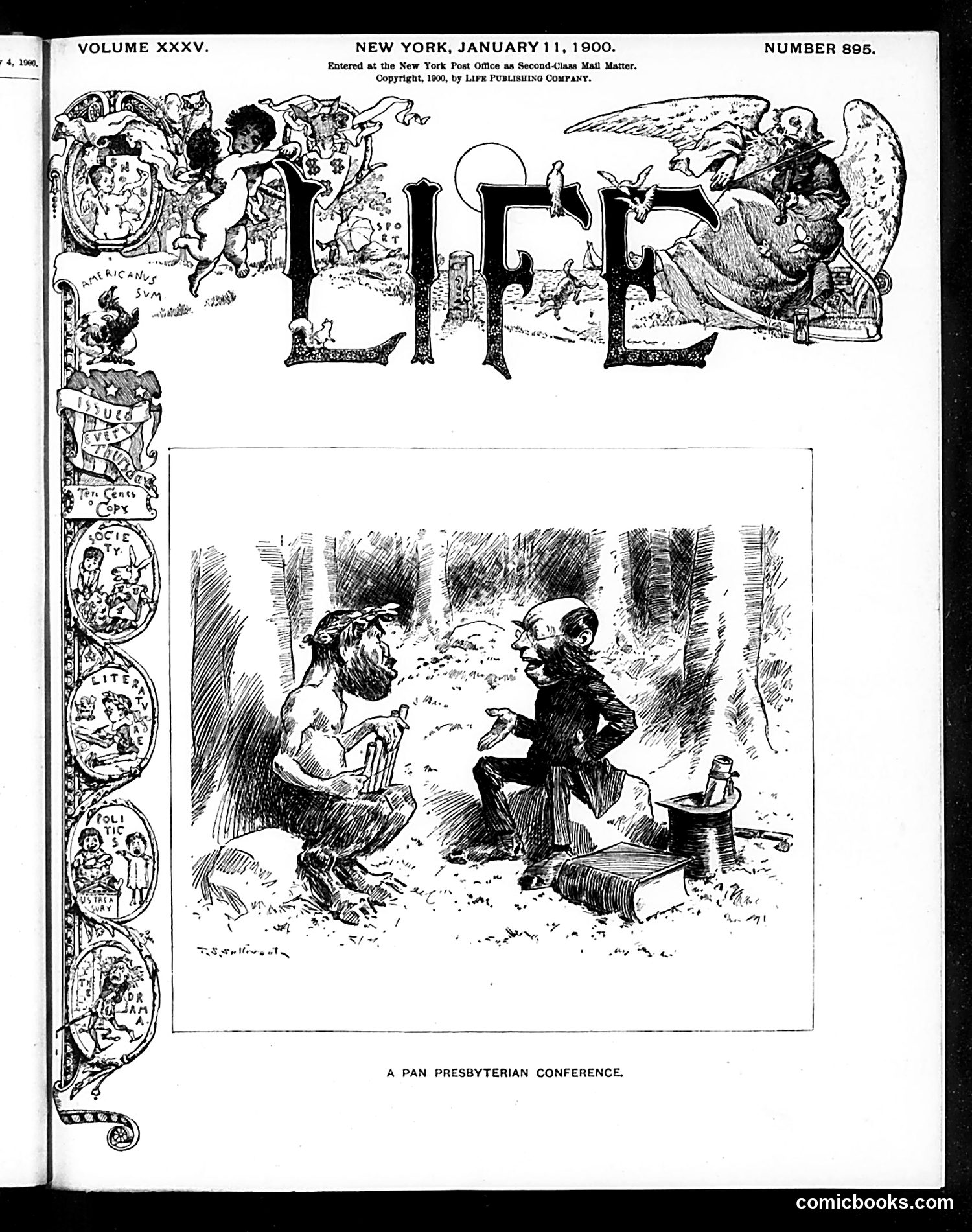
This cartoon depicts two figures meeting in a forest clearing, labeled "A Pan Presbyterian Conference." The satire appears to mock Presbyterian church gatherings or ecumenical meetings of the era. The two men—one appearing disheveled and crude, the other more formally dressed—seem to represent different Presbyterian factions or regional variations of the denomination attempting dialogue. The forest setting and their primitive surroundings suggest the cartoonist is satirizing these meetings as somewhat uncivilized or awkward affairs. Without additional context about specific Presbyterian schisms or conferences in 1900, the exact targets remain somewhat unclear, but the cartoon clearly ridicules formal church unity efforts as mismatched or ineffective.
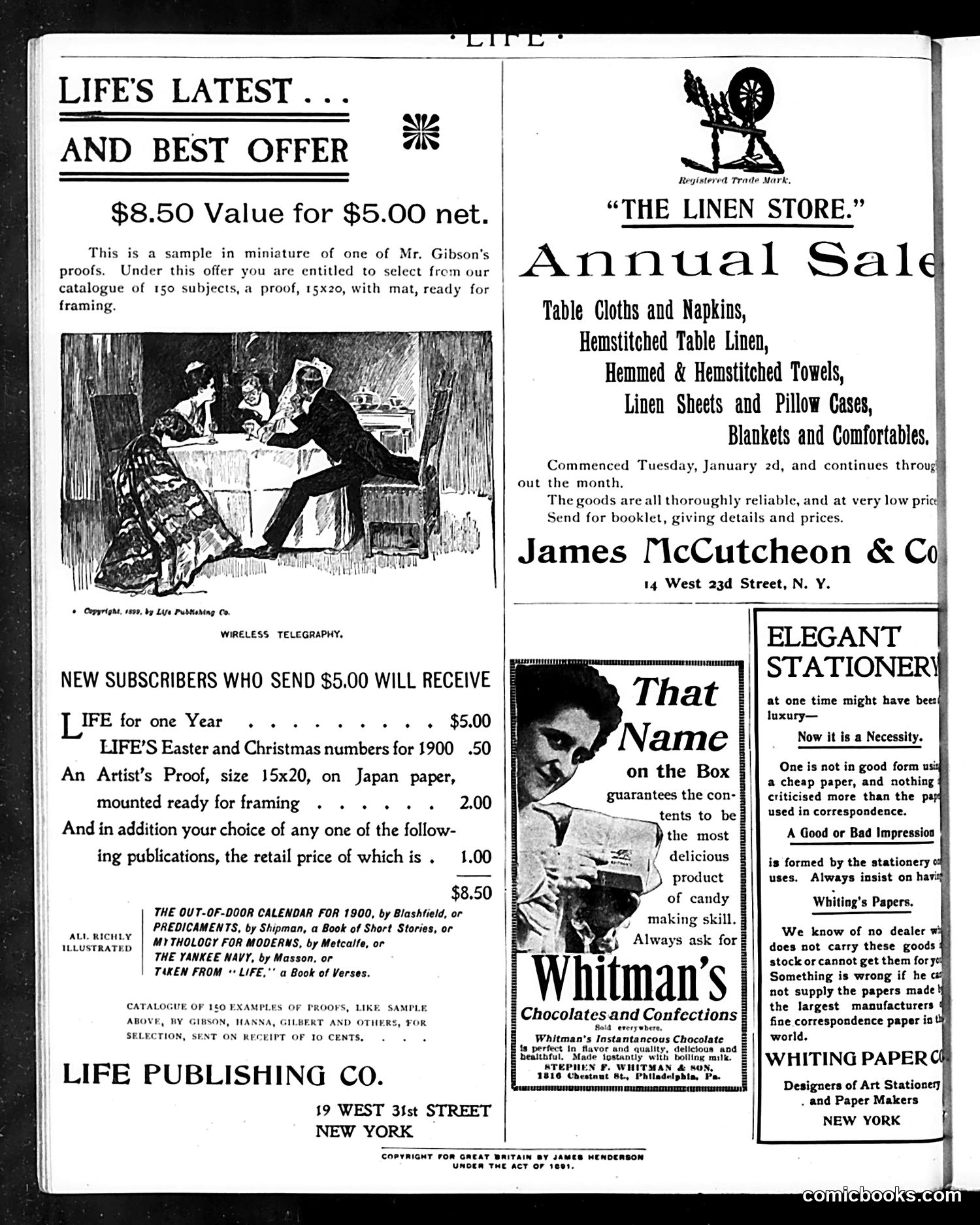
This page is primarily **advertising rather than satire or political commentary**. The left side advertises LIFE magazine subscriptions ($5.00 for one year) and includes an illustration labeled "WIRELESS TELEGRAPHY" showing what appears to be early 1900s communication technology—likely depicting people using telegraph or early radio equipment. This reflects contemporary fascination with modern technology. The right side contains commercial advertisements for "The Linen Store" (James McCutcheon & Co.), Whitman's Chocolates and Confections, and Whiting's Papers stationery company. The image serves as a sample of Mr. Gibson's artistic proofs available in a catalogue, suggesting this is from Life's early commercial operations around 1900.
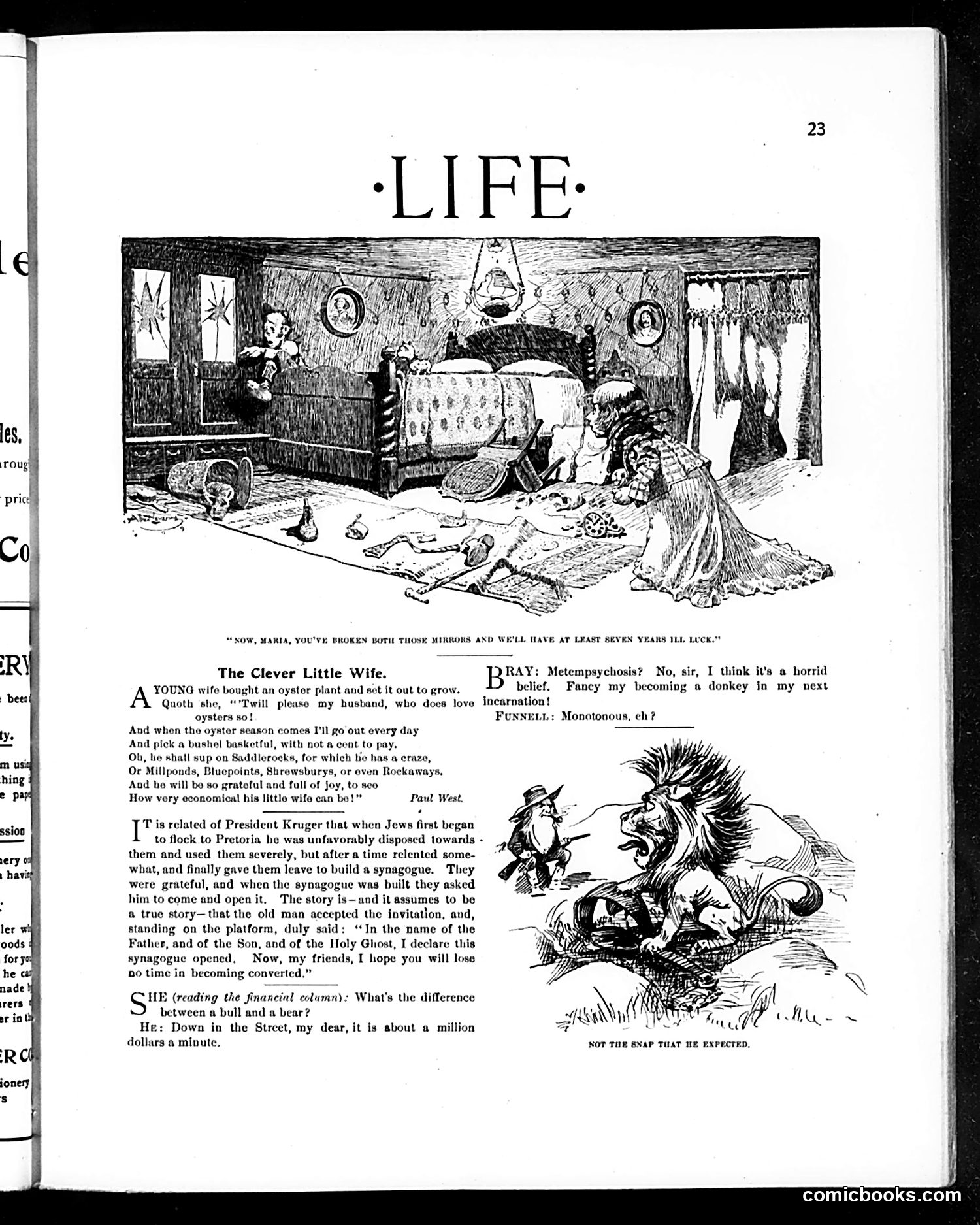
**Top Illustration:** A domestic scene showing a woman in bed while a man stands nearby with a lamp, surrounded by domestic chaos—scattered items on the floor, a child, and general disorder. The caption references breaking mirrors and seven years of bad luck, satirizing superstition and marital discord. **"The Clever Little Wife":** A poem by Paul West mocks the ideal of a dutiful wife who tolerates her husband's poor financial decisions and infidelity (oyster season, gambling debts), celebrating her economic sacrifice as virtuous. **Bottom Dialogue:** A joke about the difference between bulls and bears in financial markets—referencing stock trading rather than actual animals. The humor plays on double meaning. All content satirizes marriage dynamics, superstition, and financial folly common to early 20th-century American life.
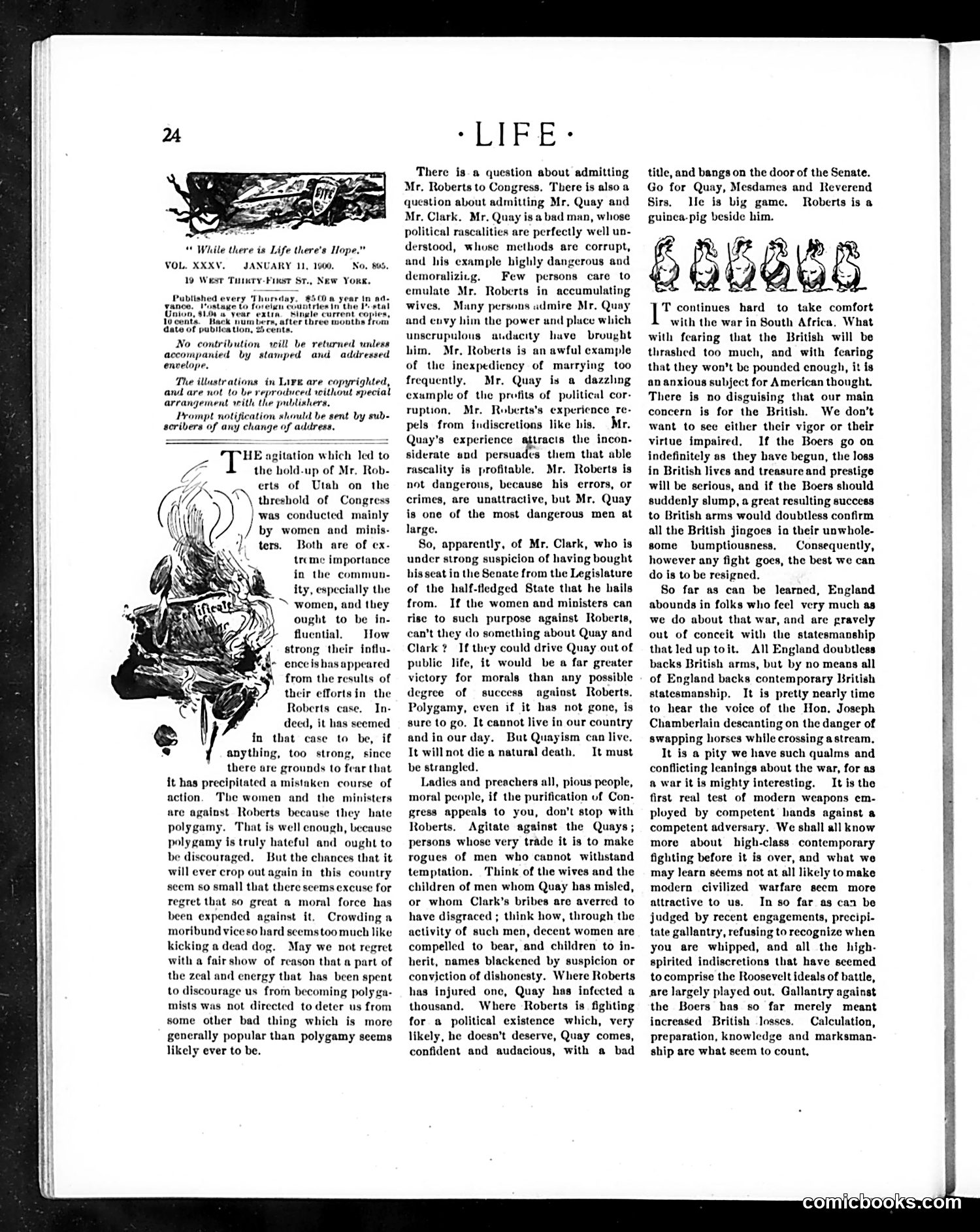
This page discusses political controversy involving congressmen Roberts, Quay, and Clark during what appears to be a Utah admission debate. The text criticizes Roberts as morally dangerous due to polygamy, while defending him against efforts to exclude him from Congress. The cartoon on the left depicts a caricatured figure (likely Roberts) as a grotesque, wild-haired character, emphasizing the satirical mockery of his polygamous practices. The small illustrations at top right show simplified figures in a row, their meaning unclear from context alone. The satire argues that while Roberts's polygamy is indefensible, efforts by Quay and Clark to remove him are hypocritical—these men are themselves corrupt politicians whose moral authority is questionable. The piece critiques using polygamy as a convenient political weapon rather than principle.
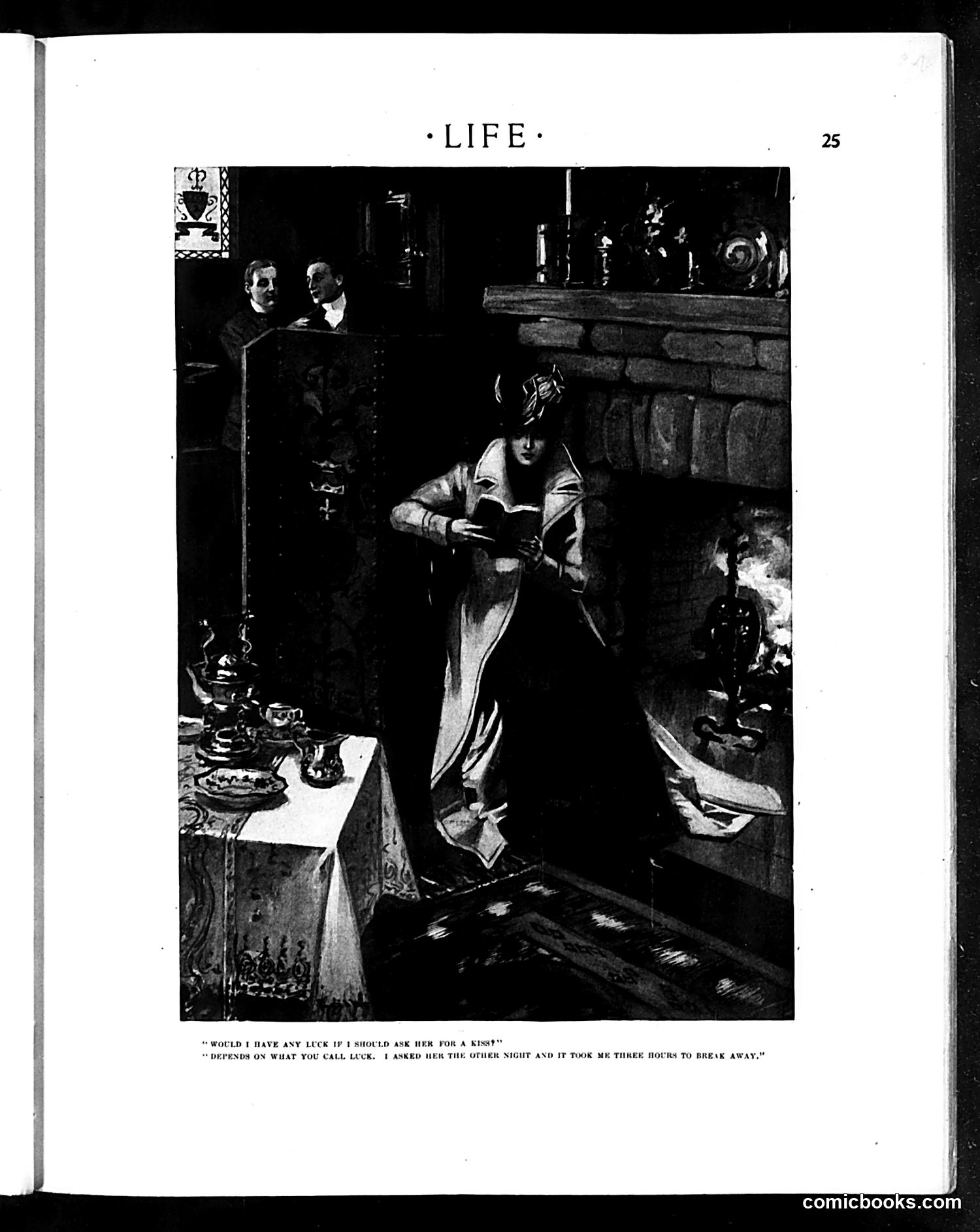
This page from *Life* magazine presents a dramatic scene depicting a woman in elegant period dress, apparently reading or holding documents, while two men converse in the background near a fireplace. The caption reads: "Would I have any luck if I should ask her for a kiss?" / "Depends on what you call luck. I asked her the other night and it took me three hours to break away." This appears to be a satirical commentary on courtship and romantic entanglement, suggesting the woman's romantic attention is difficult to escape once engaged. The formal setting and period styling suggest this may reference a well-known literary work or contemporary social drama, though I cannot identify the specific figures or determine the exact source being satirized from the image alone. The humor relies on the tension between romantic pursuit and its unexpectedly consuming consequences.
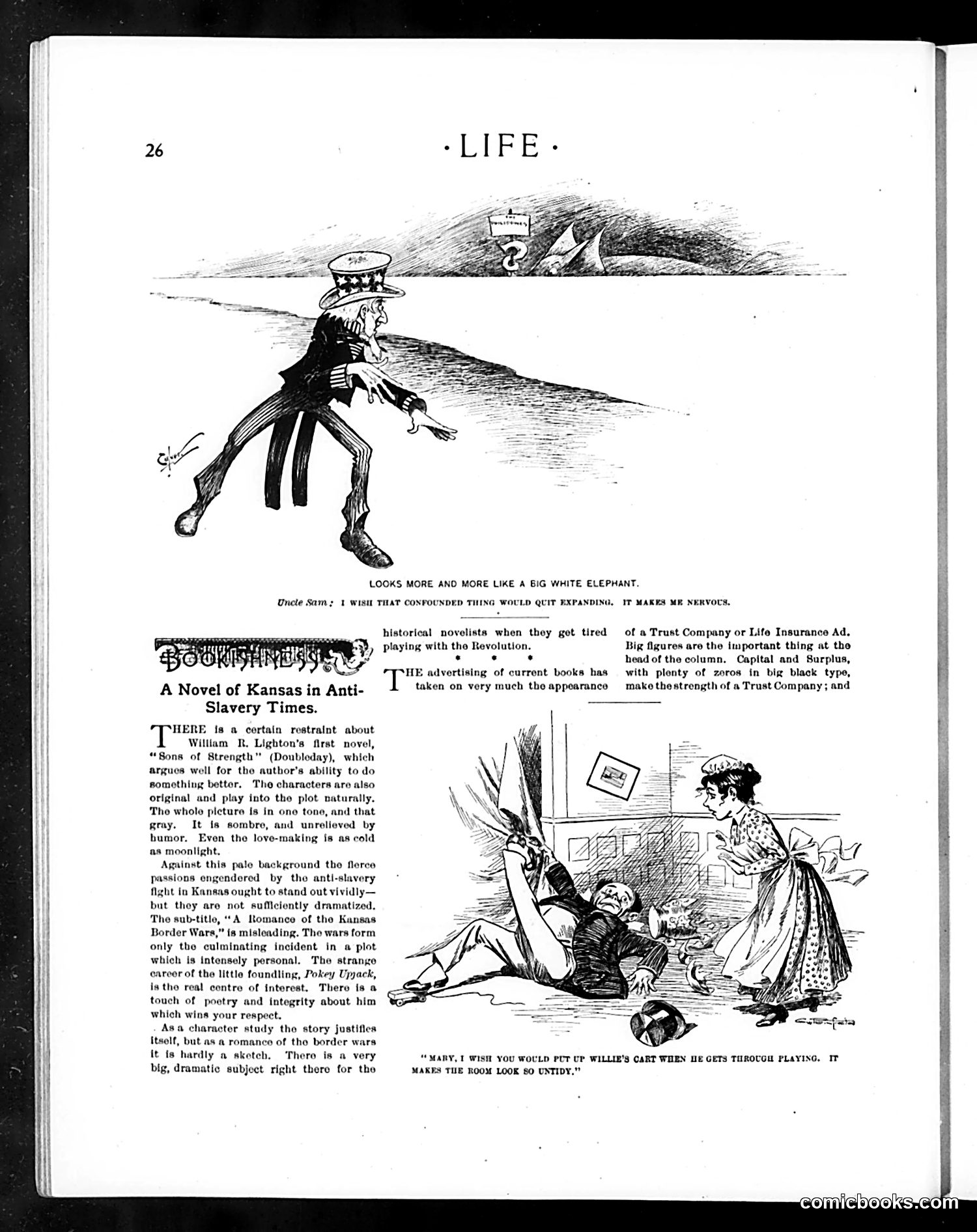
The top cartoon depicts **Uncle Sam** (identifiable by his characteristic top hat and goatee) as an emaciated, skeletal figure, nervously gesturing toward an island. His caption reads: "I wish that confounded thing would quit expanding. It makes me nervous." This satirizes American **imperial expansion**, likely referencing territorial acquisitions around the Spanish-American War era (1898). The "confounded thing" appears to be newly acquired territory, possibly the Philippines or Caribbean islands. The cartoon critiques Uncle Sam's anxiety about managing these expanded possessions—suggesting the expansion creates instability rather than strength. The lower section discusses William H. Lighton's novel "Sons of Strength," set during the Kansas slavery conflicts of the pre-Civil War era.
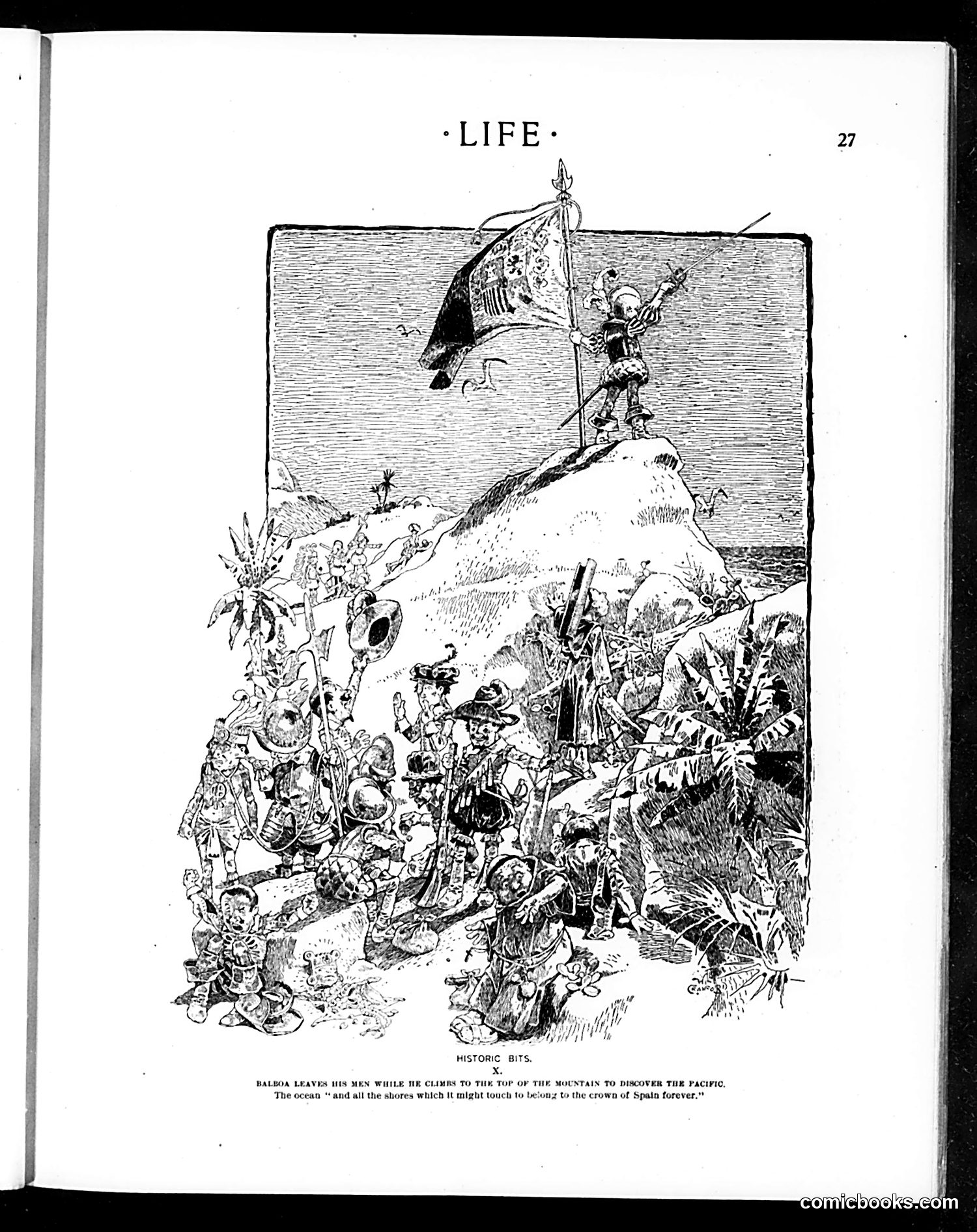
This satirical illustration depicts **Balboa leaving his men while he climbs to the top of the mountain to discover the Pacific**. The caption quotes Balboa claiming the ocean "and all the shores which it might touch to belong to the crown of Spain forever." The cartoon lampoons Spanish colonial ambitions and the absurdity of claiming vast territories through exploration. The crowded, chaotic scene of soldiers and indigenous peoples at the base contrasts with Balboa's solitary ascent, mocking the grandiosity of such proclamations. The satire suggests the gap between the modest reality of exploration and the massive imperial claims made from it—a pointed critique of Spanish expansionism dressed as historical commentary.
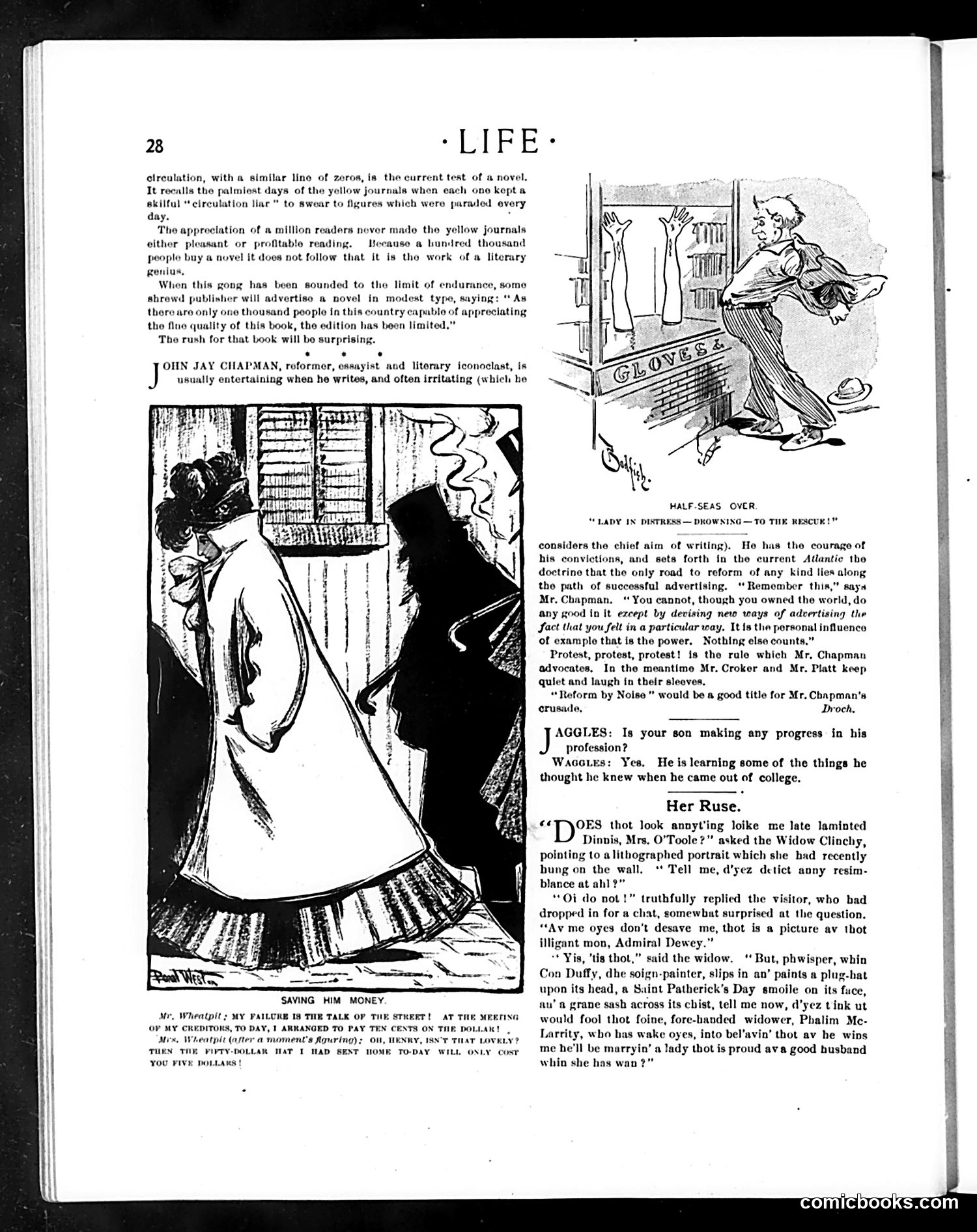
This page contains two distinct cartoons satirizing American literature and social pretension. The left cartoon, titled "Saving Him Money," depicts a man reading in a chair while a woman gestures dismissively. The caption criticizes Mr. Westright's "failure" as a street creditor—he arranged to pay debts in installments rather than lump sums, yet his wife mocks his frugality, saying he'll only cost "fifty dollars" instead of the expected amount. The right section, "Lady in Distress—Prowing—to the Rescue!" satirizes romantic sentimentality. The accompanying text mocks John Jay Chapman's literary reform crusade in the *Atlantic*, suggesting his "protest" advocacy is naive. A separate anecdote titled "Her Ruse" humorously depicts a widow deflecting a visitor's criticism of a portrait by flattering him with Saint Patrick's Day references. The overall tone ridicules both financial anxiety and overwrought literary posturing in contemporary American life.
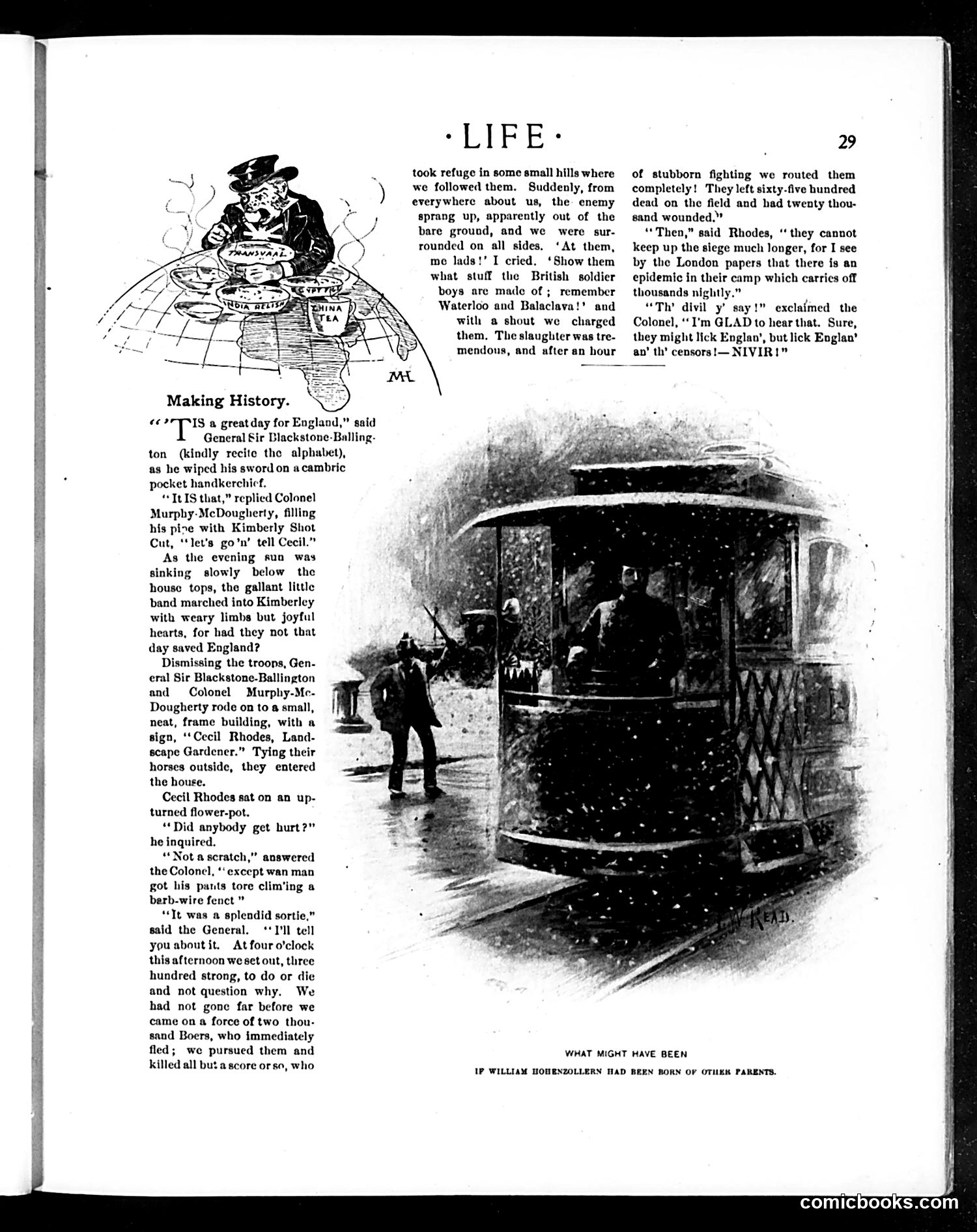
**Top Illustration:** A caricatured figure sits atop a globe labeled with various nations. The figure appears to represent a political or military leader, depicted in exaggerated style typical of satirical commentary. The globe shows British colonial territories, suggesting commentary on imperial overreach or global military ambitions. **Main Text Section ("Making History"):** The narrative describes a British military victory in South Africa, mentioning generals and colonial officials. References to "Kimberley" and conflict with "Boers" indicate this addresses the Boer Wars. **Bottom Illustration:** Shows a covered military transport vehicle, likely depicting colonial or wartime transport. **Caption:** "What Might Have Been / If William Hohenzollern Had Been Born of Other Parents" — suggesting satirical commentary on German leadership and alternative historical scenarios, though the connection to the South African narrative remains unclear from visible text.
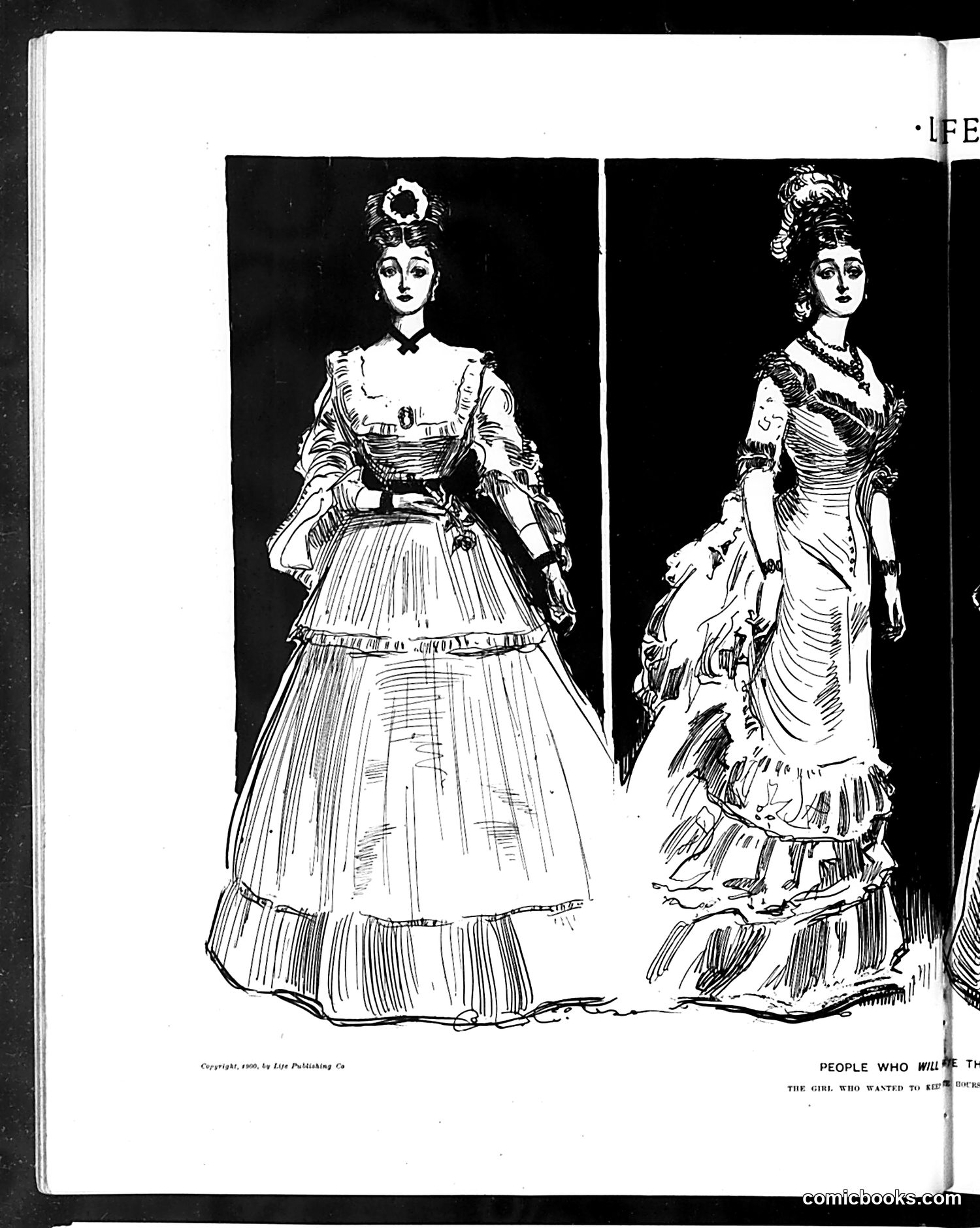
This page shows two fashion illustration sketches from Life magazine (copyright 1900, per visible text). The drawings depict elaborately dressed women in late Victorian/Edwardian era clothing, featuring the period's characteristic silhouettes: high necklines, puffy sleeves, cinched waists, and voluminous skirts with decorative ruffles and trim. The partial visible caption reads "PEOPLE WHO WILL BE TH[E]" and "THE GIRL WHO WANTED TO BE," suggesting these illustrations accompany a story or satirical piece about aspirational female characters. Without the complete text visible, the specific satirical point remains unclear, though Life magazine typically mocked social pretension and fashion absurdities of the era.
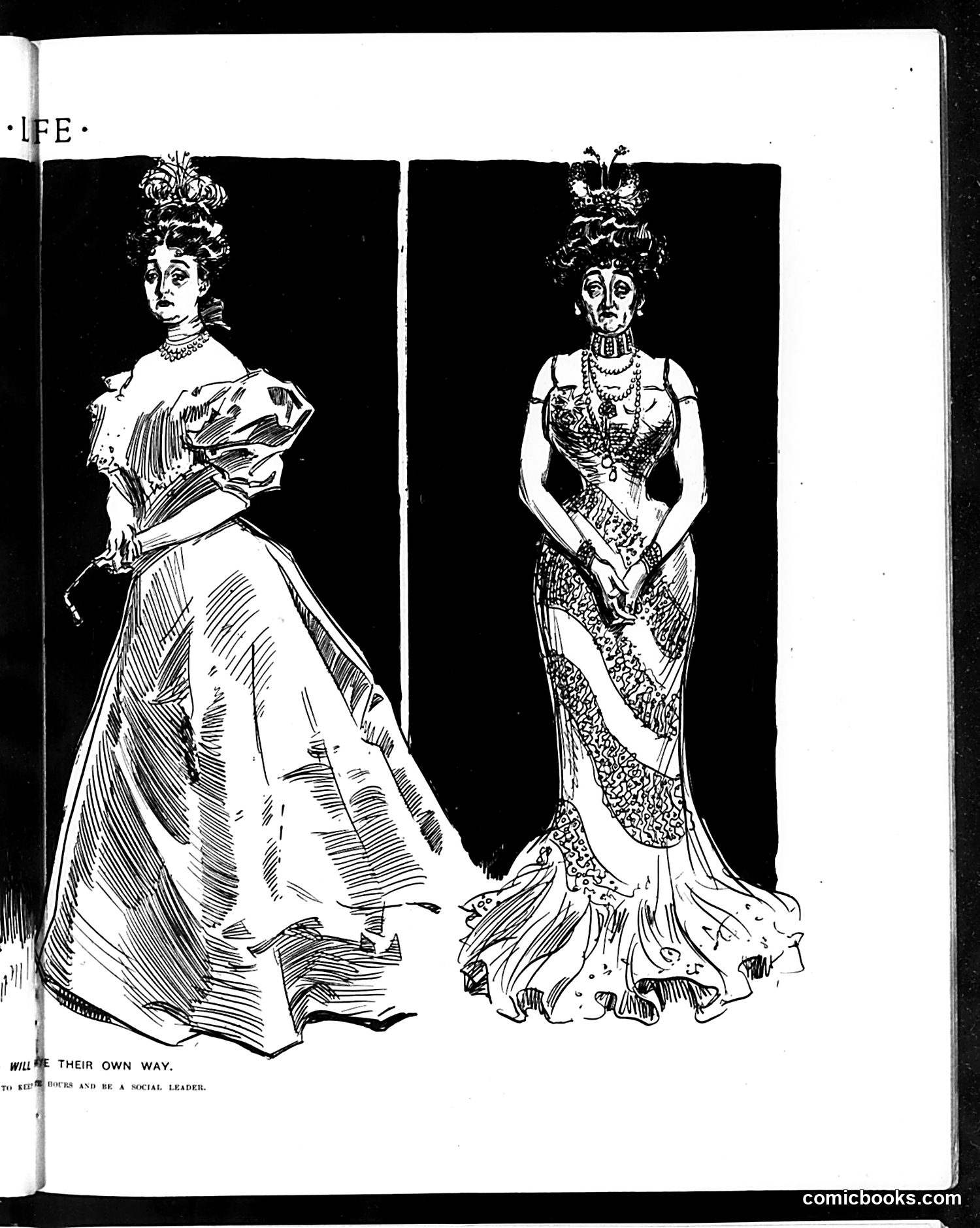
This page presents two fashion illustrations of wealthy women in early 1900s haute couture, titled "WILL BE THEIR OWN WAY" with a subtitle about "DUTIES AND BE A SOCIAL LEADER." The satire appears to mock the pretensions of society women and fashion excess of the Edwardian era. Both figures wear elaborate gowns with dramatic trains, ornate jeweled details, high collars, and elaborate upswept hair adorned with decorative elements. The exaggerated styling—particularly the right figure's extremely fitted corsetry and ornate patterning—likely satirizes the impracticality and artificiality of high-fashion dress codes that constrained women's bodies and movement. The caption suggests irony about women "having their own way" while bound by restrictive social conventions and fashion expectations of their class position.
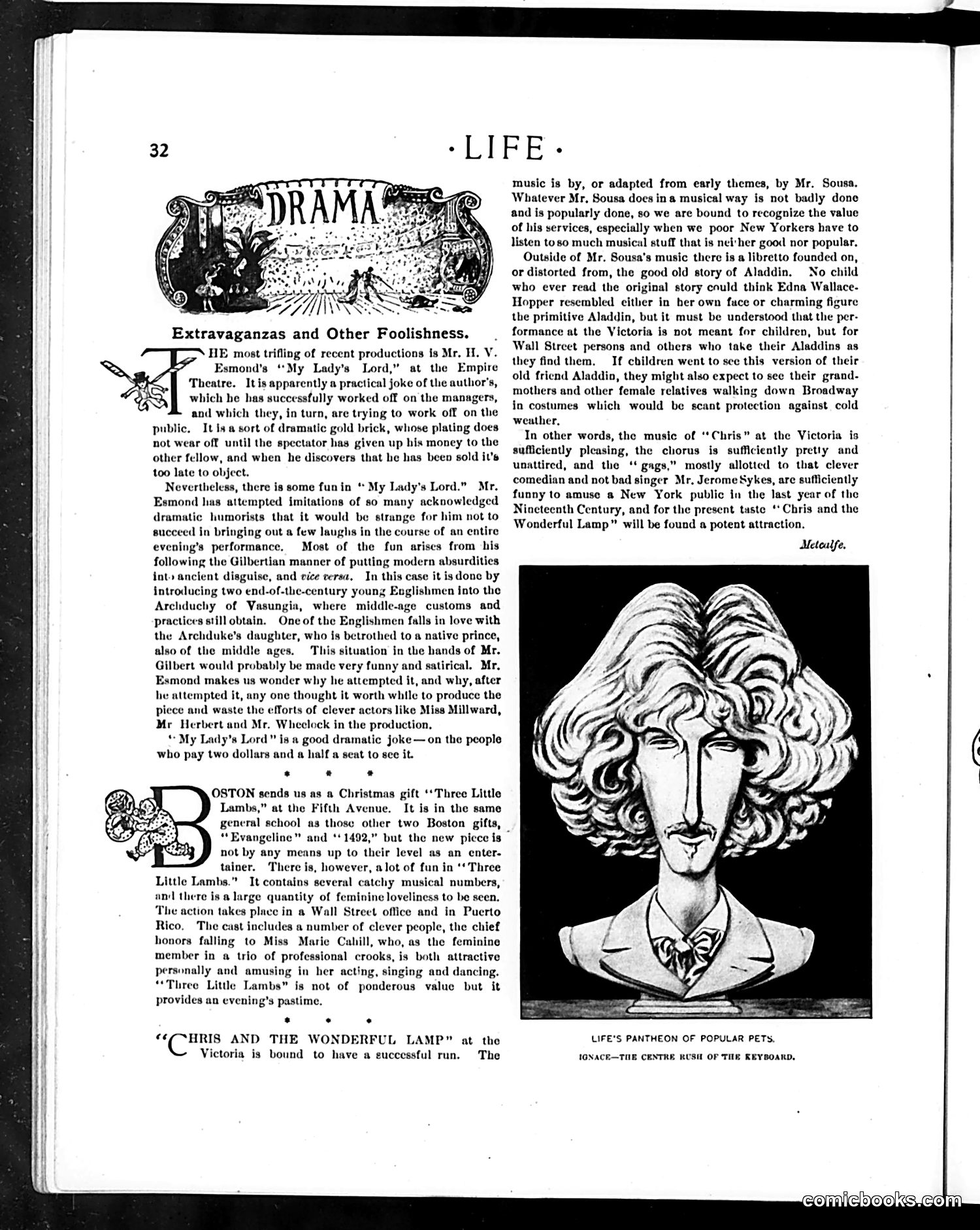
This page reviews theatrical productions. The main cartoon shows a grotesque face with elaborate curled hair, captioned "Life's Pantheon of Popular Pets—Ignace—The Centre Rush of the Keyboard." The cartoon appears to be caricaturing a pianist (likely Ignacy Jan Paderewski, a famous virtuoso), reducing him to a fashionable celebrity "pet" of society. The exaggerated features and the phrase "centre rush" suggest mockery of how popular culture elevates performers to idol status despite their questionable artistic merit. The text reviews productions including "My Lady's Lord" at the Empire Theatre and "Three Little Lambs" in Boston, critiquing their dramatic quality while acknowledging their entertainment value. The satire targets both theatrical mediocrity and the public's appetite for frivolous entertainment.
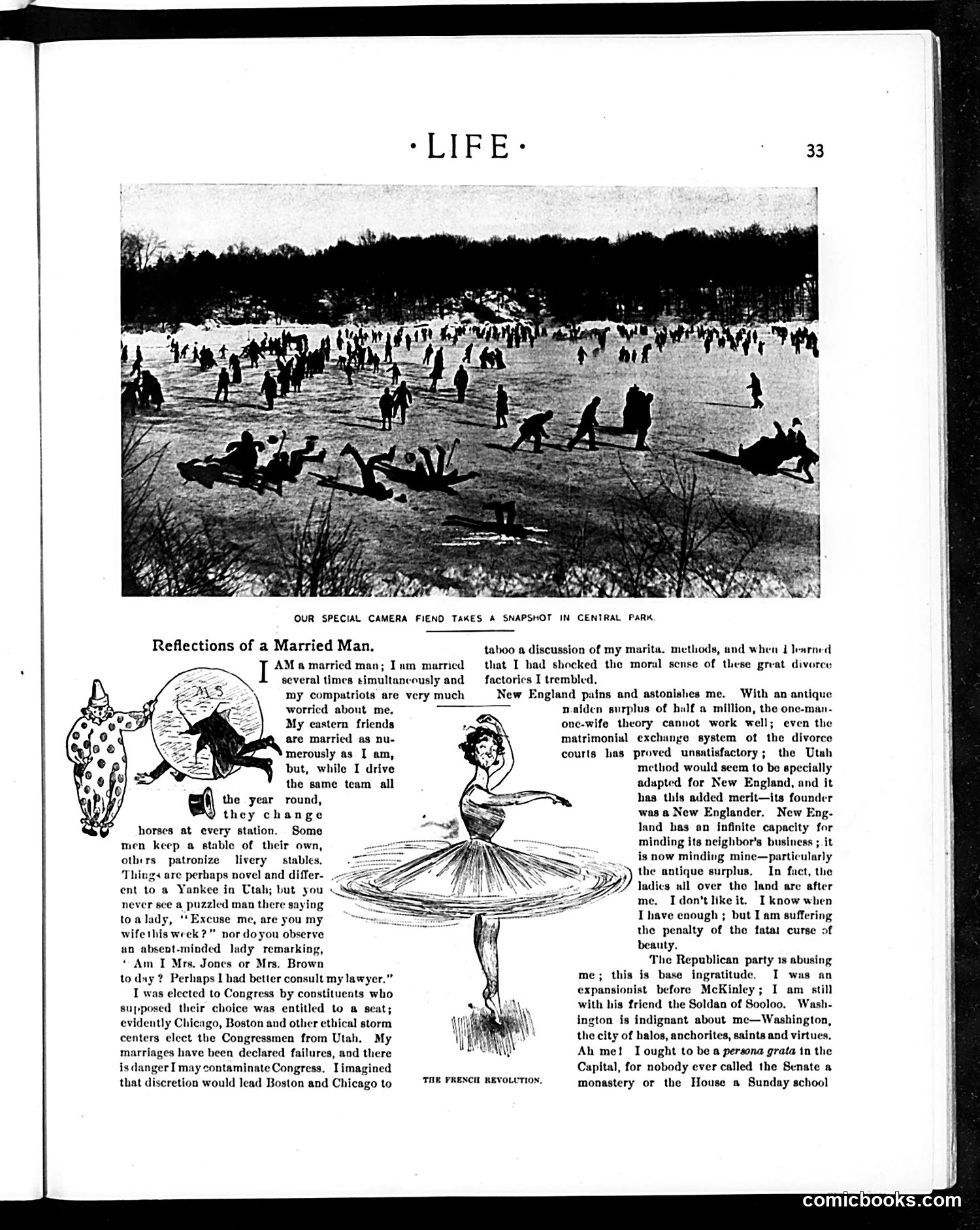
This page satirizes polygamy in Utah through the voice of a fictional married congressman. The author describes maintaining multiple simultaneous marriages while Eastern colleagues "change horses at every station" (a metaphor for serial monogamy through divorce). The satire targets: 1. **Utah polygamy**: The piece mocks Mormon plural marriage as practiced in the territory, contrasting it with the Eastern establishment's hypocritical divorce culture. 2. **Political hypocrisy**: A congressman elected from Utah faces condemnation from "Boston and Chicago"—centers of divorce activity—for practicing polygamy, while they engage in serial marriages through divorce courts. 3. **New England moralism**: The author ironically suggests that New England, with its surplus of unmarried women and thriving divorce industry, should embrace Utah's system as more practical than pretending moral superiority. The accompanying illustration labeled "The French Revolution" shows a woman on a mushroom, likely representing feminine chaos or upheaval—possibly commenting on women's roles in this matrimonial debate. The photograph shows Central Park crowds, providing visual context for leisure-class society discussed in the text.
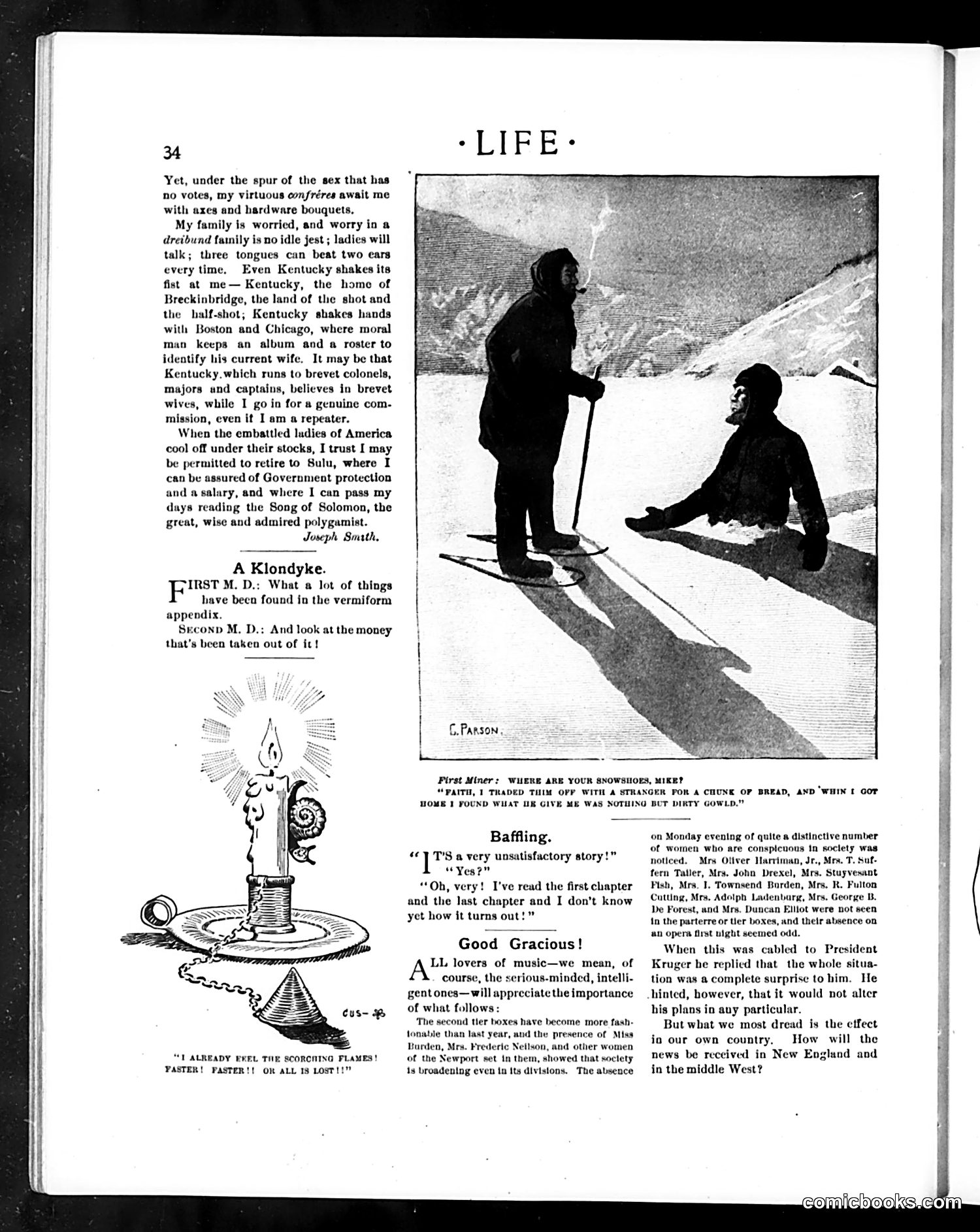
This page contains multiple satirical pieces typical of Life's style: **Main text (top):** A lengthy complaint from "Joseph Smith" about being criticized for his polygamy, sarcastically threatening to retire to Sulu (a U.S. territory) where he can practice polygamy with government protection. This mocks both polygamists and American territorial expansion rhetoric. **"A Klondyke" joke:** Two doctors discuss valuables found in appendixes and extracted money—referring to the Klondike Gold Rush's wealth-seeking frenzy. **Cartoon (C. Parson illustration):** A prospector and Native Alaskan exchange dialogue about snowshoes traded for "dirty gould" (gold)—satirizing the brutal or unfair dealings in gold-rush commerce. **"Good Gracious!" section:** Mocks high society's obsession with opera-box seating and Newport social standing, then absurdly suggests that prominent society women's absence from the opera was cabled to Boer War leader Kruger—a nonsensical punchline ridiculing society's self-importance during a serious international conflict.
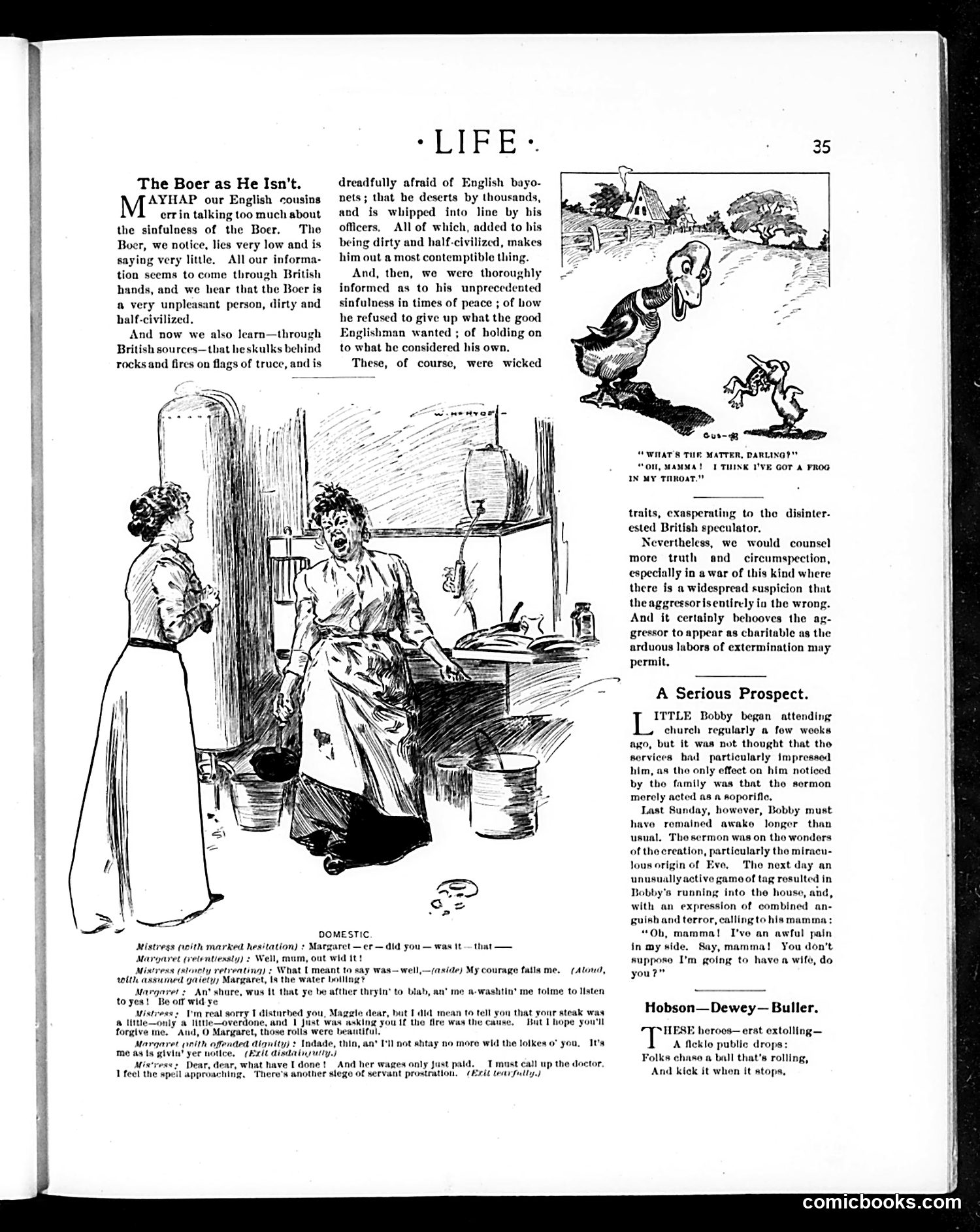
This page satirizes British wartime propaganda about the Boer War (1899-1902). The main article mocks exaggerated British claims portraying Boers as uncivilized cowards who shoot under flags of truce and desert their armies. Life's editors argue these characterizations—while circulating through British sources—deserve skepticism, especially since widespread suspicion exists that Britain (the "aggressor") is in the wrong. They urge fairer treatment of the enemy. The cartoons are unrelated domestic humor: one depicts a mistress apologizing to her maid Margaret for interrupting laundry; another shows a child thinking a throat pain indicates he'll soon marry a woman (misinterpreting a sermon about Eve's creation). The final item mocks public fickleness toward heroes—comparing them to people chasing rolling balls, then losing interest once movement stops.
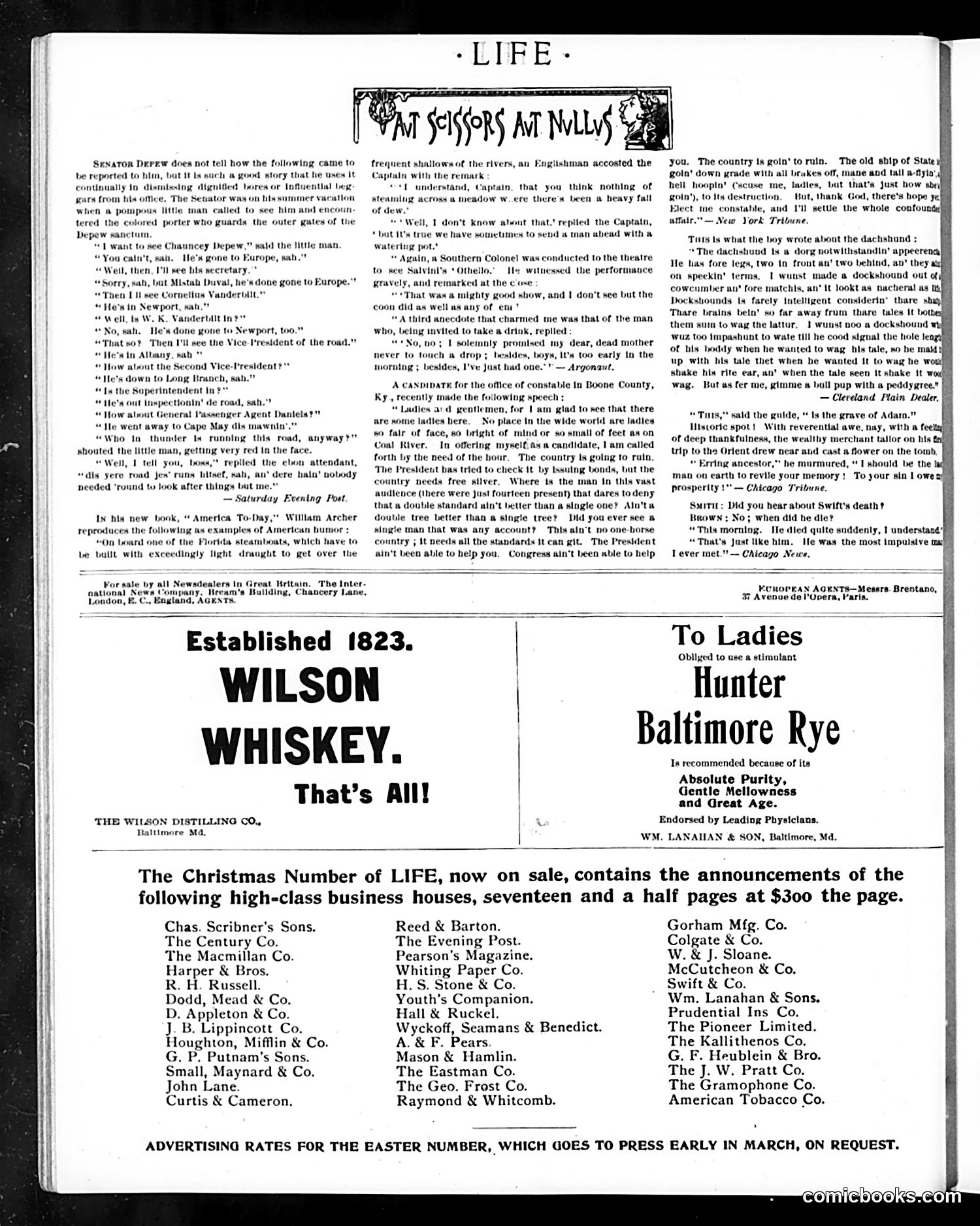
This page contains **three separate humorous anecdotes** satirizing prominent American figures of the era: 1. **The Depew story**: A persistent visitor tries to see Senator Chauncey Depew but finds him, his secretary, and various railroad executives (Vanderbilt, the Vice-President) all conveniently absent in Europe or elsewhere—mocking the inaccessibility of powerful men and their tendency to dodge petitioners. 2. **The Othello/Salvinni anecdote**: A Southern Colonel attends a performance of Shakespeare's *Othello* and dismissively remarks a Black performer (Salvinni) performed as well as the main actor—satire of racial attitudes and cultural ignorance in the South. 3. **The constable's speech**: A candidate's rambling remarks about the country "goin' to ruin" reflect contemporary anxieties about economic collapse and political incompetence. The page also includes period advertisements (Wilson Whiskey, Hunter Baltimore Rye) and announcements of *Life* magazine's Christmas issue. The humor relies on dialect humor and social commentary typical of 1890s American satire.
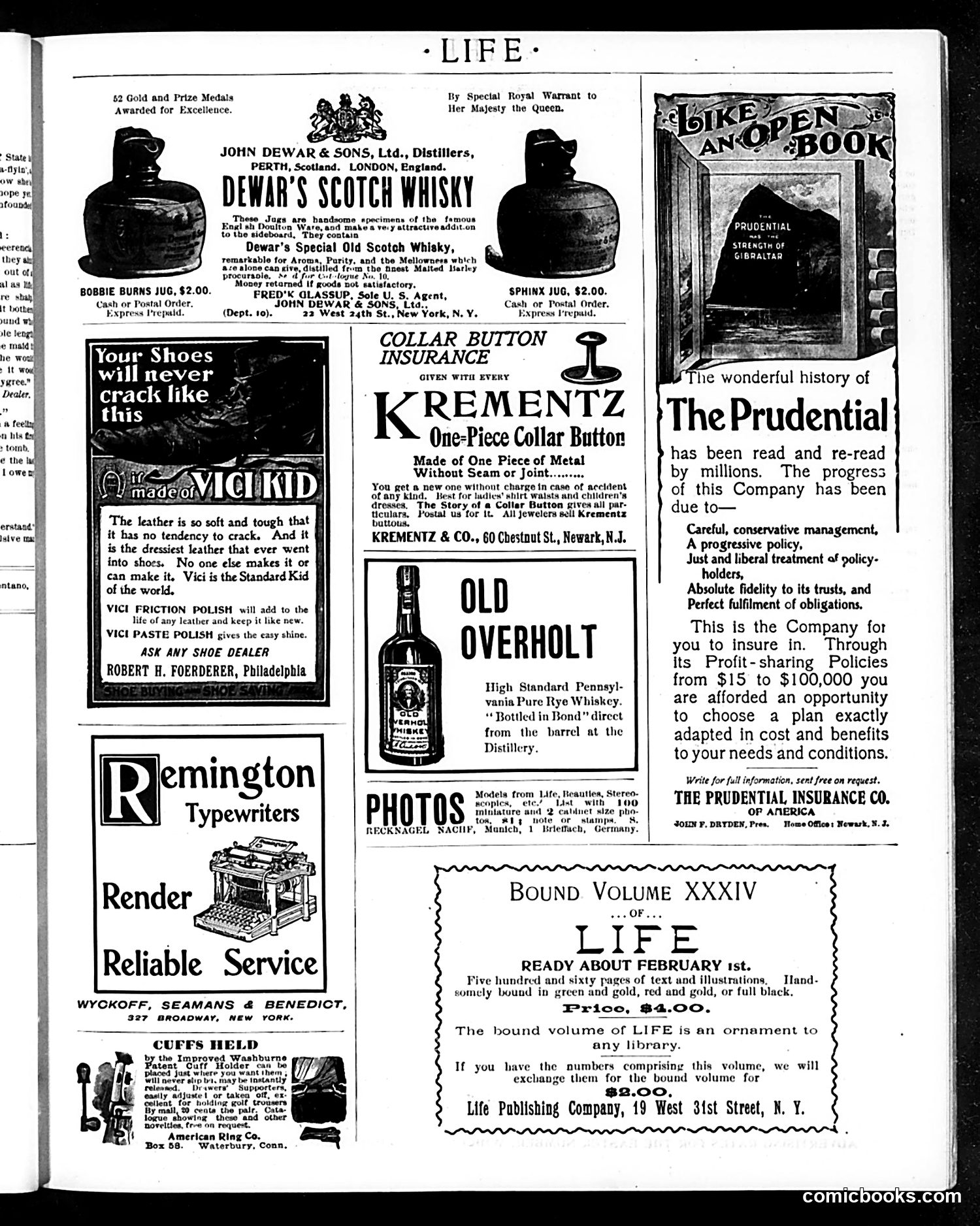
This is primarily an **advertising page** with no political cartoons or satirical content. The page consists entirely of commercial advertisements typical of early 20th-century American magazines. Notable ads include: - **Dewar's Scotch Whisky**: Advertised with decorative Doulton jugs, emphasizing the product's purity and royal warrant - **Vici Kid shoes**: Promotes durable leather that "will never crack" - **Krementz collar buttons**: Humorous "insurance" concept—the company replaces damaged buttons free - **Remington Typewriters** and other everyday products - **The Prudential Insurance Company**: A substantial ad emphasizing conservative management and profit-sharing policies The page concludes with an announcement for **Bound Volume XXXIV of Life magazine**, available February 1st for $4.00. There is no editorial cartoon or satire present—this appears to be a standard magazine advertisement section from the period.
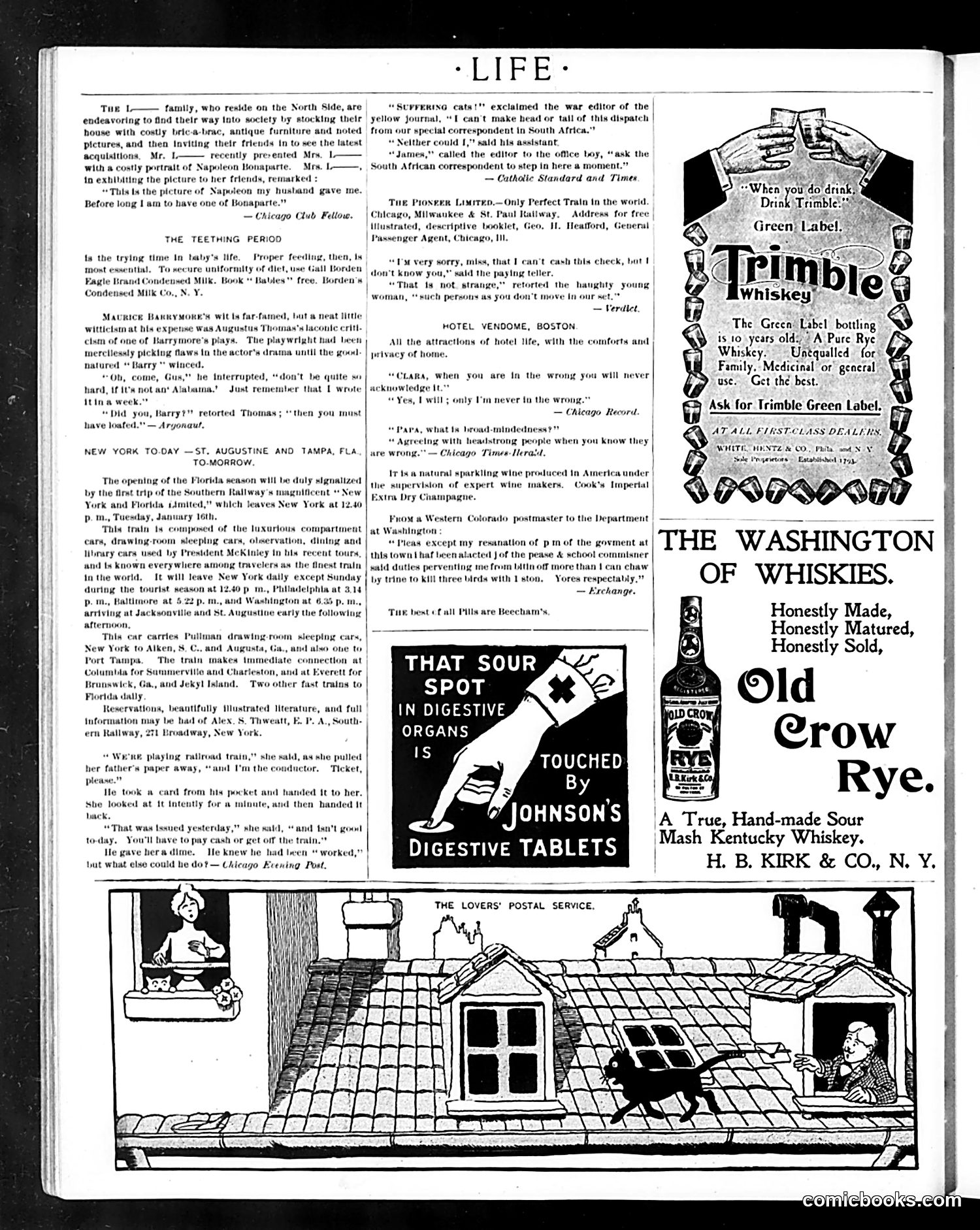
This page from *Life* magazine combines satirical humor pieces with period advertisements (whiskey, digestive tablets, railway services). **Main Cartoons/Jokes:** 1. **"The Teething Period"** and **Napoleon anecdote**: Social satire about a newly-wealthy North Side family (Chicago) attempting to enter high society by collecting expensive art and antiques. The humor lies in their pretentiousness—the wife wants to display a Napoleon portrait her husband gave her, then acquire "one of Bonaparte" (the man himself), suggesting they don't understand what they're collecting. 2. **Maurice Barrymore exchange**: Theater world wit. Playwright Augustus Thomas quips that if Barrymore had "loafed" less, the play would've been better—a barb at the actor's reputation. 3. **War correspondent joke**: Editors can't understand a dispatch from the South African correspondent (likely the Boer War, circa 1899-1902), suggesting journalistic confusion about colonial conflicts. 4. **"Lovers' Postal Service"**: Bottom cartoon depicts a romantic scene on rooftops—appears to be a visual gag about secret communication between lovers. **Context**: These reflect upper-class anxieties about social mobility, theater gossip, and contemporary war reporting.
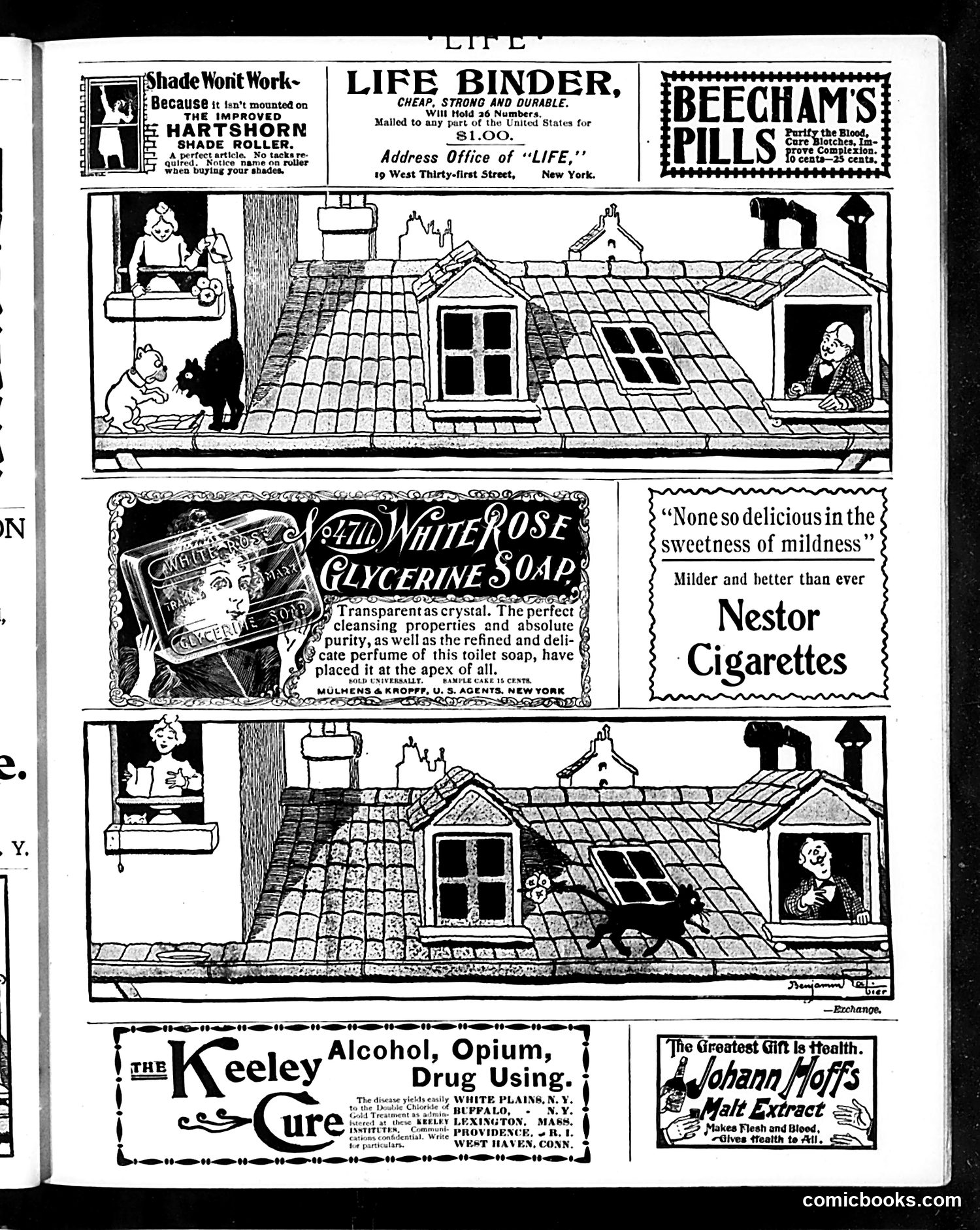
This appears to be primarily an **advertising page** from Life magazine, rather than editorial cartoons. The page contains two illustrated narrative sequences (roofline scenes) that seem designed to tell a story, but they function as framing for multiple product advertisements. The two comic-strip-style panels depict domestic scenes on rooftops with figures at windows and chimneys—likely meant to be charming or humorous vignettes. However, their actual purpose is to brand the page and draw reader attention to the surrounding ads. The advertisements themselves are striking to modern eyes for their content: **Beecham's Pills**, **White Rose Glycerine Soap**, **Nestor Cigarettes**, **Keeley Cure** (for "Alcohol, Opium, Drug Using"), and **Johann Hoff's Malt Extract**. The Keeley Cure ad is particularly notable—it openly advertised treatment for addiction to substances now recognized as dangerous, reflecting early-1900s attitudes toward such problems. This represents a historical moment when patent medicines and dubious remedies were openly advertised in mainstream publications.
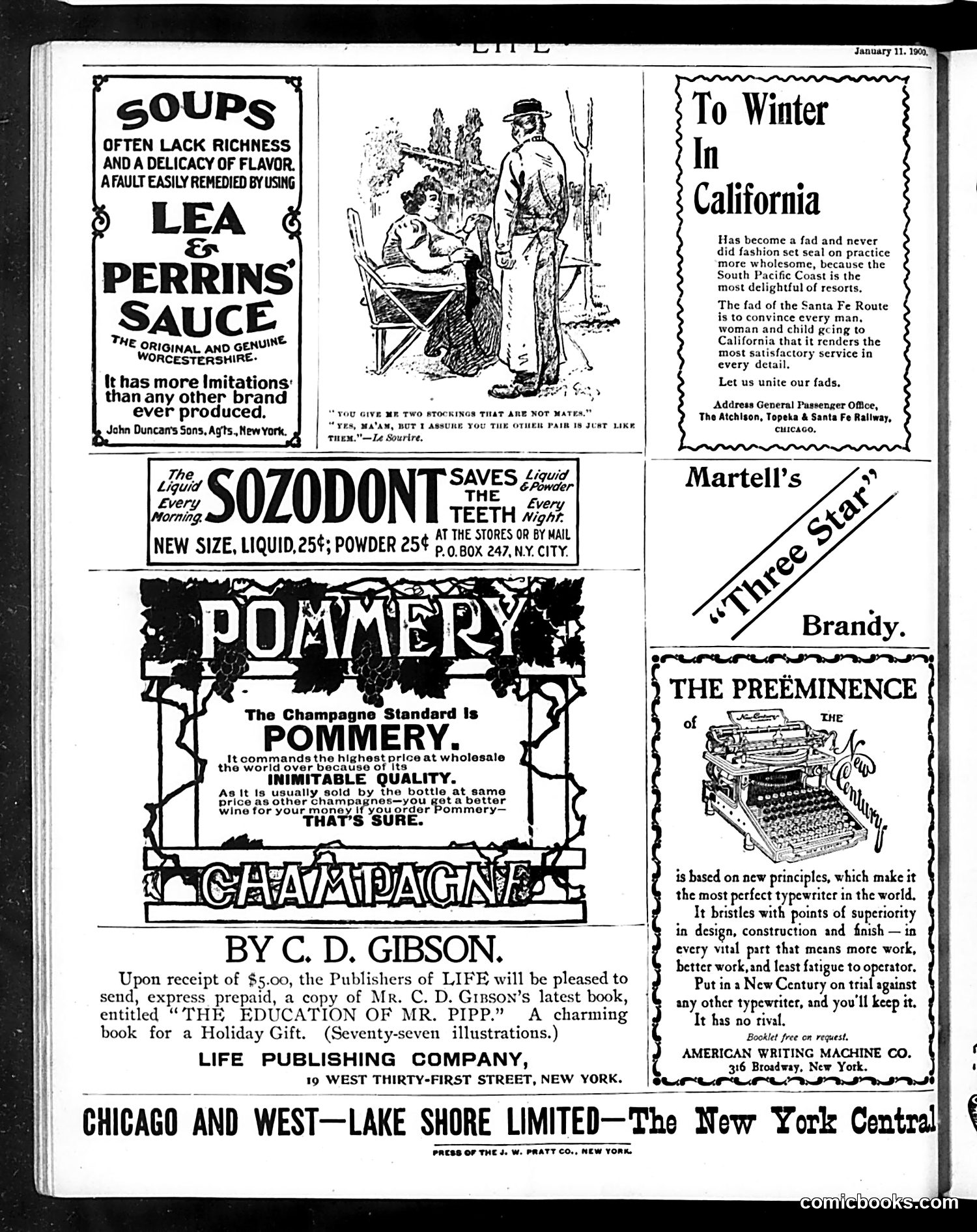
This page is primarily **advertising**, not political satire. It contains period product advertisements and a small editorial cartoon. The central cartoon depicts two men in a camping/hunting scene with the caption: "You give me two stockings that are not mates... Yes, ma'am, but I assure you the other pair is just like them." This appears to be a humorous domestic dispute about mismatched socks—likely poking fun at male carelessness or marital disagreements over household matters. The page's bulk consists of advertisements for luxury goods reflecting 1900 prosperity: Lea & Perrins sauce, Sozodont toothpaste, Pommery champagne, C.D. Gibson's book, and a typewriter. There's also a tourism ad promoting California train travel via the Santa Fe Railway—reflecting the emerging American leisure travel industry. The only explicitly satirical element is Gibson's book promotion, which appears designed to appeal to holiday gift-givers.