
Life, 1900-01-11 · page 12 of 20
Life — January 11, 1900 — page 12: what you’re looking at
What you’re looking at
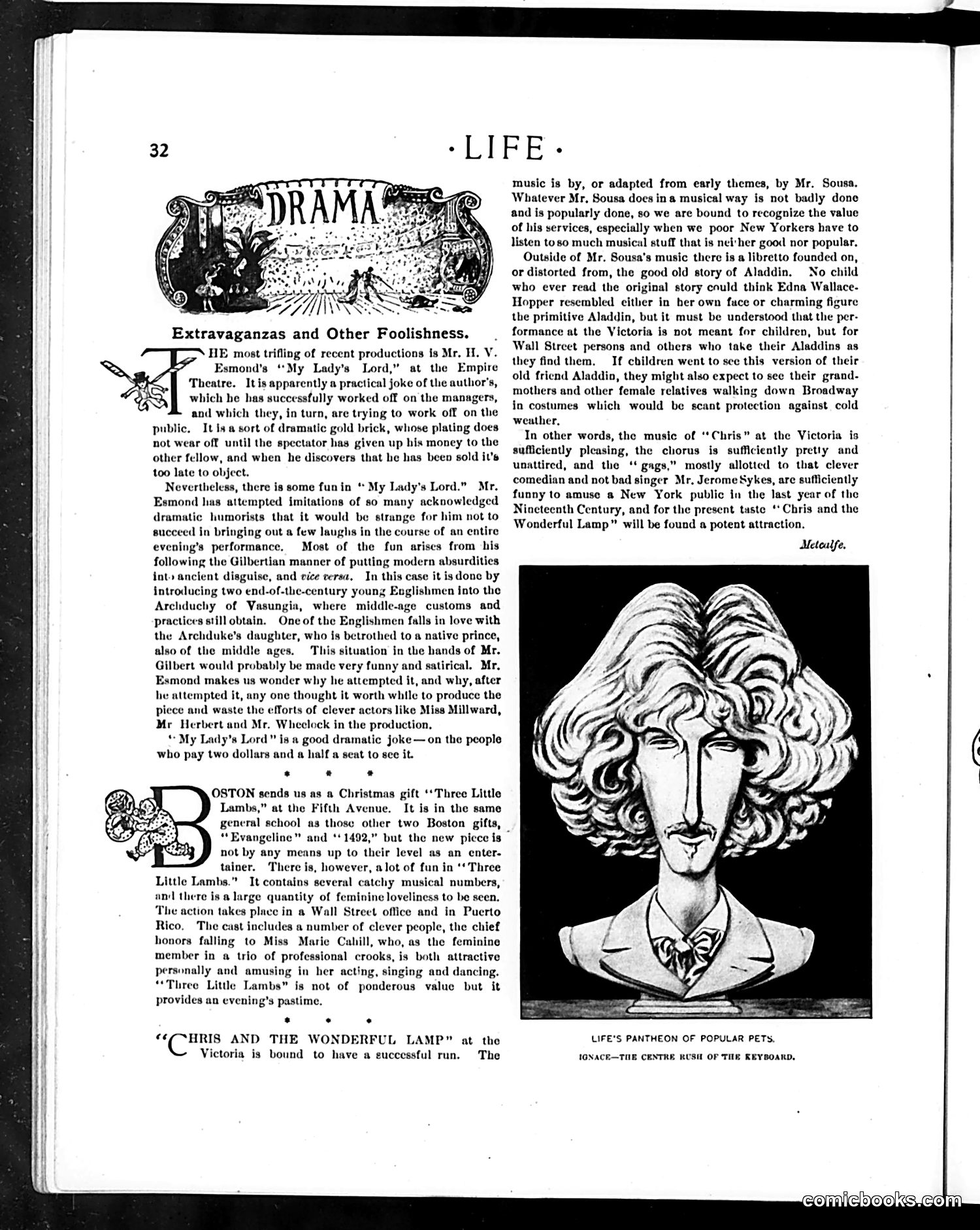
This page reviews theatrical productions. The main cartoon shows a grotesque face with elaborate curled hair, captioned "Life's Pantheon of Popular Pets—Ignace—The Centre Rush of the Keyboard." The cartoon appears to be caricaturing a pianist (likely Ignacy Jan Paderewski, a famous virtuoso), reducing him to a fashionable celebrity "pet" of society. The exaggerated features and the phrase "centre rush" suggest mockery of how popular culture elevates performers to idol status despite their questionable artistic merit. The text reviews productions including "My Lady's Lord" at the Empire Theatre and "Three Little Lambs" in Boston, critiquing their dramatic quality while acknowledging their entertainment value. The satire targets both theatrical mediocrity and the public's appetite for frivolous entertainment.
📄 Transcribed text from this page (OCR, searchable)
Machine-transcribed from the original scan — historical spelling and the odd misread are preserved.
-LIFE- Extravaganzas and Other Foolishness. HE most trifling of recent productions is Mr. H. V. Esmond’s ‘*My Lady's Lord,” at the Empire Theatre. Itis apparently a practical joke of the author's, which he has successfully worked off on the managers, and which they, in turn, are trying to work off on the It is a sort of dramatic gold brick, whose plating does ‘ar off until the spectator has given up his money to the other fellow, and when he discovers that he has been sold it’s too late to object. Nevertheless, there is some fun in * My Lady's Lord.” Mr. Esmond has attempted imitations of so many acknowledged dramatic humorists that it would be strange for him not to succeed in bringing out a few laughs in the course of an entire evening’s performance. Most of the fun ariscs from his following the Gilbertian manner of putting modern absurdities int» ancient disguise, and vice versa, In this case it is done by introducing two end-of-the-century young Englishmen into the Archduchy of Vasungia, where middle-age customs and practices still obtain. One of the Englishmen falls in love with the Archduke’s daughter, who is betrothed to a native prince, also of the middle ages. This situation in the hands of Mr. Gilbert would probably be made very funny and satirical. Mr. Esmond makes us wonder why he attempted it, and why, after he attempted it, any one thought it worth while to produce the piece and waste the efforts of clever actors like Miss Millward, Mr Herbert and Mr. Wheelock in the production, * My Lady's Lord” is a good dramatic joke—on the people who pay two dollars and a half a seat to see it * * * OSTON sends us as a Christmas gift ‘*Three Little Lambs,” at the Fifth Avenue, It is in the same gencral school as those other two Boston gifts, “Evangeline” and ‘+ 1492,” but the new picce is © not by any means up to their level as an enter. tainer. There is, however, alot of fun in ‘Three Little Lambs.” It contains several catchy musical numbers, anil there is a large quantity of feminine loveliness to be seen. The action takes place in a Wall Street office and in Puerto Rico, The cast includes a number of clever people, the chief honors falling to Miss Marie Cahill, who, as the feminine member in a trio of professional crooks, is both attractive personally and amusing in her acting, singing and dancing. “Three Little Lambs” is not of ponderous value but it provides an evening's pastime. . . . “4(-HRIS AND THE WONDERFUL LAMP” Victoria is bound to have a euccessful run. at the The music is by, or adapted from early themes, by Mr. Sousa, Whatever Mr, Sousa does ina musical way is not badly done and is popularly done, so we are bound to recognize the value of his services, especially when we poor New Yorkers have to listen toso much musical stuff that is nel’ her good nor popular, Outside of Mr, Sousa’s music there is a libretto founded on, or distorted from, the good old story of Aladdin. No child who ever read the original story could think Edna Wallace- Hopper resembled either in ber own face or charming figure the primitive Aladdin, but it must be understood that the per- formance at the Victoria is not meant for children, but for Wall Street persons and others who take their Aladdins as they find them, If children went to see this version of their old friend Aladdin, they might also expect to see their grand- mothers and other female relatives walking down Broadway in costumes which would be scant protection against cold weather, In other words, the music of “Chris” at the Victoria is sufficiently pleasing, the chorus is sufficiently pretty and unattired, and the ‘ gags,” mostly allotted to that clever comedian and not bad singer Mr. Jerome Sykes, are sufficiently funny to amuse a New York public in the last year of the Nineteenth Century, and for the present taste ‘Chris and the Wonderful Lamp” will be found a potent attraction. Metcalfe, LIFE'S PANTHEON OF POPULAR PETS. IGNACR—THE CENTRE RUSH OF THE KEYBOARD,