
Life, 1900-01-11 · page 4 of 20
Life — January 11, 1900 — page 4: what you’re looking at
What you’re looking at
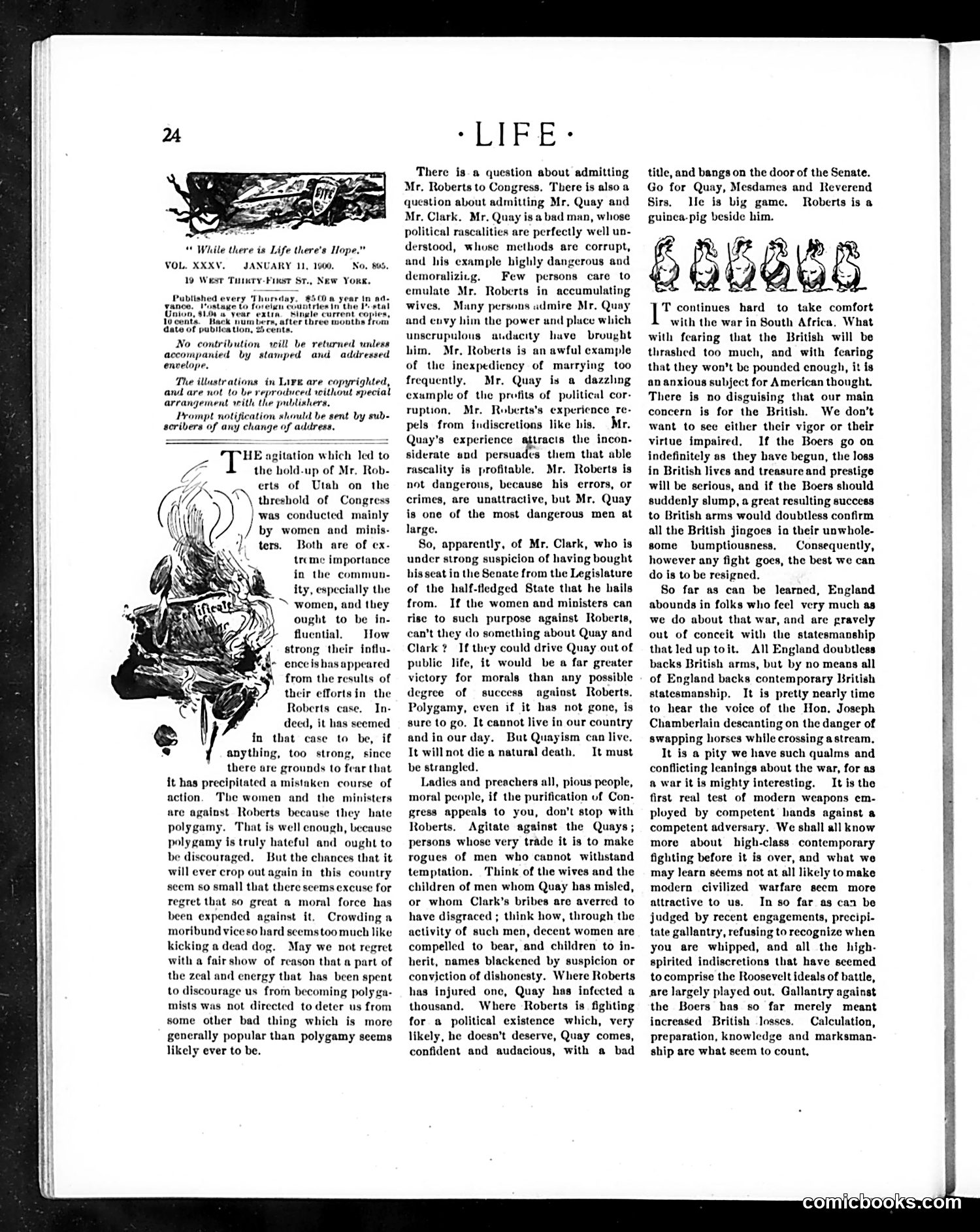
This page discusses political controversy involving congressmen Roberts, Quay, and Clark during what appears to be a Utah admission debate. The text criticizes Roberts as morally dangerous due to polygamy, while defending him against efforts to exclude him from Congress. The cartoon on the left depicts a caricatured figure (likely Roberts) as a grotesque, wild-haired character, emphasizing the satirical mockery of his polygamous practices. The small illustrations at top right show simplified figures in a row, their meaning unclear from context alone. The satire argues that while Roberts's polygamy is indefensible, efforts by Quay and Clark to remove him are hypocritical—these men are themselves corrupt politicians whose moral authority is questionable. The piece critiques using polygamy as a convenient political weapon rather than principle.
📄 Transcribed text from this page (OCR, searchable)
Machine-transcribed from the original scan — historical spelling and the odd misread are preserved.
“ While here is Life there's Hope.” VOL. XXXV. JANUARY 11, 1900, 19 West Tutnry-Finst St., New Yorg, No, 805, Published every Thursday. #5 vance, Mostage to foreign countries in the Petal Union, $1.08 a year extin. single current copies, locents. Ba ers, after three months from date of publ Oa year in ad~ No contribution will be returned unless accompanied by stamped and addressed envelope. The illustrations in Live are copyrighted, and are not to be reproduced without special arrangement with the publishers, Prompt notification should be sent by sub- seribers of any change of address. HE agitation which led to the hold-up of Mr, Rob- ~ ers of Utah on the \\ threshold of Congress was conducted mainly ,/ by women and minis- ters. Both are of cx- treme importance in the commun- ity, especially the women, and they ought to be in- flucntial. How strong their influ- ;- enccishas appeared from the results of their effortsin the Roberts case. In- deed, it has seemed \ in that case to be, if 2 anything, too strong, since there are grounds to fear that it has precipitated a mistaken course of action. The women and the r are against Roberts because they hate polygamy. That is well enough, because polygamy is truly hateful and ought to be discouraged. But the chances that it will ever crop out again in this country seem so small that there scems excuse for regret that so great a moral force has been expended against it. Crowding a moribund viceso hard scemstoo much like kicking a dead dog. May we not regret with a fairshow of reason that a part of the zeal and cnergy that has been spent to discourage us from becoming poly ga- mists was not directed to deter us from some other bad thing which is more generally popular than polygamy seems likely ever to be. ‘LIFE There is a question about admitting Mr. Roberts to Congress. There is also a question about admitting Mr. Quay and Mr. Clark. Mr. Quay is a bad man, whose political rascalities are perfectly well un- derstood, whose methods are corrupt, and his example highly dangerous and demoralizicg. Few persons care to emulate Mr. Roberts in accumulating wives, Many persons admire Mr. Quay and envy him the power und place which unscrupulous audacity have brought him. Mr. Roberts is an awful example of the inexpediency of marrying too frequently, Mr. Quay is a dazzhng example of the prefits of political cor- ruption, Mr. Roberts's experience re- pels from indiscretions like his. Mr. Quay’s experience attracts the incon- siderate und persuades them that able rascality is profitable. Mr. Roberts is not dangerous, because his errors, or crimes, are unattractive, but Mr. Quay is one of the most dangerous men at large. So, apparently, of Mr. Clark, who is under strong suspicion of having bought his seat in the Senate from the Legislature of the half-fledged State that he hails from. If the women and ministers can rise to such purpose against Roberts, can’t they do something about Quay and Clark? If they could drive Quay out of public life, it would be a far greater victory for morals than any possible degree of success against Roberts. Polygamy, even if it hus not gone, is sure to go. It cannot live in our country and in our day, But Quayism can live. It will not die a natural death, It must be strangled. Ladies and preachers all, pious people, moral people, if the purification of Con- gress appeals to you, don't stop with Roberts, Agitate against the Quays ; persons whose very trade it is to make rogues of men who cannot withstand temptation. Think of the wives and the children of men whom Quay has misled, or whom Clark’s bribes are averred to have disgraced ; think how, through the activity of such men, decent women are compelled to bear, and children to in- herit, names blackened by suspicion or conviction of dishonesty. Where Roberts has injured onc, Quay has infected a thousand. Where Roberts is fighting for a political existence which, very likely, he doesn’t deserve, Quay comes, confident and audacious, with a bad title, and bangs on the door of the Senate. Go for Quay, Mesdames and Reverend Sirs, le is big game, Roberts is a guinea-pig beside him. T continues hard to take comfort with the war in South Africa, What with fearing that the British will be thrashed too much, and with fearing that they won't be pounded enough, it is an anxious subject for American thought. There is no disguising that our main concern is for the British. We don’t want to see either their vigor or their virtue impaired, If the Boers go on indefinitely as they have begun, the loss in British lives and treasure and prestige will be serious, and if the Boers should suddenly slump, a great resulting success to British arms would doubtless confirm all the British jingoes ia their unwhole- some bumptiousness, Consequently, however any fight goes, the best we can do is to be resigned. So far as can be learned, England abounds in folks who feel very much as we do about that war, and are pravely out of conceit with the statesmanship that led up toit. All England doubtless backs British arms, but by no means all of England backs contemporary British statesmanship, It is pretly nearly time to hear the voice of the Hon, Joseph Chamberlain descanting on the danger of swapping horses while crossing astream, It is a pity we have such qualms and conflicting leanings about the war, for as a war it is mighty interesting. It is the first real test of modern weapons em- ployed by competent hands against a competent adversary. We shall all know more about high-class contemporary fighting before it is over, and what we may learn s¢ems not at all likely tomake modern civilized warfare secm more attractive to us. In so far as can be judged by recent engagements, precipi- tate gallantry, refusing to recognize when you are whipped, and all the high- spirited indiscretions that have seemed to comprise the Roosevelt ideals of battle, are largely played out. Gallantry against the Boers has so far merely meant increased British losses. Calculation, preparation, knowledge and marksman- ship are what seem to count,