
Life, 1900-01-11 · page 13 of 20
Life — January 11, 1900 — page 13: what you’re looking at
What you’re looking at
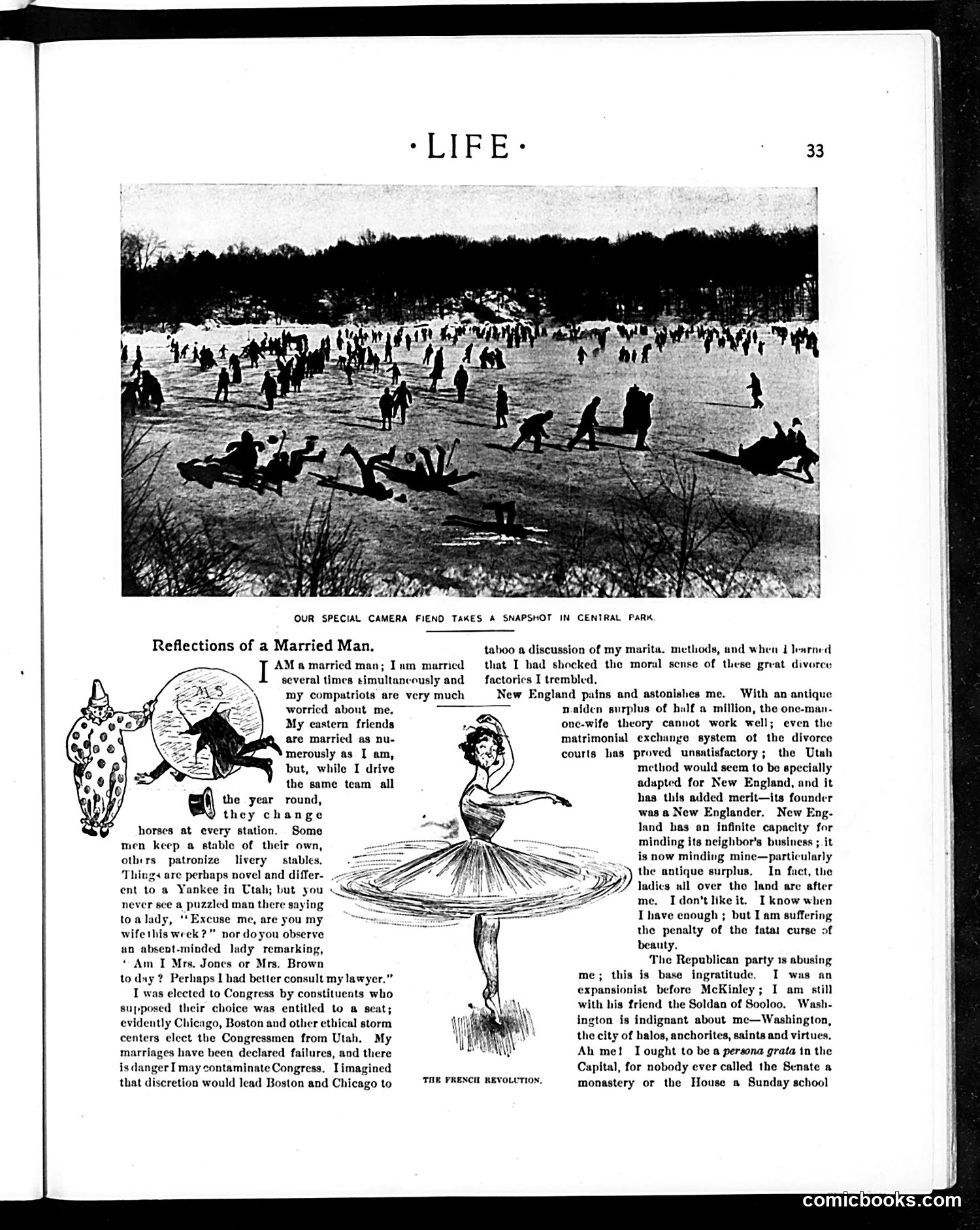
This page satirizes polygamy in Utah through the voice of a fictional married congressman. The author describes maintaining multiple simultaneous marriages while Eastern colleagues "change horses at every station" (a metaphor for serial monogamy through divorce). The satire targets: 1. **Utah polygamy**: The piece mocks Mormon plural marriage as practiced in the territory, contrasting it with the Eastern establishment's hypocritical divorce culture. 2. **Political hypocrisy**: A congressman elected from Utah faces condemnation from "Boston and Chicago"—centers of divorce activity—for practicing polygamy, while they engage in serial marriages through divorce courts. 3. **New England moralism**: The author ironically suggests that New England, with its surplus of unmarried women and thriving divorce industry, should embrace Utah's system as more practical than pretending moral superiority. The accompanying illustration labeled "The French Revolution" shows a woman on a mushroom, likely representing feminine chaos or upheaval—possibly commenting on women's roles in this matrimonial debate. The photograph shows Central Park crowds, providing visual context for leisure-class society discussed in the text.
📄 Transcribed text from this page (OCR, searchable)
Machine-transcribed from the original scan — historical spelling and the odd misread are preserved.
OUR SPECIAL CAMERA FIEND TAKES A SNAPSHOT IN CENTRAL PARK. Reflections of a Married Man. AM a married man; Iam married several times timultancously and my compatriots are very much worricd about me. My eastern friends are married as nu- merously as I am, but, while I drive the same team all r() the year round, they change horses at every station. Some men keep a stable of their own, othirs patronize livery stables. ‘Things are perbaps novel and differ- ent to a Yankee in Utah; but you + never sce a puzzled man there saying toalady, ‘Excuse me, are you my wife this week?” nor doyou observe an absept-minded lady remarking, * Am I Mrs. Jones or Mrs. Brown to day ? Perhaps I had better consult my lawyer.” I was elected to Congress by constituents who supposed their choice was entitled to a seat; evidently Chicago, Boston and other ethical storm centers elect the Congressmen from Utah. My marriages have been declared failures, and there is danger I may contaminate Congress. Timagined that discretion would lead Boston and Chicago to taboo a discussion of my marita. methods, and when i Iearned THE FRENCH REVOLUTION, that I had shocked the moral sense of these great divorce factorics I trembled. New England pains and astonishes me. With an antique maiden surplus of half a million, the one-man- one-wife theory cannot work well; even the matrimonial exchange system otf the divorce courts las proved unsatisfactory; the Utah method would seem to be specially adapted for New England, and it has this added merit—its founder was a New Englander. New Eng- land has an infinite capacity for minding its neighbor’s business ; it is now minding mine—particularly =~") the antique surplus. In fact, the ladics ull over the land are after me, I don't like it. I know when Ihave cnough ; but I'am suffering the penalty of the fatal curse of beauty. The Republican party 1s abusing me; this is base ingratitude. I was an expansionist before McKinley; I am still with his friend the Soldan of Sooloo. Wash- ington is indignant about mc—Washington, the city of halos, anchorites, saints and virtues, Ah me! I ought to be a persona grata in the Capital, for nobody ever called the Senate a monastery or the House a Sunday school comicbooks.com