
A complete issue · 20 pages · 1899
Life — October 26, 1899
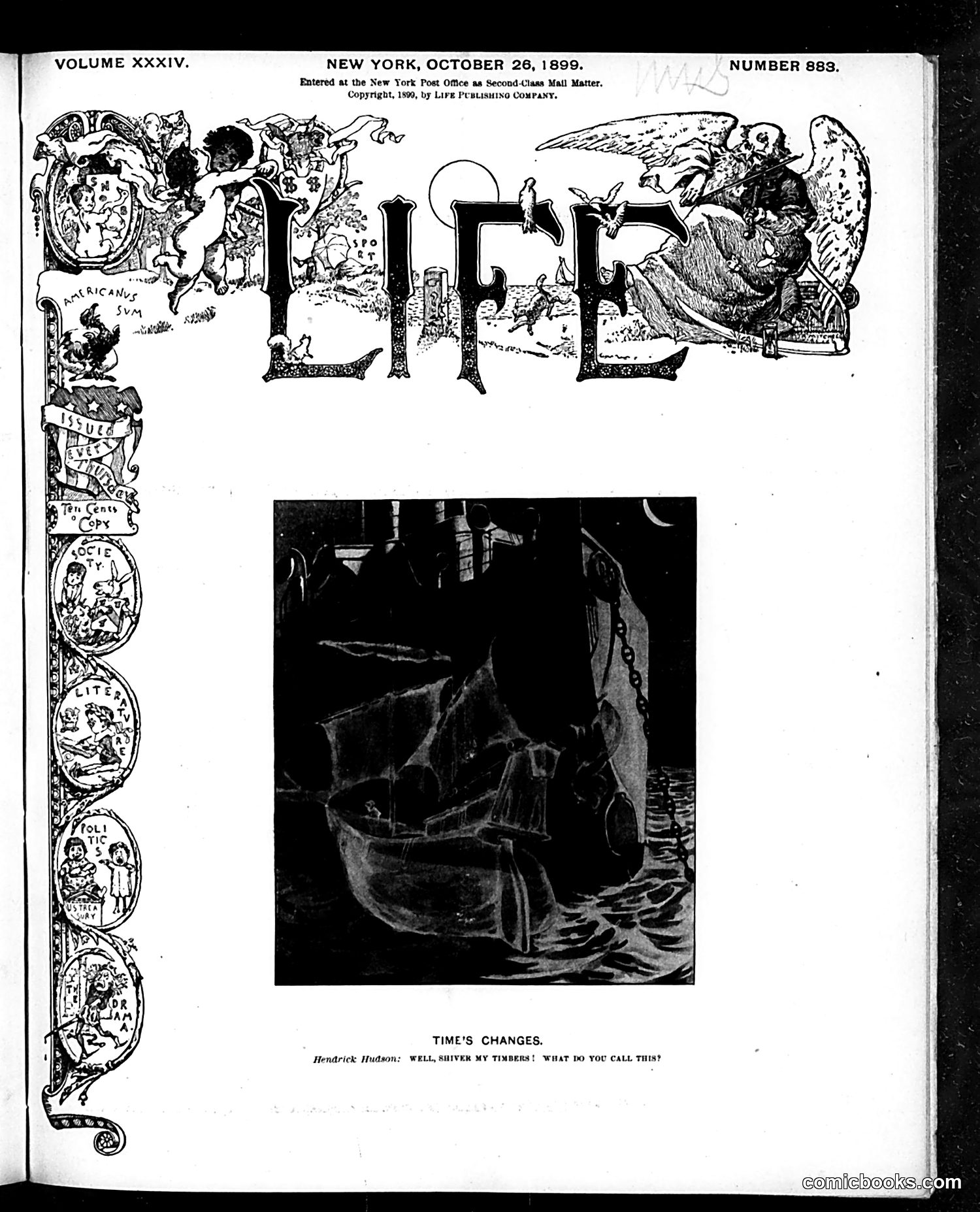
This page features a satirical illustration titled "Time's Changes" with a caption attributed to Hendrick Hudson: "Well, shivers my timbers! What do you call this?" The cartoon depicts a modern steamship, contrasting with Hudson's era of sailing vessels. Hudson—the 17th-century explorer famous for discovering the Hudson River—appears shocked at contemporary maritime technology. The joke targets rapid industrialization and technological change in the 1890s: a figure from the Age of Sail encountering modern steam-powered vessels would be bewildered by such dramatic progress. The elaborate decorative border and ornamental typography typical of Life magazine frames the satirical commentary on how dramatically transportation and technology had transformed American life in just centuries.
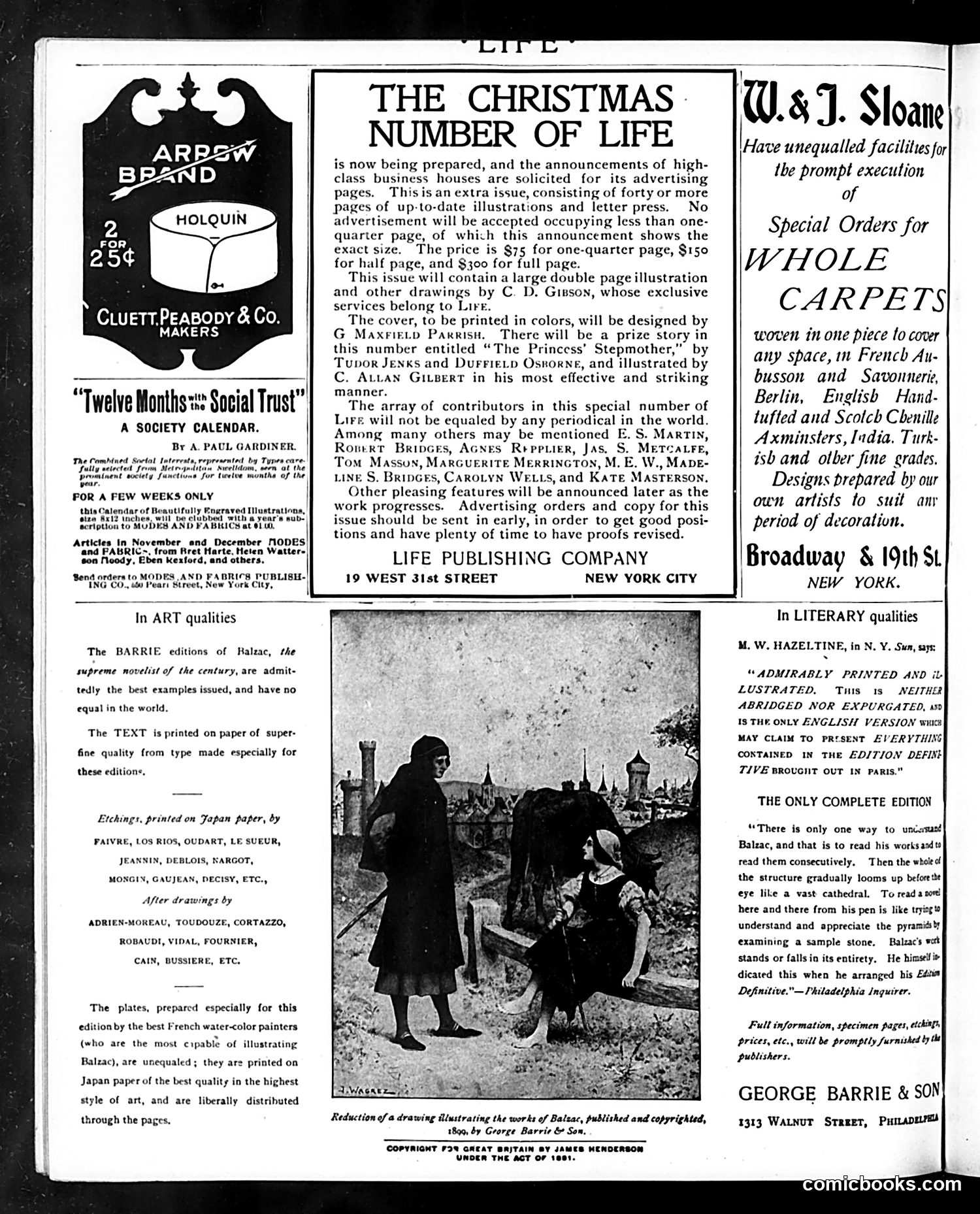
This page is primarily **advertising and publishing announcements** rather than satirical content. The central image appears to be a literary illustration (likely from Balzac, based on the surrounding text about Barrie editions), showing two figures in period dress against a European cityscape—not a political cartoon. The page announces *Life* magazine's Christmas special issue and promotes: - Arrow Brand holquin (a product) - W. & J. Sloane carpet services - George Barrie & Son's complete Balzac editions The text emphasizes the Christmas issue's quality illustrations and contributor roster. There is **no discernible political satire or social commentary** on this particular page—it functions as a commercial and literary promotion vehicle typical of early 20th-century magazine layout.
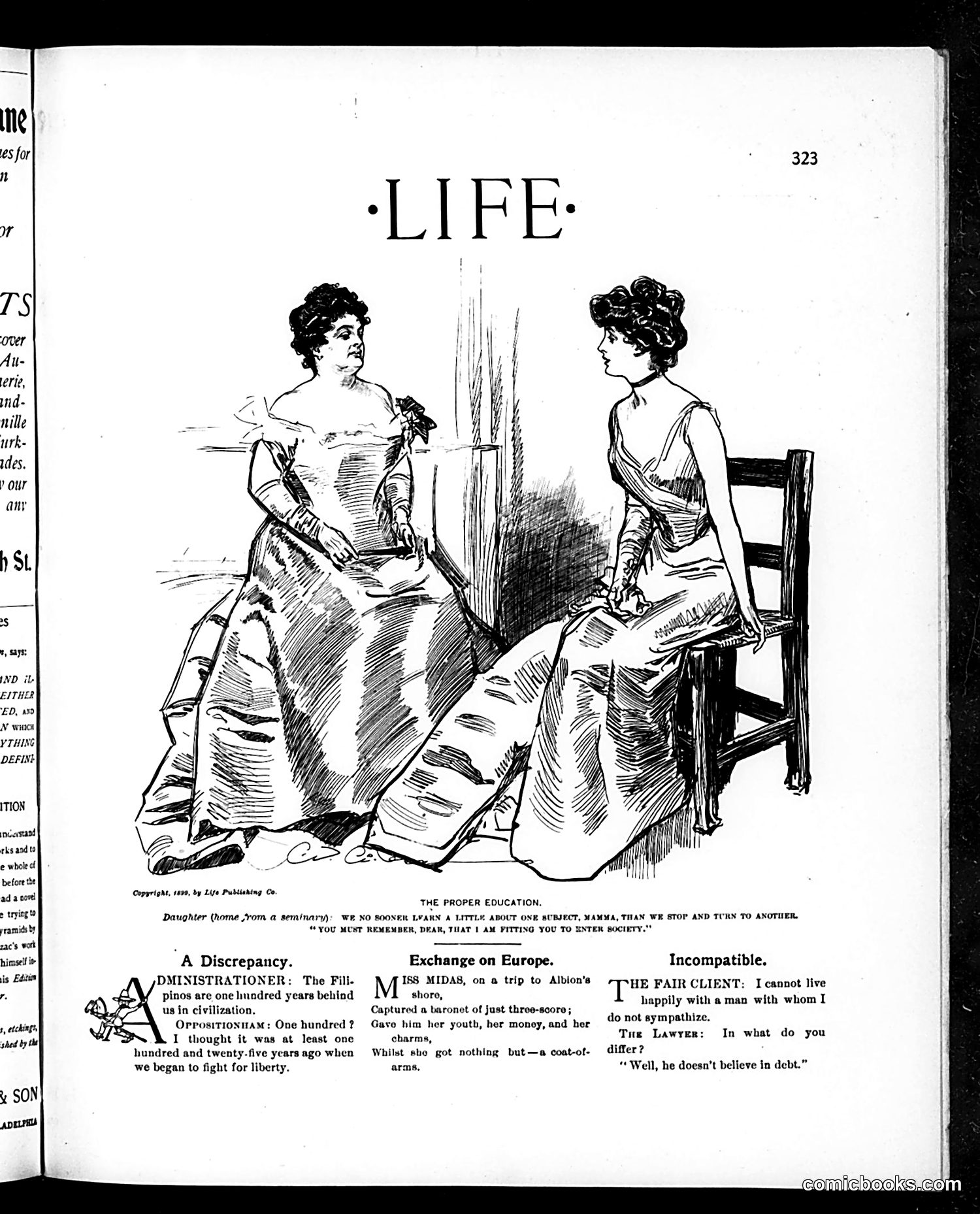
**Main Illustration:** Two elegantly dressed women in conversation. The caption reads: "Daughter (home from a seminary): 'We no sooner learn a little about one subject, mamma, than we stop and turn to another. You must remember, dear, that I am fitting you to enter society.'" **The Satire:** This mocks the limited, superficial education offered to upper-class women of this era. Rather than serious intellectual study, young women's schooling prioritized social accomplishment and "fitting" them for marriage and society. The daughter ironically lectures her mother about this shallow approach, suggesting even the student recognizes its inadequacy. **Lower Section Jokes:** Include brief satirical exchanges on civilization, European politics, and marital compatibility—typical Life magazine humor of the period (appears to be early 1900s based on style).
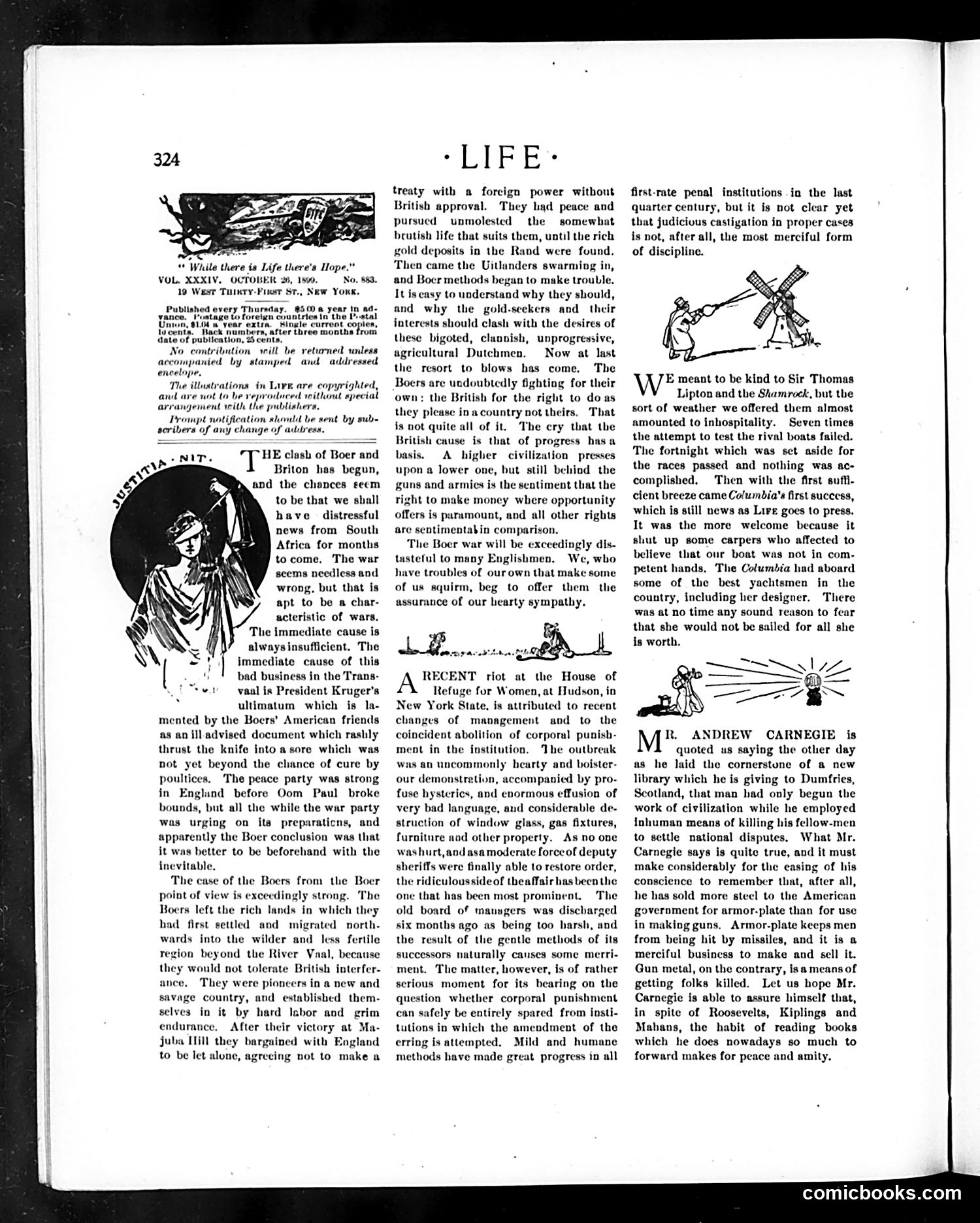
**The Main Cartoon (left side):** Shows a figure labeled "AUSTRALIA - NIT" - appears to be a personification of Australia depicted as a woman in classical dress. The accompanying text discusses the Boer War and its aftermath in South Africa, criticizing British colonial policy and the treatment of Dutch settlers ("Boers"). The cartoon likely satirizes Australia's position as a British colony caught between imperial interests and local concerns. **The Content:** The page discusses colonial conflicts in South Africa, debates over corporal punishment reform at a New York women's refuge, and praises Andrew Carnegie's philanthropic efforts with weapons manufacturing. The satire targets British imperial overreach, institutional brutality, and the moral contradictions of industrialists funding peace while profiting from armaments.
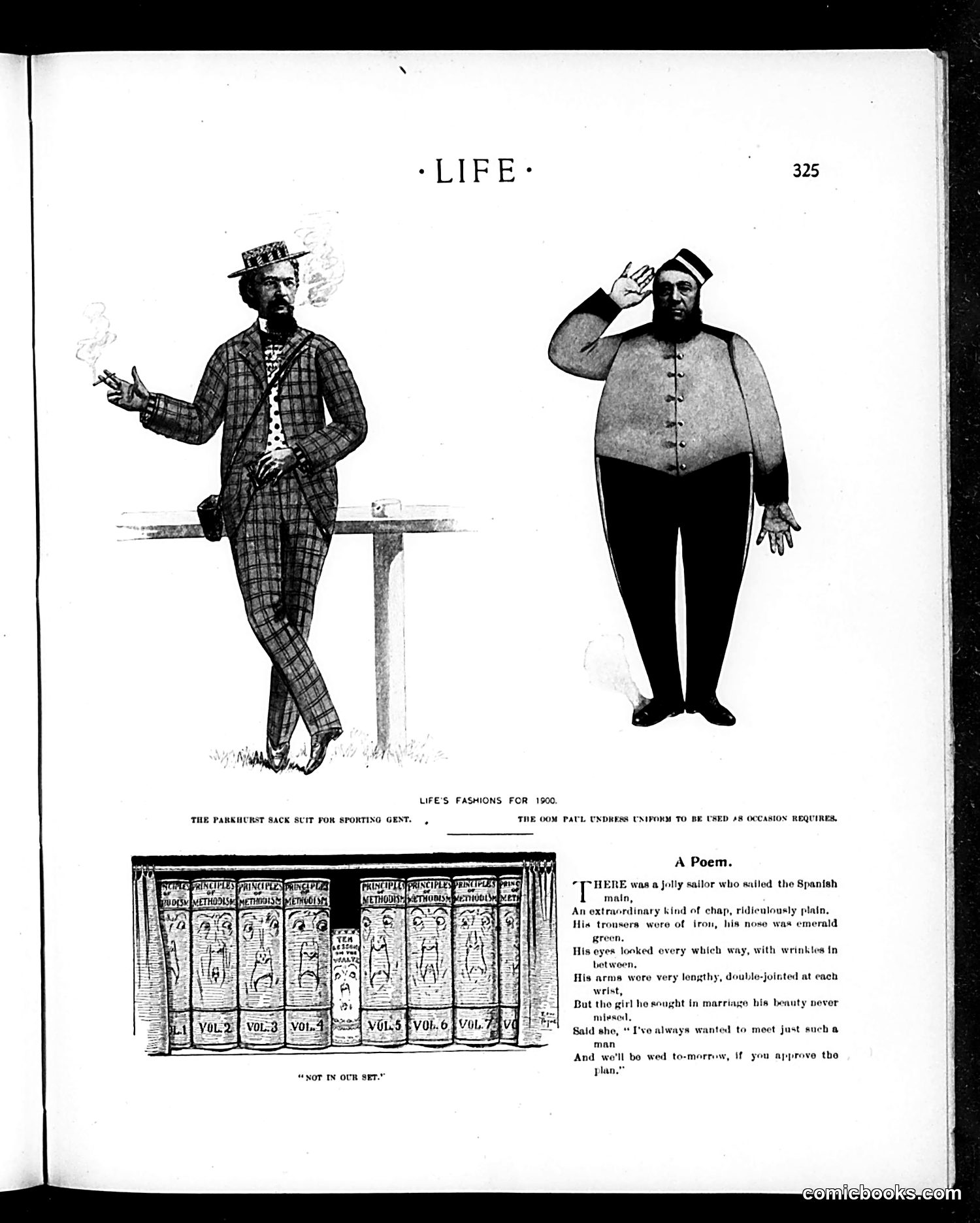
This page from Life magazine (year unclear from image) satirizes early 1900s men's fashion through two contrasting figures: **Left figure**: A thin man in a checked suit with an exaggerated peacock-like pose, smoking—labeled "The Parkhurst Back Suit for Sporting Gents." This appears to mock fashionable sporting wear and affected masculine posturing. **Right figure**: An obese man in formal attire—labeled "The Oom Paul Undress Uniform to be Used on Occasion Requires." This likely references Paul Kruger (Oom Paul), the Boer leader, satirizing either his appearance or the Boer War context (1899-1902). The middle illustration labeled "Not in Our Set" shows encyclopedia volumes, possibly mocking pretentious intellectualism. The accompanying poem about a sailor reinforces themes of masculine authenticity versus artificial fashion and social pretense.
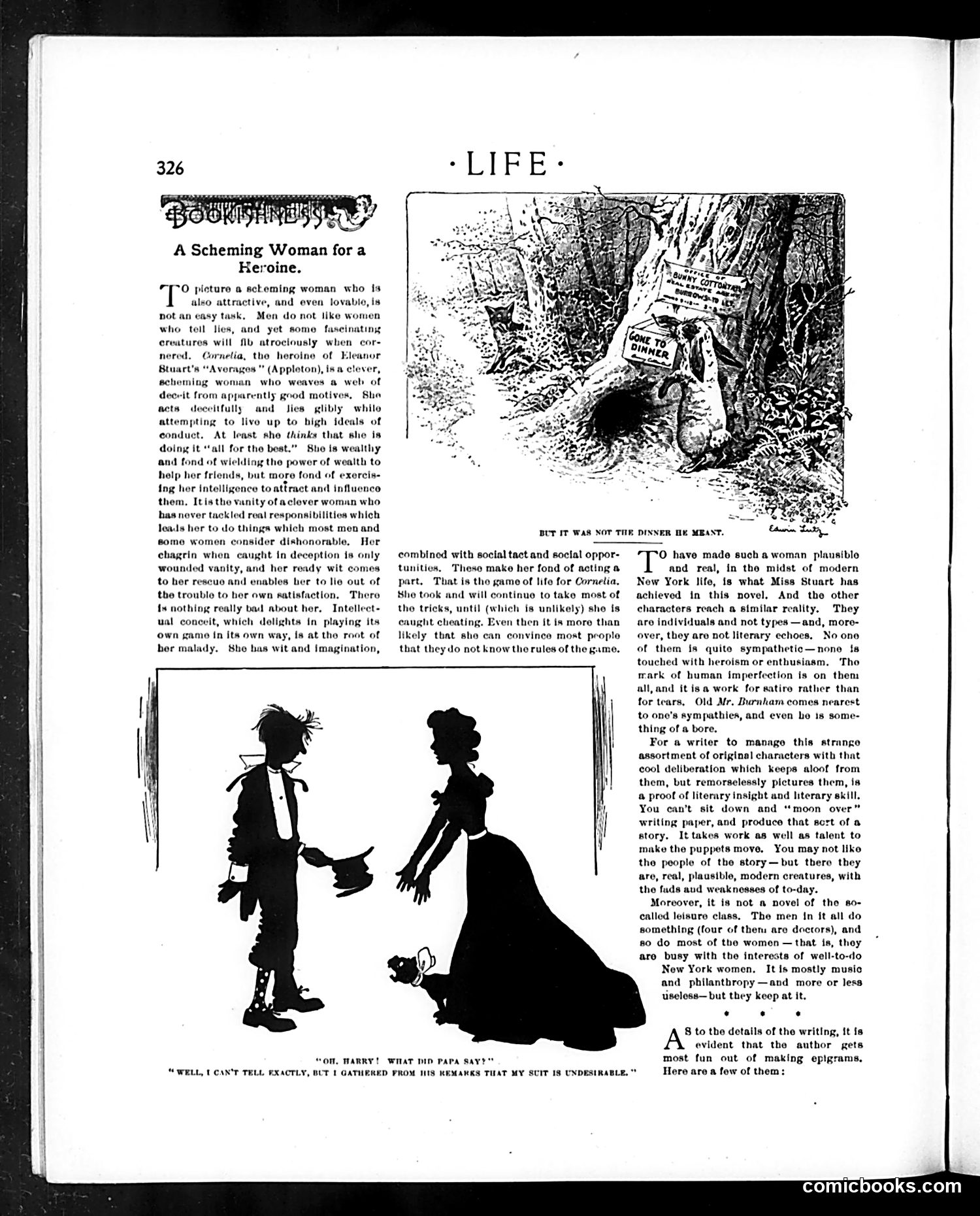
This page reviews a novel featuring Cornelia, a "scheming woman" protagonist who manipulates social situations to advance herself—typical of Gilded Age satirical fiction. The article argues this character type, while morally questionable, realistically depicts modern New York society. The silhouette cartoon below depicts a woman in an elaborate dress conversing with a man, with the caption "'Oh, Harry! What did papa say?' / 'Well, I can't tell exactly, but I gathered from his remarks that my suit is undesirable.'" The joke targets the social maneuvering of marriage-minded women of the era: despite her scheming, the woman fails to secure the desired match. The satire mocks both female social ambition and the transparent nature of such calculations.
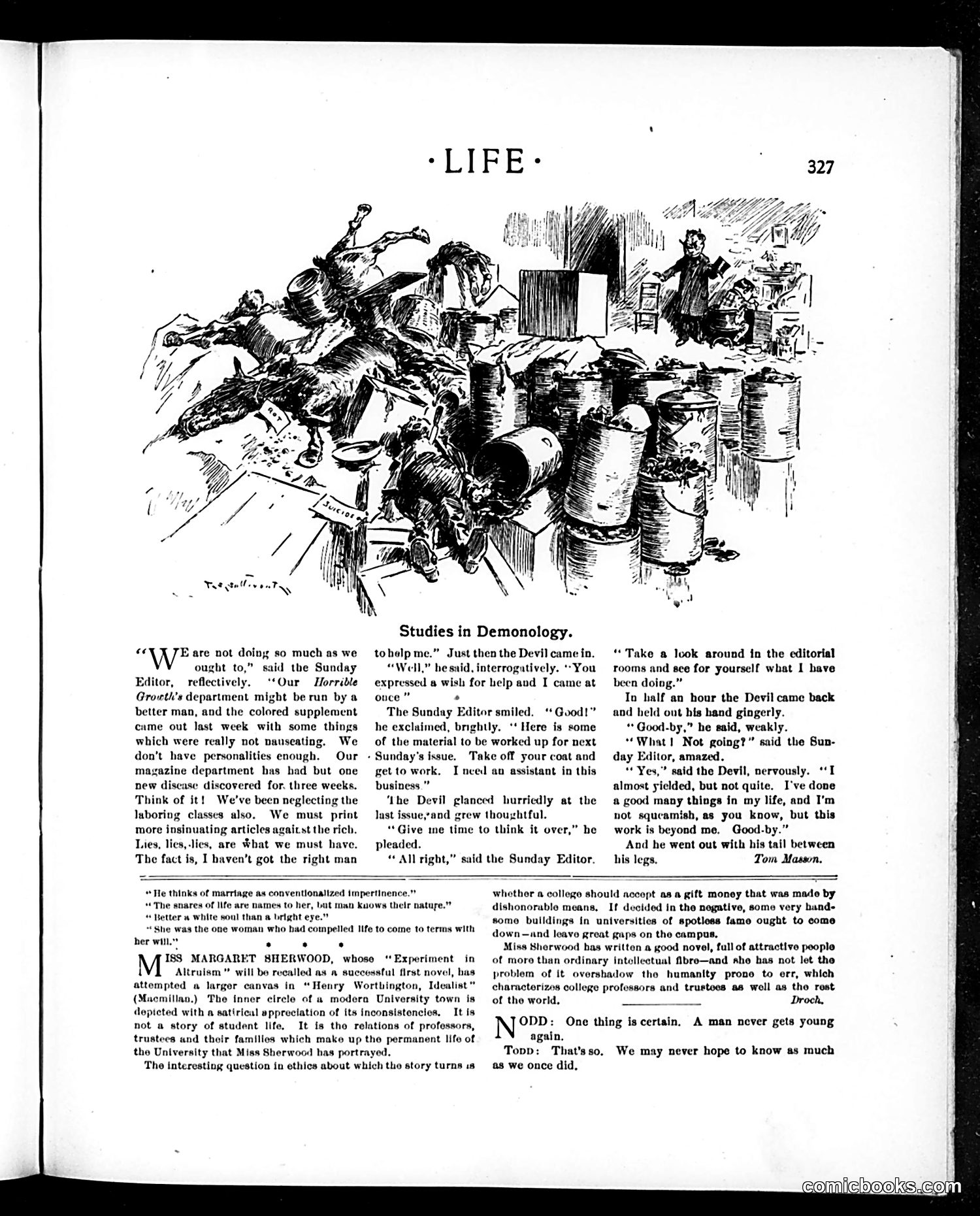
This satirical cartoon depicts a chaotic scene labeled "Studies in Demonology," showing a figure (likely representing the Devil) surrounded by various objects and smaller human figures in what appears to be an editorial office or workspace. The accompanying text is a dialogue between a Sunday Editor and the Devil, where the Editor asks for help producing content. The Devil offers assistance, and the Editor discovers various problematic materials to work with—lies, scandals, and sensational stories. The satire critiques how newspapers (particularly Sunday editions) manufacture sensationalism and rely on morally questionable content to boost circulation. It suggests that editors make "deals with the Devil" by prioritizing scandalous, false, or trivial stories over substantive journalism.
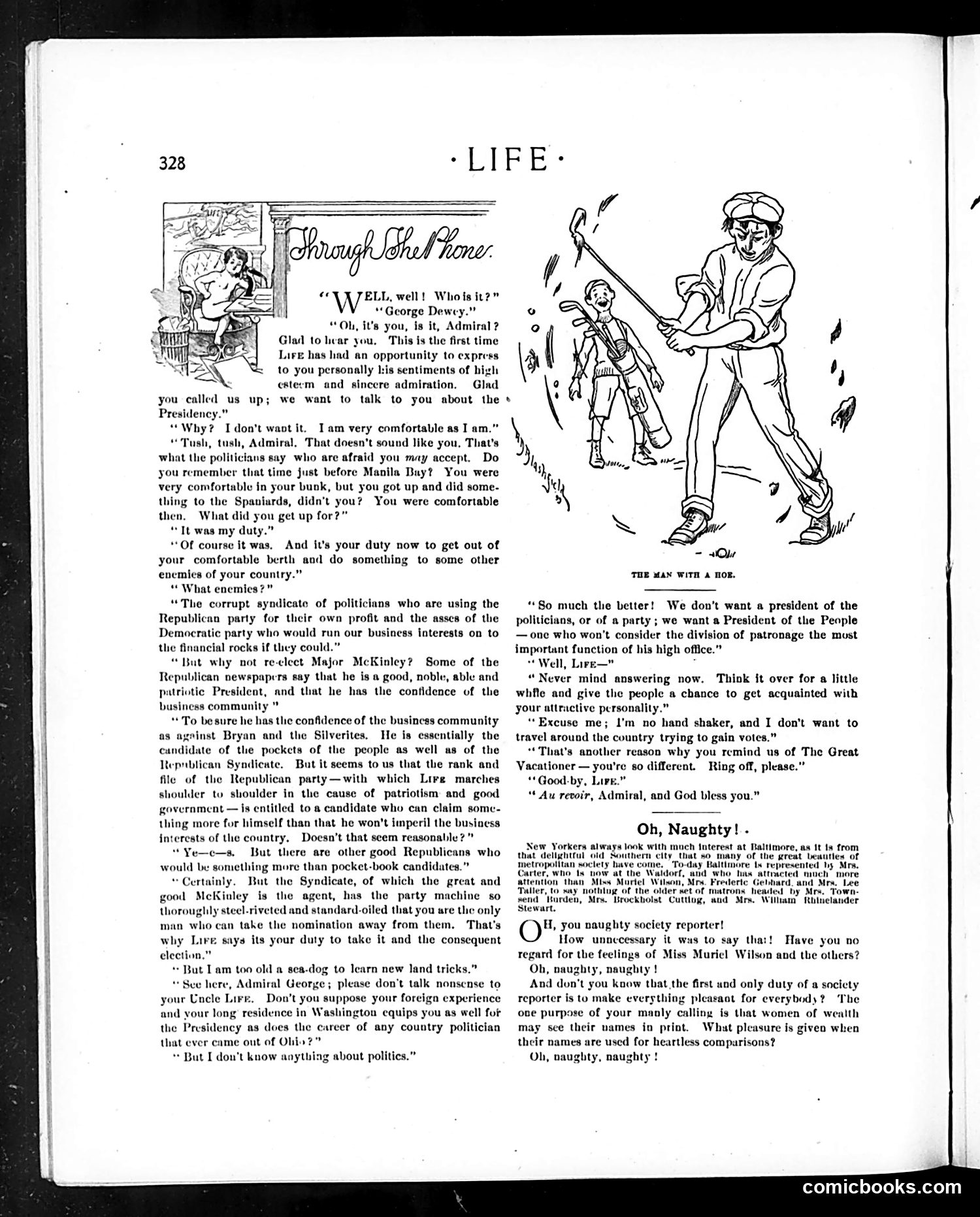
This page satirizes early 20th-century American politics through a phone conversation between Admiral George Dewey (hero of the Spanish-American War) and an unnamed politician urging him to run for president. **The Satire:** The cartoon mocks politicians pressuring a reluctant military hero into candidacy. The Admiral resists, claiming comfort in his current position—a jab at how politicians exploit war heroes for votes while the heroes themselves prefer obscurity. **Key Targets:** - Republican Party manipulation of the business community - Politicians prioritizing personal profit over patriotic duty - Society reporters (the "Oh, Naughty!" section) trivializing serious issues by focusing on wealthy women's social activities rather than meaningful civic engagement The cartoon critiques both political opportunism and frivolous journalism of the era.
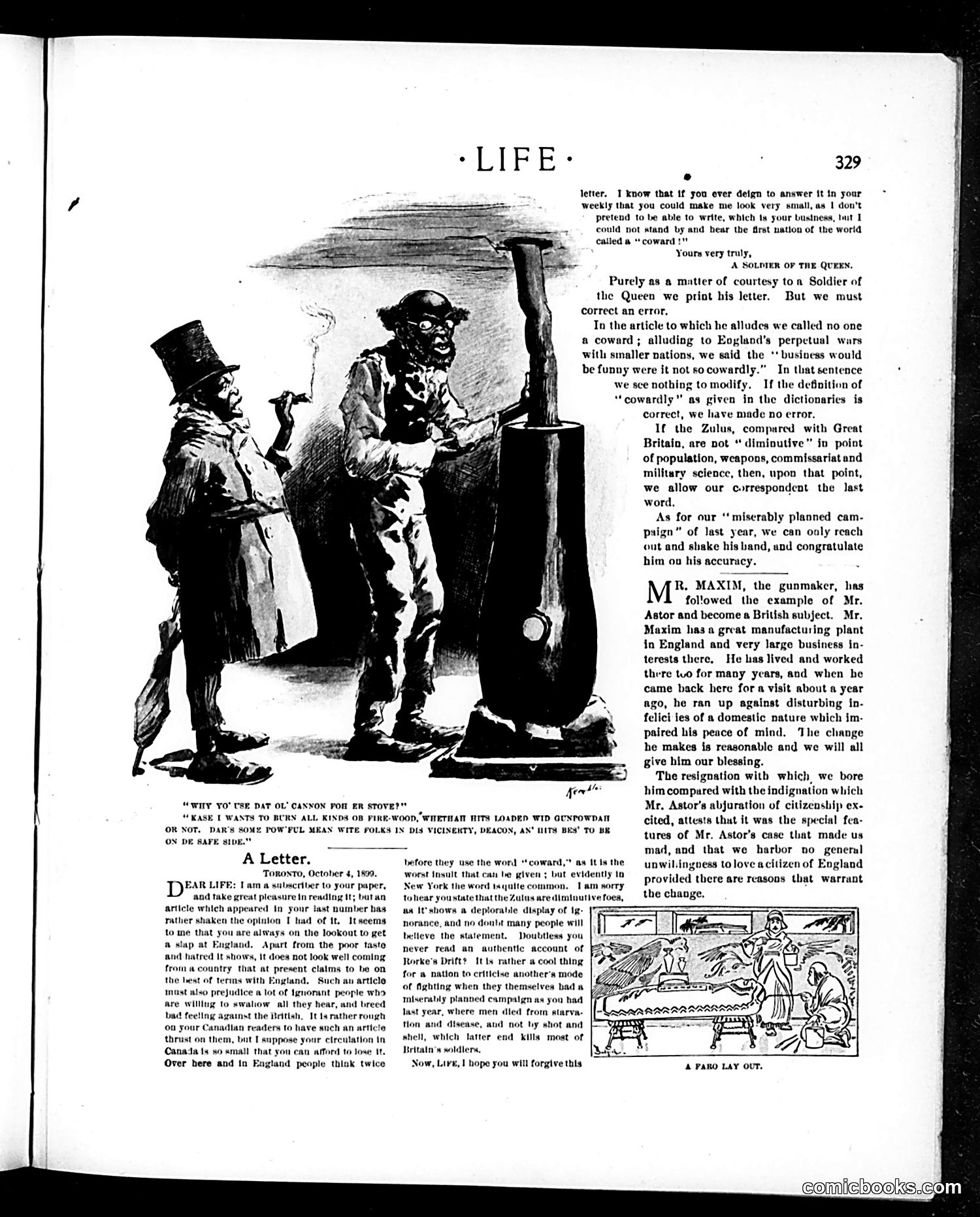
The main cartoon depicts two figures at a cannon: one in civilian dress (left) and one in military uniform (right). The caption reads: "WHY DO'S DAY O' CANNON FOR ER STOVE?" / "EASE I WANTS TO BURN ALL KINDS O' FIRE-WOOD, WHETHER HITS LOADED WID GUNPOWDER OR NOT, HAS EVEN'S FULL O' EASE WHILE HITS IN HIS VICINITY, DEACON, AN' HITS B'EN TO BE USE DE SIDE." This appears to satirize British military practices, likely referencing the Boer War (1899-1902). The dialogue mocks inefficient or absurd military decisions, with the African American dialect-speech typical of period American satire. The surrounding text discusses military campaigns and England's conduct—suggesting the cartoon criticizes wasteful or poorly-planned warfare tactics.
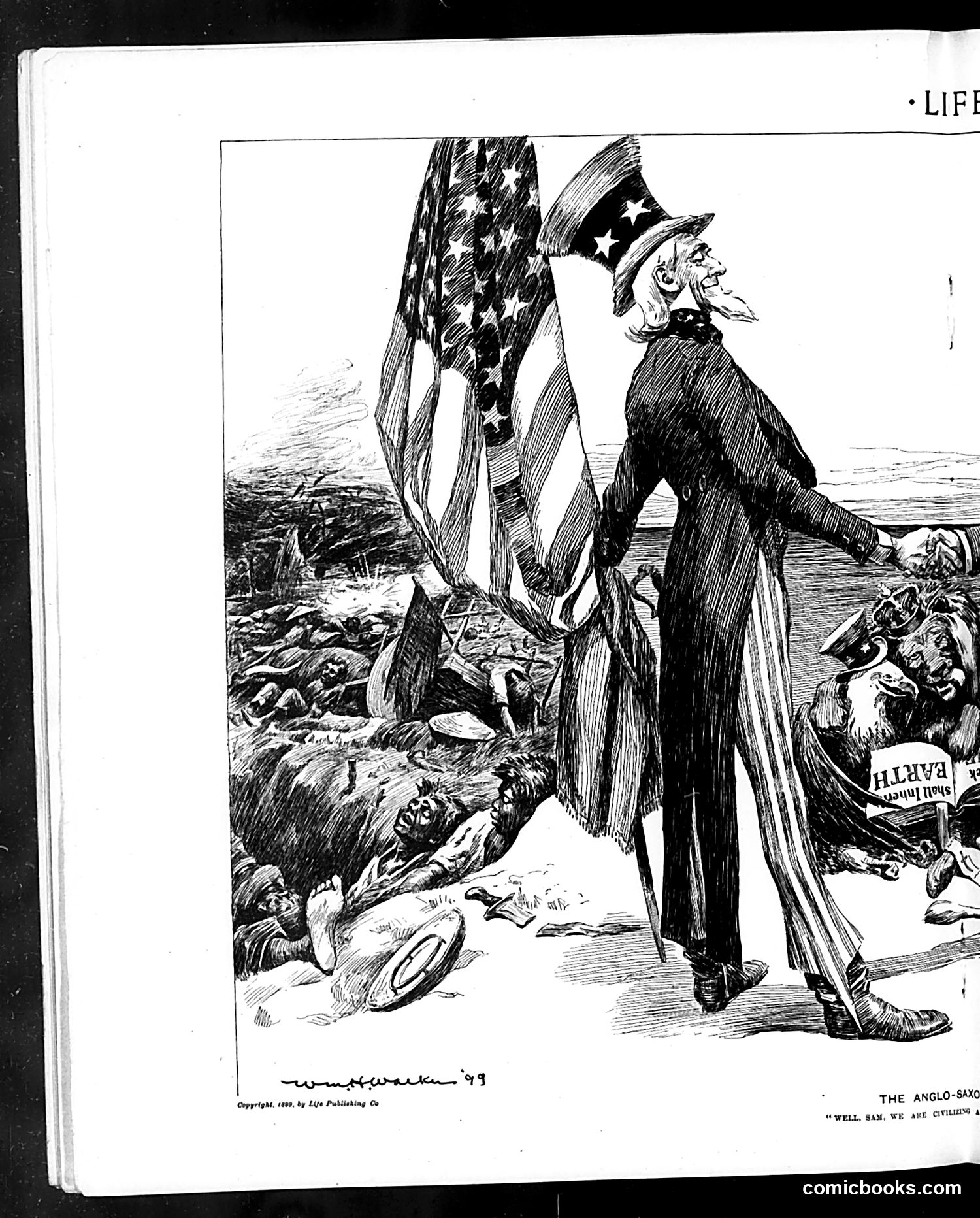
This is a Clifford Berryman cartoon (signed '99, likely 1899) titled "THE ANGLO-SAXON" with the caption "WELL, SAW, WE ARE CIVILIZING IT." The image depicts Uncle Sam (identifiable by his star-spangled top hat and formal coat) standing over a battlefield strewn with bodies and casualties. He holds the American flag while surveying the destruction below. The satire critiques American military interventionism under the guise of "civilization." The cartoon suggests that Uncle Sam's claimed civilizing mission—likely referencing U.S. involvement in the Spanish-American War (1898) or its aftermath in the Philippines—actually amounts to warfare and death. The ironic caption underscores this disconnect between stated humanitarian goals and violent reality, questioning whether military conquest constitutes genuine "civilization."
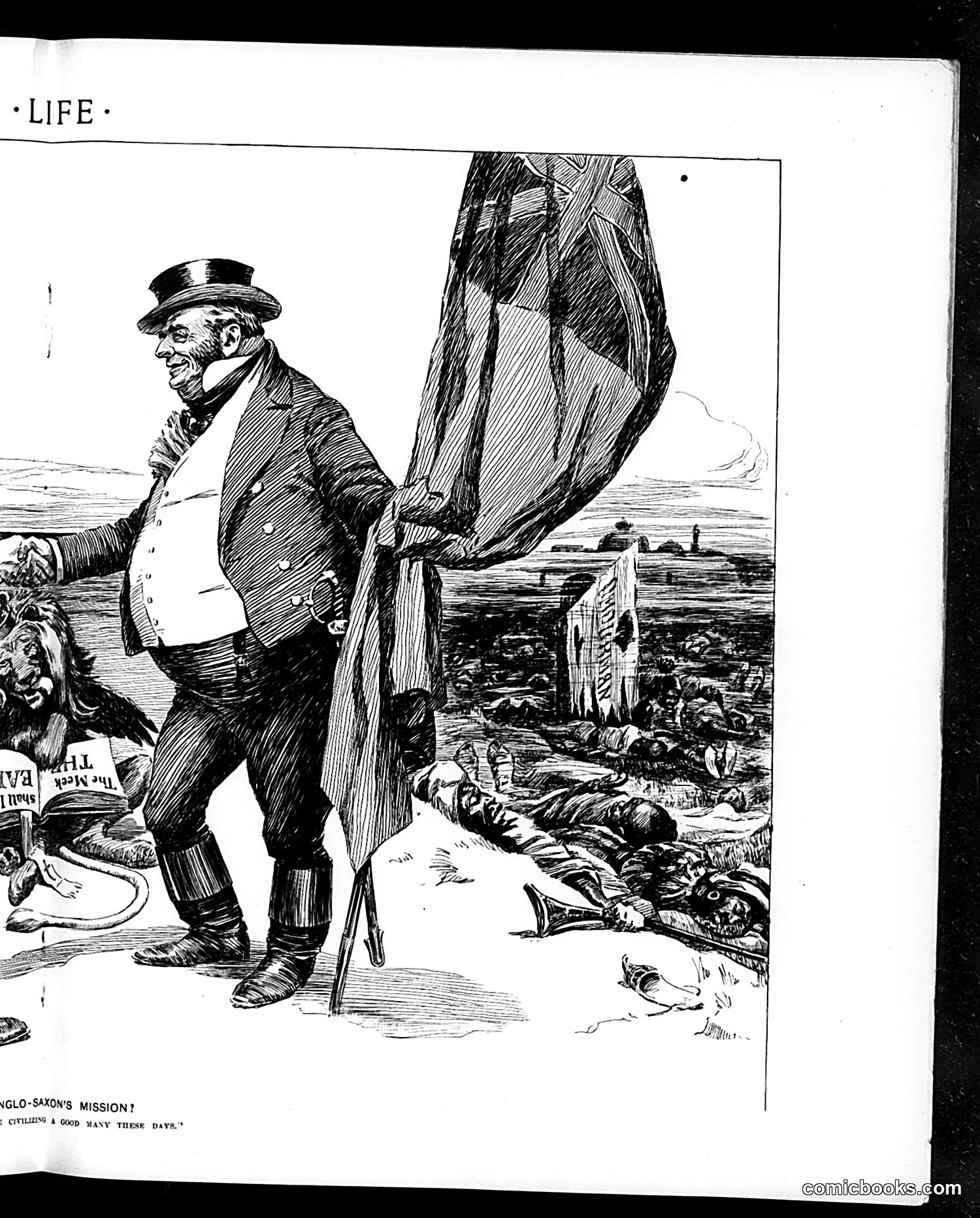
This political cartoon satirizes British imperial expansion. A well-fed, smug British gentleman holds a large flag while surveying a landscape littered with dead bodies and destruction. The caption reads "Anglo-Saxon's Mission" with a subtitle appearing to reference "good many these days." The satire critiques British colonialism and the justification of imperial conquest under the guise of a civilizing "mission." The contrast between the gentleman's self-satisfied demeanor and the carnage surrounding him exposes the hypocrisy of claiming moral or cultural superiority while conducting violent military campaigns. The cartoon appears to comment on the human costs of British imperial ambitions, likely referencing late 19th or early 20th-century colonial conflicts. The satirical point: imperial powers' self-righteous narratives mask ruthless exploitation and death.
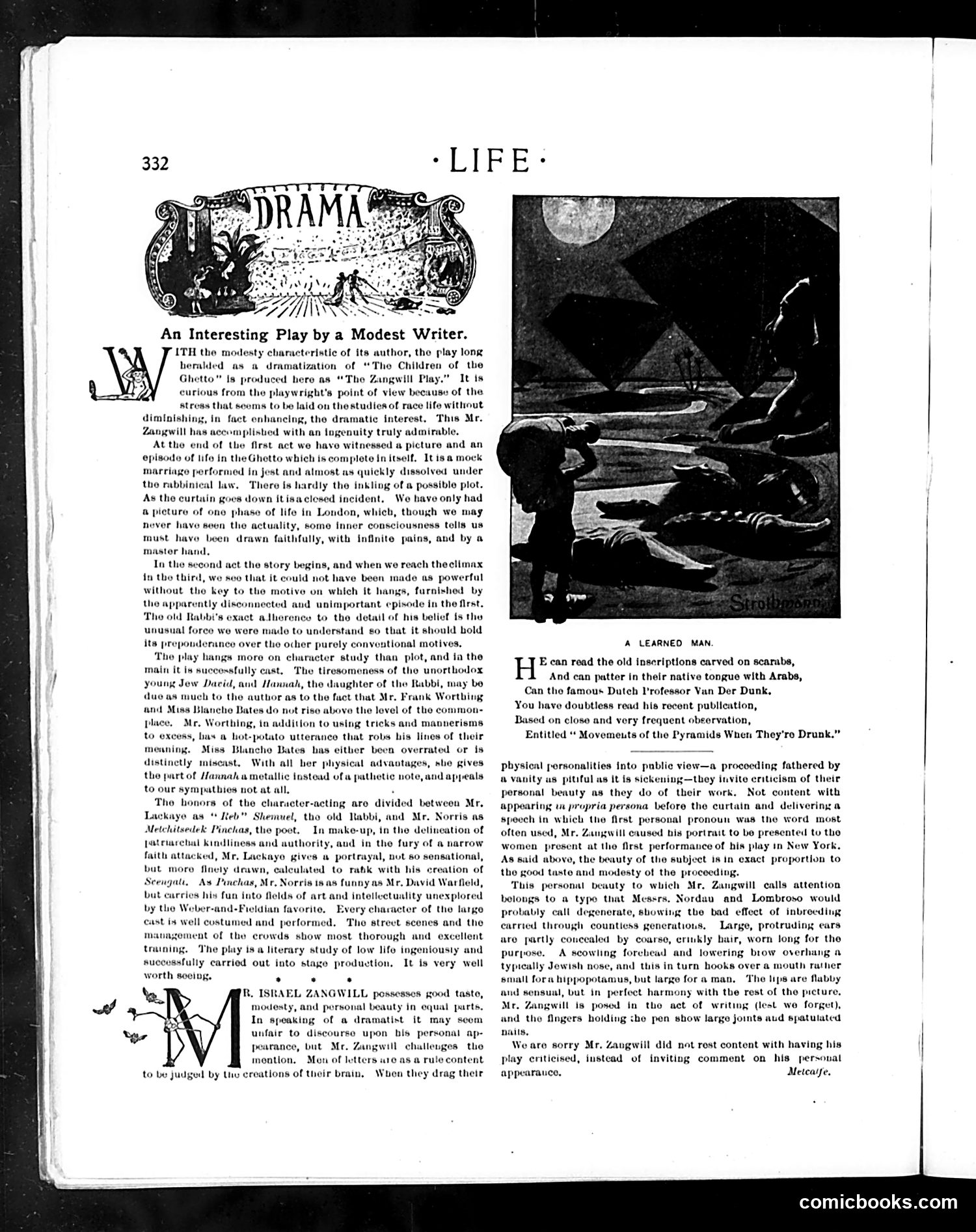
This page reviews a theatrical production, likely by Israel Zangwill (a known Jewish playwright of the early 20th century), titled "The Children of the Ghetto" or "The Zangewill Play." The review praises the work as an authentic depiction of London ghetto life—showing marriage, divorce, and daily existence among poor Jewish residents without sentimentality. The photograph shows "A Learned Man"—likely a character from the play. The review notes the production features strong performances, particularly praising physical characterizations that convey Jewish identity through appearance and mannerism, though the critic gently critiques the author's occasional tendency toward stereotyping. The piece emphasizes the play's documentary realism and artistic merit despite its modest theatrical conventions.
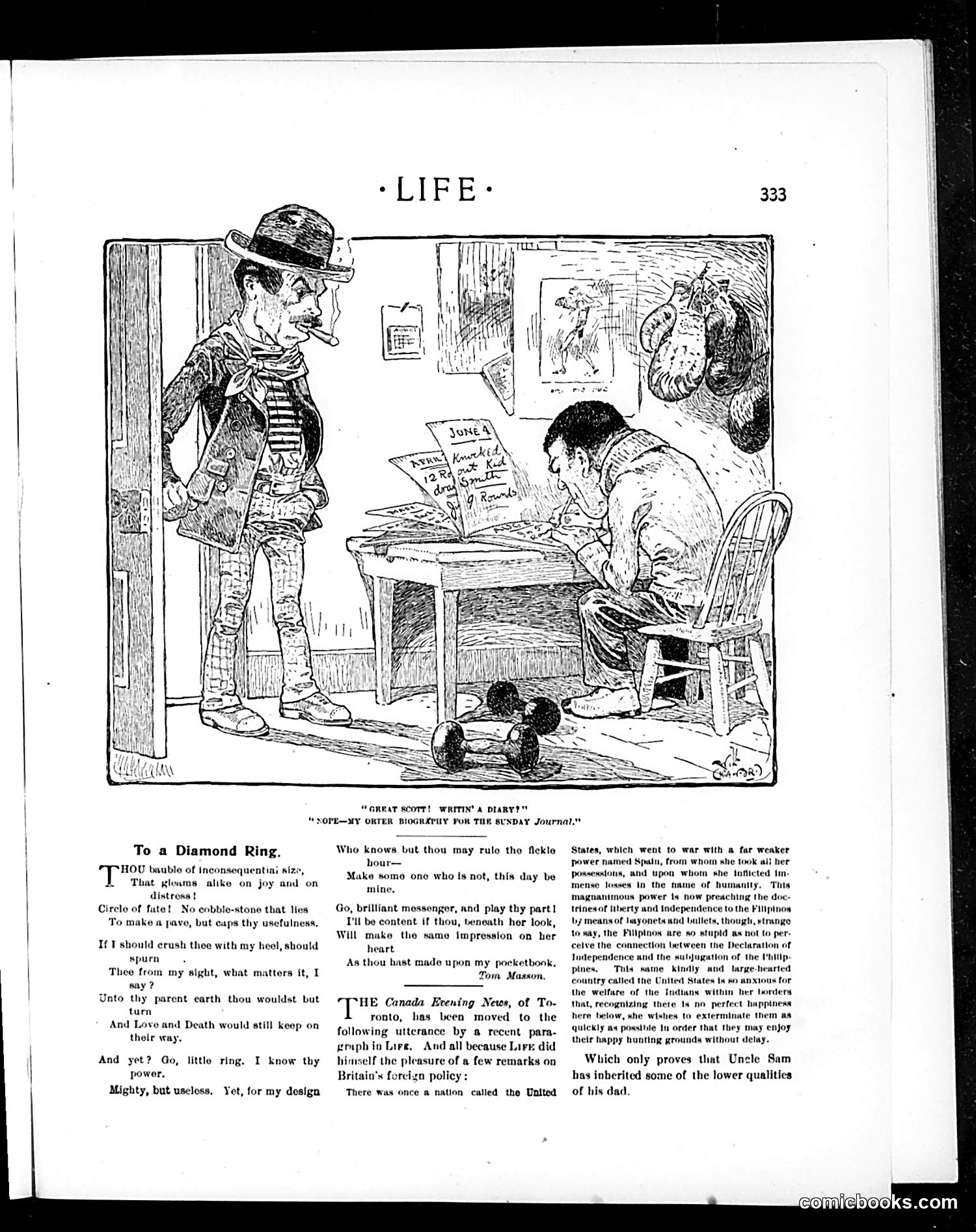
The cartoon depicts a man in a bowler hat and formal attire standing in a doorway, smoking a cigar, addressing another man seated at a desk writing. The seated man explains he's writing his "outer biography for the Sunday Journal"—a humorous reference to ghost-writing or fabricating one's own biography for publication. The accompanying text includes a sentimental poem "To a Diamond Ring" (by Tom Masson) about using an engagement ring to win a woman's heart, and a scathing editorial response from the *Canada Evening News* criticizing American hypocrisy: the U.S. waged war against Spain claiming humanitarian motives, yet now subjugates the Philippines by force while simultaneously practicing genocide against Native Americans. The piece sardonically notes this "proves that Uncle Sam has inherited some of the lower qualities of his dad" (Britain), satirizing American imperial pretensions to moral superiority.
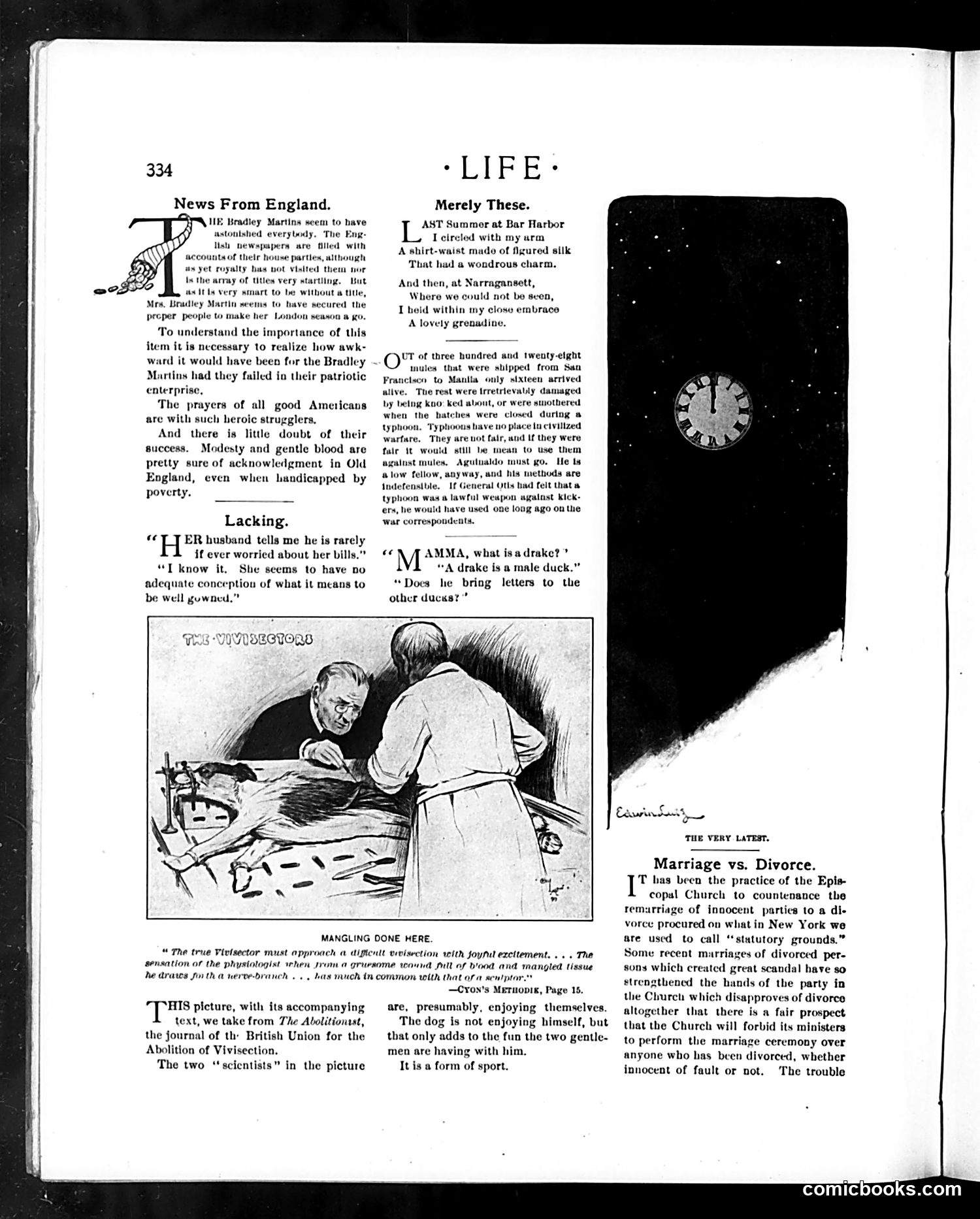
This page contains several distinct satirical pieces: **"News from England"** mocks the Bradley Martins, wealthy American socialites who apparently impressed British society despite lacking noble titles—absurd to Life's editors, who suggest it takes audacity for the rich to succeed in England even without aristocratic credentials. **"Lacking"** is a brief joke about a husband unconcerned with his wife's bills because she has no concept of being "well gowned"—satirizing women's spending habits and financial naivety. **"Mangling Done Here"** criticizes vivisection (animal experimentation). The cartoon shows scientists gleefully conducting experiments on a dog. The satire equates their "sport" with sadism, questioning whether causing animal suffering qualifies as legitimate scientific practice. **"Marriage vs. Divorce"** discusses the Episcopal Church's likely shift toward forbidding clergy from remarrying divorced persons, regardless of innocence. Life presents this as problematic policy. The page's humor targets wealthy pretension, gender stereotypes, animal cruelty, and religious rigidity.
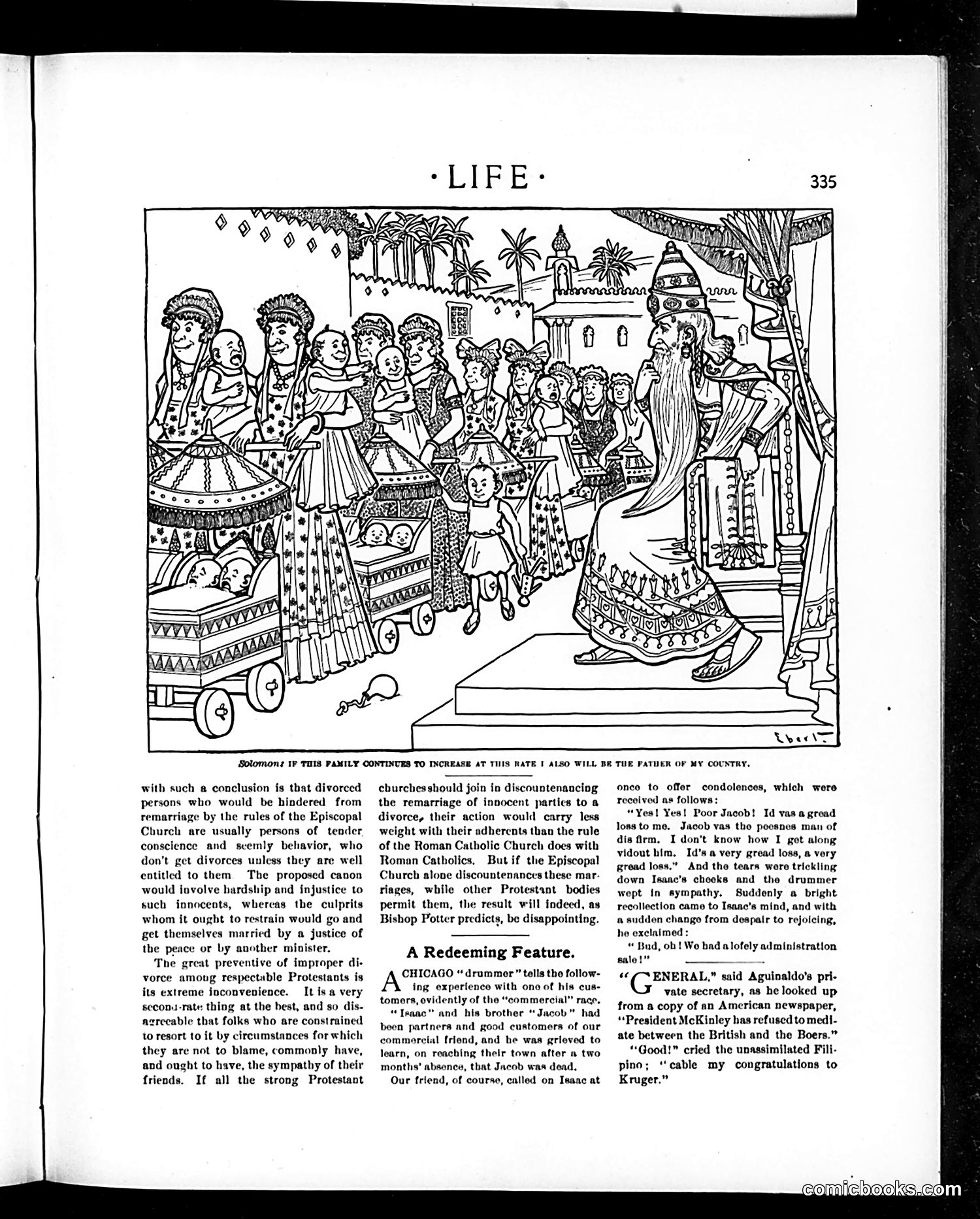
The main illustration depicts **Solomon** with multiple wives and children, captioned with his boast that if his family continues multiplying at this rate, he'll be "the father of my country." This satirizes concerns about **population growth and large families**, likely referencing contemporary debates about immigration and birth rates among different ethnic or religious groups. Below, "A Redeeming Feature" mocks Jewish merchants through a stereotyped anecdote: when "Isaac" learns his brother "Jacob" has died, he grieves—until remembering an upcoming liquidation sale, at which point his sorrow instantly converts to commercial excitement. The heavy accent and name choices reinforce ethnic stereotyping common to the era's satire. The final item jokes about **Emilio Aguinaldo** (Filipino independence leader) celebrating President McKinley's refusal to mediate the Boer War, since it leaves America focused on subduing the Philippines rather than intervening elsewhere.
This page contains **satirical stories and period advertisements** rather than political cartoons. The main narrative, "Shopping," depicts a poor woman whose purse is stolen, then recovered by a sympathetic policeman. A second story involves a man imprisoned for stealing ham to feed his family, who appeals to the Governor for a pardon. The Governor initially refuses, but the man's wife's tearful plea—that they're still hungry—moves him to reconsider. **The satire targets**: The story mocks both **poverty and governmental indifference**. The joke is the absurdity of the situation: a man steals food to survive, goes to prison for it, and only through emotional manipulation of an authority figure might escape. It's satirizing how the legal system punishes desperation while suggesting that emotion, not justice or logic, determines clemency. The third anecdote jokes about properly labeling packages for shipping. **Context for modern readers**: This reflects early-20th-century American concerns about **poverty, criminal justice, and the arbitrary nature of pardon systems**—issues still relevant today.
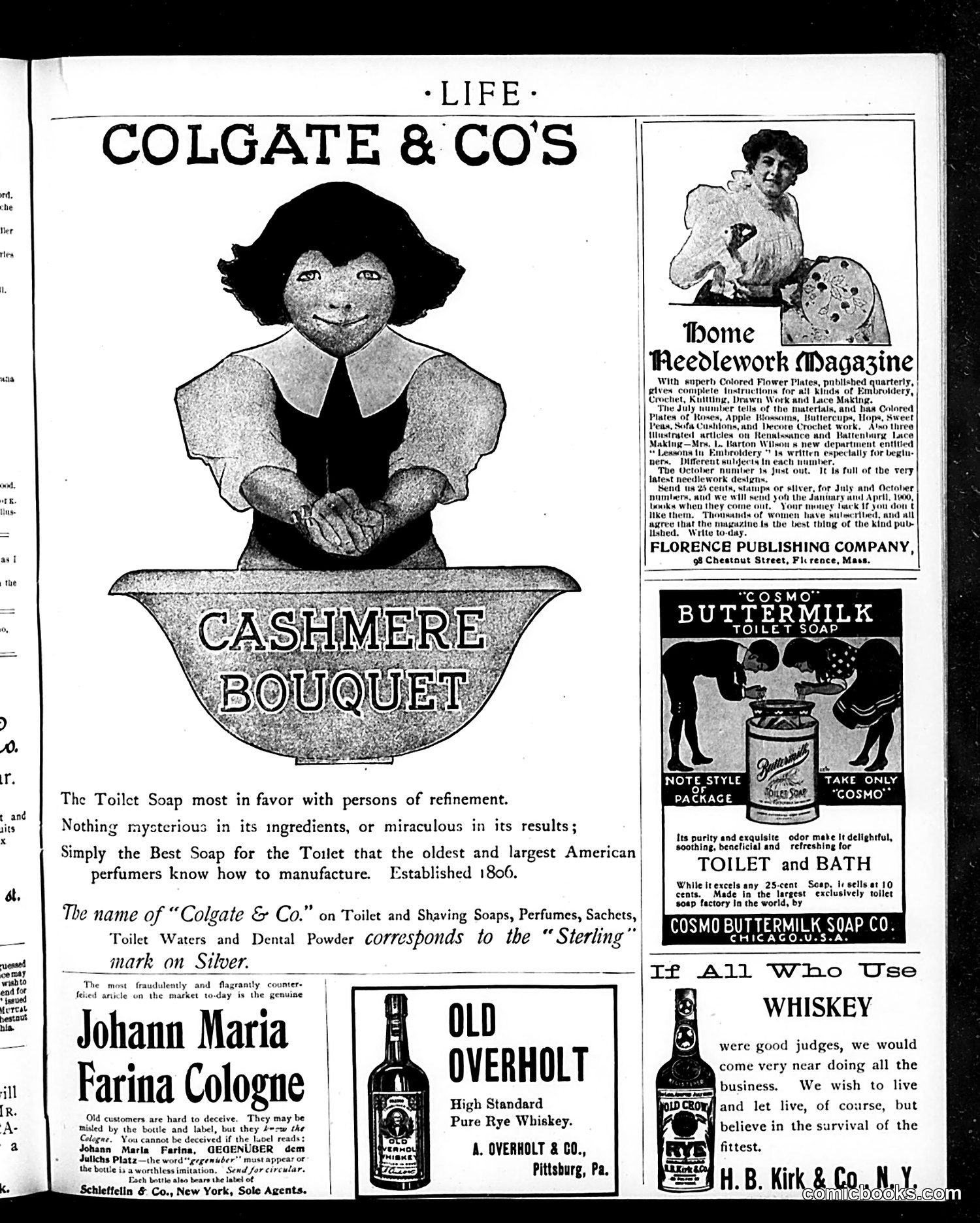
This is primarily an **advertisement page**, not a satirical cartoon. It features multiple product advertisements from the early 1900s, with no apparent political satire. The main visual is **Colgate & Co.'s "Cashmere Bouquet" soap ad**, showing a stylized woman's bust in an art nouveau style—typical packaging imagery of the era emphasizing refinement and luxury. The surrounding ads promote: - **Home Needlework Magazine** (crafts for women) - **Cosmo Buttermilk Soap** - **Johann Maria Farina Cologne** (warning against counterfeits) - **Old Overholt Whiskey** - **H.B. Kirk Whiskey** (with text about "survival of the fittest") The only quasi-editorial content is Kirk's whiskey ad, which includes commentary on business competition using Social Darwinist language—reflecting turn-of-century attitudes. Otherwise, this page simply showcases consumer goods marketed to affluent, refined audiences, particularly women interested in toiletries and domestic crafts.
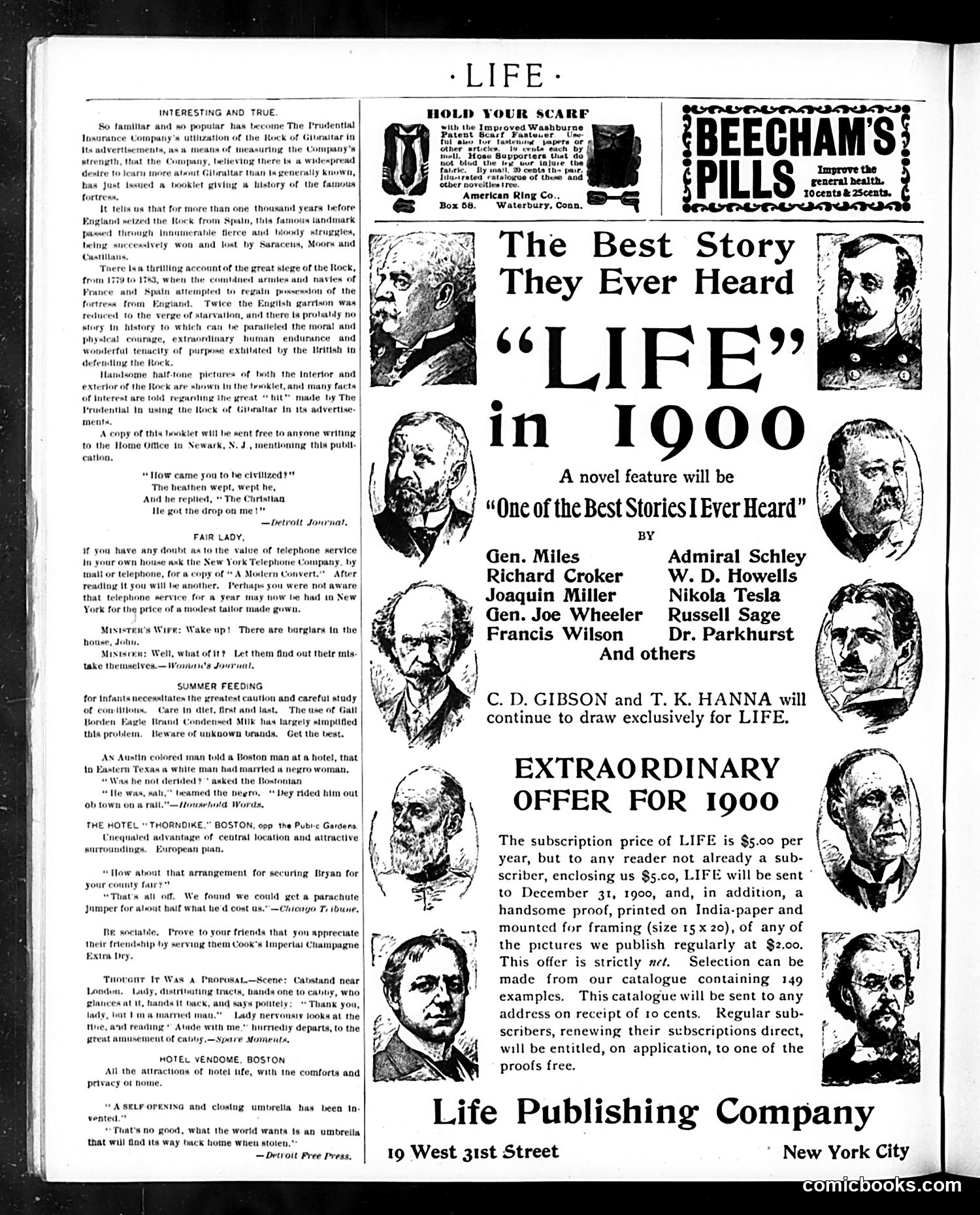
This is primarily an **advertising and promotional page** from Life magazine, circa 1900, promoting the magazine's upcoming serialization of "Life in 1000." **The Main Feature:** The central advertisement announces an upcoming serialized story featuring contributions from prominent figures of the era: General Miles, Admiral Schley, Richard Croker, W.D. Howells, Joaquin Miller, Nikola Tesla, General Joe Wheeler, Russell Sage, Francis Wilson, and Dr. Parkhurst. The illustrators C.D. Gibson and T.K. Hanna would draw exclusively for Life. **The Offer:** New subscribers could pay $5.00 to receive the magazine through December 31, 1900, plus a framed art print (size 15x20) from Life's catalogue of 149 illustrations—a significant premium for the time. **Surrounding Content:** The page also contains various brief humorous anecdotes and advertisements (Beecham's Pills, telephone service, Cook's Champagne, condensed milk), typical of Life's satirical format mixing editorial content with commercial notices. The page demonstrates Life's strategy of leveraging celebrity contributors to attract subscribers as the new century approached.
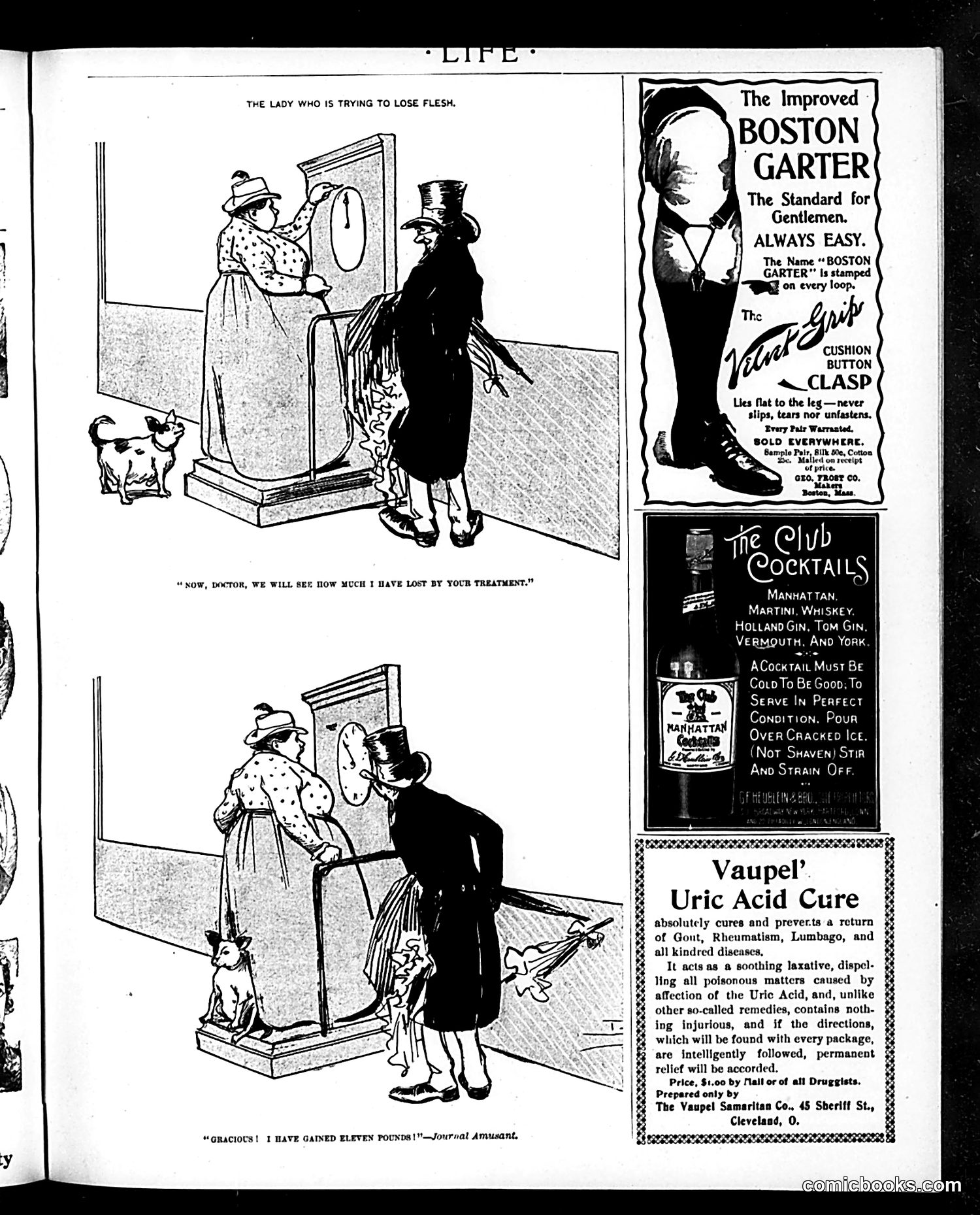
This page contains a two-panel cartoon about weight loss, plus period advertisements. **The Cartoon**: A woman visits a doctor claiming to want to lose weight. In the first panel, she's weighed on a scale. In the second, she's gained eleven pounds instead—shown here with the doctor and a small dog present. The joke satirizes the futility of weight-loss treatments: despite the doctor's intervention, the patient has actually gotten heavier. The caption credits "Journal Amusant," a French source, suggesting this was a reprinted international cartoon. **The Advertisements**: The page includes typical early-20th-century ads for: - Boston Garters (men's sock supporters) - The Club Cocktails (alcoholic beverages) - Vaupel's Uric Acid Cure (a patent medicine claiming to treat gout and rheumatism) The medical "cure" advertisement is particularly ironic appearing alongside a cartoon mocking ineffective treatments—both reflect an era when unregulated patent medicines made exaggerated health claims.
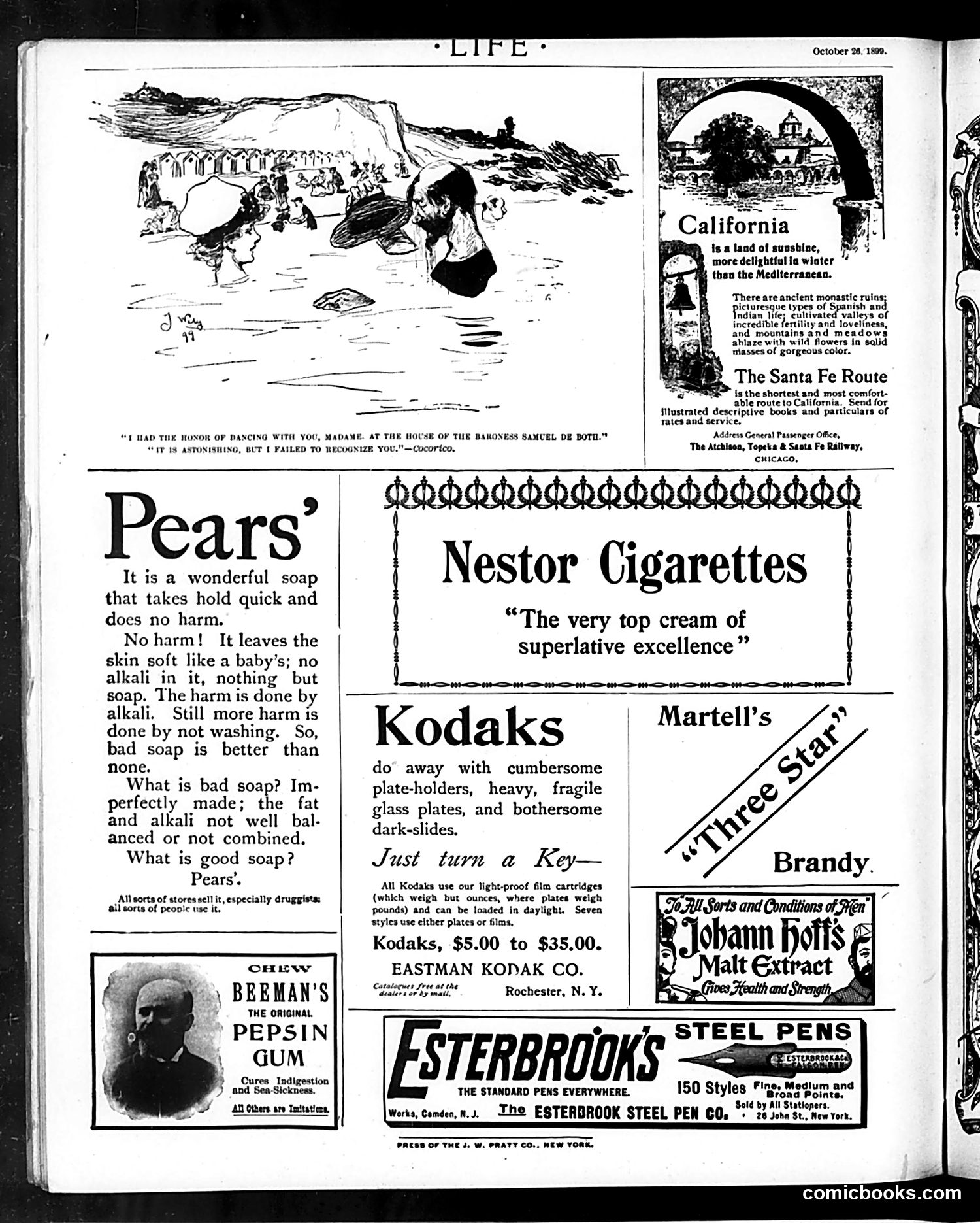
The cartoon depicts a social encounter between two elegantly dressed women at what appears to be a aristocratic gathering. One woman claims she danced with the other at "the house of the Baroness Samuel de Both," but the second woman insists she doesn't recognize her. The joke relies on a French phrase—"Cocorico" (French for "cock-a-doodle-doo")—suggesting the first woman is boasting or lying about her social connections. The humor targets pretentious social climbing: the woman fabricates an encounter at a prestigious venue to appear more socially important than she actually is. The other woman's pointed non-recognition serves as a humbling rebuke to this social pretension. The remainder of the page contains period advertisements for Pears' soap, Kodak cameras, Nestor cigarettes, and other products typical of 1899 publications.