
Life, 1899-10-26 · page 6 of 20
Life — October 26, 1899 — page 6: what you’re looking at
What you’re looking at
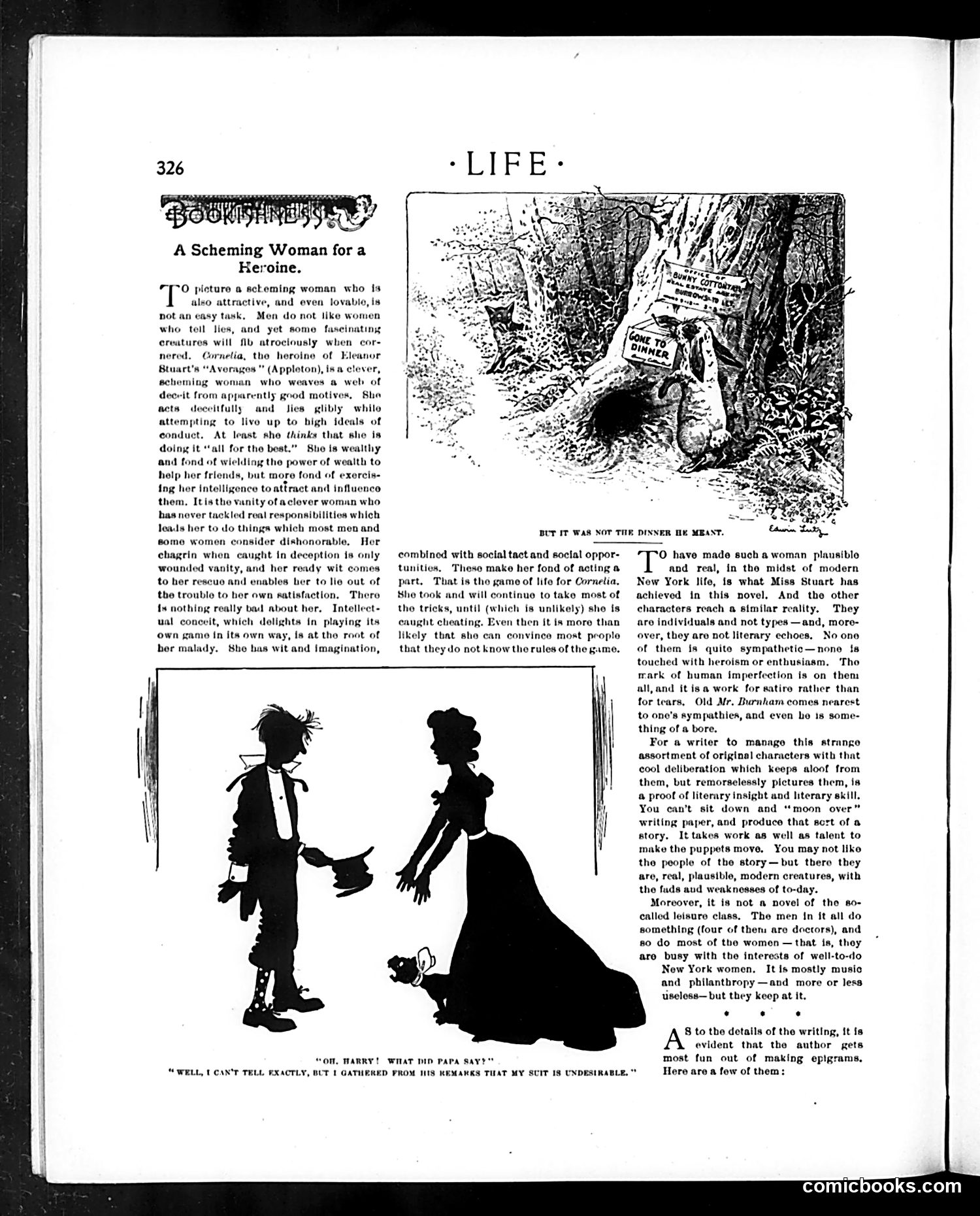
This page reviews a novel featuring Cornelia, a "scheming woman" protagonist who manipulates social situations to advance herself—typical of Gilded Age satirical fiction. The article argues this character type, while morally questionable, realistically depicts modern New York society. The silhouette cartoon below depicts a woman in an elaborate dress conversing with a man, with the caption "'Oh, Harry! What did papa say?' / 'Well, I can't tell exactly, but I gathered from his remarks that my suit is undesirable.'" The joke targets the social maneuvering of marriage-minded women of the era: despite her scheming, the woman fails to secure the desired match. The satire mocks both female social ambition and the transparent nature of such calculations.
📄 Transcribed text from this page (OCR, searchable)
Machine-transcribed from the original scan — historical spelling and the odd misread are preserved.
A Scheming Woman for a Heroine. ‘TO picture a sctoming woman who is also attractive, and even lovable, is not an easy task, Men do not like women who tell lies, and yet some fascinating creatures will fib atrociously when cor- nered. Cornelia, tho heroine of Eleanor Btuart’s “Averagos " (Apploton), isa clever, scheming woman who weaves a web of decrit from apparently good motives, She acts deceitfully and jies glibly while attempting to live up to high {deals of conduct. At least sho thinks that sho is doing it “all for tho best.” Sho is wealthy and fond of wielding the power of wealth to help her friends, but more fond of exercis- ing hor intelligence to attract and influenco them, Itis the vanity of aclever woman who has never tackled real responsibilities which leads her to do things which most mon and somo women consider dishonorable, Her chagrin when caught in deception is only wounded vanity, and her ready wit comes to her rescuo and enables ber to lie out of the trouble to her own satisfaction. Thero is nothing really bad about her, Intellect- ual conceit, which delights in playing its own gamo in its own way, is at tho root of ber malady. Sho bas wit and imagination, BUT IT Was NOT THR Dr combined with social tact and social oppor- tunities, These make her fond of acting a part, That is tho gamo of life for Cornetia, Sho took and will continuo to take most of the tricks, until (which is unlikely) sho is caught cheating. Even then it is more than likely that sho can convince most people that they do not know tho rules of the game. SOM, HARRY! WHAT DID PAPA SAY?” “WELL, [CAN'T TELL FXACTLY, BUT 1 GATHERED PROM 1118 REMARKS THAT MY SUIT 18 UNDESIRABLE, * ‘0 have made such a woman plausiblo and real, in tho midst of modern Now York life, is what Miss Stuart has achieved in this novel. And the other characters reach a similar reality. They aro individuals and not types —and, moro- over, they aro not literary echoes, No ono of them is quite sympathetic—nono $s touched with heroism or enthusiasm, Tho mark of human imperfection is on then: all,and it isa work for satire rather than for tears, Old Mr. Burnham comes nearest to one's sympathies, and even he 18 some- thing of a bore. For a writer to manago this strango assortment of original characters with that cool deliberation which keeps aloof from them, but remorselessly pictures them, is a proof of literary insight and literary skill You can’t sit down and “moon over” writing paper, and produce that scrt of a story. Ittakes work as well as talent to make the puppets move, You may not like the people of the story—but there they are, real, plausible, modern creatures, with the fuds aud weaknosses of to-day. Moreover, it i8 not a novel of the #0- called leisure class, Tho men in it all do something (four of then: aro doctors), and so do most of the women — that is, thoy aro busy with the interests of well-to-do New York women, It 1s mostly music and philantbropy—and more or less tiseloss— but they keop at it. 8 to tho details of tho writing, It fs evident that the author gets most fun out of making epigrams, Hero are a fow of them: comicbooks.com