
Life, 1899-10-26 · page 4 of 20
Life — October 26, 1899 — page 4: what you’re looking at
What you’re looking at
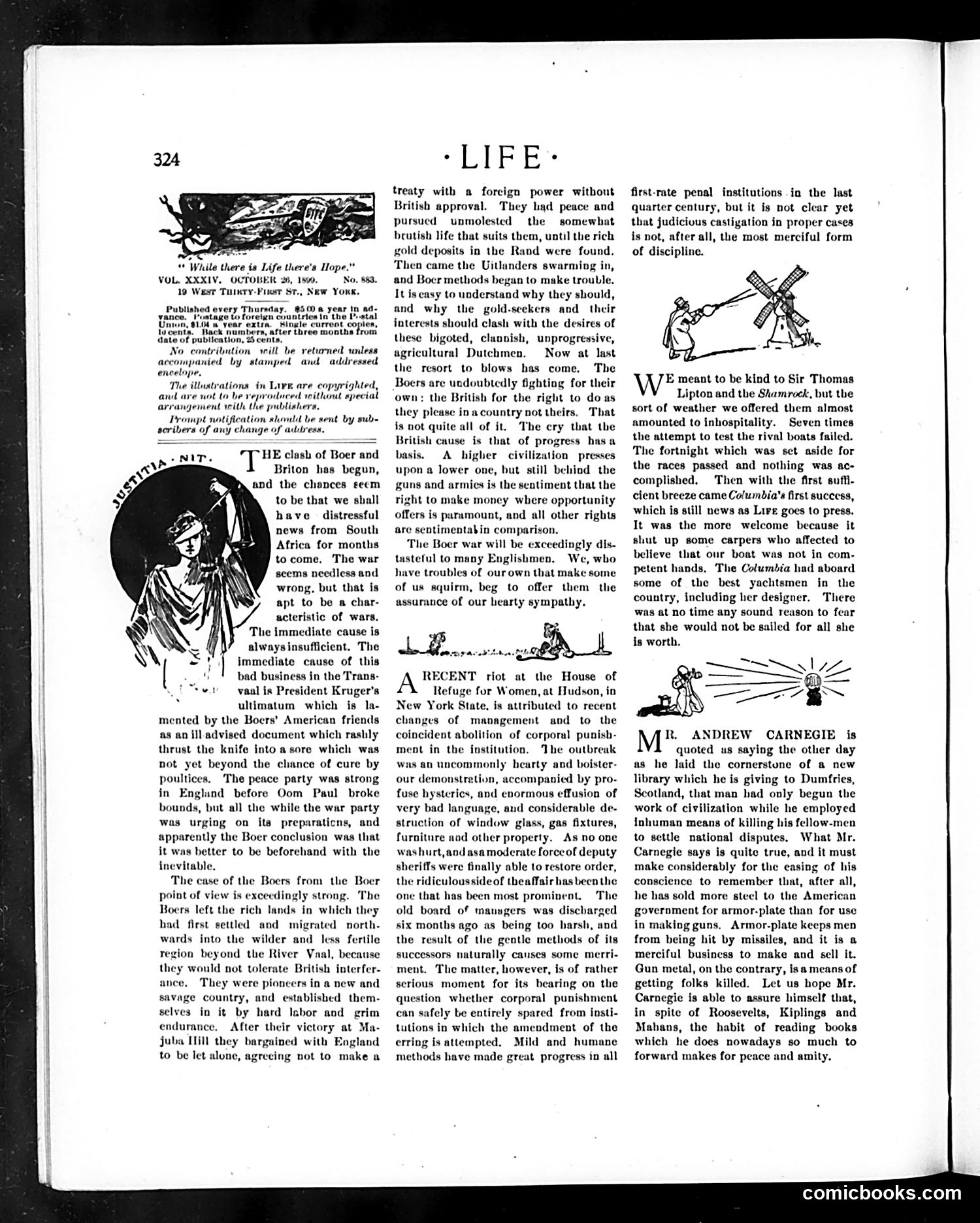
**The Main Cartoon (left side):** Shows a figure labeled "AUSTRALIA - NIT" - appears to be a personification of Australia depicted as a woman in classical dress. The accompanying text discusses the Boer War and its aftermath in South Africa, criticizing British colonial policy and the treatment of Dutch settlers ("Boers"). The cartoon likely satirizes Australia's position as a British colony caught between imperial interests and local concerns. **The Content:** The page discusses colonial conflicts in South Africa, debates over corporal punishment reform at a New York women's refuge, and praises Andrew Carnegie's philanthropic efforts with weapons manufacturing. The satire targets British imperial overreach, institutional brutality, and the moral contradictions of industrialists funding peace while profiting from armaments.
📄 Transcribed text from this page (OCR, searchable)
Machine-transcribed from the original scan — historical spelling and the odd misread are preserved.
VOL. XXXIV, OCTOBER 25, 1899. 19 West Tutnry-Finst St., New Yot Published every. ‘Thursday. $500 0 year tn ad- ¥ 6 to forelun countries in the Pesta ‘iatvear je current copies, Hack numb ree months from Le of publication, 2 No contribution will be returned unless accompanied by stamped and addressed envelope. The illustrations in Live are copyrighted, produced without special teith the publishers, iL be sent by sube diiress, HE clash of Boer and Briton has begun, and the chances secm to be that we sball have distressful news from South Africa for months tocome. The war seems needless and wrong, but that is apt to be a char- acteristic of wars. The immediate cause is alwaysinsufficient. The immediate cause of this bad business in the Trans- vaal is President Kruger’s ultimatum which is la- mented by the Bocrs’ American friends as an ill-advised document which rashly thrust the knife into a sore which was not yet beyond the chance of cure by poultices, The peace party was strong in Englind before Oom Paul broke bounds, but all the while the war party was urging on its preparations, and apparently the Boer conclusion was that it was better to be beforehand with the inevitable. The case of the Boers from the Boer point of view is exceedingly strong. The Boers left the rich lands in which they had first settled and migrated north. wards into the wilder and less fertile region beyond the River Vaal, because they would not tolerate British interfer- ance, They were pioncers in a new and savage country, and established them- selves in it by hard labor and grim endurance. After their victory at Ma- juba Ili they bargained with England to be let alone, agreeing not to make a LIFE treaty with a foreign power without British approval. They had peace and pursucd unmolested the somewhat brutish life that suits them, until the rich gold deposits in the Rand were found. ‘Then came the Uitlanders swarming in, and Bocr methods began to make trouble. It is easy to understand why they should, and why the gold-seekers and their interests should clash with the desires of these bigoted, clannish, unprogressive, agricultural Dutchmen. Now at last the resort to blows has come. The Boers are undoubtedly fighting for their own: the British for the right to do as they please inacountry not theirs. That is not quite all of it, The cry that the British cause is that of progress has a basis. A higher civilization presses upon a lower one, but still behiod the guns and armics is the sentiment that the right to make money where opportunity offers is paramount, and all other rights are sentimentabin comparison. ‘The Boer war will be exceedingly dis- tasteful to many Englishmen. We, who have troubles of our own that make some of us squirm, beg to offer them the assurance of our hearty sympathy. RECENT riot at the House of Refuge for Women, at Hudson, in New York State, is attributed to recent changes of management and to the coincident abolition of corporal punish- ment in the institution. ‘The outbreak was an uncommonly hearty and boister- our demonstration, accompanied by pro- fuse hysterics, and enormous effusion of very bad language, aud considerable de- struction of window glass, gas fixtures, furniture aod other property. As no one was hurt, and asa moderate force of deputy sheriffs were finally able to restore order, the ridiculoussideof theaffairbas bec the one that has been most prominent. The old board of manugers was discharged six months ago as being too harsh, and the result of the gentle methods of its successors naturally causes some merri- ment. The matter, however, is of rather serious moment for its bearing on the question whether corporal punishment can safely be entirely spared from insti- tutions in which the amendment of the erring is attempted, Mild and humane methods have made great progress in all first-rate penal institutions in the last quarter century, but it is not clear yet that judicious castigation in proper cases is not, after all, the most merciful form of discipline. E meant to be kind to Sir Thomas Lipton and the Shamrock, but the sort of weather we offered them almost amounted to inhospitality. Seven times the attempt to test the rival boats failed. The fortnight which was set aside for the races passed and nothing was ac- complished, Then with the first suffi- cient breeze came Columbia's first success, which is still news as Lie goes to press. It was the more welcome because it shut up some carpers who affected to believe that our boat was not in com- petent hands, The Columdia had aboard some of the best yachtsmen in the country, including her designer. ‘There was at no time any sound reason to fear that she would not be sailed for all she is worth. = — R. ANDREW CARNEGIE is quoted us saying the other day as he laid the cornerstune of a new library which he is giving to Dumfries, Scotland, that man had only begun the work of civilization while he employed inhuman means of killing his fellow-men to settle national disputes, What Mr. Carnegie says is quite true, and it must make considerably for the easing of his conscience to remember that, after all, he has sold more steel to the American government for armor-plate than for use in making guns. Armor-plate keeps men from being hit by missiles, and it is a merciful busincss to make and sell it. Gun metal, on the contrary, isa means of getting folks killed. Let us hope Mr. Carnegie is able to assure himself that, in spite of Roosevelts, Kiplings and Mahans, the habit of reading books which he does nowadays so much to forward makes for peace and amity. comicbooks.com