
Life, 1899-10-26 · page 7 of 20
Life — October 26, 1899 — page 7: what you’re looking at
What you’re looking at
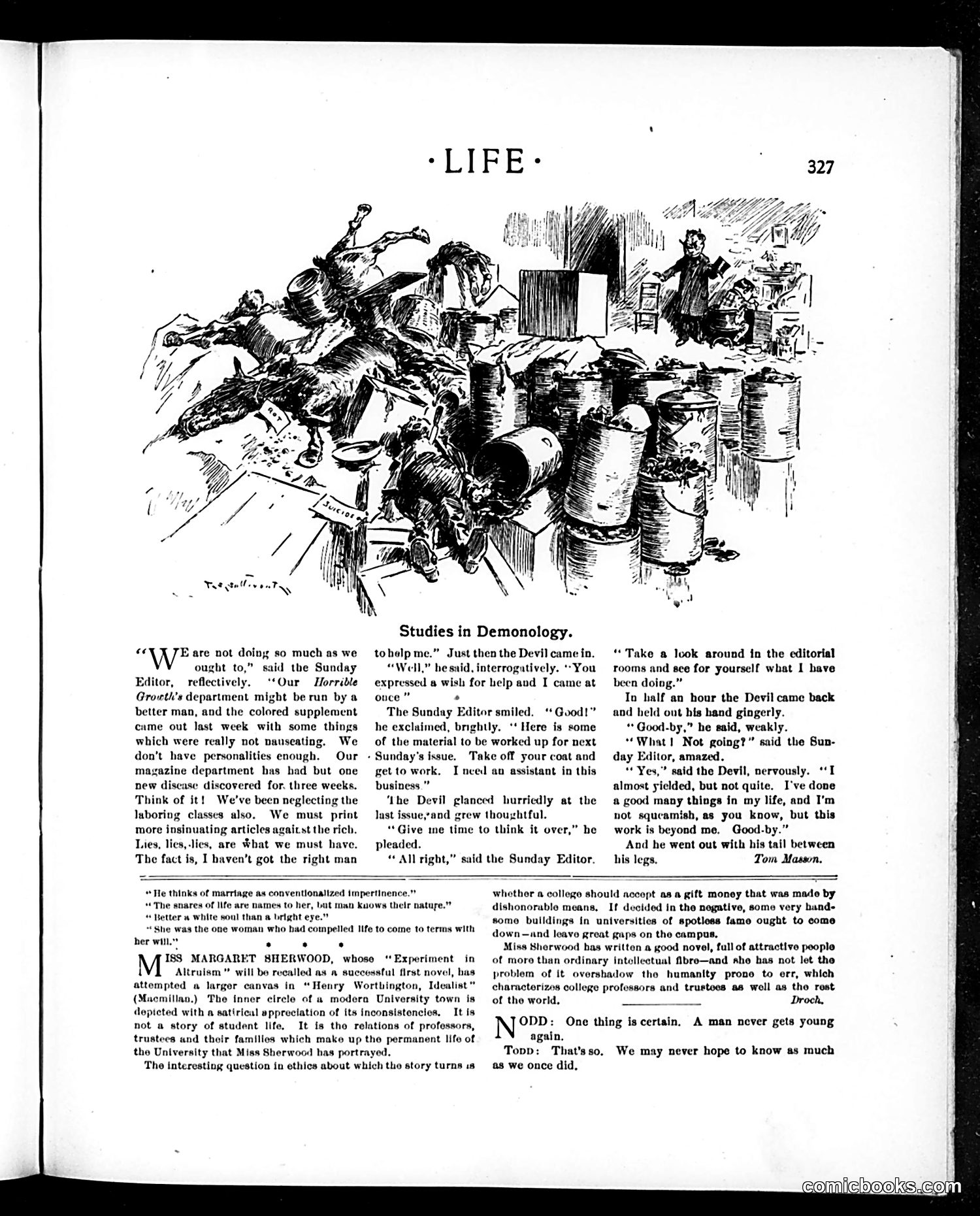
This satirical cartoon depicts a chaotic scene labeled "Studies in Demonology," showing a figure (likely representing the Devil) surrounded by various objects and smaller human figures in what appears to be an editorial office or workspace. The accompanying text is a dialogue between a Sunday Editor and the Devil, where the Editor asks for help producing content. The Devil offers assistance, and the Editor discovers various problematic materials to work with—lies, scandals, and sensational stories. The satire critiques how newspapers (particularly Sunday editions) manufacture sensationalism and rely on morally questionable content to boost circulation. It suggests that editors make "deals with the Devil" by prioritizing scandalous, false, or trivial stories over substantive journalism.
📄 Transcribed text from this page (OCR, searchable)
Machine-transcribed from the original scan — historical spelling and the odd misread are preserved.
ties Tet ote! “TA “oe E are not doing so much as we ought to,” said the Sunday Editor, reflectively. ‘‘Our Horrible Growth’s department might be run by a better man, and the colored supplement came out last week with some things which were really not nauseating, We Studies in Demonology. tohelp me.” Just then the Devil came in. “Well,” he said, interrogatively. “You. expressed a wish for help aud I came at once” ad The Sunday Editor smiled. ‘* Good!” he exclaimed, brightly. ‘Here is some of the material to be worked up for next “Take a look around in the editorial rooms and see for yourself what I have been doing.” In half an hour the Devil came back and held ont his hand gingerly. * Good-by,” he said, weakly. “What! Not going?” said the Sun- don’t have personalities enough. Our magazine department has had but one new discase discovered for. three weeks. Think of it! We've been neglecting the Inboring classes also. We must print more insinuating articles agaitst the rich. Lies, lies,-lies, are What we must have. The fact is, I haven't got the right man + Sunday's ixsue. get to work, business.” Jast issu pleaded. Take off your coat and Toced ao assistant in this ‘the Devil glanced hurriedly at the ‘and grew thoughtful. “Give me time to think it over,” be “ All right,” said the Sunday Editor. day Editor, amazed. * Yes,” said the Devil, nervously. ‘‘I almost yielded, but not quite. I've done a good many things in my life, and I'm not squcamish, as you know, but this work is beyond me, Good-by.” And he went out with his tail between his legs. Tom Maswn. + He thinks of marriage as conventionalized tmpertinence.” +The snares of life are names to her, but man kuows thelr nature.” + Better a white soul than @ bright eye." ~ She was the one woman who had compelled Ilfe to come to terms with her will.” * * * ISS MARGARET SHERWOOD, whoso “Experiment in Altruism” will be recalled as a successful first novel, has attempted a larger canvas in “Henry Worthington, Idealist" (Mucmillan.) ‘Tho inner circle of u modera University town is depicted with a satirical wppreciation of its inconsistencies. It is not a story of student life, It is tho relations of professors, trustees und thoir families which make up tho permanent life of tho University that Miss Sherwood has portrayed. Tho interesting question in ethics about which tho story turns is whether a collego should nccopt as a gift money that was mado by dishonorable means, If decided in the nogative, some very band- somo buildings in untversities of spotless famo ought to come down —and leavo great gups on the campus, Miss Sherwood has written a good novel, full of attractive people of moro than ordinary intellectual fibro—and rho has not let the problem of it overshadow tho humanity prono to err, which characterizes college professors and trustees as well as tho rost of tho world, Droch, ODD: One thing is certain. again, Topp: That's so, as we once did, A man never gets young We may never hope to know as much