
Life, 1899-10-26 · page 12 of 20
Life — October 26, 1899 — page 12: what you’re looking at
What you’re looking at
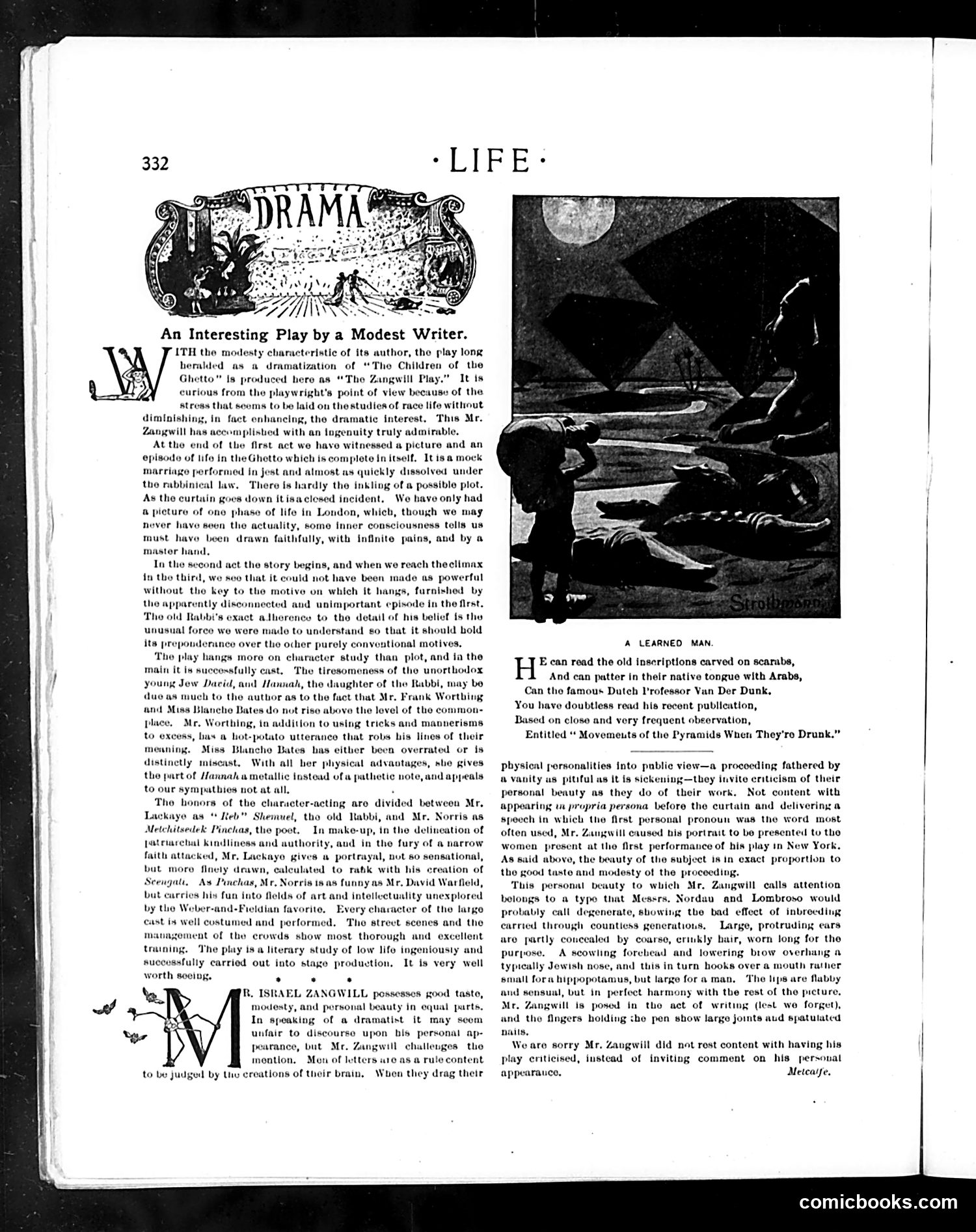
This page reviews a theatrical production, likely by Israel Zangwill (a known Jewish playwright of the early 20th century), titled "The Children of the Ghetto" or "The Zangewill Play." The review praises the work as an authentic depiction of London ghetto life—showing marriage, divorce, and daily existence among poor Jewish residents without sentimentality. The photograph shows "A Learned Man"—likely a character from the play. The review notes the production features strong performances, particularly praising physical characterizations that convey Jewish identity through appearance and mannerism, though the critic gently critiques the author's occasional tendency toward stereotyping. The piece emphasizes the play's documentary realism and artistic merit despite its modest theatrical conventions.
📄 Transcribed text from this page (OCR, searchable)
Machine-transcribed from the original scan — historical spelling and the odd misread are preserved.
An Interesting Play by a Modest Writer. ITH the modesty characteristic of its author, the play long heralded as a dramatization of “The Children of the Ghetto” Is produced here as “The Zangwill Play.” It is curious from the playwright’s point of view because of the Stross that sooms to be laid on the studies of race life without diminishing, in fact enhancing, the dramatic interest, This Mr. Zangwill has accomplisted with an togenuity truly admirable. At the end of the first act we have witnessed a picture and an episode of life in the Ghetto which is complete in itself, It is a mock marriage performed in jest and almost as quickly dissolved under tho rabbinical law, There is hardly the inkling of a possible plot. As the curtain goes down itisaclesed incident. We have only had 4 picture of one phase of life in London, which, though we may never have seen the actuality, some inner consciousness tells us must have been drawn faithfully, with inflnite pains, and by a master hand, In the second act the story begins, and when we reach theclimax in tho third, we seo that it could not have been made as powerful without the key to the motive on which it hangs, farnished by tho apparently disconnected and unimportant episode in the first, Tho old Rabbi's exact ath to tho detail of his belief ts the unusual force we were made to understand so that it should bold its preponderance over the ocher purely conventional motives, ‘Tho play hangs more on churacter study than plot, and ia the main it is succossfully cast. ‘The tiresomeness of the unorthodox K Jow Dacid, aud Hannah, the daughter of the Rabbi, may be due as much to the author as to the fuct that Mr. Frank Worthing and Miss Blanche Bates do not rise above the level of the common- Place, Mr, Worthing, in addition to using tricks and mannerisms to excess, bas a hot-potato utterance that robs his lines of their meaning. Miss Bluncho Bates bas either been overrated or is distinctly miscast, With all her physical advantages, she gives the part of Hannah a metallic Instead ofa pathetic note, and appeals to our sympathies not at all, ‘ Tho honors of the charucter-acting are divided between Mr. Lackaye as“ Keb" Shemuel, tho old Rabbi, and Mr. Norris as Metchitsedek Pinchas, the poot, In make-up, in the delineation of Patriarchal kindliness and authority, aud in the fury of a narrow faith attacked, Mr, Lackayo gives u portrayal, not so sensational, but more finely drawn, calculated to ratk with his creation of Seengal. As Pachas, Mr, Norris tas funny as Mr, David Warfleld, his fun into flelds of art and intellectuality unexplored by the Weber-and-Fieldian favorite, Every character of the largo cast is well costumed and performed, The strect scenes and the mauagoment of the crowds show most thorough and excellent traning. ‘The play is a literary study of low life ingeniously and successfully carried out into stage production, It is very well worth socing. * 8 . Ye R, ISRAEL ZANGWILL possesses good tasto, modesty, and personal beauty in equal parts. In speaking of a dramatist it may seom tye unfair to discourse upon bis personal ap- pearance, but Mr. Zangwill challenges the mention, Mon of letters are as a rule content to be judged by thw creations of their brain, Wun they drag their A LEARNED MAN. E can read the old inscriptions carved on scarabs, And can patter in their native tongue with Arabs, Can tho famous Dutch Professor Van Der Dunk, You have doubtless read his recent publication, Based on close and vory frequent obeorvation, Entitled “ Movements of the Pyramids When Thoy'ro Drunk.” physical porsonalities Into public view—a procoeding fathered by a vanity us pitiful as It is sickening—they invite eriticism of their personal beauty as they do of their work, Not content with appearing wm propria persona before tho curtain and delivering a speech in which the first personal pronoun was the word most often used, Mr. Zangwill caused bis portrait to be presented to the women present at tho first performance of his play in New York. As said above, the beauty of the subject 18 in exact proportion to tho good taste and modesty of the proceeding. This personal beauty to which Mr, Zangwill calls attention belongs to a typo that Messrs, Nordau and Lombroso would probably call degenerate, showing the bad effect of inbreeding carried through countiess generations, Large, protruding ears aro partly concealed by coarse, ermkly hair, worn tong for the purpose. A scowling forehead and lowering brow overhang a typrcully Jewish nose, and this in turn books over a mouth rather small fora hippopotamus, but large fora man, ‘The lips are flabby and sensual, but in perfect harmony with the rest of the picture, Mr. Zangwill is posed in tho act of writing (lest woe forget), and the fngers holding che pen show large jomts aud spatulated nails. We aro sorry Mr. Zangwill did not rost content with having his play eriticised, instead of inviting comment on his personal appearauce, Metcaife. comicbooks.com