
A complete issue · 20 pages · 1899
Life — September 14, 1899
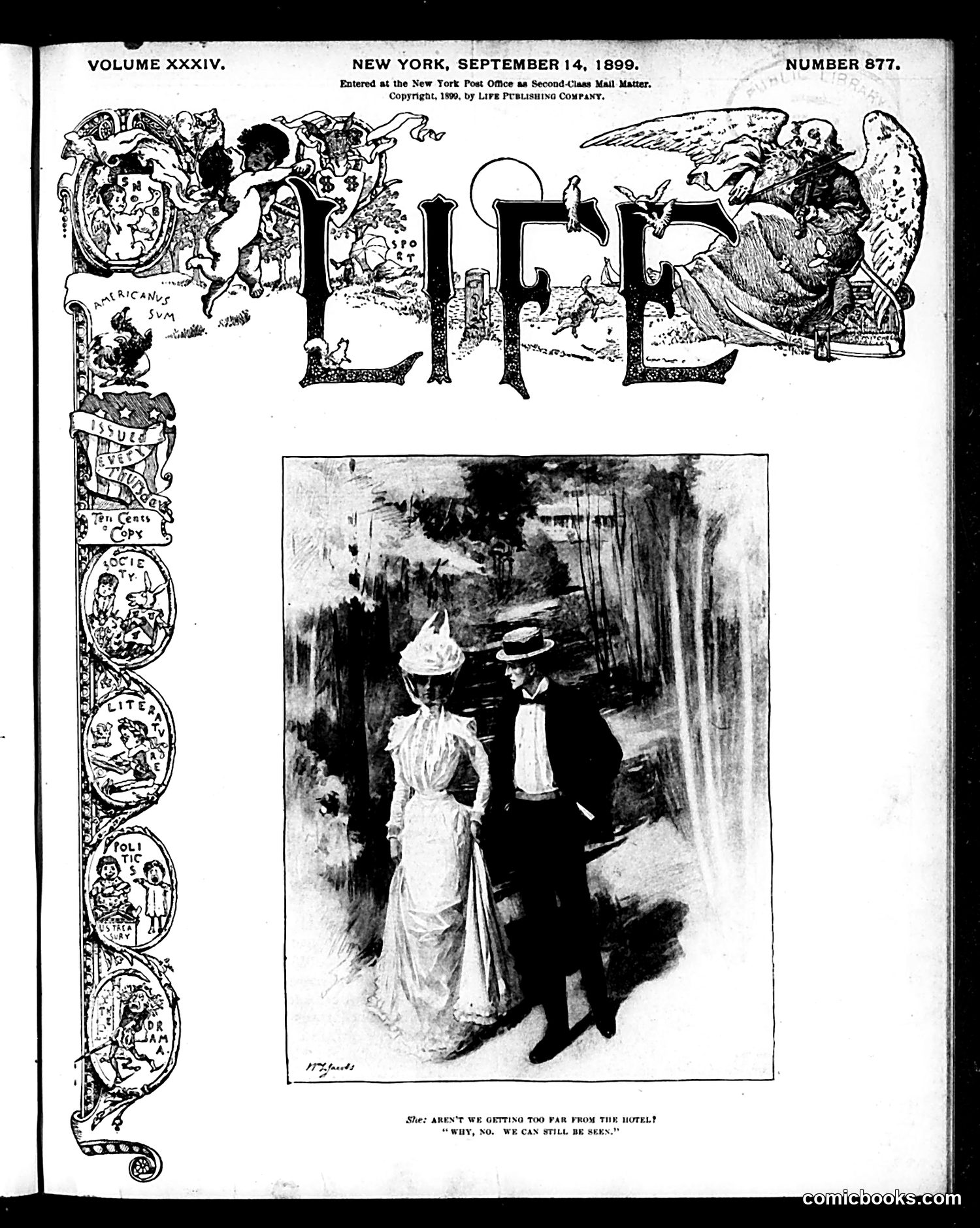
The main illustration shows a couple in conversation on a tree-lined path. The caption reads: "She: 'Aren't we getting too far from the hotel?' He: 'Why, no. We can still be seen.'" This is a social satire about courtship propriety in the 1890s. The joke centers on the tension between romantic privacy and Victorian social conventions requiring public visibility for unmarried couples. The man's reassurance that they remain visible reflects the era's strict rules: couples couldn't be truly alone without compromising the woman's reputation. The humor lies in his casual acknowledgment of constant social surveillance—they must maintain the *appearance* of propriety by staying within sight of potential witnesses, even while attempting a private moment. This captures period anxieties about courtship, respectability, and social control.
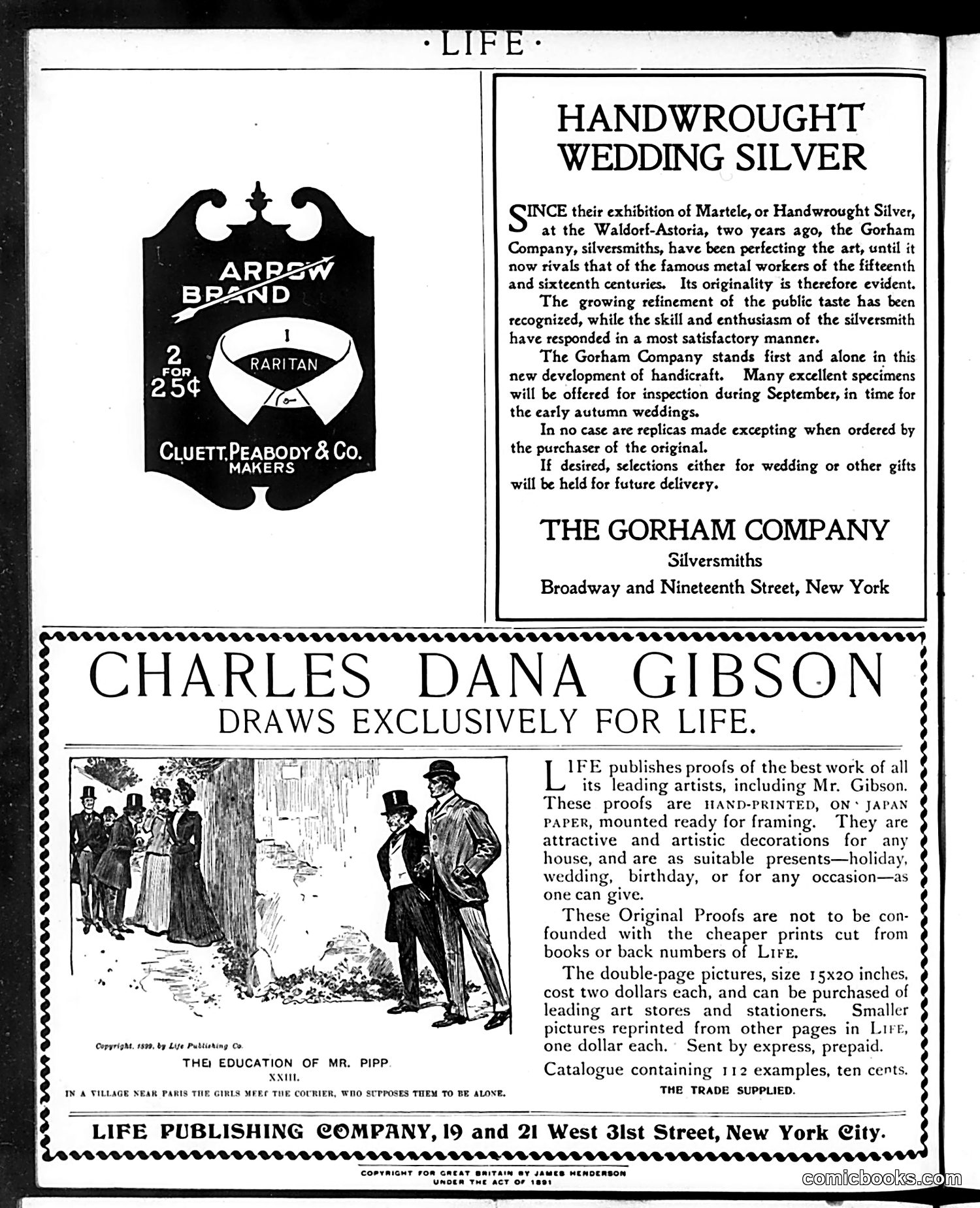
This page is primarily **advertising**, not satirical content. It contains three distinct ads: 1. **Arrow Brand Collar** (top left): A vintage clothing advertisement for men's collars made by Cluett, Peabody & Co., priced at 2 for 25¢. 2. **Gorham Company Silver** (top right): An announcement of handwrought wedding silver products, positioning them as rivals to famous historical metalwork. 3. **Charles Dana Gibson Drawing** (bottom): Life Publishing Company advertises art proofs by the famous illustrator Gibson (likely the creator of the "Gibson Girl"), promoting hand-printed reproductions available for framing as gifts or decoration. There is **no political cartoon or satire** on this page. The Gibson illustration depicts a social scene—men in formal dress meeting a woman—but functions solely as an advertisement for art prints rather than commentary.
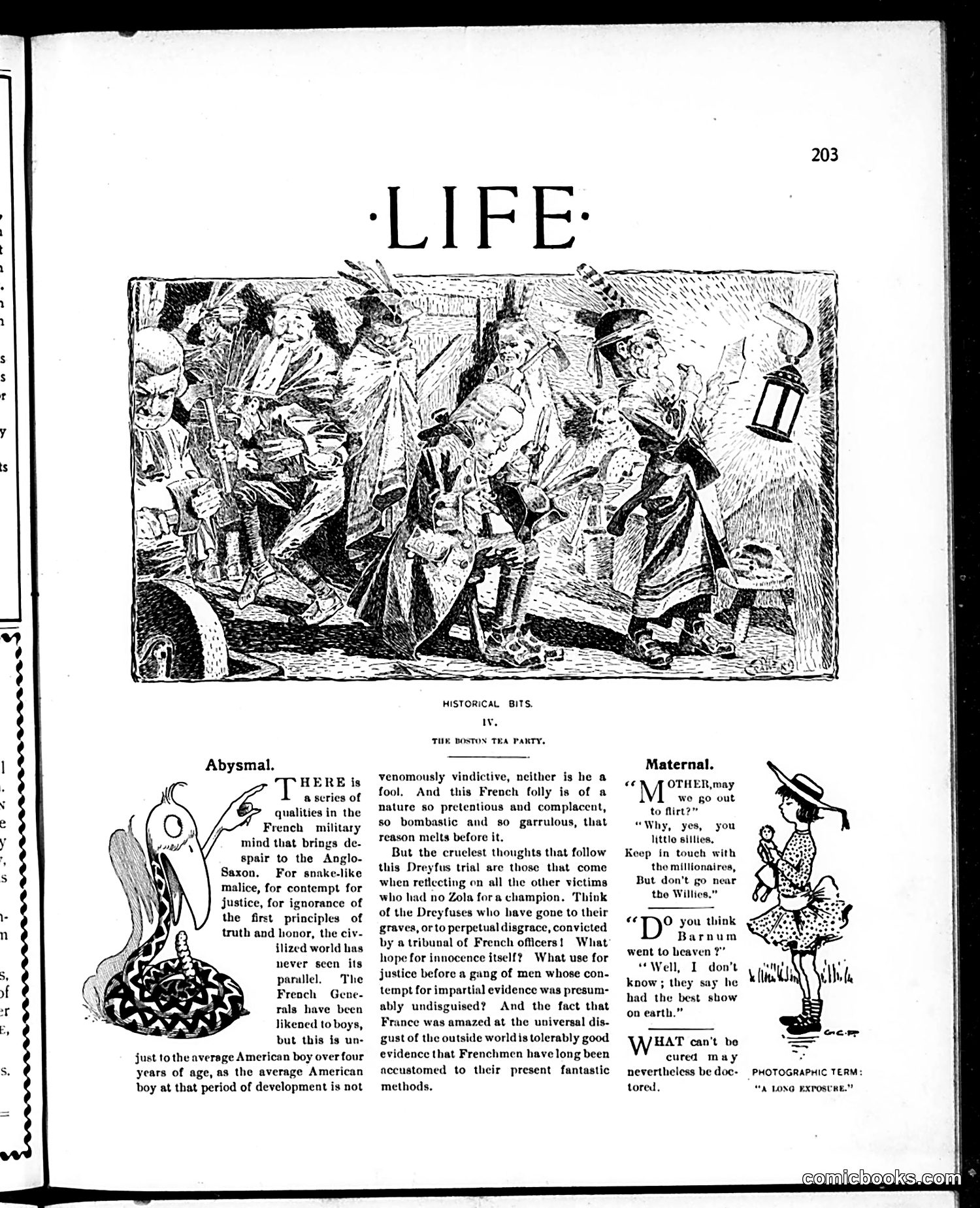
This page satirizes the **Dreyfus Affair**, a major French scandal involving a Jewish military officer falsely accused of treason. The "Abysmal" section mocks French military "justice" by comparing it unfavorably to even the most corrupt practices—suggesting French officers are worse than Anglo-Saxon villains. The "Maternal" section presents a satirical mother-son dialogue mocking American reverence for wealth ("the Willies," slang for millionaires). The child asks if Barnum (P.T. Barnum, famous American showman/huckster) went to heaven, and the mother replies he had "the best show on earth"—suggesting Americans worship commerce over morality. The title references the Boston Tea Party, likely to contrast American and French justice systems ironically.
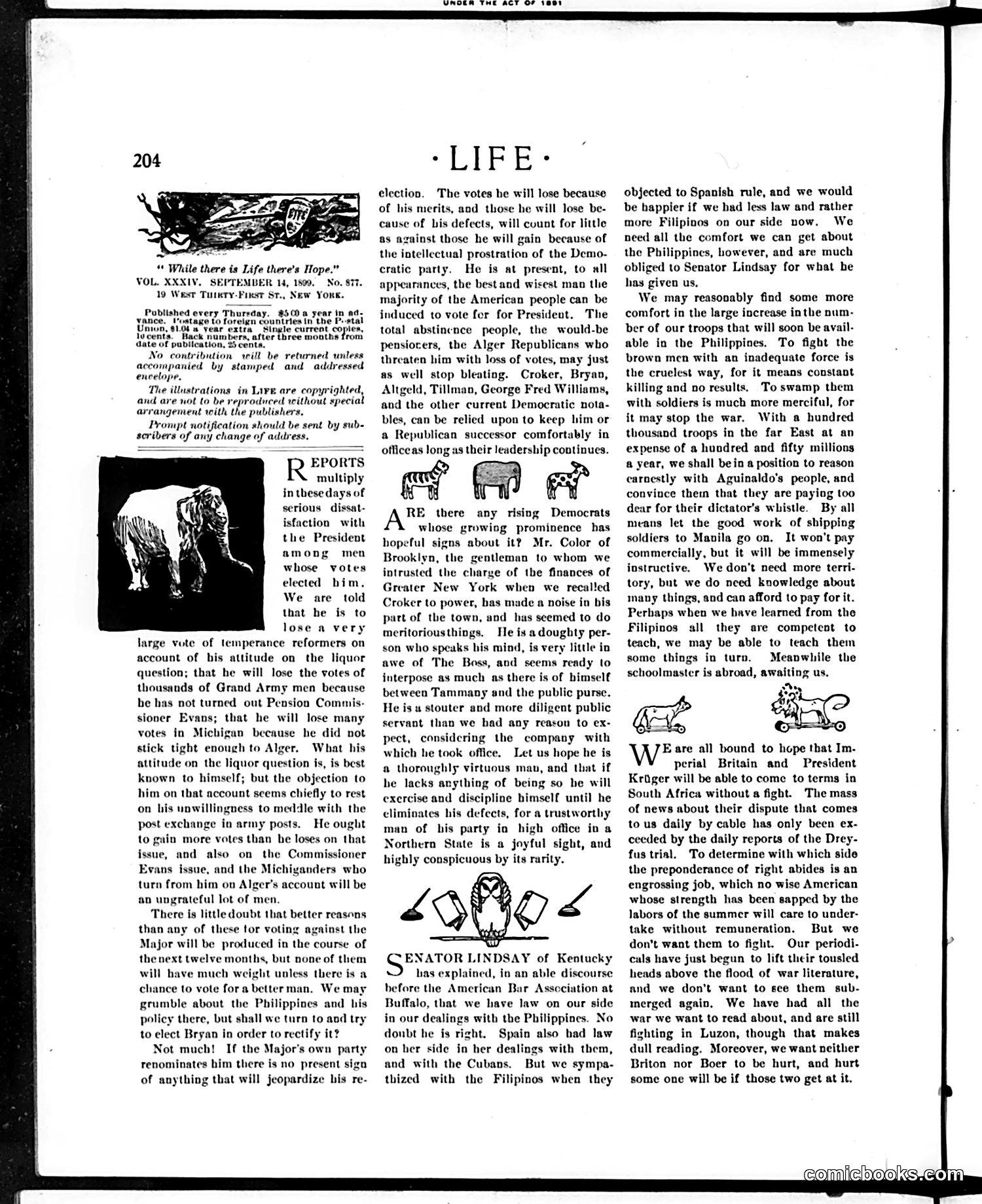
This political commentary discusses the 1900 presidential election and Democratic defections. The main cartoon depicts a donkey (the Democratic symbol) looking distressed—representing party divisions over whether to support William Jennings Bryan again. The text critiques President McKinley's popularity and warns that Democratic voters, particularly "temperance reformers" and those alienated by Bryan's previous loss, may defect. It specifically names Colonel Color of Brooklyn as an example of a prominent Democrat considering switching sides. The commentary also addresses the Philippine-American War, arguing that while it's costly, fighting efficiently is preferable to prolonged conflict. The piece reflects anxieties about party loyalty and voter realignment in this election cycle.
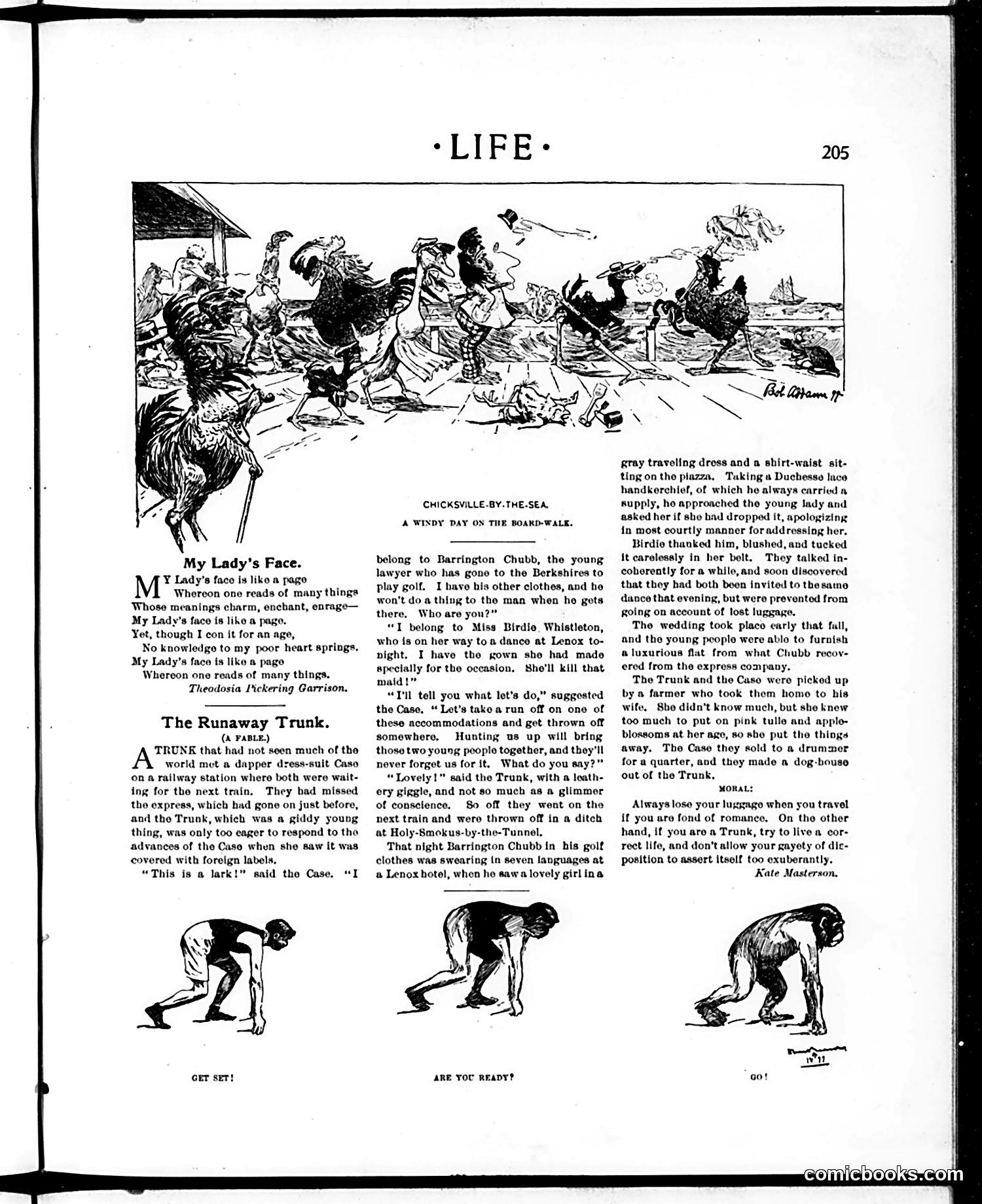
This page contains three distinct pieces: 1. **"My Lady's Face"** - A poem about a woman's appearance and its emotional impact. 2. **"The Runaway Trunk (A Fable)"** - A story about Barrington Clubb, a young lawyer, and a traveling trunk mix-up involving a woman named Birdie Whistleton. The narrative describes mishaps when Clubb and "the Case" (unclear who this refers to) board a train with the wrong trunk, leading to romantic complications and eventual wedding. 3. **Bottom illustrations** - Three sequential cartoons showing athletic/gymnastic positions labeled "GET SET!", "ARE YOU READY?", and "GO!" - likely depicting sports or competition preparation poses. The content appears to be light satirical humor typical of early 20th-century Life magazine, focusing on romantic entanglements and social situations rather than political commentary.
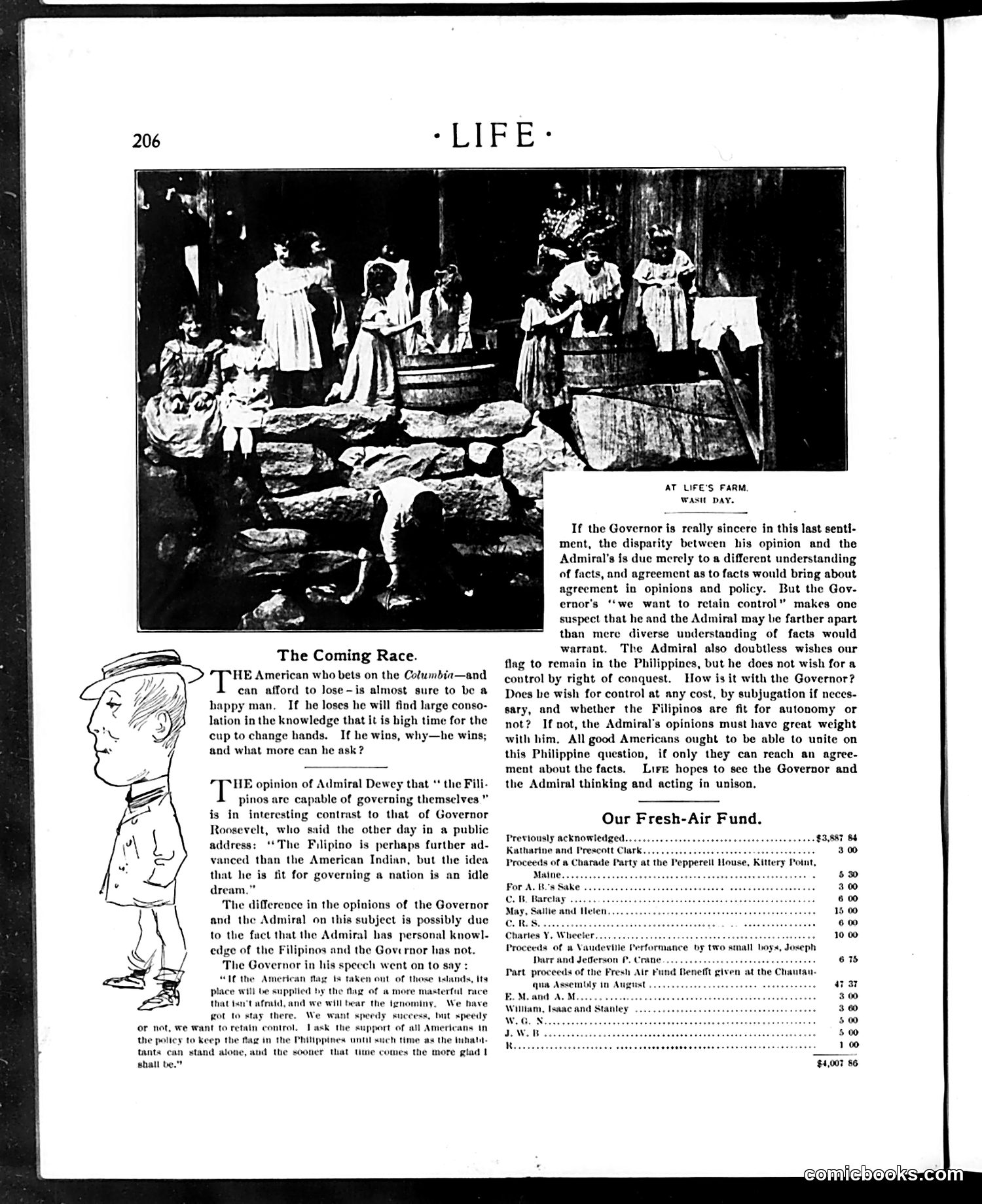
**The Cartoon "The Coming Race"** features a profile caricature of a man in a hat, accompanying satirical text about American optimism. The piece jokes that Americans betting on the "Columbus" steamship can afford to lose—if they lose, they'll find "large consolation" in knowing they contributed to "the cup to change hands." The humor hinges on American confidence and competitive spirit. **The Main Article** discusses a dispute between Governor Roosevelt and Admiral Dewey regarding Philippine governance. The text suggests their disagreement stems from differing factual understandings rather than ideological differences, advocating for unified American policy on Philippine autonomy versus conquest. **"Our Fresh-Air Fund"** lists charitable contributions, appearing to be a fundraising tracker for providing outdoor experiences to those in need.
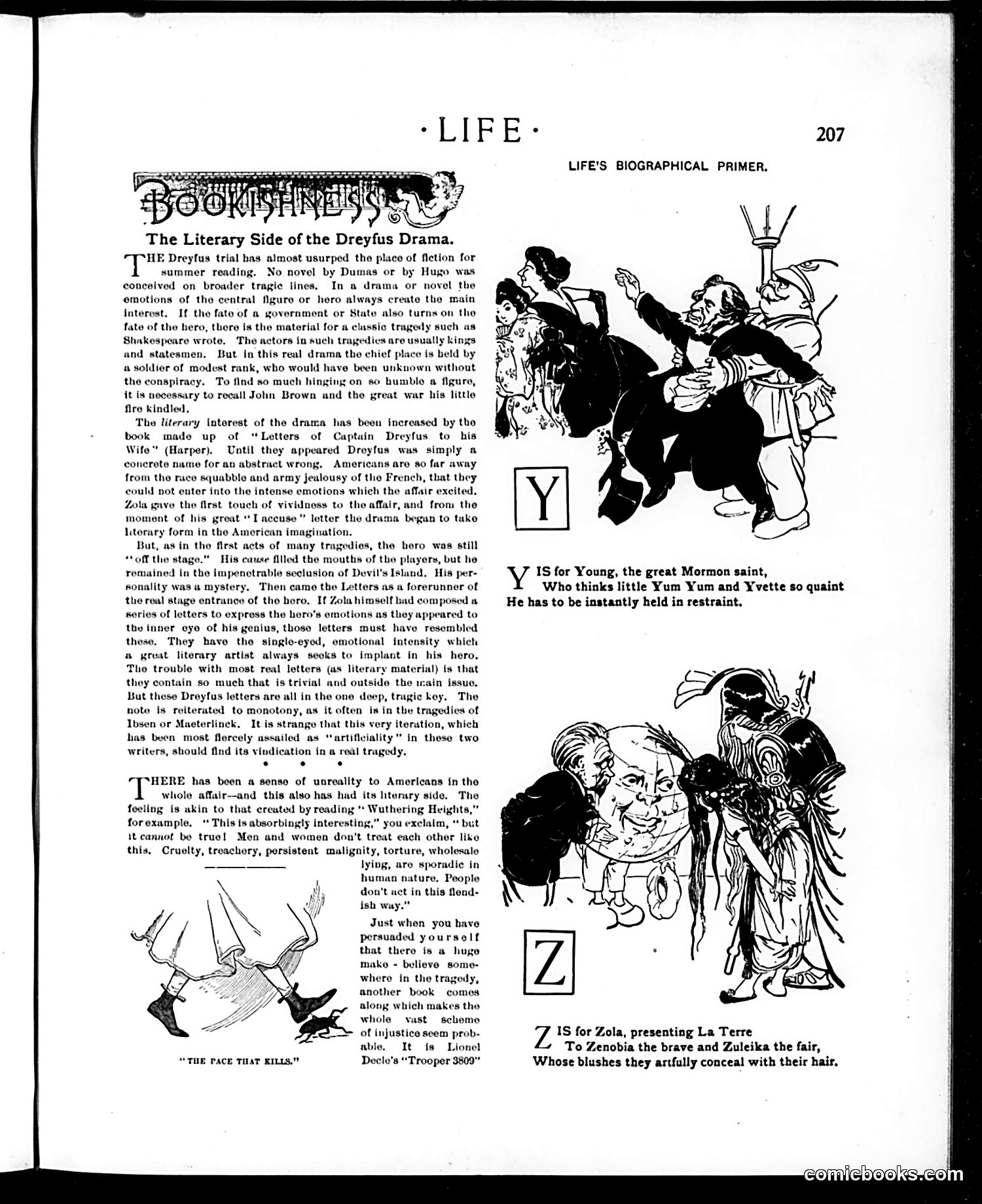
This page satirizes the Dreyfus Affair through illustrated alphabet entries. The main text analyzes the "literary side" of the Dreyfus drama, noting how the trial's emotional intensity rivaled fiction. The illustrated entries shown are: **Y** depicts Young Brigham (unclear if this is Young or a Mormon saint), mocking his control of "Yum Yum and Yvette." **Z** presents Zola presenting "La Terre" to Zenobia, with a caption about concealing "blushes" with hair—likely a crude sexual joke about the novel's controversial content. The cartoons use exaggerated caricature styles typical of 1890s satire to mock various figures connected to or symbolic of the Dreyfus controversy and contemporary scandals.
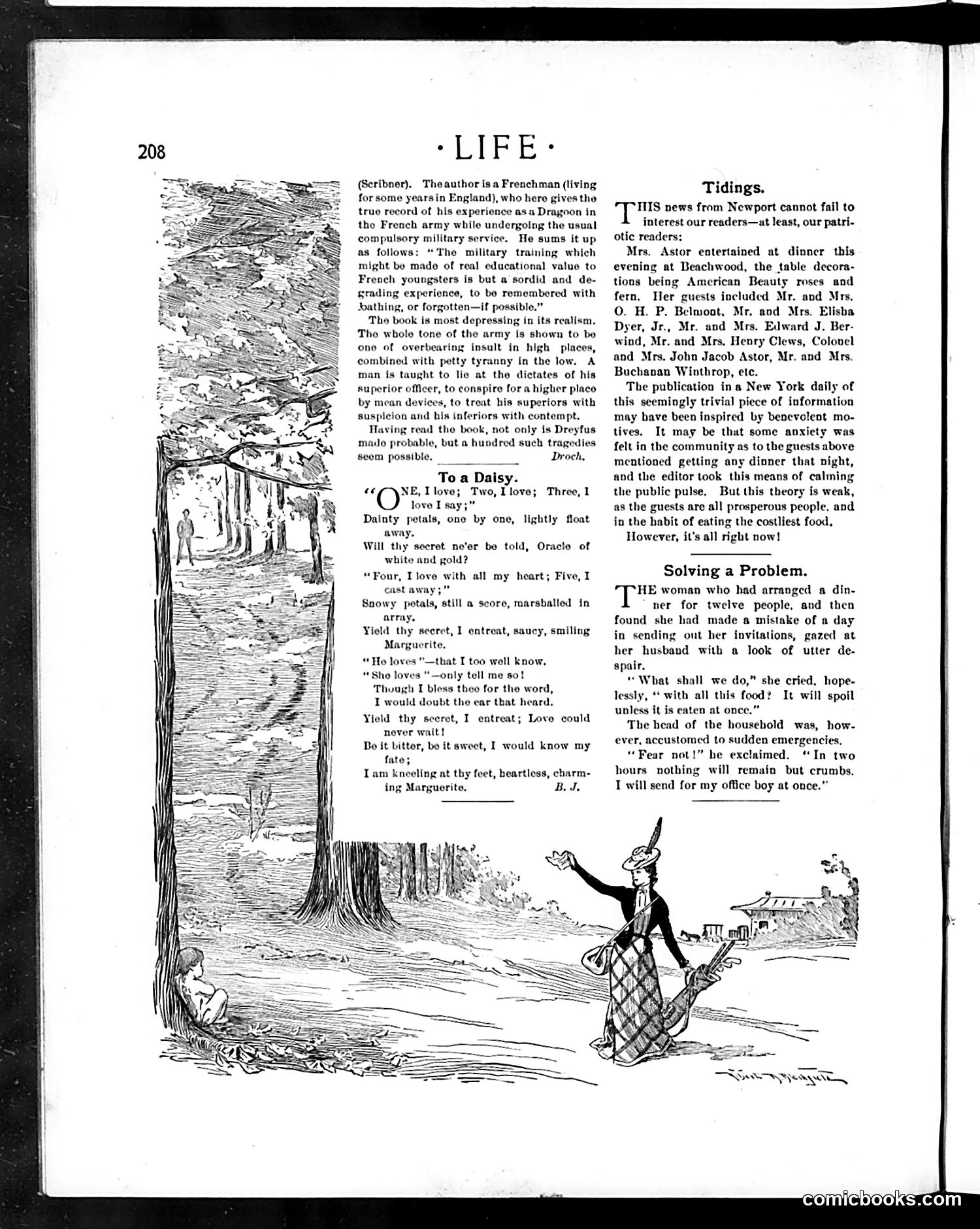
This page contains three distinct items: 1. **Book Review** (top): A Frenchman's account of military service, criticized for its depressing realism and "overwearing insult" toward superiors and authority figures. 2. **"To a Daisy"** (center): A romantic poem by "B.J." playing on the lover's traditional pledge "I love you," with humorous variations from different suitors (Daisy, Snowy, etc.), each proposing different emotional stakes. 3. **"Solving a Problem"** (right): A brief anecdote about a woman who mistakenly invited guests for the wrong day. When faced with excess food, her husband pragmatically suggests: "In two hours nothing will remain but crumbs. I will send my office boy at once." The accompanying sketch shows a woman gesturing dramatically while a boy runs off—illustrating the practical, if undignified, solution to her dinner party mishap.
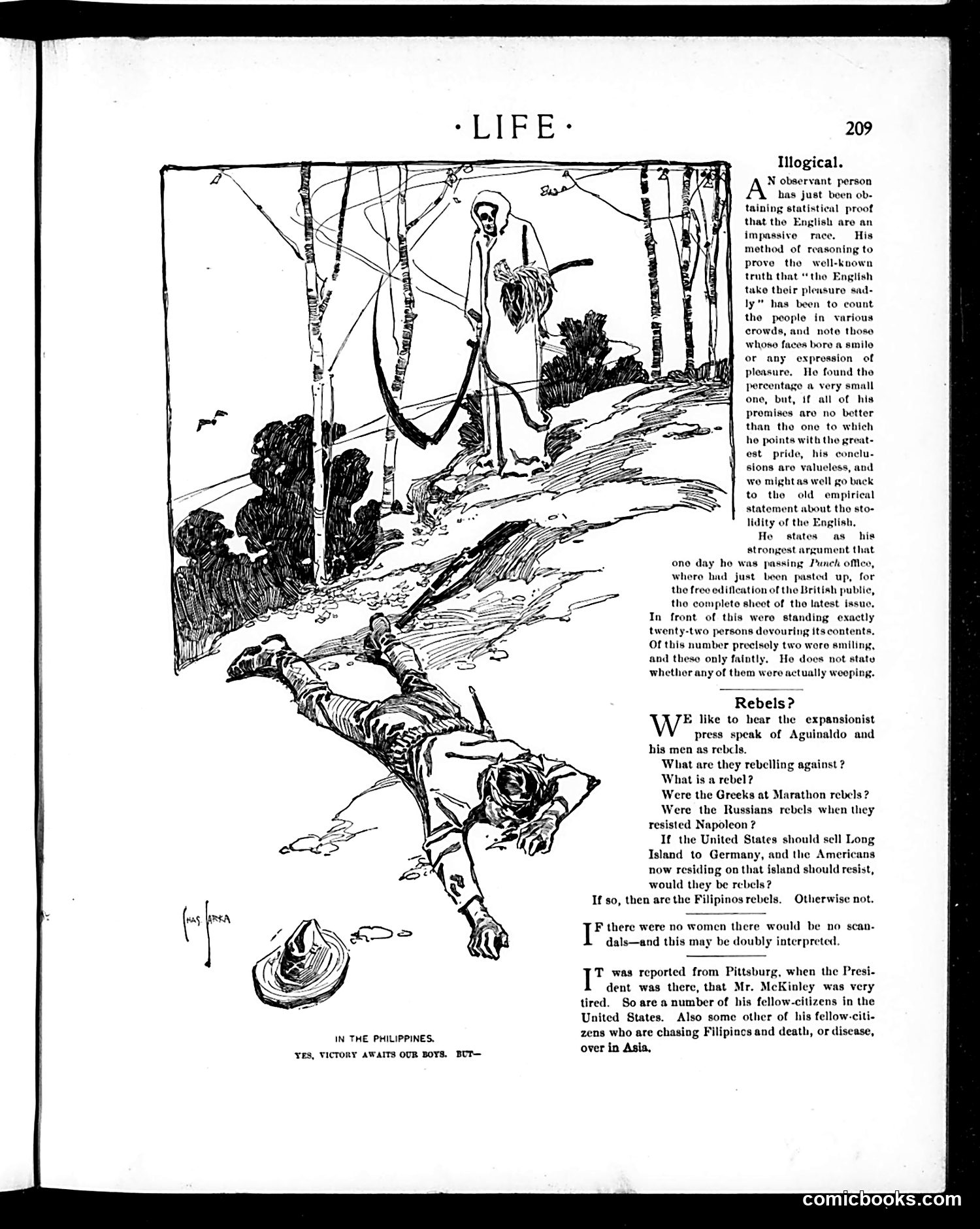
This page contains a satirical cartoon titled "In the Philippines" with the caption "Yes, victory 'awaits our boys. But—" The image depicts a dead or dying soldier lying on the ground in a tropical forest setting, with birch trees visible. The stark visual contrasts the optimistic rhetoric about American military victory with the grim reality of combat casualties. The accompanying text discusses whether Filipino insurgents qualify as "rebels." The article argues that if Americans would resist foreign occupation of their own territory, Filipinos deserve the same designation and justification for their resistance. This appears to critique American imperialism and the Philippine-American War, presenting anti-war commentary through dark humor and juxtaposing official optimism against battlefield suffering.
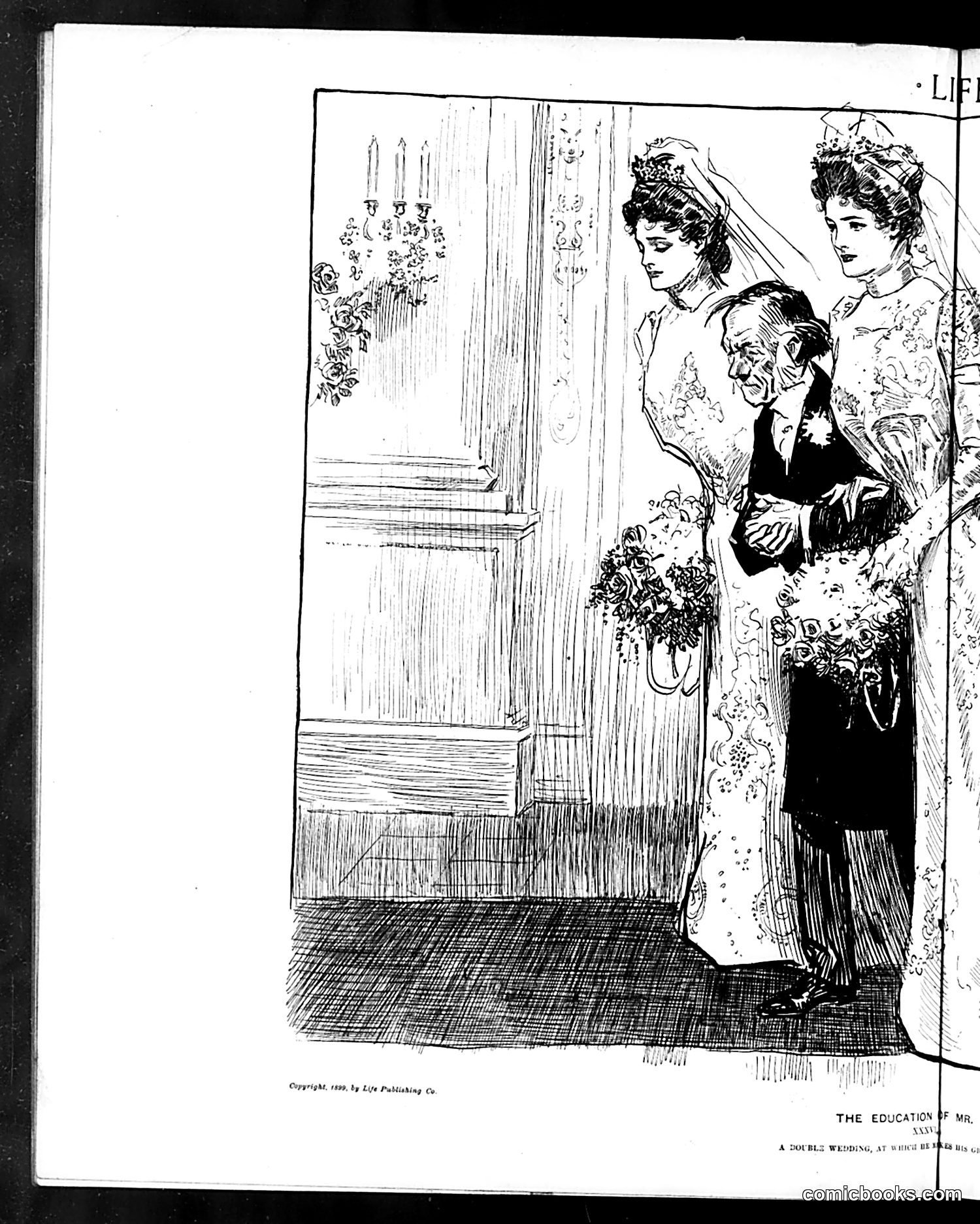
This appears to be a satirical illustration about a cynical man's transformation through witnessing a wedding. The sketch shows three elegantly dressed figures in what looks like a formal interior—two women in elaborate gowns with ornate hairstyles and headpieces, and a man in formal attire between them. The title suggests the joke centers on how witnessing matrimony has reformed or "educated" a previously cynical gentleman, making him lose his cynicism ("lost his cynic"). The double wedding context implies that the emotional weight of seeing two couples wed has softened his previously hardened worldview about marriage and romance. This reflects early-20th-century satirical humor about masculine skepticism toward romance being overcome by sentimental occasions.
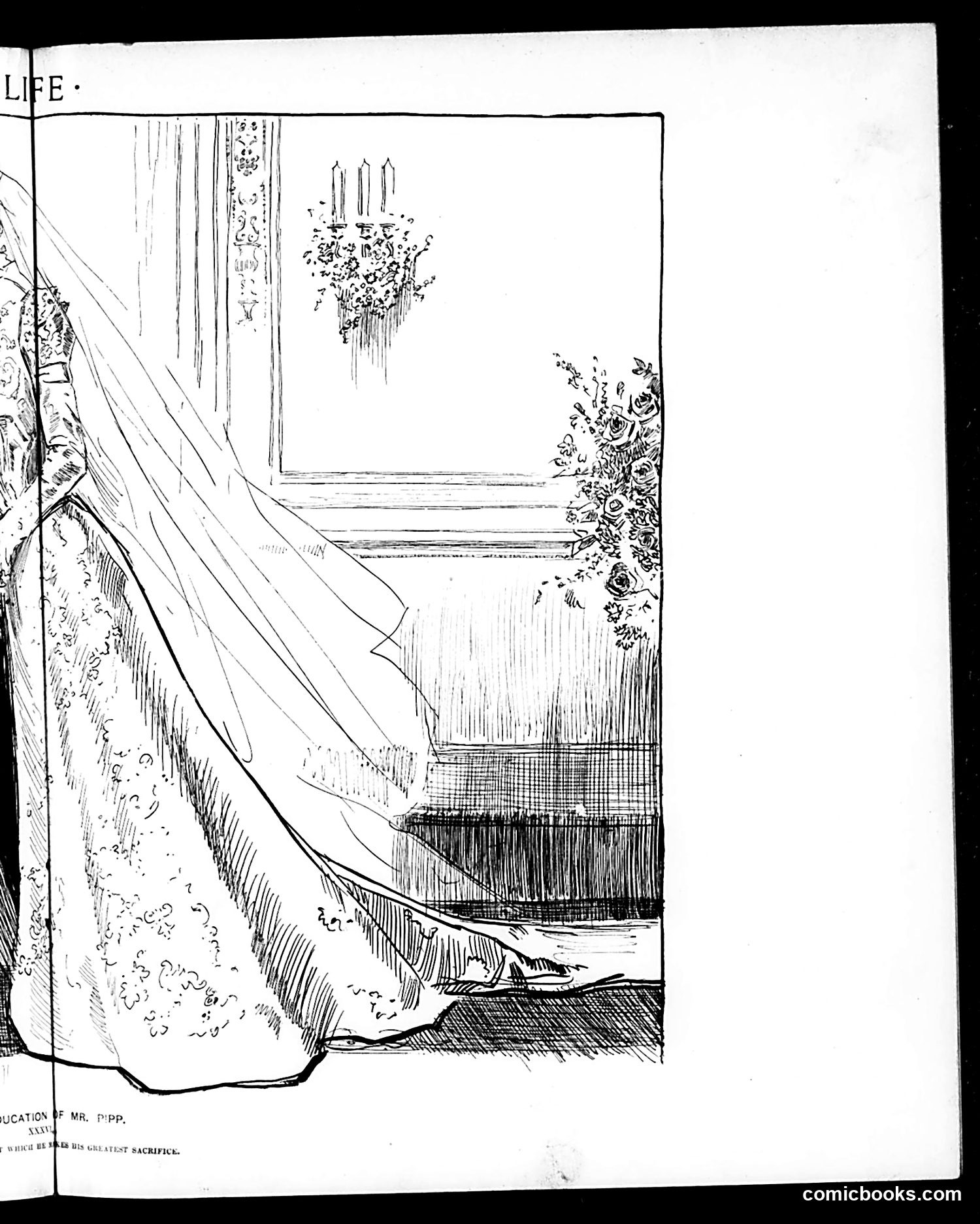
This page from *Life* magazine shows an interior domestic scene with architectural detail. The illustration depicts a formal room with draped curtains, a fireplace with candles, floral arrangements, and what appears to be period furnishings rendered in detailed pen-and-ink style. The page header reads "LIFE" and partial text at bottom mentions "ICATION OF MR. PIPP" and references "HIS GREATEST SACRIFICE." Without clearer OCR text or visible captions identifying the specific cartoon's subject, I cannot confidently identify which political or social figure "Mr. Pipp" represents or what sacrifice is being satirized. The domestic setting suggests commentary on upper-class life or a particular person's domestic circumstances, but the specific satirical point remains unclear from this image alone.
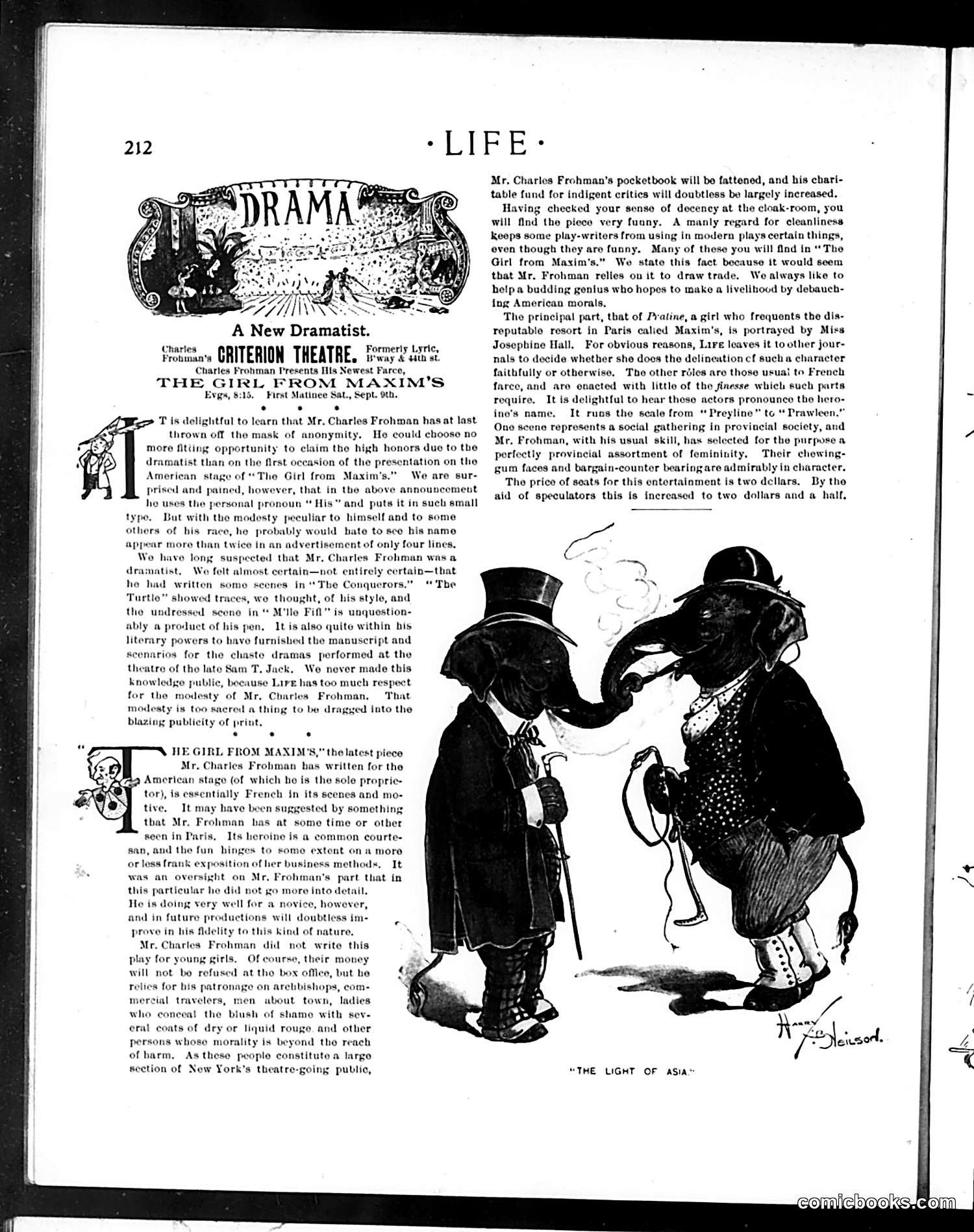
This page reviews Charles Frohman's theatrical productions at the Criterion Theatre. The main illustration, titled "The Light of Asia," depicts two figures in what appears to be a scene from a play—likely showing a Western man and an Asian woman in a dramatic encounter. The review discusses Frohman's new play "Yveline," set in Paris at a disreputable resort, and praises his earlier work "The Girl from Maxim's." The text indicates Frohman relies on French farce for his theatrical material, though the reviewer notes his plays often feature morally questionable characters and scenarios targeting New York's theater-going public. The review appears satirical about the commercial nature of Frohman's theatrical choices.
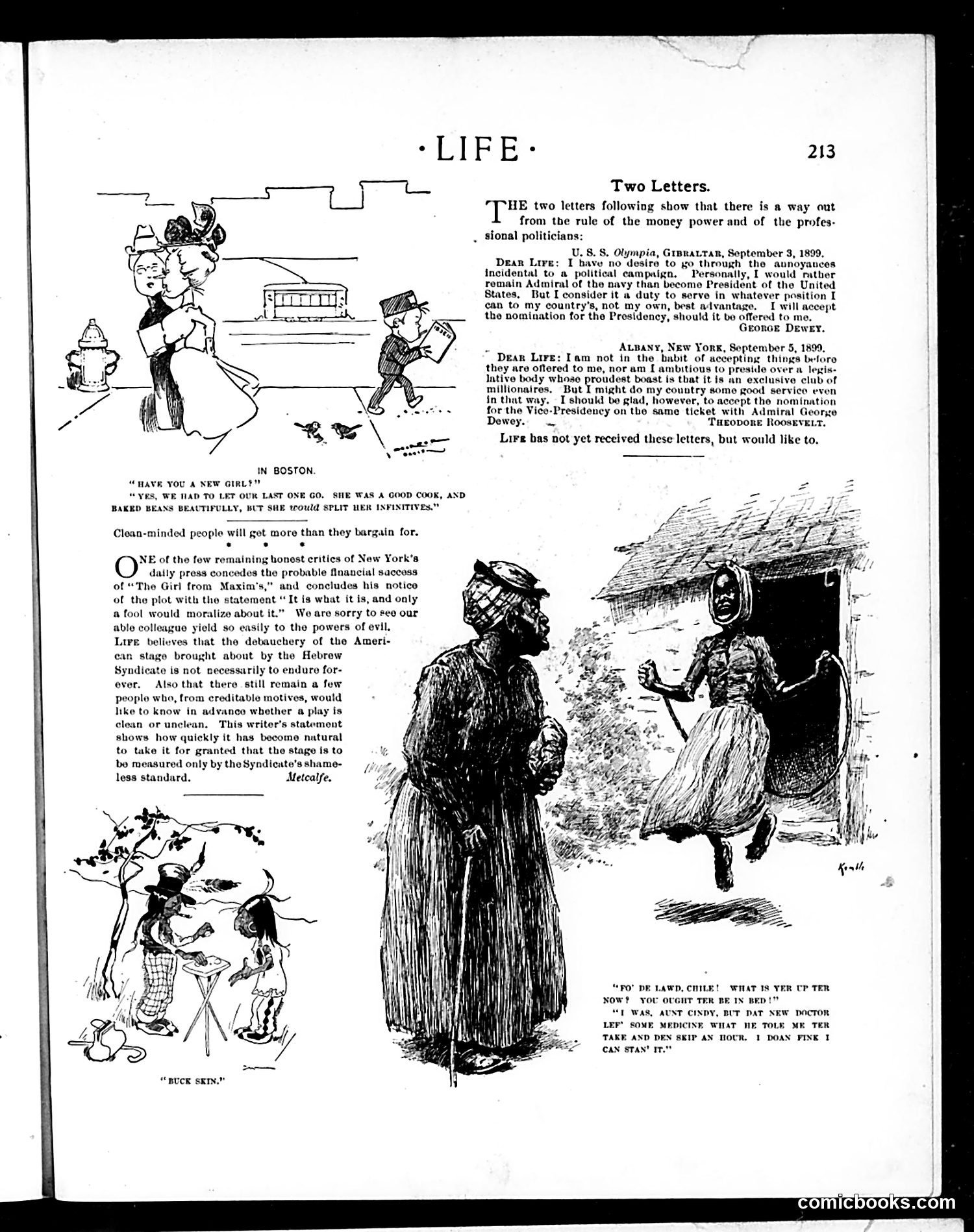
This page contains three satirical items from a 1899 American weekly: **Top cartoon** mocks Boston's pretensions: a servant is dismissed for being an excellent cook who nonetheless commits the social sin of splitting infinitives—a grammar rule. The joke: Boston values rigid linguistic propriety over practical competence. **Middle section** critiques New York theater's moral decline, blaming the "Hebrew Syndicate" (a reference to theater producers perceived as Jewish) for degrading stage standards. The author laments that critics accept immorality as inevitable rather than demanding clean entertainment. **Two Letters** parody political ambition. Admiral George Dewey (a celebrated Spanish-American War hero) claims reluctance about a presidential nomination, while Theodore Roosevelt similarly feigns hesitation about the vice-presidency—both transparently angling for these positions while performing false modesty about accepting them. **Bottom cartoon** uses racist dialect to show a Black child taking medicine that prevents sleep, unable to "stan' it"—a crude joke about medication side effects.
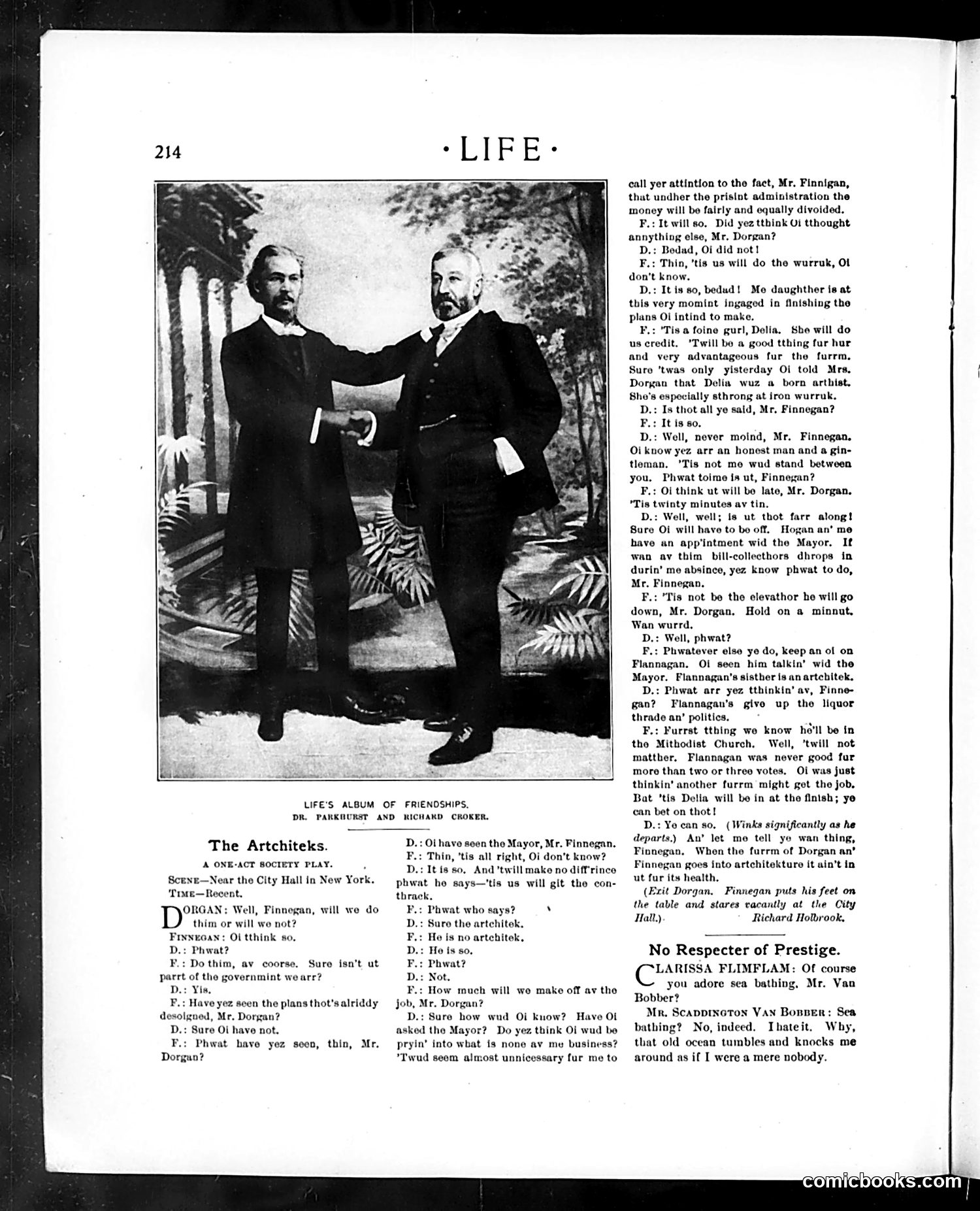
This one-act play satirizes New York City political corruption in the early 1900s. Two Irish-American politicians (Dorgan and Finnegan, rendered in heavy dialect) casually discuss securing a municipal contract near City Hall, speaking openly about manipulating the process despite claims of "fair and equal" distribution of money under the current administration. The satire's target: they will win the contract regardless of the architect's actual plans or the Mayor's involvement. Finnegan's daughter will design the plans *after* they've already won the bid. A competitor (Flannagan) is dismissed as harmless because he's given up liquor and politics—suggesting political irrelevance follows moral reform. The joke hinges on their brazen, unapologetic acknowledgment of predetermined outcomes and payoffs, presented as entirely normal government procedure. The dialect exaggerates their outsider status while their casual corruption commentary critiques endemic municipal graft of the era.
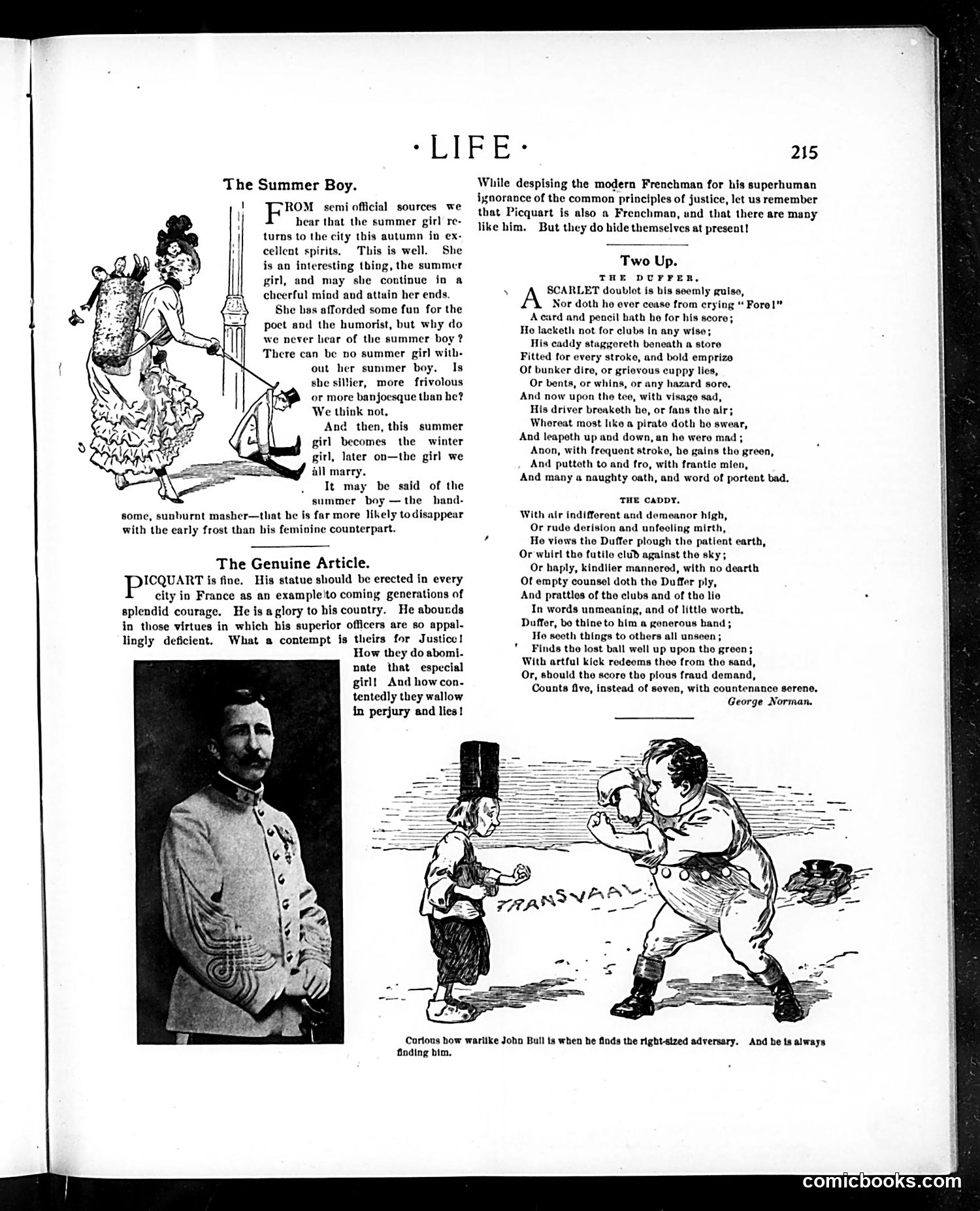
**The Summer Boy**: A brief essay mocking the literary focus on the "summer girl" while ignoring her male counterpart. The satire suggests the summer boy—described as a "handsome, sunburnt masher"—disappears by autumn more readily than the girl, yet receives no poetic attention. The illustration shows a fashionable couple. **The Genuine Article**: This section praises Picquart (a French military officer), likely referring to Major Georges Picquart, who exposed corruption in the Dreyfus Affair. The text celebrates his integrity while condemning his superior officers' contempt for justice and willingness to commit perjury—a direct reference to the Dreyfus scandal's institutional dishonesty. **Golf Poems**: Two humorous verses about golf culture: "The Duffer" mocks an incompetent golfer in comical language, while "The Caddy" depicts the caddy's patient (or patronizing) observation, implying he may help obscure poor scores through dishonest counting. **Bottom Cartoon**: John Bull (Britain personified) shown boxing, captioning his tendency to fight opponents of equal size—likely commentary on British imperial confidence.
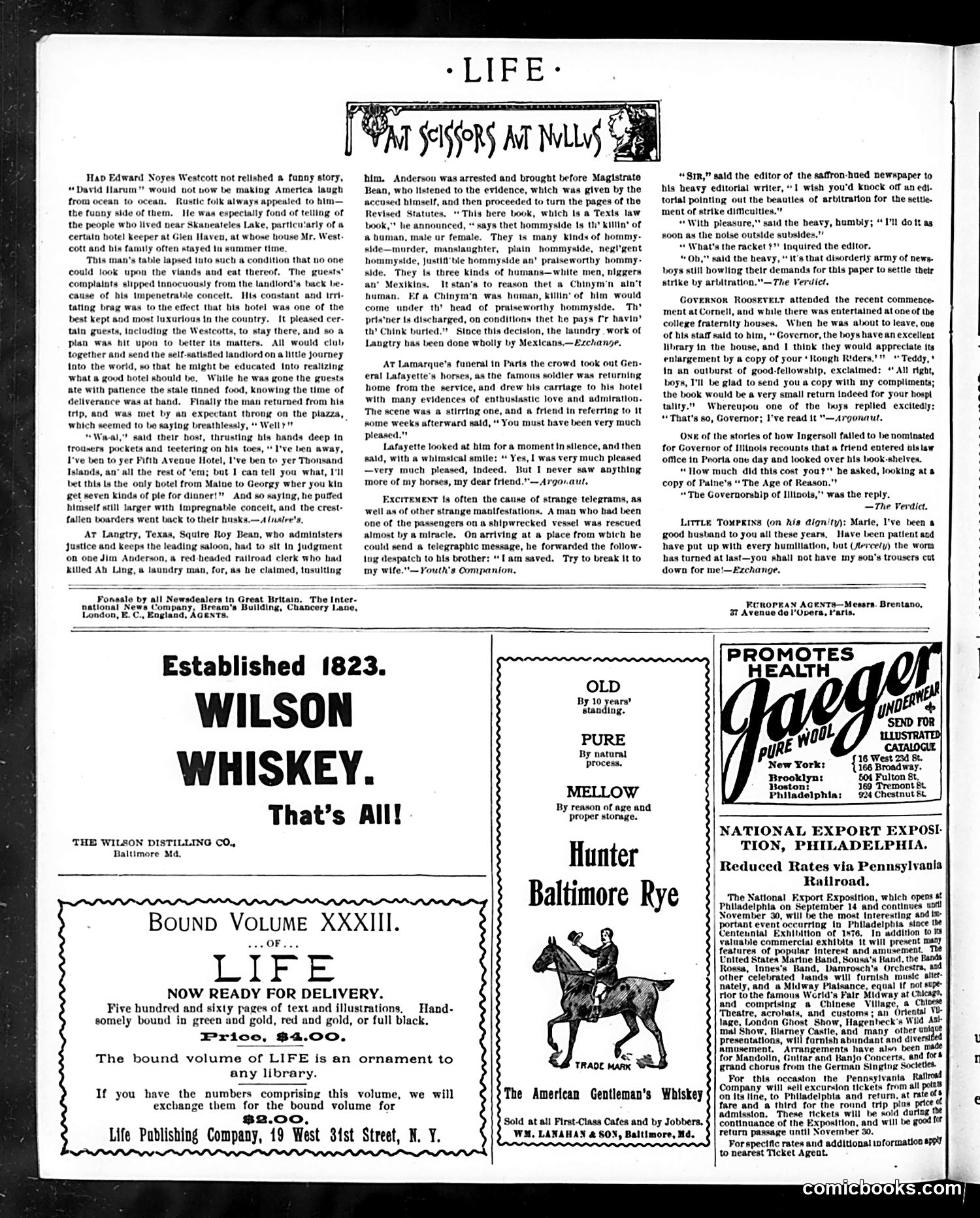
This page contains three anecdotal stories rather than political cartoons, presented as humorous "true tales" typical of Life's satirical humor. **The stories satirize American character types:** 1. **The Delusional Hotelier**: A pompous innkeeper near Syracuse remains oblivious to his terrible food despite guests' complaints, maintaining his conceit even after touring fine hotels. The joke mocks self-delusion and resistance to criticism. 2. **Squire Roy Bean's Justice**: This depicts the famous Texas frontier judge dispensing racist frontier jurisprudence—acquitting a man who killed a Chinese laborer by arguing Chinese aren't "human" under law, therefore not subject to homicide statutes. The satire exposes both frontier legal absurdity and anti-Chinese racism of the era. 3. **Lafayette's Horses**: A brief anecdote about the general being pleased crowds pulled his carriage but disappointed they stole his actual horses—satirizing excessive enthusiasm masking practical loss. These represent *Life*'s style: rustic Americana humor highlighting rural ignorance, frontier lawlessness, and human folly through exaggerated dialect and ironic understatement.
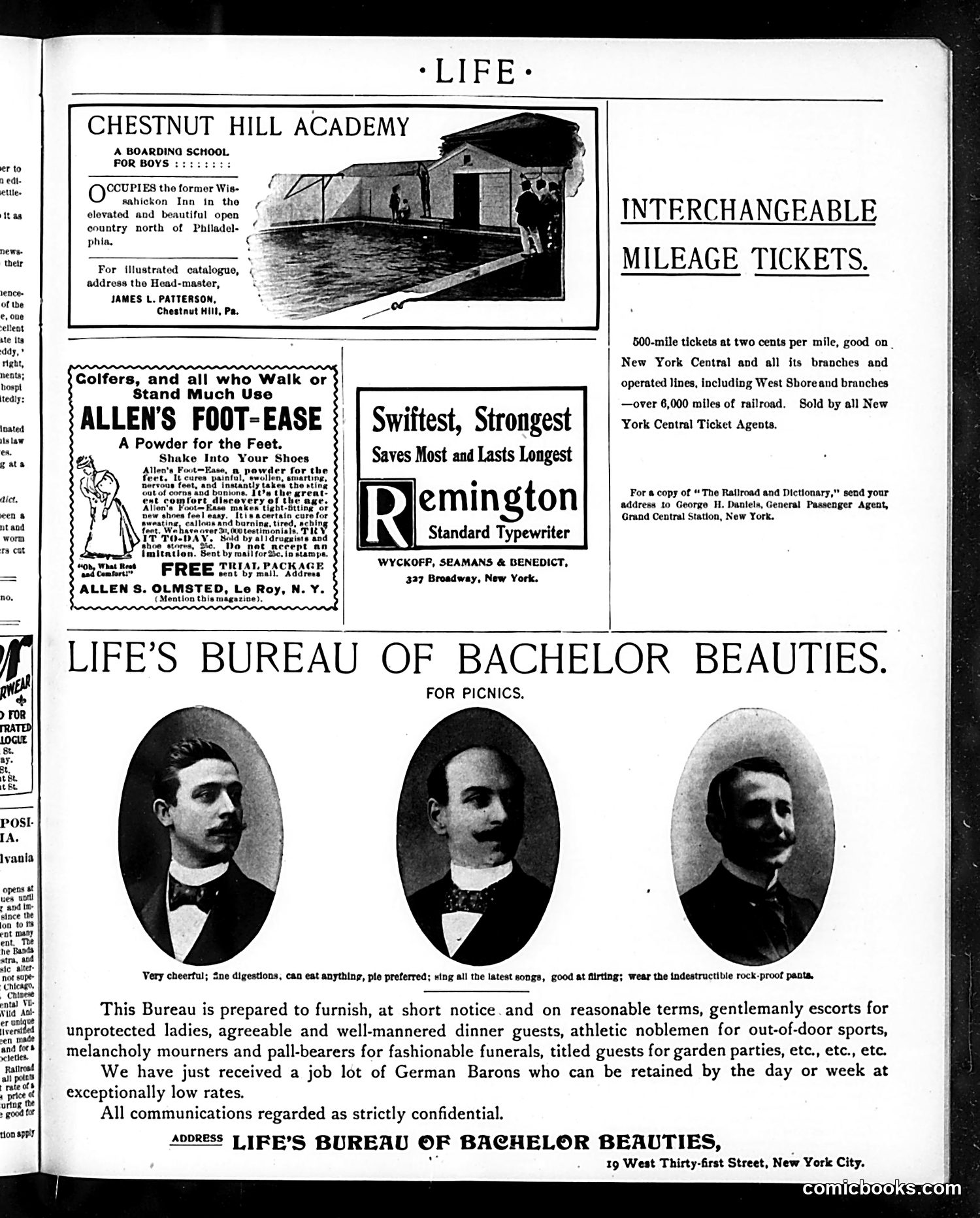
This page is primarily **advertising** with satirical content embedded in one section. The main satire is **"Life's Bureau of Bachelor Beauties,"** a mock escort service. The humor targets Gilded Age social conventions: unprotected women needing male companions for respectability at picnics, dinners, and funerals. The three portrait photographs represent available "escorts." The joke's sharpest point: the bureau advertises "German Barons" available "by the day or week at exceptionally low rates"—satirizing both the American upper class's fascination with European nobility and the desperation of impoverished European aristocrats willing to hire themselves out as social accessories. This reflects real Gilded Age anxieties about class, marriage markets, and the commodification of social status. The remaining content consists of straightforward period advertisements (Chestnut Hill Academy, Allen's Foot-Ease powder, Remington typewriters, railroad tickets)—typical of Life magazine's revenue model.
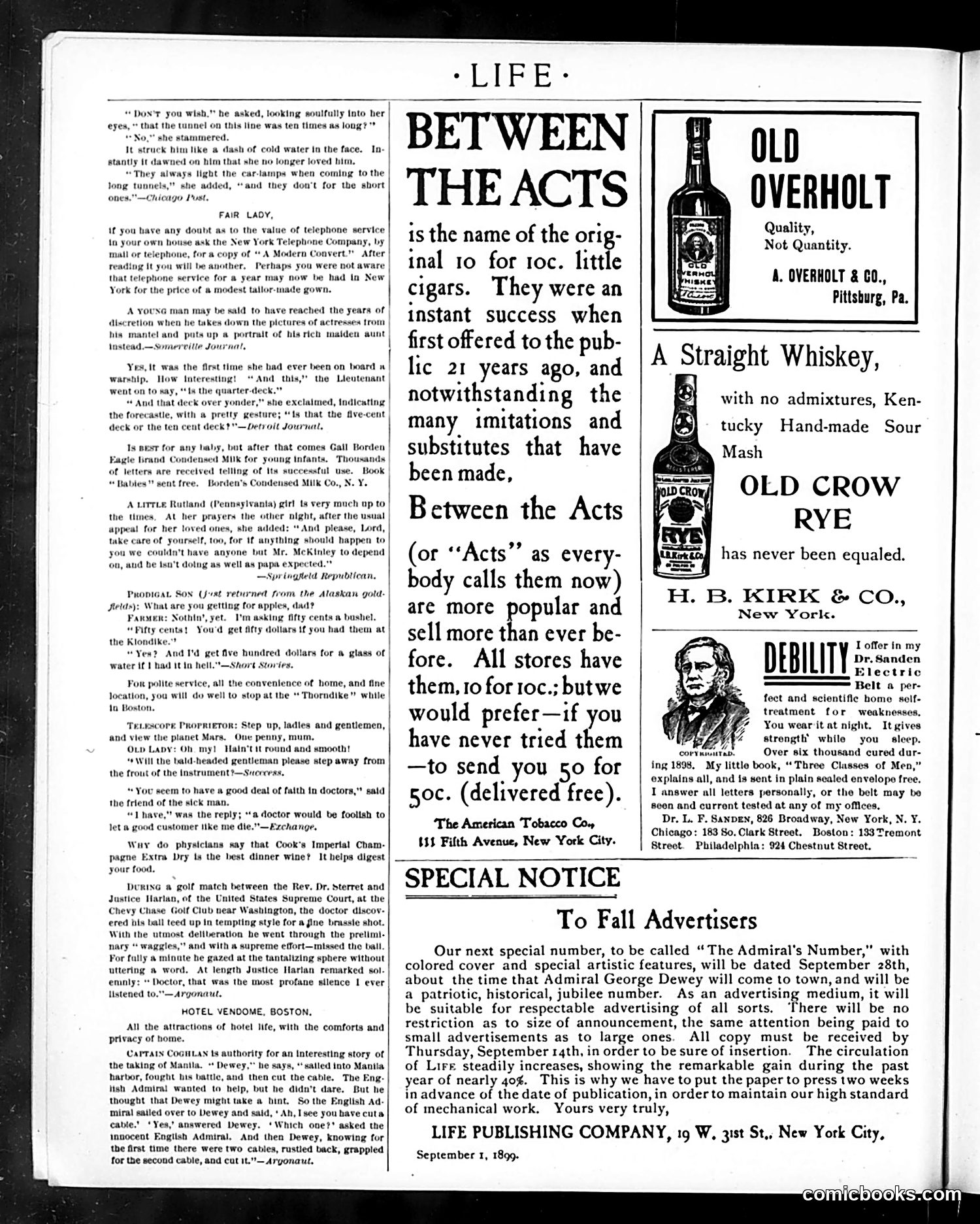
This page is primarily **advertisements and miscellaneous humor**, not political satire. The content includes: **Main feature**: "Between the Acts" — an advertisement for 10-cent cigars by The American Tobacco Company, describing their popularity over the past 21 years. **Advertisements**: Old Overholt whiskey, Old Crow rye, and Dr. Sanden's electric belt (a dubious health device). **Humor section**: Brief anecdotes on various topics — a woman in a train tunnel making romantic implications, a prodigal son returning from Alaska, a golf story involving Rev. Dr. Sterret and Supreme Court Justice Harlan, and a story about Admiral Dewey and the taking of Manila during the Spanish-American War. The Dewey reference appears topical (Manila was taken in 1898), but there's **no political cartoon visible** on this page. The humor is largely domestic and lighthearted rather than satirical commentary.
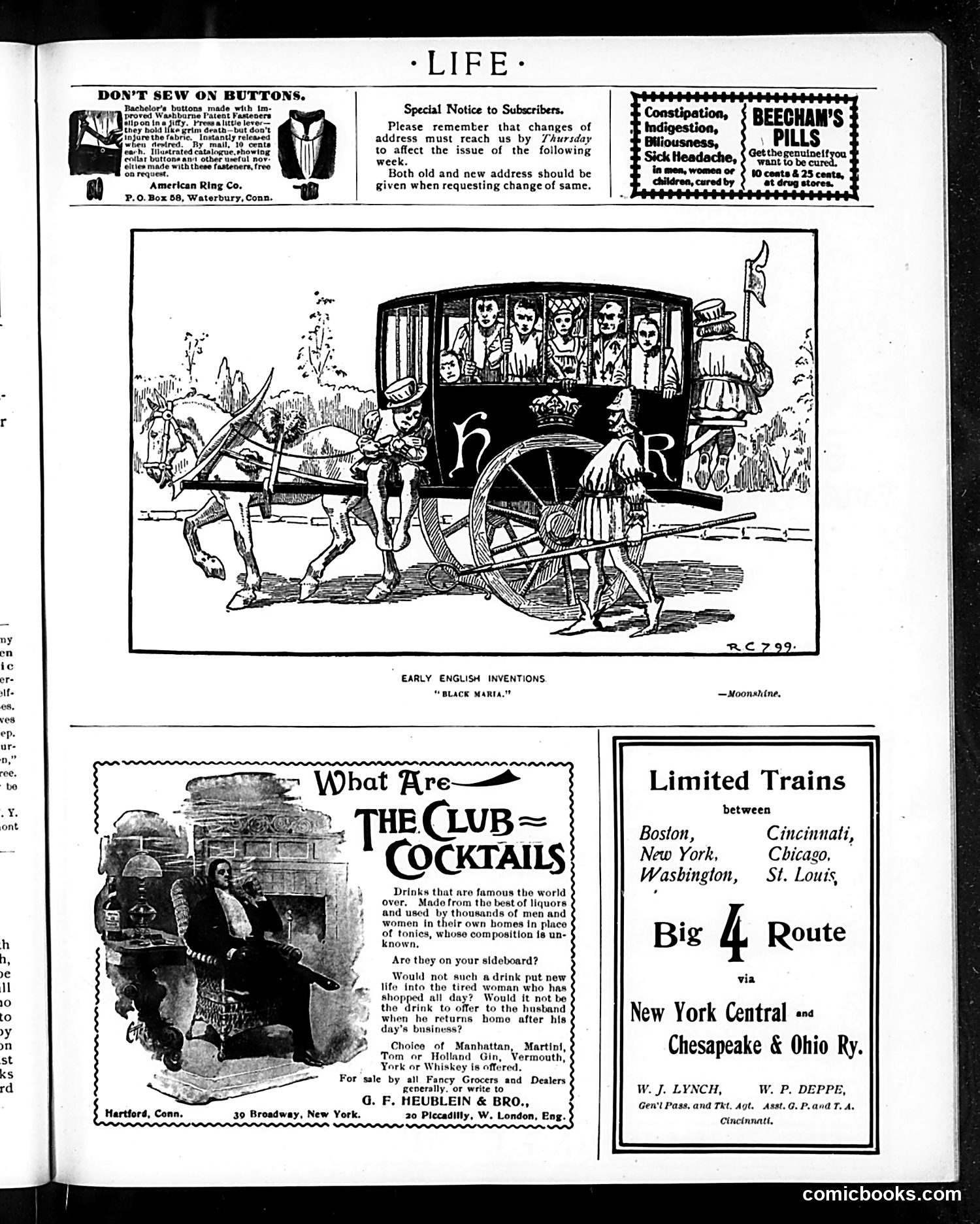
The main cartoon depicts the "Black Maria"—an early English police wagon. It shows a horse-drawn enclosed vehicle with uniformed officers and prisoners visible through barred windows, with a woman being loaded inside. The caption credits this as an "Early English Invention," presented as satire on British innovations. The page is primarily **advertising**, featuring: - A button fastener company - Beecham's Pills (a popular patent medicine) - Club Cocktails (pre-made drink mixtures marketed to housewives as tonics) - Limited train service via the Big 4 Route The cocktail ad is notably gendered, suggesting these drinks would revitalize tired shopping wives and impress husbands returning home—reflecting early 20th-century domestic expectations and the pre-Prohibition normalization of alcohol. The "Black Maria" cartoon appears to be gentle mockery of British institutions rather than serious political commentary.
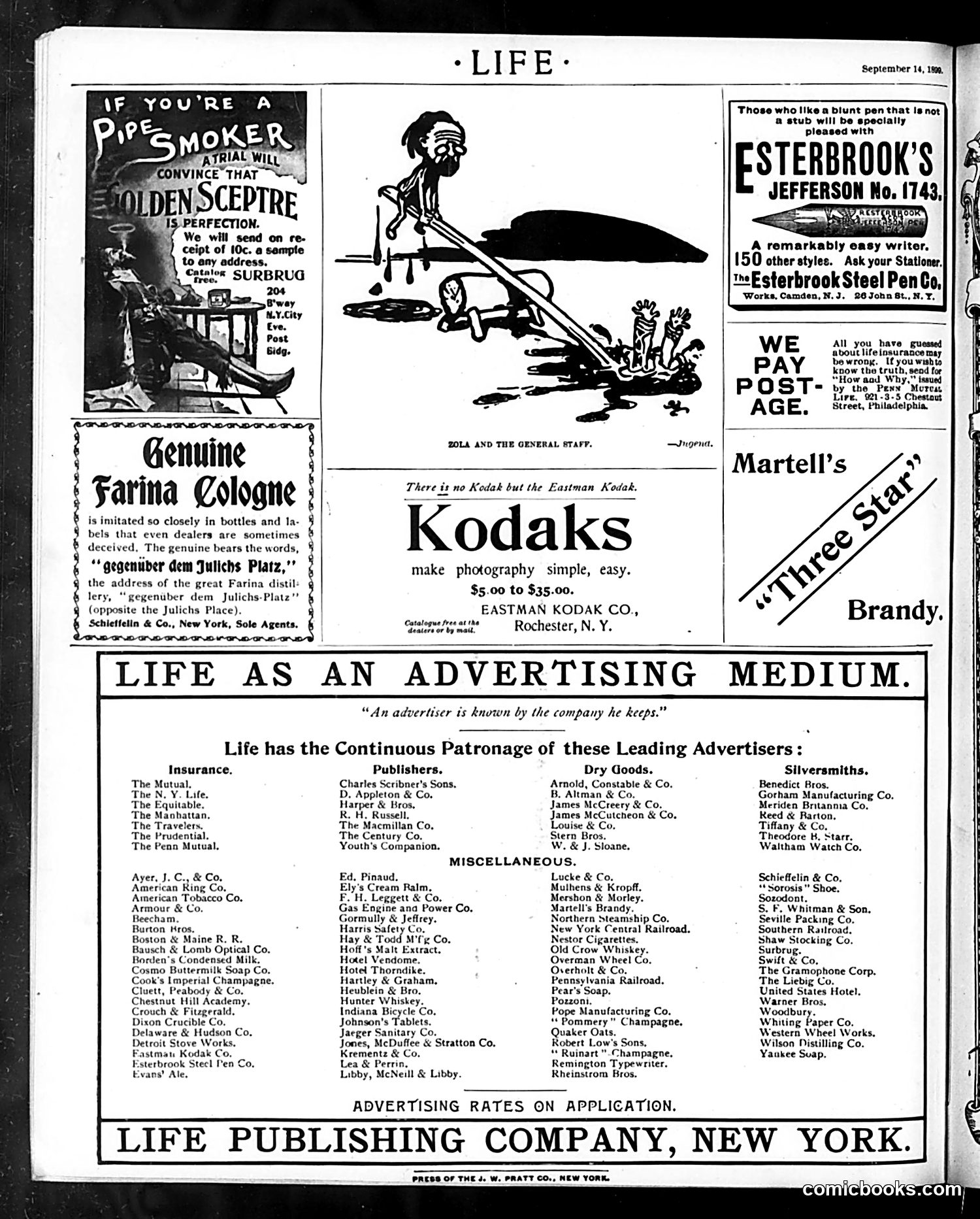
The central cartoon depicts the famous Dreyfus Affair, a major French political scandal of the 1890s. The figure wielding a large pen is Émile Zola, the celebrated French novelist who publicly defended Alfred Dreyfus, a Jewish military officer falsely accused of treason. The "General Staff" refers to the French military establishment that prosecuted Dreyfus. Zola's famous 1898 open letter "J'accuse" (meaning "I accuse") exposed the injustice and anti-Semitism behind Dreyfus's conviction. The cartoon shows Zola's pen as a weapon against military authority—suggesting his writing as a powerful force for truth against institutional corruption. The caption "Zola and the General Staff" emphasizes the conflict between the individual writer fighting for justice and the entrenched military bureaucracy defending a wrongful conviction. This was a significant moment when journalism and literature challenged state power.