
Life, 1899-09-14 · page 7 of 20
Life — September 14, 1899 — page 7: what you’re looking at
What you’re looking at
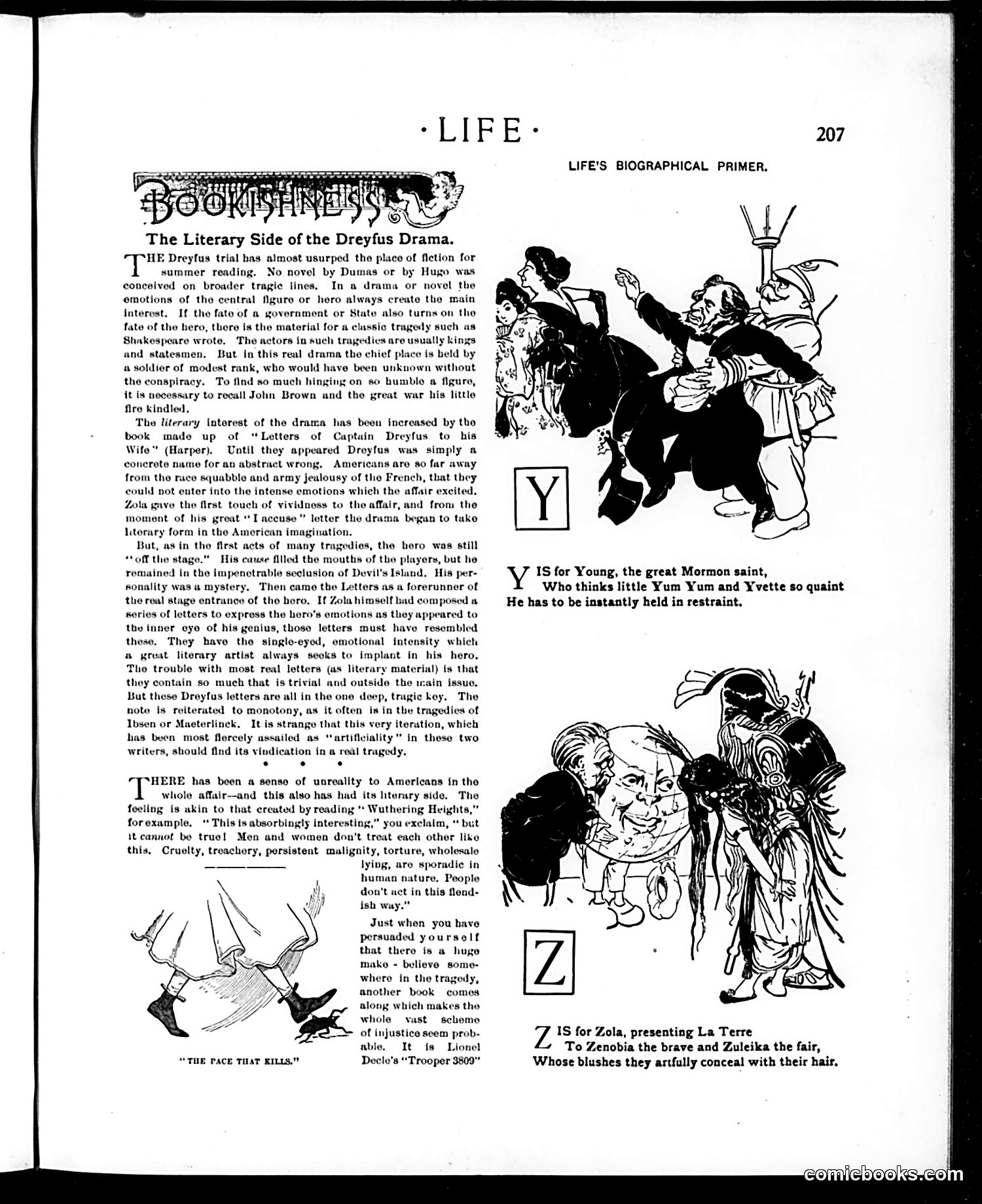
This page satirizes the Dreyfus Affair through illustrated alphabet entries. The main text analyzes the "literary side" of the Dreyfus drama, noting how the trial's emotional intensity rivaled fiction. The illustrated entries shown are: **Y** depicts Young Brigham (unclear if this is Young or a Mormon saint), mocking his control of "Yum Yum and Yvette." **Z** presents Zola presenting "La Terre" to Zenobia, with a caption about concealing "blushes" with hair—likely a crude sexual joke about the novel's controversial content. The cartoons use exaggerated caricature styles typical of 1890s satire to mock various figures connected to or symbolic of the Dreyfus controversy and contemporary scandals.
📄 Transcribed text from this page (OCR, searchable)
Machine-transcribed from the original scan — historical spelling and the odd misread are preserved.
The Literary Side of the Dreyfus Drama. HE Dreyfus trial has almost usurped the placo of fletion for summer reading. No novel by Dumas or by Hugo was conceived on broader tragic lines, In a drama or novel the emotions of the central figure or hero always create the main interost, If the fato of a governmont or State also turns on tho fate of the hero, thoro is the material for a classic tragedy such as Shakespeare wrote. The actors in such tragedies are usually kings and statesmen. But in this real drama tho chief place is beld by asoldior of modest rank, who would have been unknown without the conspiracy. To find so much hinging on so humble a figure, it is necessary to recall John Brown und tho great war his little fire kindled. The literary intorest of the drama has been increased by the book mado up of “Letters of Captain Dreyfus to his Wife” (Harper), Until they appeared Droyfus was simply a concrete name for ap abstract wrong. Americans aro so far away from the race squabble and army jealousy of the French, that they could not enter into the intense emotions which the affair excited, Zola gave the first touch of vividness to the affair, and from the moment of his great “I accuse” letter the drama begun to tako \itorary form in the American imagination. But, as in tho first acts of many tragedies, the boro was still “off the stage.” His cause filled the mouths of tho players, but he remained In the Impenctrable seclusion of Devil's Islind, His per- sonality was a mystery, Then camo tho Letters as a forerunner of the real stage entrance of tho hero. If Zola himself bad composed a series of letters to express the Loro’s emotions as they appeared to the inner oye of his genius, those letters must have resembled these, They havo tho singlo-eyed, motional intensity which & great literary artist always sooks to implant in his hero. Tho trouble with most real letters (us literary mater! they contain so much that is trivial and outside the ic But these Dreyfus letters are all in the one deep, tragic koy. The note is reiterated to monotony, as it often is in the tragedies of Ibsen or Maeterlin It is strange that this very iteration, which has been most flercely assailed as “artifleiality" in these two writers, should find its vindication in a real tragedy. * ° . “HERE has been a sense of unreality to Americans in tho JT whole affair—and this also has had its literary side. Tho feeling is ukin to that created by reading “ Wuthering Heights,” forexample, “ This ts absorbingly interesting,” you exclaim, “ but it cannot be true! Men and women don't treat each other like this, Cruelty, treachory, persistent malignity, torture, wholesale lying, aro sporadic in human nature, People don’t act in this fend- ish way.” Just when you have persuaded yoursolf that thero is a hugo mako - believe some- where in the tragedy, another book comes along which makes tho whole vast schemo of injustice seem prob- able, It {8 Lionel “THE PACE THAT KILLS.” Decle’s “Trooper 3809" IS for Young, the great Mormon saint, Who thinks little Yum Yum and Yvette so quaint He has to be instantly held in restraint. Z IS for Zola, presenting La Terre To Zenobia the brave and Zuleika the fair, Whose blushes they artfully conceal with their hair,