
Life, 1899-09-14 · page 8 of 20
Life — September 14, 1899 — page 8: what you’re looking at
What you’re looking at
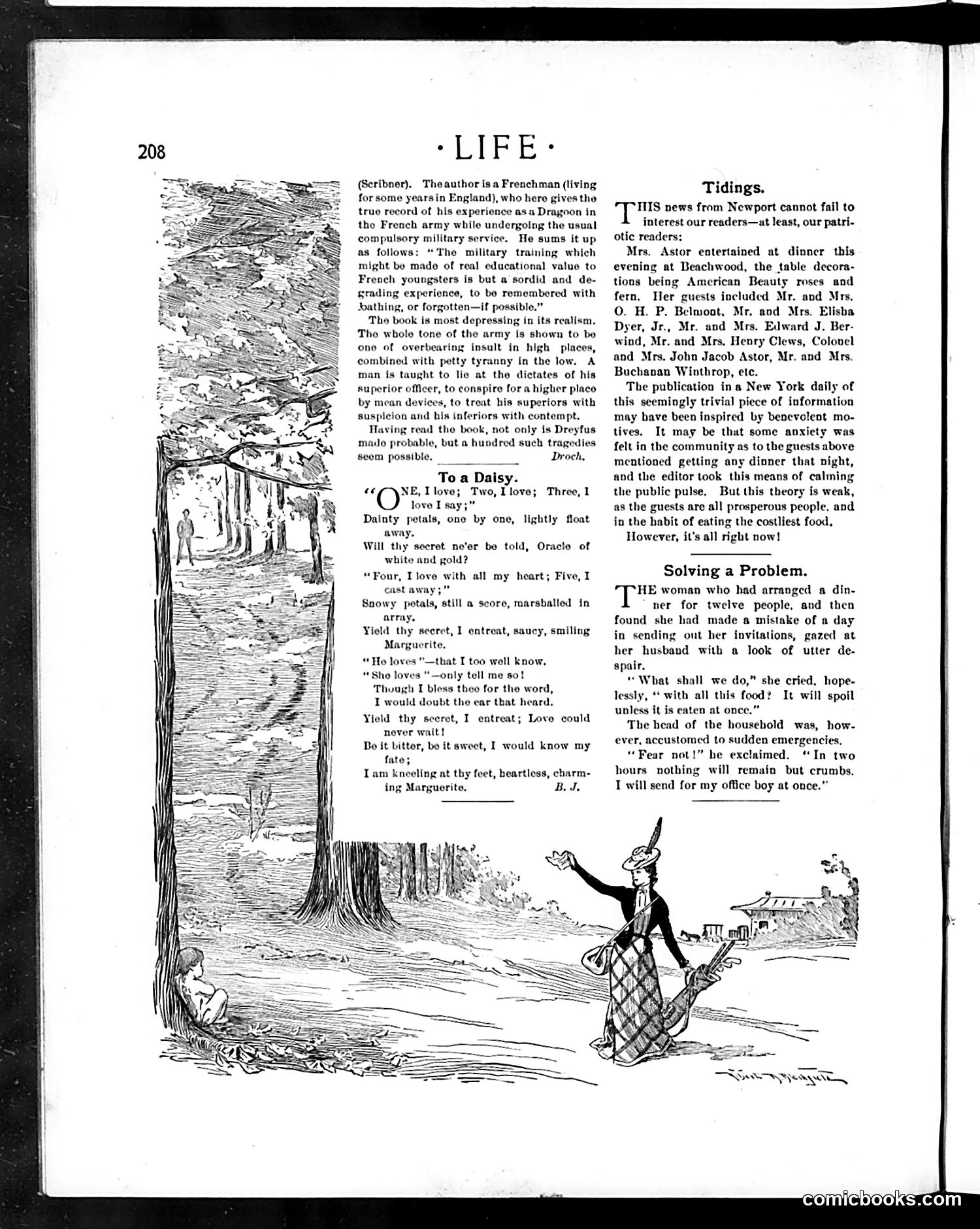
This page contains three distinct items: 1. **Book Review** (top): A Frenchman's account of military service, criticized for its depressing realism and "overwearing insult" toward superiors and authority figures. 2. **"To a Daisy"** (center): A romantic poem by "B.J." playing on the lover's traditional pledge "I love you," with humorous variations from different suitors (Daisy, Snowy, etc.), each proposing different emotional stakes. 3. **"Solving a Problem"** (right): A brief anecdote about a woman who mistakenly invited guests for the wrong day. When faced with excess food, her husband pragmatically suggests: "In two hours nothing will remain but crumbs. I will send my office boy at once." The accompanying sketch shows a woman gesturing dramatically while a boy runs off—illustrating the practical, if undignified, solution to her dinner party mishap.
📄 Transcribed text from this page (OCR, searchable)
Machine-transcribed from the original scan — historical spelling and the odd misread are preserved.
‘LIP E * (Scribner). The author isa Frenchman (living for some years in England), who here gives the true record of his experience asa Dragoon in tho French army while undergoing the usual compulsory military service. He sums it up as follows: “Tho military training which might be mado of real educational value to French youngsters is but a sordid and de- grading experience, to bo remembered with bathing, or forgotten—if possible.” ‘Tho book is most depressing in its realism. Tho whole tone of the army is shown to bo one of overbearing insult in high places, combined with petty tyranny in the low. A man {s taught to lio at the dictates of his superior officer, to conspire for a higher placo by mean devices, to treat his superiors with suspicion and bis inferiors with contempt. Having read the book, not only is Dreyfus mado probable, but a hundred such tragedies seom possible, Droch, To a Daisy. “ E, I love; Two, I love; Threo, 1 O* rot sa35" Dainty petals, one by one, lightly float away, Will thy secret ne’or be told, Oracle of white and gold? “Four, Ilove with all my heart; Five, I cast away ;" Snowy potals, still a scoro, marsballed in array. Yield thy sceret, I ontreat, saucy, smiling Marguorite. “Ho loves "—that I too well know, “Sho loves "—only tell me so! Though I bless theo for the word, I would doubt the ear that heard. Yield thy secret, I entreat; Love could nover wait! Bo it bittor, be it sweet, I would know my fate; Tam kneeling at thy feet, heartless, charm- ing Marguerite. BJ. Tidings. HIS news from Newport cannot fail to interest our readers—at least, our patri- otic readers: Mrs. Astor entertained at dinner this evening at Beachwood, the table decora- tions being American Beauty roses and fern. Her guests included Mr. and Mrs. O. H. P. Belmoat, Mr. and Mrs, Elisba Dyer, Jr., Mr. and Mrs. Edward J. Ber- wind, Mr. and Mrs, Henry Clews, Colonel and Mrs. John Jacob Astor, Mr. and Mrs. Buchanan Winthrop, ete. The publication ina New York daily of this seemingly trivial piece of information may have been inspired by benevolent mo- tives. It may be that some anxiety was felt in the community as to the guests above mentioned getting any dinner that night, and the editor took this means of calming the public pulse. But this theory is weak, as the guests are all prosperous people, and in the habit of eating the costliest food, However, it's all right now! Solving a Problem. HE woman who had arranged a din- ner for twelve people, and then found she had made a mistake of a day in sending out her invitations, gazed at her husband with a look of utter de- spair, “What shall we do,” she cried, hope- lessly, “with all this food? It will spoil unless it is eaten at once.” The head of the household was, how- ever, accustomed to sudden emergencies. “Fear not!” he exclaimed. ‘In two hours pothing will remain but crumbs. I will send for my office boy at once.”