
A complete issue · 20 pages · 1899
Life — August 17, 1899
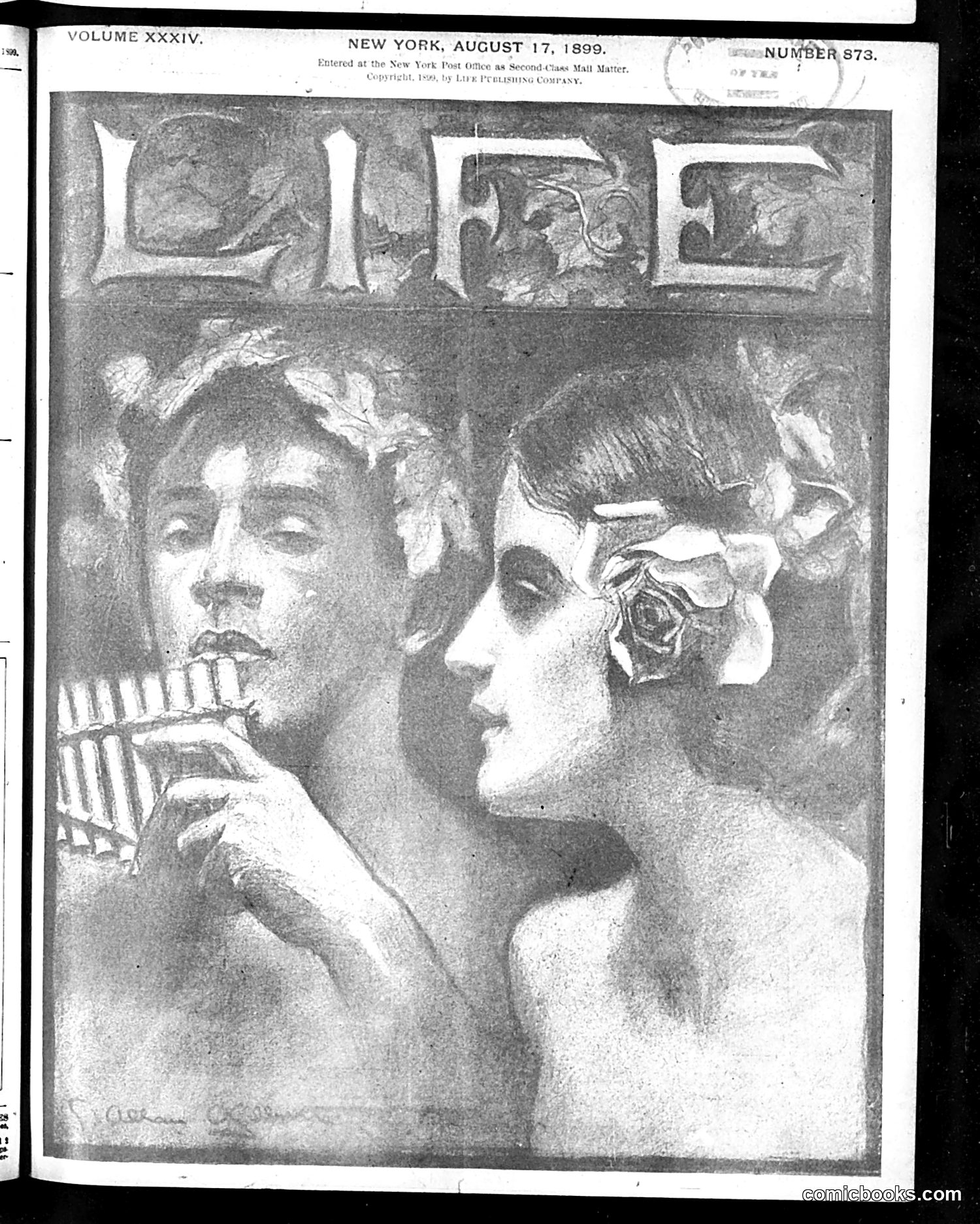
This appears to be a satirical illustration from Life magazine's cover. The image shows two figures in classical/allegorical style—a male figure playing Pan pipes on the left and a female figure with flowers in her hair on the right. The "LIFE" masthead suggests this is commentary on themes of life, nature, or cultural values. Without clearer identifying details or accompanying article text, I cannot definitively identify the specific political figures or events being satirized. The classical artistic styling and pastoral imagery suggest commentary on aestheticism, nature worship, or possibly cultural attitudes of the 1890s, but the exact satirical target remains unclear from the image alone.
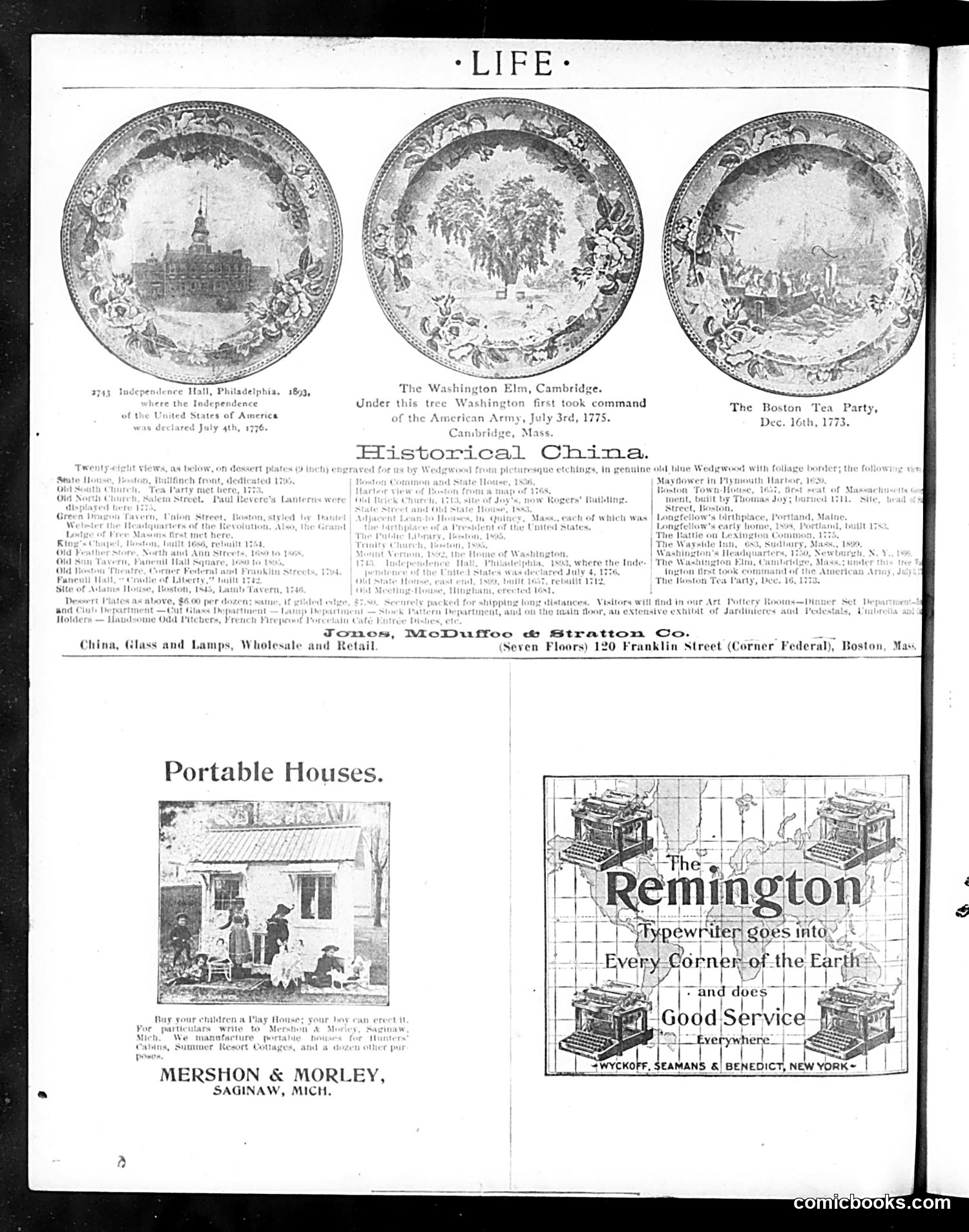
This page is primarily **advertising and historical content**, not political satire. The top section features three decorative china plates labeled "Historical China," depicting American Revolutionary War sites: Independence Hall (1776), Washington's appointment location (1775), and the Boston Tea Party (1773). These appear to be commemorative dishware products. Below are advertisements for: - **Jones, McDuffee & Stratton Co.** - a china, glass, and lamps wholesale business in Boston - **Mershon & Morley** - portable houses for children (Saginaw, Michigan) - **Remington Typewriter** - highlighting its global availability The page lacks satirical political cartoons. Instead, it combines patriotic historical imagery with period product advertisements, representing typical early-20th-century magazine layout mixing editorial content with commercial messages.
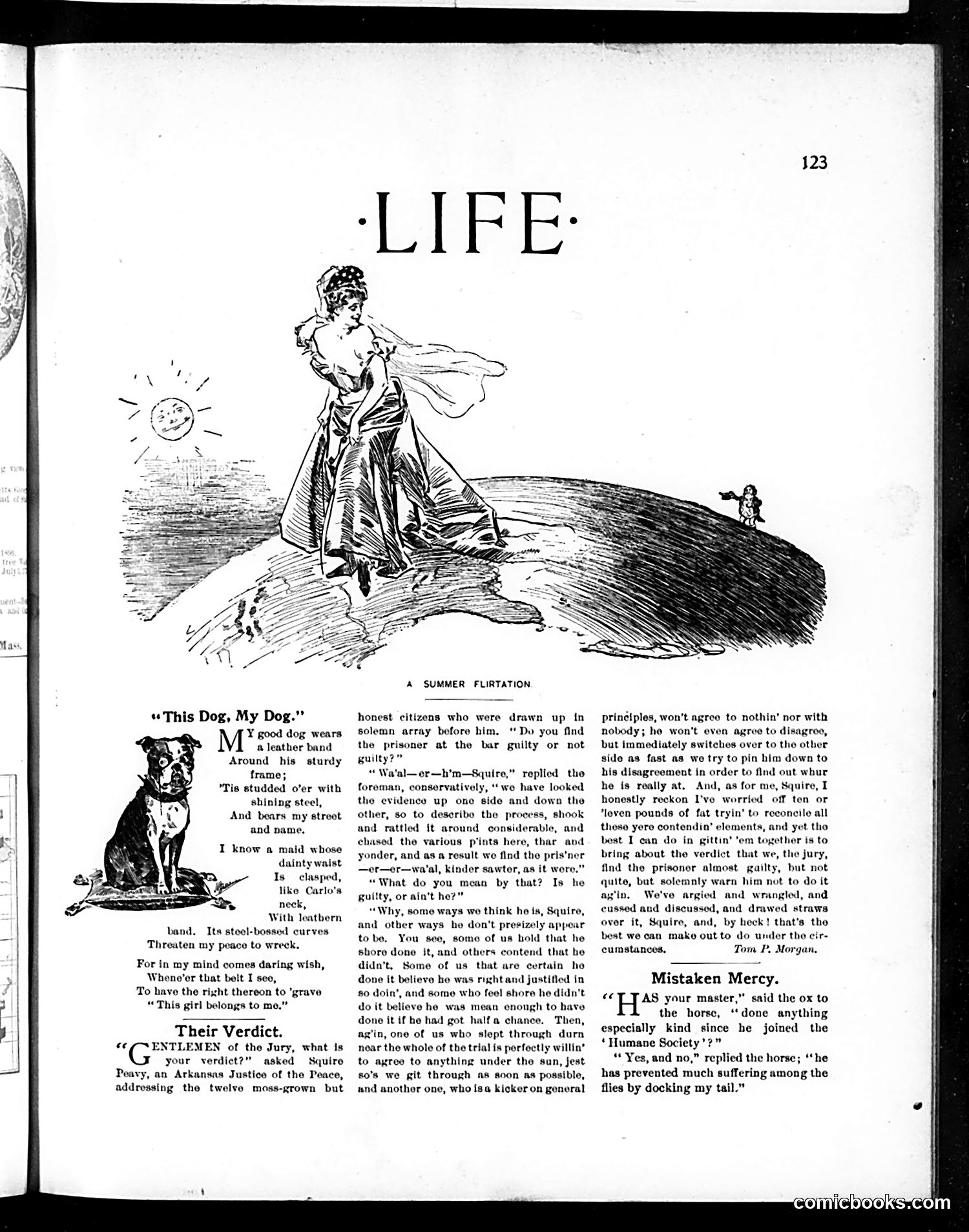
This page contains three distinct satirical pieces: 1. **"A Summer Flirtation"** (top): An allegorical illustration showing a woman on a large curved form (possibly representing a whale or landscape feature), with a small figure in the distance and a rising sun—likely a commentary on romantic pursuit or social courtship. 2. **"This Dog, My Dog"** (left): Poem about a loyal dog, contrasting the dog's unwavering devotion with human inconsistency. The accompanying illustration shows a sturdy bulldog, celebrating canine loyalty as morally superior to human behavior. 3. **"Gentlemen of the Jury"** and **"Mistaken Mercy"** (right): A dialogue apparently critiquing judicial leniency toward a prisoner. A judge and defendant discuss whether the prisoner is "guilty" or "mean," with the conclusion that mercy toward criminals may cause broader harm. This reflects Progressive-era debates about criminal justice reform.
This page contains editorial commentary rather than cartoons. The text discusses President Harrison's summer vacation on Lake Champlain and Admiral Dewey's Mediterranean cruise. The piece critiques Harrison's political leadership, suggesting he lacks humor and makes poor decisions. It notes his "great misfortune seems to have been in his lack of humor, which made him take things hard." The editorial then shifts to praise the President for "recruiting his strength" during vacation, hoping he'll return reinvigorated for the upcoming year's work. The decorative illustrations (small engravings of animals and leisure scenes) are typical period ornaments rather than political cartoons. This appears to be standard editorial commentary on current political figures and events, characteristic of Life's satirical approach to contemporary governance.
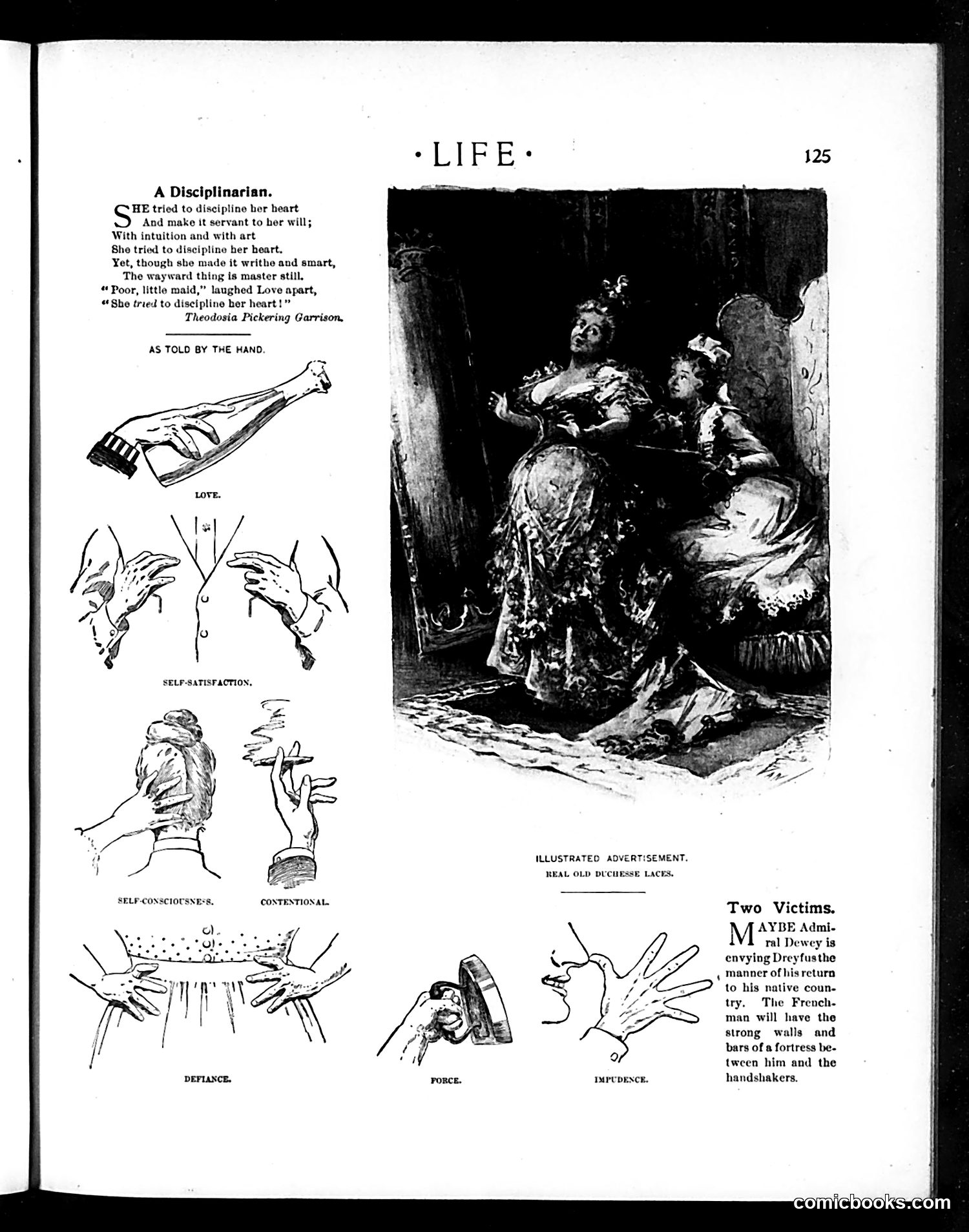
This page combines satirical content with advertising. The upper section features "A Disciplinarian," a poem by Theodesia Pickering Garrison about a woman who tried to control her heart through willpower, only to have love triumph anyway—a commentary on the futility of emotional restraint. Below are hand-gesture illustrations labeled with emotions: "Love," "Self-Satisfaction," "Self-Consciousness," "Contentional" [sic], "Defiance," "Force," and "Impudence." These appear to be a humorous guide to reading hand language, suggesting body language reveals true feelings despite attempts at composure. The large illustration depicts an elaborate social scene, likely satirizing aristocratic pretension or romantic intrigue, though specific figures are unclear. The bottom advertises "Real Old Duchesse Laces" under "Two Victims"—an ad suggesting expensive laces ensnare wealthy buyers.
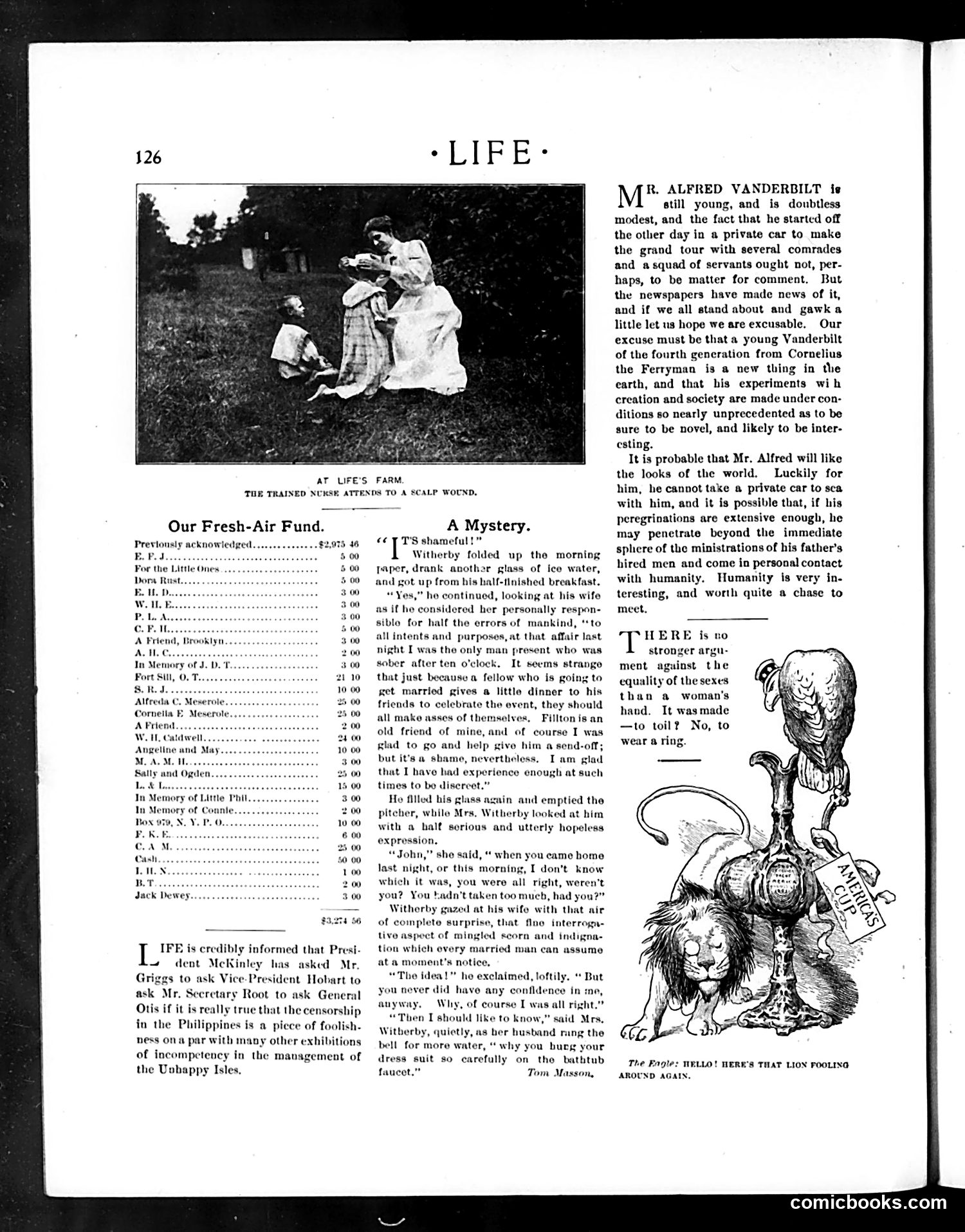
This page contains three distinct elements: 1. **"At Life's Farm"** photograph shows a trained nurse attending to a scalp wound—illustrating medical care. 2. **"Our Fresh-Air Fund"** is a charitable fundraising list, showing donations received for what appears to be a program providing outdoor recreation access to underprivileged people (likely children), a common Progressive-era charity. 3. **"A Mystery"** is a short comic story about Mr. Witherly, who returns home drunk after a late night out, creating domestic tension with his wife. The humor derives from his implausible explanations and her skeptical responses—a common marital comedy theme. The cartoon illustration titled "The Eagle: Hello! Here's That Lion Fooling Around Again" uses animal characters for social commentary, though the specific reference is unclear without additional context.
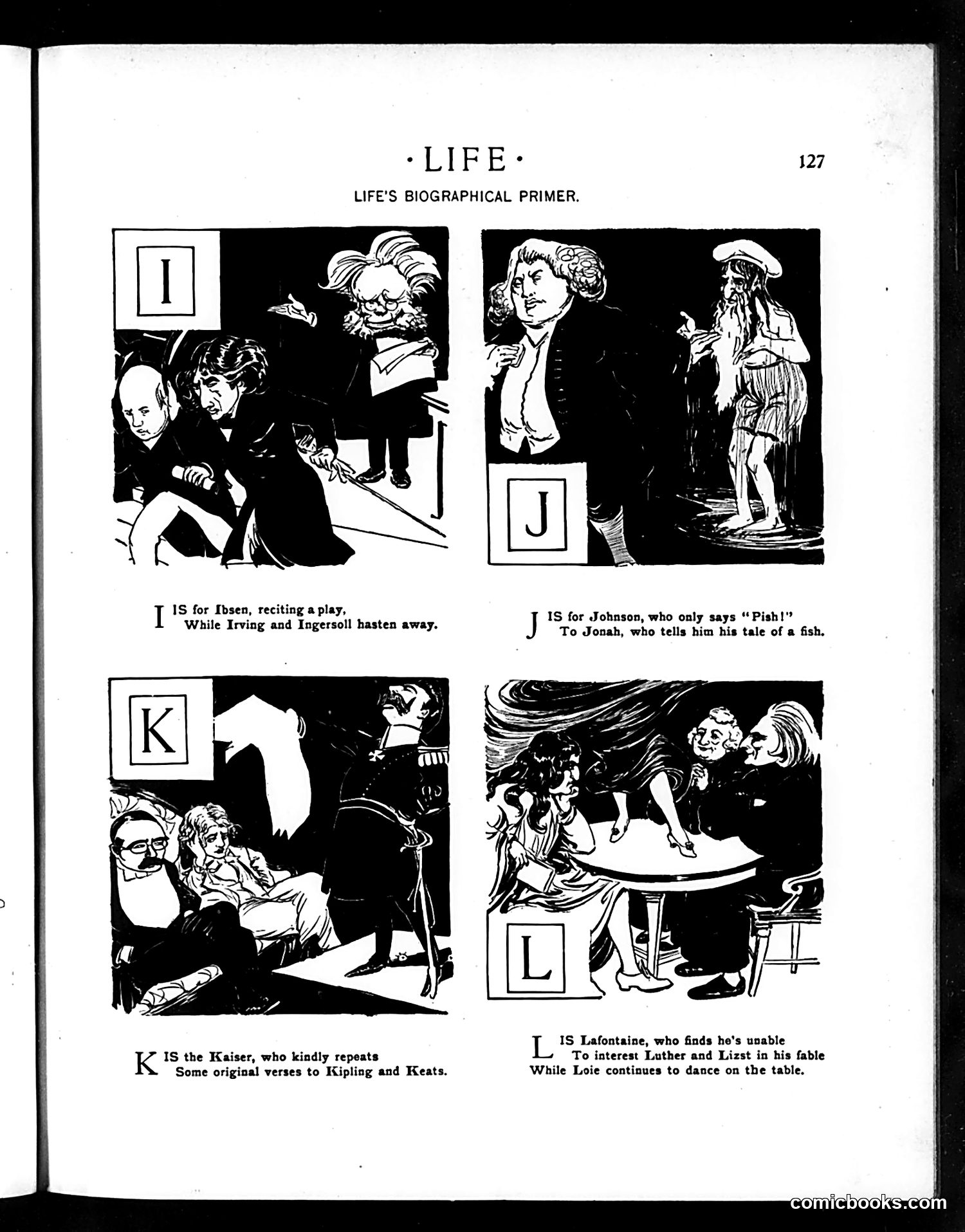
This is a satirical alphabet page featuring caricatures of famous figures. Each letter pairs a notable person with a humorous couplet: **I** - Ibsen (the Norwegian playwright) reciting while Irving and Ingersoll "hasten away" **J** - Johnson, depicted as someone who only says "Fish!" and tells Jonah fish tales **K** - The Kaiser, shown reciting verses to Kipling and Keats **L** - Lafontaine, unable to interest Luther and Liszt while Loïe continues dancing on the table The satire targets celebrity culture and famous figures' pretensions—playwrights boring audiences, obsessive fishermen, autocrats appropriating great poets. "Loïe" (likely dancer Loïe Fuller) dancing on furniture represents artistic excess. The humor relies on readers recognizing these contemporary figures and finding the juxtapositions absurd.
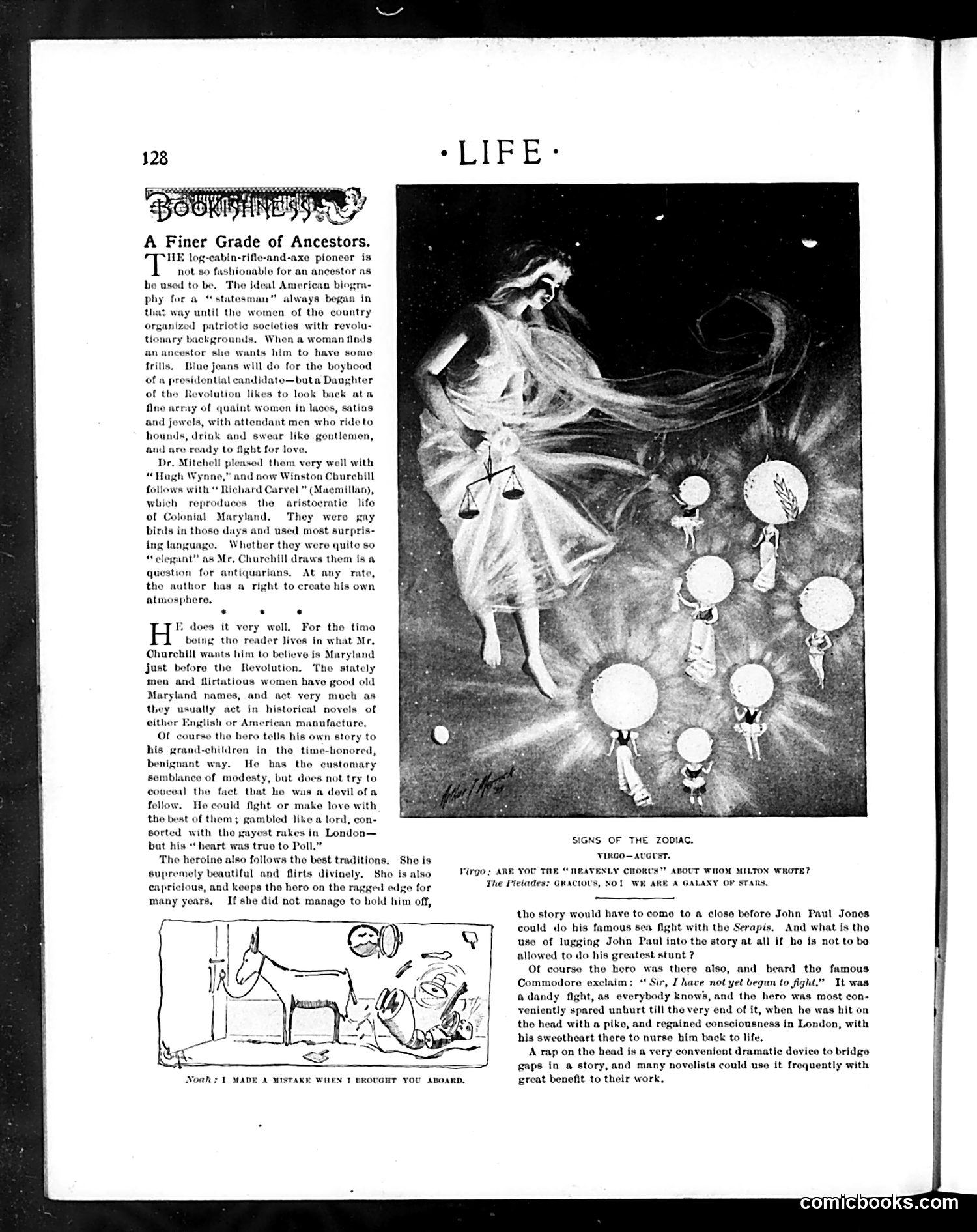
This page satirizes genealogical snobbery among American women. The article "A Finer Grade of Ancestors" mocks the trend of wealthy women joining patriotic societies (like the Daughters of the Revolution) to prove aristocratic lineage, replacing frontier ancestors with refined colonial Maryland gentry. The main cartoon shows a woman in a ballroom gown holding scales of justice, surrounded by zodiac symbols labeled "Virgo—August." This appears to reference astrology or heavenly/divine judgment of one's worthiness—likely satirizing how women use fabricated genealogies to claim moral and social superiority. The lower cartoon shows a scene labeled "Noah's! I made a mistake when I brought you aboard," humorously suggesting even Noah's Ark couldn't accommodate certain ancestry claims—implying some genealogies are absurdly inflated or false.
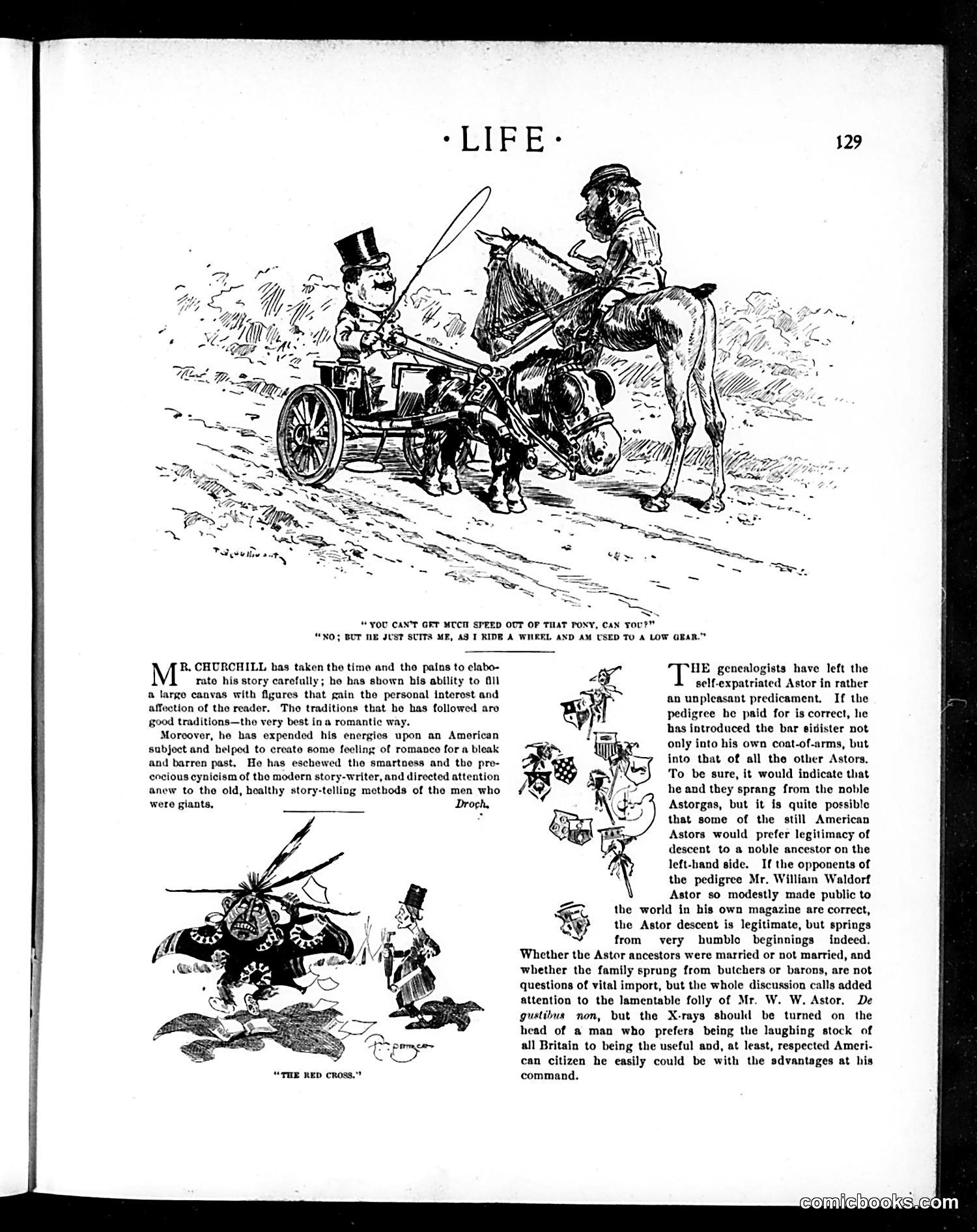
**Top Cartoon:** Shows a man in a top hat in a cart pulled by a pony, while a man on horseback approaches. The caption reads: "You can't get much speed out of that pony, can you?" / "No; but he just suits me, as I ride a wheel and am used to a low gear." This is a bicycle joke—the man on the cart is comparing his slow pony to bicycle riding, suggesting the pony's slow pace matches cycling speeds. It's light satire about the popularity of bicycles in this era. **Article Text:** Discusses Mr. Churchill's storytelling abilities and literary work, praising his style. The lower section debates the genealogy of the Astor family, discussing whether William Waldorf Astor's ancestry is legitimate—a social commentary on American wealth, class pretensions, and European aristocratic lineage.
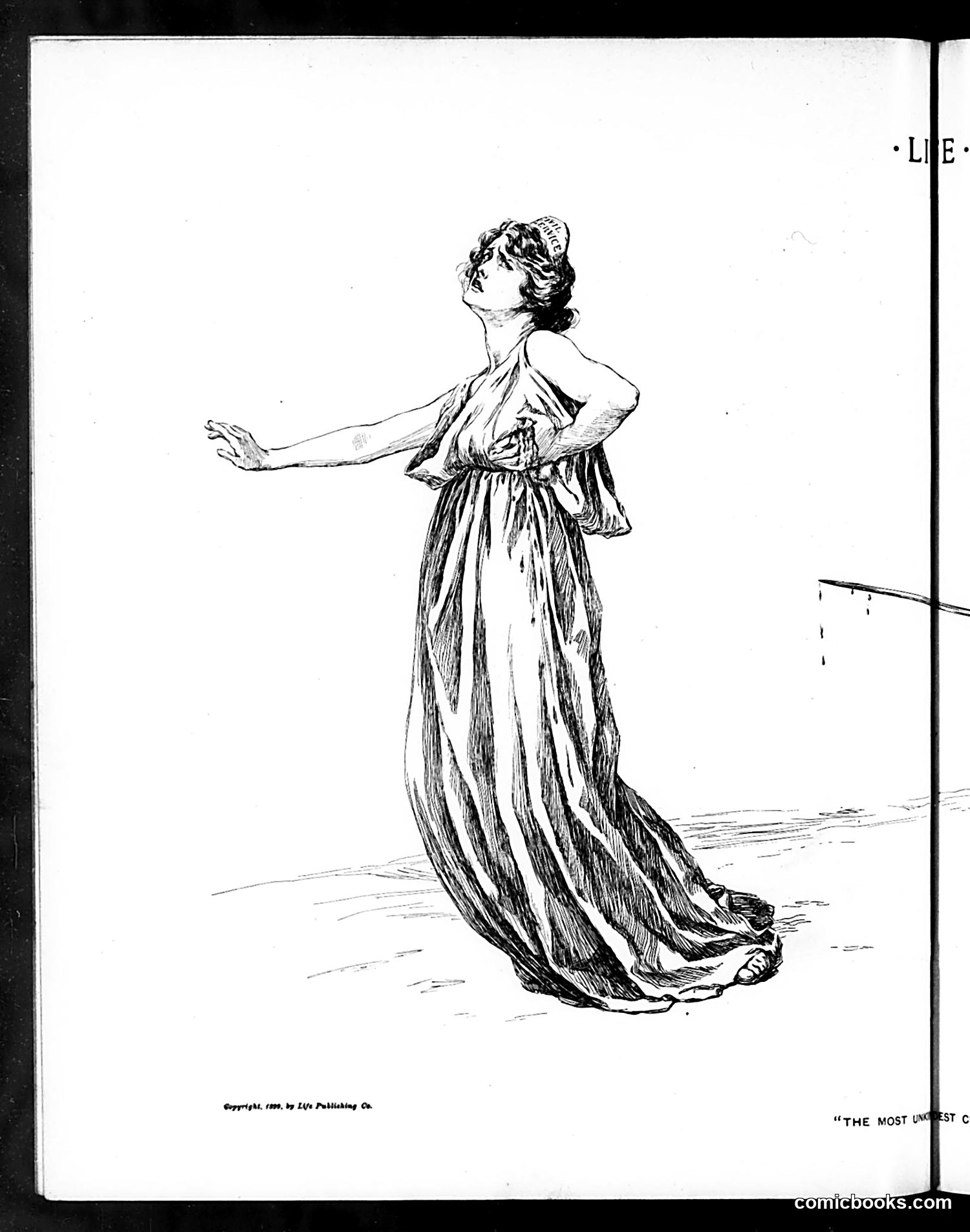
This appears to be an illustration from *Life* magazine (copyright 1909, per the bottom text). The image shows a woman in an elegant Edwardian-era gown with upswept hair, depicted in a refined pen-and-ink style typical of early 20th-century fashion illustration. The partial caption visible reads "THE MOST UNJEST C[...]" (text cut off), suggesting this is satirizing something about a woman or feminine ideal. Without the complete caption, the specific satirical target is unclear—it could reference beauty standards, fashion pretension, social climbing, or a contemporary scandal—but the elegant pose and detailed rendering suggest the humor likely derives from commenting on women's fashionable pretensions or social aspirations of the Edwardian period.
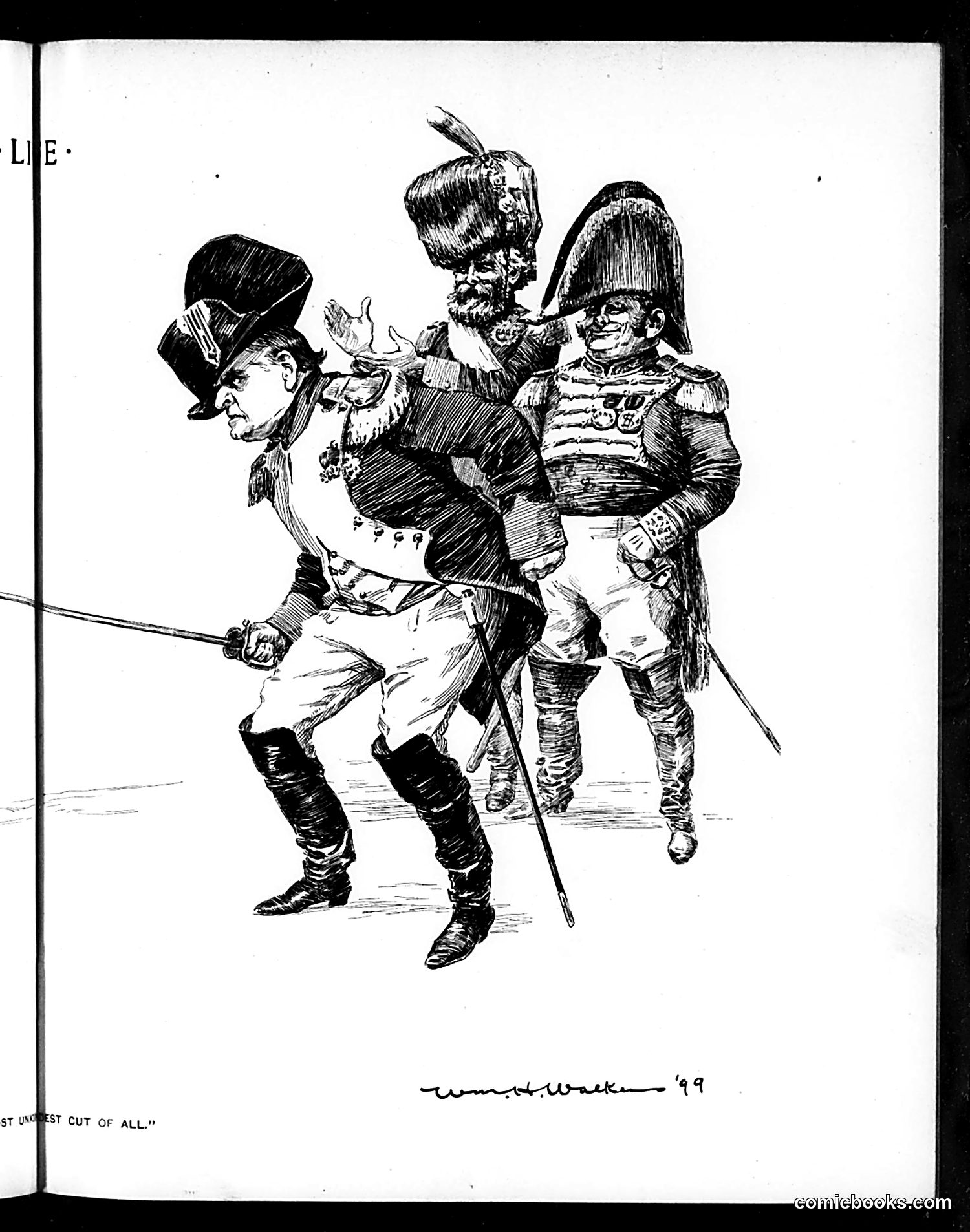
This appears to be a satirical cartoon from *Life* magazine showing three military figures in ornate uniforms and tall plumed hats. The leftmost figure is being stabbed or cut from behind by the two others wielding swords. The visible caption reads "UNKINDEST CUT OF ALL," referencing Shakespeare's *Julius Caesar* and suggesting betrayal. The cartoon likely depicts a political or military leader being undermined by allies or subordinates. Without the date or additional context visible on this page, I cannot identify the specific figures or historical moment. However, the "unkindest cut" reference suggests a commentary on treachery within military or political circles—possibly relating to early 20th-century European or American military politics. The ornate uniforms suggest foreign military leaders.
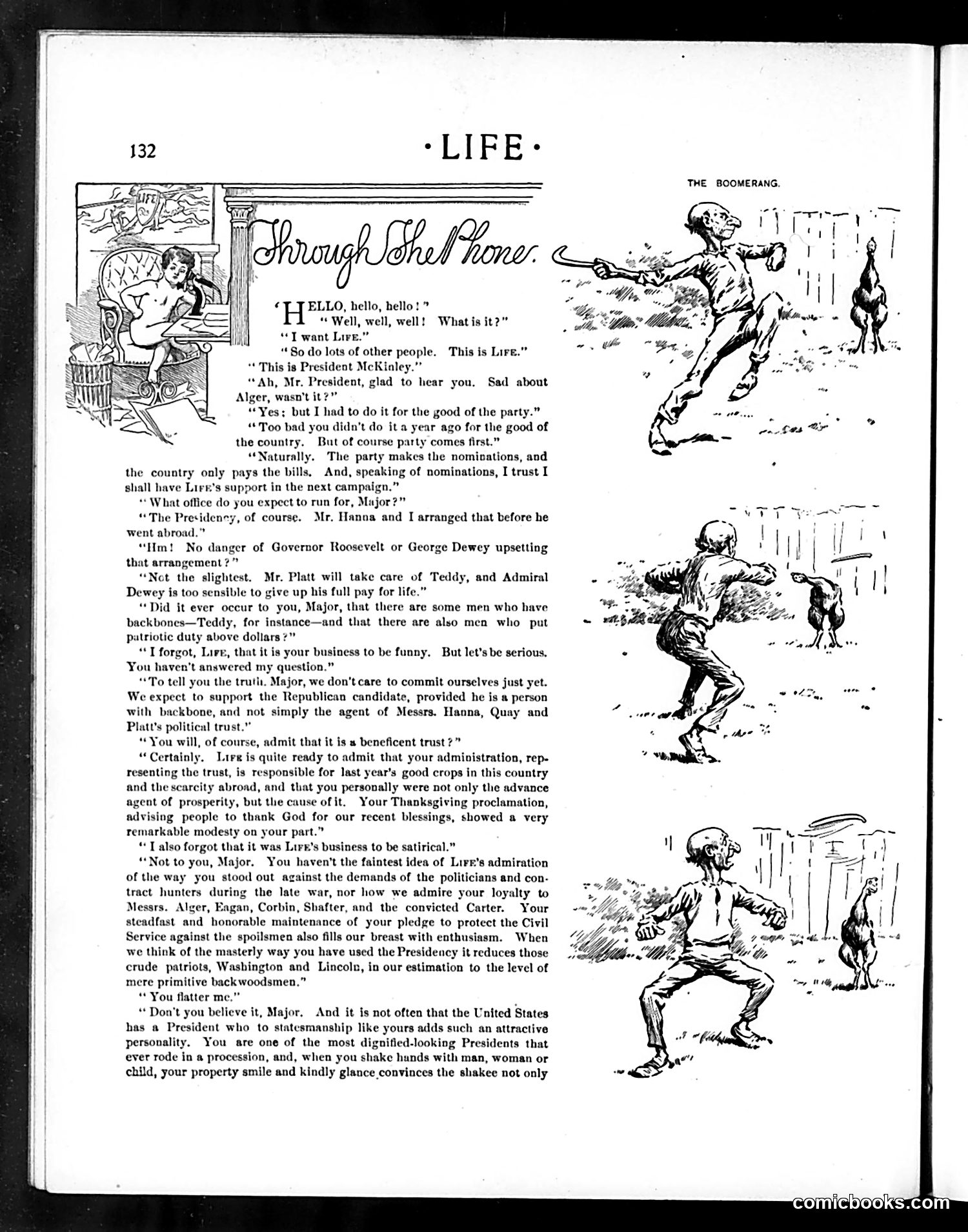
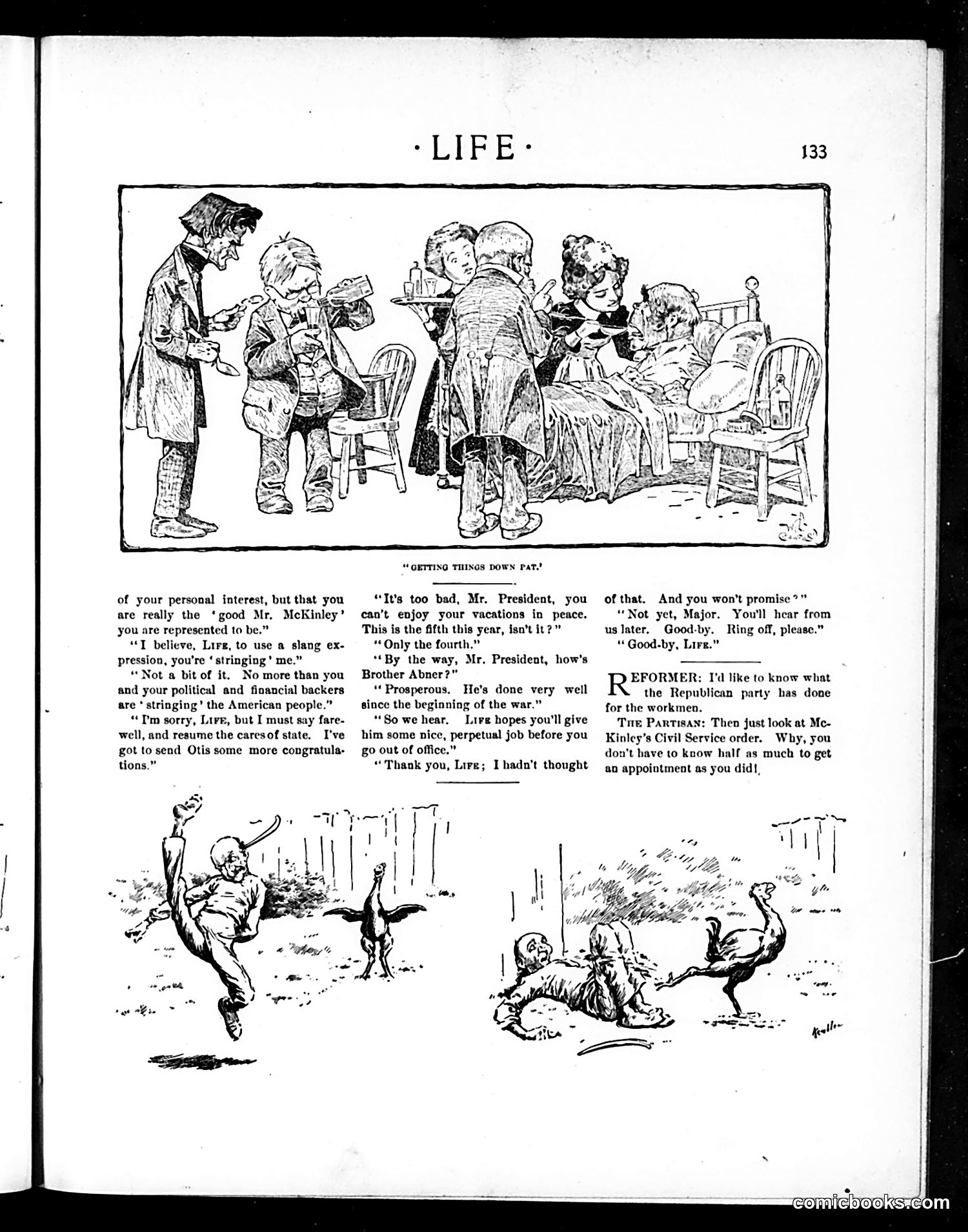
This page satirizes President McKinley's administration during the Spanish-American War era. The top cartoon titled "Getting Things Down Pat" depicts McKinley being interviewed by a character named "Life" (the magazine's personified voice). The satire targets: **McKinley's vacations**: Life criticizes the president for taking frequent vacations while claiming to work, noting this is his fourth or fifth that year. **Nepotism and patronage**: Life suggests McKinley will reward his brother Abner with a cushy government job as post-war payoff, mocking the corrupt "spoils system" of political appointments. **Wartime profiteering**: References suggest McKinley's associates have grown wealthy since the war's beginning. The bottom cartoons show children playing roughly, likely satirizing American imperialist aggression during the Philippine-American War. The exchange between "Reformer" and "Partisan" critiques McKinley's Civil Service reforms as superficial—you need less knowledge for appointments, suggesting merit-based reform is mere window-dressing.
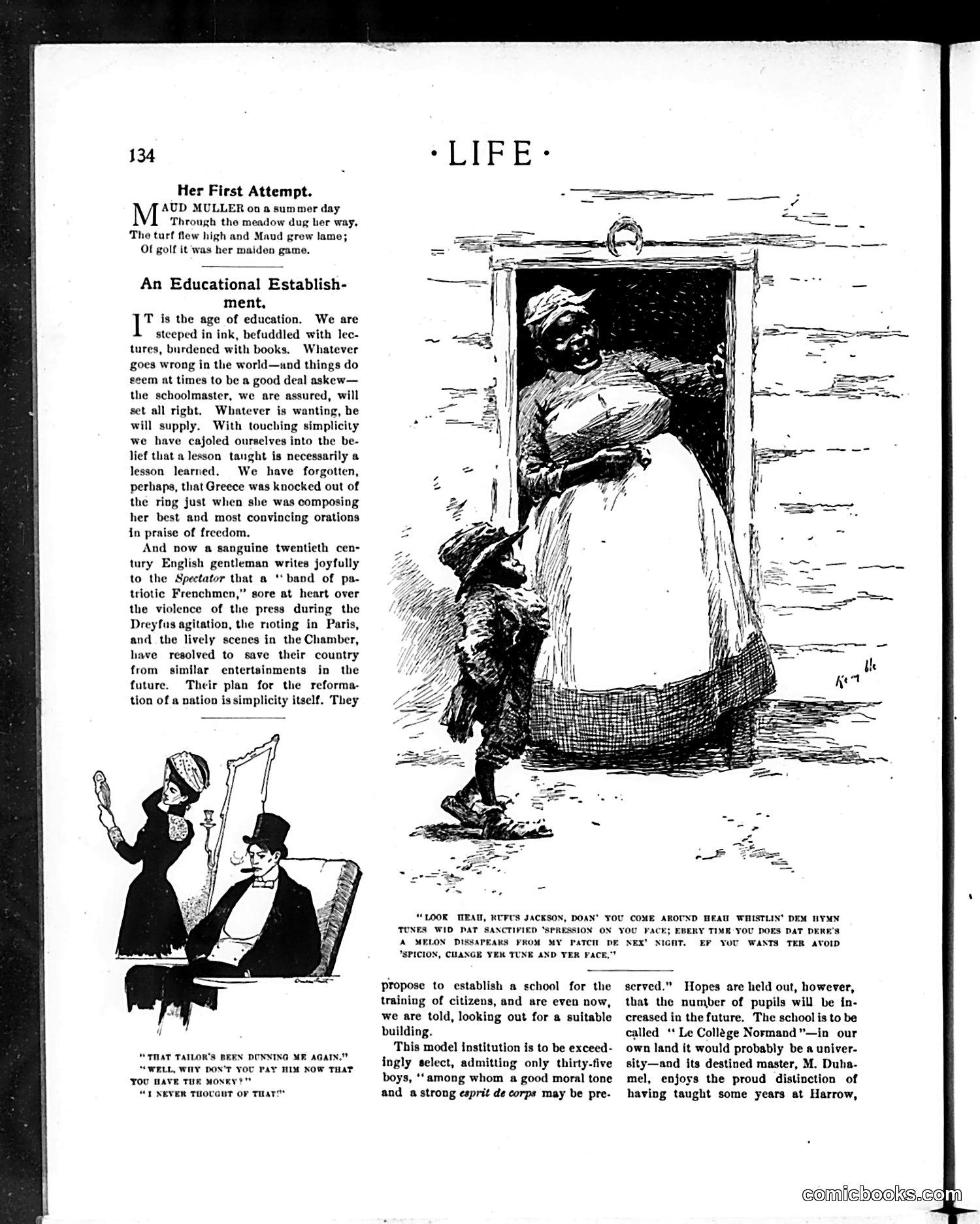
This page contains multiple satirical pieces mocking education and social pretension: **"Her First Attempt"**: A brief poem ridiculing women golfers, depicting Maud Muller's clumsy first golf outing as comedic physical mishap. **"An Educational Establishment"**: The main satire critiques French reformers proposing an elite school ("Le Collège Normand") with only 35 boys to cure national problems through education. Life mocks this naive faith that schooling alone fixes societal ills, referencing the recent Dreyfus Affair's chaos in France. The author sarcastically notes that ancient Greece composed brilliant orations while collapsing—education doesn't guarantee virtue or stability. **Bottom cartoons**: Dialogue sketches satirizing everyday foolishness—a man forgetting he has money to pay debts; a Black character warning another against whistling near his melon patch (a racial stereotype). These reinforce the magazine's point: education doesn't cure human stupidity or moral failings. The overall message: reformers overestimate education's power to improve society.
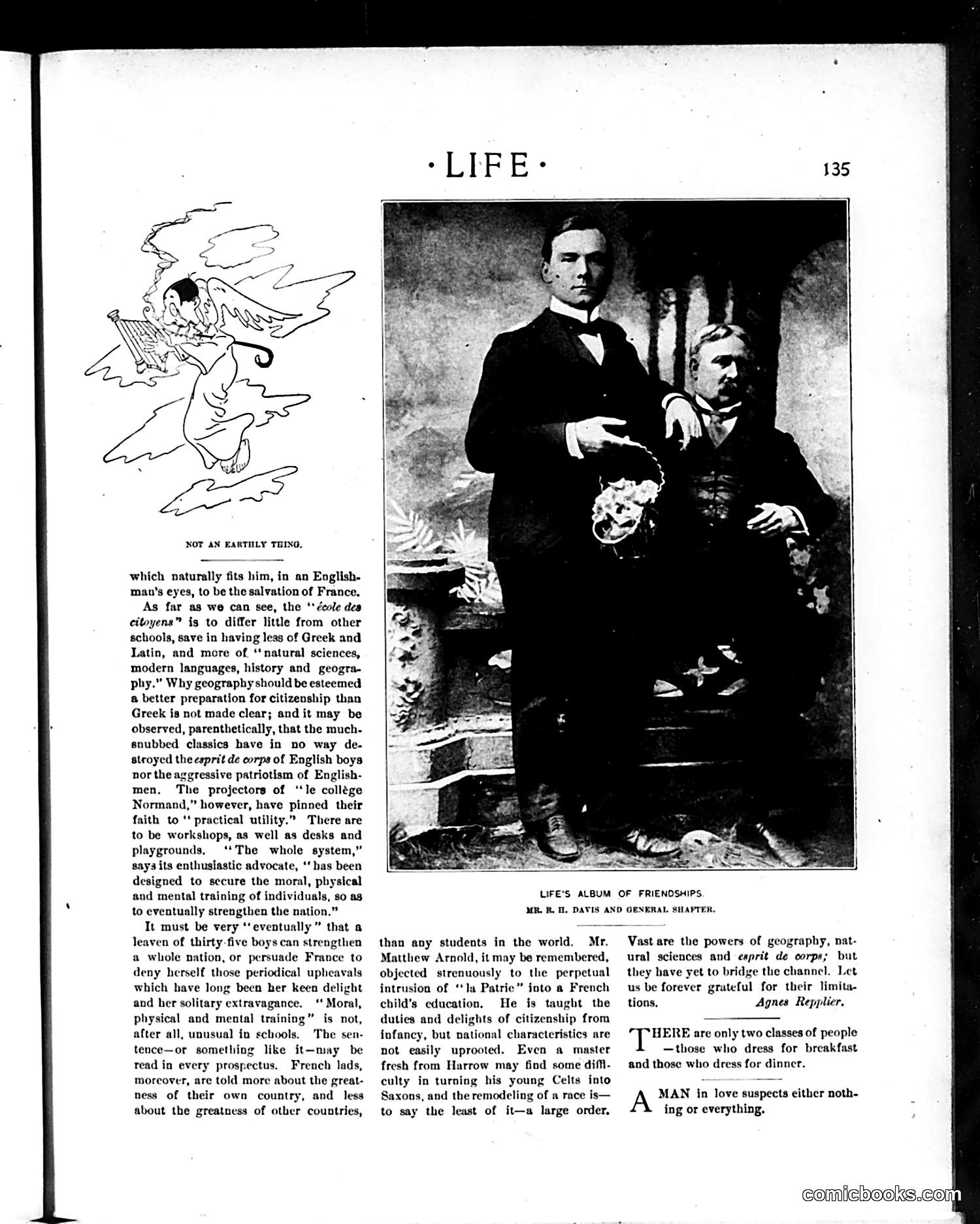
This page critiques a French educational reform called "le collège Normand," which proposed replacing classical studies (Greek and Latin) with practical subjects like natural sciences, modern languages, and geography. **The satire's point:** The author (Agnes Repplier) mocks the French belief that practical education and nationalist fervor ("esprit de corps") can strengthen the nation. She argues this is naive—France's periodic upheavals are rooted in national character, not pedagogy. Even Matthew Arnold recognized that constant "la Patrie" indoctrination doesn't erase deep cultural traits. **The photograph** shows "Mr. R. H. Davis and General Shafter"—likely a contemporary figure of note, though the connection to the education debate isn't explicit from this text. **The humor** lies in dismissing grandiose French educational schemes as unlikely to produce their promised results. The page reflects Anglo-American skepticism about continental European social engineering during the turn-of-the-century period. The aphorisms at bottom are unrelated filler content typical of Life's miscellaneous satirical observations.
This page contains three humorous anecdotes typical of early-20th-century satirical magazines, rather than political cartoons. Each joke illustrates social awkwardness or human folly: 1. **The Insurance Manager**: A busy executive asks his office boy to identify a visitor whose name he's forgotten—a commentary on impersonal business dealings and the embarrassment of social forgetfulness. 2. **The Railway Passenger**: A confused traveler misunderstands railroad signal posts marked "R" and "W," asking how to spell "whistle" with an "R"—poking fun at literal-minded confusion and misunderstanding. 3. **The Cigar Anecdote**: A stingy man smokes a good cigar but refuses to share, disappointing his friend—satirizing petty miserliness. The page is primarily advertising (Wilson Whiskey, Life bound volume, Saratoga Springs), with these jokes serving as editorial content to fill space and entertain readers with gentle satire about everyday social situations.
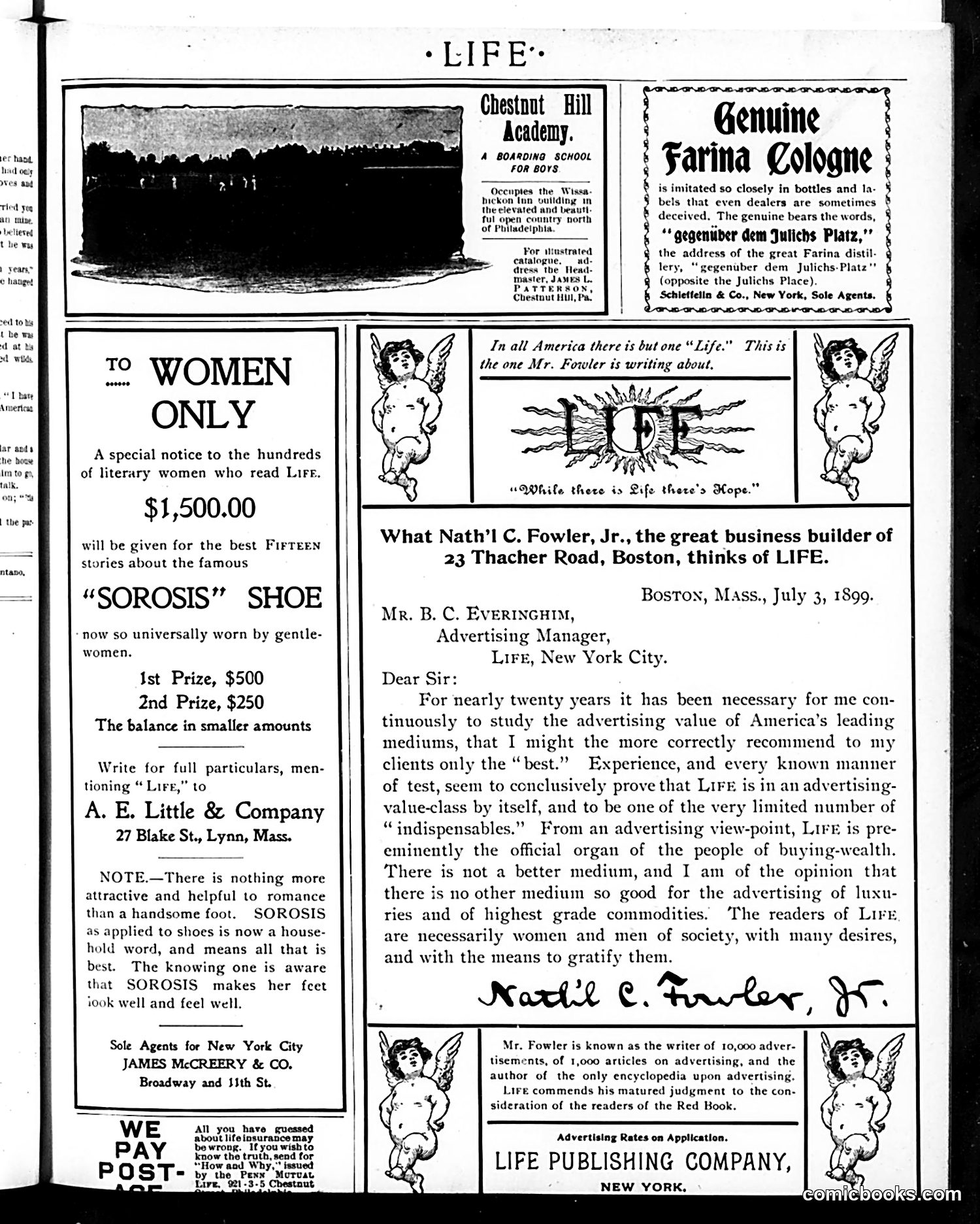
This page contains advertisements disguised as editorial content for *Life* magazine (dated July 3, 1899). The key elements: **Main Advertisement**: A testimonial letter from Nathaniel C. Fowler Jr., a prominent advertising expert known for writing 10,000 advertisements, endorsing *Life* as superior for advertising luxury goods. Fowler argues *Life* reaches wealthy consumers—"people of buying-wealth"—making it the ideal publication for high-end products. **Secondary Ads**: - A contest offering $1,500 for stories about "Sorosis" shoes, directed at female readers - Chestnut Hill Academy boarding school - Farina Cologne, with a note about counterfeit imitations **The Satire**: The page's motto declares "In all America there is but one 'Life.'" This self-promotional content reflects *Life's* confidence in its cultural status and advertising power. By securing testimonials from influential figures, the magazine positioned itself as essential to reaching affluent consumers, a common advertising strategy of the Gilded Age.
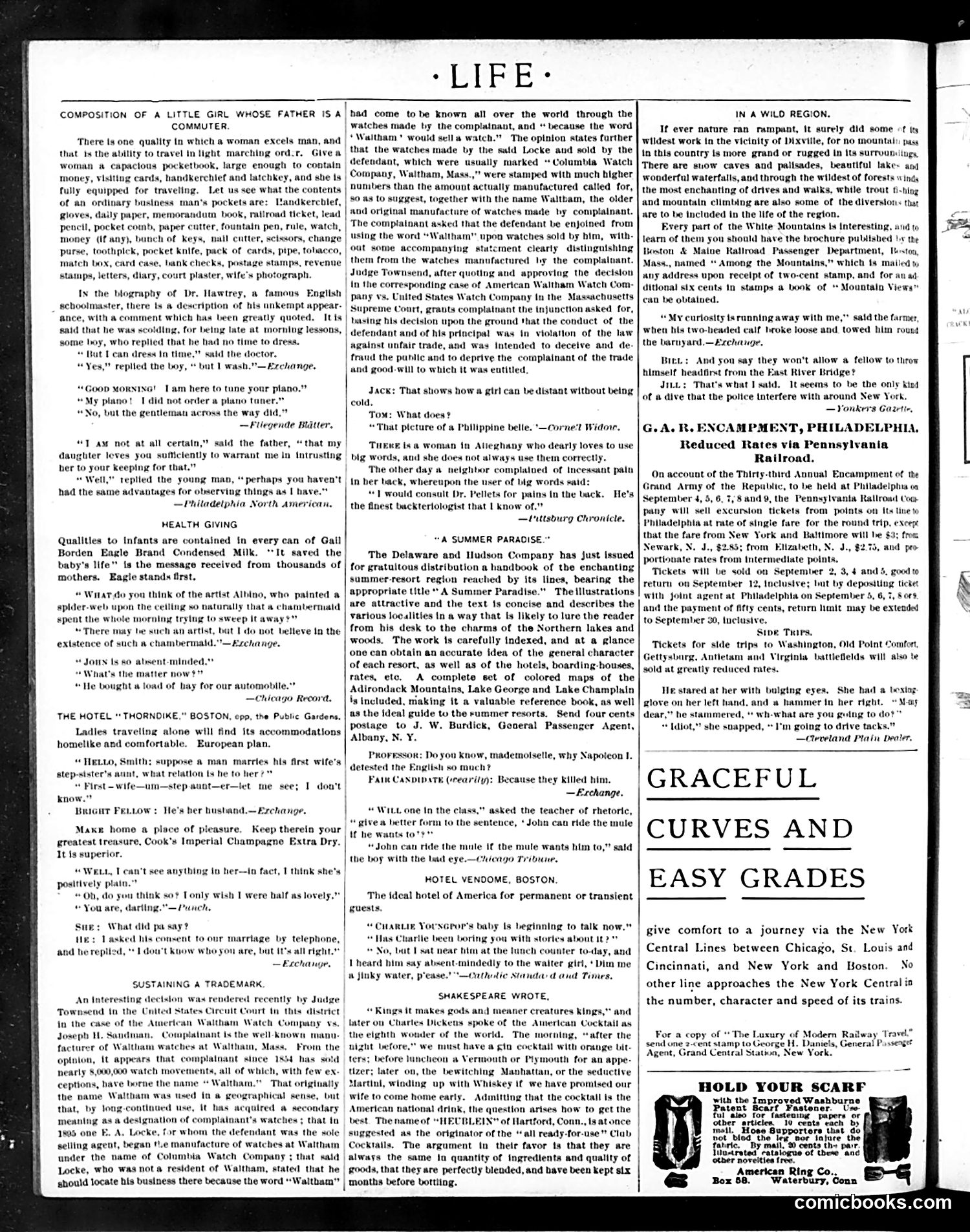
This page contains primarily **humorous short jokes and advertisements** rather than political cartoons. The content reflects early-20th-century American domesticity and gender roles. The notable satire includes: **"Composition of a Little Girl Whose Father is a Commuter"** — contrasts a woman's efficient packing (needing only a purse with essentials) against a businessman's cluttered pockets overflowing with items including "wife's photograph." The joke satirizes male disorganization and bourgeois materialism. **Piano tuning dialogue** — jokes about courtship conventions, where a suitor arrives to tune the piano, leading to commentary on whether the daughter's affections warrant trusting him with her company. **Waltham Watch trademark case** — discusses a legal decision protecting the "Waltham" brand name, showing how consumer goods had become major commercial concerns. The overall tone mocks Victorian social conventions, commuter culture, and the absurdities of middle-class life, typical of Life magazine's satirical approach during this era.
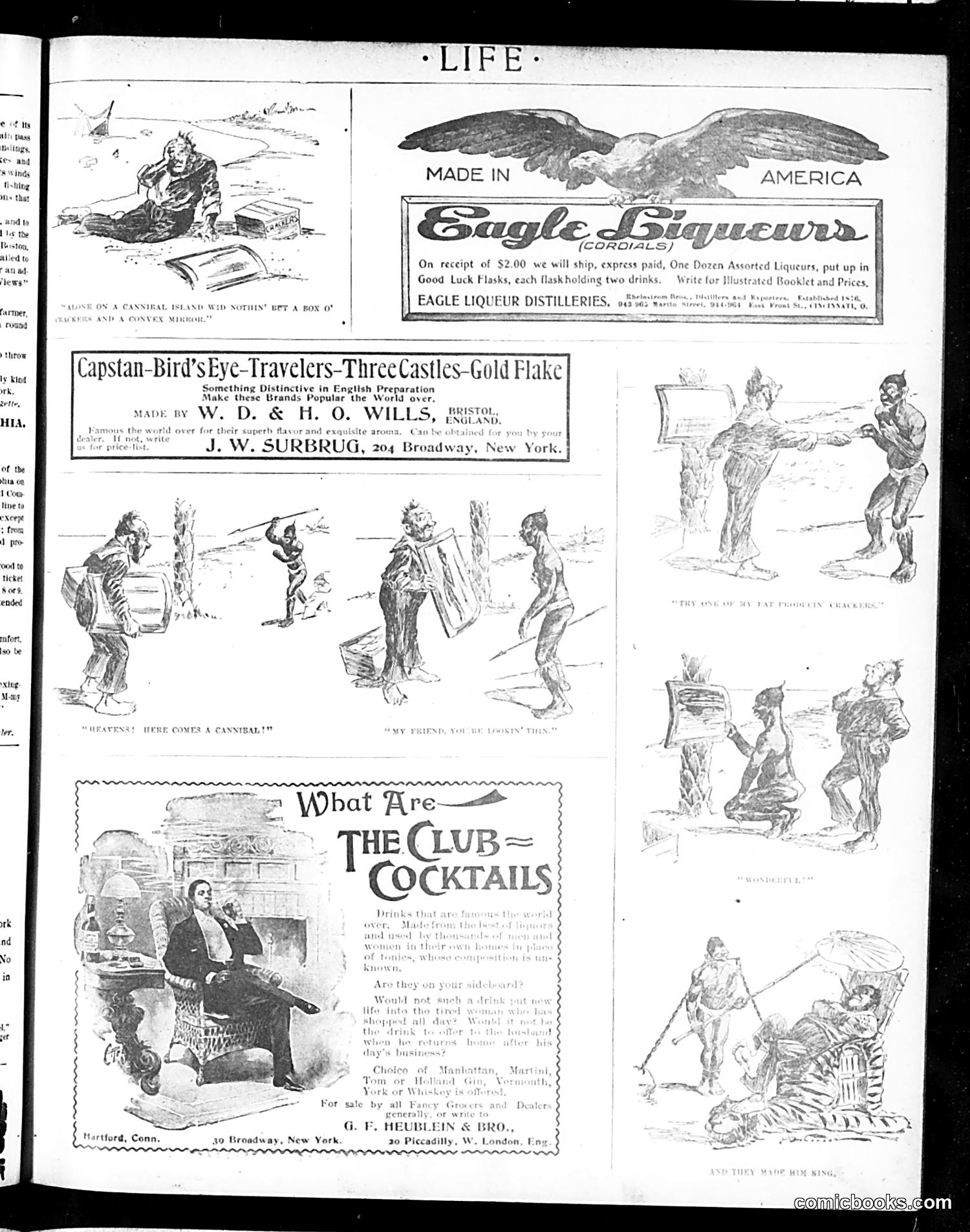
This page is primarily **advertising**, not editorial satire. It contains multiple liquor and tobacco advertisements from the early 20th century. The top features **Eagle Liqueurs** ("Made in America"), offering mail-order spirits in flasks. Below that, **W.D. & H.O. Wills** (a British tobacco company) advertises cigarette brands including Capstan, Bird's Eye, and Gold Flake, with humorous illustrated vignettes of men in various comedic situations—likely depicting the appeal or lifestyle associated with smoking. The bottom advertisement for **Club Cocktails** (by G.F. Heublein & Bro.) shows a well-dressed gentleman and promotes pre-mixed cocktail options for home consumption. The left sidebar contains a small cartoon captioned "On a cannibal island wid nothin' bet a box of cigars and a convex sekond" (unclear reference, possibly dated racial humor). **Context**: This reflects the era before Prohibition (1920-1933), when alcohol and tobacco advertising was unrestricted in American magazines, often using humor and lifestyle appeals to market these products directly to consumers.
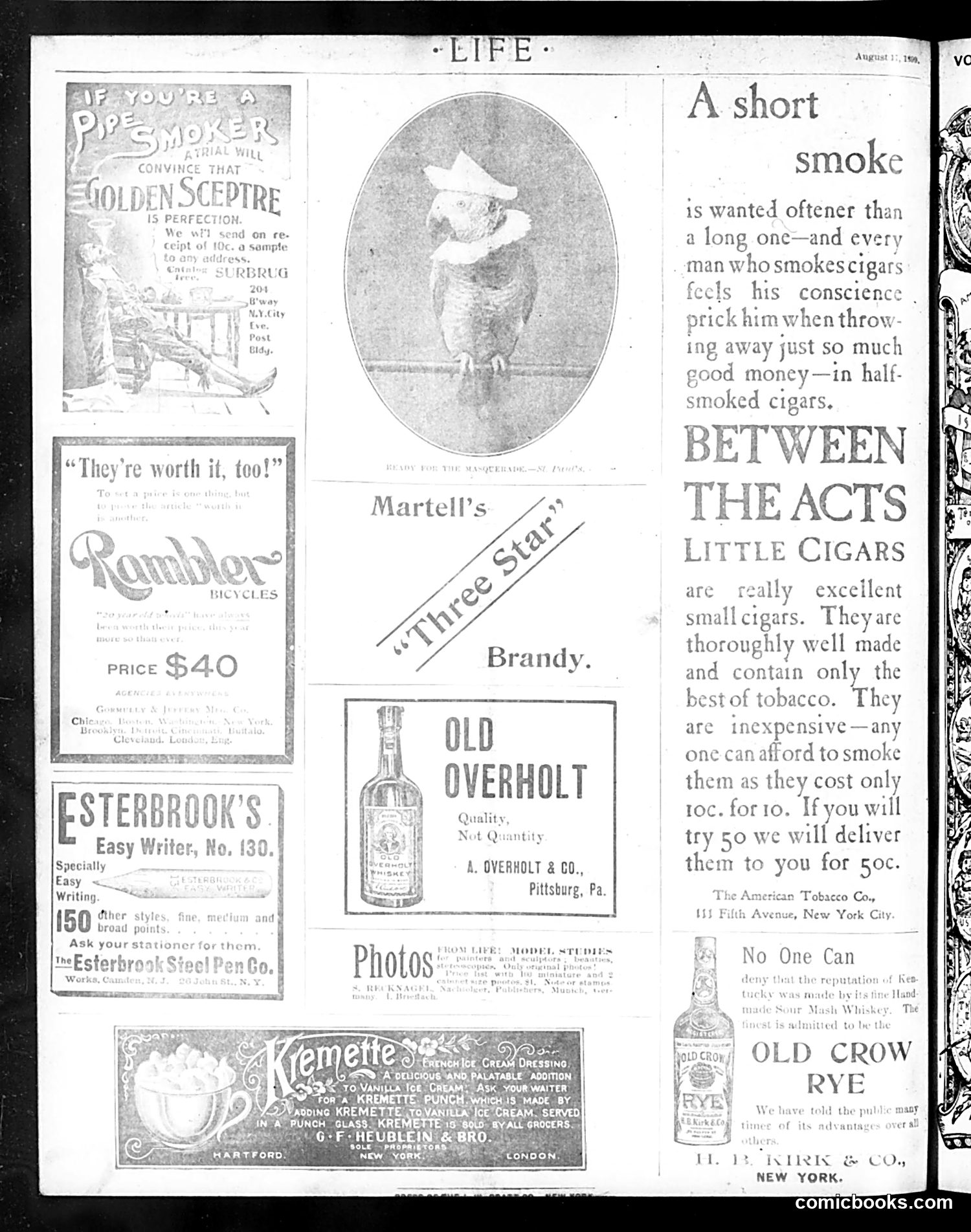
This page is primarily **advertising content** rather than political satire. It contains multiple product advertisements typical of early 1900s magazines. The central image shows a dog wearing a hat—apparently advertising "Between the Acts Little Cigars." The accompanying text argues that short smokes are preferable to long ones because smokers waste money discarding half-smoked cigars. The ad promotes these small cigars as affordable (10¢ for 10) and well-made. Other advertisements include: - **Rambler Bicycles** ($40) - **Esterbrook's Easy Writer** pens - **Old Overholt** whiskey - **Kremette** cream dressing (bottom) - **Old Crow Rye** whiskey - **Sour Mash Whiskey** The dog illustration is whimsical rather than satirical—apparently meant to catch readers' attention for the cigar brand. There is no apparent political commentary on this page.