
Life, 1899-08-17 · page 3 of 20
Life — August 17, 1899 — page 3: what you’re looking at
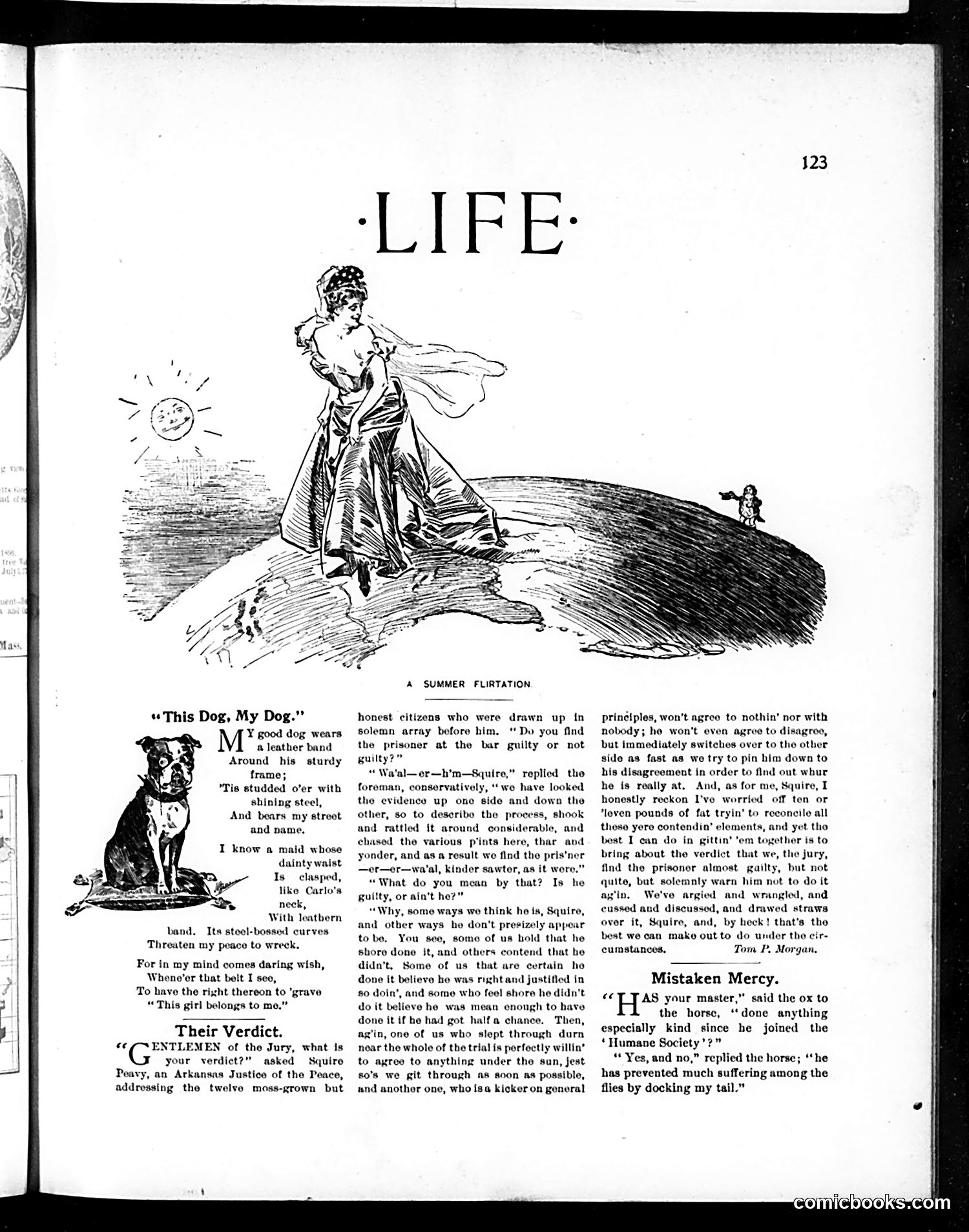
What you’re looking at
This page contains three distinct satirical pieces: 1. **"A Summer Flirtation"** (top): An allegorical illustration showing a woman on a large curved form (possibly representing a whale or landscape feature), with a small figure in the distance and a rising sun—likely a commentary on romantic pursuit or social courtship. 2. **"This Dog, My Dog"** (left): Poem about a loyal dog, contrasting the dog's unwavering devotion with human inconsistency. The accompanying illustration shows a sturdy bulldog, celebrating canine loyalty as morally superior to human behavior. 3. **"Gentlemen of the Jury"** and **"Mistaken Mercy"** (right): A dialogue apparently critiquing judicial leniency toward a prisoner. A judge and defendant discuss whether the prisoner is "guilty" or "mean," with the conclusion that mercy toward criminals may cause broader harm. This reflects Progressive-era debates about criminal justice reform.
📄 Transcribed text from this page (OCR, searchable)
Machine-transcribed from the original scan — historical spelling and the odd misread are preserved.
“This Dog, My Dog.” x Y¥ good dog wears a leather band Around his sturdy frame; ‘Tis studded o’er with shining steel, And bears my street and name. I know a maid whose dainty waist Is clasped, like Carlo's neck, With leatbern band, Its stool-bossed curves Threaten my peace to wreck. For in my mind comes daring wish, Wheno’er that belt I seo, To havo tho right thereon to ‘grave “This girl bolongs to me. Their Verdict. «¢€(- ENTLEMEN of the Jury, what is your verdict?” asked Squire Peavy, an Arkansas Justice of the Peace, addressing the twelve moss-grown but A SUMMER FLIRTATION honest citizens who were drawn up in solemn array before him. “Do you find the prisoner at the bar guilty or not guilty?” “ Wa'al—or—h'm—Squire,” replied the foreman, conservatively, we have looked the evidence up one side and down the other, so to deseribo the process, shook and rattled {t around considerable, and chased the various p'ints here, thar and yonder, and as a result we find tho pris'ner —er—or—wa'al, kinder sawtor, as it wore.” “What do you mean by that? Is he guilty, or ain't he?” “Why, some ways wo think ho is, Squire, and otber ways ho don't presizely appear tobe. You see, some of us hold that he shoro done it, and others contend that be didn’t, Some of us that are certain ho done it believe ho was right and justifled in 80 doin’, and some who feel shore he didn’t do it believe he was mean enough to have done it if he had got halfa chance. Then, agin, one of us who slept through durn near the whole of the trial is perfectly willin’? to agreo to anything under tho sun, jest 80's we git through as soon as possible, and anothor one, who isa kicker on gonoral prinéiples, won’t agreo to nothin’ nor with nobody; he won't even agree to disagreo, but immediately switches over to the other sido as fast as we try to pin him down to his disagreement in order to find out whur he is really at. And, as for me, Squire, I honestly reckon I've worried off ten or ‘leven pounds of fat tryin’ to reconcile all these yero contendin’ elements, and yet tho best I can do in gittin’ ’em together is to bring about the verdict that we, the jury, find the prisonor almost gailty, but not. quite, but solemnly warn him not to do it ag'in. We've argied and wrangled, and cussed and discussed, and drawed straws over it, Squire, and, by heck! that's the best we can make out to do under tho cir- cumstances, Tom P, Morgan, Mistaken Mercy. SS your master,” said the ox to the horse, ‘‘done anything especially kind since he joined the * Humane Society’?” “Yes, and no,” replied the horse; “he has prevented much suffering among the flies by docking my tail.”