
Life, 1899-08-17 · page 14 of 20
Life — August 17, 1899 — page 14: what you’re looking at
What you’re looking at
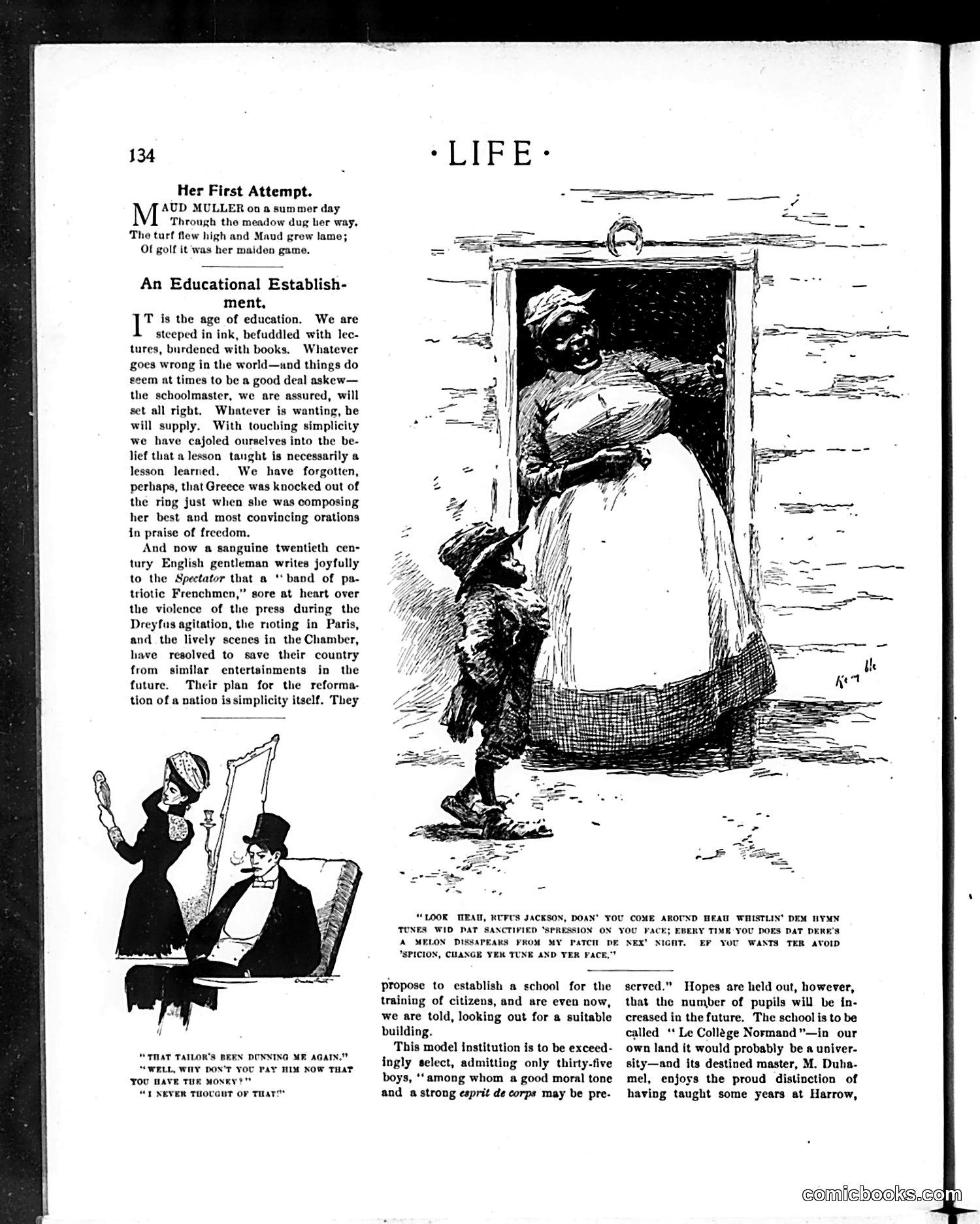
This page contains multiple satirical pieces mocking education and social pretension: **"Her First Attempt"**: A brief poem ridiculing women golfers, depicting Maud Muller's clumsy first golf outing as comedic physical mishap. **"An Educational Establishment"**: The main satire critiques French reformers proposing an elite school ("Le Collège Normand") with only 35 boys to cure national problems through education. Life mocks this naive faith that schooling alone fixes societal ills, referencing the recent Dreyfus Affair's chaos in France. The author sarcastically notes that ancient Greece composed brilliant orations while collapsing—education doesn't guarantee virtue or stability. **Bottom cartoons**: Dialogue sketches satirizing everyday foolishness—a man forgetting he has money to pay debts; a Black character warning another against whistling near his melon patch (a racial stereotype). These reinforce the magazine's point: education doesn't cure human stupidity or moral failings. The overall message: reformers overestimate education's power to improve society.
📄 Transcribed text from this page (OCR, searchable)
Machine-transcribed from the original scan — historical spelling and the odd misread are preserved.
134 Her First Attempt. AUD MULLER on a summer day Through the meadow dug ber way. ‘The turf flew high and Maud grew lame; Of golf it was her maiden game. An Educational Establish- ment, T is the age of education. We are steeped in ink, befuddled with lec- tures, burdened with books, Whatever goes wrong in the world—uand things do seem at times to be a good deal askew— the schoolmaster, we are assured, will set all right. Whatever is wanting, be will supply. With touching simplicity we have cajoled ourselves into the be- lief that a lesson taught is necessarily a lesson learned. We have forgotten, perhaps, that Greece was knocked out of the ring just when she was composing her best and most convincing orations in praise of freedom, And now a sanguine twentieth cen- tury English gentleman writes joyfully to the Spectator that a ‘band of pa- triotic Frenchmen,” sore at heart over the violence of the press during the Dreyfus agitation, the moting in Paris, and the lively scenes in the Chamber, lave resolved to save their country from similar entertainments in the future. Their plan for the reforma- tion of a nation is simplicity itself. They “TNAT TAILOR'S BEEN DCNNING MB AGAIN.” “WELL, WHY DON'T YOU PAY HD NOW THAT ‘YOU HAVE THR MONEY?" “1 NEVER THOUGHT OF THAT!" “LOOK TEAU, RUFUS JACKSON, DOAN’ YOU COME AROUND HEAU WHISTLIN’ DEM NYMN TUNES WID PAT SANCTIFIED ‘SPRESSION ON YOU FACE; EGERY TIME YOU DOES DAT DERR’S. A MELON DISSAPEARS FROM MY PATCH DE NEX’ *SPICION, CHANGE YER TUNE AND YER PACE," Propose to establish a school for the training of citizens, and are even now, we are told, looking out for a suitable building. This model institution is to be exceed- ingly select, admitting only thirty-five boys, ‘‘among whom a good moral tone and a strong esprit de corps may be pre- NIGHT. EP YOU WANTS TER avoID served.” Hopes are held out, however, that the number of pupils will be in- creased in the future. The school is to be called ‘* Le Collége Normand "—in our own land it would probably be a univer- sity—and its destined master, M. Duha- mel, enjoys the proud distinction of having taught some years at Harrow, comichooks.