
A complete issue · 20 pages · 1899
Life — July 20, 1899
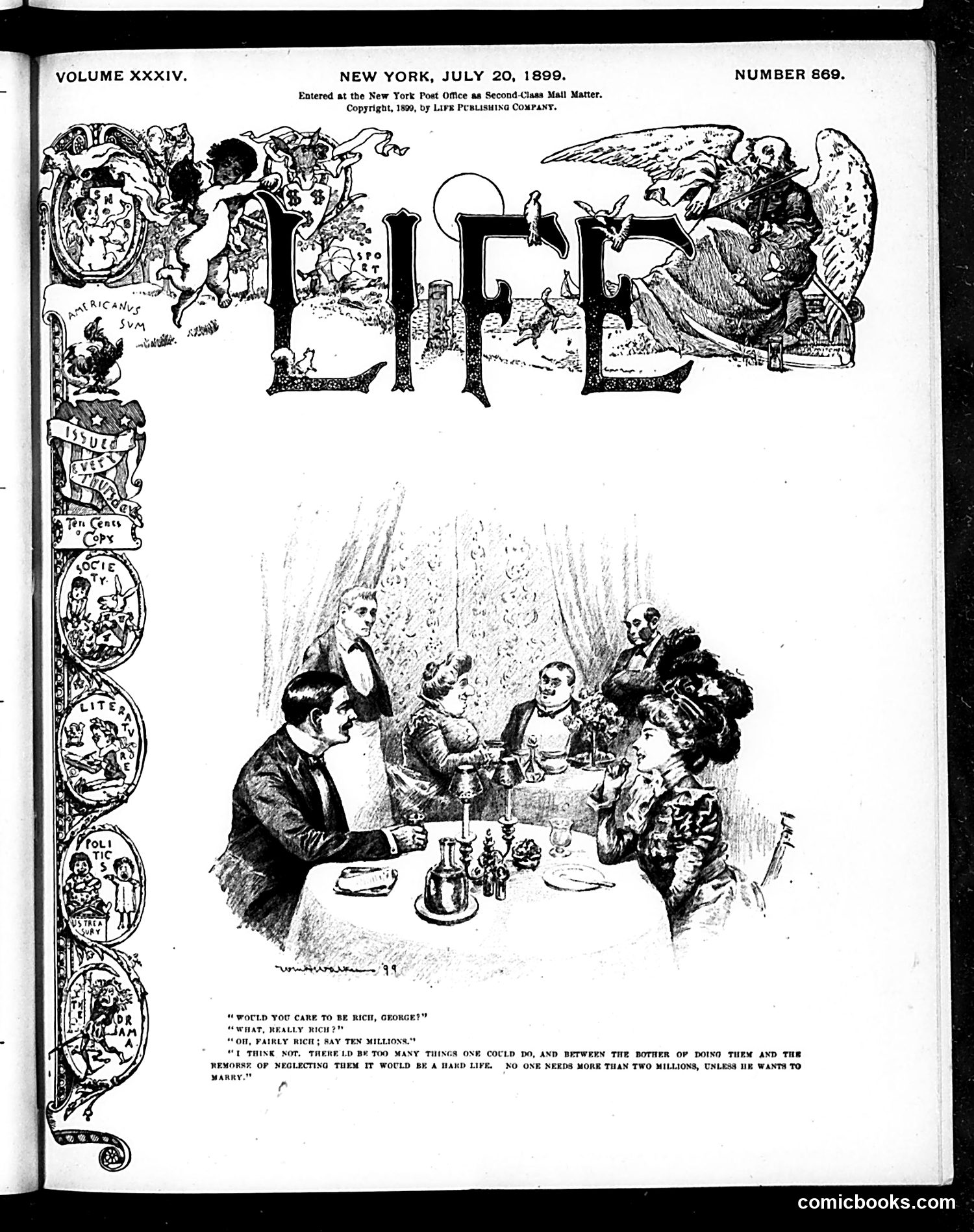
This page satirizes wealth and marriage among the wealthy. The cartoon depicts a dinner conversation where a man (likely named George) is being asked if he'd care to be rich. His response indicates wealth requires managing "too many things"—suggesting the complications of maintaining a fortune. The punchline argues that two million dollars is sufficient for comfortable living, but more creates burdensome obligations and prevents marriage. The satire targets late-19th-century anxieties about wealth accumulation: the idea that excessive riches paradoxically complicate life rather than simplify it. The ornate decorative borders and period clothing reflect 1899 aesthetic conventions. The cartoon mocks the upper class's rationalization of limited wealth as somehow preferable to abundance.
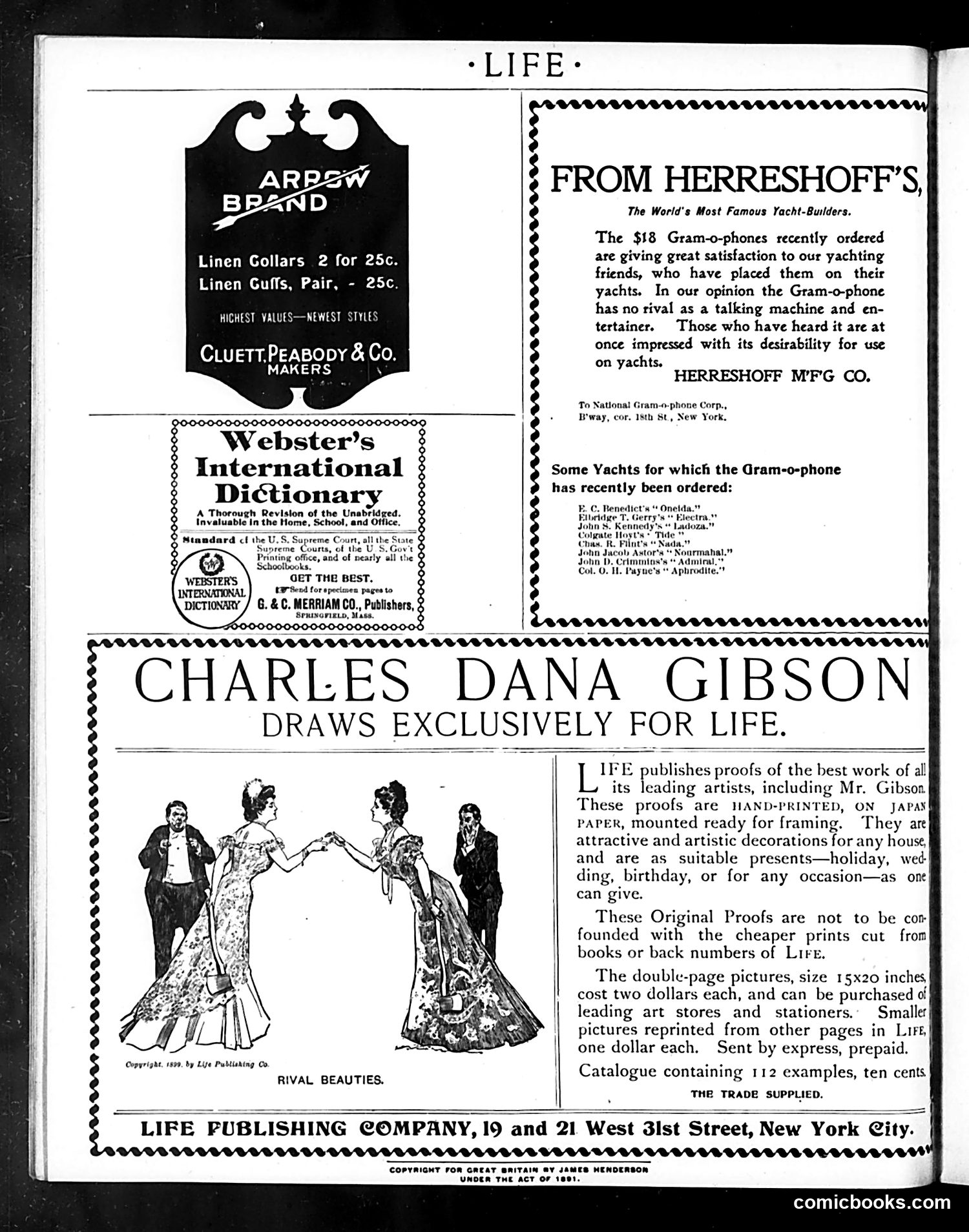
This page is primarily **advertising**, not satire or political commentary. The top features ads for Arrow Brand linen collars/cuffs (Cluett, Peabody & Co.) and Webster's International Dictionary. The main content advertises **Charles Dana Gibson's artwork**—specifically that Life magazine publishes high-quality proofs of his illustrations. The large drawing titled "Rival Beauties" shows Gibson's characteristic style: elegant figures in formal dress engaged in social interaction. The ad promotes these art prints as decorative pieces for homes, available in various sizes and prices ($1-2 for smaller prints, up to $2 for larger double-page versions). A secondary ad mentions Herreshoff Manufacturing Company's Gram-o-phones being installed on yachts. The page reflects early 1900s consumer culture and Gibson's prominence as America's leading illustrator of high society.
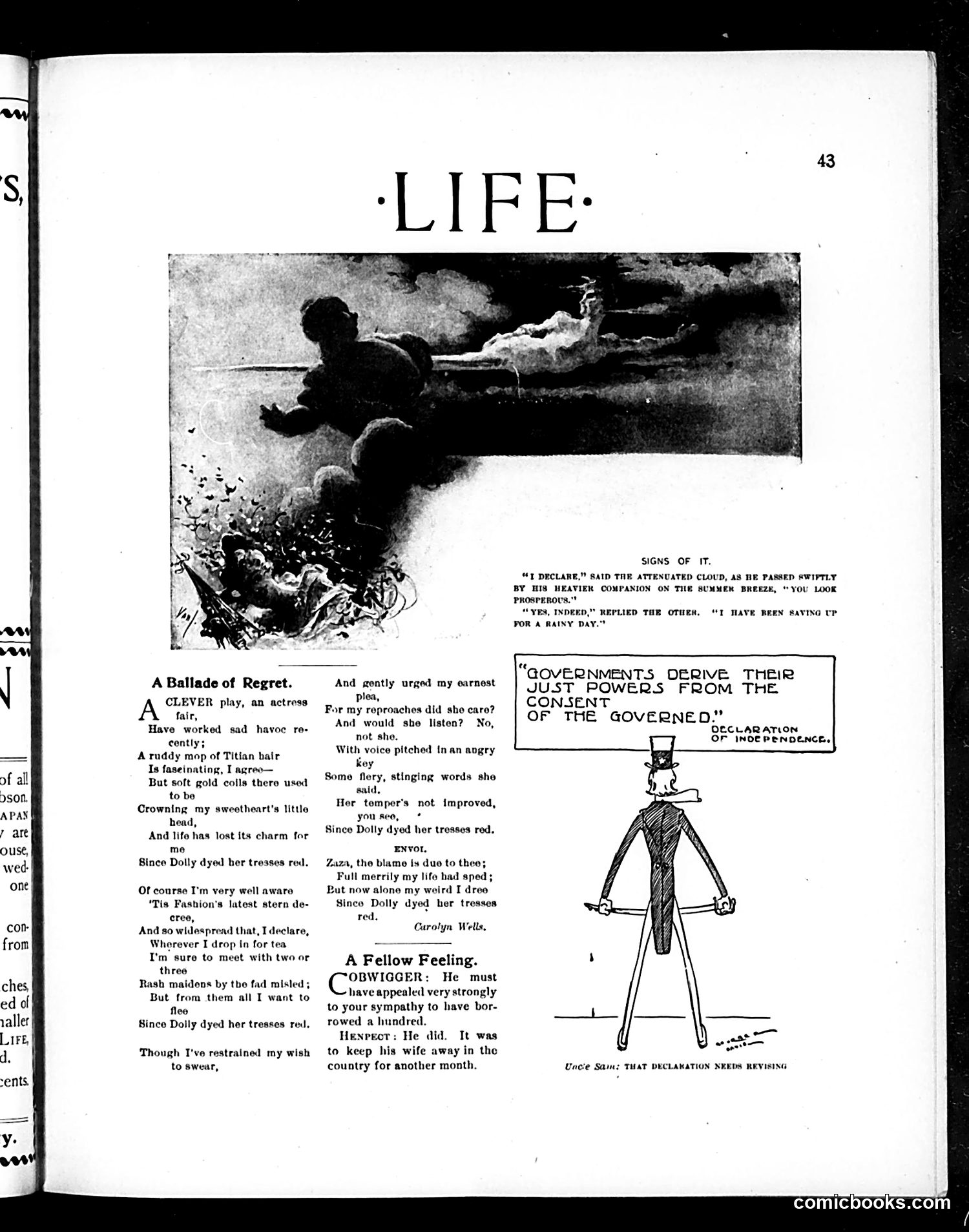
The page contains two satirical pieces: **"A Ballad of Regret"** (poem by Carolyn Wells): A woman laments dyeing her hair red to follow fashion, regretting the decision since it damaged her tresses and attracted unwanted attention. **"A Fellow Feeling"** (dialogue): A humorous exchange between a cloakroom attendant and patron about borrowing money—the attendant sympathizes because he too borrowed a hundred pounds from his wife, whom he's now keeping away for a month to avoid repayment demands. **The cartoon** (captioned "Uncle Sam: That Declaration Needs Revising") depicts Uncle Sam as a skeletal figure, mocking the Declaration of Independence. The boxed quote critiques government power, suggesting declarations of independence are hollow since governments derive power from consent anyway—likely commentary on American governmental overreach or hypocrisy circa the magazine's publication period.
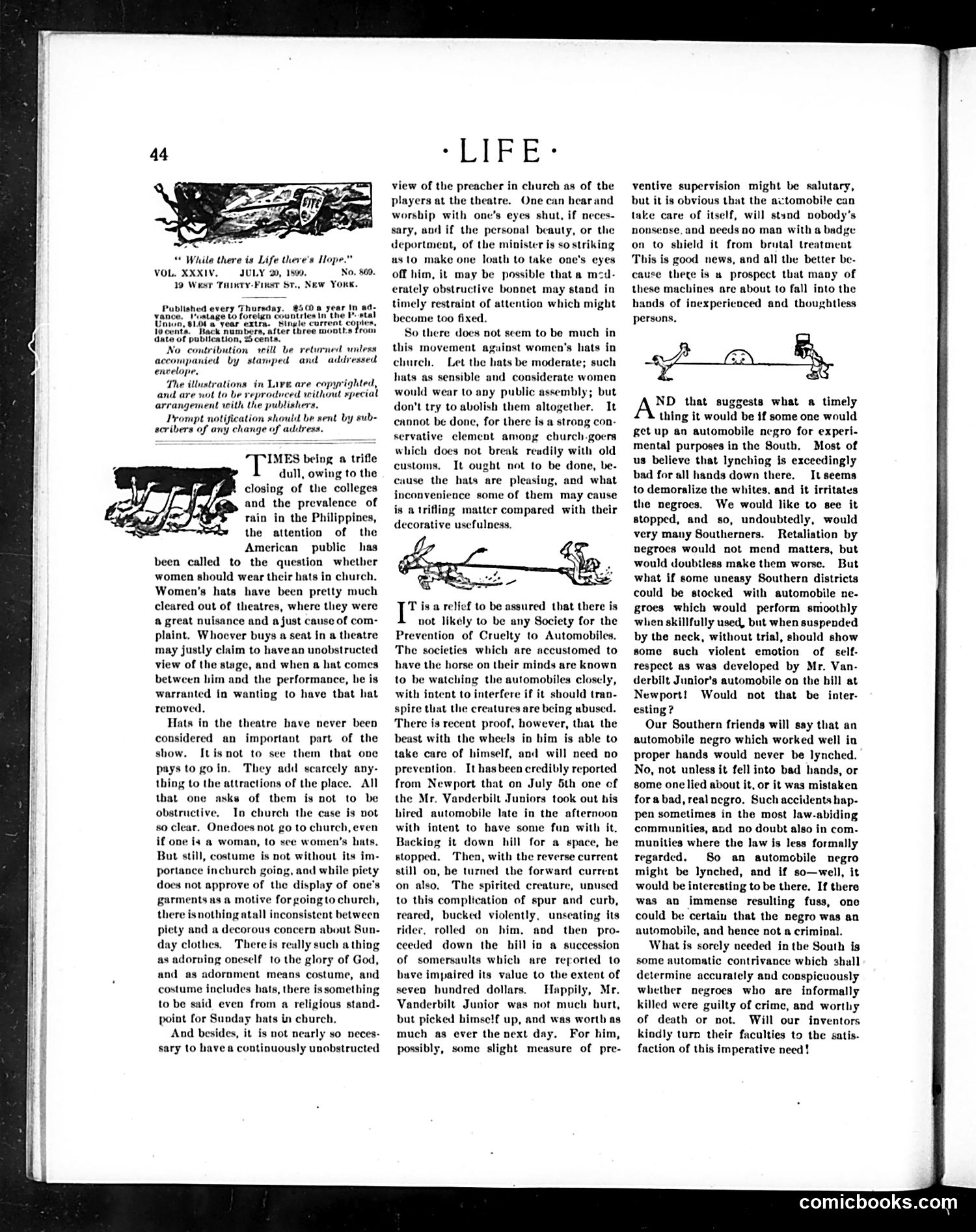
This page contains satirical commentary on early automobile culture and social issues, rather than political cartoons with identified figures. The text critiques: 1. **Women's hats in church**: The author argues against efforts to ban women's elaborate hats from church services, as they obstruct views. He suggests moderate hats would be reasonable compromise rather than abolition. 2. **Automobile safety and race relations**: The piece discusses an incident involving a Mr. Vanderbilt Jr.'s automobile that struck a Black man in Newport. The author satirizes the legal system's indifference to such accidents and suggests that if automobiles cause deaths among Black Americans, inventors should take responsibility. The satire targets both social hypocrisy and the emerging dangers of automobile culture in early 20th-century America, particularly regarding inequality in how accidents were treated based on victim's race.
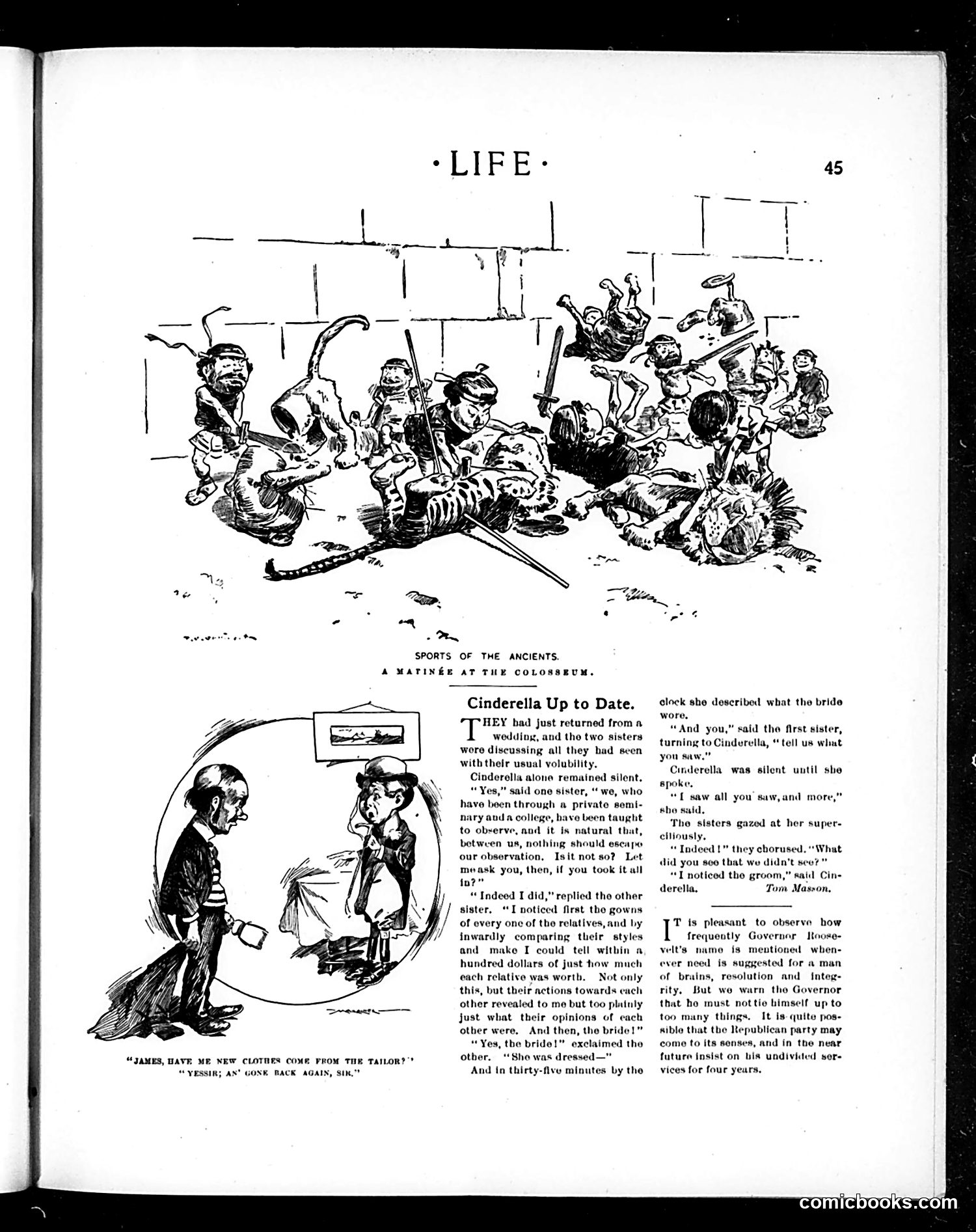
**Top Cartoon:** "Sports of the Ancients - A Matinee at the Colosseum" depicts gladiatorial combat as chaotic slapstick, with exaggerated figures in absurd poses. This satirizes the brutality of ancient Roman entertainment by rendering it ridiculous rather than dignified. **Bottom Story:** "Cinderella Up to Date" presents a modern twist on the fairy tale. Two sisters discuss Cinderella's wedding attendance and her new clothes, with dialogue emphasizing keen observation of fashion and social comparison. The caption "James, have me new clothes come from the tailor? Yessir, an' gone back again, sir" suggests satirical commentary on either the expense of women's fashion or the rapid obsolescence of clothing trends in contemporary society.
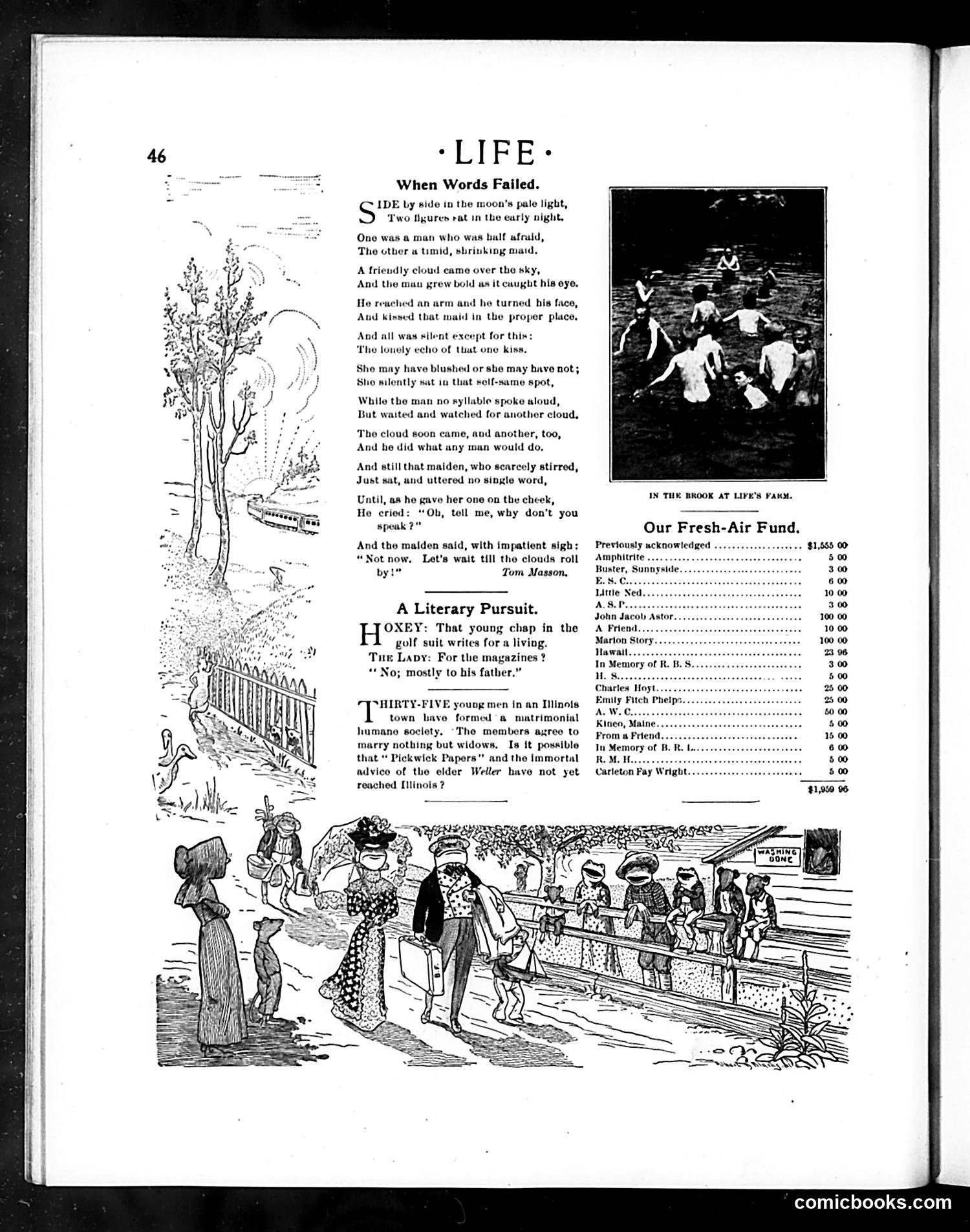
This page contains primarily literary and humorous content rather than political cartoons. **"When Words Failed"** is a sentimental poem about two figures meeting under moonlight—one timid, one bold—where a kiss replaces spoken words. The accompanying illustration shows a romantic scene by a tree and stream. **"A Literary Pursuit"** is a brief satirical exchange mocking aspiring writers: a young man in a golf suit writes for magazines, and his father dismissively assumes he does so "mostly to his father," implying the work is frivolous rather than serious. **"Our Fresh-Air Fund"** lists charitable donations, suggesting this was a contemporary fundraising campaign. The bottom illustration depicts a beach or waterside scene with Victorian-era figures, likely accompanying another article or story on this page.
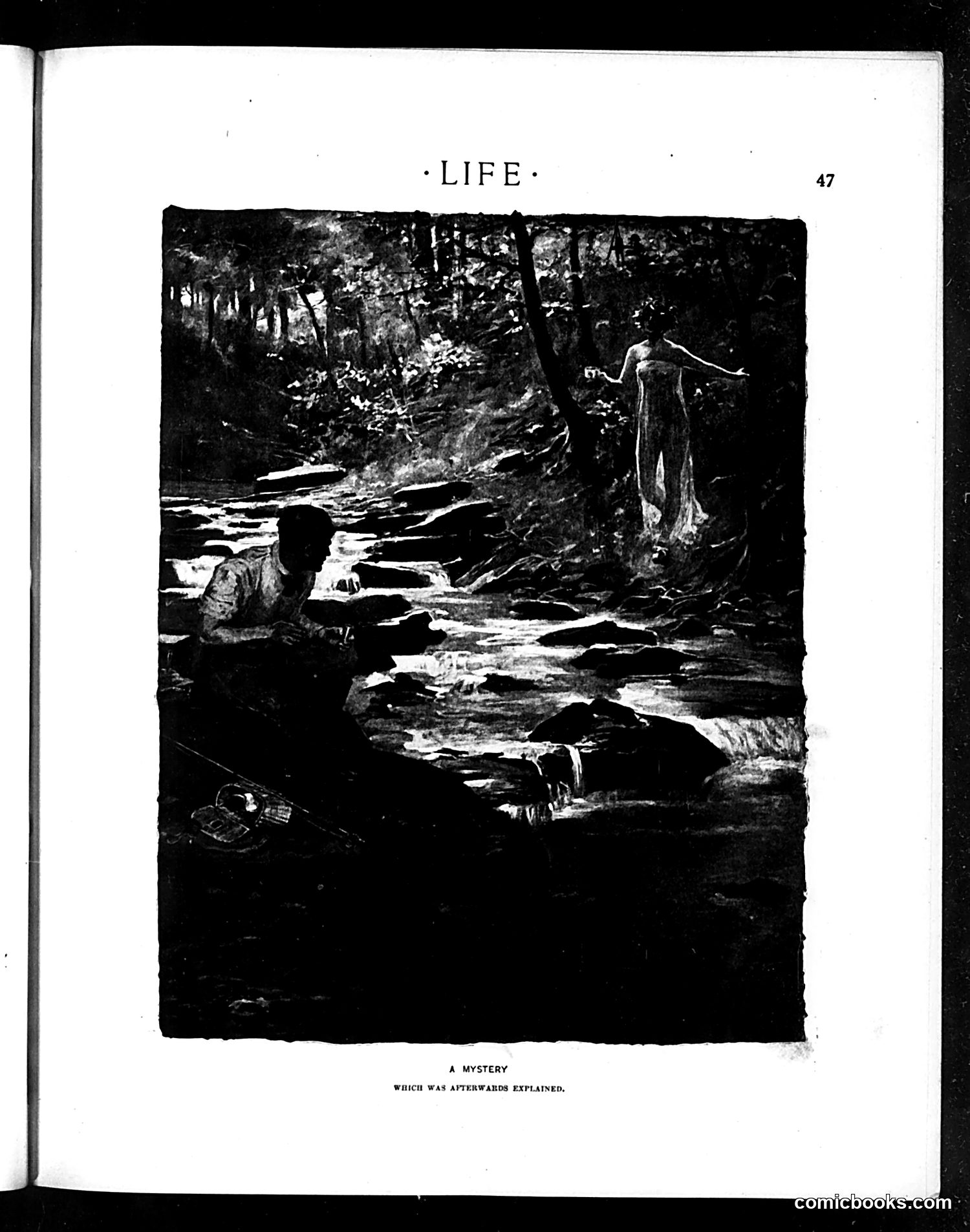
This appears to be an illustration from *Life* magazine depicting a mysterious or supernatural scene in a wooded forest setting near a stream. A man crouches or sits on the left side observing something, while a ghostly or ethereal female figure stands on the right, arms outstretched in a dramatic pose. The caption promises that this mystery "was afterwards explained," suggesting the image is part of a narrative sequence—likely a humorous story where something initially appears supernatural or inexplicable but receives a rational explanation in subsequent text or illustrations. Without additional context or visible accompanying text, the specific nature of the "mystery" and its explanation remain unclear from this image alone.
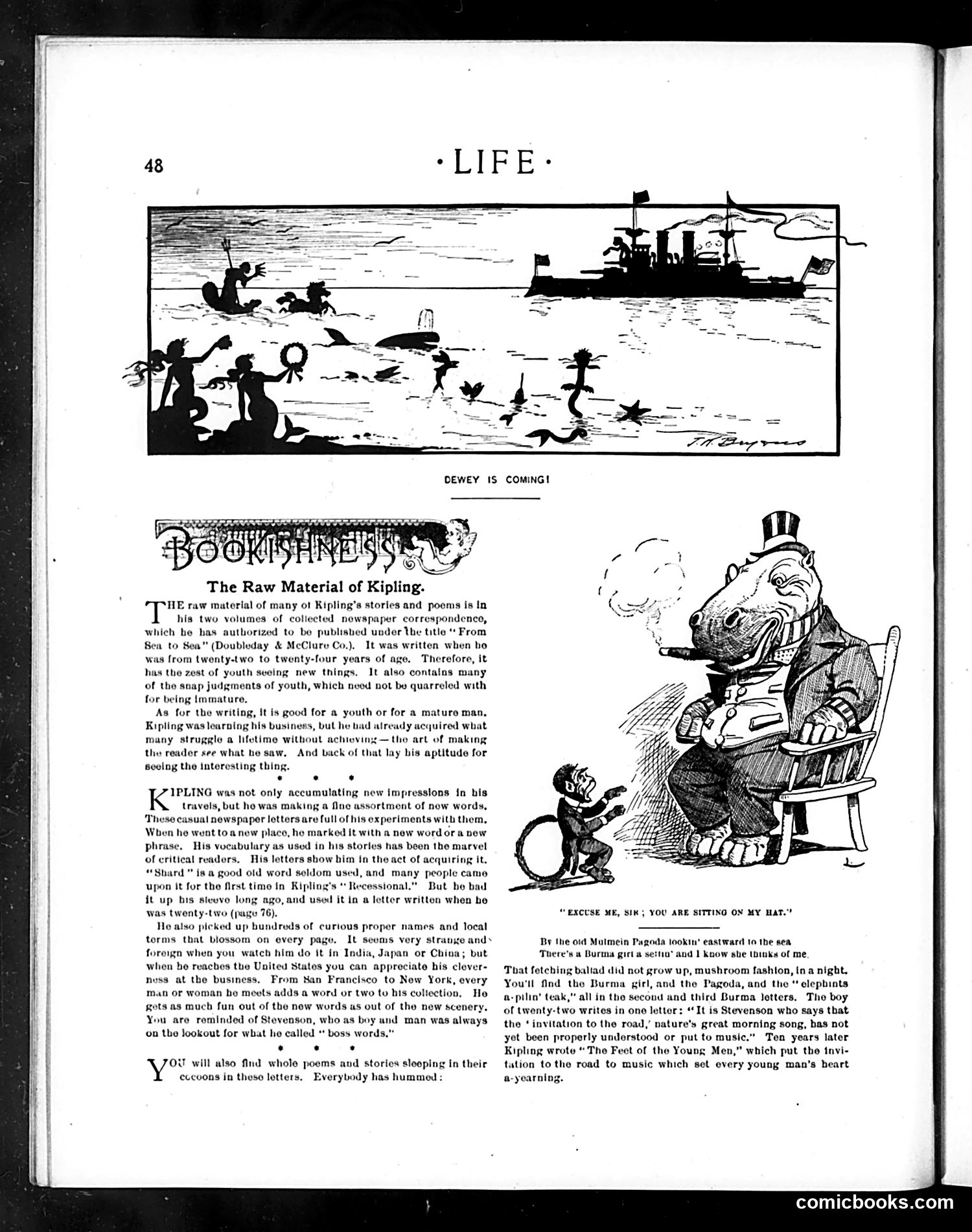
**Top Cartoon:** Titled "DEWEY IS COMING!" This silhouette illustration depicts a naval vessel approaching a beach crowded with swimming figures. The reference appears to be to Admiral George Dewey, likely commemorating his naval victory during the Spanish-American War (the cartoon's style suggests early 1900s). The composition suggests both celebration and chaos as people respond to his arrival. **"Bookishness" Section:** This is a book review of Kipling's collected newspaper correspondence, published as "From Sea to Sea." The text discusses Kipling's literary innovations, his use of new vocabulary and proper names, and his vivid descriptive style. An illustration shows a man reading in a chair. The page blends news commentary with literary criticism typical of Life's satirical approach.
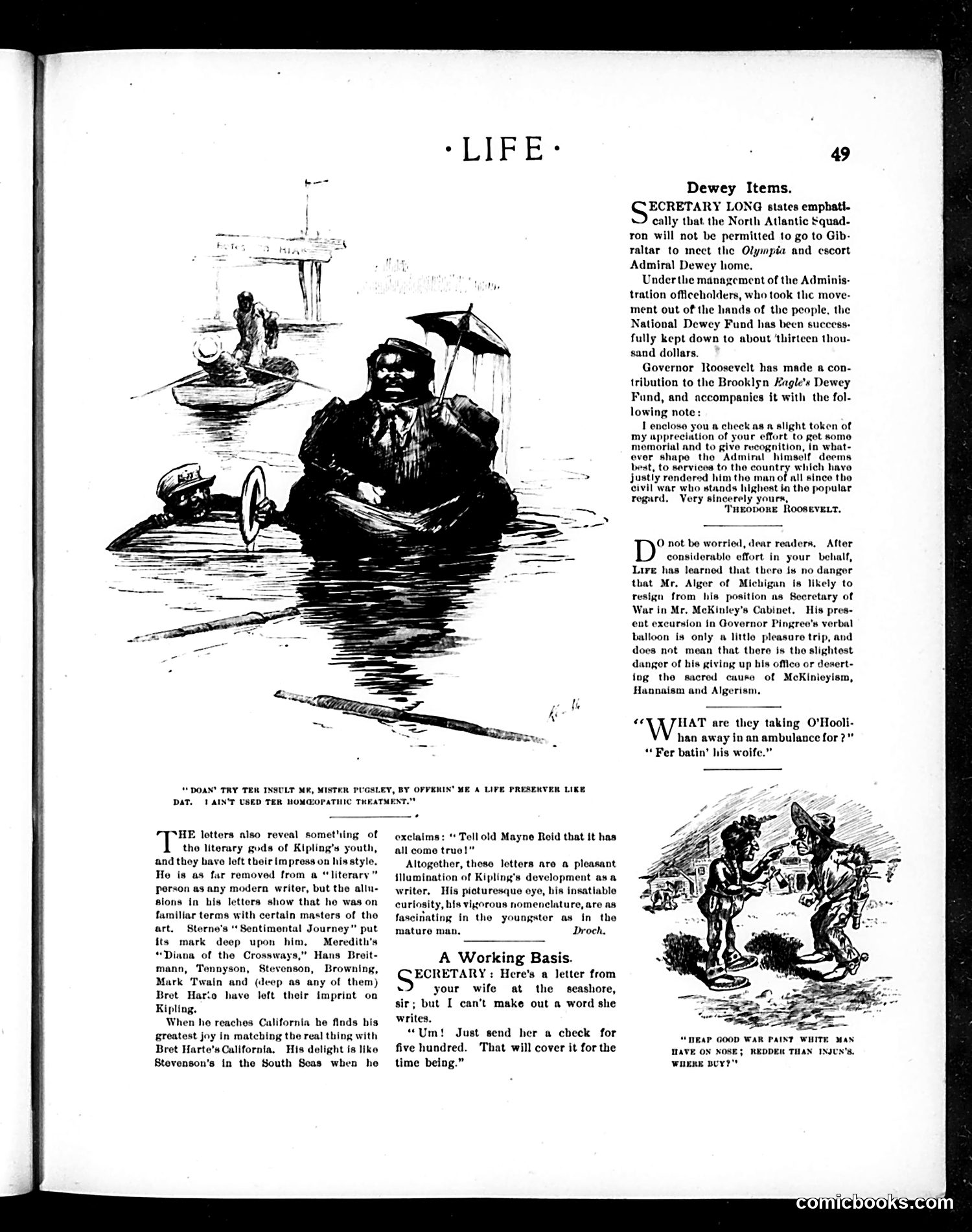
This page contains editorial commentary on Admiral George Dewey and references to President Theodore Roosevelt's administration. The main cartoon depicts a figure in water with an umbrella during what appears to be stormy conditions—likely satirizing political turbulence surrounding Dewey or a Cabinet member. The "Dewey Items" section discusses Secretary Long's prohibition on the North Atlantic Squadron visiting Gibraltar, and mentions Roosevelt's contribution to a Dewey Fund. The text assures readers there's "no danger" of Secretary of War Elihu Root resigning, and dismisses concerns about a "pleasure trip" in the Governor's verbal balloon. Additional humor includes a dialogue joke about O'Hoolihan and an ambulance, plus literary references to Kipling and other authors popular in that era.
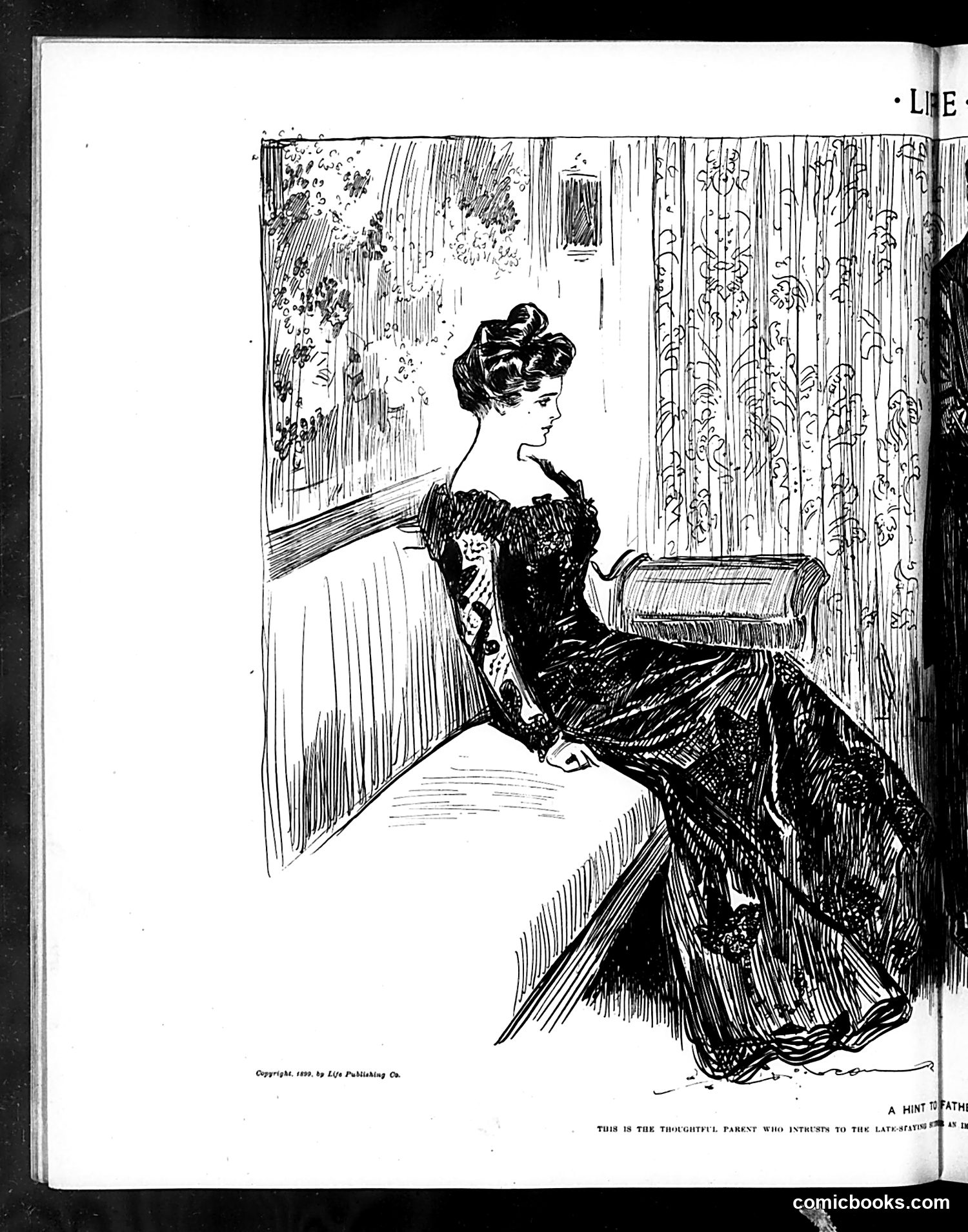
This is a satirical illustration from *Life* magazine (copyright 1897, per the visible text). The caption reads: "A HINT TO PATLI" and "THIS IS THE THOUGHTFUL PARENT WHO LISTENS TO THE LATE-STATION CAR IN..." The cartoon depicts an elegantly dressed woman in late Victorian fashion, seated by a window with elaborate curtains, appearing to listen intently. The caption's reference to "Pathi" (likely a misspelling of a contemporary figure) and the "late-station car" suggests social commentary about a woman eavesdropping on gossip or scandal from a streetcar—a public transportation setting associated with lower-class communication. The satire appears to target upper-class pretension: a refined woman compromising her dignity by secretly listening to working-class chatter. The "hint" mocks parents who tolerate or encourage such undignified behavior.
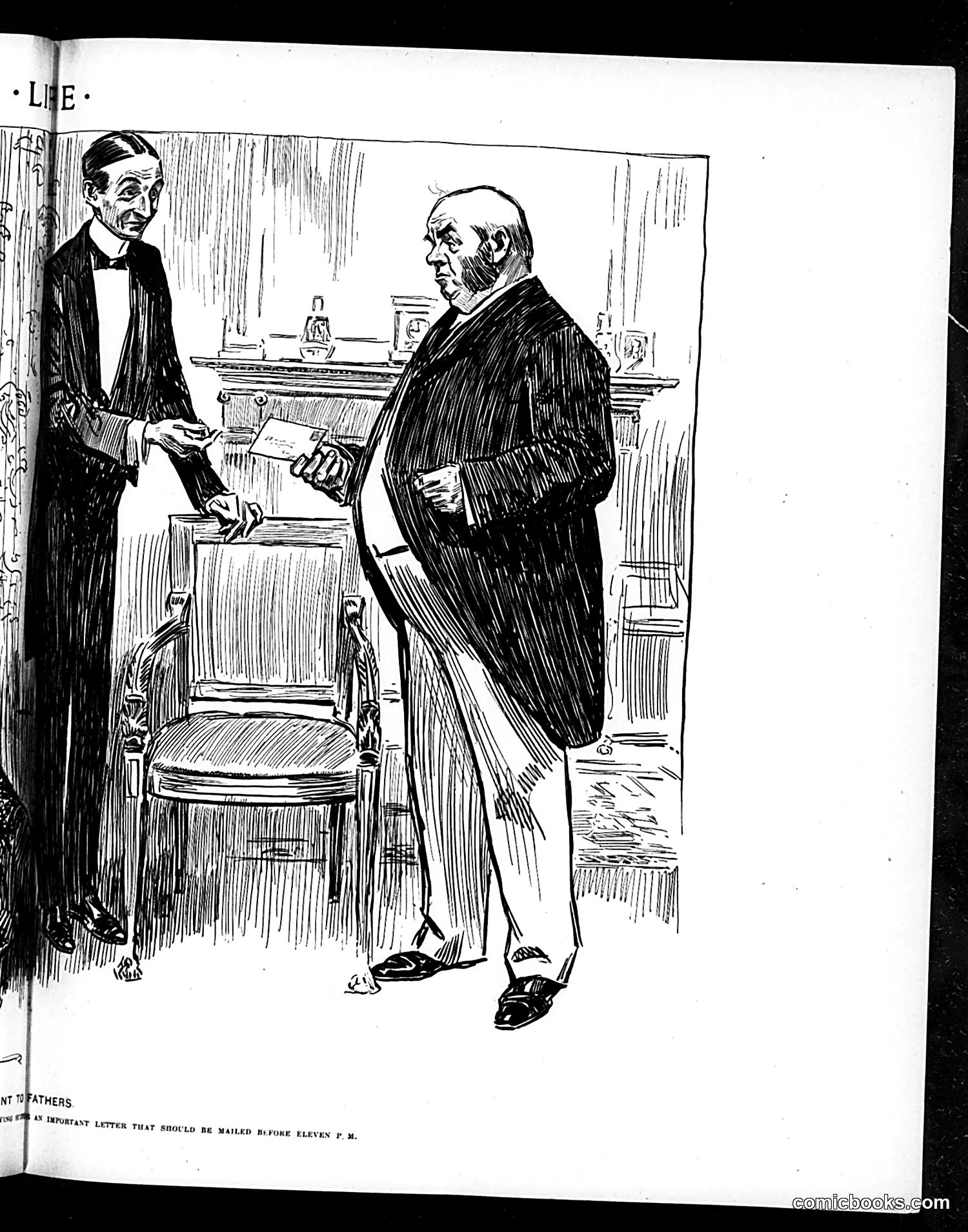
This appears to be a cartoon from *Life* magazine's satirical section. The image shows two men in formal Victorian-era dress in what seems to be an office or study. One man stands holding what appears to be a document or letter, while the other sits. The caption references "AN IMPORTANT LETTER THAT SHOULD BE MAILED BEFORE ELEVEN P.M." Without clearer identification of the specific individuals depicted or the historical context visible on this page, I cannot definitively identify who these figures represent or what political event or social issue the cartoon satirizes. The formal setting and emphasis on a time-sensitive letter suggests commentary on bureaucratic or political correspondence, but the specific targets and meaning remain unclear from the image alone.
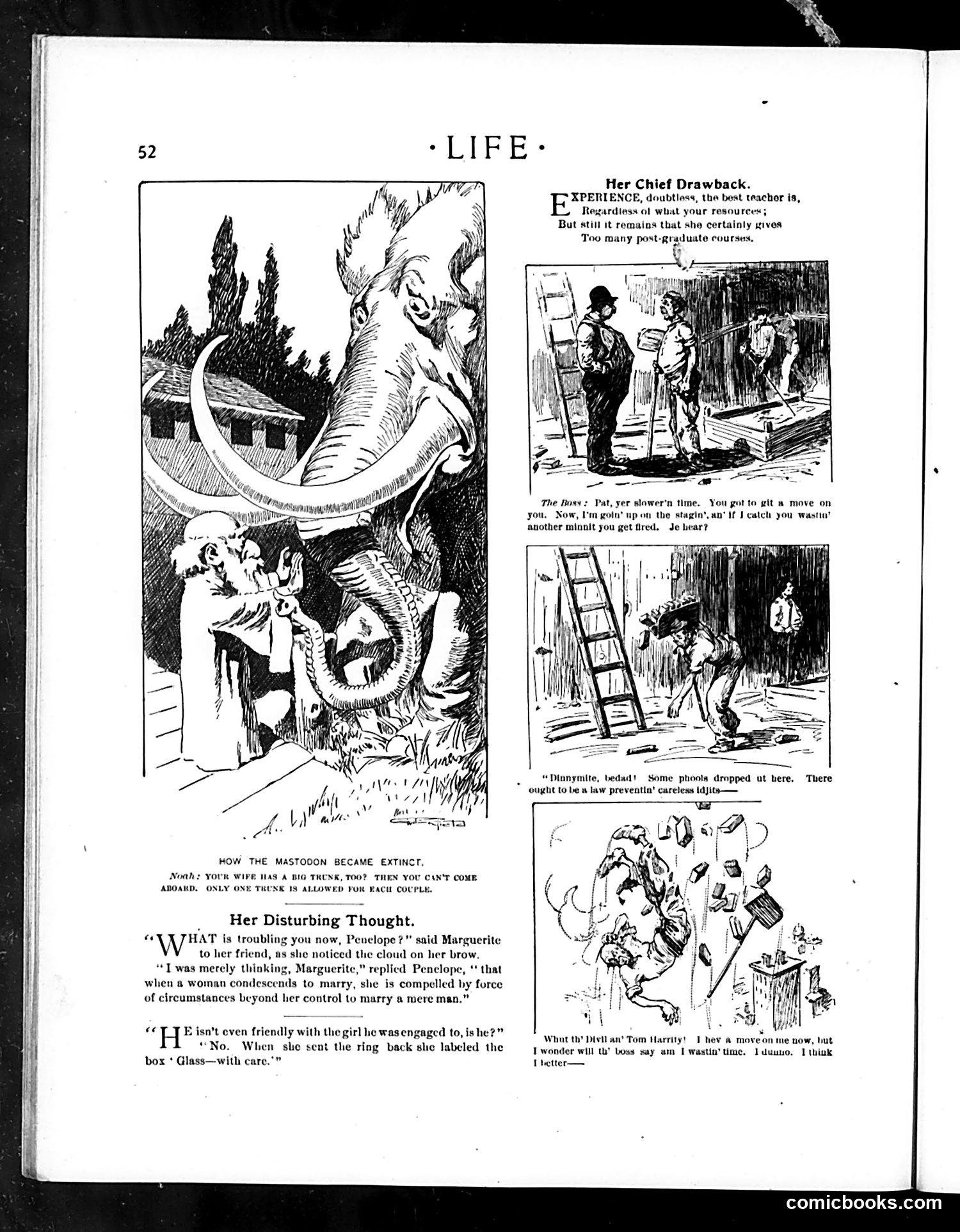
This page contains three satirical pieces about gender relations and marriage: **"How the Mastodon Became Extinct"** (left): A visual joke about domestic authority. The caption reads: "Noah: 'Your wife has a big trunk, too? Then you can't come aboard. Only one trunk is allowed each couple.'" The humor targets wives who pack excessively for travel. **"Her Chief Drawback"** (upper right): Criticizes women teachers, claiming they give "too many post-graduate courses" despite limited experience. The cartoon shows construction workers being lectured. **"Her Disturbing Thought"** (lower left): A woman named Marguerite questions whether her fiancé truly loves her, reflecting period anxieties about marriage as coercion rather than choice. **Lower right**: A slapstick scene of domestic mishaps, with dialogue suggesting marital frustration. Overall, these pieces humorously critique women's incompetence in public roles while satirizing marriage dynamics.
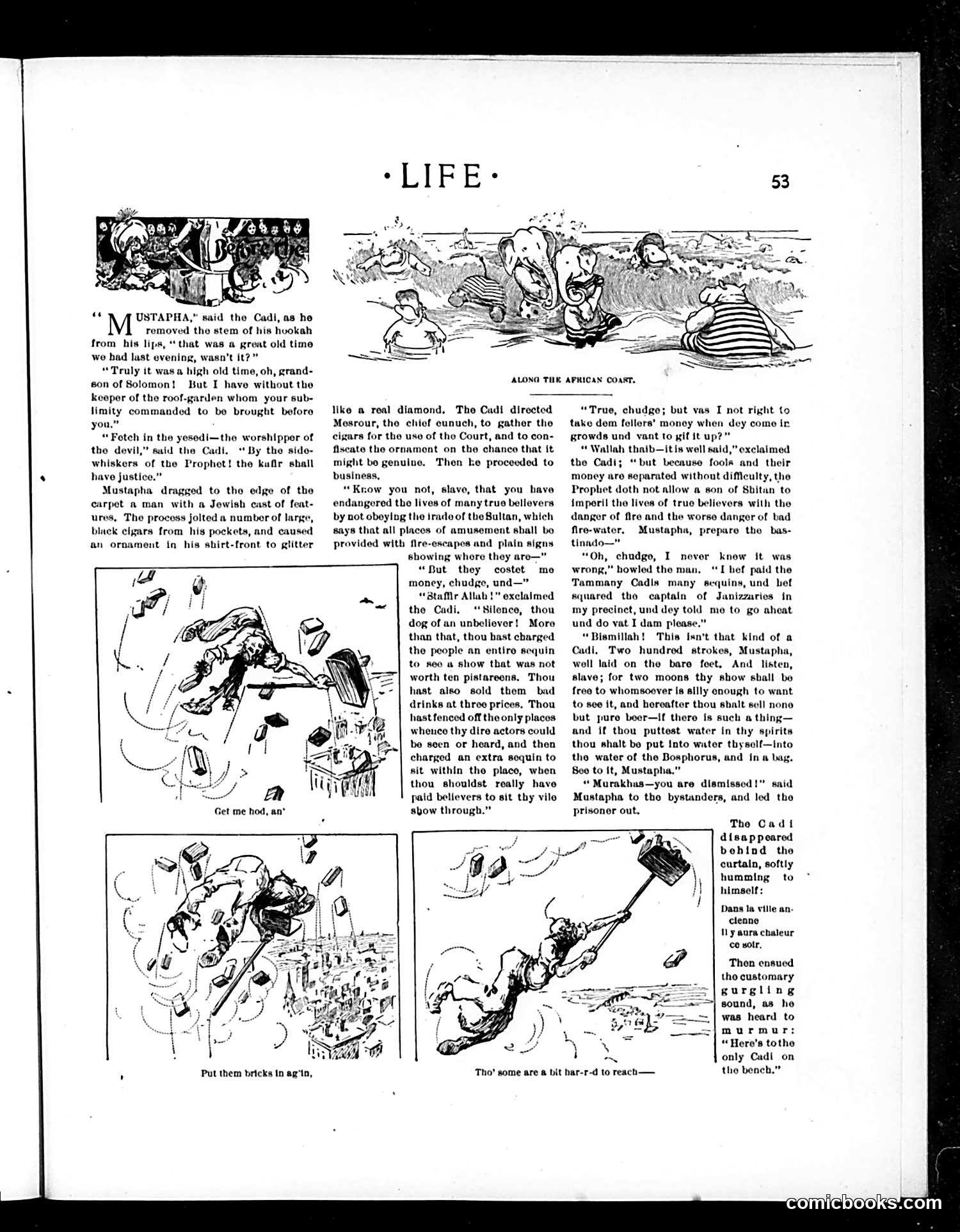
This is a satirical narrative illustrated with cartoon panels, likely from the early 1900s. The story mocks corrupt municipal officials through an orientalist fantasy framework—a Muslim judge (Cadi) discovers a Jewish roof-garden keeper has violated fire safety codes, charged excessive prices, sold poor-quality drinks, and overcharged for seating. The satire's target becomes clear when the accused claims he paid off "Tammany Cadis" and a police captain for permission. This is a direct reference to **Tammany Hall**, New York City's notoriously corrupt Democratic political machine. By transposing Tammany corruption into an Ottoman setting, the cartoonist ridicules American urban corruption—where bribery of political bosses and police was routine practice. The "Cadi" (Islamic judge) represents an idealized honest official, in stark contrast to real American city administrators who enabled exploitative entertainment venues through graft.
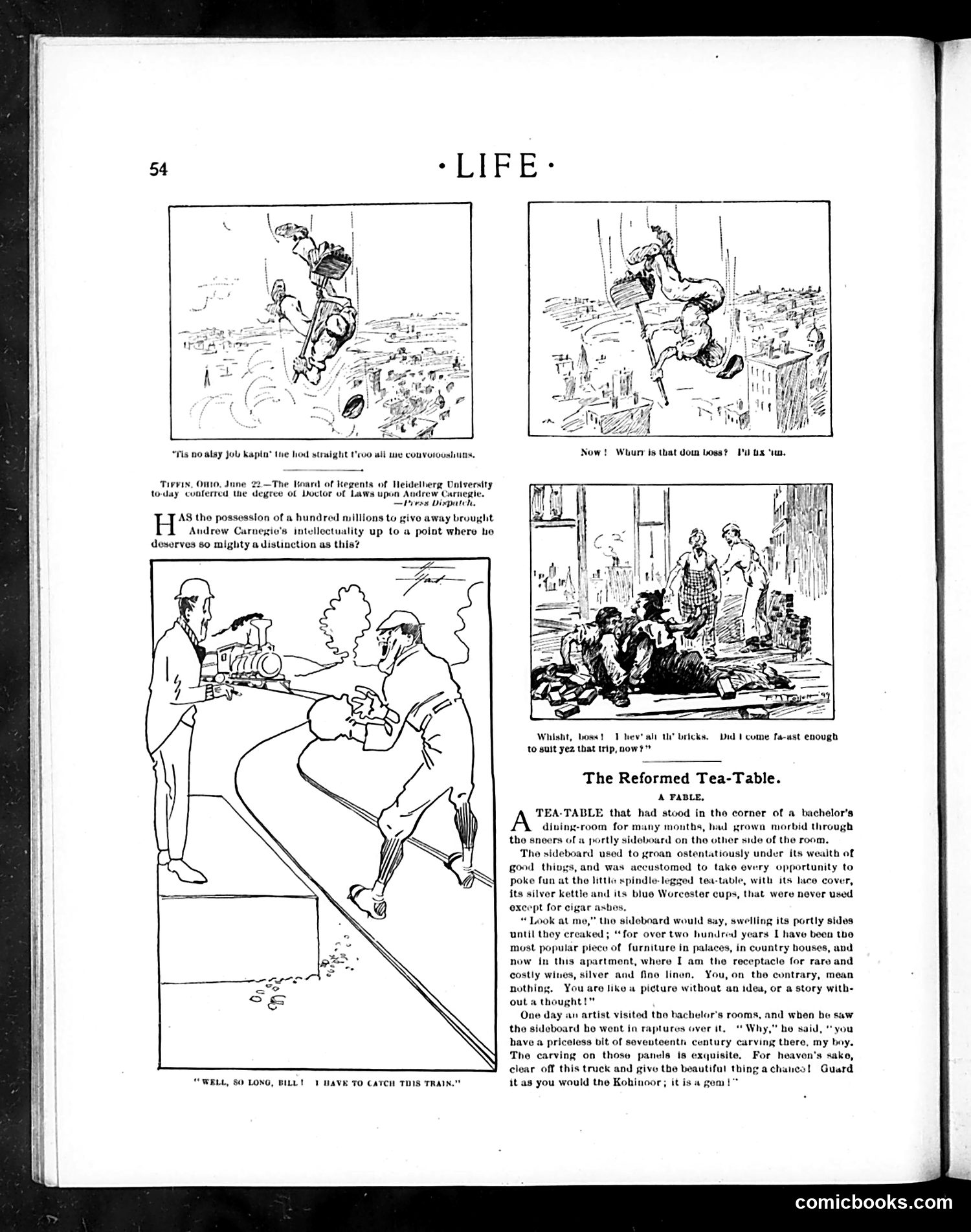
**Top cartoons**: These mock Andrew Carnegie's honorary doctorate from Heidelberg University. The satire questions whether wealth alone qualifies someone for intellectual distinction—Carnegie, a steel magnate and philanthropist, receives scholarly honors simply because he has "a hundred millions to give away." The joke suggests his money, not merit, earned the degree. **Lower cartoon**: A Aesop-style fable criticizing materialism and status anxiety. A decorative tea-table, mocked by an ostentatious sideboard for its modest usefulness, gains validation when an artist recognizes its genuine seventeenth-century artistic value. The moral: true worth lies in authentic craftsmanship and beauty, not in flashy display or practical function. This likely satirizes Victorian consumer culture and the nouveaux riches who value possessions for status rather than genuine merit or artistry.
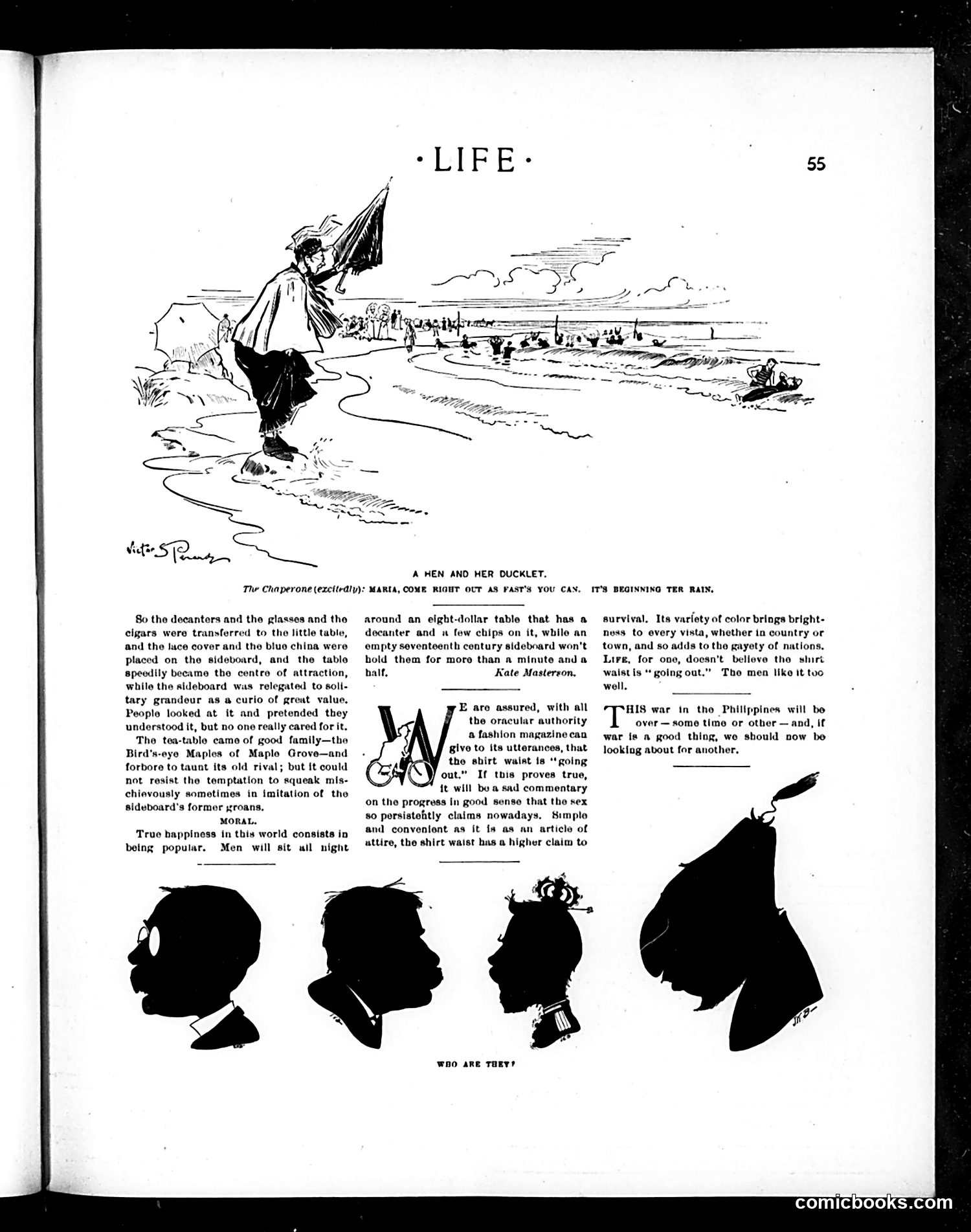
**Main Cartoon ("A Hen and Her Ducklet"):** A satirical domestic scene where a chaperone urgently summons a young woman ("Maria") away from a beach gathering. The moral mocks social pretension: people flock to a modest dining table with drinks and food, while ignoring an expensive antique sideboard—suggesting humans value sociability over material value. It's commentary on misplaced priorities in upper-class society. **"Who Are They?" Silhouettes:** Four profile silhouettes labeled simply "WHO ARE THEY?" Their identities remain unclear from the image alone, likely recognizable contemporary figures to 1900s readers. **Text Articles:** One discusses the "shirt waist" fashion item, defending it against predictions it would "go out" of style. Another briefly comments on the Philippine-American War, sardonically suggesting if warfare is beneficial, Americans should seek another conflict—likely satirizing imperialist attitudes of the era. The page exemplifies Life's satirical approach to social customs, fashion, and foreign policy.
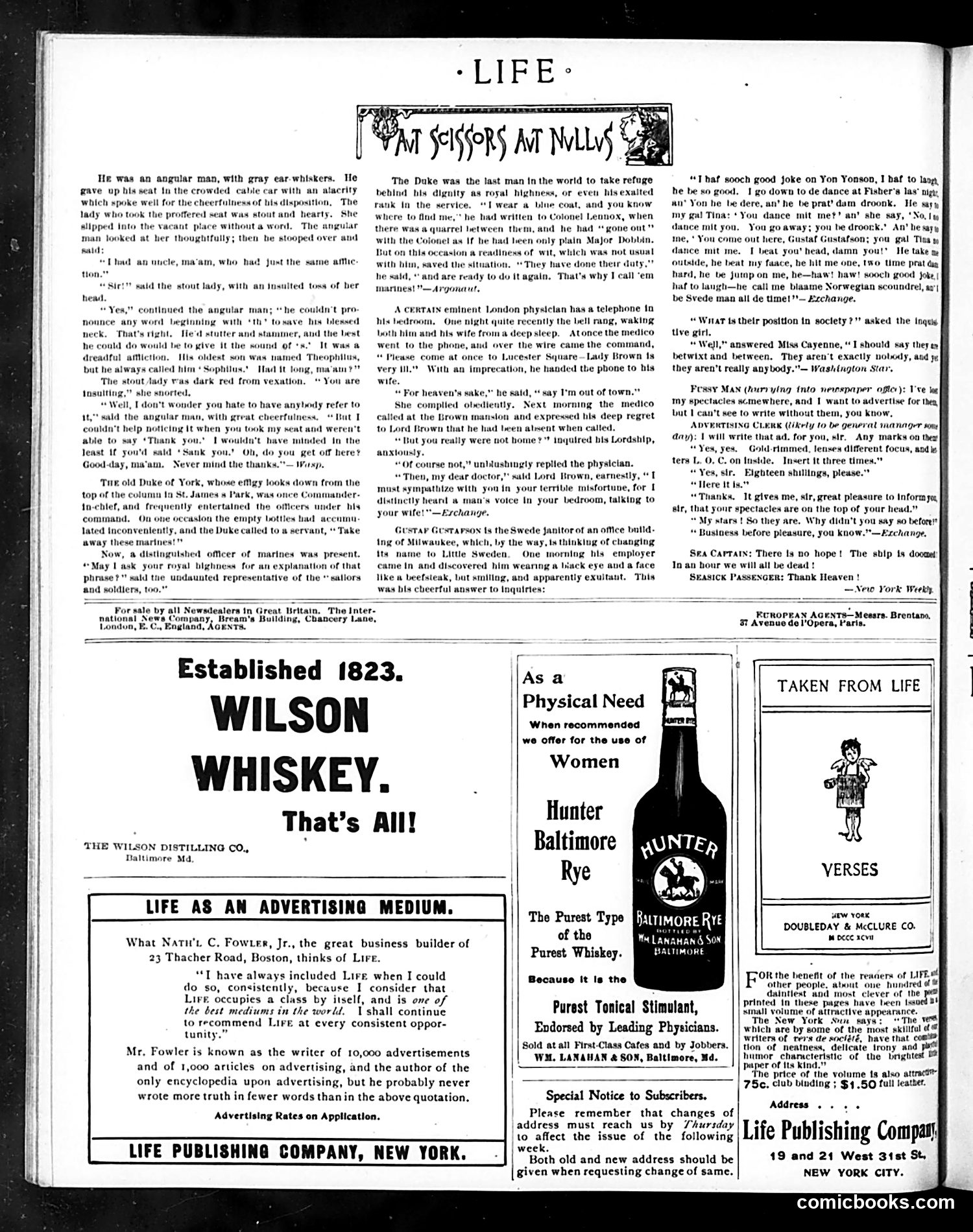
This page contains three humorous anecdotes satirizing social hypocrisy and pretense: 1. **The Cable Car Story**: An angular man with a speech impediment mocks a stout woman for her rudeness, claiming his uncle had the same affliction. The satire targets *selective courtesy*—she was rude until made to feel ashamed, revealing that politeness is conditional rather than genuine. 2. **The Duke of York Story**: A military officer challenges a duke's derogatory term "marines" for empty bottles. The duke cleverly reframes his insult as a compliment, suggesting marines are reliable and obedient. The satire mocks *power dynamics*—the subordinate must accept the superior's convenient reinterpretation. 3. **The Physician's Story**: A London doctor lies about being out of town when summoned at night, then visits the next day. When confronted with his own voice heard in his bedroom, he shamelessly denies it. The satire exposes *professional dishonesty* and selective integrity. All three mock Victorian-era pretense and the gap between stated principles and actual behavior.
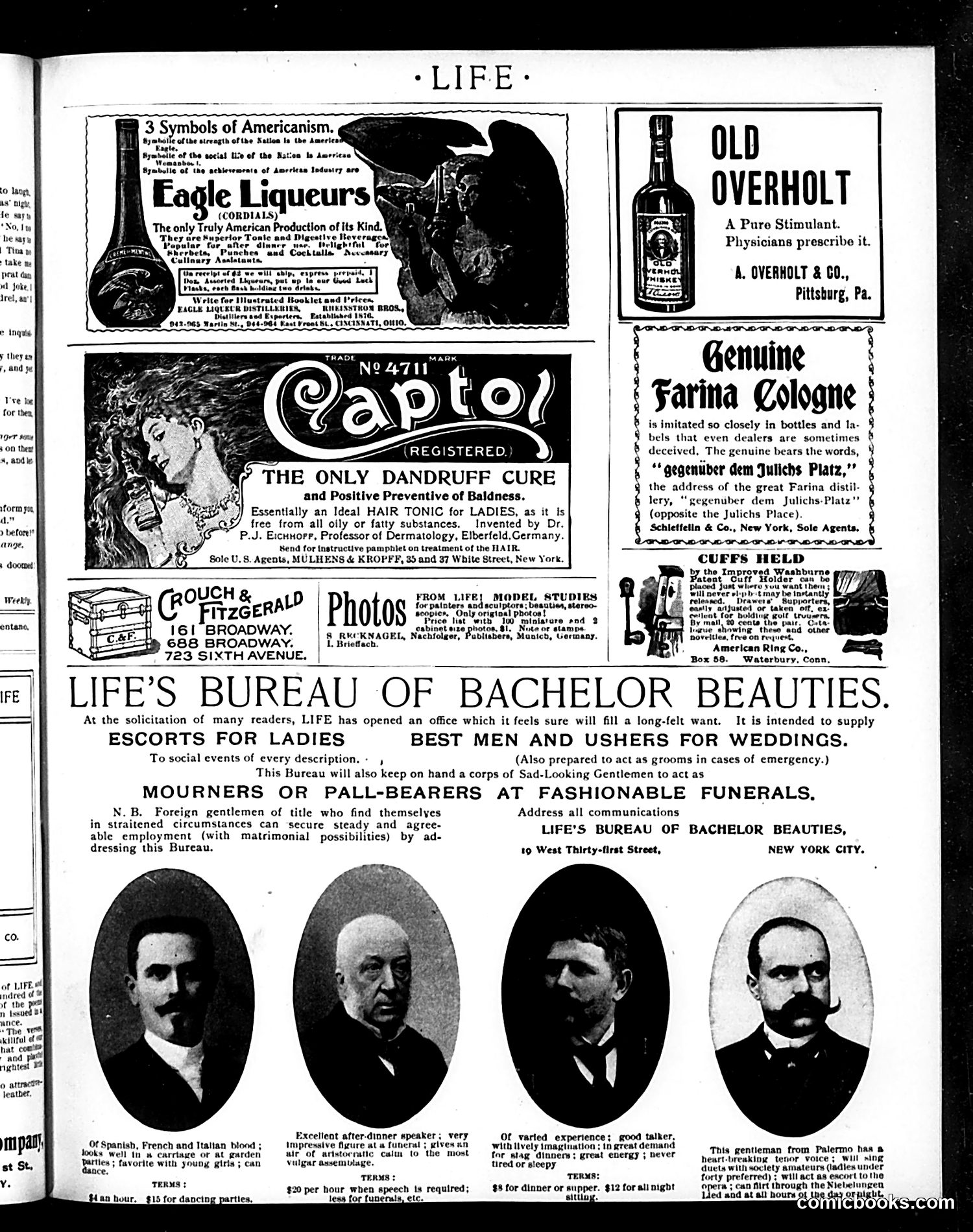
This page is primarily **advertising** with one substantial satirical feature. The main content is "Life's Bureau of Bachelor Beauties"—a mock-serious service announcement offering escorts, wedding attendants, and professional mourners for hire. The satire targets **unmarried men of dubious financial status** and the era's rigid social conventions. The four photographs show "eligible gentlemen" available as escorts, best men, or paid mourners at funerals. The humor lies in the frank commodification of male companionship and the absurdity of hiring "sad-looking gentlemen" as professional mourners—suggesting wealthy society women and men needed to *purchase* appropriate social company. The descriptions (Spanish/French/Italian suitors, accomplished speakers, energetic companions) mock both the pretensions of these men and wealthy society's superficial social requirements. The surrounding advertisements—Eagle Liqueurs, hair tonic, cologne—are period products claiming various benefits, typical of early 1900s magazine advertising practices.
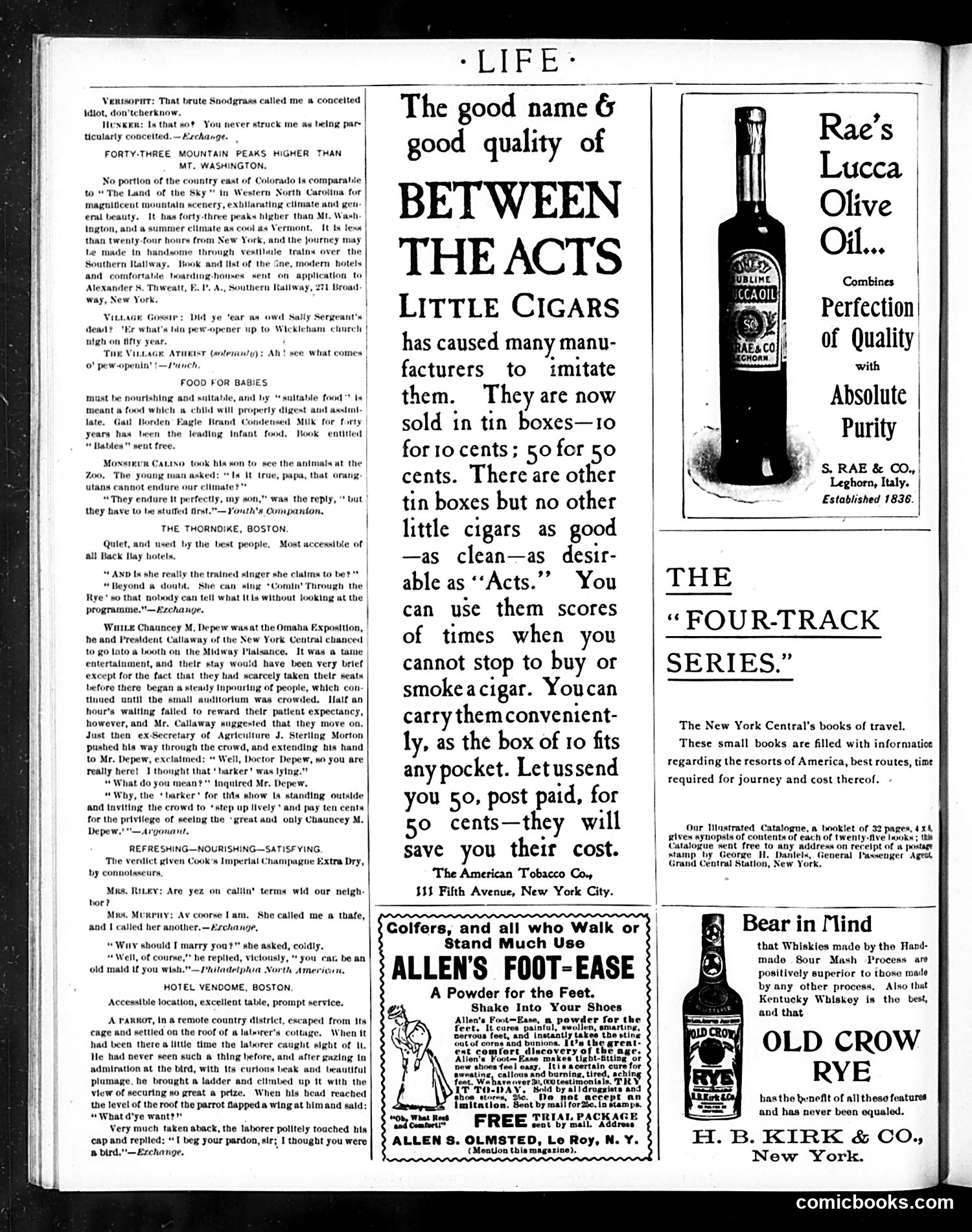
This page is primarily **advertising and filler content** rather than political satire. The bulk consists of commercial advertisements (olive oil, cigars, foot powder, whiskey, travel guides) interspersed with brief humor snippets and anecdotes. The small cartoons/jokes scattered throughout reflect typical early-20th-century Life magazine humor: - A dialogue joke about someone called "conceited" by Snodgrass - Anecdotes about zoo visits, singers, and social encounters - A story about Chauncey Depew (a famous railroad executive/wit) being mistaken for a paid attraction at an exposition The satire is **mild and social rather than political**—poking fun at pretension, misunderstandings, and everyday absurdities. The page reflects Life's original identity as a humor and satire magazine before it shifted to photojournalism, filled with advertisements targeting upper-middle-class readers with travel, food, and luxury goods. There are **no identifiable political figures or events** depicted here.
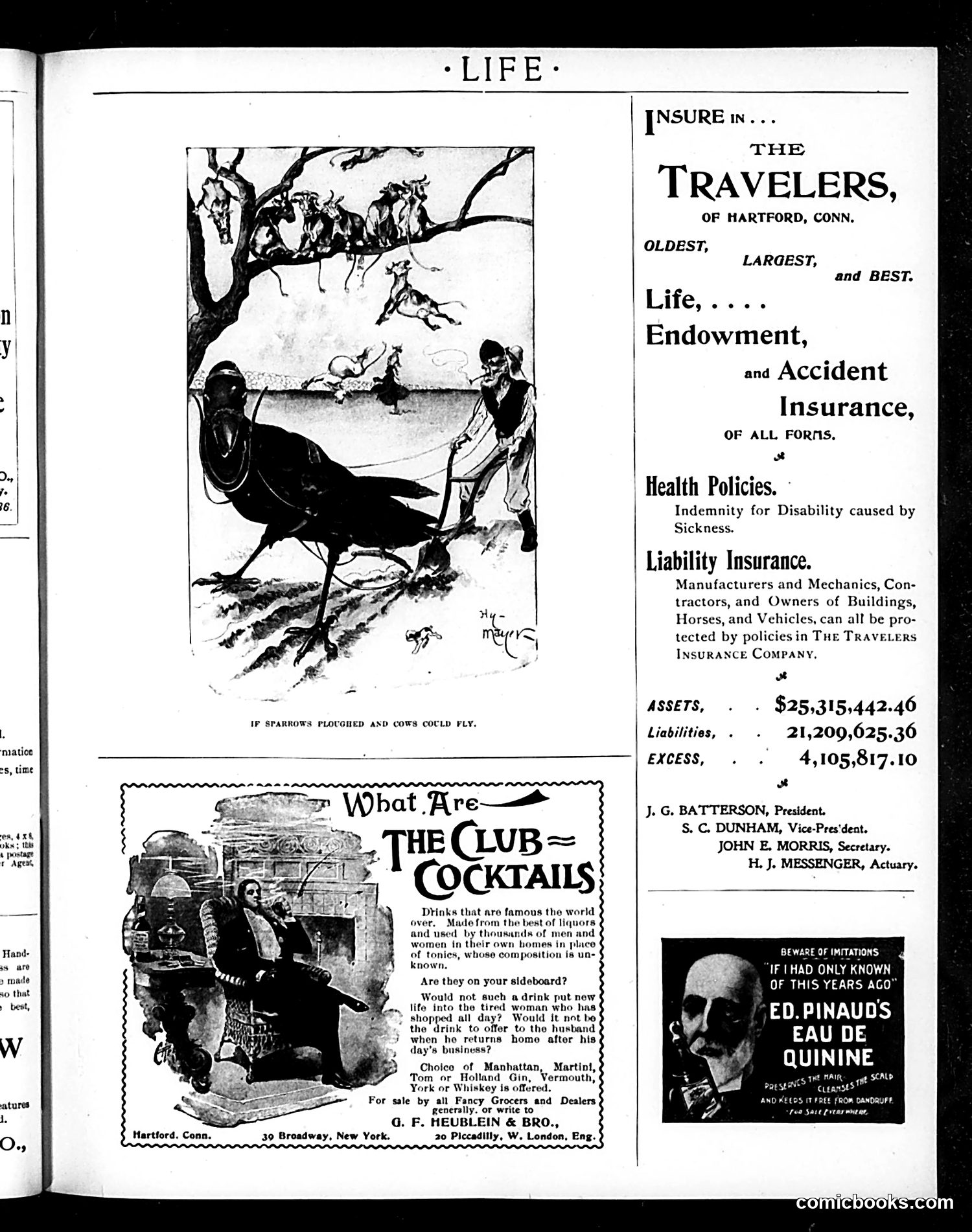
This page is primarily **advertising**, not political satire. The main cartoon—showing sparrows and cows perched improbably in a tree—illustrates the caption "If sparrows ploughed and cows could fly," a whimsical absurdist image with no apparent deeper meaning beyond visual humor. The advertisements promote: 1. **The Travelers Insurance Company** (Hartford, Connecticut)—listing life, endowment, accident, health, and liability insurance products with financial assets 2. **Club Cocktails** by G.F. Heublein & Bros.—marketing pre-mixed cocktails to middle-class households, targeting wives who'd shopped all day and husbands returning from work 3. **Ed. Pinaud's Eau de Quinine**—a hair/grooming product with a testimonial The cocktail ad is notably progressive for its era in addressing women's domestic fatigue, while the insurance ads reflect early-20th-century business concerns about industrial liability.
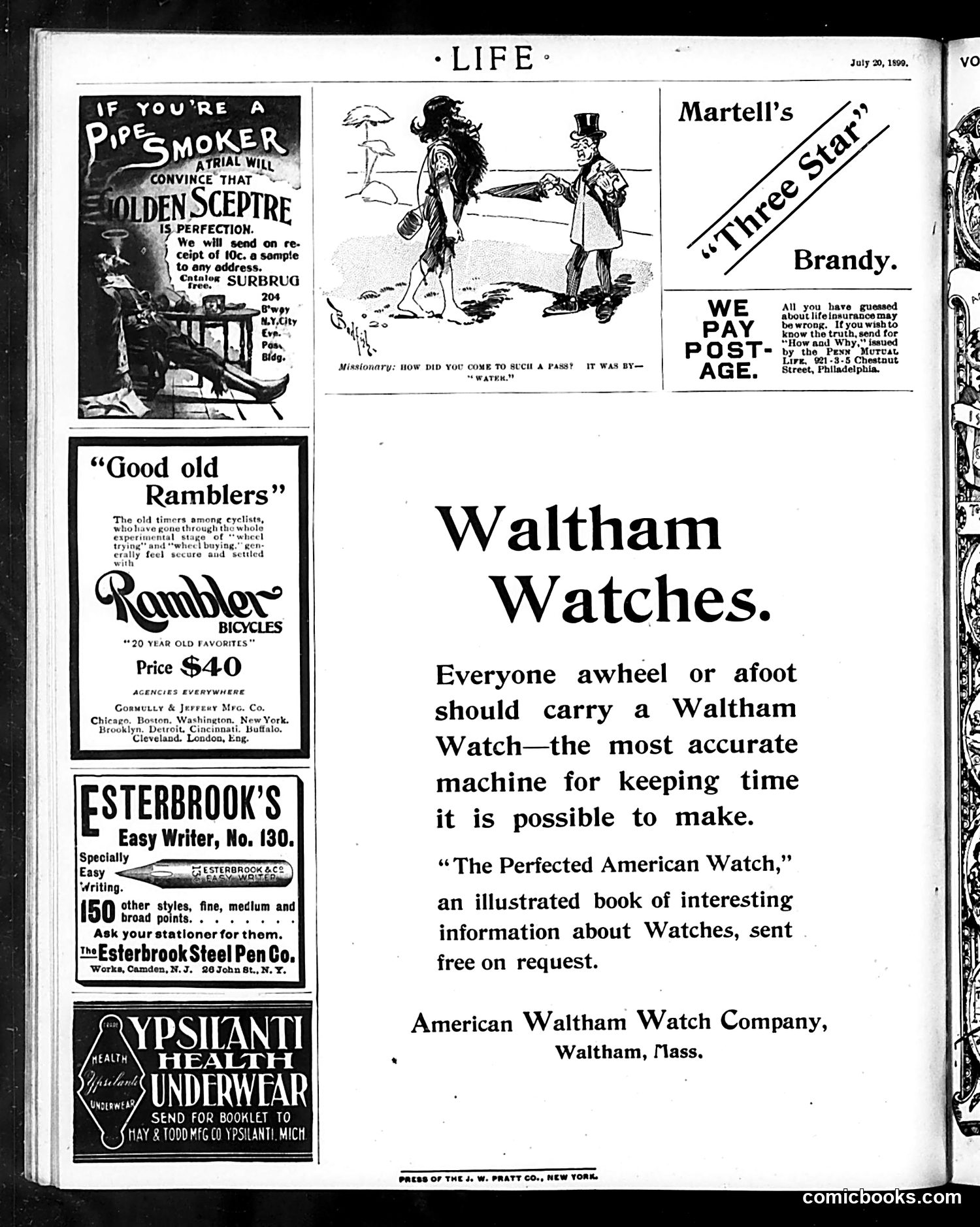
This page is primarily **advertising**, not political satire. The central cartoon shows a missionary encountering what appears to be an Indigenous person in a desert setting. The caption reads: "Missionary: How did you come to such a pass? It was by—'Water.'" The joke relies on a pun: the missionary assumes spiritual/moral failure ("come to such a pass"), but the person's literal answer about water suggests physical hardship from the environment rather than moral degradation. This reflects 1899 attitudes portraying non-Western peoples through a lens of assumed spiritual need. The surrounding ads promote period products: Golden Sceptre pipes, Rambler bicycles ($40), Esterbrook pens, Waltham watches, and Ypsilanti health underwear. These ads target middle-class consumers of the Gilded Age, with the watch company emphasizing accuracy as essential for "everyone awheel or afoot"—reflecting the bicycle craze and modern transportation of that era.