
Life, 1899-07-20 · page 4 of 20
Life — July 20, 1899 — page 4: what you’re looking at
What you’re looking at
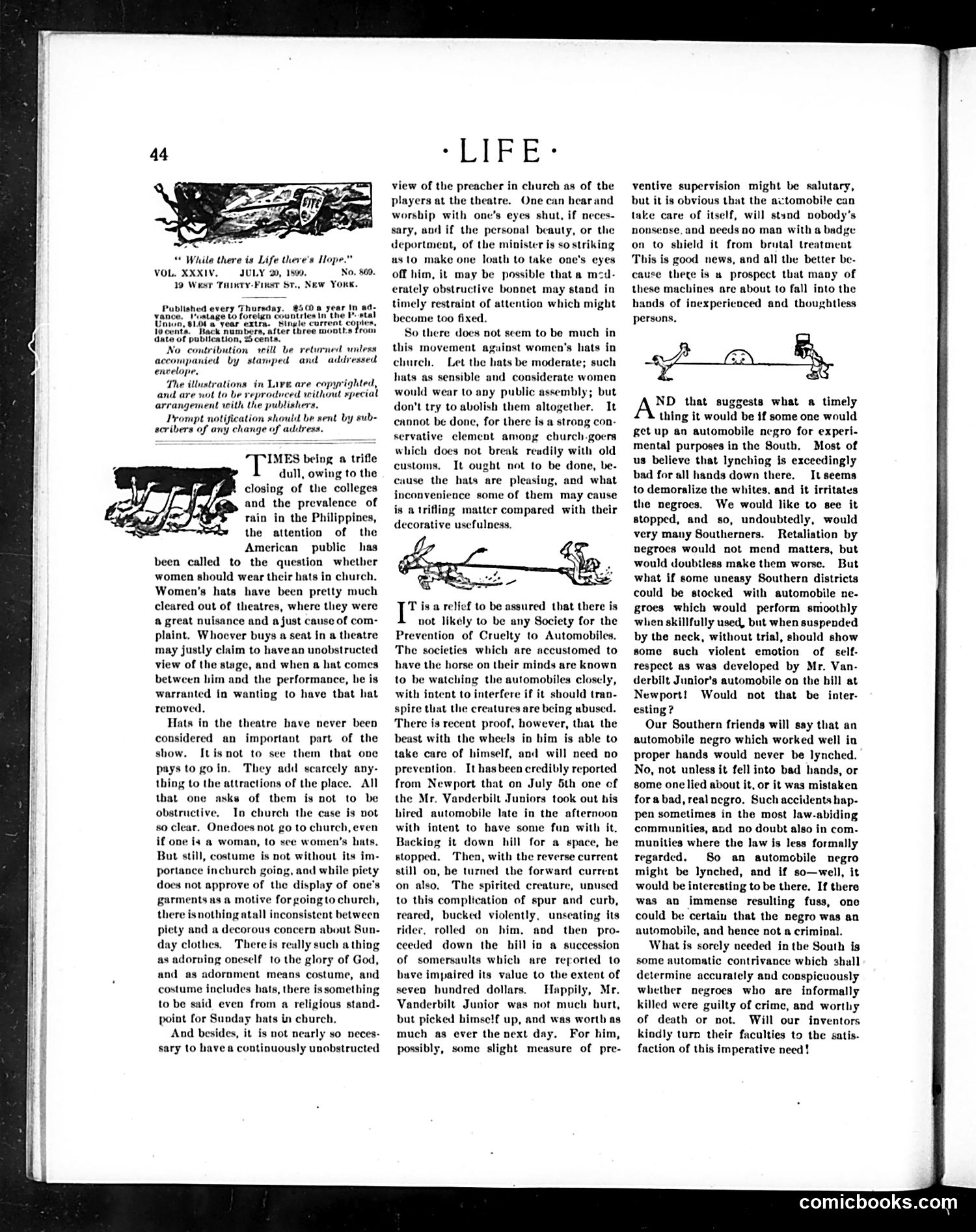
This page contains satirical commentary on early automobile culture and social issues, rather than political cartoons with identified figures. The text critiques: 1. **Women's hats in church**: The author argues against efforts to ban women's elaborate hats from church services, as they obstruct views. He suggests moderate hats would be reasonable compromise rather than abolition. 2. **Automobile safety and race relations**: The piece discusses an incident involving a Mr. Vanderbilt Jr.'s automobile that struck a Black man in Newport. The author satirizes the legal system's indifference to such accidents and suggests that if automobiles cause deaths among Black Americans, inventors should take responsibility. The satire targets both social hypocrisy and the emerging dangers of automobile culture in early 20th-century America, particularly regarding inequality in how accidents were treated based on victim's race.
📄 Transcribed text from this page (OCR, searchable)
Machine-transcribed from the original scan — historical spelling and the odd misread are preserved.
VOL. XXXIV, JU! 19 Wesr Tunery-Finst St., New You. Published every Thursday. Lage to foreign countries I Single cu year In ad: the P a mbers, after three m date of publication, 2 cents. No contribution will be returned unless accompanied by stamped and addressed envelope. The illustrations in Live are copyrighted, and are not to be reproduced without special arrangement with the publishers, Trompt notification should be sent by sub- scribers of any change of address. IMES being a trifle dull, owing to the closing of the colleges and the prevalence of rain in the Philippines, the attention of the American public has been called to the question whether women should wear their hats in church. Women’s hats have been pretty much cleared out of theatres, where they were a great nuisance and a just cause of com- plaint. Whoever buys a seat in a theatre may justly claim to have an unobstructed view of the stege, and when a hat comes between him and the performance, he is warranted in wanting to have that hat removed. Hats in the theatre bave never been considered an important part of the show. Itisnot to see them that one pays to goin. They add scarcely any- thing to the attractions of the place. All that one asks of them is not to be obstructive, In church the case is not 80 clear. Onedoes not go to church, even if one ia a woman, to see women’s hats, But still, costum not without its im- portance inchurch going, and while piety does not approve of the display of one's garments as a motive forgoing to church, there isnothing atall inconsistent between piety and a decorous concern about Sun- day clothes. Theres really such a thing as adorving oneself to the glory of God, and as adornment means costume, and costume includes hats, there is something to be said even from a religious stand- point for Suoday hats in church. And besides, it is not nearly so neces- sary to havea continuously unobstructed *LIFE : view of the preacher in church as of the players at the theatre. One can bear and worship with one’s eyes shut, if neces- sary, and if the personal beauty, or the deportment, of the minister is so striking as to make one loath to take one’s eyes off him, it may be possible that a mcd- erately obstructive bonnet may stand in timely restraint of attention which might become too fixed. So there does not seem to be much in this movement aguinst women’s hats in church, Let the hats be moderate; such hats as sensible and considerate women would wear to any public assembly; but don’t try to abolish them altogether, It cannot be done, for there is a strong con- servative clement among church.goers which does not break readily with old customs, It ought not to be done, be- cause the hats are pleasing, and what inconvenience some of them may cause is a trifling matter compared with their decorative usefulness, T is a relief to be assured that there is not likely to be any Society for the Prevention of Cruelty to Automobiles. The societies which are accustomed to have the horse on their minds are known to be watching the automobiles closely, with intent to interfere if it should tran- spire that the creatures are being abused. There is recent proof, however, that the beast with the wheels in him is able to take care of himself, and will need no prevention. It has been credibly reported from Newport that on July 5th one cf the Mr. Vanderbilt Juniors took out his hired automobile late in the afternoon with intent to have some fun with it. Backiog it down hill for a space, he stopped. Then, with the reverse current still on, he turned the forward current on also, The spirited creature, unused to this complication of spur and curb, reared, bucked violently, unseating its rider, rolled on him, and then pro- ceeded down the bill in a succession of somersaults which are reported to buve impaired its value to the extent of seven hundred dollars. Happily, Mr. Vanderbilt Junior was not much burt, but picked bimse!f up, and was worth as much as ever the next day. For him, possibly, some slight measure of pre- ventive supervision might be salutary, but it is obvious that the actomobile can take care of itself, will stand nobody’s nonsense, and needs no man with a badge on to shield it from brutal treatment This is good news, and all the better be- cause there is a prospect that many of these machines are about to fall into the hands of inexpericoced and thoughtless persons, ND that suggests what a timely thing it would be if some one would get up an automobile negro for experi- mental purposes in the South, Most of us believe that lynching is excecdingly bad for all hands down there. It seems to demoralize the whites, and it irritates the negroes. We would like to see it stopped, and so, undoubtedly, would very many Southerners. Retaliation by negrocs would not mend matters, but would doubtless make them worse. But what if some uneasy Southern districts could be stocked with automobile ne- groes which would perform smoothly when skillfully used, but when suspended by the neck, without trial, should show some such violent emotion of self- respect as was developed by Mr. Van- derbilt Juaior’s automobile on the bill at Newport! Would not that be inter- esting? Our Southern friends will say that an automobile negro which worked well in proper hands would never be lynched. No, not unless it fell into bad hands, or some one lied about it, or it was mistaken fora bad, real negro. Such accidents hap- pen sometimes in the most law-abiding communities, and no doubt also in com. munities where the law is less formally regarded. 80 an automobile negro might be lynched, and if so—well, it would be interesting to be there. If there was an immense resulting fuss, one could be certain that the negro was an automobile, and hence not a criminal. What is sorely needed in the South is some automatic contrivance which shall determine accurately and conspicuously whether negroes who are informally killed were guilty of crime, and worthy of death or not. Will our inventors kindly turn their faculties to the satis. faction of this imperative need! comicbooks.com