
Life, 1899-07-20 · page 8 of 20
Life — July 20, 1899 — page 8: what you’re looking at
What you’re looking at
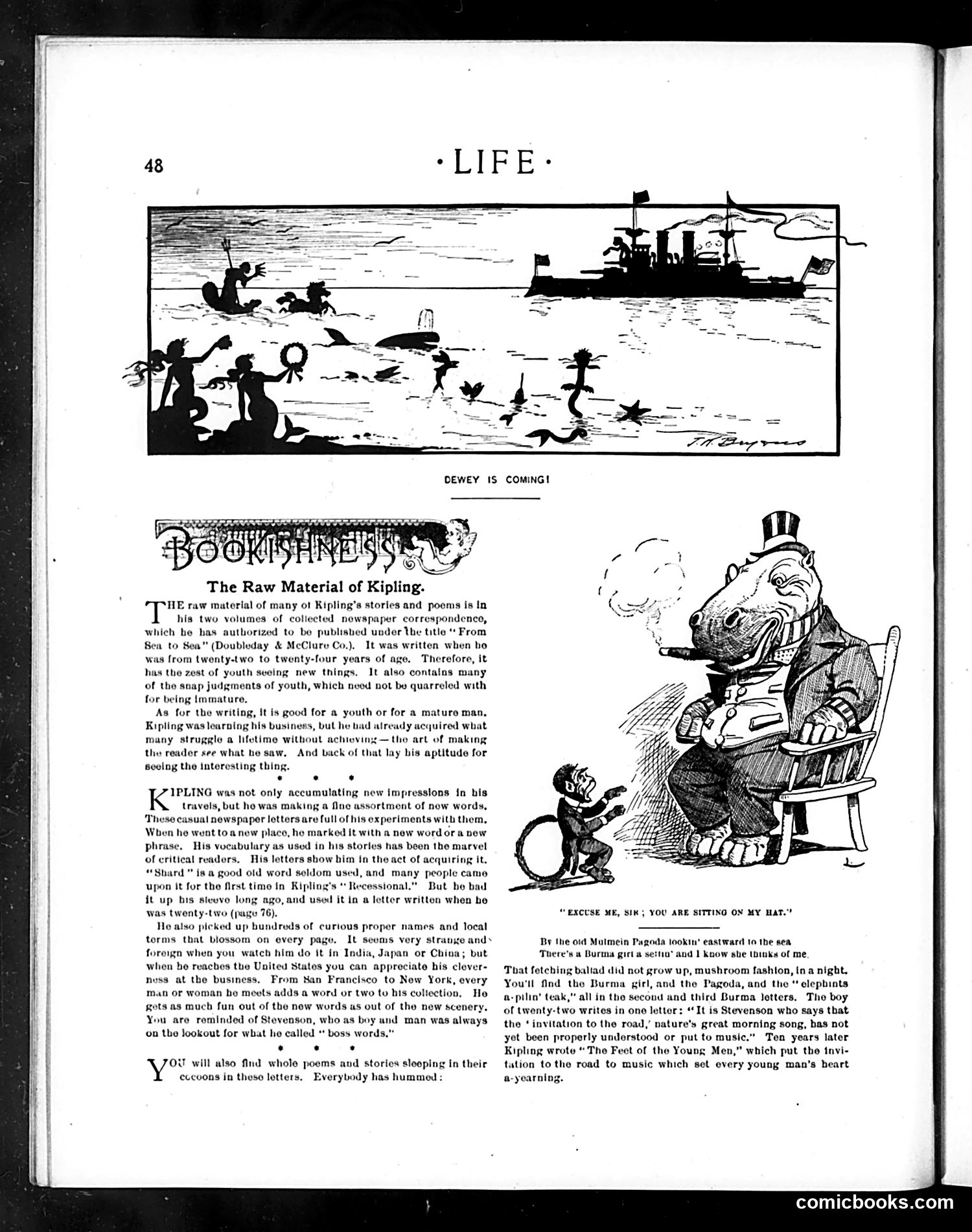
**Top Cartoon:** Titled "DEWEY IS COMING!" This silhouette illustration depicts a naval vessel approaching a beach crowded with swimming figures. The reference appears to be to Admiral George Dewey, likely commemorating his naval victory during the Spanish-American War (the cartoon's style suggests early 1900s). The composition suggests both celebration and chaos as people respond to his arrival. **"Bookishness" Section:** This is a book review of Kipling's collected newspaper correspondence, published as "From Sea to Sea." The text discusses Kipling's literary innovations, his use of new vocabulary and proper names, and his vivid descriptive style. An illustration shows a man reading in a chair. The page blends news commentary with literary criticism typical of Life's satirical approach.
📄 Transcribed text from this page (OCR, searchable)
Machine-transcribed from the original scan — historical spelling and the odd misread are preserved.
The Raw Material of Kipling. HE raw material of many ot Kipling’s stories and pooms is In his two volumes of collected nowspaper correspondence, which be has authorized to be published under the title “ From Sea to Sea" (Doubleday & McClure Co), It was written when bo was from twenty-two to twenty-four years of age. Therefore, it has the zest of youth sveing new things. It also contains many of the snap judgments of youth, which neod not be quarreled with for being immature. As for the writing, it is good for a youth or for a maturo man. Kipling was learning his business, but he bad already acquired what many struggle a lifetime without achwving —tho art of making thy reader see what he saw. And back of that lay bis aptitude for seeing the interesting thing. . . . 1PLING was not only accumulating new impressions in bis travels, but ho was making a fine assortment of now words, ‘These casual newspaper letters are full of his experiments with them, When he went toa new placo, ho marked it with a new word ora pew phrase, His vocabulary as used in his stories has been the marvel of critical readers. His letters show him in the act of acquiring it. “Shard” is a good old word seldom used, and many people came upon it for the first timo in Kipling’s * Recessional.” But be bad it up bis sieeve long ago, and used it in a letter written when bo was twenty-two (page 76). He also picked up bundreds of curtous proper names and local torms that blossom on every page. It seums very strange ands foreign when you watch him do it in India, Japan or China; but when be reaches tbe United States you can appreciate his clever- ness at the business. From San Francisco to New York, every man or woman he mevts adds a word or two to his coltection, He gots as much fun out of the new words as out of the new scenery. You are reminded of Stevenson, who as boy und man was always ‘on the lookout for what he called * boss words," . . . OU will also find whole poems and stories slooping In their cccvons in theso letters, Everybody has hummed : “EXCUSE ME, SIK; YOU ARE SITTING ON MY HAT.” By the od Mulmein Pagoda lookin’ eastward to the sea, ‘There's « Burma girt a sertiu’ and 1 know sue thinks of me That fetching baliad did not grow up, mushroom fashion, ina night, You'll Nod the Burma girl, and the Pagoda, and the “ elepbints a- pilin’ teak,” all in the second and third Burma letters, Tho boy of twenty-two writes in ono letter: “It is Stevenson who says that the ‘invitation to the road,’ nature's great morning song, bas not yet been properly understood or put to music.” Ten years later Kipling wrote “ The Feet of the Young Men,” which put the tnvi- tution to the road to music which set every young man’s beart a-yearning. comicbooks.com