
A complete issue · 20 pages · 1899
Life — July 13, 1899
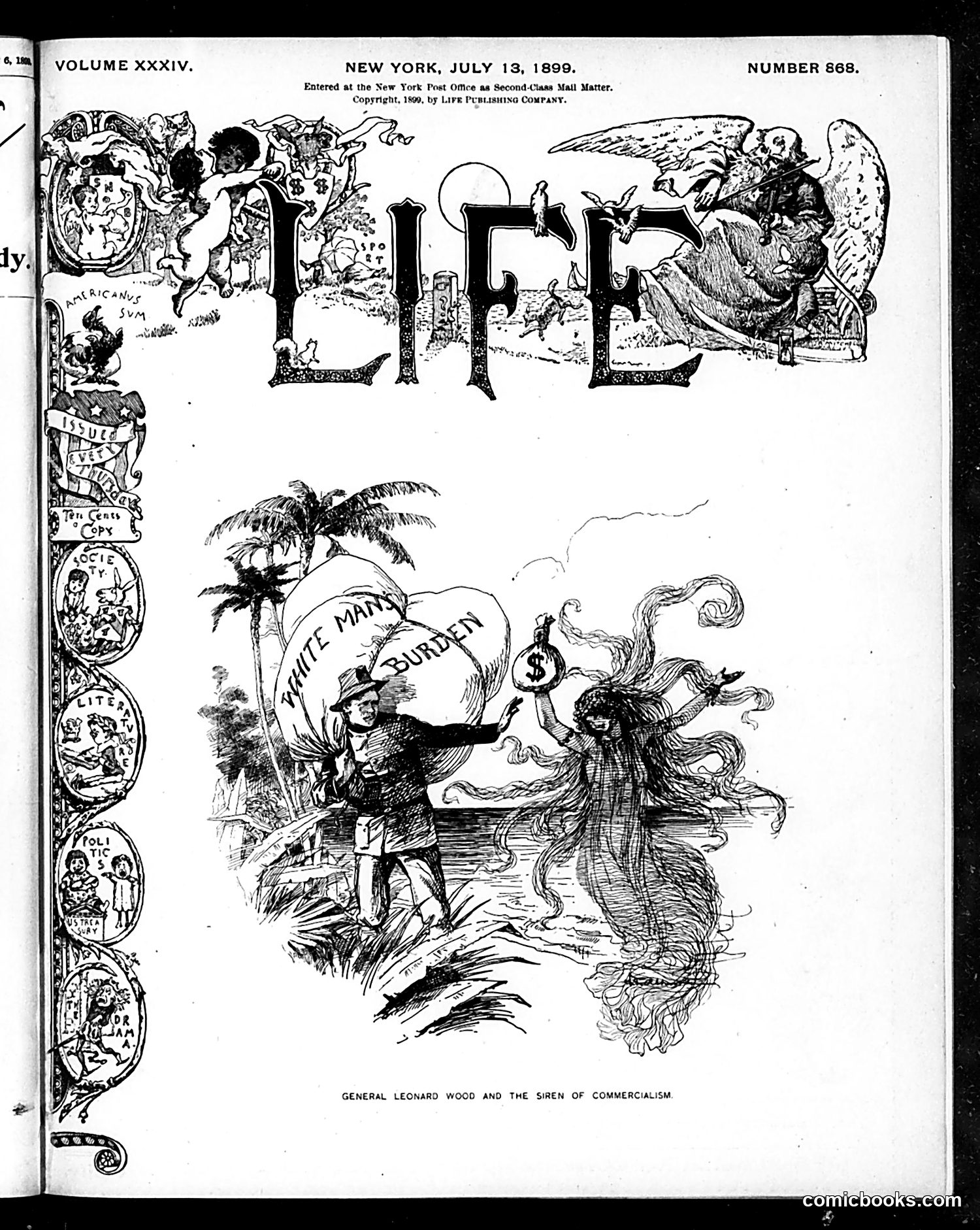
The main cartoon depicts "General Leonard Wood and the Siren of Commercialism." General Leonard Wood (identifiable by the caption) confronts a seductive female figure labeled "White Man's Burden" and "$" (representing commercial interests). Wood holds a money bag, suggesting he's being tempted or compromised by commercial forces. This satirizes American imperialism in the Philippines during the Spanish-American War aftermath. The "White Man's Burden" reference invokes Kipling's famous poem justifying colonialism. The cartoon criticizes how commercial interests exploited American military presence in occupied territories—suggesting that Wood and military leadership were being corrupted by profit motives rather than pursuing noble imperial goals. The ornamental left border contains smaller satirical vignettes typical of Life's format.
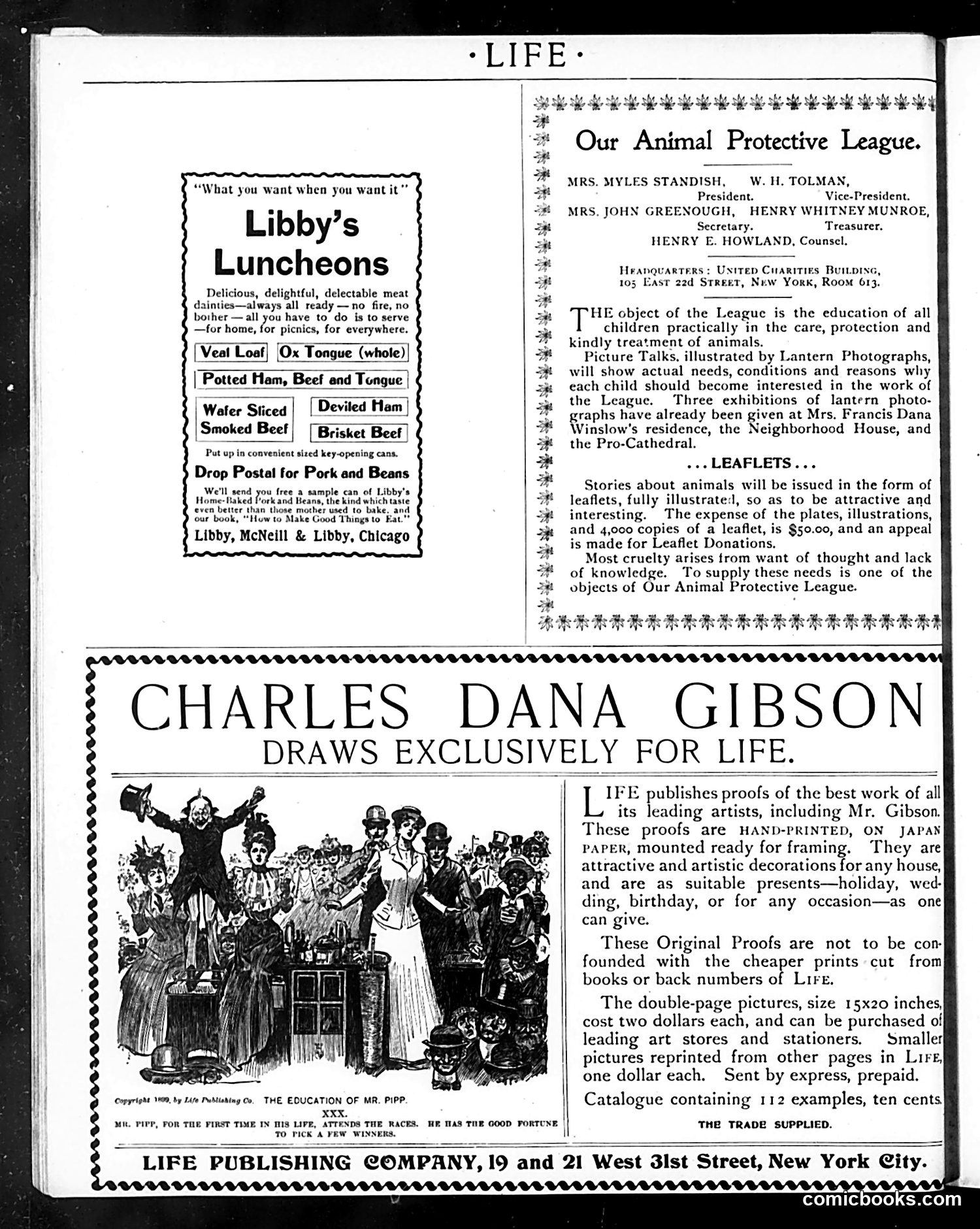
This Charles Dana Gibson illustration depicts a scene from what the caption identifies as "The Education of Mr. Pipp," showing a well-dressed man (Mr. Pipp) surrounded by costumed figures at what appears to be a formal social gathering or masquerade ball. The caption notes this is "for the first time in his life" and "he has the good fortune to pick a few winners"—suggesting the cartoon satirizes social climbing or a naive gentleman gaining unexpected success in high society. Gibson was famous for his "Gibson Girl" illustrations and social satire. This appears to mock pretension and luck in navigating elite social circles, though the specific reference to "the races" and "winners" suggests commentary on gambling or fortune rather than purely social aspiration.
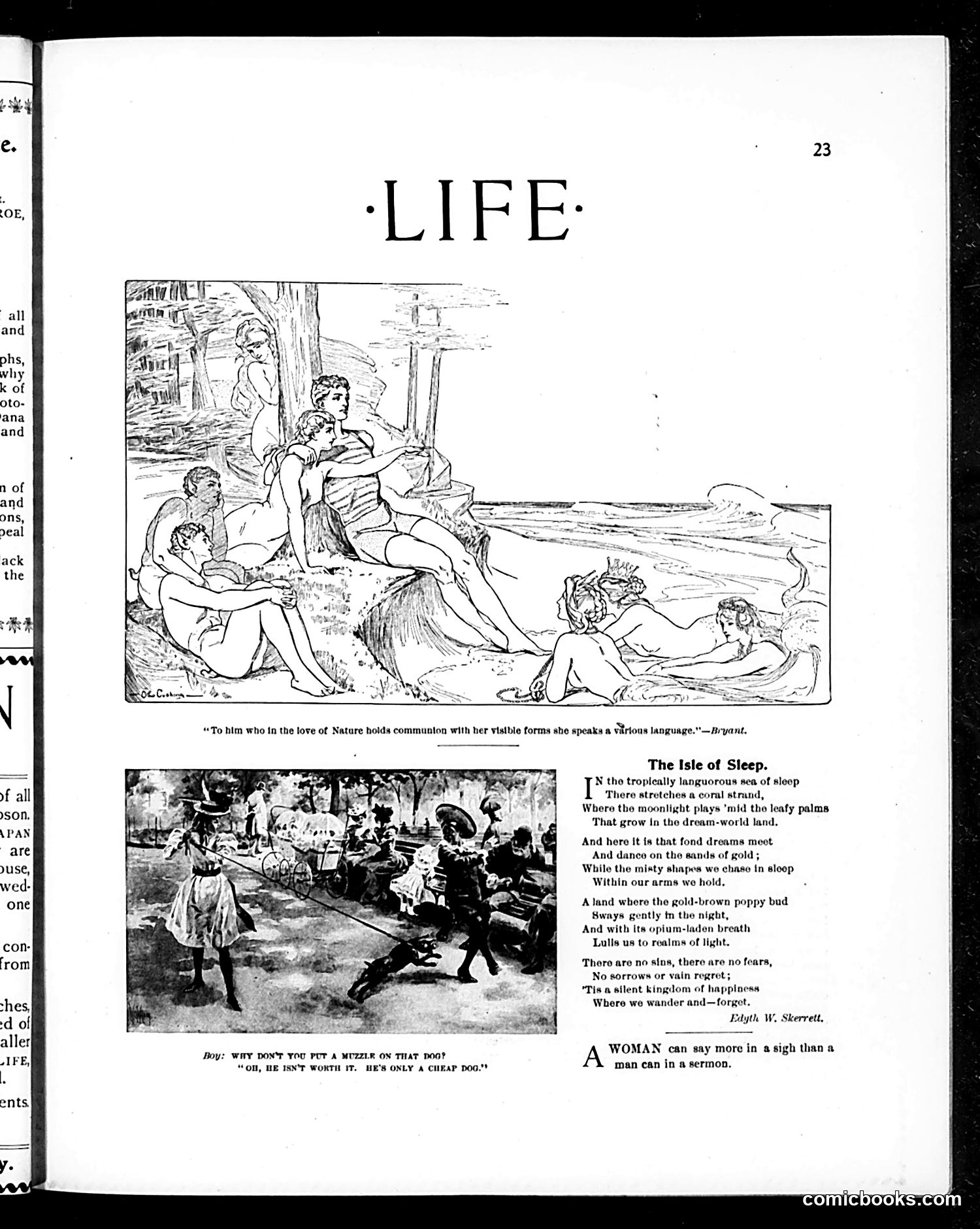
This page contains two distinct items: **Top illustration**: A classical/allegorical scene depicting figures in a natural setting, captioned with a Bryant quote about Nature's communion with visible forms and "various language." **Middle cartoon**: Shows a scene with a dog and dialogue: "WHY DON'T YOU PUT A MUZZLE ON THAT DOG?" / "OH, HE ISN'T WORTH IT. HE'S ONLY A CHEAP DOG." This appears to be simple social humor about class distinctions, suggesting that valuable dogs warrant muzzles while worthless ones don't. **"The Isle of Sleep"**: A poem by Eligh W. Skerrett about a dreamland. **Bottom quip**: "A WOMAN can say more in a sigh than a man can in a sermon"—typical period humor contrasting feminine and masculine communication styles. The page is primarily literary/poetic rather than political satire.
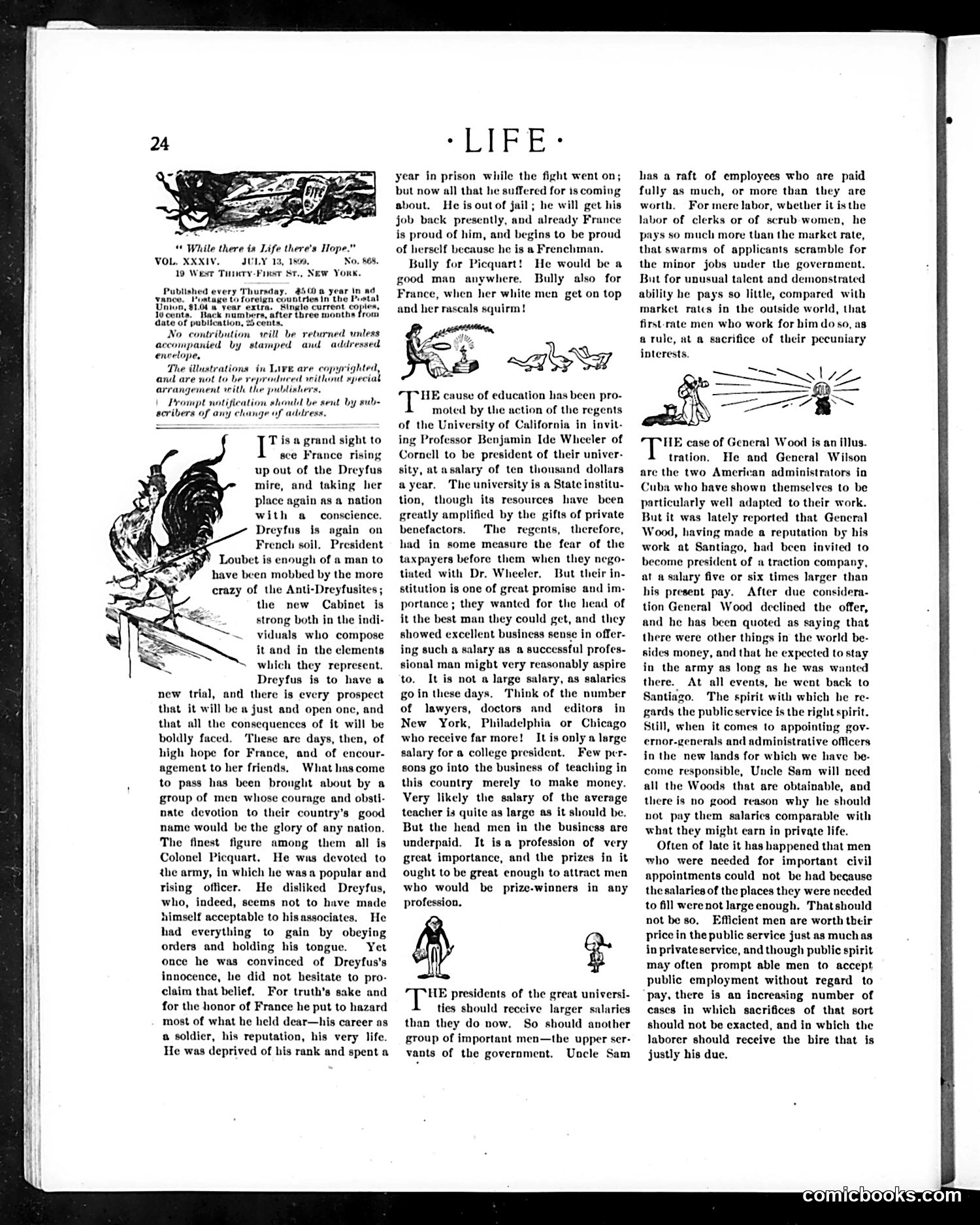
The page contains two political cartoons addressing French affairs and American education policy. The **left cartoon** depicts Colonel Dreyfus (identifiable from context referencing his recent exoneration). The satire mocks the Anti-Dreyfusites—those who opposed his reinstatement—suggesting they're "crazy" for their stubborn refusal to accept his vindication. The image criticizes French political divisions surrounding the famous Dreyfus Affair. The **right section** discusses California's University of California appointing Professor Benjamin Ide Wheeler as president at $10,000 annually. The accompanying cartoon satirizes General Wood's appointment to Cuban administration, suggesting government positions are filled by military figures rather than merit-based civilians. Both pieces critique institutional appointments and political obstinacy in early 1900s American and French governance.
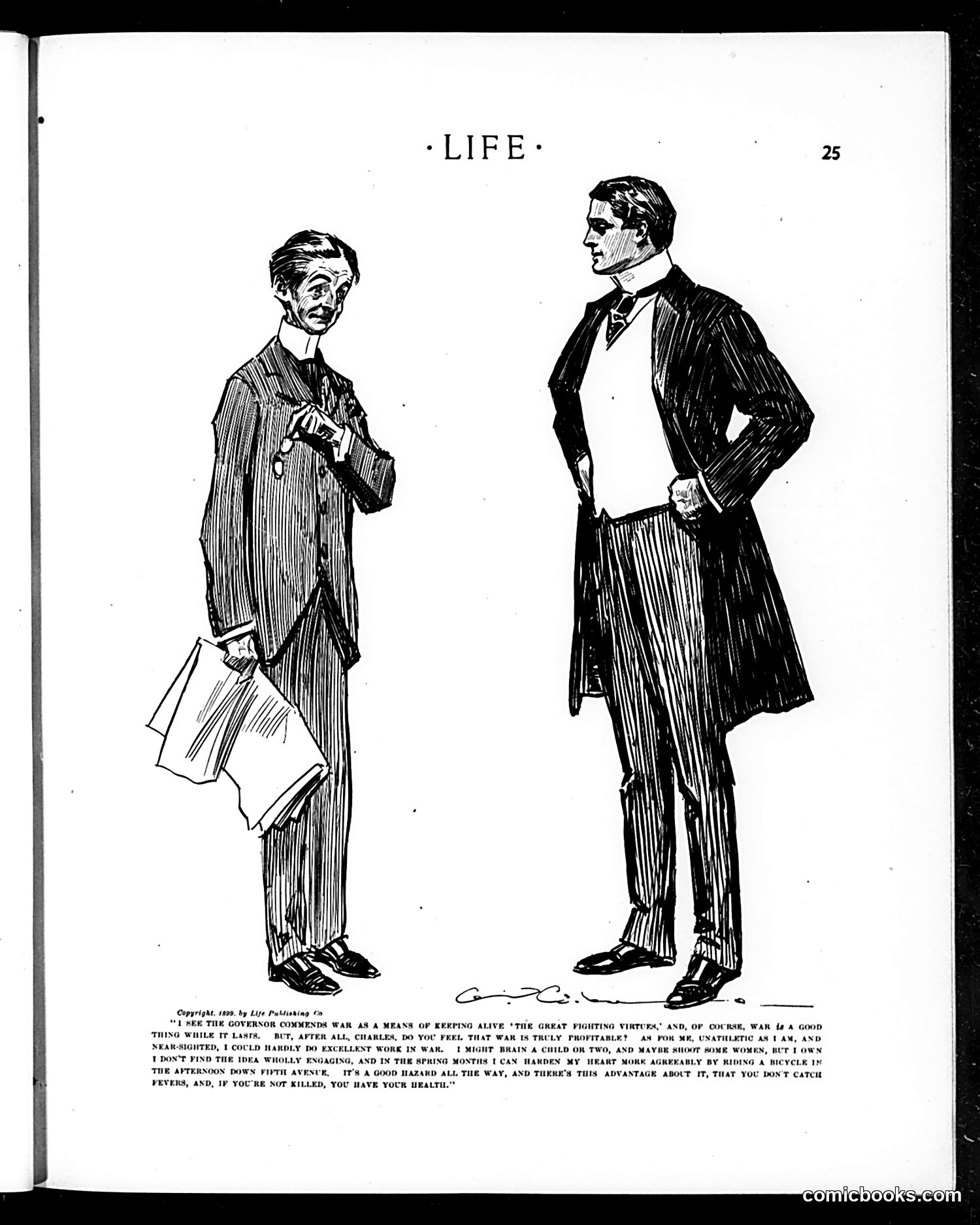
This Life magazine page presents two men in conversation, appearing to debate war's merits. The left figure (smaller, anxious-looking) holds papers and seems to represent a concerned citizen or politician questioning war's value. The right figure (taller, confident) presents the pro-war argument visible in the text below. The caption quotes the right figure arguing that war keeps "great fighting virtues" alive and is "profitable." He contends that without war's risks, people grow soft—even suggesting bicycle riding causes "fevers." The left figure's dubious expression suggests skepticism toward this romantic militarism. This satirizes early 20th-century arguments justifying warfare on moral grounds—the idea that conflict builds character and national strength. Life's satire exposes the absurdity and self-interest behind such rhetoric, likely responding to pre-WWI or WWI-era militaristic propaganda.
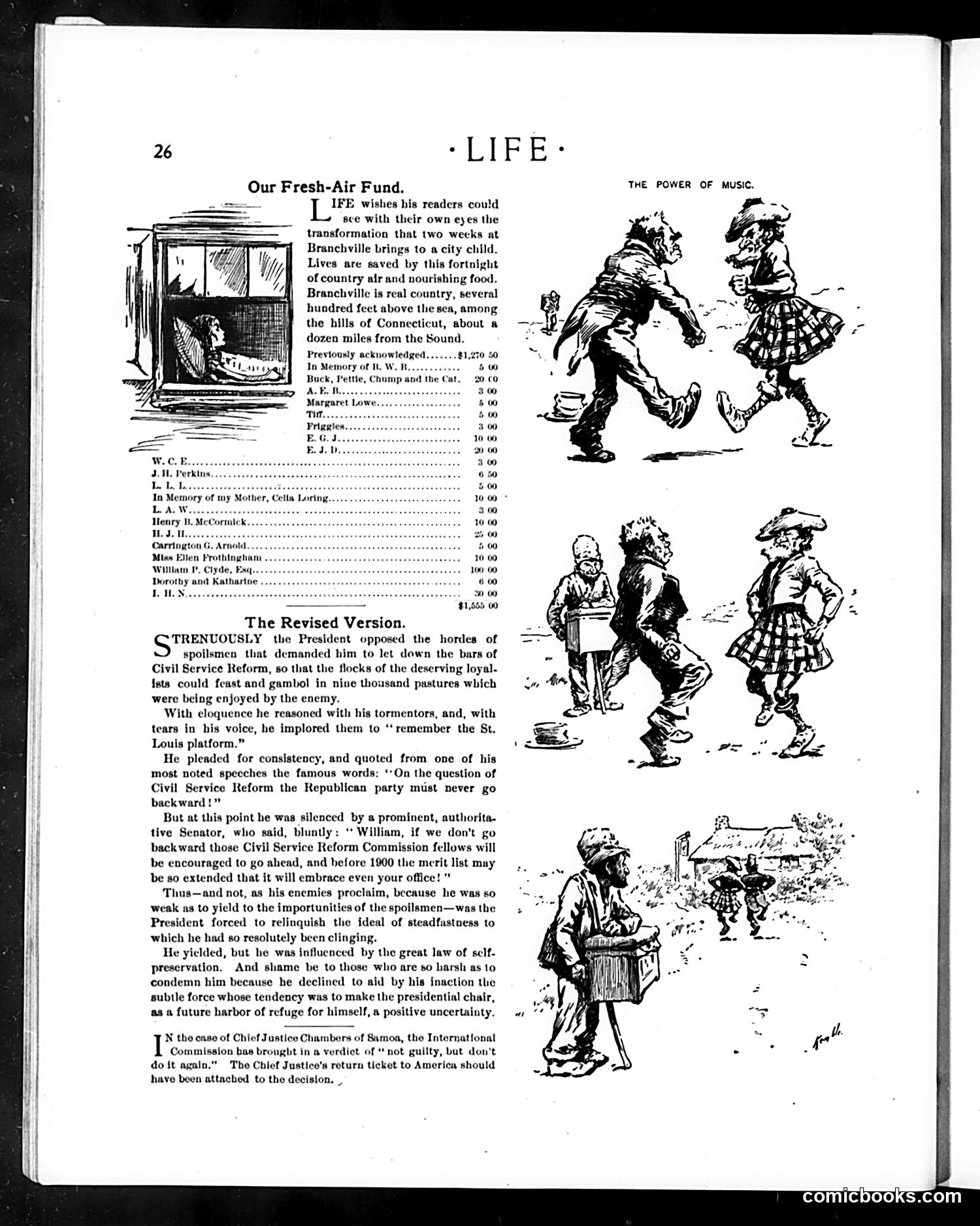
This page contains two distinct sections: **"Our Fresh-Air Fund"** (left): A fundraising list for sending city children to the countryside for health benefits. The accompanying sketch shows a child at a window, illustrating the magazine's charitable cause. **"The Power of Music"** (right): A series of cartoons depicting what appears to be a romantic or comedic scenario between two figures—likely a man and woman—dancing or being charmed by music. The sketches show playful interaction, with the final panel showing musicians performing outdoors. **"The Revised Version"** (center): Political commentary on Civil Service Reform, discussing presidential pressure regarding spoilsmen (political appointees). The text references debates about merit-based versus patronage-based government positions during the late 19th/early 20th century Civil Service Reform movement. The page blends satire about government corruption with lighter entertainment content typical of Life magazine's satirical approach.
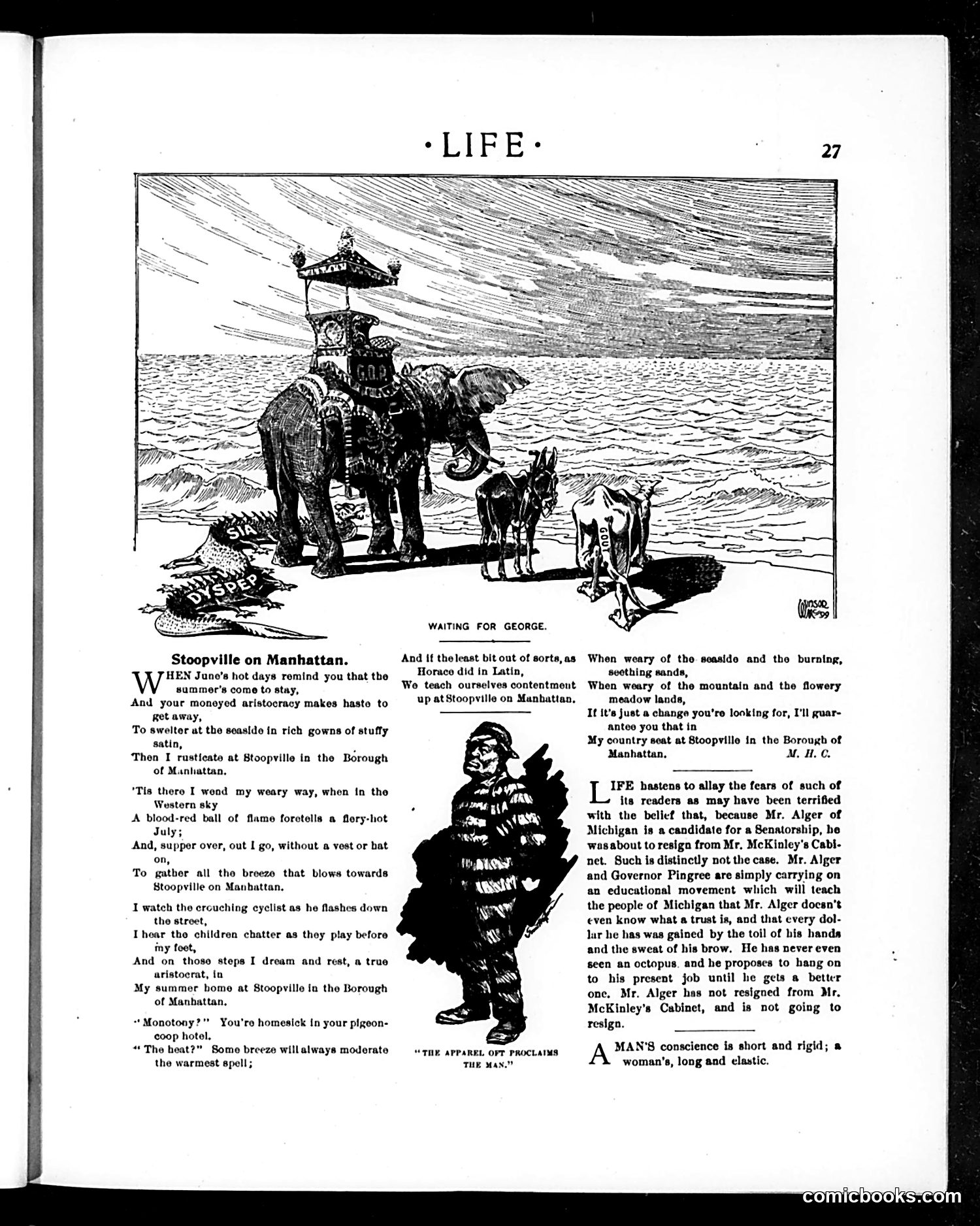
This page contains a poem titled "Stoopville on Manhattan" and accompanying editorial commentary about political resignations. The illustration shows an elephant carrying a howdah (decorative carriage) on a beach—a reference to the Republican Party mascot. The editorial discusses Mr. Alger of Michigan, a candidate for the U.S. Senate, and notes that Mr. McKinley's Cabinet members (including Governor Pingree) are conducting an educational campaign promoting Alger despite uncertainty about his qualifications. The commentary sarcastically suggests they're "carrying on an educational movement" to convince Michigan voters of Alger's merit. The poem humorously celebrates Stoopville in Manhattan as a summer refuge from urban heat—satirizing the wealthy aristocracy's escape to seaside leisure while the working poor endure the city. The final proverb contrasts men's and women's consciences, likely social commentary typical of the era's gender discourse.
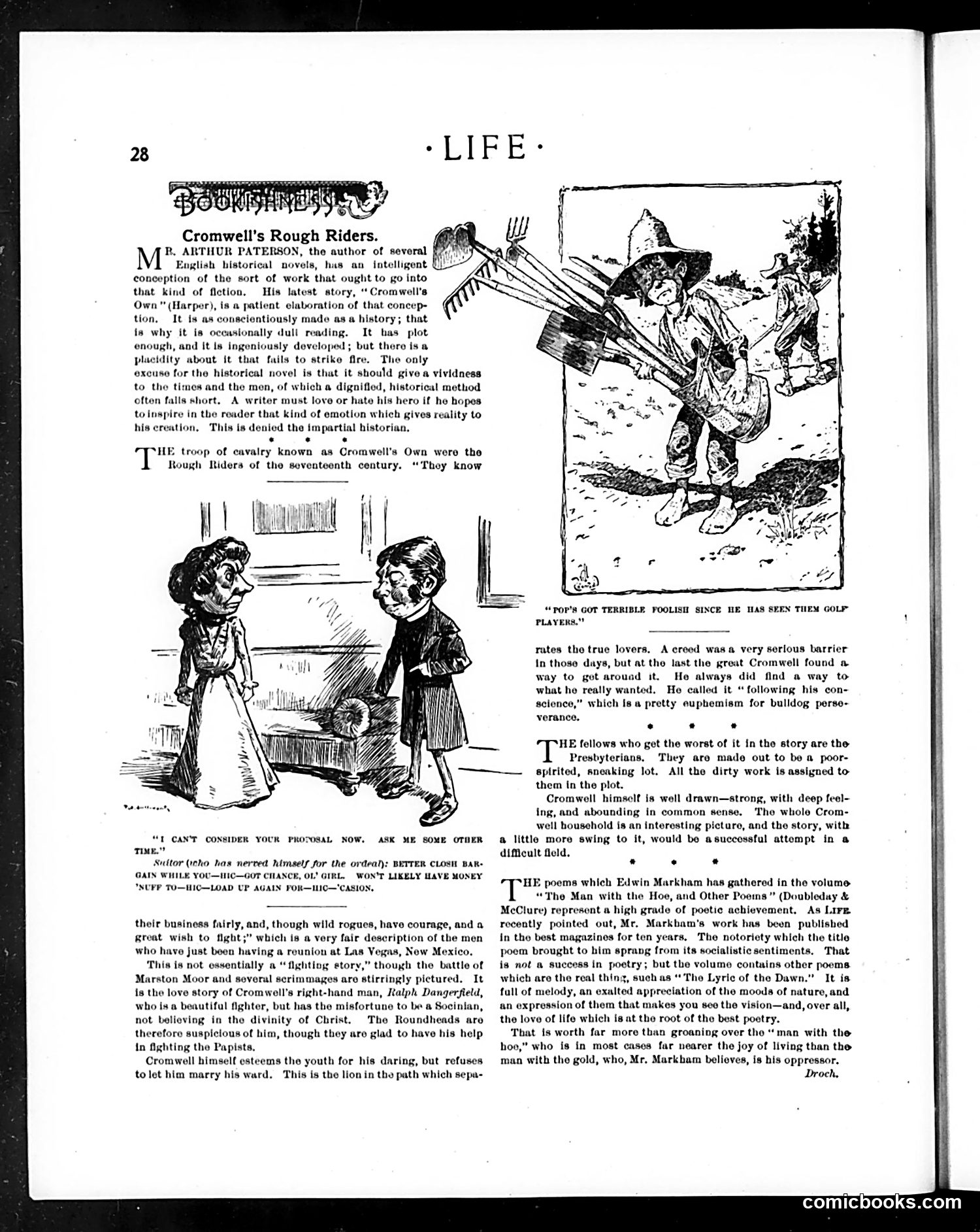
This page contains a book review of "Cromwell's Rough Riders" by Arthur Paterson. The left cartoon illustrates a domestic scene where a woman asks a man about his "proposal," with text suggesting financial concerns ("Won't likely have money enough to—load up again"). The right illustration shows armed figures in period dress, likely depicting Cromwell's cavalry soldiers referenced in the book title. The review discusses how historical fiction should balance vivid characterization with accuracy. It critiques Paterson's portrayal of Cromwell and his supporters, noting they're depicted as "poor-spirited, sneaking lot" in the narrative. The page evaluates the novel's literary merit and historical authenticity, a typical 19th-century magazine book review format.
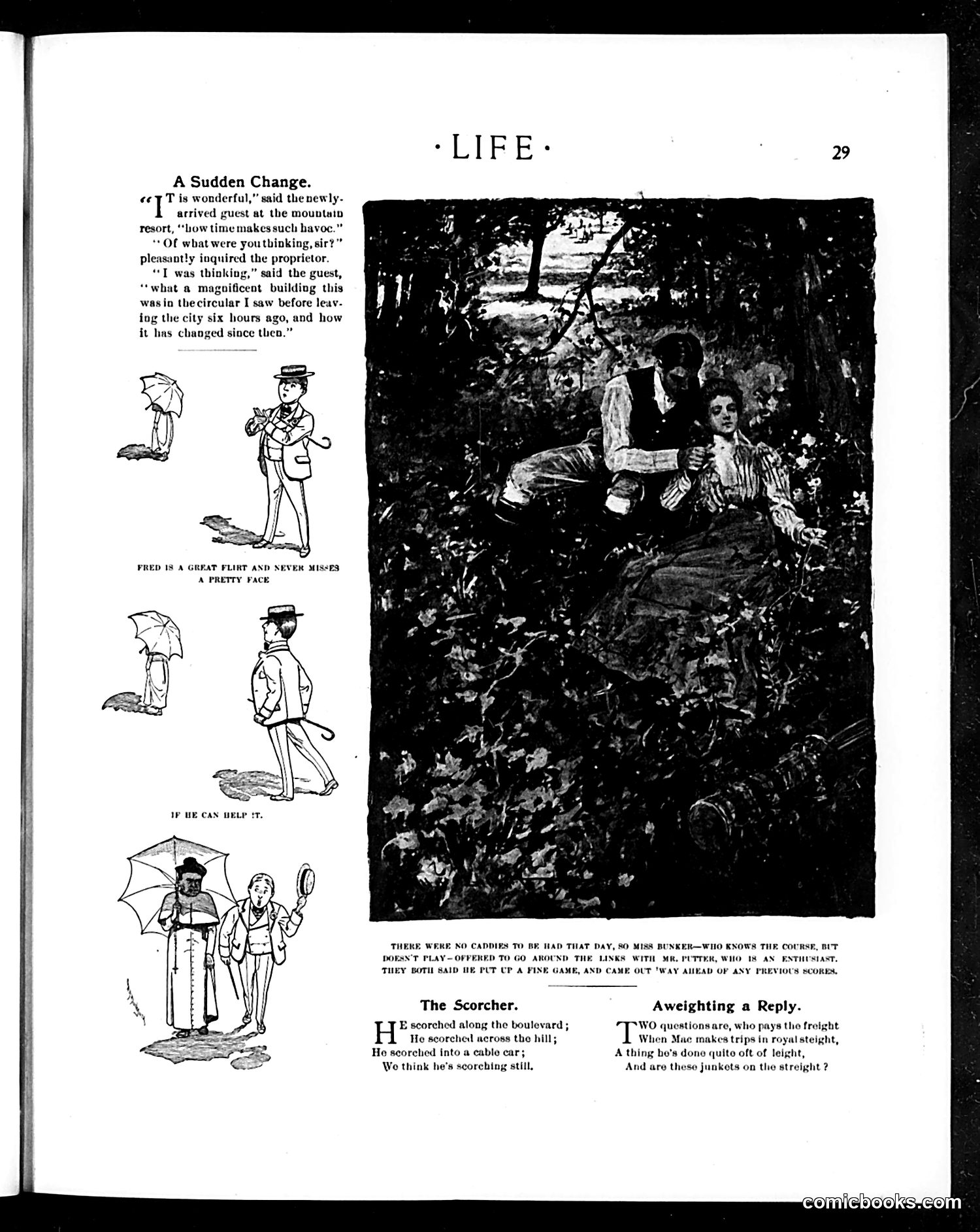
**"A Sudden Change"** (top left): A humorous four-panel comic strip showing a man's reaction to discovering how much a mountain resort building has deteriorated since he last visited. The joke: he flirts successfully with a woman until realizing the building's decay—suggesting his renewed interest depends on finding an impressive location, not genuine attraction. **Large photograph** (center-right): Shows two figures relaxing outdoors. The caption references "Miss Bunker" and "Mr. Putter," indicating this depicts real people from what appears to be a golf or leisure society story. **Two poems below**: "The Scorcher" and "Aweighting a Reply" are light verse jokes about transportation (scorching/speeding) and social awkwardness, typical of Life's satirical humor. The page represents Life's mix of visual humor and social commentary.
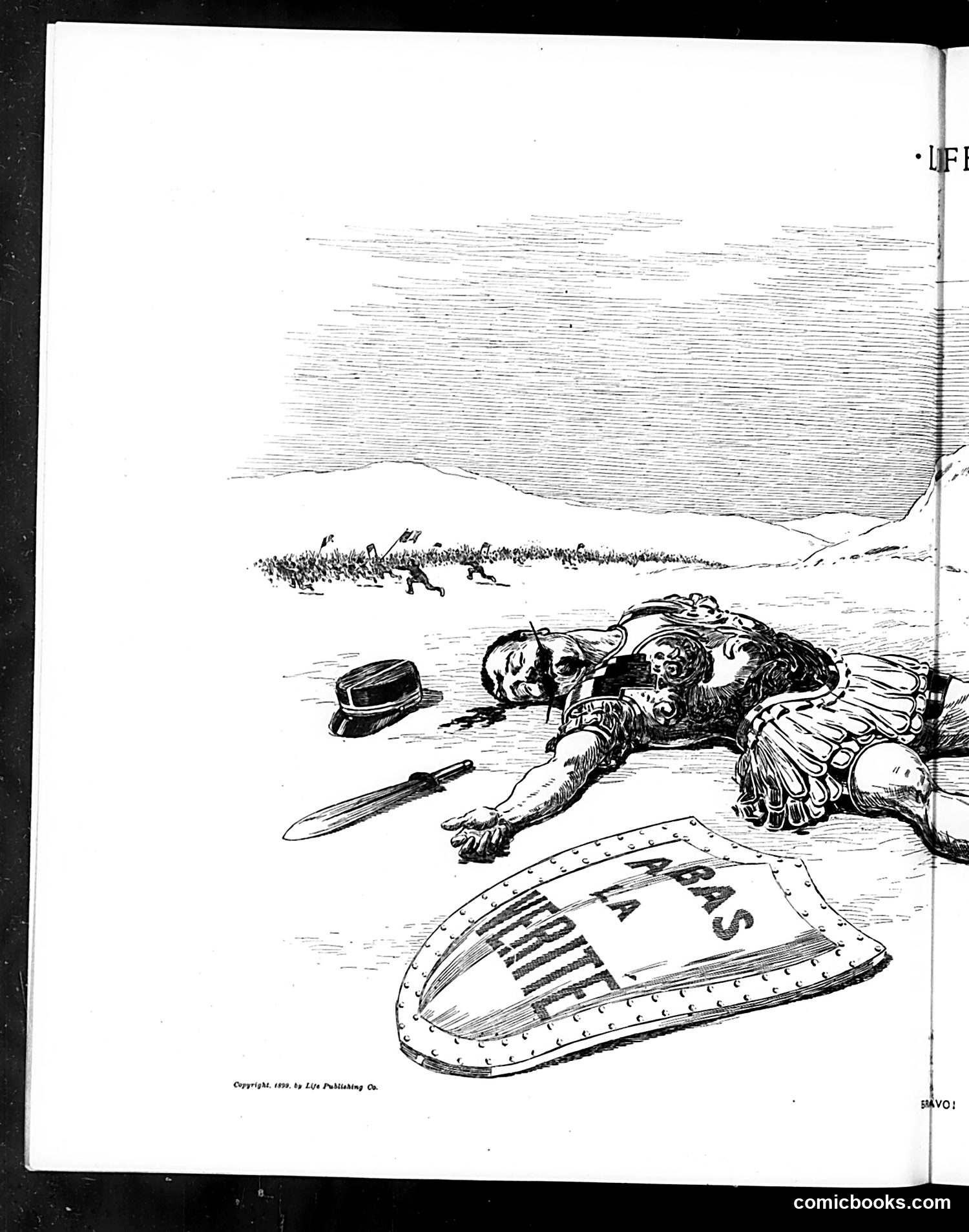
This is a dark political cartoon depicting a dead figure lying on a beach with a boat marked "S.S." nearby. The corpse wears ornate clothing and military regalia, surrounded by personal effects including a hat, knife, and what appears to be a crown or elaborate headdress. The image appears to be satirizing the death or downfall of a specific political or military leader, likely from the early 20th century (given the 1928 copyright visible). The elaborate dress and royal symbolism suggest commentary on aristocratic or authoritarian power. The beach setting and abandoned boat imply escape attempt or failed flight. However, **without additional context or clearer caption text**, I cannot definitively identify which specific historical figure this satirizes or what particular political event prompted this cartoon. The satire criticizes someone's pretensions to grandeur, shown now stripped of power.
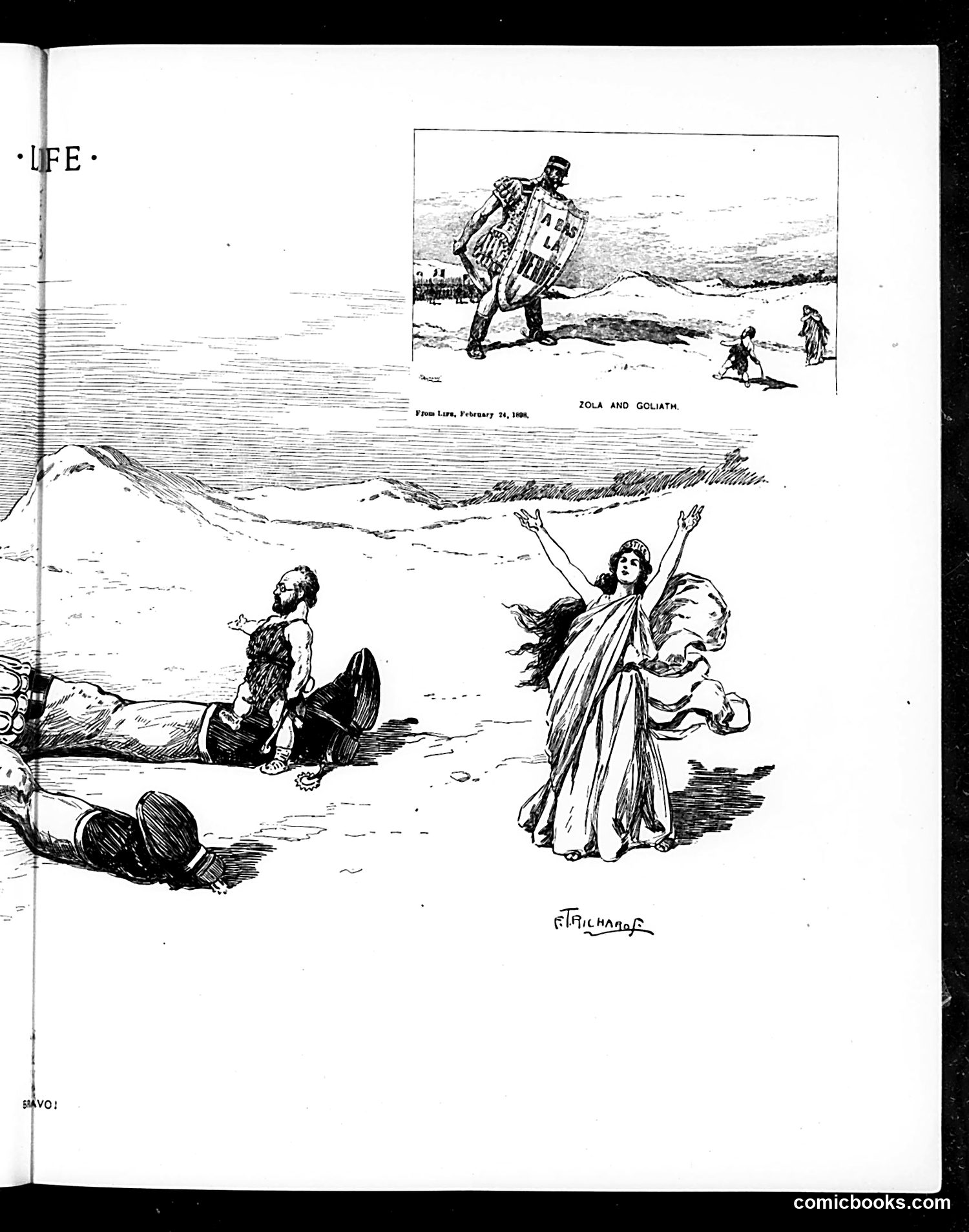
This page contains two satirical cartoons from *Life* magazine (dated February 12, 1908, per the top illustration's caption). **Top cartoon ("Zola and Goliath"):** References French novelist Émile Zola, depicted as David confronting a giant labeled "A Gas Trust." This satirizes Zola's role as a public crusader against corruption and injustice, paralleling the biblical David-and-Goliath story. It comments on contemporary trust-busting debates during the Progressive Era. **Bottom cartoon:** Shows a classical female figure (likely representing Liberty or Justice) triumphantly gesturing amid fallen logs or debris, while a wounded male figure sits dejected nearby. This appears to celebrate victory against some industrial or monopolistic threat, reflecting Progressive Era anti-trust sentiment and labor concerns. The cartoonist's signature is visible but unclear in reproduction.
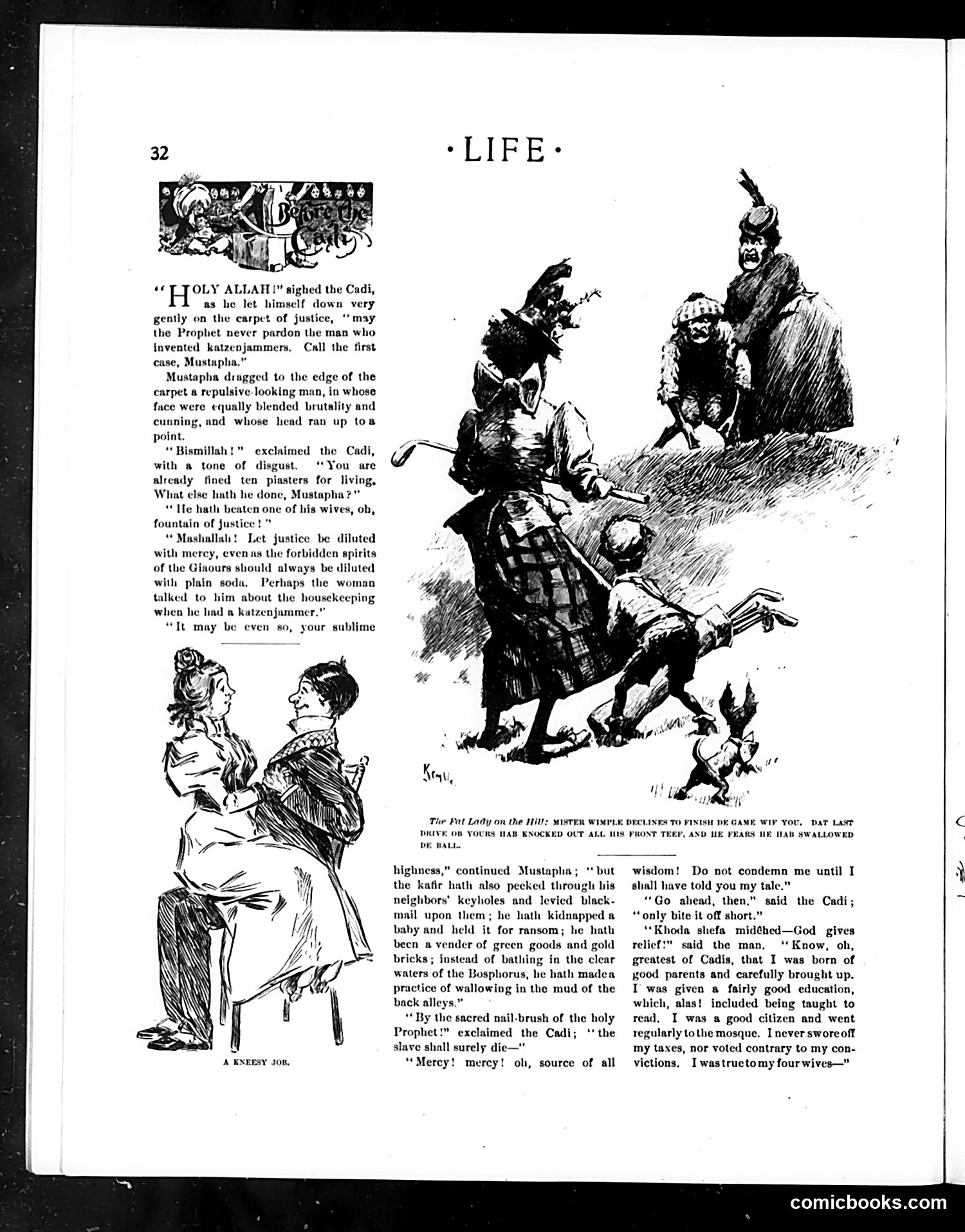
This page presents a satirical story about Islamic justice, featuring characters identified as "the Cadi" (Islamic judge) and "Mustapha." The narrative mocks what the magazine presents as arbitrary and harsh Muslim legal practices. The large illustration depicts figures in Ottoman/Middle Eastern dress, including what appears to be the Cadi administering punishment. The smaller illustration shows two figures in conversation—likely illustrating domestic or social commentary. The satire targets Islamic jurisprudence as brutal and irrational, reflecting 19th-century Western prejudices against Muslim cultures. The detailed costume caricatures and exaggerated depictions of "Oriental" justice systems were typical of period satirical magazines aimed at Western audiences unfamiliar with or hostile toward Islamic societies. The humor relies entirely on ethnic/religious stereotyping.
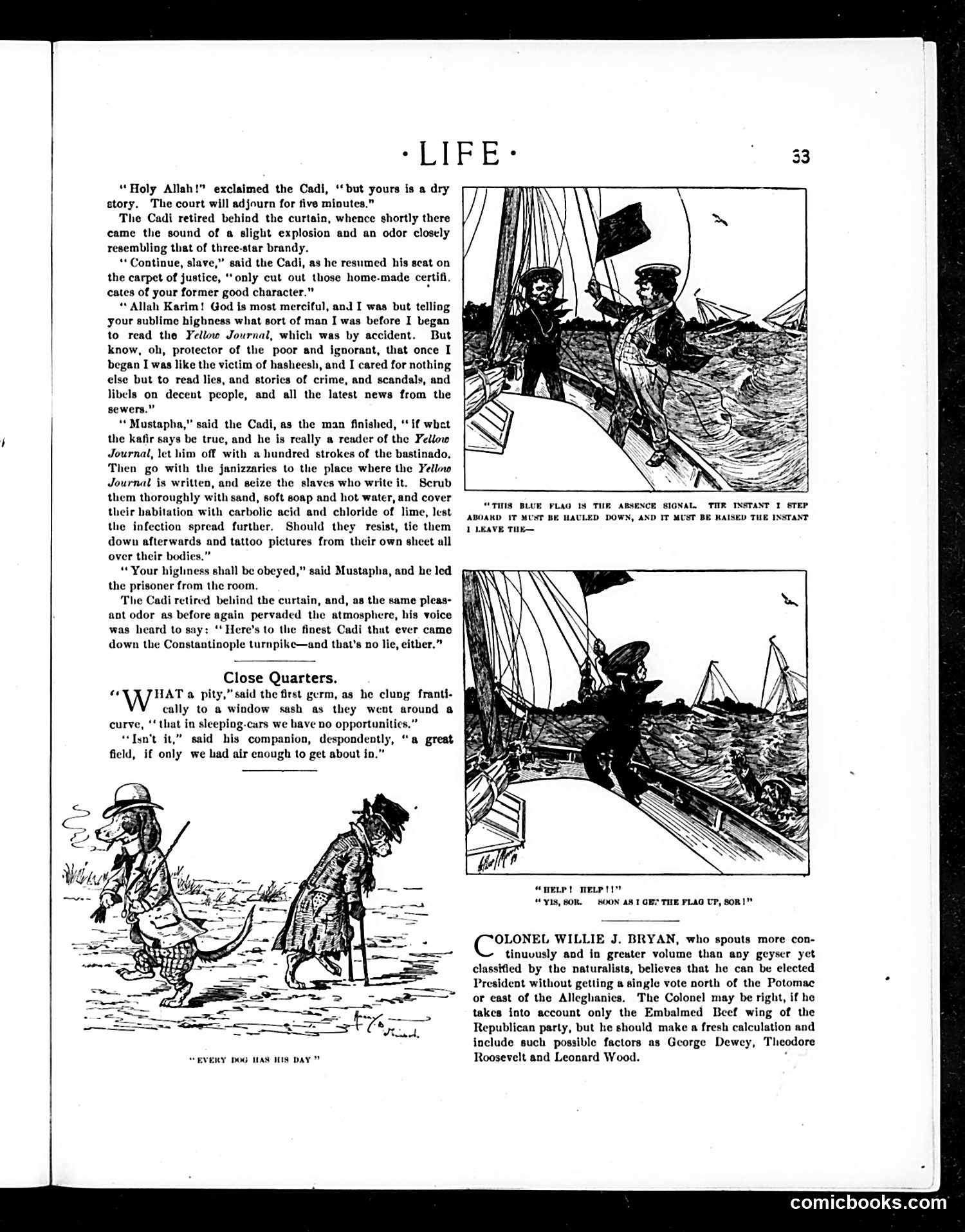
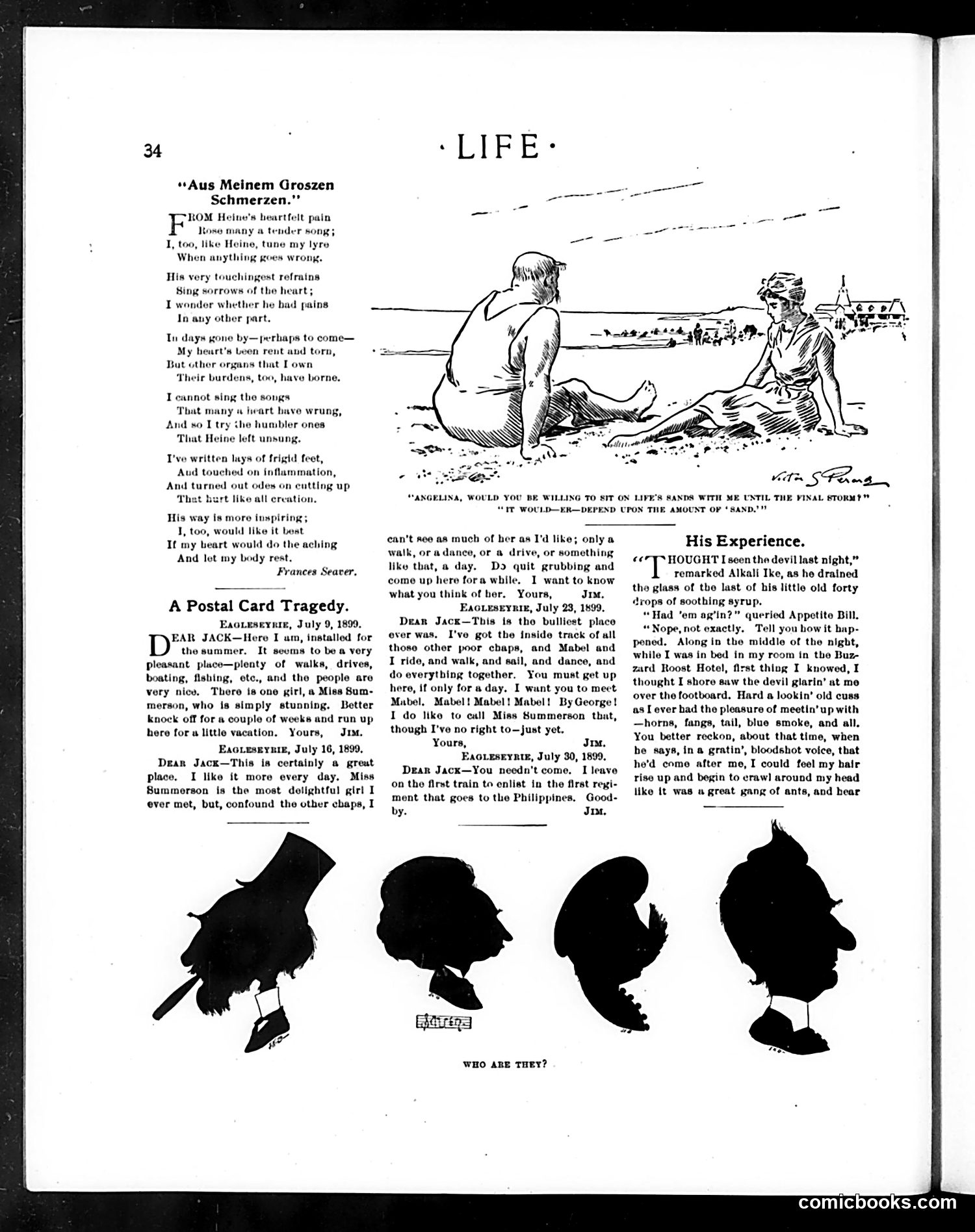
This page contains three distinct pieces of satire from Life magazine (circa 1899): **"A Postal Card Tragedy"** satirizes romantic melodrama through a series of postcards where Jim becomes increasingly obsessed with "Miss Summerson" (nicknamed Mabel), urging his friend Jack to visit. The twist: Jim suddenly enlists for the Philippines War, abandoning romance for military duty—likely mocking both overwrought romantic conventions and the contemporary Philippine-American War. **"His Experience"** is a humorous Western tall tale where "Alkali Ike" recounts seeing the devil in his room, delivering frontier vernacular humor common to Life's comic sketches. **The German poem** ("Aus Meinem Groszen Schmerzen") humorously contrasts Heine's famous heartfelt poetry with the author's own "humble" verses about physical ailments—a gentle parody of Romantic poetry's emotional excess. The silhouettes at bottom ("WHO ARE THEY?") appear to be an unrelated puzzle feature, typical of Life's mixed-content format.
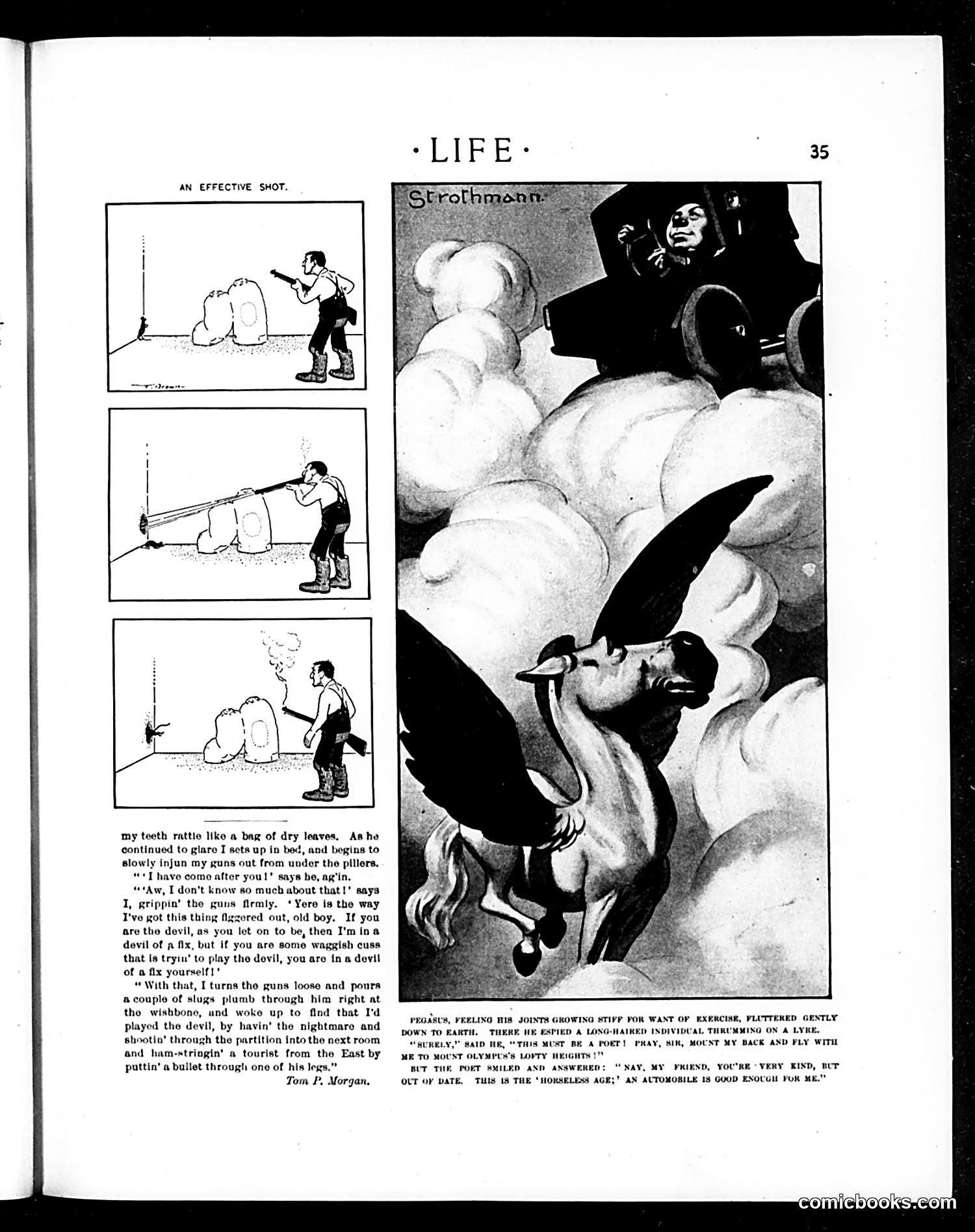
**"An Effective Shot"** (left): A humorous narrative comic about a man who dreams a devil visits him. Half-asleep and confused, he grabs guns from under his pillow and fires "through the partition," accidentally shooting a tourist from the East in the leg. The joke plays on frontier paranoia and incompetence. **"Pegasus and the Poet"** (right, by Strothmann): The mythological winged horse Pegasus descends to Earth seeking exercise, hoping to carry a poet to Mount Olympus. But the long-haired poet declines—he'd rather ride in an **automobile**. The satire mocks the rapid obsolescence of classical ideals and romanticism in the automobile age. Even poets prefer modern cars to mythic transportation. This reflects early-1900s American culture's embrace of industrialization over traditional art and literature. The joke: modernity has made even ancient poetry irrelevant.
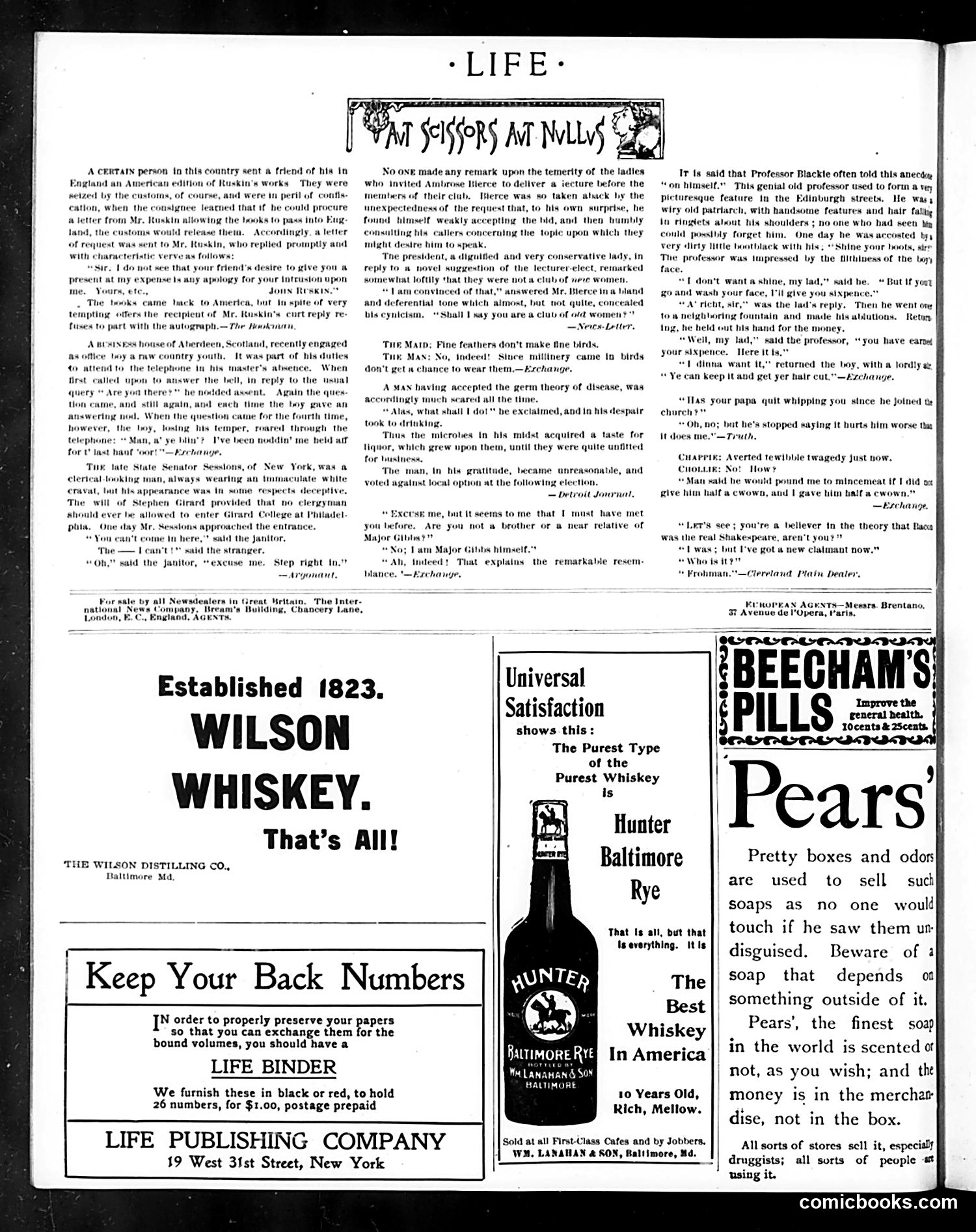
This page contains six brief humorous anecdotes typical of *Life* magazine's satirical style, rather than political cartoons. The humor relies on wordplay, social pretension, and character types recognizable to period readers: 1. **Ruskin anecdote**: Satirizes literary pretension—a man seeks permission to gift expensive books, and the famous author John Ruskin dismissively refuses, mocking the sender's presumption. 2. **Aberdeen office boy**: Plays on rural naiveté—a country youth repeatedly misunderstands instructions, confusing "bell" with "bell-ringing." 3. **Bootblack and Professor**: Mocks professorial affectation through a dirty child's literalism about cleanliness and payment. 4. **Germ theory**: Dark humor about a man who believes in disease transmission so thoroughly he becomes neurotically hostile to his own germs. 5. **Senator Sessions**: Satirizes hypocrisy—a pious man's principles shift conveniently when microbes inconvenience him personally. 6. **Shakespeare attribution**: Contemporary literary debate joke—someone constantly changes claims about the "true" Shakespeare author. The page is primarily **advertising** (whiskey, pills, soap, binders) with humor fillers.
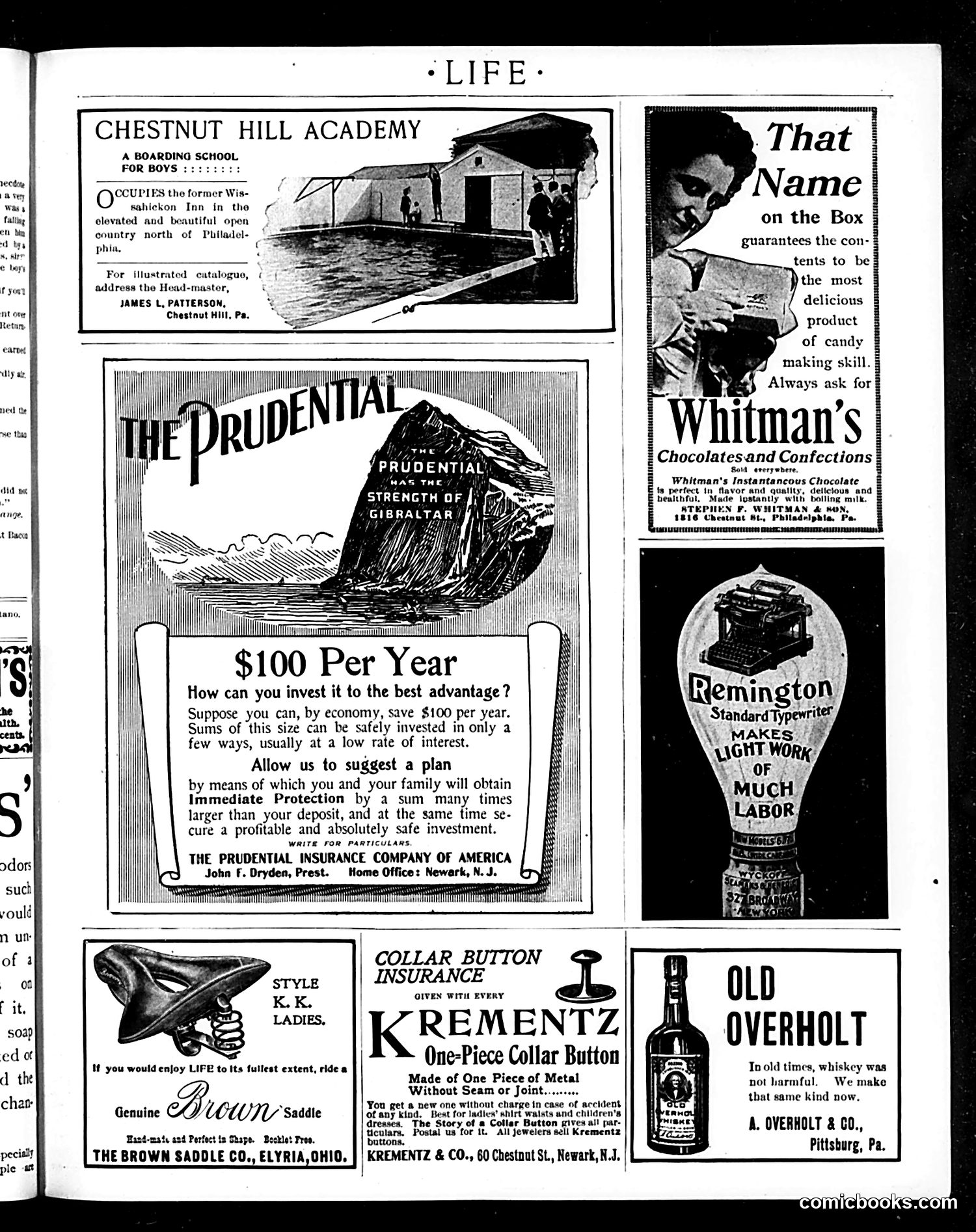
This page consists entirely of **period advertisements**, not political satire or editorial cartoons. The content reflects early 20th-century consumer goods and services: **Key Advertisements:** - **Chestnut Hill Academy**: A boys' boarding school near Philadelphia - **The Prudential Insurance Company**: Promotes investing $100/year in life insurance as "protection" for families - **Whitman's Chocolates**: Emphasizes quality candy production - **Krementz Collar Buttons**: One-piece metal buttons marketed as durable and accident-proof - **Brown Saddle Company**: Promotes riding saddles for women - **Remington Typewriter**: Claims to reduce labor - **Old Overholt Whiskey**: Claims modern production matches historical quality **Historical Context:** This appears to be from the **Progressive Era** (early 1900s), when newly-industrialized products were marketed to middle and upper classes. The advertisements reflect period concerns: educational advancement, financial security, consumer convenience, and traditional leisure (horseback riding). There is **no satire** visible here—this is straightforward commercial advertising typical of Life magazine's revenue model.
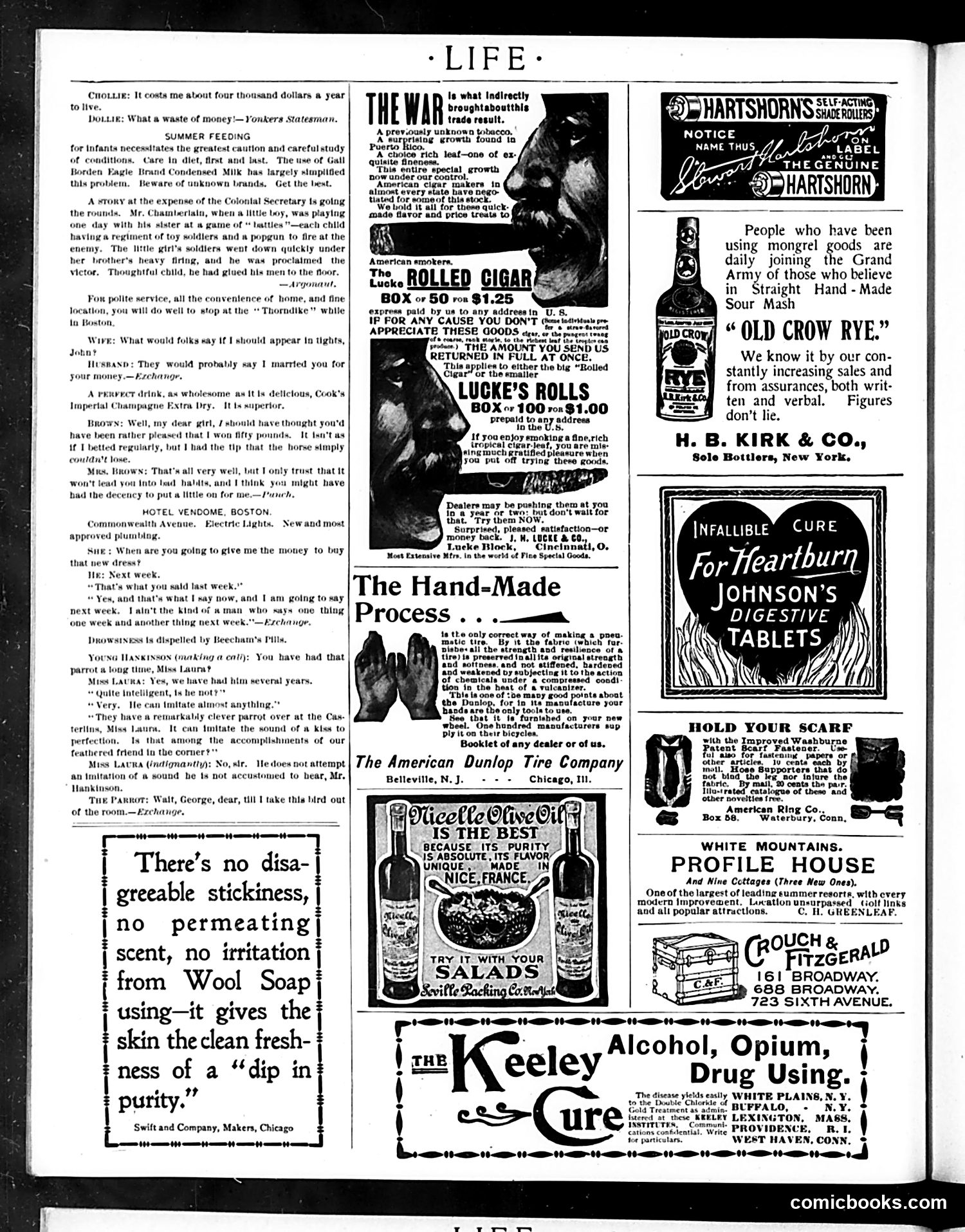
This page from *Life* magazine is primarily **advertising**, interspersed with brief humorous anecdotes typical of the publication's satirical format. The advertisements reflect early 20th-century consumer goods and patent medicines: condensed milk for infants, Wool Soap (emphasizing purity), olive oil, cigars and tobacco products, digestive tablets, and notably "The Keeley Cure"—a notorious treatment center for alcohol and drug addiction. The small jokes and dialogues mock domestic life and social pretension: a wife complaining about her husband's gambling, a couple debating dress money, and a parrot's owner embarrassed that her bird can imitate a kiss (considered improper). One anecdote lampoons Joseph Chamberlain, the Colonial Secretary, depicting childhood dishonesty—gluing toy soldiers to a floor to cheat at games. The page reflects Victorian/Edwardian social anxieties about consumption, addiction, and marital discord, presented through gentle satire aimed at middle-class readers.
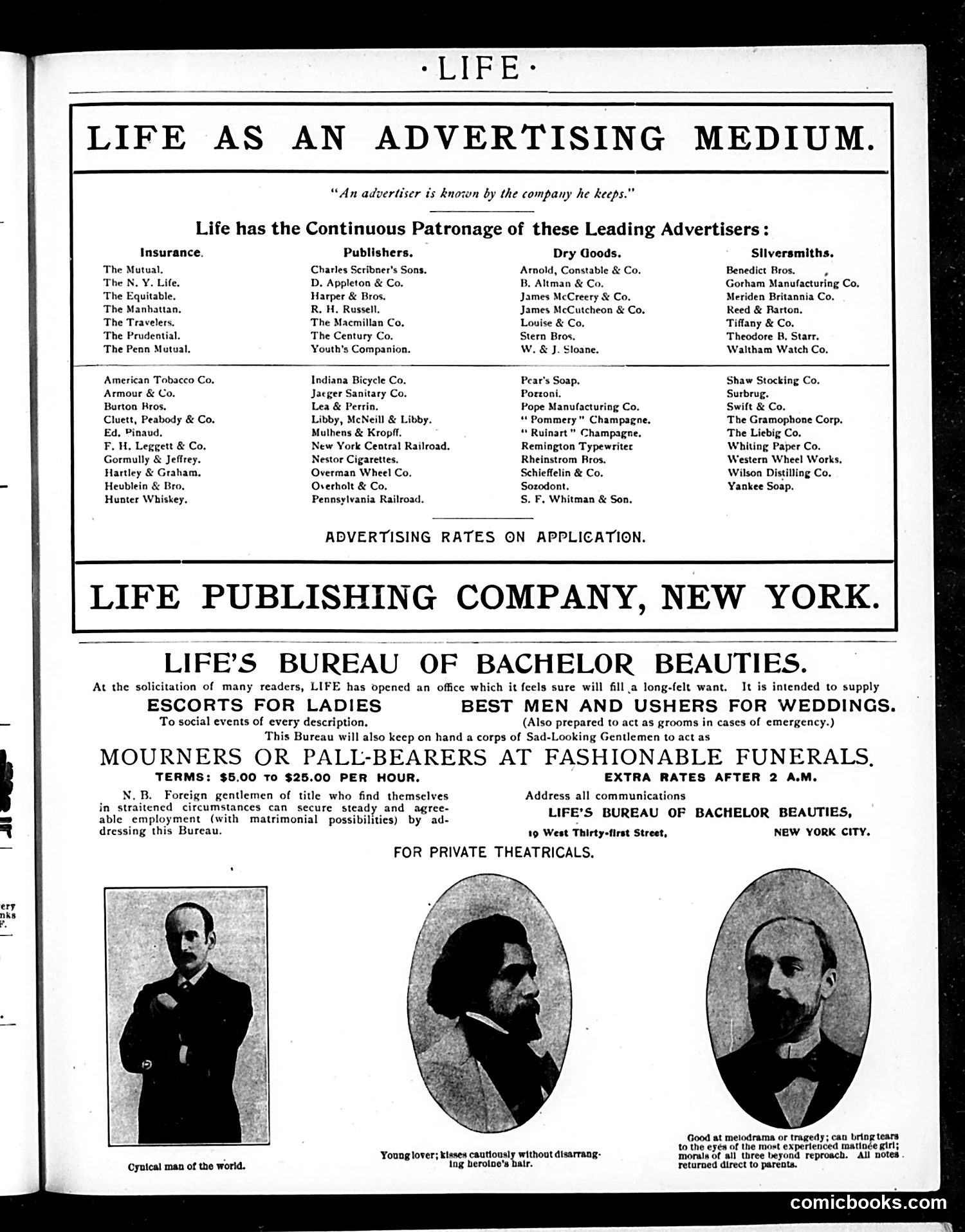
This is primarily a **satirical advertisement** rather than a political cartoon. Life magazine mocks the era's commercialization and social pretense by offering a fake "employment service" for professional escorts, wedding attendants, funeral mourners, and theatrical actors—available by the hour. The satire targets: 1. **Wealthy social climbing**: The ability to "rent" respectable men for fashionable events suggests that appearances and hired propriety matter more than genuine relationships. 2. **Social desperation**: The note about "foreign gentlemen of title" in financial straits seeking work (with "matrimonial possibilities") jokes about impoverished European nobility marrying for money—a real phenomenon of the Gilded Age. 3. **The commodification of respectability**: Treating mourning, romance, and theatricality as purchasable services mocks how artificial and transactional upper-class society had become. The three photographs show "types" available for hire, each with deadpan descriptions emphasizing their professional acting ability rather than genuine emotion.
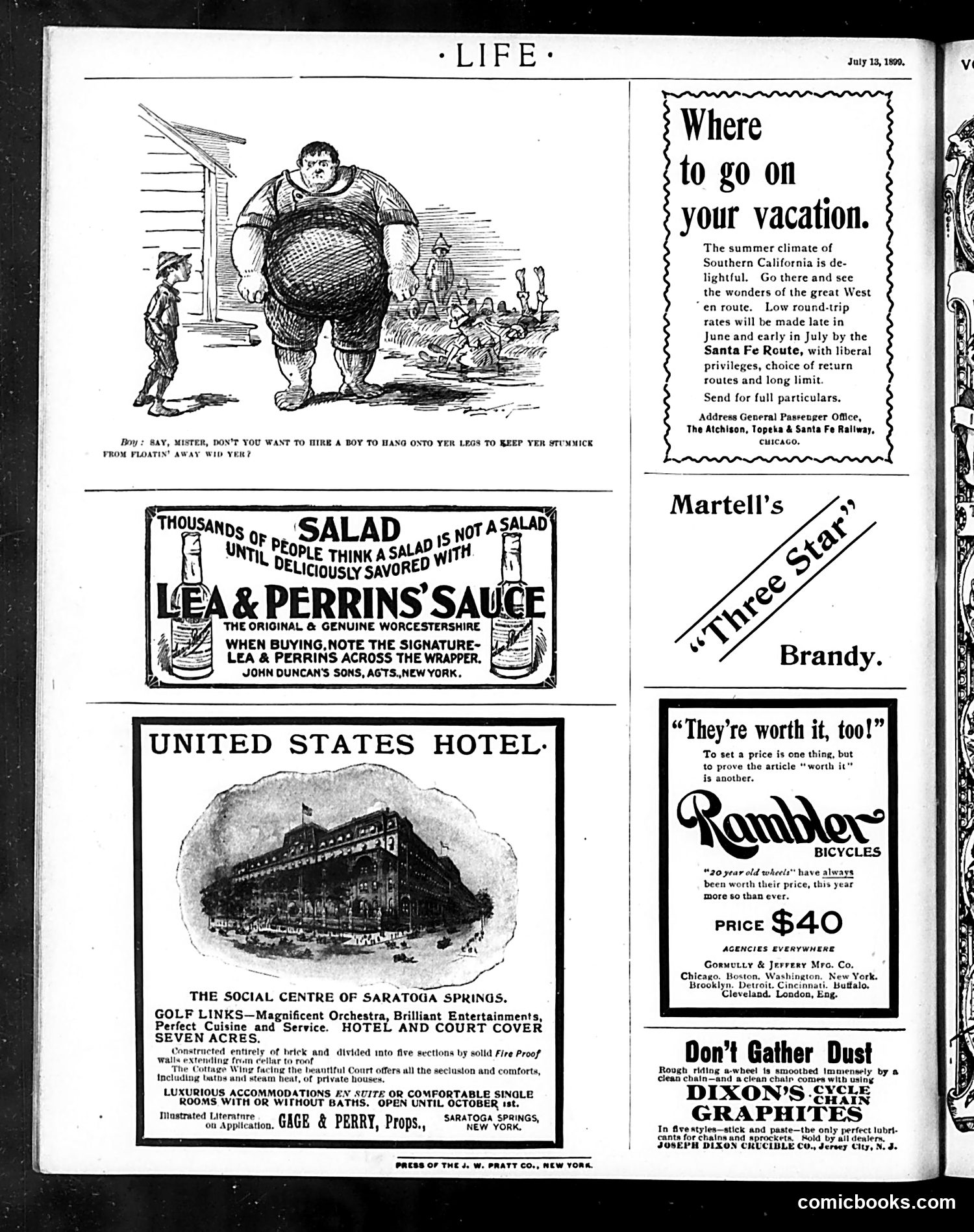
The main cartoon depicts a street encounter between a thin street urchin and an extremely obese man. The boy offers to hire himself out to "hang onto yer legs to keep yer stomach from floatin' away." This is satire of **extreme wealth inequality and obesity** in the Gilded Age. The grotesquely fat figure represents wealthy excess and over-consumption, while the desperate, malnourished boy represents urban poverty. The joke's dark humor mocks the rich man's obvious gluttony—so excessive his body appears to levitate—while simultaneously highlighting the desperation of poor children forced to seek any work. The exaggerated caricature style was typical of *Life* magazine's satirical approach to social commentary. The caption's deliberate working-class dialect adds to the satirical edge, emphasizing class division. The page also contains period advertisements (Lea & Perrins sauce, hotels, bicycles, brandy), typical of *Life*'s commercial content.