
Life, 1899-07-13 · page 4 of 20
Life — July 13, 1899 — page 4: what you’re looking at
What you’re looking at
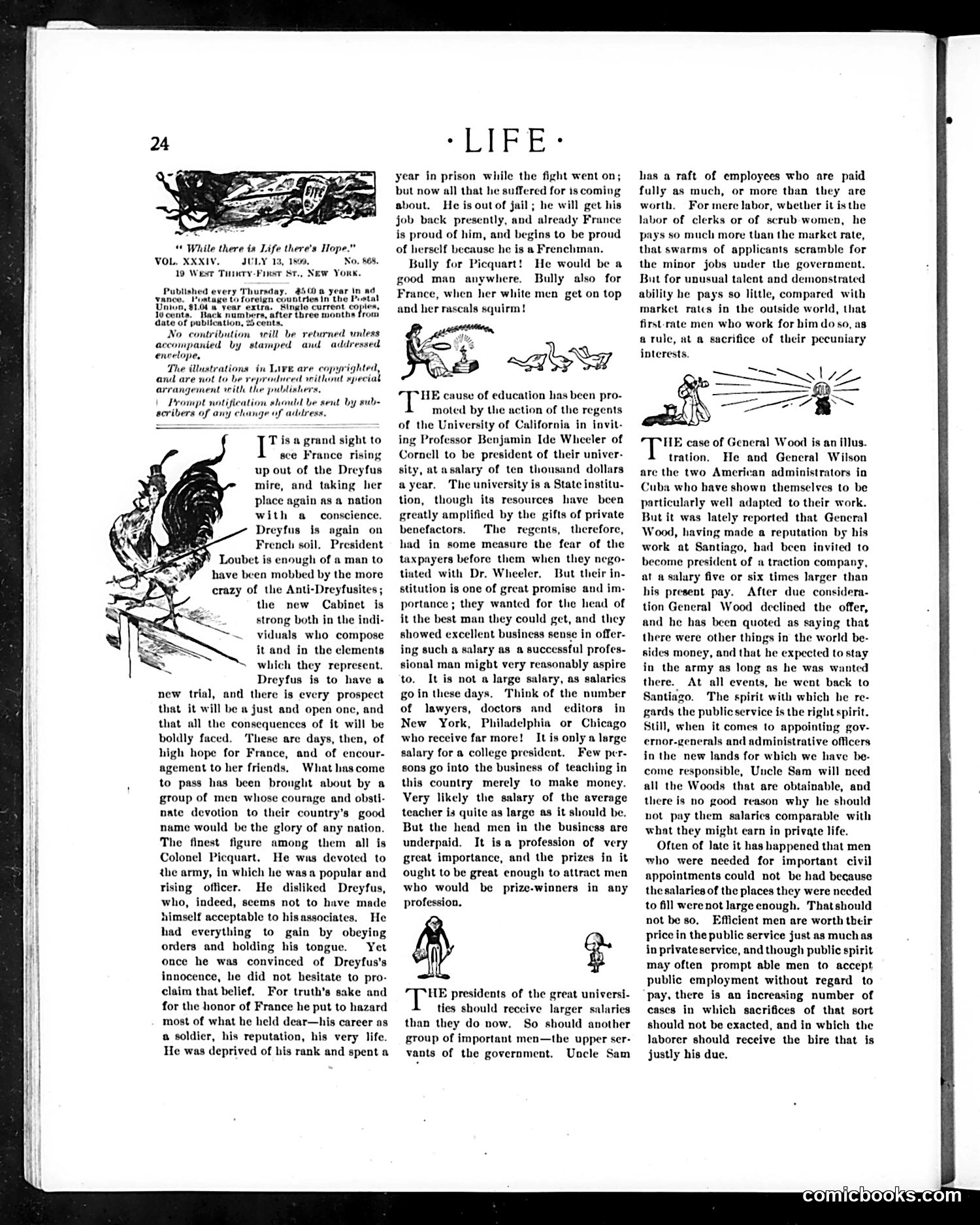
The page contains two political cartoons addressing French affairs and American education policy. The **left cartoon** depicts Colonel Dreyfus (identifiable from context referencing his recent exoneration). The satire mocks the Anti-Dreyfusites—those who opposed his reinstatement—suggesting they're "crazy" for their stubborn refusal to accept his vindication. The image criticizes French political divisions surrounding the famous Dreyfus Affair. The **right section** discusses California's University of California appointing Professor Benjamin Ide Wheeler as president at $10,000 annually. The accompanying cartoon satirizes General Wood's appointment to Cuban administration, suggesting government positions are filled by military figures rather than merit-based civilians. Both pieces critique institutional appointments and political obstinacy in early 1900s American and French governance.
📄 Transcribed text from this page (OCR, searchable)
Machine-transcribed from the original scan — historical spelling and the odd misread are preserved.
Published every Thursday. 2500 @ year in ad. Vance, Mostage to foreign countries in the Postal Un 1.04 a year extra. Single curren! copies. Back numbers, after three months fr ifeation, 2 cents, No contribution will be returned unless accompanied by stamped and addressed envelope, The illustri righted, anil are not be reproduced without speciat arrangement with the publisher: Prompt no scribers of a: LiL be sent by sub dress. T is a grand sight to sce France rising up out of the Dreyfus mire, and taking her place again as a nation with a conscience. Dreyfus is again on French soil. President Loubet is enough of a man to have been mobbed by the more crazy of the Anti-Dreyfusites ; the new Cabinet is strong both in the indi- viduals who compose it and in the elements which they represent. Dreyfus is to have a new trial, and there is every prospect that it will be a just and open one, and that all the consequences of it will be boldly faced. ‘These are days, then, of high hope for France, and of encour- agement to her friends, What hascome to pass has been brought about by a group of men whose courage and obsti- nate devotion to their country’s good name would be the glory of any nation. The finest figure among them all is Colonel Picquart. He was devoted to the army, in which he was a popular and rising officer. He disliked Dreyfus, who, indeed, scems not to have made himself acceptable to his associates. He had everything to gain by obeying orders and holding his tongue. Yet once he was convinced of Dreyfus's innocence, he did not hesitate to pro- claim that belief. For truth’s sake and for the honor of France he put to hazard most of what he held dear—his career as a soldier, his reputation, his very life. He was deprived of his rank and spent a LIFE year in prison while the fight went on; but now all that he suffered for is coming about. He is out of jail; he will get his job back presently, and already France is proud of him, and begins to be proud of herself because he is a Frenchman. Bully for Picquart! He would be a good man anywhere. Bully also for France, when her white men get on top and her rascals squirm! waite HE cause of education has been pro- moted by the action of the regents of the University of California in invit- ing Professor Benjamin Ide Wheeler of Cornell to be president of their univer- sity, atasalary of ten thousand dollars ayear. The university is a State institu. tion, though its resources have been greatly amplified by the gifts of private benefactors. The regents, therefore, had in some measure the fear of the taxpayers before them when they nego- tiated with Dr. Wheeler, But their in- stitution is one of great promise and im- portance ; they wanted for the head of it the best man they could get, and they showed excellent business sense in offer- ing such a salary as a successful profes- sional man might very reasonably aspire to. It is not a large salary, as salaries goin these days. Think of the number of lawyers, doctors and editors in New York, Philadelphia or Chicago who receive far more! It is only a large salary for a college president. Few per- sons go into the business of teaching in this country merely to make money. Very likely the salary of the average teacher is quite as large as it should be. But the head men in the busincss are underpaid. It isa profession of very great importance, and the prizes in it ought to be great enough to attract men who would be prize-winners in any profession, e HE presidents of the great universi- ties should receive larger salaries than they do now. So should another group of important men—the upper ser- vants of the government. Uncle Sam has a raft of employees who are paid fully as much, or more than they are worth. For mere labor, whether it isthe labor of clerks or of scrub women, he pays so much more than the market rate, that swarms of applicants scramble for the minor jobs under the government. But for unusual talent and demonstrated ability he pays so little, compared with market ratcs in the outside world, that first-rate men who work for him do so, as arule, at a sacrifice of their pecuniary interests ———— | JZ a HE case of General Wood is an illus. tration, He and Gencral Wilson are the two American administrators io Cuba who have shown themselves to be particularly well adapted to their work. But it was lately reported that General Wood, having made a reputation by his work at Santiago, had been invited to become president of a traction company, at asalury five or six times larger than his present pay. After due considera- tion General Wood declined the offer, and he has been quoted as saying that there were other things in the world be- sides money, and that he expected to stay in the army as long as he was wanted there. At all events, he went back to Santiago. The spirit with which he re- gards the public service is the right spirit. Sul, when it comes to appointing gov- ernor-generals and administrative officers in the new lands for which we have be- come responsible, Uncle Sam will nced all the Woods that are obtainable, and there is no good reason why he should not pay them salarics comparable with what they might carn in private life. Often of late it has happened that men who were needed for important civil appointments could not be had because the salaries of the places they were necded to fill werenot large enough. Thatshould not be so, Efficient men are worth their price in the public service just as muchas in privateservice, and though public spirit may often prompt able men to accept public employment without regard to pay, there is an increasing number of cases in which sacrifices of that sort should not be exacted, and in which the laborer should receive the bire that is justly his due.