
Life, 1899-07-13 · page 6 of 20
Life — July 13, 1899 — page 6: what you’re looking at
What you’re looking at
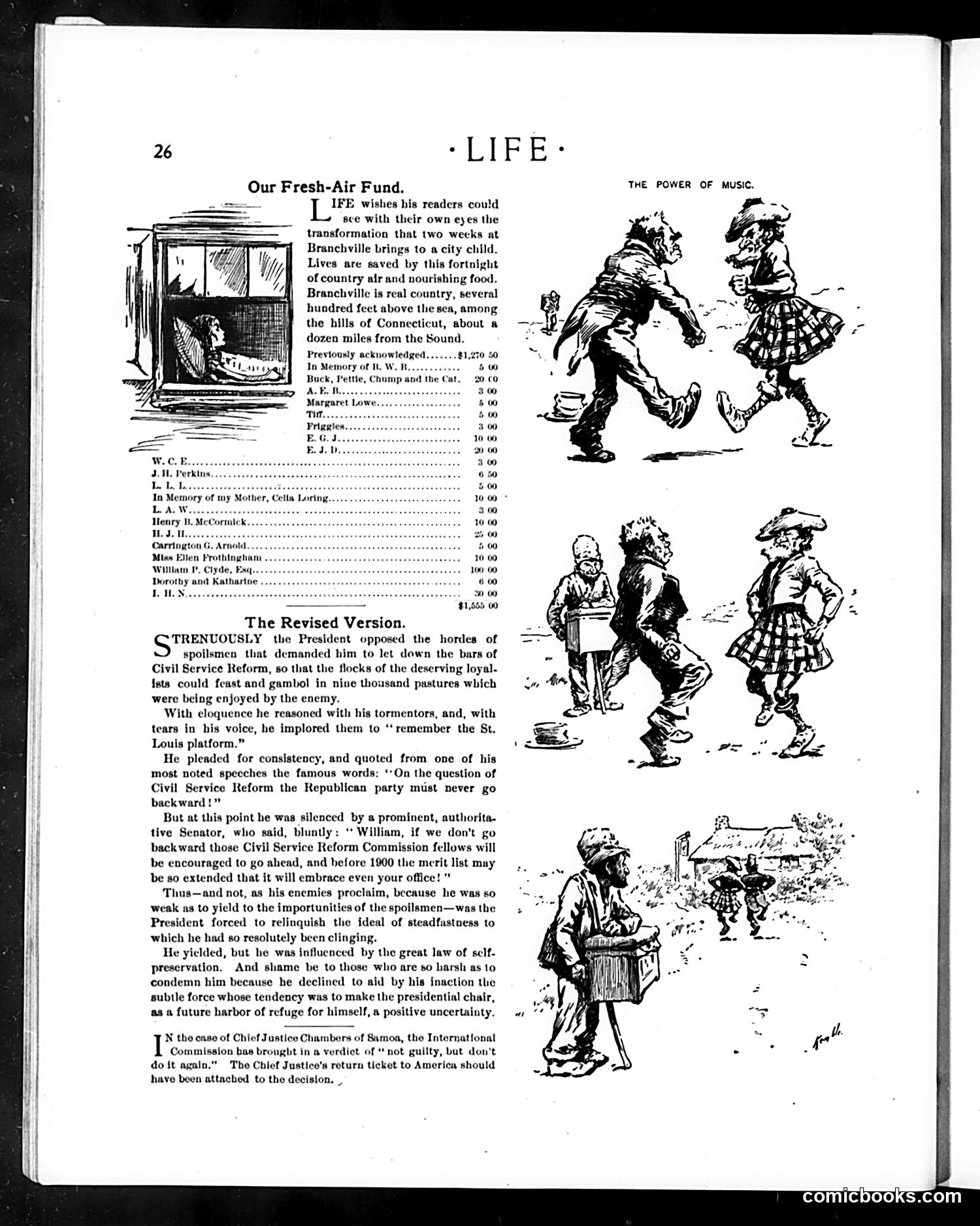
This page contains two distinct sections: **"Our Fresh-Air Fund"** (left): A fundraising list for sending city children to the countryside for health benefits. The accompanying sketch shows a child at a window, illustrating the magazine's charitable cause. **"The Power of Music"** (right): A series of cartoons depicting what appears to be a romantic or comedic scenario between two figures—likely a man and woman—dancing or being charmed by music. The sketches show playful interaction, with the final panel showing musicians performing outdoors. **"The Revised Version"** (center): Political commentary on Civil Service Reform, discussing presidential pressure regarding spoilsmen (political appointees). The text references debates about merit-based versus patronage-based government positions during the late 19th/early 20th century Civil Service Reform movement. The page blends satire about government corruption with lighter entertainment content typical of Life magazine's satirical approach.
📄 Transcribed text from this page (OCR, searchable)
Machine-transcribed from the original scan — historical spelling and the odd misread are preserved.
* LIFE: Our Fresh-Air Fund. THE POWER OF MUSIC. IFE wishes his readers could sce with their own eyes the transformation that two weeks at Branchville brings to a city child. Lives are saved by this fortnight of country air and nourishing food. Branchville is real country, several hundred feet above the sea, among the hills of Connecticut, about a dozen miles from the Sound. Previously acknowledged In Memory of 8. W. B. ettle, Champ W.C.E... 4.11. Perkins L. be, bees In Memory of my LAW. Henry 8. McCormick Carrington G. Arnold. ‘Milas Ellen Frothinghan The Revised Version. TRENUOUSLY the President opposed the hordes of spoilsmen that demanded him to let down the bars of Civil Service Reform, so that the flocks of the deserving loyal- ists could feast and gambol in nive thousand pastures which were being enjoyed by the enemy. With eloquence he reasoned with his tormentors, and, with tears in his voice, he implored them to ‘remember the St. Louis platform.” He pleaded for consistency, and quoted from one of his most noted speeches the famous words: ‘*On the question of Civil Service Reform the Republican party must never go backward!” But at this point he was silenced by a prominent, authorita- tive Senator, who said, bluntly: ‘ William, if we don't go backward those Civil Service Reform Commission fellows will be encouraged to go ahead, and before 1900 the merit list may be so extended that it will embrace even your office! " ‘Thus—and not, as his enemies proclaim, because he was so weak as to yicld to the importunitics of the spoilsmen—was the President forced to relinquish the ideal of steadfastness to which he had so resolutely been clinging. He yielded, but he was influenced by the great law of sclf- preservation. And shame be to those who are so harsh as to condemn him because he declined to aid by his inaction the subtle force whose tendency was to make the presidential chair, as a future harbor of refuge for himself, a positive uncertainty. N the case of Chief Justice Chambers of Samoa, tho International Commission bas brought in a verdict of * not guilty, but don't do it again,” The Chief Justice's return ticket to America should have been attached to the decision. _