
Life, 1899-07-13 · page 8 of 20
Life — July 13, 1899 — page 8: what you’re looking at
What you’re looking at
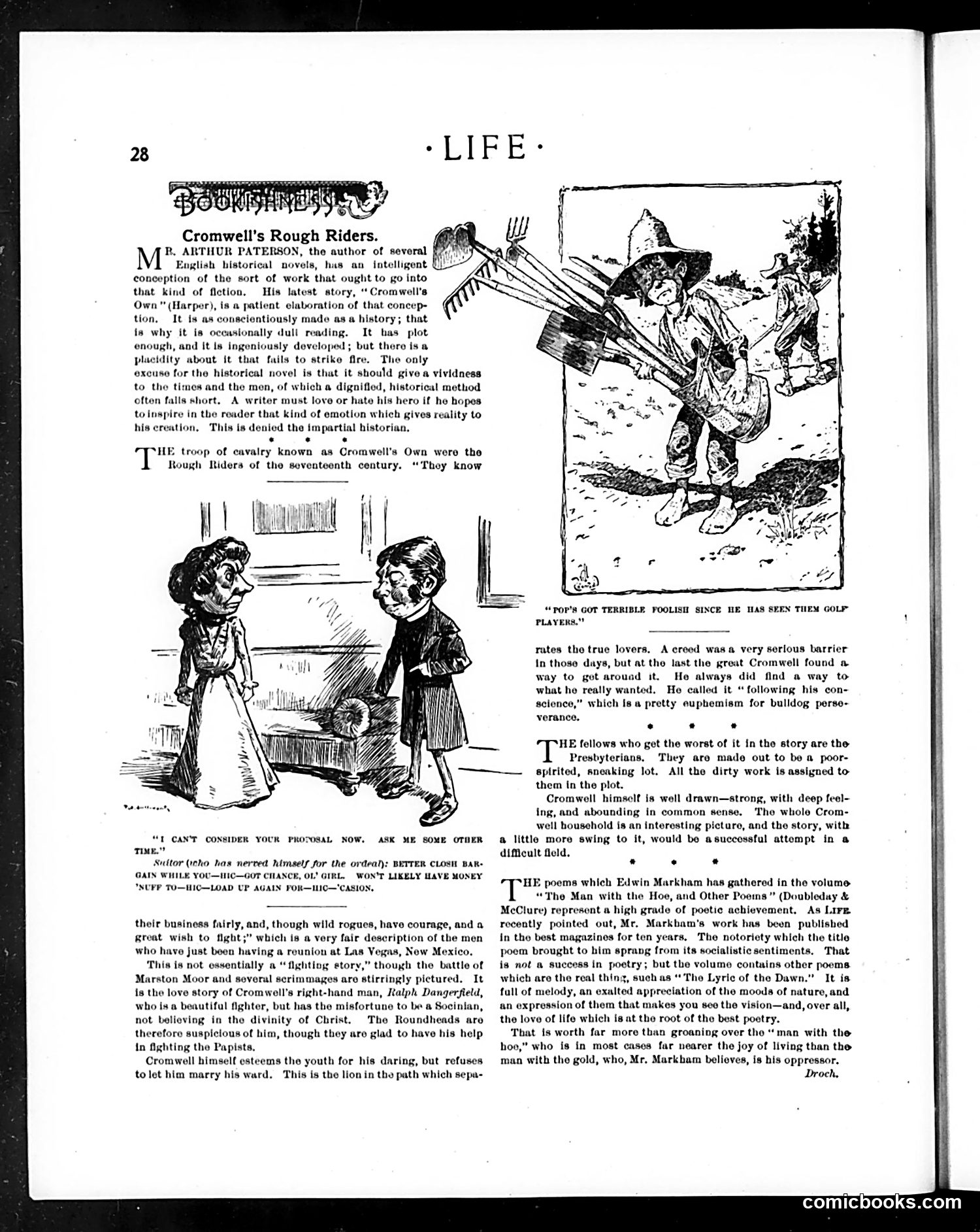
This page contains a book review of "Cromwell's Rough Riders" by Arthur Paterson. The left cartoon illustrates a domestic scene where a woman asks a man about his "proposal," with text suggesting financial concerns ("Won't likely have money enough to—load up again"). The right illustration shows armed figures in period dress, likely depicting Cromwell's cavalry soldiers referenced in the book title. The review discusses how historical fiction should balance vivid characterization with accuracy. It critiques Paterson's portrayal of Cromwell and his supporters, noting they're depicted as "poor-spirited, sneaking lot" in the narrative. The page evaluates the novel's literary merit and historical authenticity, a typical 19th-century magazine book review format.
📄 Transcribed text from this page (OCR, searchable)
Machine-transcribed from the original scan — historical spelling and the odd misread are preserved.
Cromwell's Rough Riders. RB, ARTHUR PATERSON, the author of several M English historical novels, hus an intelligent conception of the sort of work that ought to go into that kind of fiction, His latest story, “Cromwell's Own" (Harper), is a patient claboration of that concep tion, It is as conscientiously made as a history; that is why it is occasionally dull reading. It bas plot enough, and it is ingeniously developed; but there is a plucidity about it that fails to strike fire. The only excuse for the historical novel is that it should give a vividness to the times and the men, of which a dignified, historical method often falls short, A writer must love or hate his hero if he hopes toinspire in the rouder that kind of emotion which gives reality to his creation, ‘This is denied the {mpartial historian, . . * TT troop of cavalry known as Cromwell's Own were tho Rough Riders of the seventeenth century. “They know “1 CANT CONSIDER YOUR PROTOSAL NOW. Time."? Suttor (iho has nerved himself for the ordeal): BETTER CLOSIt BAR+ GAIN WHILE YOU—I1C—GOT CHANCE, OL GIRL, WON'T LIKELY HAVE MONEY °NUFP TU—HIC—LOAD UP AGAIN FOR—11C—"casioN, ASK ME SOME OTHER their business fairly, and, though wild rogues, have courage, and a. great wish to fight;” which is a very fair description of the men who have just been having a reunion at Las Vegas, Now Mexico, ‘This is not ossentially a “fighting story,” though the battle of Marston Moor and several scrimmages aro stirringly pictured. It 1s the love story of Cromwoll’s right-hand man, Ralph Dangerfield, who isa beautifal fighter, but has the misfortune to be a Socinian, not believing in the divinity of Christ. The Roundheads aro therefore suspicious of him, though they uro glad to have his help in fighting the Papists, Cromwell himself esteems the youth for his daring, but refuses tolet him marry his ward. This is the lion in the path which sepa- “Ppor's GOT TERRIBLE FOOLISH SIXCE ME MAS SEEN THEM GOLF PLAYERS.” rates tho true lovers, A creed wasa very serious barrier In those days, but at the last the great Cromwell found a way to got arouad it. He always did find a way to what ho really wanted, He called it “following his con- science,” which Is a pretty ouphemism for bulldog perso- verance. ° * . HE fellows who get the worst of it in tho story are the Presbyterians, ‘They are made out to be a poor- spirited, sneaking lot. All the dirty work is assigned to them in the plot. Cromwell himselt is well drawn—strong, with deep feel ing, and abounding in common sense. ‘Tho whole Crom- well household is an interesting picturo, and the story, with @ little more swing to it, would be asuccossful attempt in a diMcult fleld, * . * HE poems which Edwin Markham has gathered in the volume. “The Man with the Hoe, and Other Poems” (Doubleday & McClure) represont a high grade of poetic achievement, As LIFE recently pointed out, Mr. Markbam's work has been published In tho best magazines for ten years, ‘The notoriety which the title poem brought to him sprang from its socialistic sentiments, That is not a success in poetry; but the volume contains other poems which aro tho real thing, such as “Tho Lyric of the Dawn.” It is fall of melody, an exalted appreciation of the moods of nature, and an expression of them that makes you seo the vision—and, over all, tho love of life which is at the root of the best poetry. That 1s worth far more than groaning over the “man with the hoo,” who is in most cases far nearer the joy of living than the man with the gold, who, Mr, Markham belioves, is his oppressor. Droch, comicbooks.com