
A complete issue · 20 pages · 1899
Life — June 8, 1899
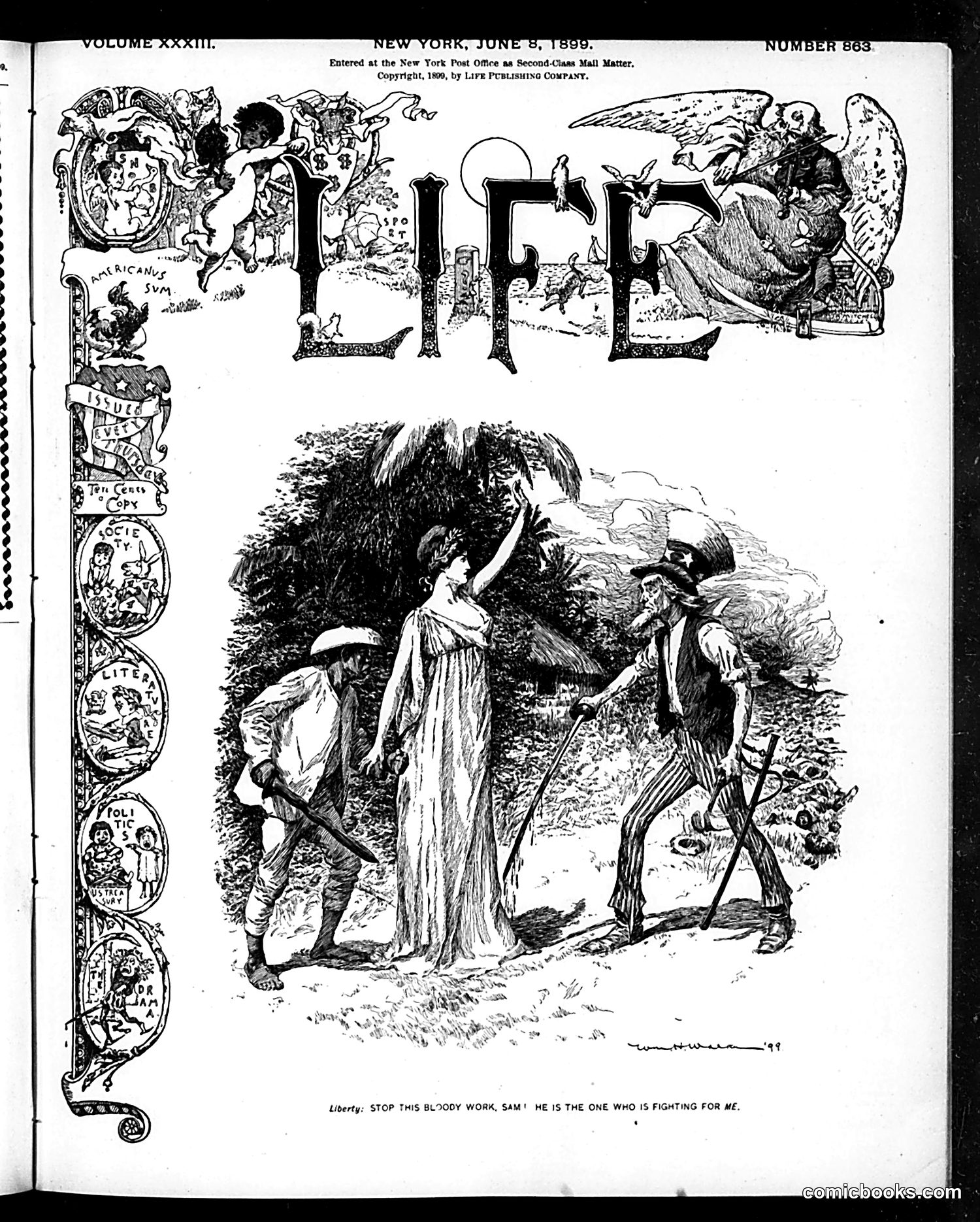
This satirical cartoon depicts **Lady Liberty** (the female allegorical figure representing America) intervening in what appears to be a violent conflict. Two male figures—likely representing warring parties or nations—are engaged in brutal combat with tools/weapons while Liberty commands them to stop, saying "STOP THIS BLOODY WORK, SAM! HE IS THE ONE WHO IS FIGHTING FOR ME." The timing (June 1898) and reference to "Sam" (Uncle Sam) suggests this relates to the **Spanish-American War**, possibly satirizing American involvement or the justifications given for military intervention. The cartoon critiques the contradiction between America's stated ideals of liberty and the violent realities of warfare conducted in her name.
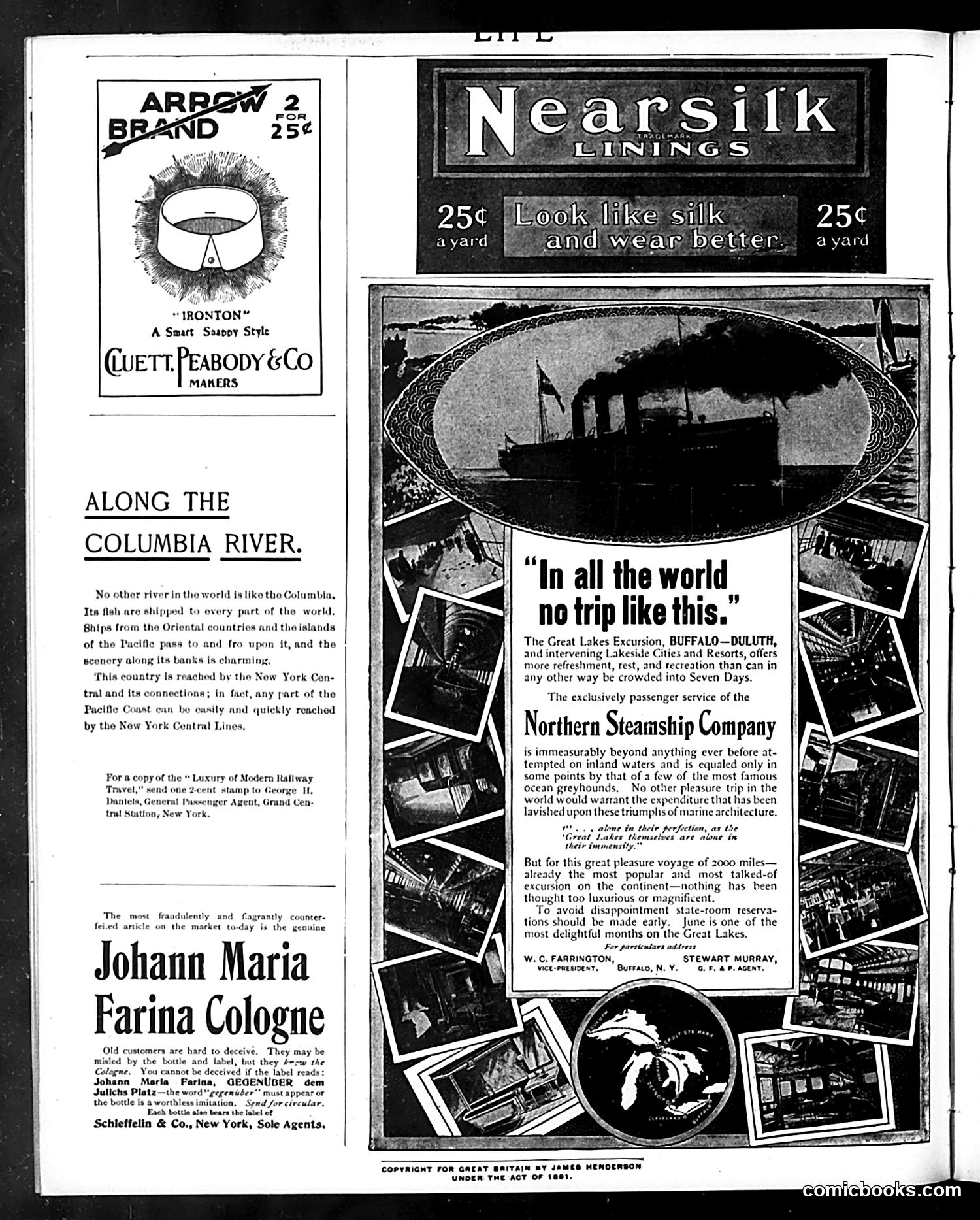
This page is primarily **advertising**, not satire or political commentary. It contains three distinct advertisements: 1. **Arrow Collar** (top left): A collar brand ad featuring the "Irontown" style from Cluett, Peabody & Co., priced at 2 for 25¢. 2. **Nearsilk Linings** (top right): A textile product marketed as affordable silk-look fabric at 25¢ per yard. 3. **Northern Steamship Company** (center-right): The dominant ad promoting luxury cruises along the Columbia River and Great Lakes, emphasizing exclusivity and scenic beauty. It includes a steamship image and surrounding landscape photographs. 4. **Johann Maria Farina Cologne** (bottom left): A fragrance advertisement highlighting the genuine product's superiority over imitators. The page contains informational text about Columbia River travel but lacks political or satirical content. It represents typical early 20th-century *Life* magazine advertising for consumer goods and leisure travel.
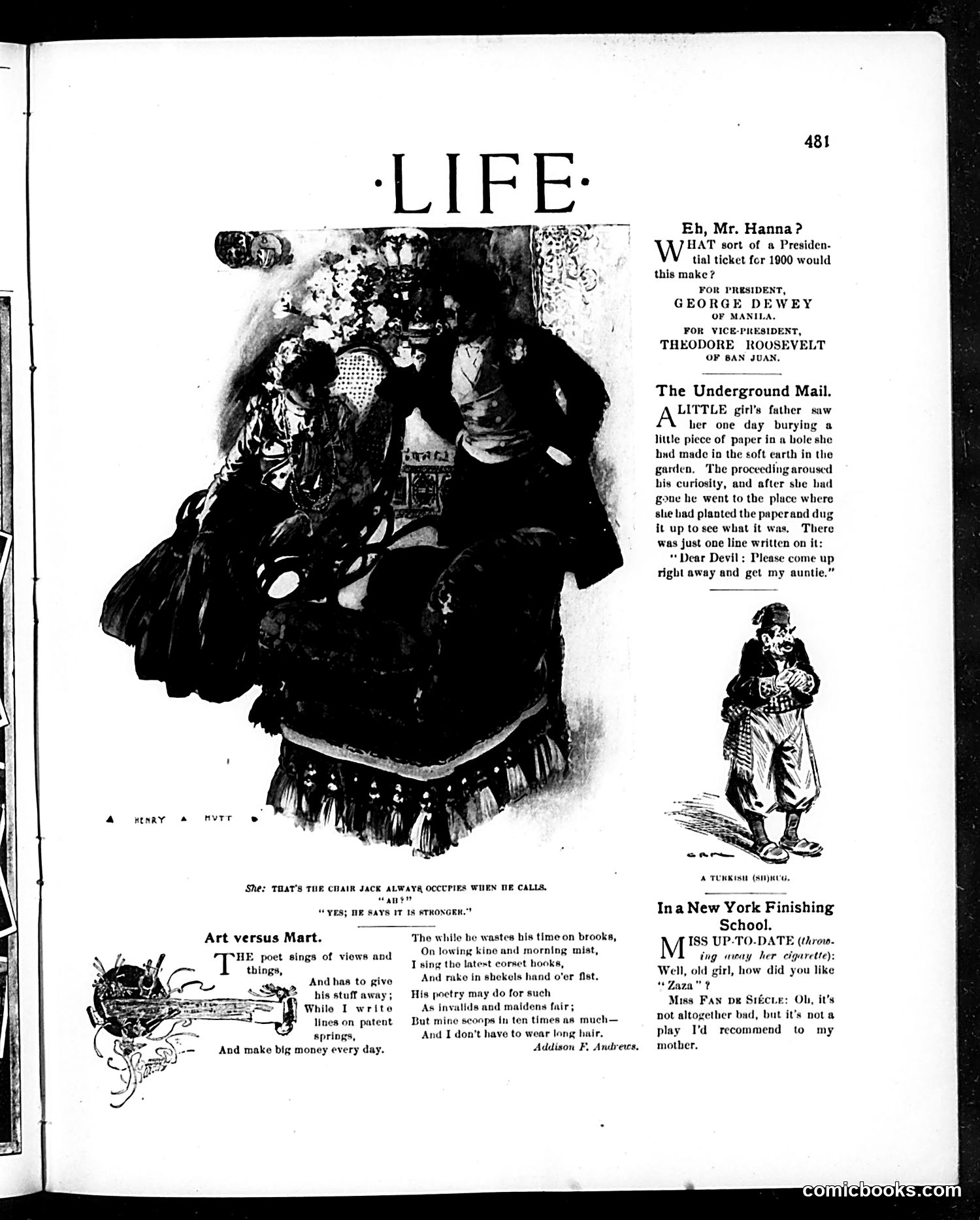
The main cartoon at top addresses the 1900 U.S. presidential election, proposing **George Dewey** (the Spanish-American War naval hero) for president and **Theodore Roosevelt** for vice president. Below, "Art versus Mart" satirizes the tension between artistic integrity and commercial success—a poet must compromise ideals to earn money, illustrated by the decorative header showing springs and a purse. "The Underground Mail" humorously depicts a child burying a note requesting her uncle's visit, treating it like postal delivery. The small figure labeled "A Turkish Urchin" appears unrelated to the main content. The page reflects turn-of-century American debates about art, commerce, imperialism, and the upcoming 1900 election.
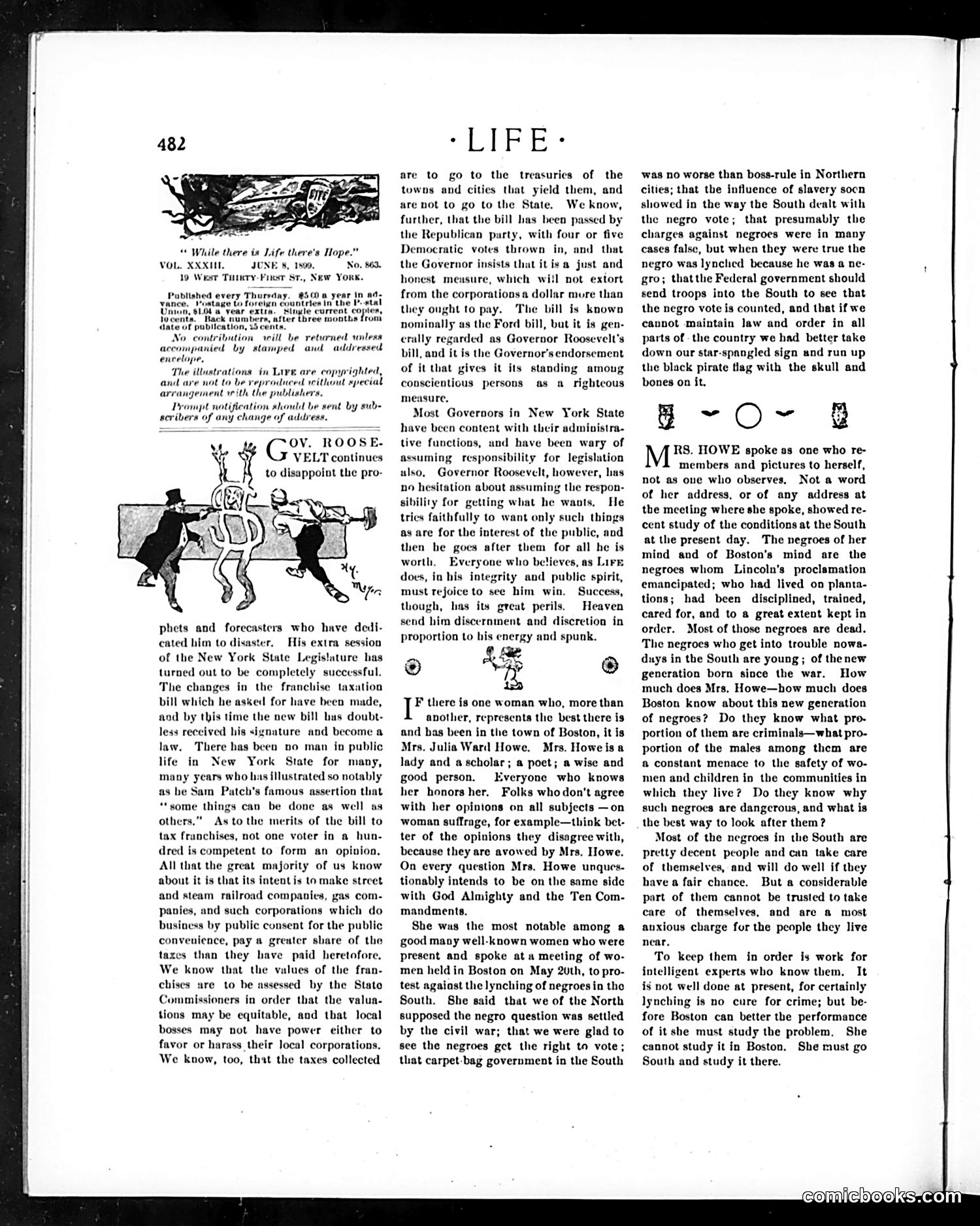
The main cartoon depicts **Governor Roosevelt** (Theodore Roosevelt, then New York Governor) astride a bucking horse labeled with Republican/political symbols. The satire criticizes Roosevelt for his reluctance to take legislative responsibility—the text notes he "continues to disappoint" those wanting him to champion bills in the legislature. The accompanying article discusses a **Mrs. Julia Ward Howe** speaking about lynching and negro rights in Boston. The text contrasts Northern claims about settling the "negro question" with Southern reality, suggesting Northern hypocrisy: they lecture the South while ignoring their own racial problems and the plight of this "new generation" of African Americans born after the Civil War. The satire targets both Roosevelt's political timidity and Northern moral pretension on racial issues.
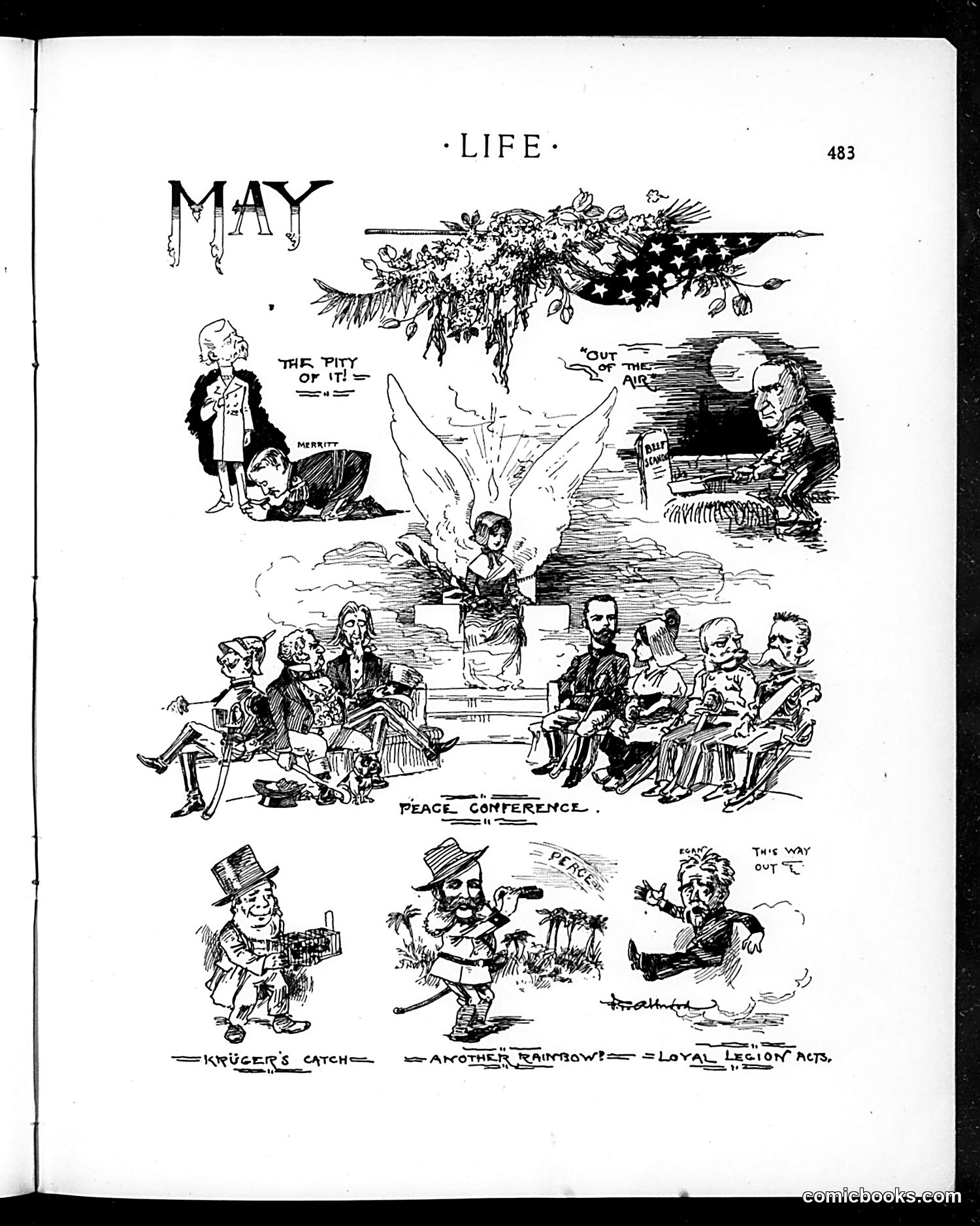
This page presents several cartoons satirizing post-World War I peace negotiations and international relations. The central "Peace Conference" cartoon depicts world leaders gathered around a table with an angel descending above—suggesting idealistic peace efforts undermined by political maneuvering. The top section shows "The Pity of It" with Merritt depicted alongside a fallen soldier, commenting on war's human cost. "Out of the Air" appears to mock empty diplomatic promises. Bottom cartoons reference specific figures: "Kruger's Catch" likely alludes to Paul Kruger; "Another Rainbow" and "Loyal Legion Acts" appear to satirize other contemporary political actors or events, though their specific references are unclear without additional historical context. The overall theme critiques the gap between peaceful intentions and political reality.
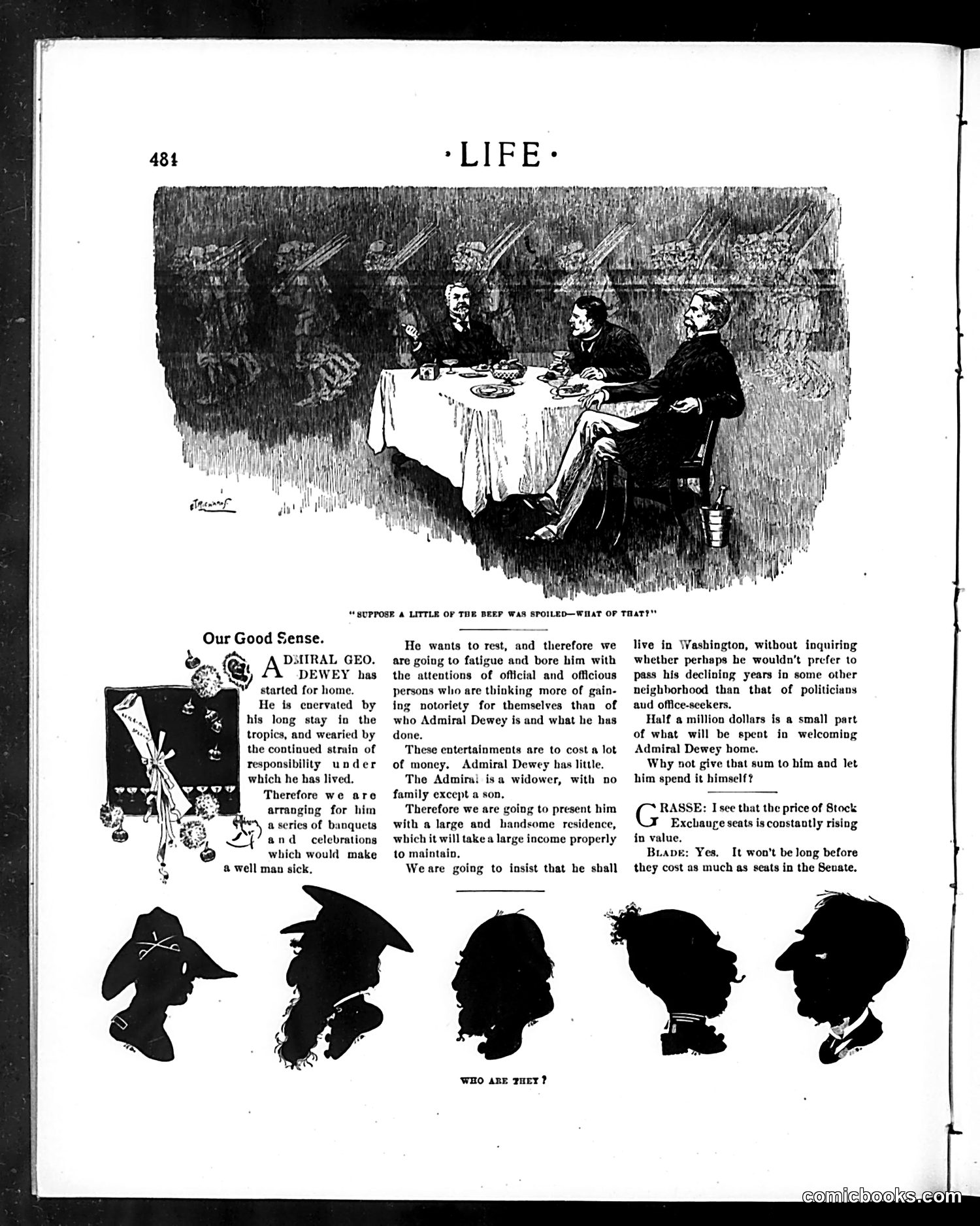
**Main Cartoon (top):** Three men dine while military figures parade in background. Caption reads "Before a little of the beef was spoiled—what of that?" This appears to satirize political figures dismissing military concerns or scandals as trivial. **"Our Good Sense" Section:** Discusses Admiral George Dewey's homecoming celebration. The text argues Dewey deserves rest rather than exhausting official functions, and proposes giving him money for a residence instead of elaborate public entertainments. **Bottom Section:** Five silhouette profiles labeled "Who Are They?" - likely contemporary political or military figures the contemporary reader would recognize. The page satirizes the tension between public spectacle and practical concerns regarding celebrated military figures.
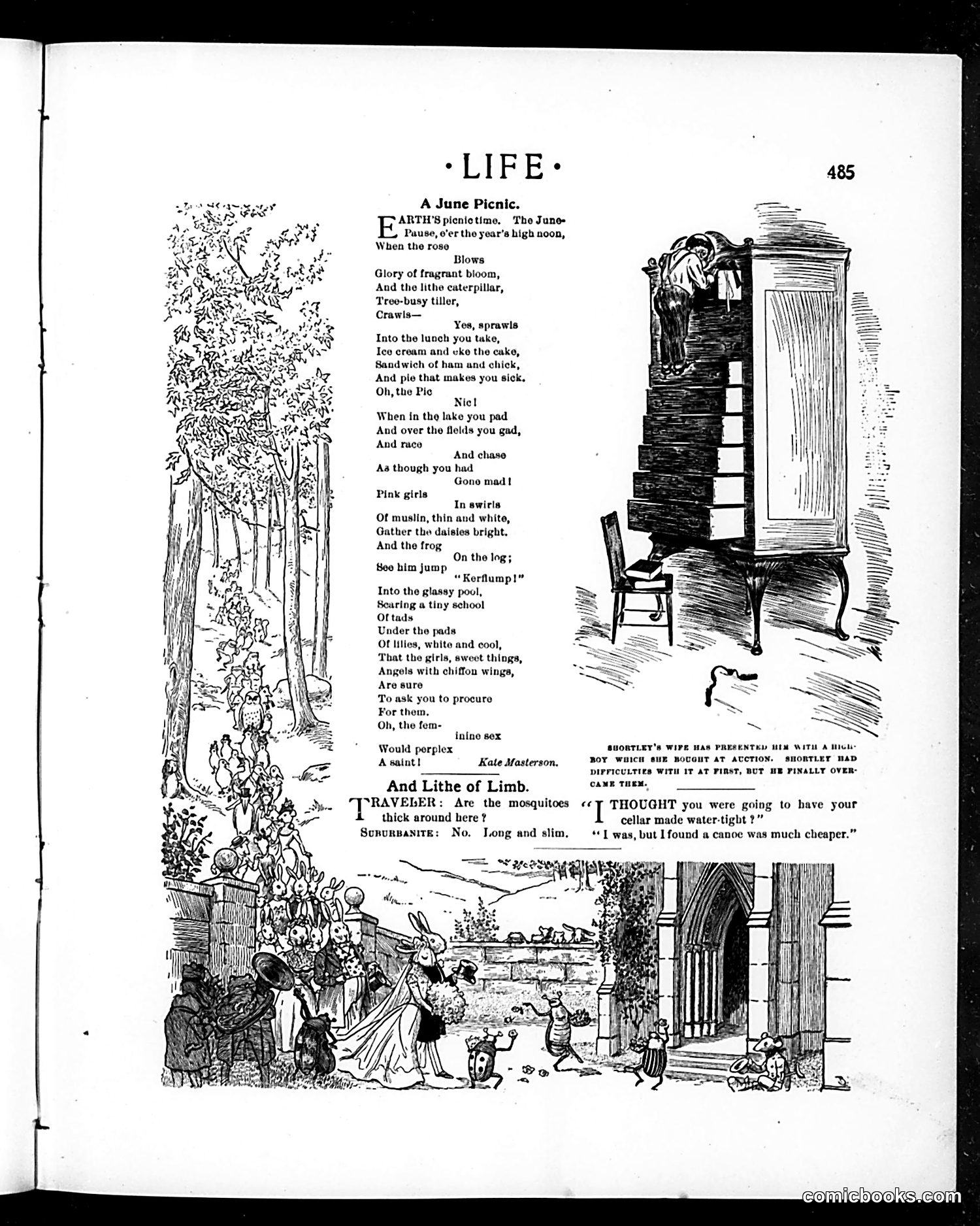
This page contains two satirical pieces. "A June Picnic" by Kate Masterson is a humorous poem mocking the messy reality of outdoor picnics—ice cream melts, food attracts insects ("mosquitoes thick around here"), and participants get dirty. It contrasts romantic ideals with uncomfortable reality. "And Lithe of Limb" appears to be a brief comedic exchange about cellar construction. A man thought he was commissioning water-tight cellar work but ended up with something "much cheaper"—the implication being shoddy workmanship or a bait-and-switch. The accompanying illustration shows what appears to be a hastily-built structure, reinforcing the joke about cutting corners on home improvement.
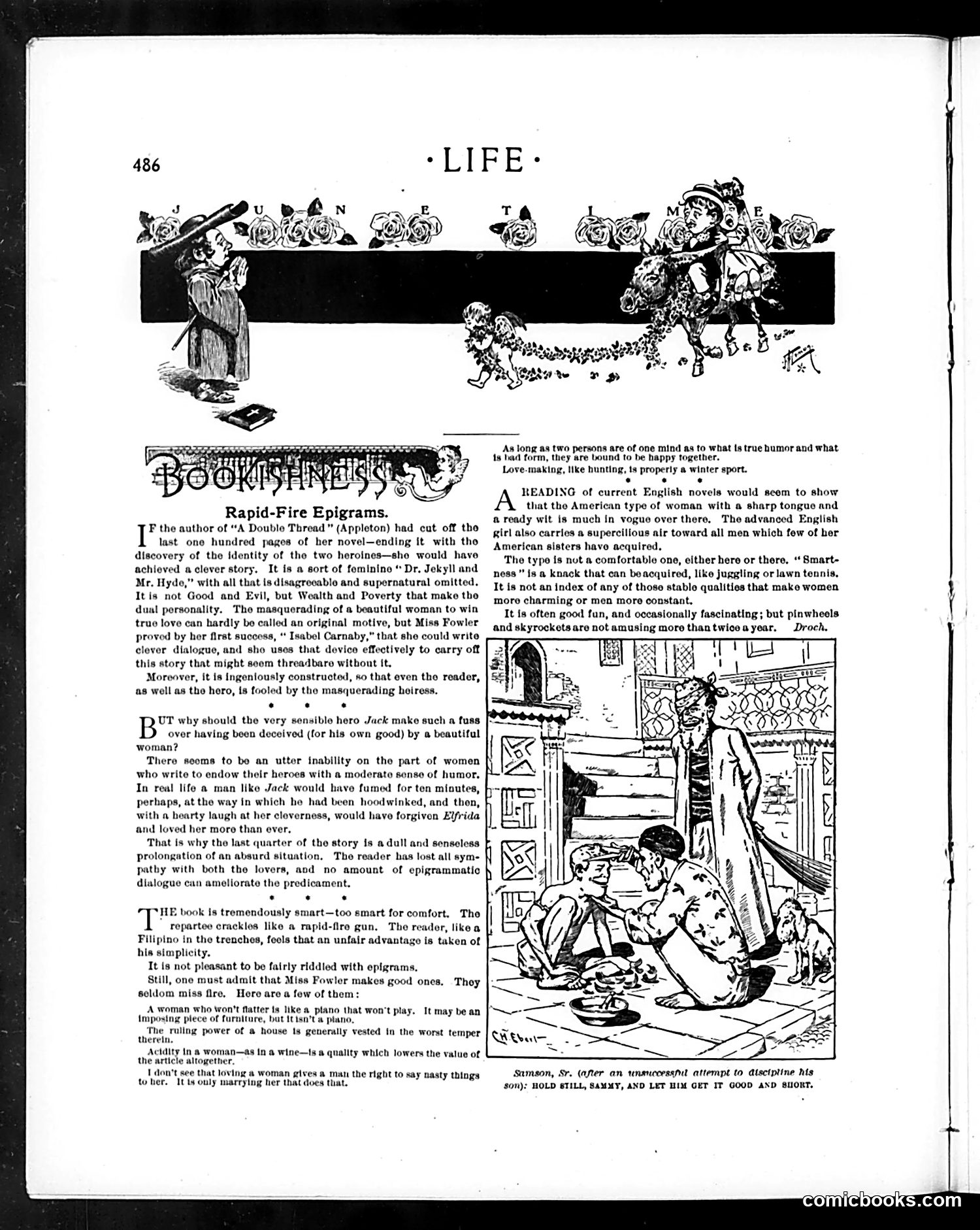
This page critiques the "American type of woman with a sharp tongue" through discussion of rapid-fire epigrams in novels. The text argues that while witty banter is entertaining in fiction, it's unrealistic and unflattering to actual women. The illustration shows a domestic scene where a man and woman interact, likely depicting the kind of sharp-tongued interchange the article criticizes. The accompanying caption references "Simson" attempting to discipline his son, suggesting a comparison between literary wit and real marital dynamics. The article's broader point: literary "smartness" in female characters doesn't translate to actual charm or virtue. The satire mocks both the literary convention of witty heroines and women who adopt this affectation, arguing such behavior undermines genuine human connection rather than enhancing it.
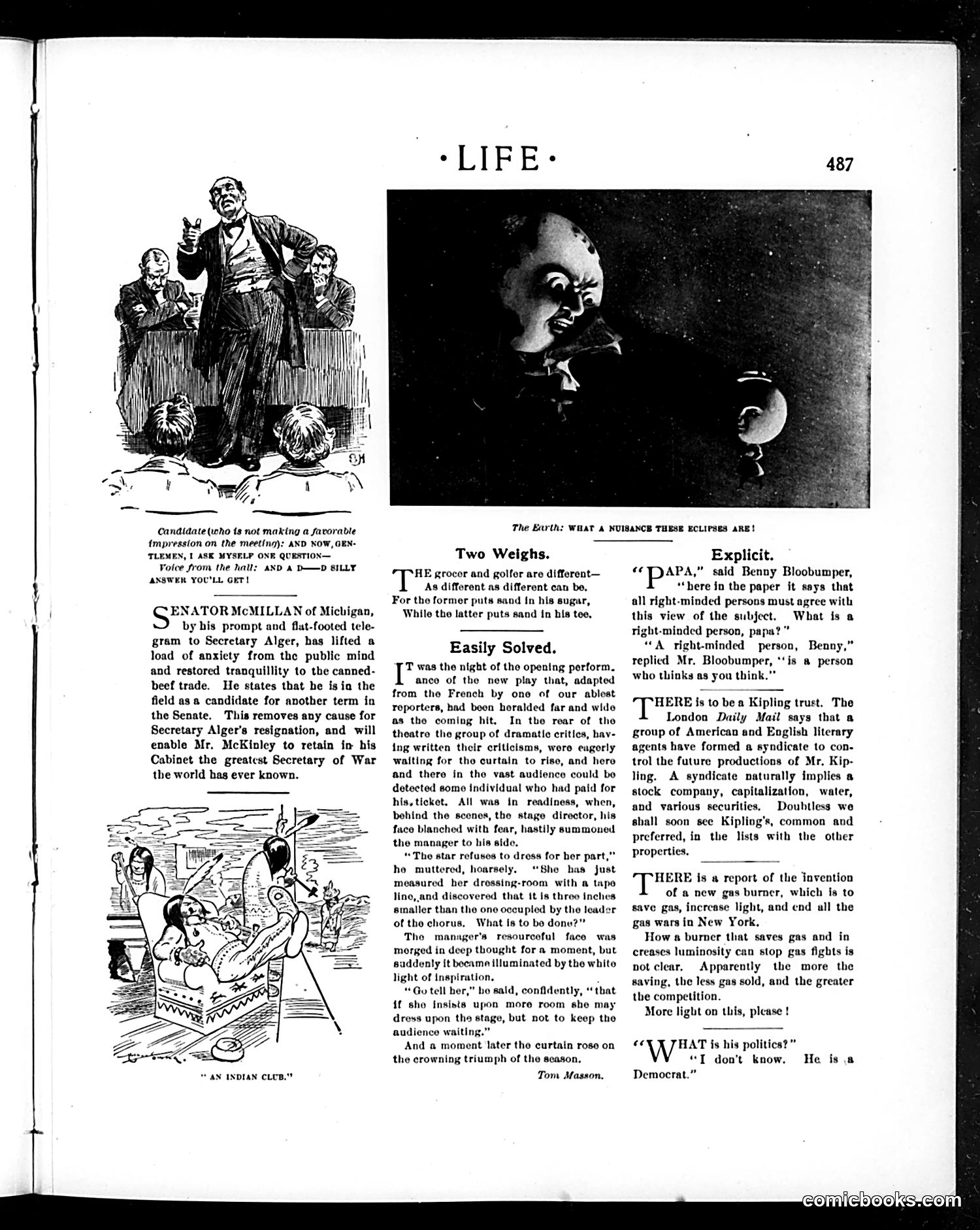
The top cartoon depicts **Senator McMillan of Michigan** using a telegraph to lift a heavy load from Secretary Alger, restoring "tranquility to the canned-beef trade." This references the Spanish-American War era scandal where Secretary of War Alger faced criticism over spoiled beef supplied to troops. McMillan's intervention suggests political maneuvering to remove Alger from office. The lower cartoon titled "An Indian Club" appears to satirize theatrical critics and dramatic production, showing figures in what seems to be a stage or performance setting—likely mocking contemporary theater controversies. The right side contains brief satirical items about a "Kipling trust" controlling literary production, gas lighting innovations, and a political joke about a "Democrat." The overall page combines political and cultural satire typical of Life magazine's approach.
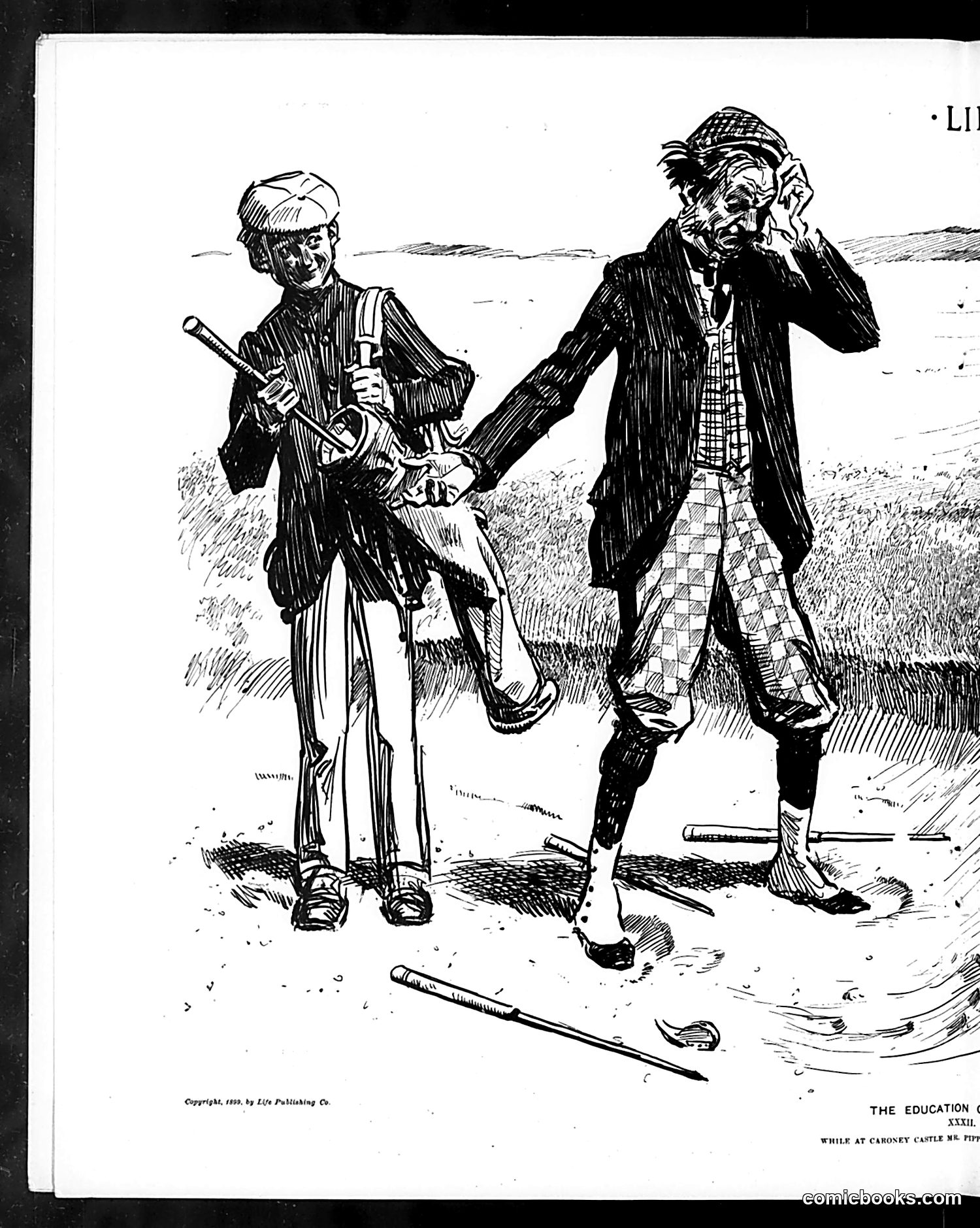
This political cartoon, titled "The Education of..." (complete title cut off), depicts two figures in a barren landscape. The figure on the right appears distressed, clutching his head, while the younger figure on the left holds a club or stick—suggesting violence or coercion as a teaching method. The caption references "Caroney Castle" (exact spelling unclear from OCR), which may indicate a specific historical or political location. The 1898 copyright date and Life magazine context suggest this satirizes contemporary political or social issues, likely mocking the "education" of someone through forceful or brutal means. Without clearer identification of the figures or the complete title, the specific political target remains unclear, though the satire appears to criticize authoritarian or violent approaches to governance or instruction.
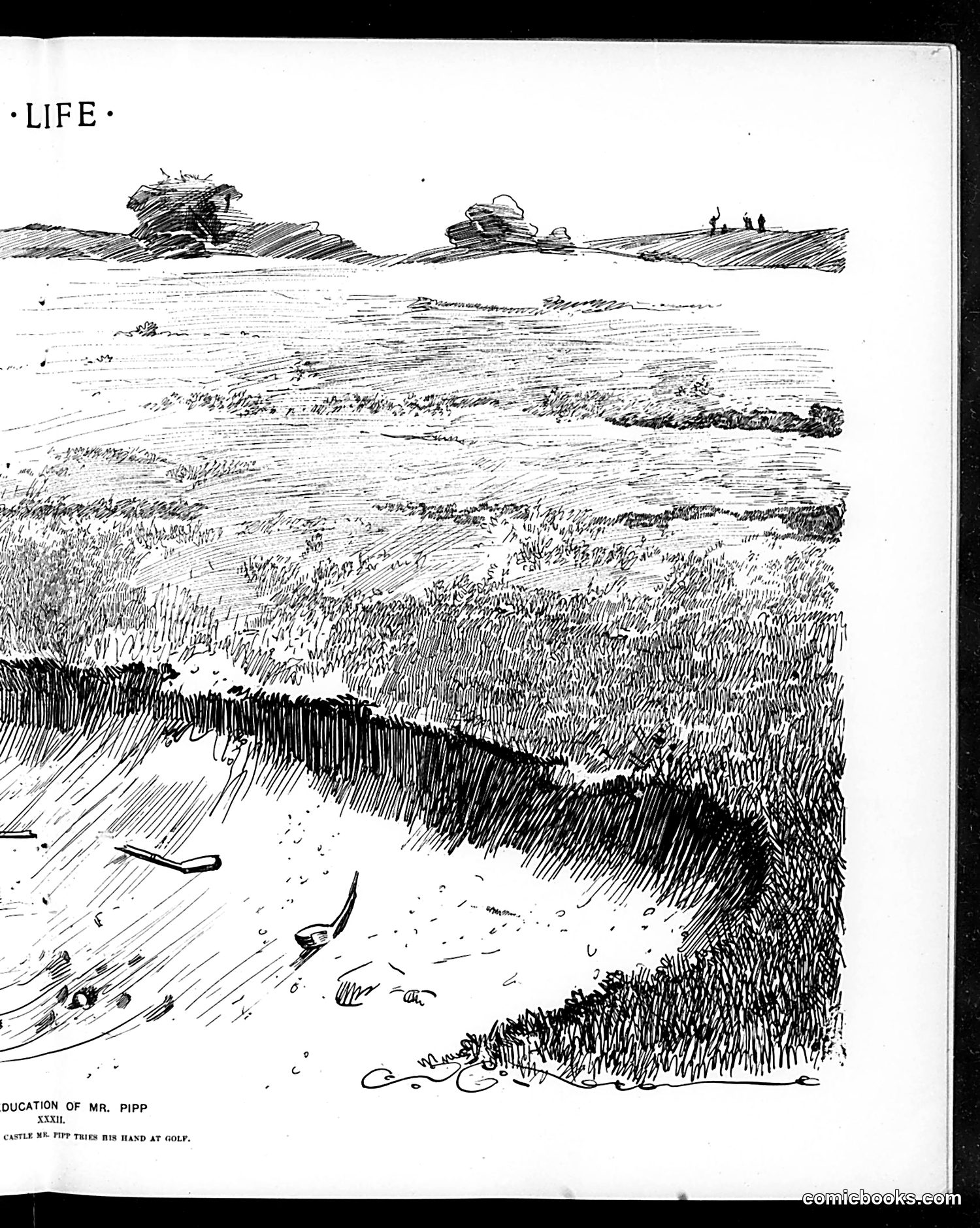
This appears to be a satirical illustration from Life magazine's "Education of Mr. Pipp" series (item XXXII). The caption reads "Castle Mr. Pipp Tries His Hand at Golf." The sketch depicts a golfer on a links course near water, with what appears to be a failed or awkward golf shot—possibly the ball going into the water or sand, or the golfer struggling with his swing. The detailed cross-hatching emphasizes the landscape and the golfer's predicament. Mr. Pipp appears to be an ongoing character used for satirical commentary through his misadventures. Without additional context about who Mr. Pipp represents, the humor likely plays on amateur golfing incompetence—a relatable topic for Life's audience during the magazine's era.
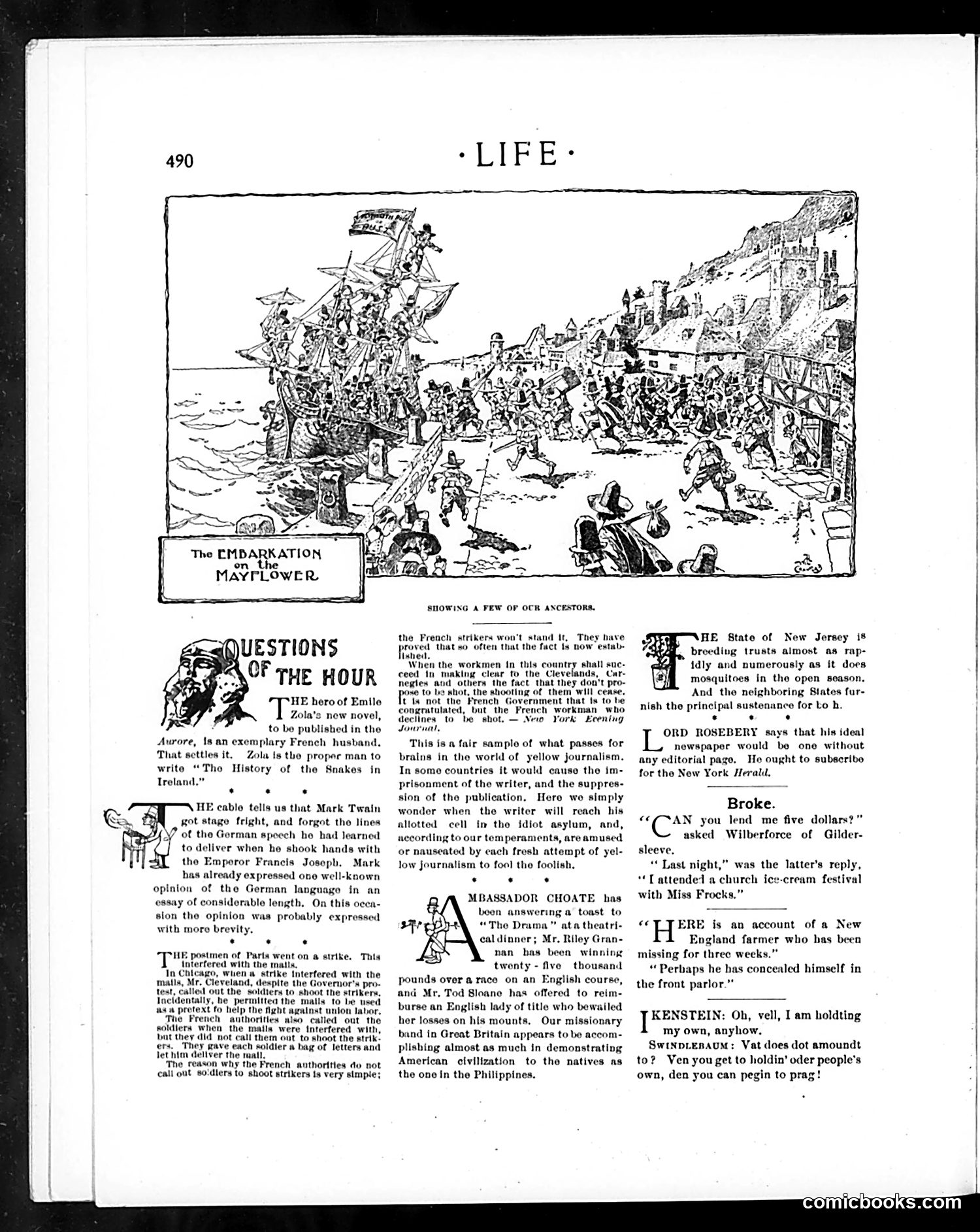
The main illustration depicts "The Embarkation on the Mayflower," showing a chaotic colonial-era scene with ships and crowds—likely meant to humorously contrast the Pilgrims' dignified historical narrative with messy reality. The text sections are satirical commentary on contemporary issues (early 1900s): - **Yellow journalism critique**: Attacks sensationalist newspapers for their low standards and how they mislead readers - **French labor disputes**: Discusses French strikers and government response - **Colonial/imperialist commentary**: References American missionary work and "civilization" efforts in the Philippines, suggesting skepticism about such ventures The "Questions of the Hour" format uses historical and current events to mock political hypocrisy and journalistic excess of the era.
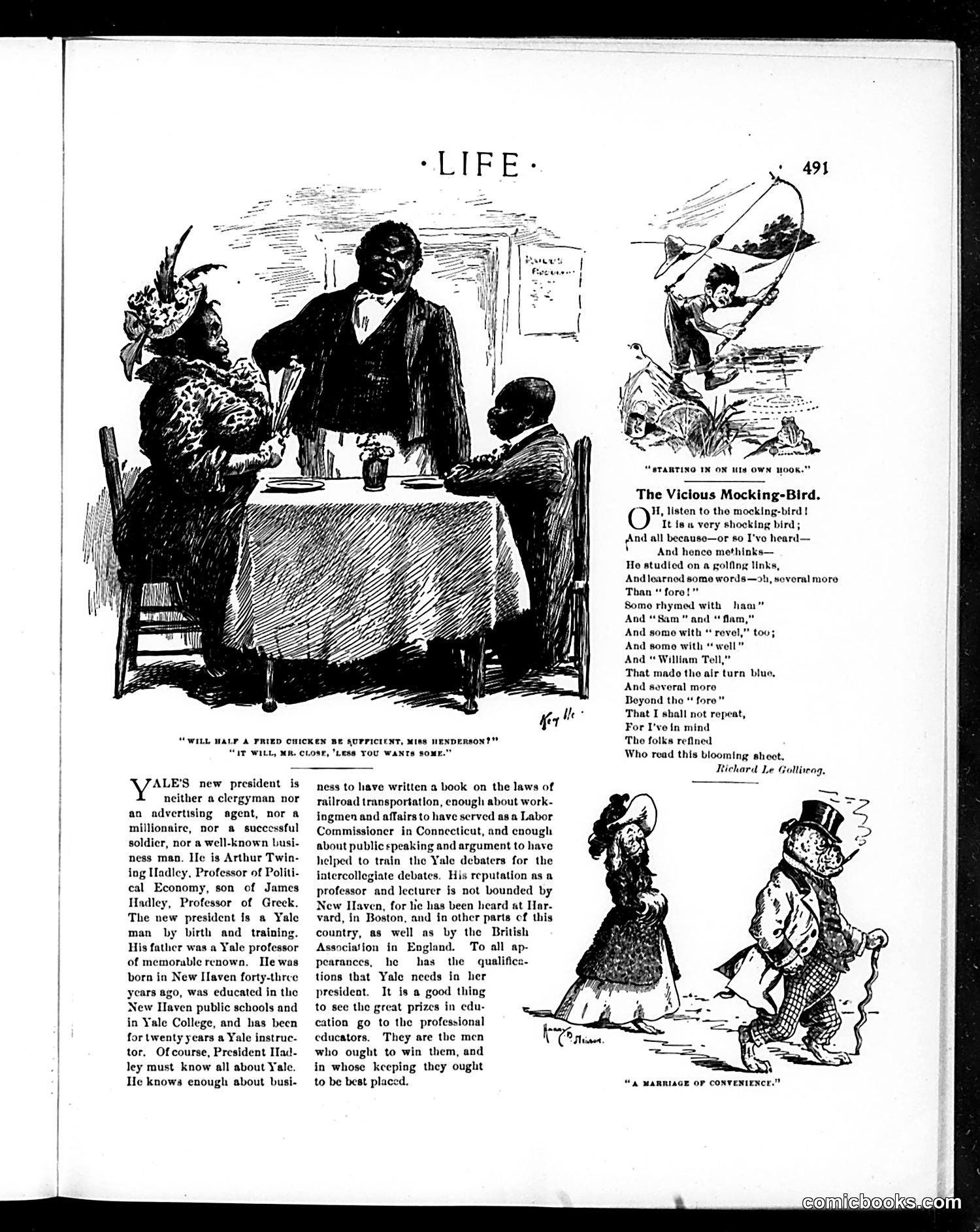
The main cartoon depicts Yale's new president, Arthur Twining Hadley, at dinner with a wealthy donor ("Mr. Close"). The satire mocks the implicit transaction: the donor asks if fried chicken will suffice as entertainment, suggesting a crude, transactional relationship between wealthy benefactors and university leadership. The caption "Will Half a Fried Chicken Be Sufficient?" implies the donor expects deference in exchange for financial support. The accompanying text praises Hadley as an actual educator rather than a businessman or clergyman—celebrating merit-based academic leadership over typical wealthy donors' influence. The secondary cartoons ("The Vicious Mocking-Bird" and "A Marriage of Convenience") appear to be humorous filler pieces unrelated to the main political point, typical of Life's satirical format. The page criticizes how universities depended on wealthy patrons while advocating that professional educators, not donors, should control institutional direction.
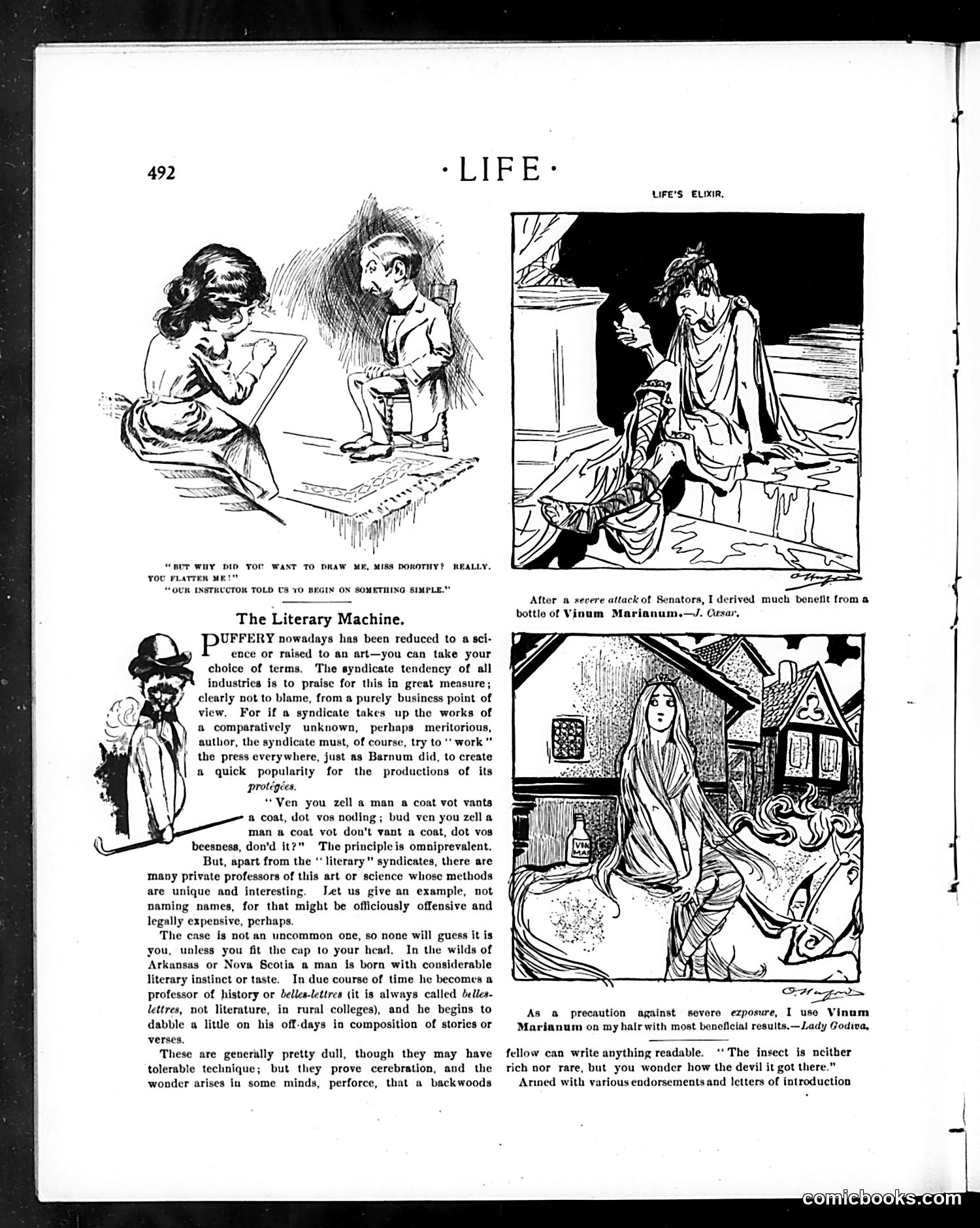
This page satirizes the commercialization of literature through "syndicates"—publishing operations that aggressively marketed mediocre writers to the public using promotional techniques borrowed from P.T. Barnum's circus showmanship. **"The Literary Machine"** (main article) mocks how syndicates manufactured literary celebrity regardless of actual talent. The opening cartoon jokes that a young woman draws an unimpressive man because her instructor told her to "begin on something simple"—implying the subject himself is simple/dull. **The sidebars titled "Life's Elixir"** parody fake patent medicine endorsements by fictitious historical figures (Julius Caesar, Lady Godiva). This visual pun equates syndicate-promoted literature with snake oil—worthless products sold through celebrity testimonials and aggressive marketing rather than genuine merit. The satire targets how turn-of-century publishing relied on hype and manufactured authority rather than literary quality, reducing writing to a commercial product like any other commodity.
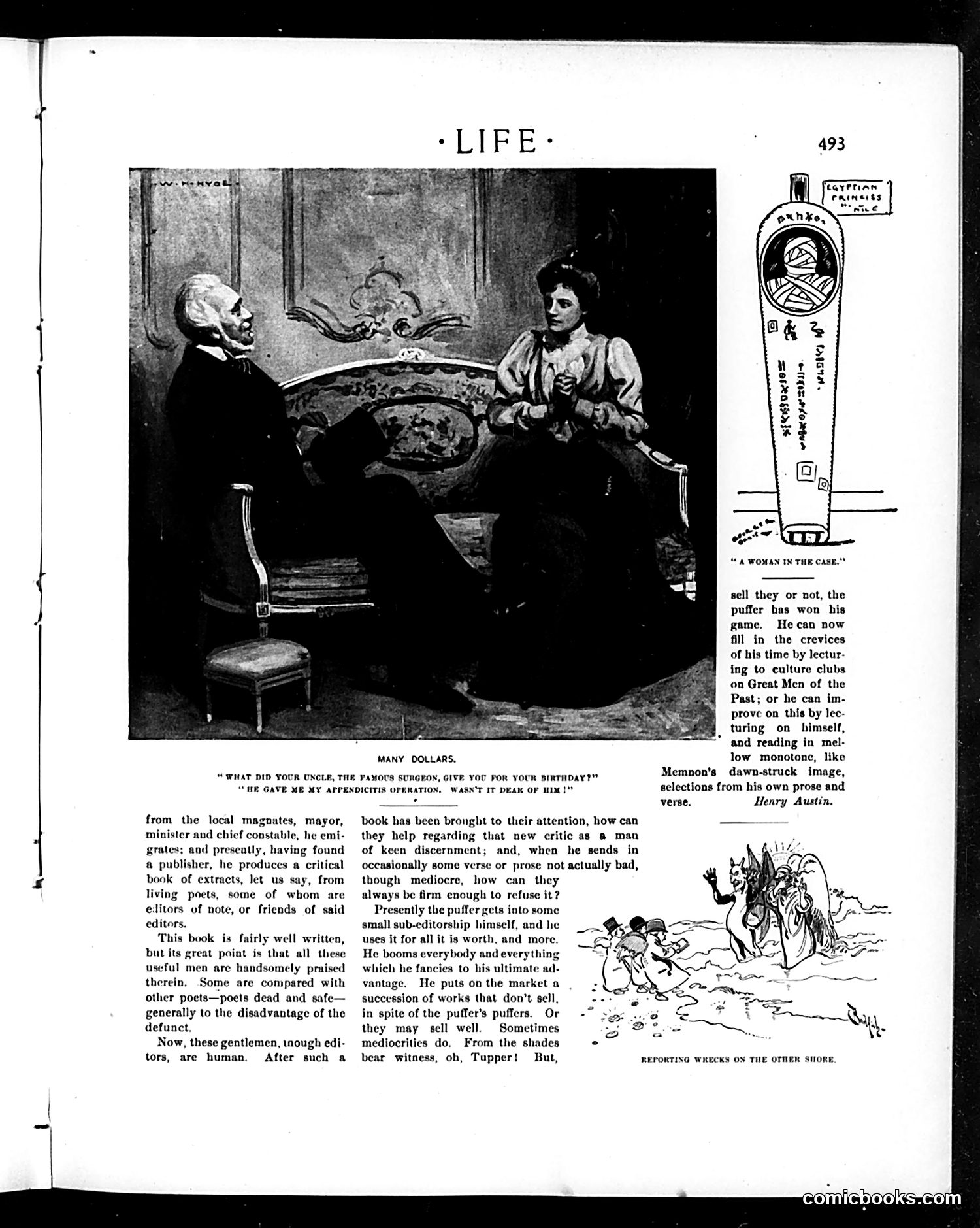
The main cartoon depicts a social satire about a famous surgeon's peculiar "birthday gift." When asked what his uncle gave him, a man replies: "An appendicitis operation"—framed as a generous present. The joke mocks wealthy doctors who perform unnecessary surgeries on family members, treating invasive medical procedures as favors rather than health needs. This reflects early-20th-century anxiety about surgeons' financial incentives and the performative generosity of the upper class. The accompanying text critiques literary "puffers"—ambitious critics who flatter established poets in published books, then leverage those connections for editorial positions, using their influence to promote mediocre work. The satire targets nepotism, reciprocal favoritism, and the corruption of literary merit through personal networks. References to the poet Tupper suggest mockery of once-celebrated but now-forgotten verse.
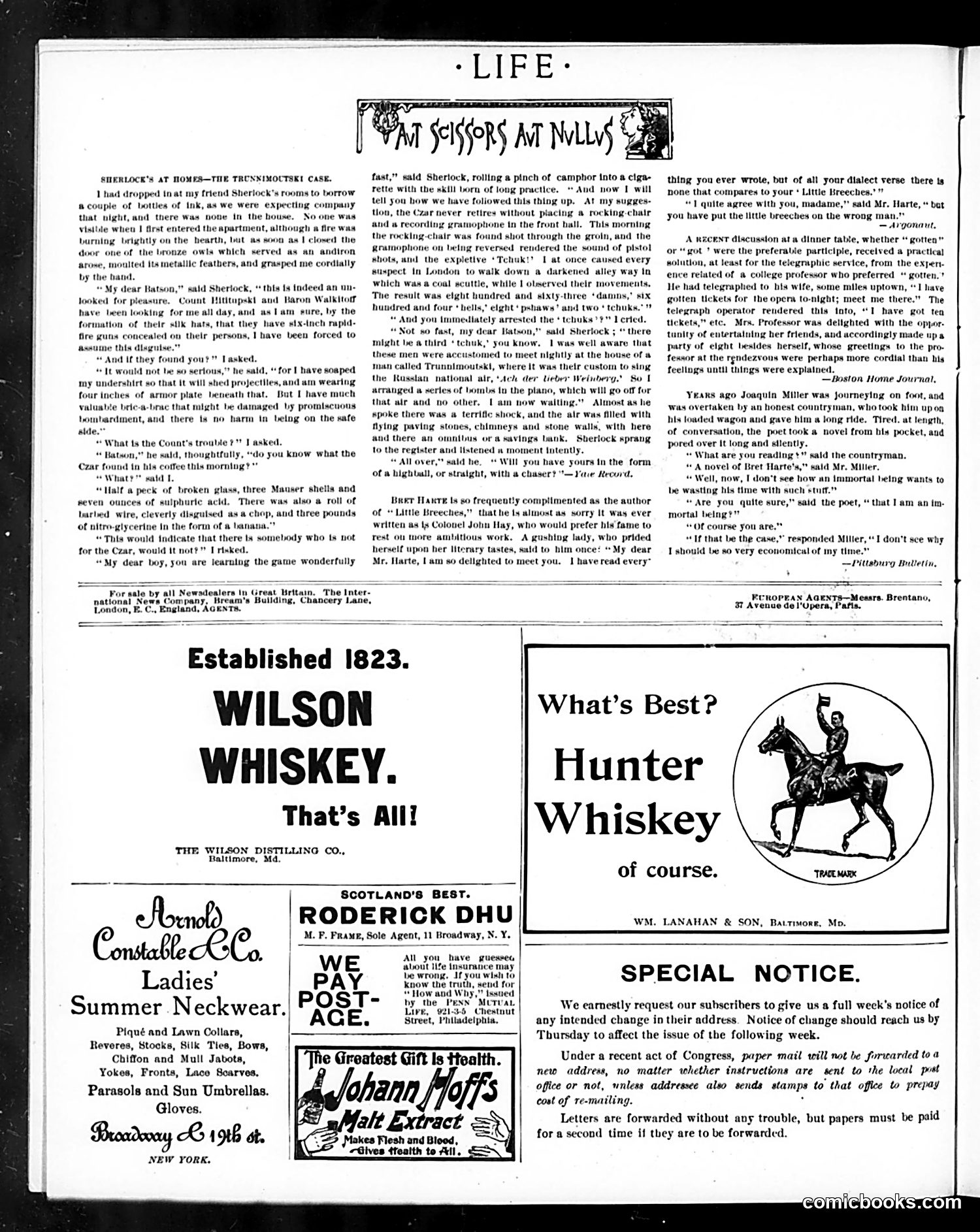
This is a satirical parody of Sherlock Holmes detective stories, mocking both the famous fictional detective and contemporary Russian political anxieties. The humor relies on absurdist escalation: Holmes disguises himself as a bronze owl to avoid Russian assassins, the Czar finds broken glass and explosives in his morning coffee, and Holmes sets bombs in a piano to trap suspects. The satire targets two things: the overwrought melodrama of Holmes stories themselves (with their implausible deductions and elaborate schemes), and anxieties about Russian nihilists and anarchists—a real contemporary concern in the early 1900s. The "Trunnimocktsee Case" involves Russian nationals attempting assassination via poisoned coffee, reflecting genuine period fears about Russian revolutionary violence reaching Western cities. The joke is that Holmes treats this absurd, escalating chaos as perfectly logical detective work.
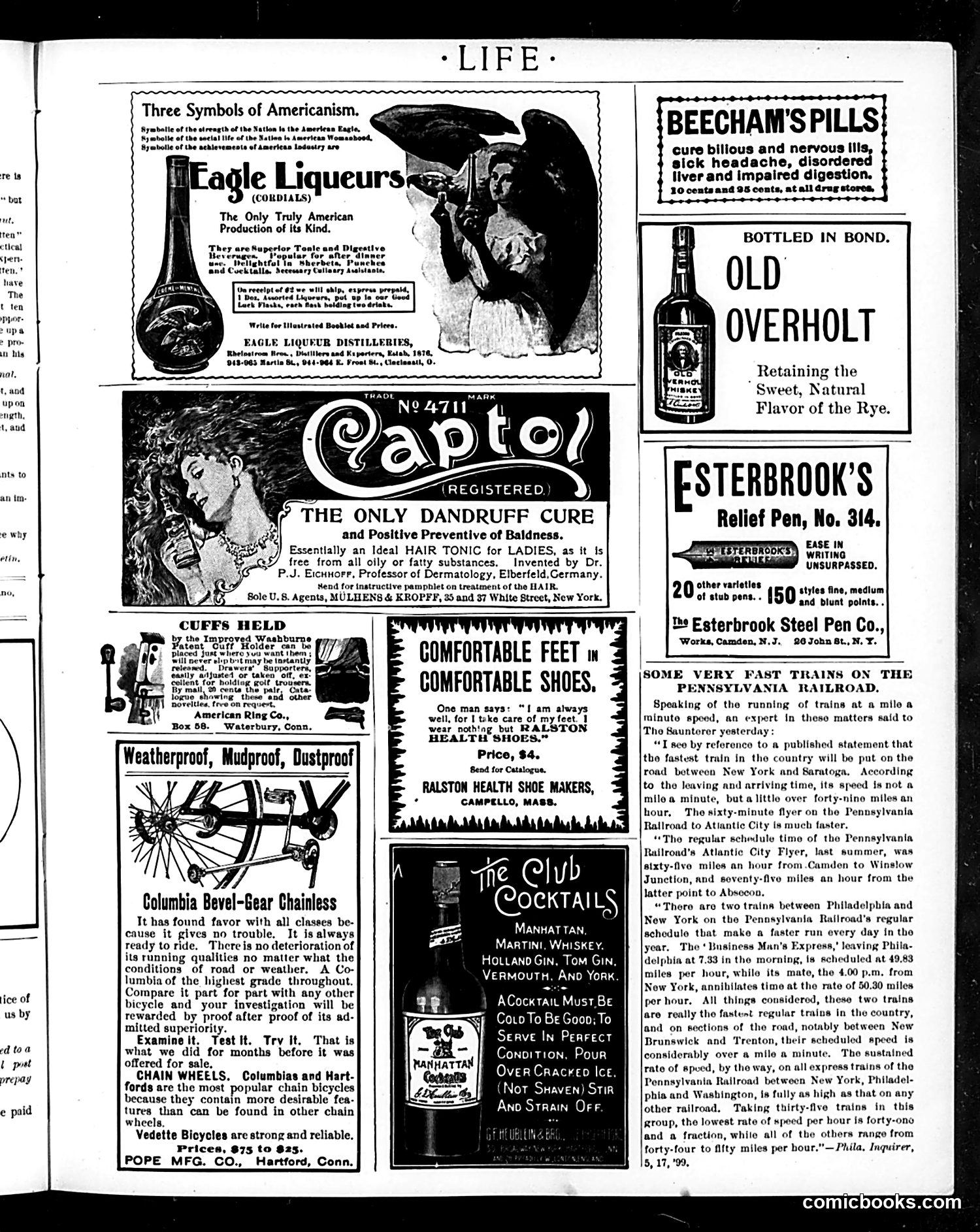
This page is primarily **advertising**, not satire or political commentary. The dominant content consists of product advertisements typical of early 1900s American commerce. The one notable editorial element appears at the top: "Three Symbols of Americanism" presents the **American Eagle**, **Eagle Liqueurs** (as industrial achievement), and **American Womanhood** as national symbols. This patriotic framing was common Progressive-era marketing that linked consumer products to national identity and pride. The remaining content—Beecham's Pills, Old Overholt whiskey, Esterbrook pens, Ralston Health Shoes, Columbia bicycles, and other items—represents standard period advertising emphasizing product quality, health benefits, and American manufacturing. The small railroad article discusses train speed records between major cities, presented as factual reporting rather than satire. The page reflects turn-of-the-century consumer culture where advertisers frequently invoked patriotism and national achievement to market everyday goods.
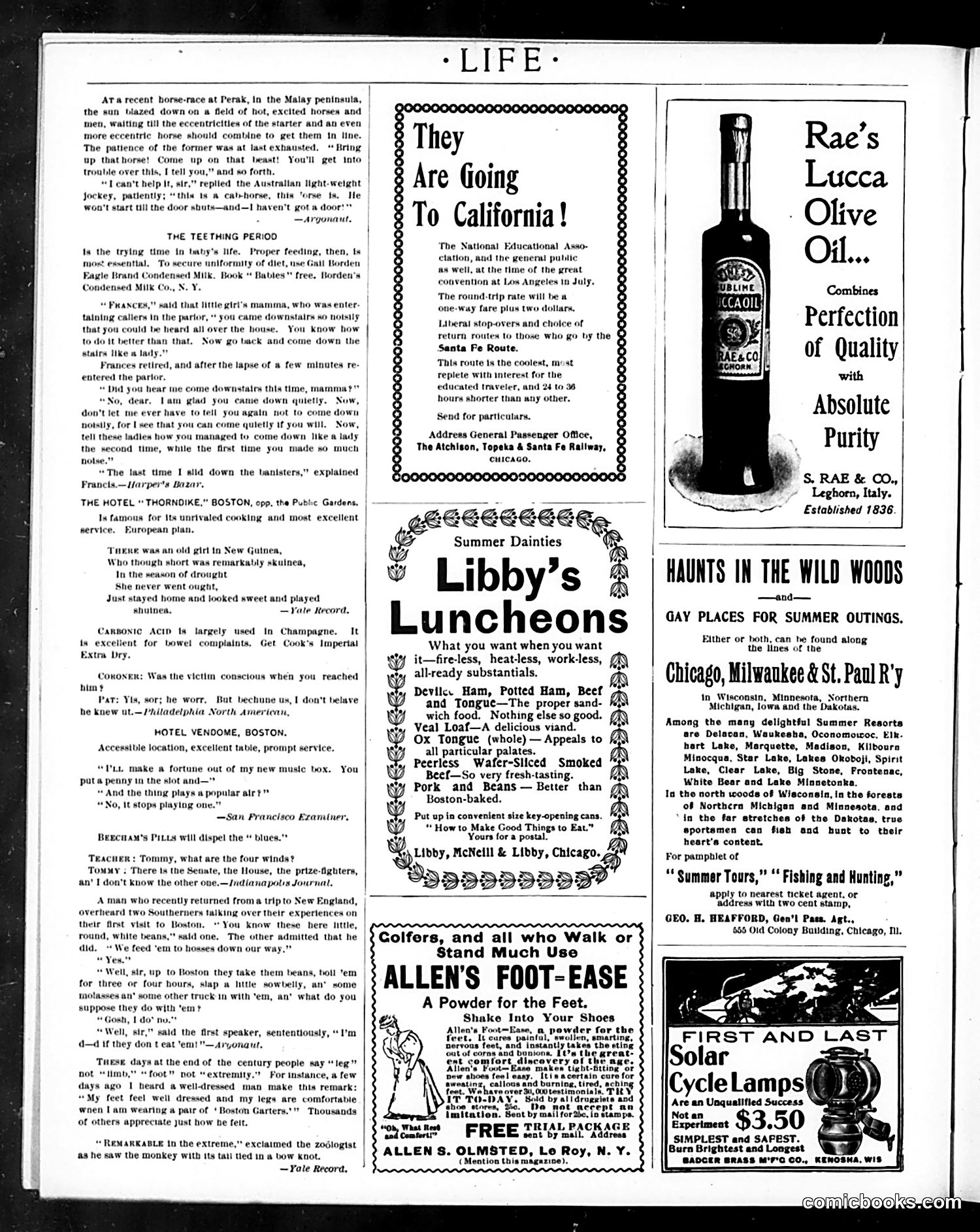
This is primarily a **page of advertisements and humorous anecdotes** rather than political cartoons. Life magazine here functions as a satirical humor publication mixing social comedy with advertising. The content includes: - **Short joke pieces** about everyday life: a horse that won't start without a door, a child learning to descend stairs quietly, debates about Boston baked beans among Southerners - **Social observation humor**: commentary on evolving propriety (using "leg" instead of "limb"), the absurdity of bureaucratic speech - **Period advertisements**: for olive oil, foot powder, solar lamps, and railroad excursions The humor is **gentle domestic satire** rather than sharp political commentary—poking fun at regional differences (North vs. South), parenting anxieties, and genteel manners. There are **no identified political figures or caricatures**. The satire targets universal human situations: impatience, social embarrassment, and miscommunication across cultures. This reflects Life's early role as a **humor and lifestyle magazine** for educated middle-class readers.
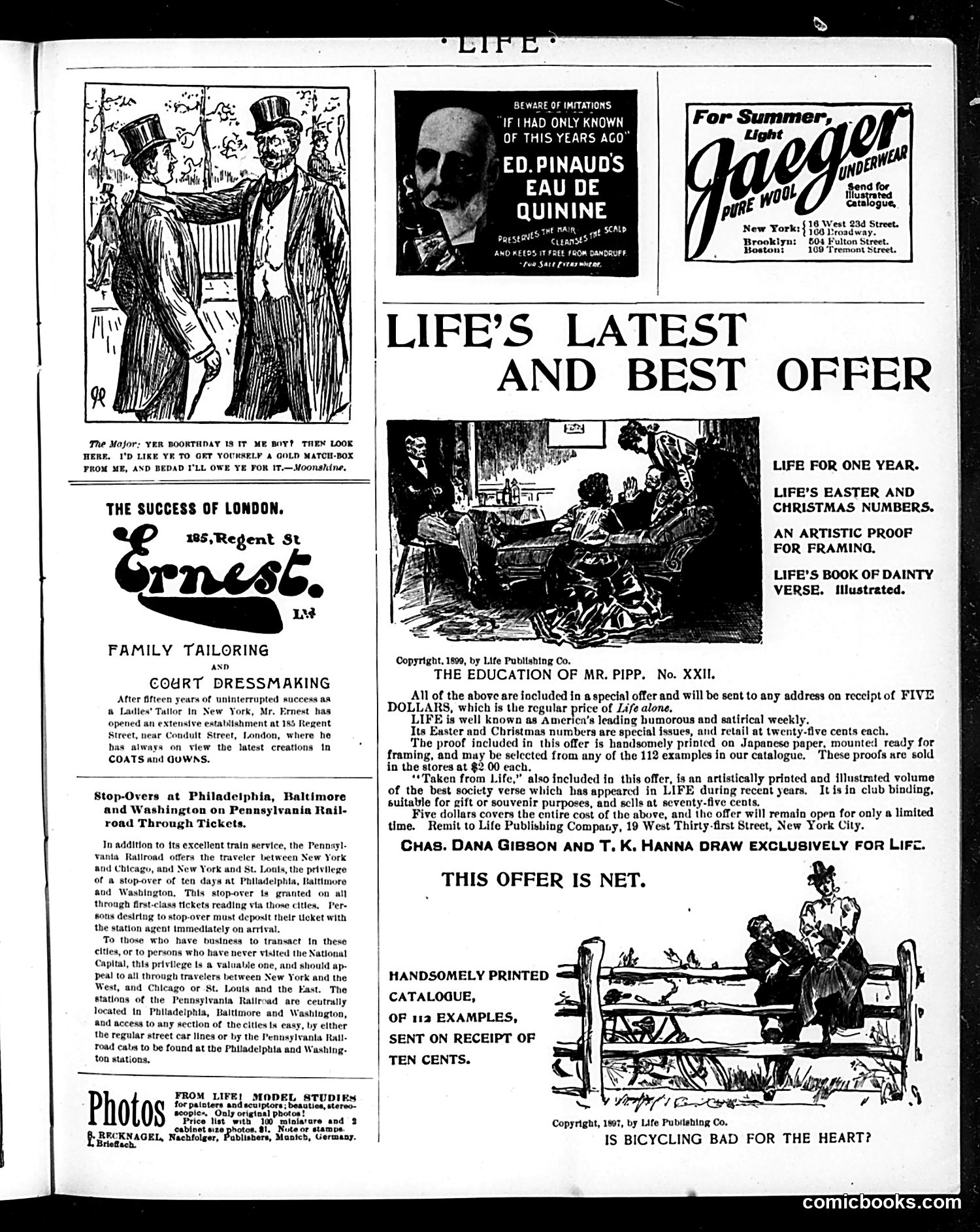
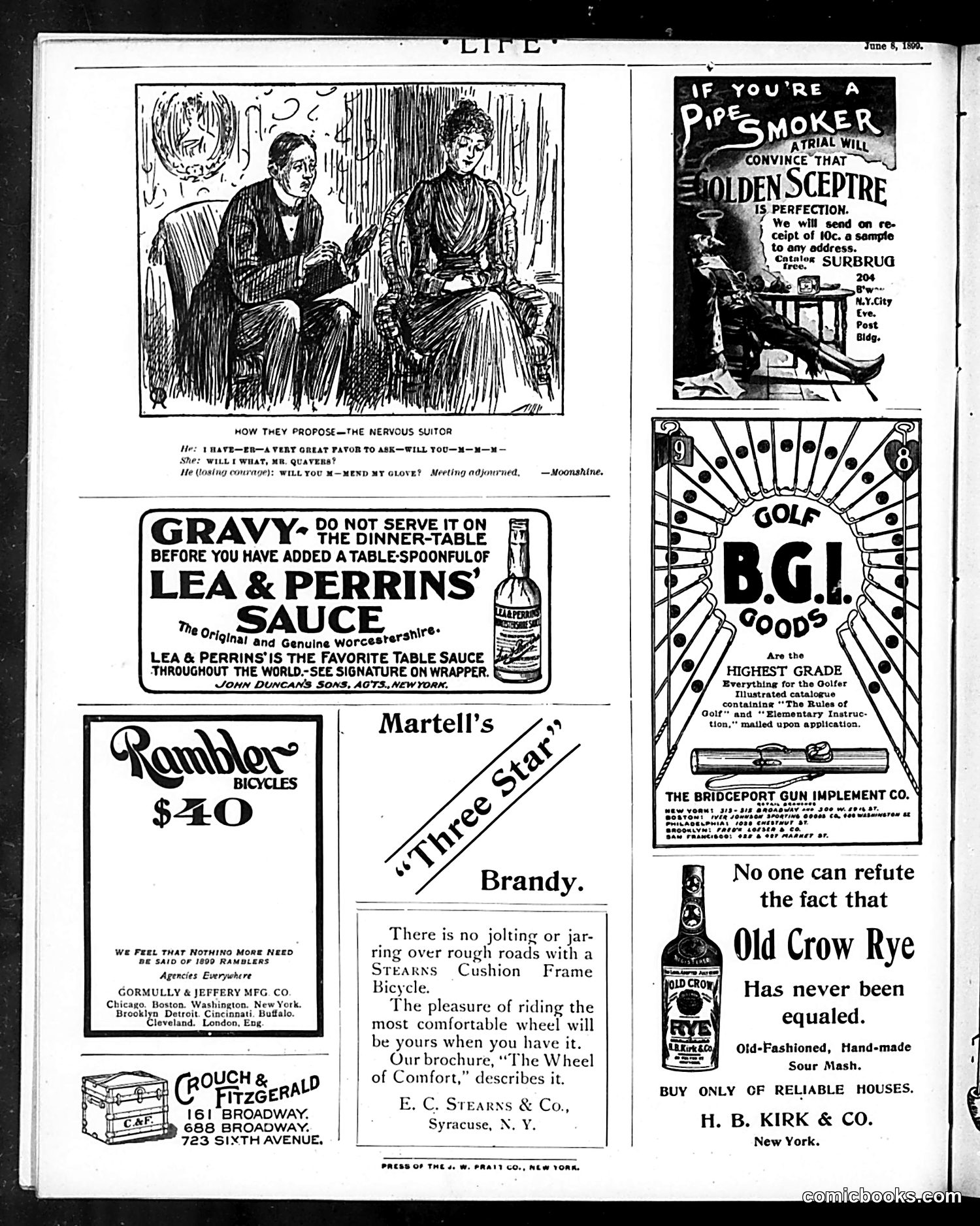
This page is primarily **advertisements** with one small satirical cartoon at the top. The cartoon, titled "How They Propose—The Nervous Suitor," depicts a Victorian-era romance scene. A stammering man attempts to propose marriage to a woman but loses his nerve mid-sentence. Instead of asking "Will you marry me?" he awkwardly pivots to asking "Will you mend my glove?"—a comedic deflation of romantic intention. The joke relies on period conventions: marriage proposals as formal, anxious social rituals, and the expectation that women perform domestic services like mending. The surrounding advertisements showcase 1900 consumer goods: Lea & Perrins sauce, Rambler bicycles ($40), Stearns Cushion Frame bicycles, Old Crow Rye whiskey, and golf equipment. These ads reflect upper-middle-class leisure and dining culture of the Edwardian era. The cartoon's humor would resonate with *Life*'s educated, affluent readership familiar with courtship conventions and domestic expectations.