
Life, 1899-06-08 · page 4 of 20
Life — June 8, 1899 — page 4: what you’re looking at
What you’re looking at
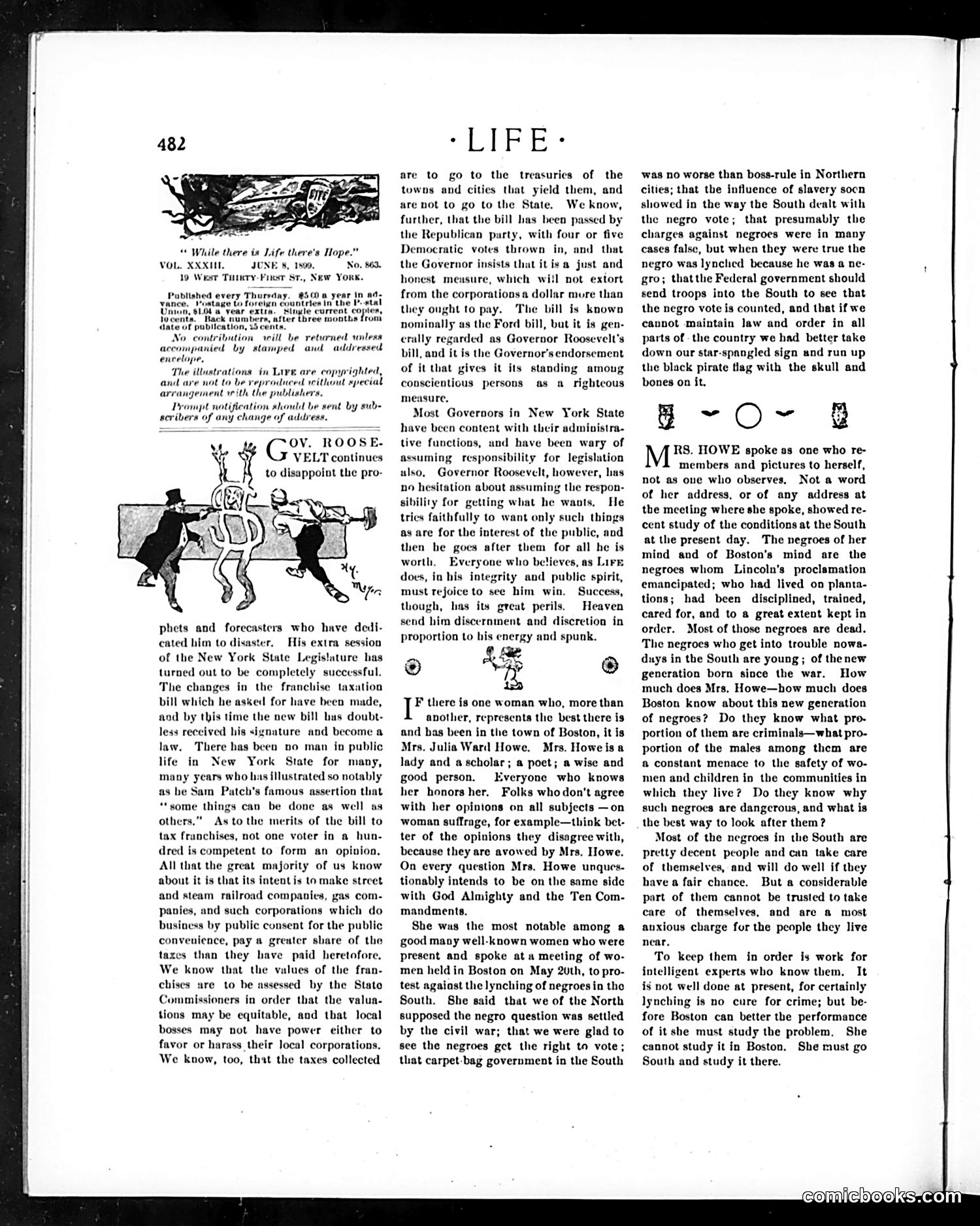
The main cartoon depicts **Governor Roosevelt** (Theodore Roosevelt, then New York Governor) astride a bucking horse labeled with Republican/political symbols. The satire criticizes Roosevelt for his reluctance to take legislative responsibility—the text notes he "continues to disappoint" those wanting him to champion bills in the legislature. The accompanying article discusses a **Mrs. Julia Ward Howe** speaking about lynching and negro rights in Boston. The text contrasts Northern claims about settling the "negro question" with Southern reality, suggesting Northern hypocrisy: they lecture the South while ignoring their own racial problems and the plight of this "new generation" of African Americans born after the Civil War. The satire targets both Roosevelt's political timidity and Northern moral pretension on racial issues.
📄 Transcribed text from this page (OCR, searchable)
Machine-transcribed from the original scan — historical spelling and the odd misread are preserved.
“* While there ix Life there's Hope.” XXXHL JUNE 8, 1890. No, 863. tee Hack numbers, after three mothe from nf publication, 35 ¢ No contribution accompanied by stamped envelope. The itlustrations in Live are copyrighted, awl are not to be reproduced without special arrangement with the publishers. Prompt notification should be sent by sub- scribers 8 of any change of address. will be returned unless and addressed OV. ROOSE- VELT continues to adimopst the pro- phets and forecasters who have dedi- cated him to disaster, His extra session of the New York State Legis!ature has turned out to be completely successful. The changes in the franchise taxation bill which he asked for have been made, aod by this time the new bill bus doubt- less reccived his signature and become a law. There has been no man in public life in New York State for many, many years who has illustrated so notably as be Sam Patch's famous assertion that “some things can be done as well as others.” As to the merits of the bill to tax frunchises, not one voter in a hun. dred is competent to form an opinion, All that the great majority of us know about it is that its intent is to make street and steam railroad companies, gas com- panies, and such corporations which do business by public consent for the public convenience, pay a greater sbare of the taxes than they have paid heretofore, We know that the values of the fran- chises ure to be assessed by the Stato Commissioners in order that the valua- tions may be equitable, and that local bosses may not have power either to favor or harass their local corporations. We know, too, that the taxes collected LIFE are to go to the treasurics of the towns and cities that yield them, and are not to go to the State. We know, further, that the bill has been passed by the Republican purty, with four or five Democratic votes thrown in, and that the Governor insists that it is a just and honest measure, which will not extort from the corporations a dollar more than ht to pay. The bill is known nominally as the Ford bill, but it is gen- crally regarded as Governor Roosevelt's bill, and it is the Governor's endorsement of it that gives it its standing amoug conscientious persons as a righteous measure, Most Governors in New York State have been content with their administra- tive functions, und have been wary of assuming responsibility for legislation also, Governor Roosevelt, however, has no hesitation about assuming the respon- sibility for getting what he wants, He tries faithfully to want only such things as are for the interest of the public, and then he goes after them for all he is worth. Everyone who believes, as Lire does, in his integrity and public spirit, must rejoice to see him win. Success, though, has its great perils. Heaven send him discernment and discretion in proportion to his energy and spunk. | Ae iB [* there is one woman who, more than another, represents the best there is and bas been in the town of Boston, it is Mrs. Julia Ward Howe. Mrs. Howe isa lady and a scholar; a poet; a wise and good person. Everyone who knows her honors her. Folks who don't agree with her opintons on all subjects —on woman suffrage, for example—think bet- ter of the opinions they disagree with, because they are avowed by Mrs, Howe. On every question Mrs. Howe unques- tionably intends to be on the same side with God Almighty and the Ten Com- mandments. She was the most notable among a good many well-known women who were present and spoke ata meeting of wo- men held in Boston on May 2Uth, to pro- test agaiast the lynching of negroes in tho South. She said that we of the North supposed the negro question was settled by the civil war; that we were glad to see the negroes gct the right to vote; that carpet-bag government in the South ® was no worse than boss-rule in Northern cities; that the influence of slavery socn showed in the way the South dealt with the negro vote; that presumably the charges against negroes were in many cases false, but when they were true the negro was lynched because he was a ne- gro; thatthe Federal government should send troops into the South to see that the negro vote is counted, and that if we cannot maintain law and order in all parts of the country we had better take down our star-spangled sign and run up the black pirate flag with the skull and bones on it, B~O~ 8 RS. HOWE spoke as one who re- members and pictures to herself, not as one who observes, Not a word of her address, or of any address at the meeting where she spoke, showed re- cent study of the conditions at the South at the present day. The negroes of her mind and of Boston's mind are the negroes whom Lincoln's proclamation emancipated; who had lived on planta- tions; had been disciplined, trained, cared for, and to a great extent kept in order. Most of those negroes are dead. The negroes who get into trouble nowa- duys in the South are young ; of thenew gencration born since the war. How much does Mrs, Howe—how much does Boston know about this new generation of negroes? Do they know what pro- portion of them are criminals—what pro- portion of the males among them are a constant menace to the safety of wo- men and children in the communities in which they live? Do they know why such negrocs are dangerous, and what is the best way to look after them? Most of the negroes in the South are pretty decent people and can take care of themselves, and will do well if they have a fair chance. But a considerable part of them cannot be trusted to take care of themselves, and are a most anxious cbarge for the people they live near. To keep them in order is work for intelligent experts who know them, It ig not well done at present, for certainly lynching is no cure for crime; but be- fore Boston can better the performance of it she must study the problem, She cannot study it in Boston. She must go South and study it there.