
A complete issue · 20 pages · 1899
Life — May 11, 1899
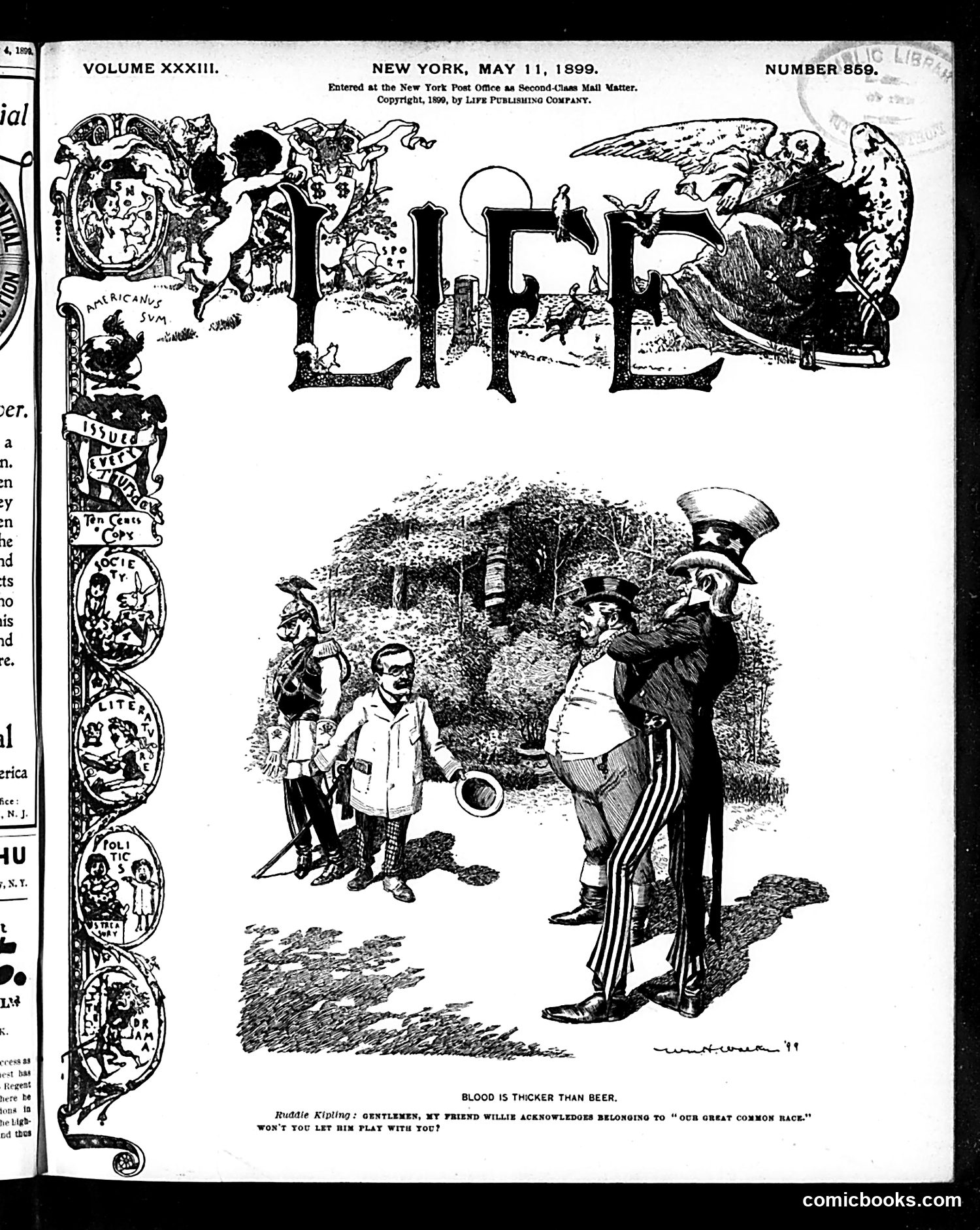
The main cartoon depicts a confrontation between what appears to be Uncle Sam (identifiable by his star-spangled hat and striped pants) and military figures, likely representing American soldiers. The caption "Blood is Thicker Than Beer" references a quote attributed to Rudyard Kipling about a soldier named Willie acknowledging belonging to "our great common race." The cartoon likely satirizes late 1890s imperial politics, possibly relating to the Spanish-American War (1898) or American-British relations. The "blood is thicker than beer" phrase suggests commentary on Anglo-American solidarity or shared racial/cultural bonds being invoked for political purposes. The ornate left border contains decorative emblems typical of Life's design. Without additional context, the specific political situation being critiqued remains somewhat unclear from the image alone.
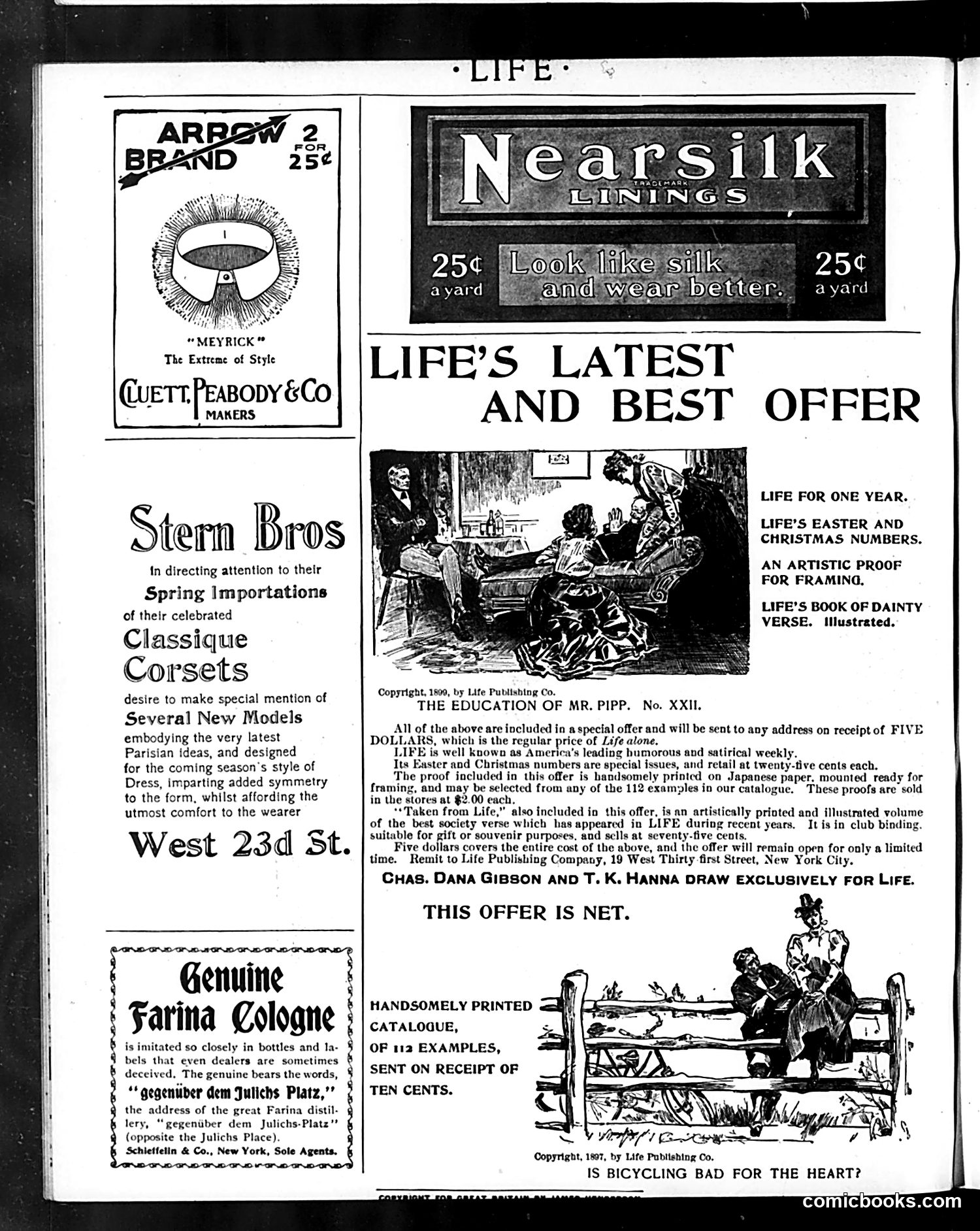
This page is primarily **advertising**, not political satire. It features several commercial advertisements from circa 1900: - **Arrow Brand** collar advertisement (Cuett, Peabody & Co.) - **Nearsilk Linings** fabric promotion - **Stern Bros** corset importation announcement - **Genuine Farina Cologne** bottled fragrance The main illustrated content is "**The Education of Mr. Pipp, No. XXII**"—an ongoing serial comic or illustrated story in Life magazine. The image shows multiple figures in what appears to be a domestic scene, suggesting this was a humorous narrative feature following a character named Mr. Pipp through various situations. The bottom cartoon asks "**Is Bicycling Bad for the Heart?**"—a topical health question reflecting era concerns about cycling's effects on women's and men's health, a debated issue in the 1890s-1900s.
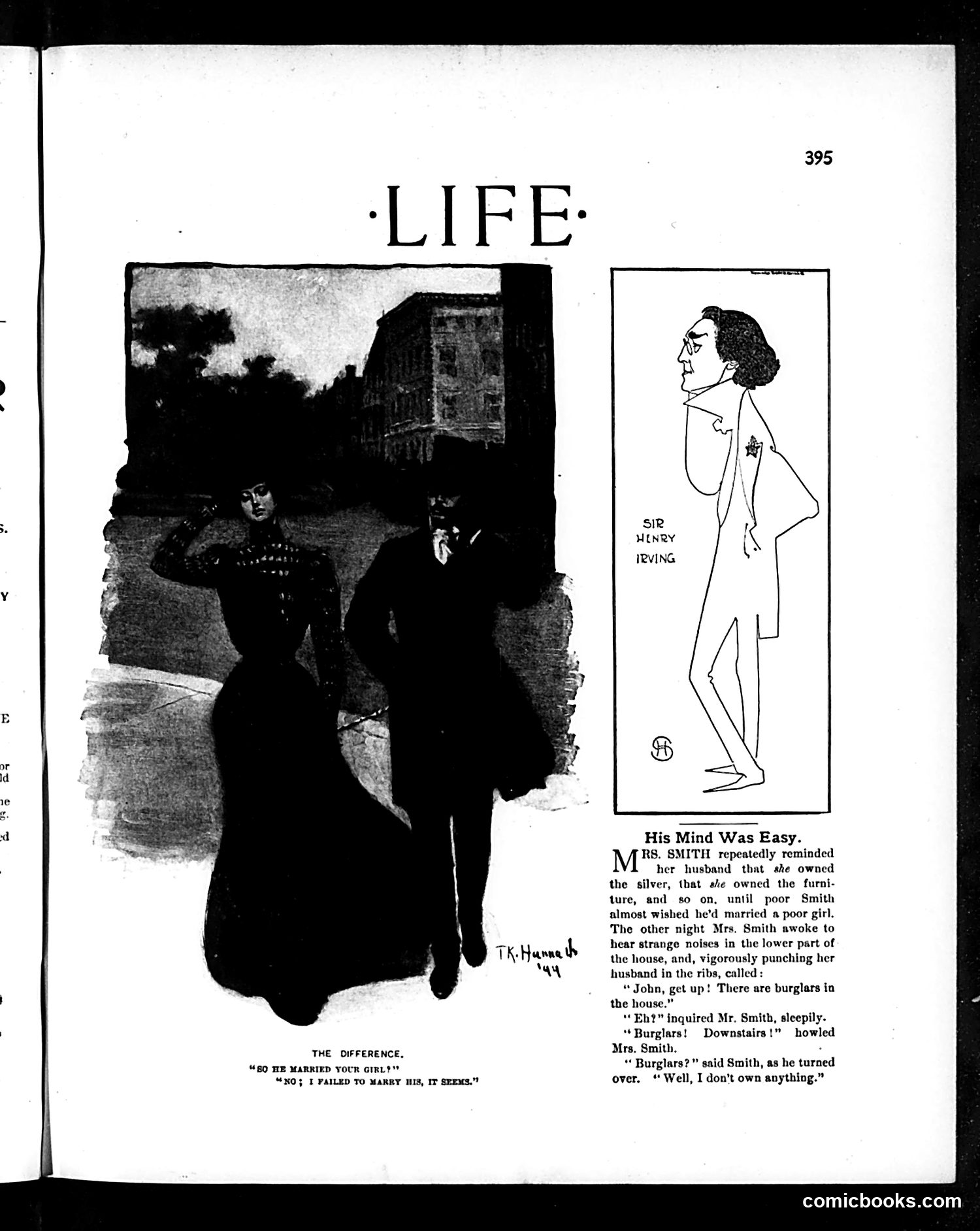
**"The Difference" cartoon** (left): Shows a couple in evening wear with the caption: "He married your girl!" / "No; I failed to marry his, it seems." This is a satirical commentary on marriage as a transactional or competitive matter between men, suggesting that marrying someone is equivalent to "winning" them from rivals. The joke critiques the era's view of women as prizes or possessions to be claimed through marriage. **"His Mind Was Easy" article** (right): Features Sir Henry Irving and a humorous anecdote about Mr. and Mrs. Smith. Mrs. Smith repeatedly reminded her husband that she owned their silver, furniture, and possessions. When burglars broke in, Mr. Smith calmly stated he owned nothing—implying his wife's obsessive property claims actually protected him from loss. The satire mocks marital dynamics and property disputes of the era.
The page contains editorial commentary on the Philippine-American War, with illustrations featuring military figures. The text discusses Admiral Dewey, General Otis, General Wheaton, and General Lawton—figures involved in the Philippines conflict. The central debate concerns whether the war was "efficiently managed" and what should happen post-conflict. A key figure, Senator Frye, advocates for American occupation of the Philippines for commercial and moral purposes. The editorial expresses skepticism about whether the islands' conquest justified the costs. The satirical element critiques both enthusiastic war supporters and those questioning the military campaign's necessity. The cartoons (showing figures in military dress) appear to mock the glorification of warfare and the competing political interests regarding the Philippines' future governance and economic value.
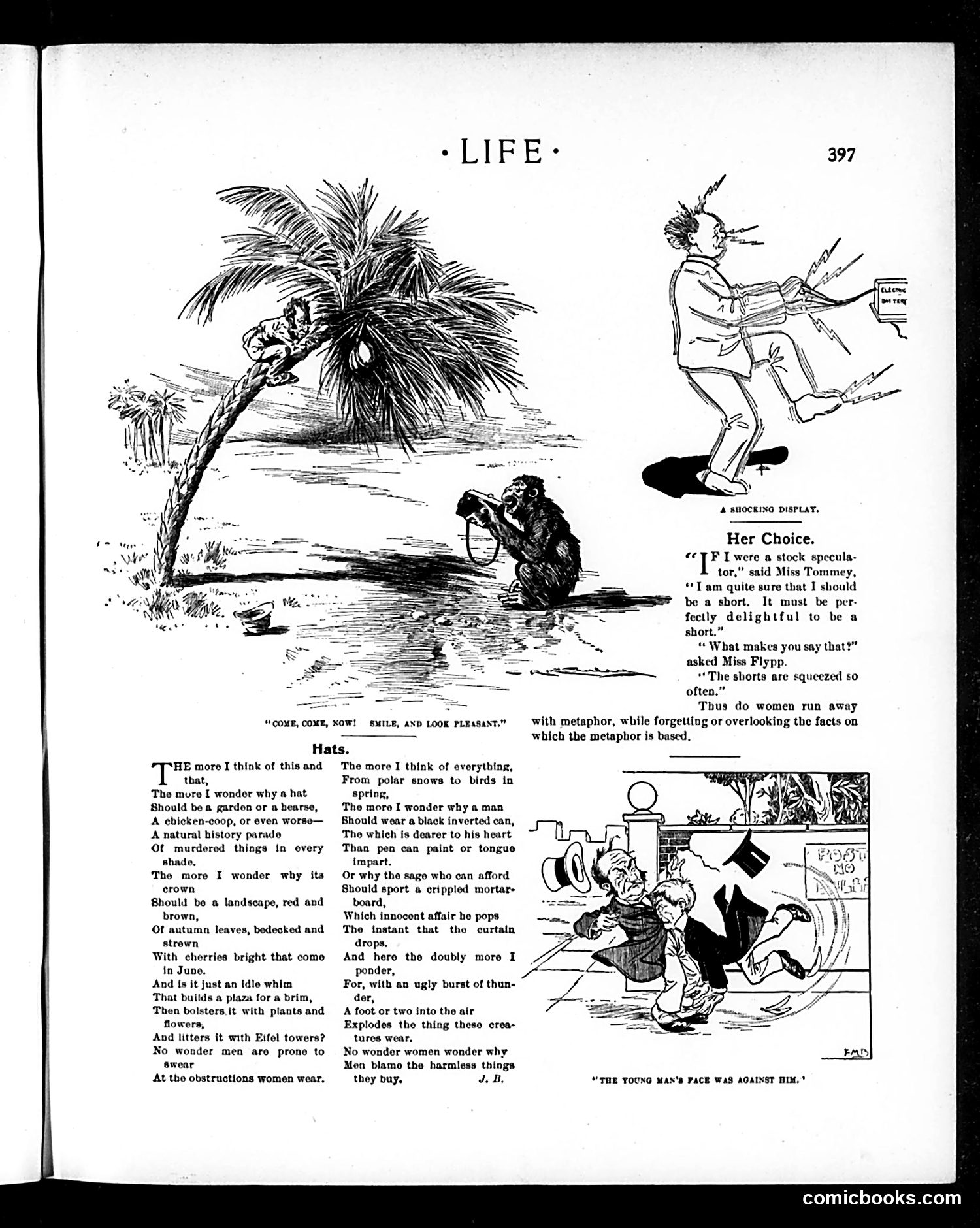
This page contains three distinct satirical pieces: 1. **"Come, Come, Don't Smile, and Look Pleasant"** - A naturalistic sketch of a monkey posing with a bicycle, seemingly mocking staged photography or artificial posturing. 2. **"Hats"** - A poem critiquing women's elaborate hat fashions, sarcastically wondering why women choose such impractical, oversized headwear decorated with natural elements (feathers, leaves). The satire targets both the absurdity of the fashion itself and men's bewilderment at women's choices. 3. **"Her Choice"** and **"A Shocking Display"** - Cartoons mocking women's fashion choices and physical comedy. One depicts an electrocution-like scenario; another shows domestic chaos, suggesting women's clothing or behavior causes household disruption. The overall theme satirizes late 19th/early 20th-century women's fashion as impractical and ridiculous.
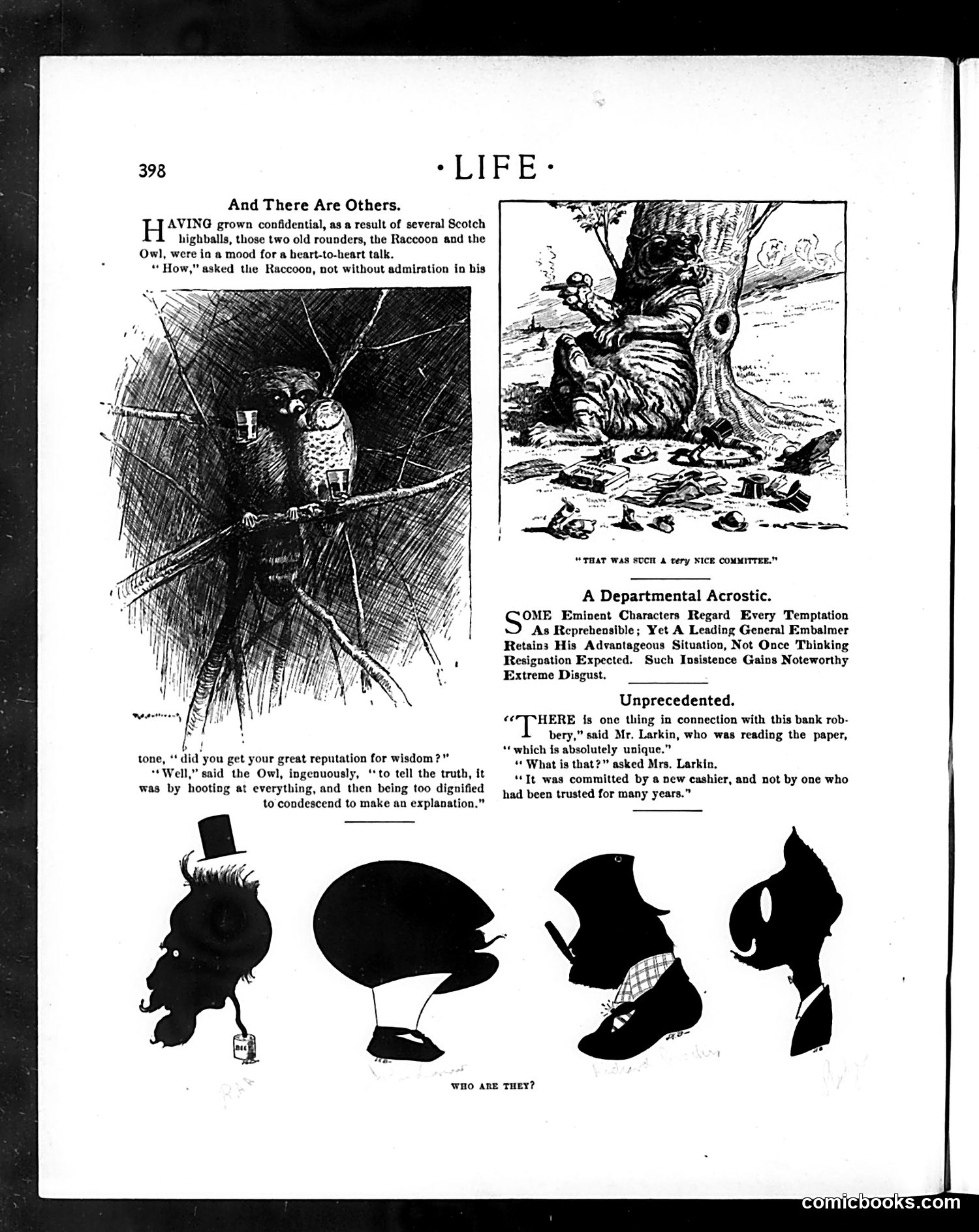
This page presents satirical commentary on embezzlement and financial dishonesty. The upper narrative mocks animals (Raccoon and Owl) discussing reputation and wisdom—a fable suggesting that those who gain status through deception eventually face exposure. The main section, "A Departmental Acrostic," critiques prominent figures who commit crimes yet maintain their positions, viewing resignation as unnecessary despite their "advantageous situation." The story "Unprecedented" references a bank robbery committed by a trusted cashier rather than a new employee—inverting expectations about who commits fraud. The silhouette illustrations at bottom ("Who Are They?") likely depict specific contemporary figures involved in recent embezzlement scandals, though their identities aren't specified in the visible text. The satire targets institutional hypocrisy regarding financial crime.
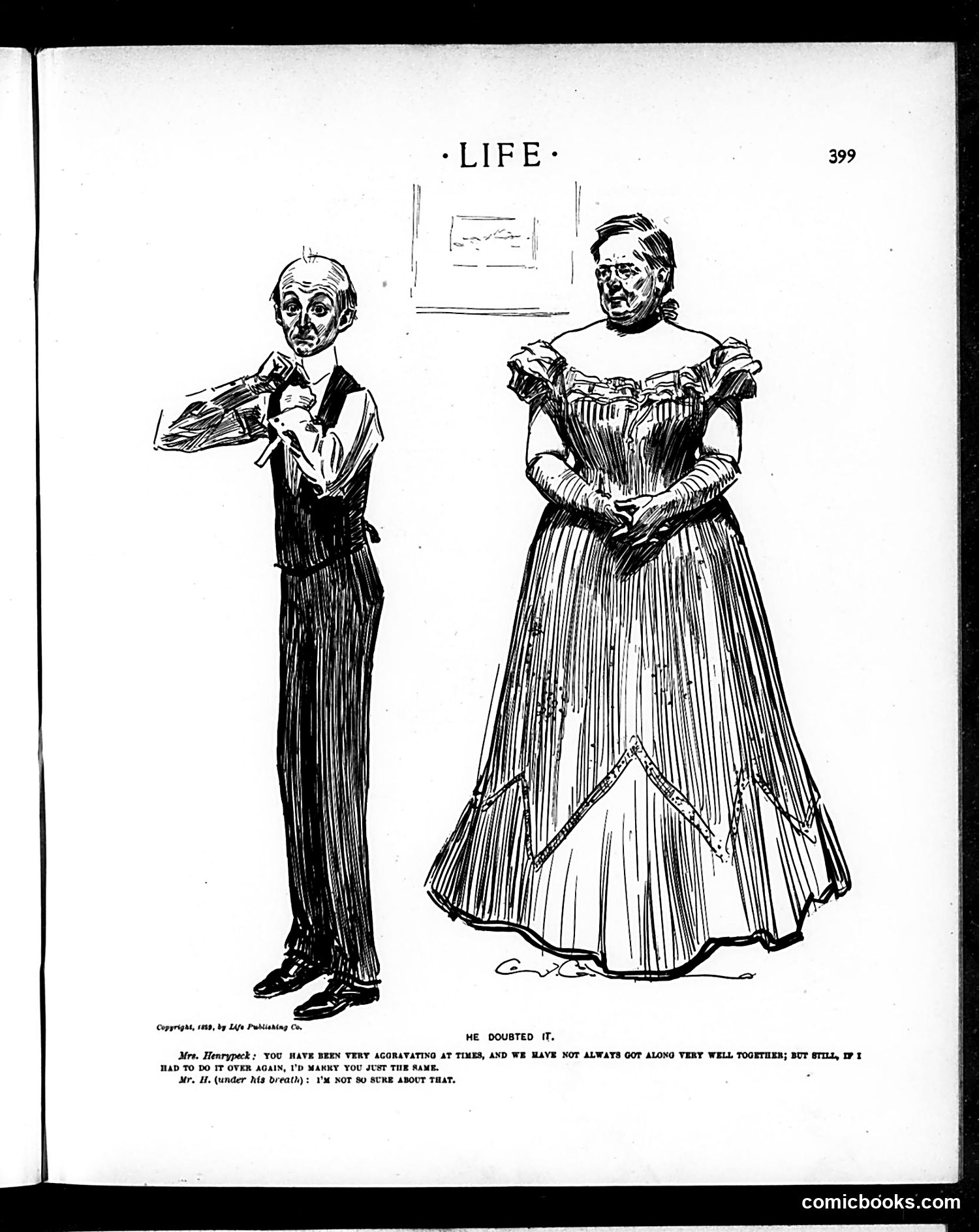
This cartoon depicts a marital conversation about fidelity and commitment. A thin, anxious man holds what appears to be papers or documents, addressing a stern-faced woman in an elegant dress. Mrs. Honeycutt claims they've had "very aggravating" times together and haven't "always got along very well," yet proposes remarrying him "just the same." Mr. H responds (under his breath) that he's "not so sure about that." The satire mocks romantic reconciliation and the ambivalence surrounding marriage proposals. The husband's private doubts—voiced only when she cannot hear—contrast sharply with his apparent acquiescence to her plan. The cartoon humorously suggests that even when given a second chance at marriage, the groom-to-be harbors serious reservations he won't voice aloud.
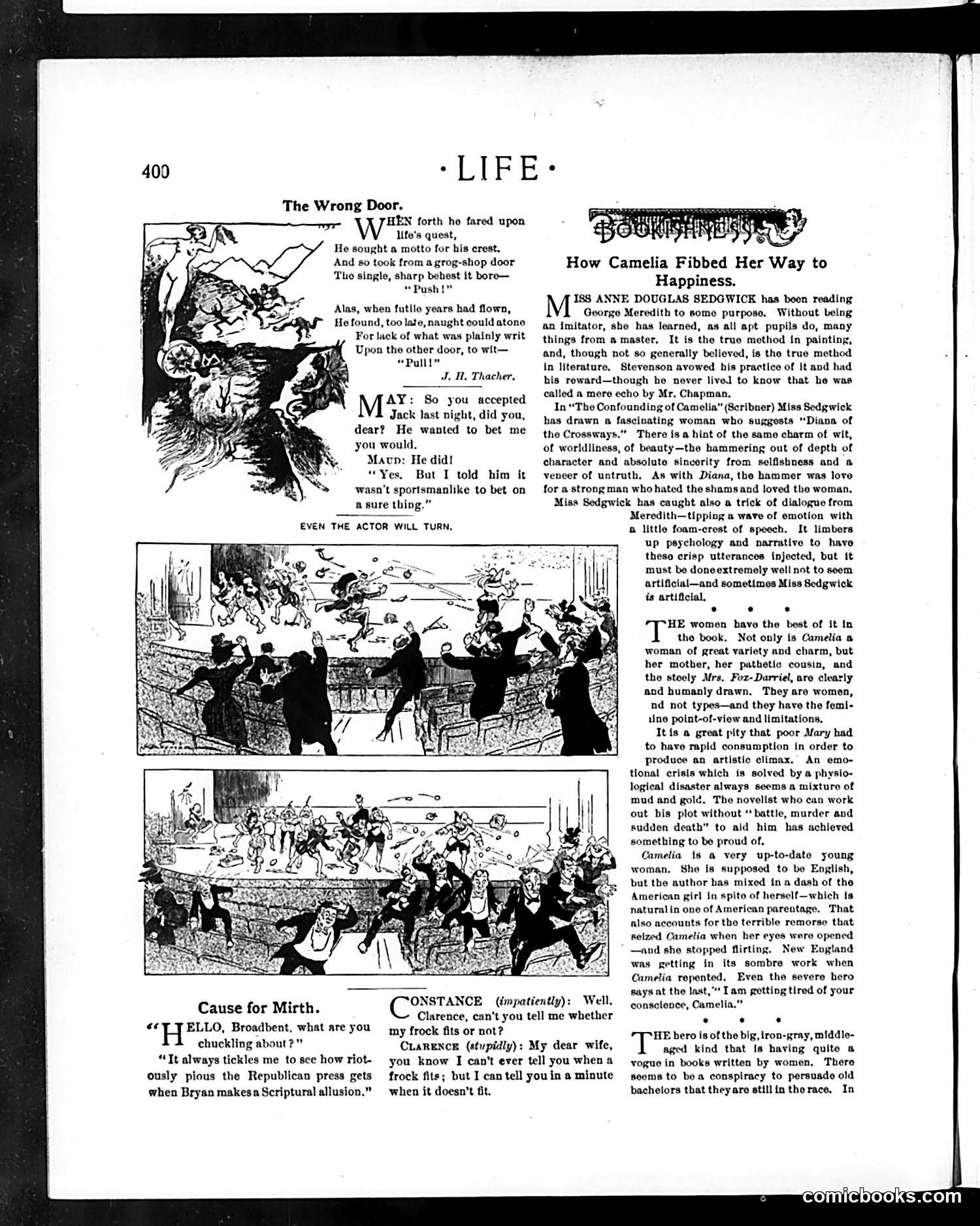
This small cartoon presents a domestic debate between **Constance** (impatient) and **Clarence** (stupidly). The joke hinges on a contemporary political reference: Bryan's "Scriptural allusion." The humor targets **William Jennings Bryan**, the three-time presidential candidate known for invoking religious rhetoric in his campaigns. Clarence suggests Bryan's mixing of Scripture with politics is absurd enough to "tickle" even Republican press coverage—implying Bryan's religious appeals are so ridiculous they become unintentionally comic fodder. The cartoon satirizes how Bryan weaponized biblical language in political discourse, treating his rhetoric as inherently laughable rather than persuasive. This reflects early 1900s skepticism toward religiously-inflected populism.
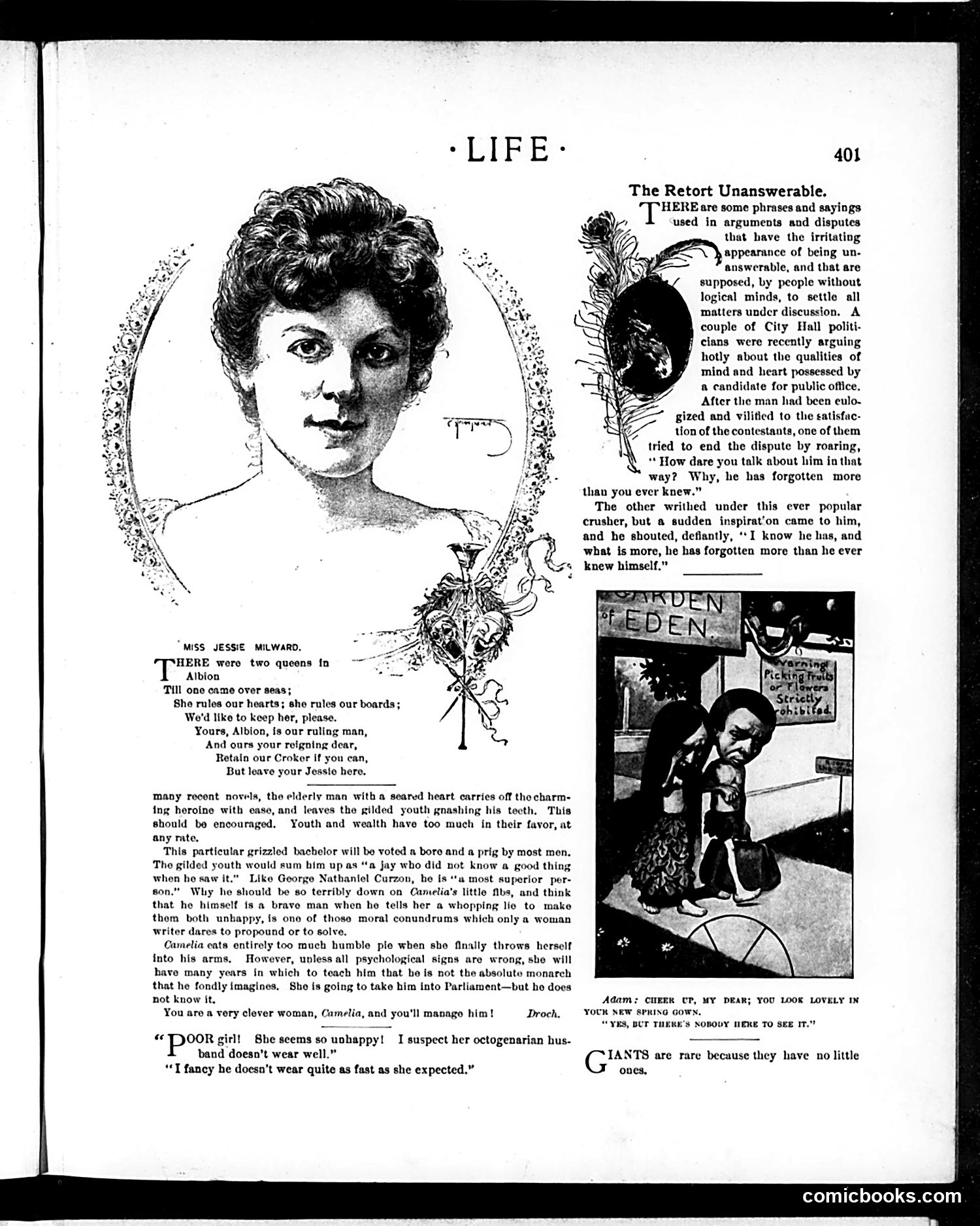
This page features **Miss Jessie Milward**, a theatrical performer, with a portrait and accompanying verse praising her appeal ("There were two queens in Albion / Till one rose over seas"). The main satirical content attacks an "unanswerable retort" in a City Hall political dispute about a candidate's mental qualities. Two politicians argued: one claimed the candidate had "forgotten more" knowledge than his opponent ever possessed; the other countered he "knows he has, and what is more, he has forgotten more than he ever knew himself"—a logical trap suggesting the candidate is simultaneously knowledgeable and forgetful. The secondary cartoon (bottom right, labeled "Garden of Eden") appears to be a separate humorous illustration, though details are unclear in this reproduction.
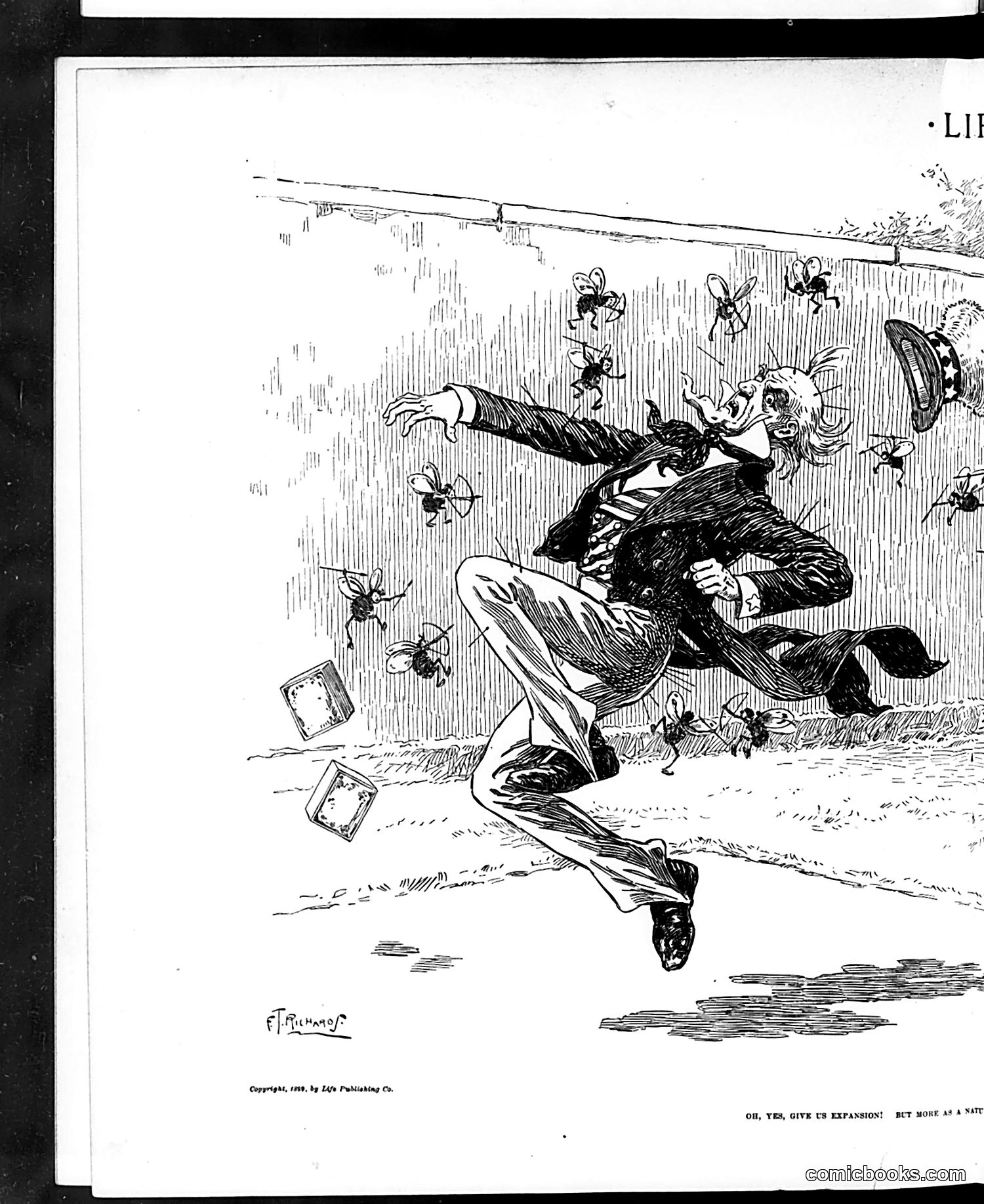
This is a satirical cartoon by F.F. Plummer (signature visible) from Life magazine. It depicts a disheveled figure being swarmed by insects or flies while frantically swatting at them. The caption reads: "OH, YES, GIVE US EXPANSION! BUT MORE AS A BAIT" The cartoon appears to satirize American imperial expansion (likely early 1900s context, given Life's publication period). The figure represents either a political leader or the American body politic being overwhelmed by the unintended consequences of expansionism—depicted as a plague of insects. The caption suggests expansion is promoted as bait or enticement, but the reality proves chaotic and uncontrollable. The satire critiques imperialist rhetoric versus its messy practical outcomes.
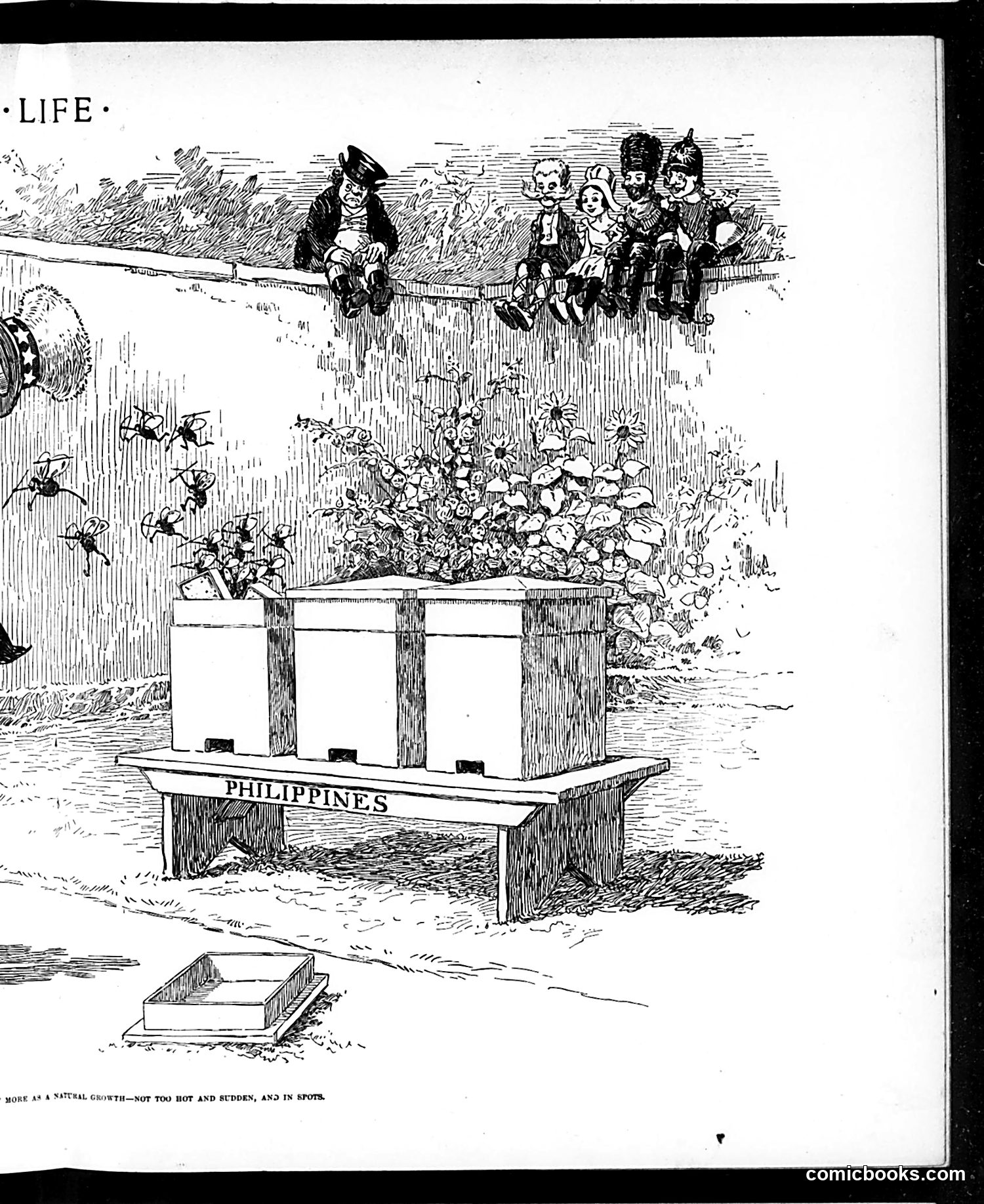
This cartoon satirizes American imperialism regarding the Philippines. The image shows a large planter box labeled "PHILIPPINES" overflowing with flowers, observed by well-dressed figures on a bridge above. The caption reads "MORE AS A NATURAL GROWTH—NOT TOO HOT AND SUDDEN, AND IN STOCK." The satire critiques how American political leaders present colonial expansion as organic and carefully managed "growth" rather than aggressive conquest. The planter box metaphor suggests the Philippines are being cultivated like a controlled garden product—implying the U.S. government's paternalistic rhetoric about "civilizing" the islands while actually exploiting them commercially ("in stock"). The figures observing from above likely represent American political or business leadership admiring their imperial acquisition.
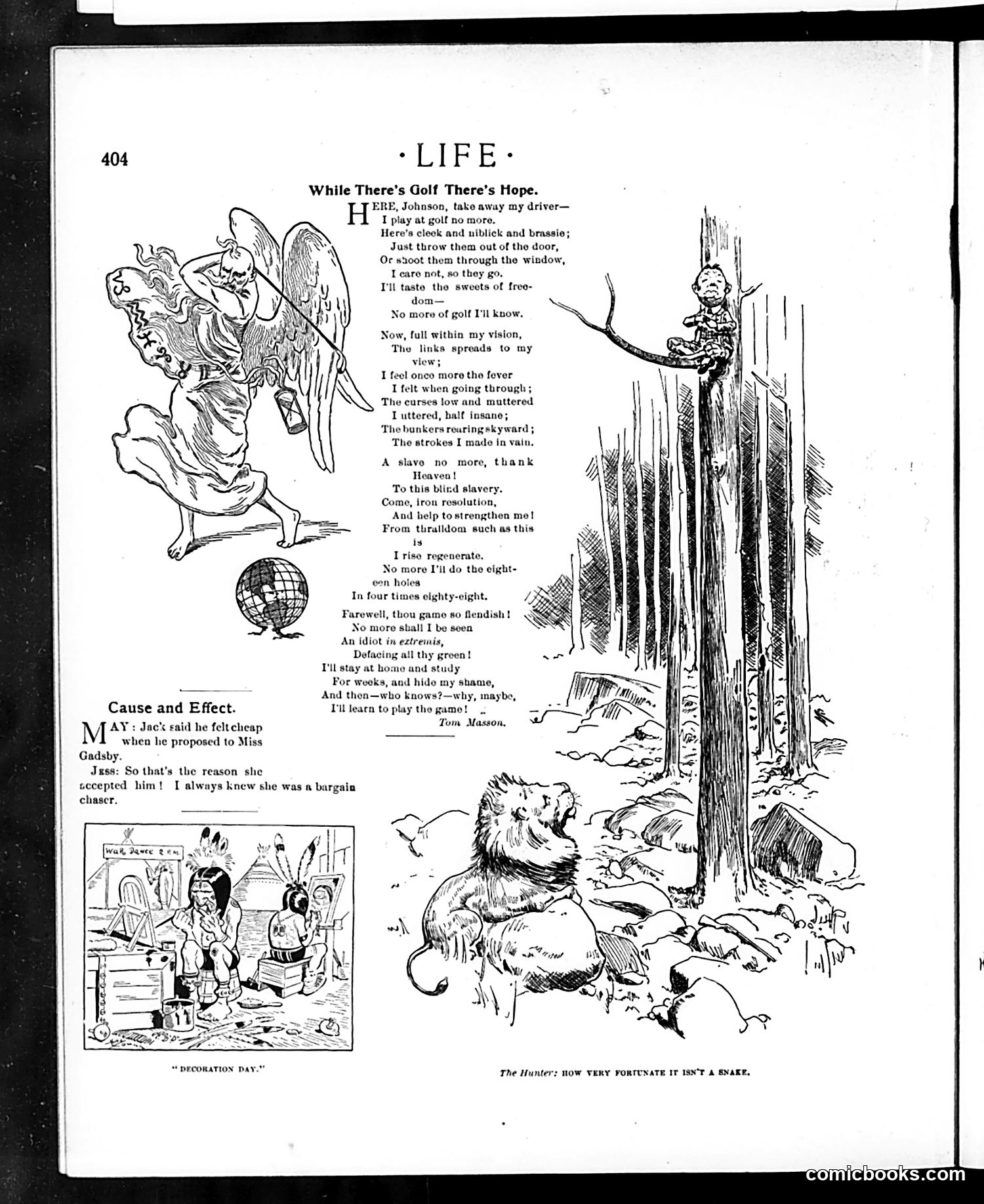
This page contains two distinct pieces of satire: **"While There's Golf There's Hope"** (top): A poem mocking a golfer's obsession with the sport. An angel figure offers escape from golf's torments, but the speaker ultimately resolves to "learn to play the game"—satirizing how people become enslaved to recreational pursuits despite acknowledging their futility and frustration. **"Cause and Effect"** (bottom): A brief comic dialogue where Jack proposed to Miss Gadsby cheaply, yet she accepted. The joke: women are portrayed as mercenary—she's a "bargain chaser" willing to marry for minimal effort or expense. This reflects period gender stereotypes about women's materialism. **"The Hunters"** (right illustration): Shows a bear treed by hunters, captioned "How Very Fortunate It Isn't a Snake"—likely satirizing hunters' poor marksmanship or decision-making.
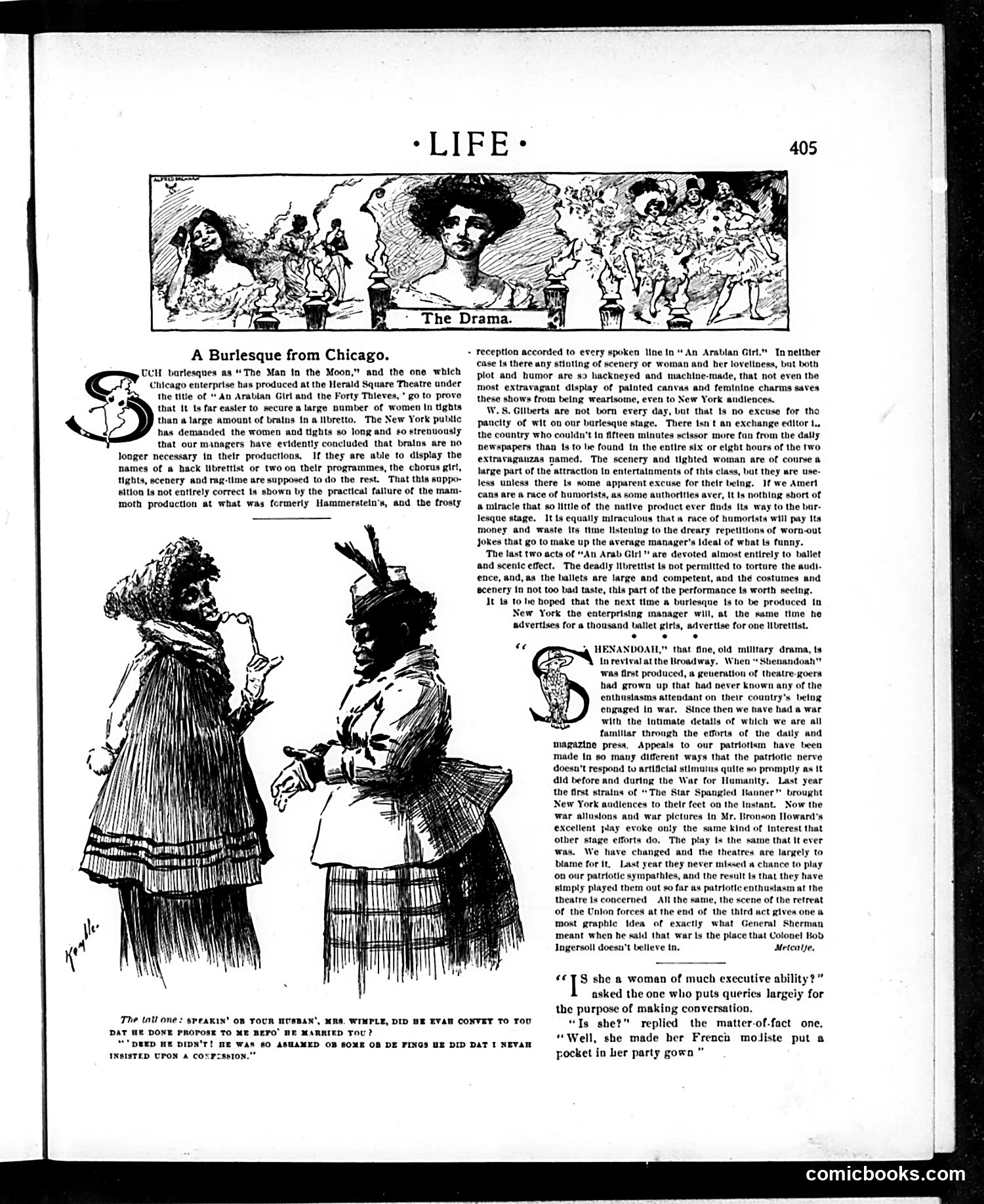
This page critiques Chicago's burlesque theater productions, particularly "An Arabian Girl and the Forty Thieves" at the Herald Square Theatre. **The Main Satire:** The author argues that burlesque producers prioritize scantily-clad chorus girls over actual comedy writing. Managers assume audiences will accept any show if it features enough "women in tights, scenery and rag-time," abandoning the need for intelligent scripts or talented librettists (playwrights). **The Cartoon:** The illustration depicts two Black women in domestic conversation—a racial caricature typical of early 20th-century "humor." The dialogue mocks dialect speech about marriage proposals, representing the lowbrow comedy the article criticizes. **The Broader Critique:** The article attacks American theater's intellectual decline, arguing that while writers and humorists exist, virtually none contribute to burlesque stages. The author sarcastically suggests managers simultaneously advertise for "a thousand ballet girls" and "one librettist"—implying none can be found. The piece reflects both genuine theatrical criticism and period racism in its "humor."
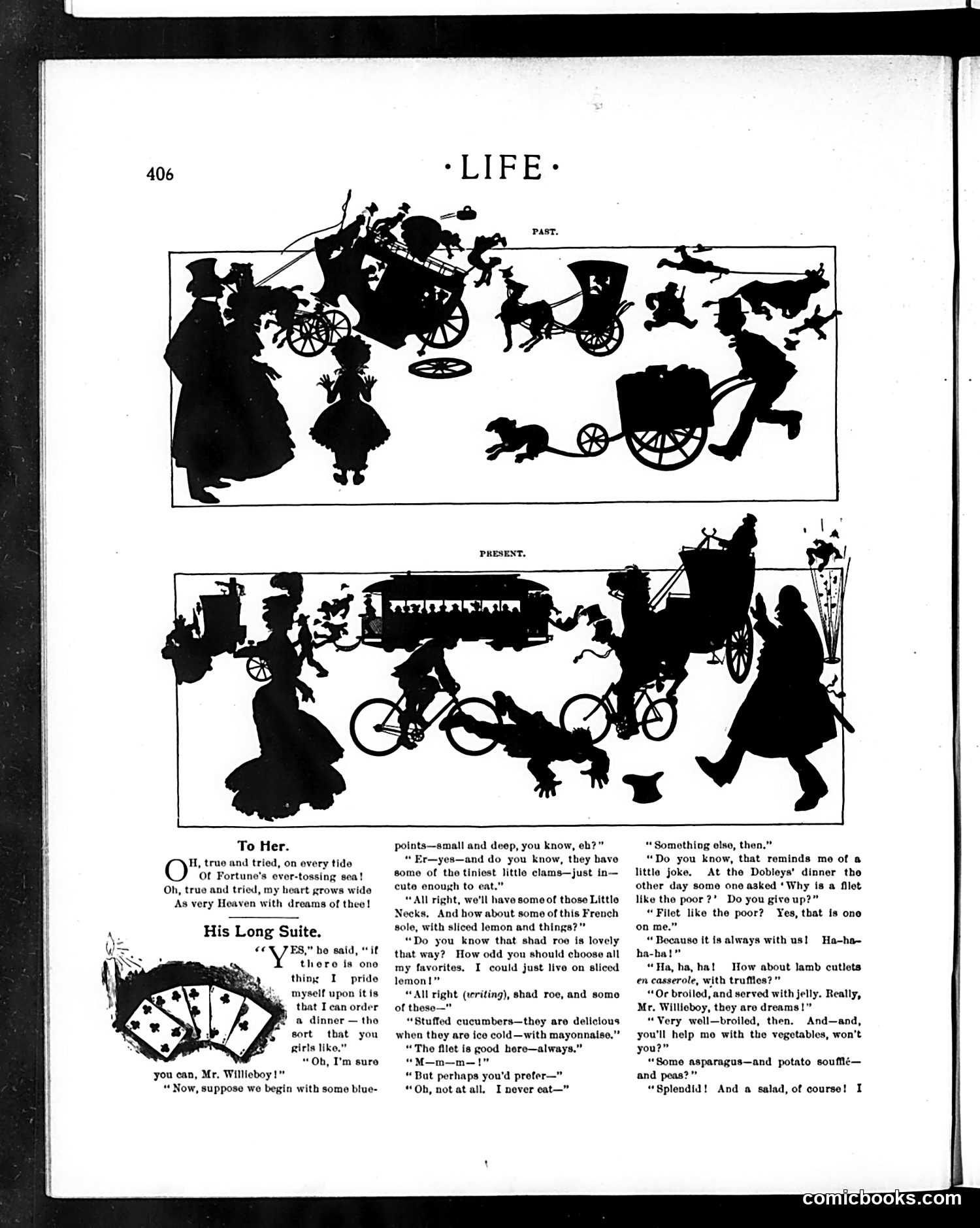
This two-panel cartoon contrasts past and present approaches to romance. The top panel ("PAST") shows chaotic, exuberant courtship—people in carriages and on horseback, energetic and wild. The bottom panel ("PRESENT") depicts a more orderly, modern scene with bicycles, a trolley, and restrained figures. The accompanying story satirizes a gentleman ("Mr. Willieboy") attempting to impress a woman through an elaborate, theatrical dinner. He performatively orders increasingly specific dishes (oysters, shad roe, stuffed cucumbers, lamb cutlets) while she repeatedly claims each is *her* favorite—suggesting either his transparent attempt at manipulation or her strategic flattery. The humor lies in the empty courtship ritual: he believes he's orchestrating romance through culinary sophistication, while she simply agrees with everything, reducing his "long suite" of preparations to predictable social theater. The page mocks early 1900s courtship conventions where dining was theatrical performance rather than genuine connection.
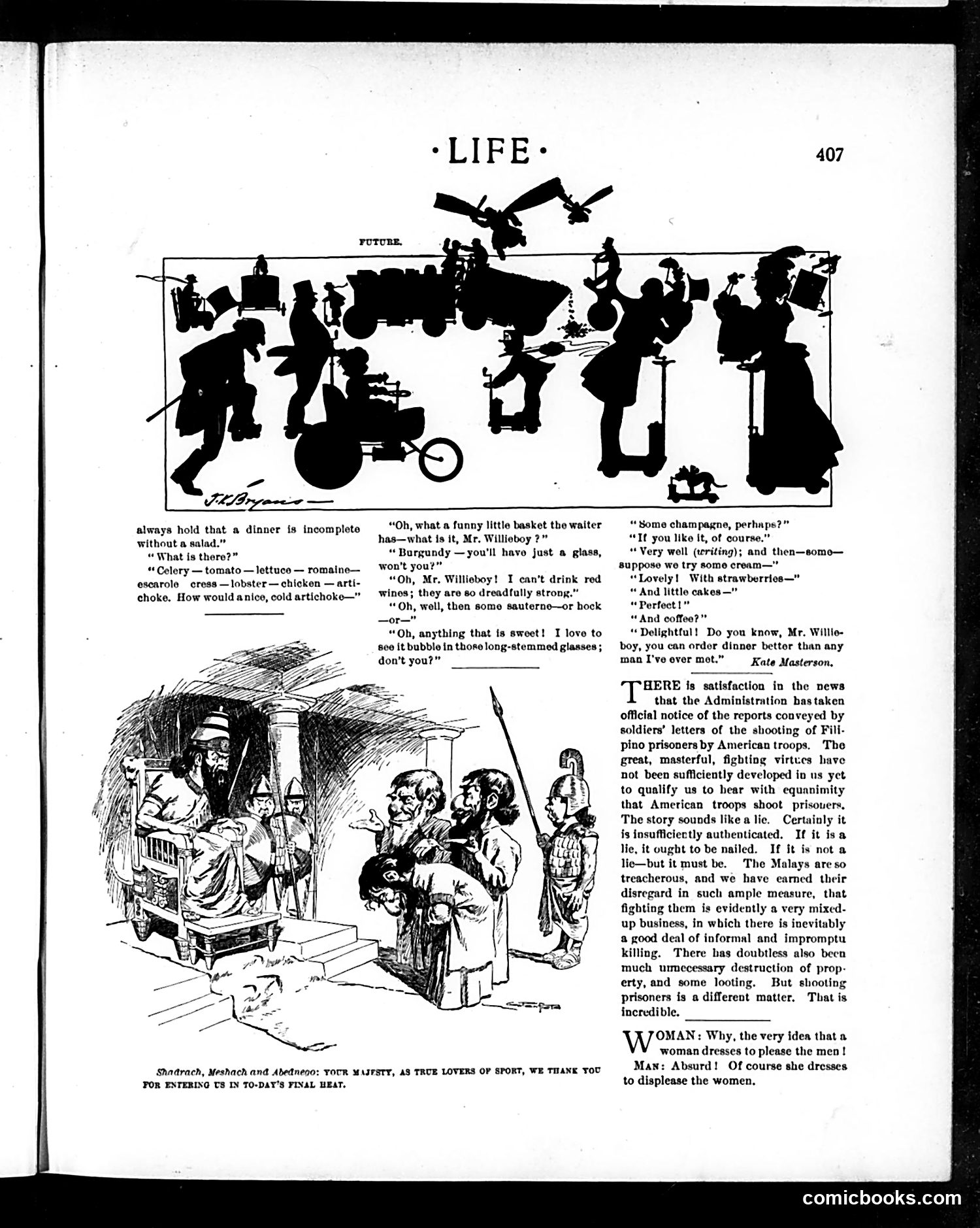
**Upper Cartoon ("Future"):** A silhouette scene depicting an elaborate formal dinner, satirizing upper-class dining excess. The conversation shows a wealthy diner (Mr. Willioboy) ordering an absurdly elaborate meal with multiple wines and desserts, while his companion enthusiastically approves of each extravagant course. The satire targets the pretension and gluttony of the wealthy during what appears to be the Progressive Era. **Lower Cartoon ("Shadrach, Meshach and Abednego"):** A biblical reference (three men thrown into a furnace) applied to what appears to be military figures, likely satirizing the Philippine-American War. The accompanying text discusses American troops allegedly shooting Filipino prisoners—a controversial and morally troubling incident the author struggles to believe, ultimately dismissing it as implausible despite acknowledging the war's brutality. **Final Dialogue:** A brief gender satire suggesting women dress to compete with other women rather than to please men. The page reflects early 1900s concerns: class excess, imperial warfare morality, and gender relations.
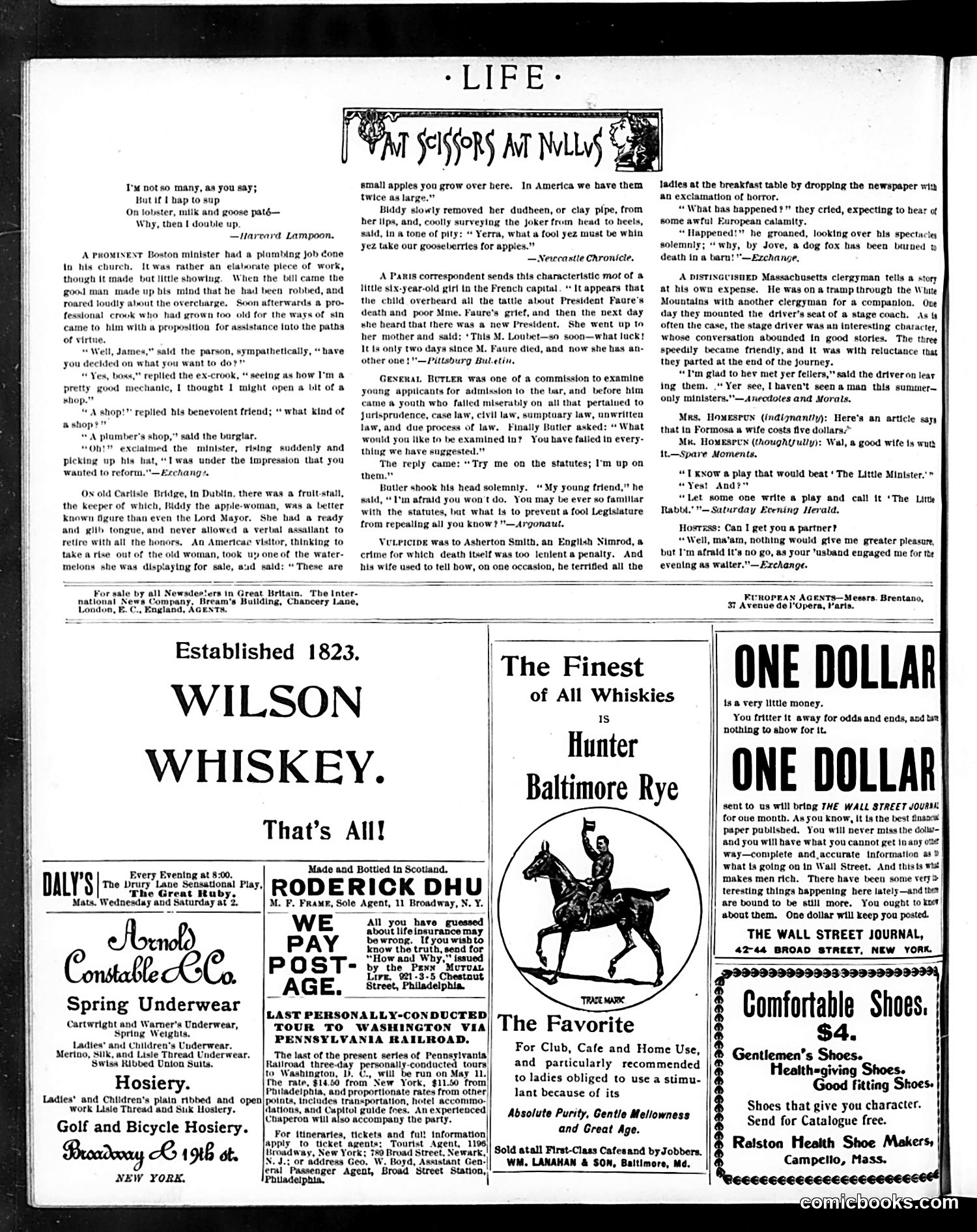
This page contains **humorous anecdotes** rather than political cartoons. The title heading is a visual pun using scissors imagery. The jokes satirize: 1. **Clergy hypocrisy**: A Boston minister complains about plumbing overcharges, then ironically hires a reformed criminal who becomes a plumber—suggesting the minister got what he deserved. 2. **American boastfulness**: An American tourist brags about larger American watermelons to an Irish fruit-seller (Biddy), who deflates him by claiming they're actually gooseberries—mocking American superiority claims. 3. **French social commentary**: A six-year-old girl treats President Faure's death casually, viewing his replacement as convenient timing—dark humor about political indifference. 4. **Legal incompetence**: General Butler examines a law student who fails every subject but claims expertise in "statutes"—implying legislators are fools who could repeal laws anyway. The page also mocks excessive concern for animals over human suffering. These are gentle, Victorian-era satirical pieces targeting human folly, pretension, and irony.
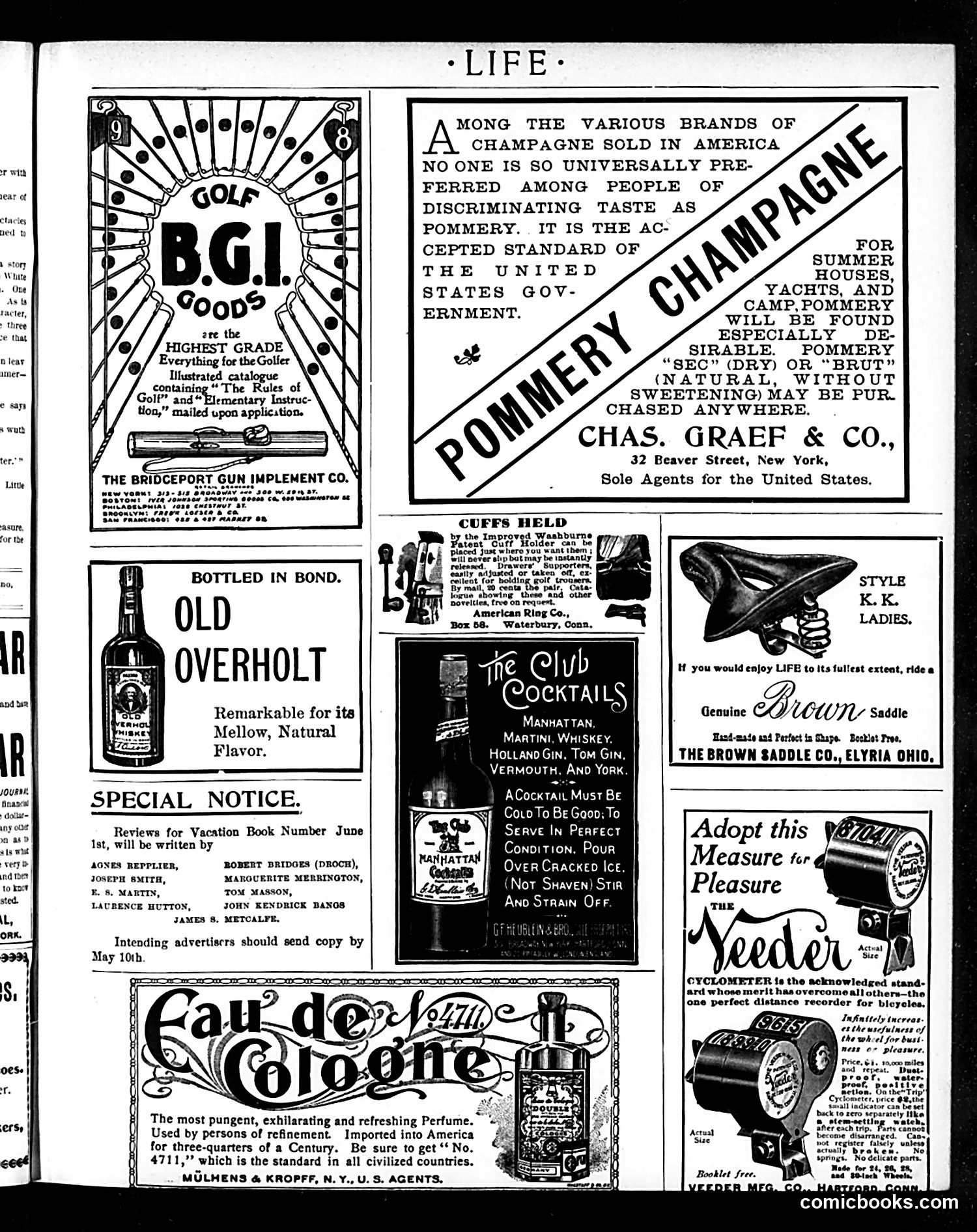
This is primarily an **advertising page** from Life magazine, not a satirical cartoon section. The page contains commercial advertisements for various luxury goods popular in the early 1900s. Key advertisements include: - **B.G.I. Golf Goods** (top left): promoting golf equipment - **Pommery Champagne** (center): claiming to be "the accepted standard of the United States Government" for yachts and camps - **Old Overholt Whiskey**: promoting its "mellow, natural flavor" - **Brown Saddle Company**: advertising genuine saddles - **The Club Cocktails**: listing mixed drink recipes - **Eau de Cologne #4711**: claiming three-quarters-century use by "persons of refinement" - **Needer Cyclometer**: a bicycle distance recorder The page also contains a **special editorial notice** listing writers who will review the upcoming vacation book issue. The content reflects gilded-age consumer culture and aspirational advertising targeting wealthy Americans.
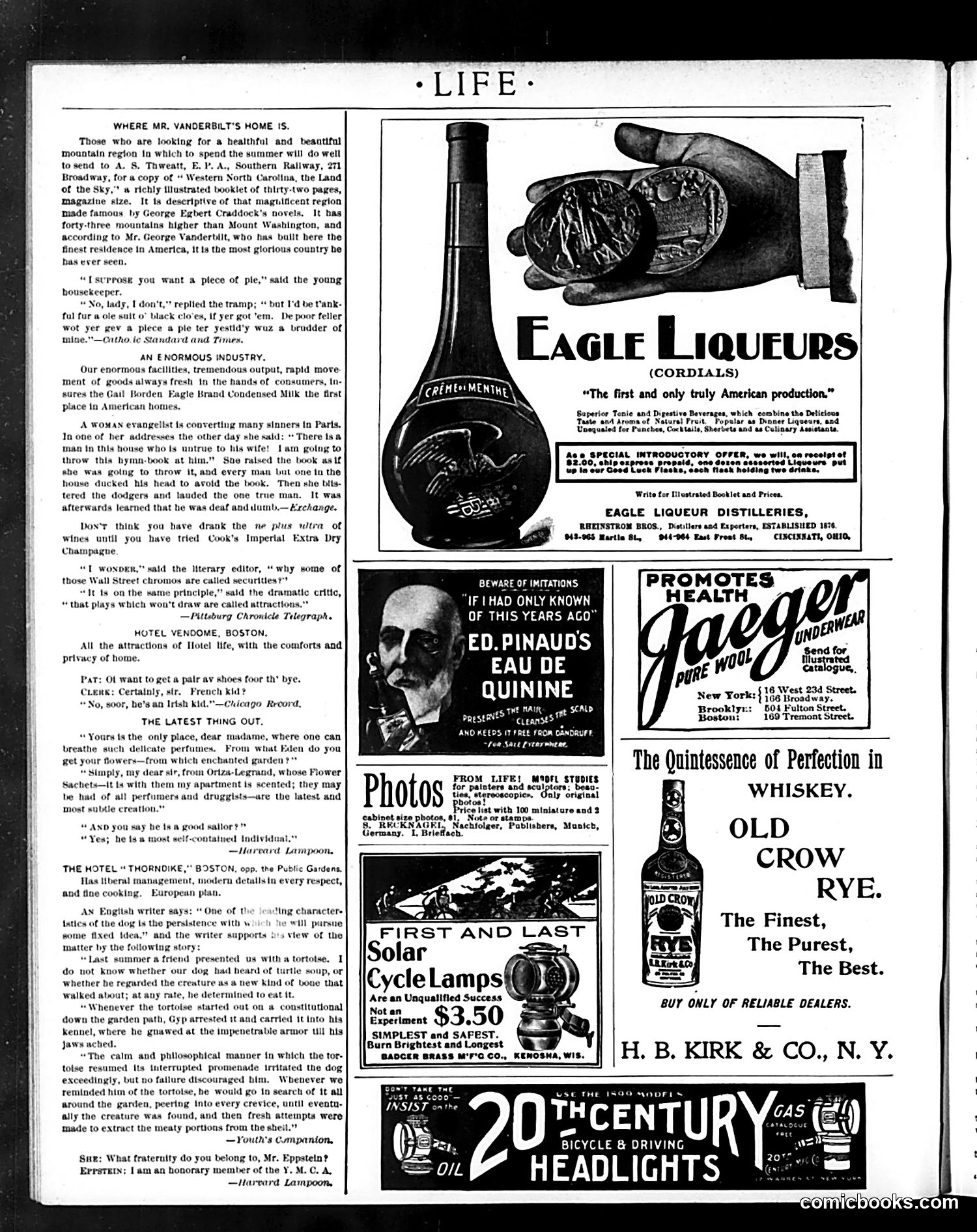
This page is primarily **advertising with humor interspersed**—typical of Life magazine's format. The satirical content includes brief anecdotes mocking social pretension and human nature: a woman evangelist throws a hymn book at unfaithful husbands (only a deaf man doesn't duck); a tramp asks for clothes instead of pie; Wall Street financial instruments are called "securities" because they won't "draw" audiences, like failed theatrical "attractions." The advertisements promote luxury goods—Eagle Brand liqueurs, Old Crow rye whiskey, Solar cycle lamps, and Jaeger underwear—targeting wealthy readers. One ad references **George Vanderbilt's North Carolina estate**, appealing to aspirational consumers. A notable ad warns against "imitations" of **Ed. Pinaud's eau de quinine**, a hair tonic—suggesting counterfeit patent medicines were common concerns. The humor is gentle, class-conscious, and designed for educated, affluent readers of the early 1900s.
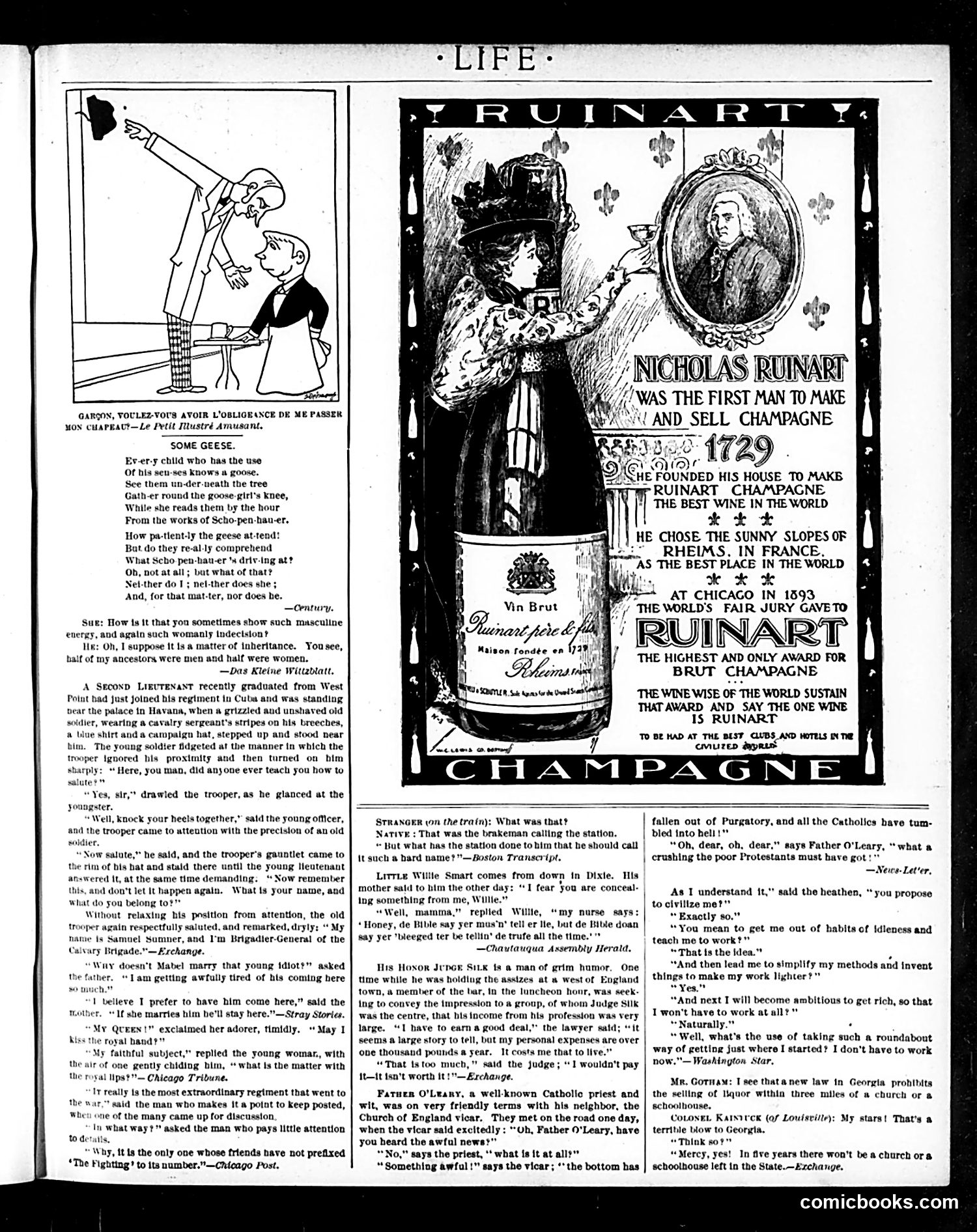
This is primarily an **advertising page for Ruinart Champagne** (right side), with humorous anecdotes and jokes filling the left column. ## The Advertisement The Ruinart ad celebrates the champagne house's history and prestige, claiming Nicholas Ruinart "was the first man to make and sell champagne" (1729) and that Ruinart won the "highest and only award for brut champagne" at the 1893 Chicago World's Fair. ## The Humor Pieces The left side contains short jokes and anecdotes typical of early Life magazine's satirical style: - A poem about geese listening to Schopenhauer (absurdist humor) - A quip about feminine/masculine inheritance - A story of a young Army officer unknowingly saluting a Brigadier-General disguised as a grizzled trooper—a commentary on military hierarchy and appearances - Various domestic and social humor pieces **Context for modern readers:** This represents Life's mix of sophisticated satire and genteel humor aimed at upper-class audiences, blended seamlessly with luxury advertising.
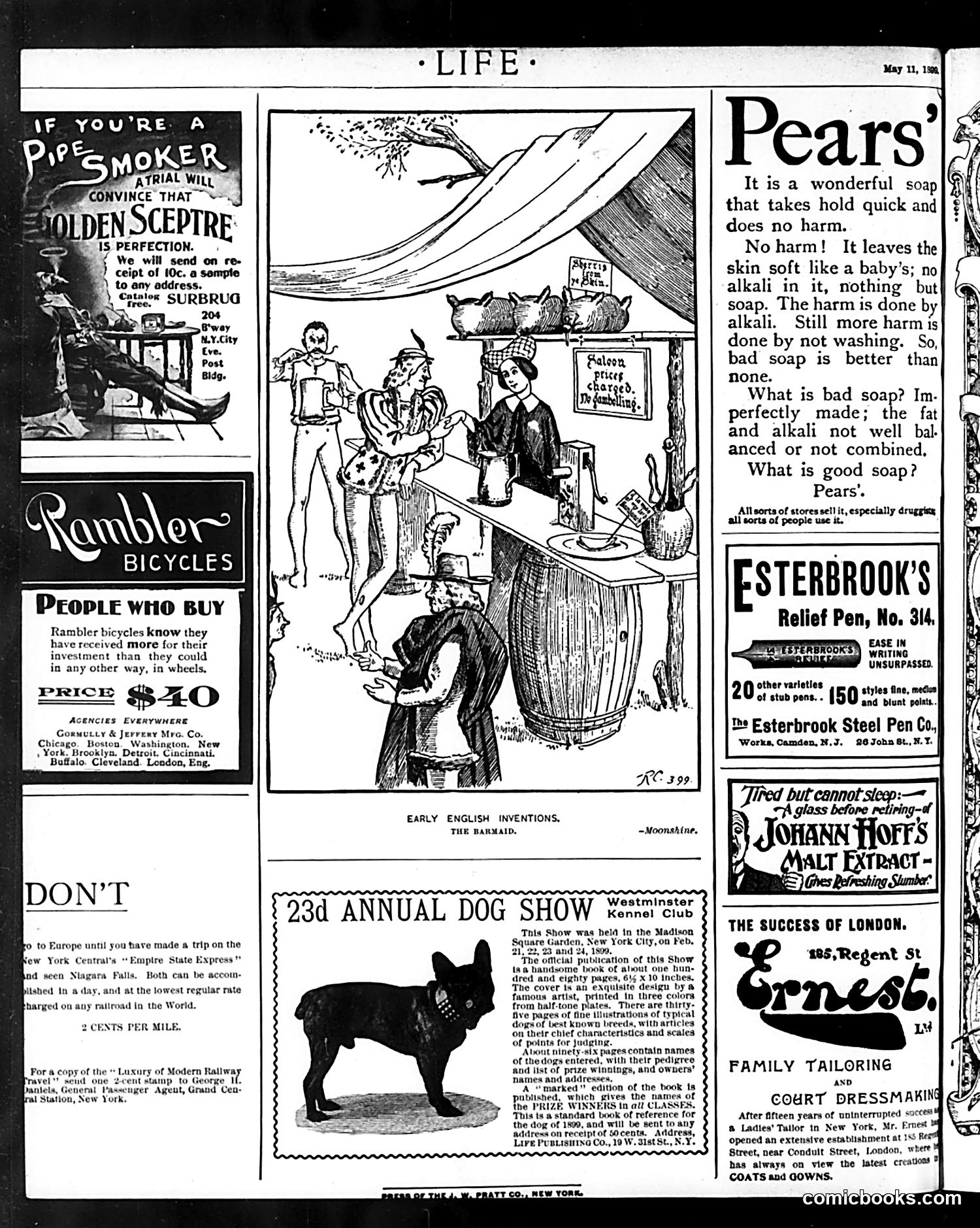
This cartoon satirizes a supposed medieval English invention—the barmaid serving customers at a tavern counter. The figures in period costume appear to represent historical characters witnessing or participating in this "invention." The satire likely mocks the notion that serving drinks in a public house was somehow a notable English innovation worthy of historical documentation. The page is primarily filled with advertisements (bicycles, soap, pens, railroads, tailoring services), typical of *Life* magazine's commercial content. The cartoon's caption—"Early English Inventions"—and subtitle "The Barmaid" suggest gentle humor about attributing ordinary occupations the status of historical innovations, reflecting Victorian-era attitudes toward labor and commerce. The date is May 11, 1899.