
Life, 1899-05-11 · page 4 of 20
Life — May 11, 1899 — page 4: what you’re looking at
What you’re looking at
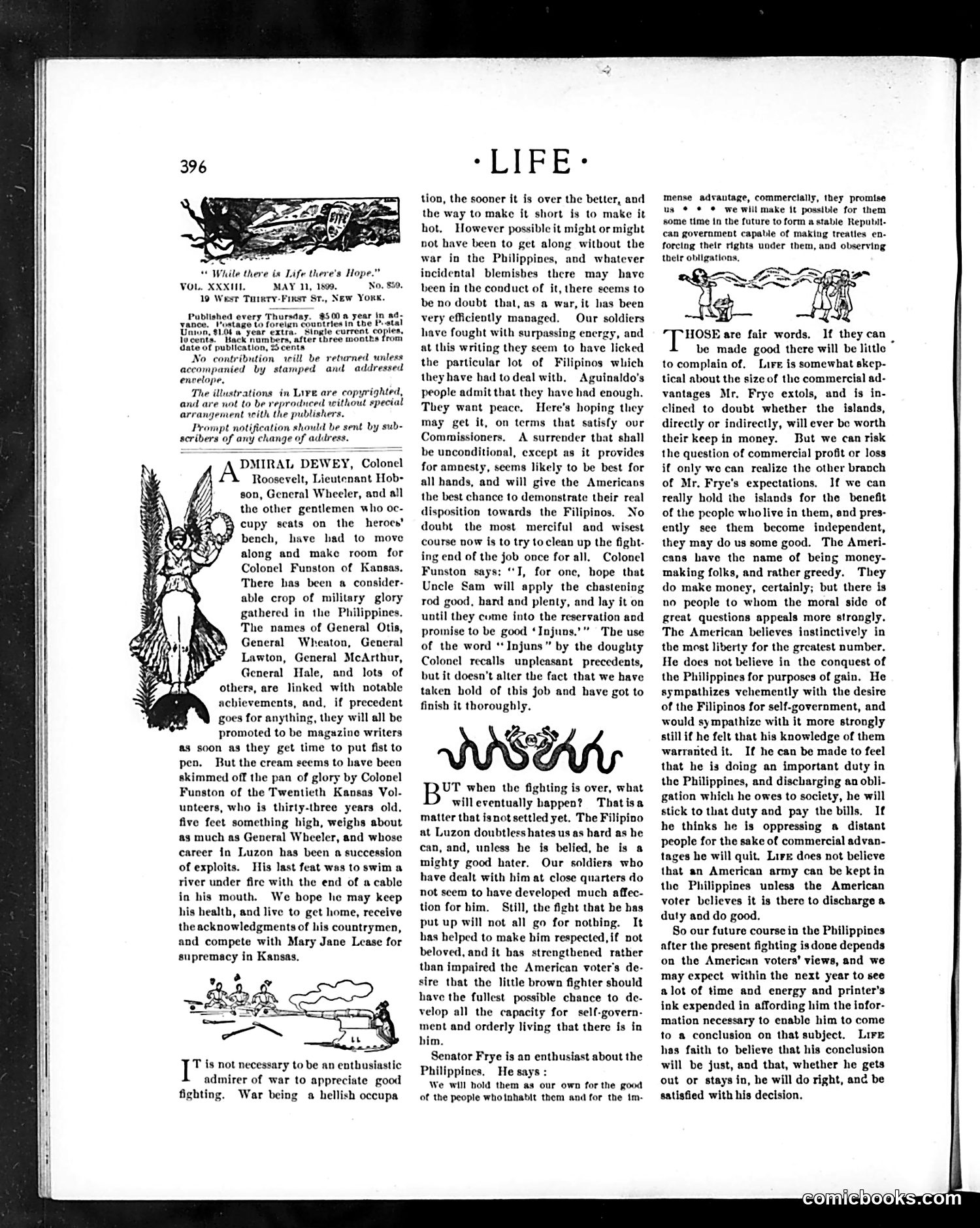
The page contains editorial commentary on the Philippine-American War, with illustrations featuring military figures. The text discusses Admiral Dewey, General Otis, General Wheaton, and General Lawton—figures involved in the Philippines conflict. The central debate concerns whether the war was "efficiently managed" and what should happen post-conflict. A key figure, Senator Frye, advocates for American occupation of the Philippines for commercial and moral purposes. The editorial expresses skepticism about whether the islands' conquest justified the costs. The satirical element critiques both enthusiastic war supporters and those questioning the military campaign's necessity. The cartoons (showing figures in military dress) appear to mock the glorification of warfare and the competing political interests regarding the Philippines' future governance and economic value.
📄 Transcribed text from this page (OCR, searchable)
Machine-transcribed from the original scan — historical spelling and the odd misread are preserved.
9500 a year in ad- untries in the Petal . | Single current copies, locents. Mack numbers, after three months from date of publication, 2 cents yo contribution will be returned unless accompanied by stamped and addressed envelope, The illustrations in Live are copyrighted, and are not to be reproduced without special arrangement with the publishers. Prompt notification should be sent by sub- scribers of any change of address. DMIRAL DEWEY, Colonel Roosevelt, Lieutenant Hob- son, General Wheeler, and all the other gentlemen who oc- cupy seats on the heroes’ bench, have had to move along and make room for Colonel Funston of Kansas. There has been a consider- able crop of military glory gathered in the Philippines. The names of General Otis, General Wheaton, General Lawton, General McArthur, General Hale, and lots of others, are linked with notable acbievements, and, if precedent goes for anything, they will all be promoted to be magazine writers as soon as they get time to put fist to pen. But the cream seems to have beco skimmed off the pan of glory by Colonel Funston of the Twentieth Kansas Vol- unteers, who is thirty-three years old, five feet something high, weighs about as much as General Wheeler, and whose career in Luzon has been a succession of exploits. His last feat was to swim a river under fire with the end of a cable in his mouth. We hope he may keep his health, and live to get home, receive the acknowledgments of his countrymen, and compete with Mary Jane Lease for supremacy in Kansas, T° is not necessary to be an enthusiastic admirer of war to appreciate good fighting. War being a hellish occupa "LIFE tion, the sooner it is over the better, and the way to make it short is to make it hot. However possible it might or might not have been to get along without the war in the Philippines, and whatever incidental blemishes there may have been in the conduct of it, there scems to be no doubt that, as a war, it has been very efficiently managed. Our soldiers have fought with surpassing energy, and at this writing they seem to have licked the particular lot of Filipinos which they have had to deal with. Aguinaldo’s people admit that they have had enough. They want peace, Here’s hoping they may get it, on terms that satisfy our Commissioners. A surrender that shall be unconditional, except as it provides for amnesty, seems likely to be best for all hands, and will give the Americans the best chance to demonstrate their real disposition towards the Filipinos. No doubt the most merciful and wisest course now is to try toclean up the fight- ing end of the job once for all. Colonel Funston says: “J, for one, bope that Uncle Sam will apply the chastening rod good, hard and plenty, and lay it on until they come into the reservation and promise to be good ‘Injuns.’” The use of the word *Injuns” by the doughty Colonel recalls unpleasant precedents, but it doesn’t alter the fact that we have taken hold of this job and have got to finish it thoroughly. WISH UT when the fighting is over, what willeventually happen? Thatisa matter that isnot settled yet. The Filipino at Luzon doubtless hates us as hard as he can, and, unless he is belied, he is a mighty good hater. Our soldiers who have dealt with him at close quarters do not scem to have developed much affec- tion for him. Still, the fight that be has put up will not all go for nothing. It has helped to make him respected, if not beloved, and it has strengthened rather than impaired the American voter's de- sire that the little brown fighter should have the fullest possible chance to de- velop all the capacity for self-govern- ment and orderly living that there is in him. Senator Frye is an enthusiast about the Philippines, He says : We will bold them as our own for the good of the people whoinhabit them and for the im- mense advantage, commercially, they promise us ¢ © © wewlil make it possible for them some time In the future to form a stable Repubil- can government capatle of making treatles en- forcing their rights under them, and observing thelr obligations, Fy GOS wars <a HOSE are fair words, If they can be made good there will be little to complain of. Lire is somewhat skep- tical about the size of the commercial ad- vantages Mr. Frye extols, and is in- clined to doubt whether the islands, directly or indirectly, will ever be worth their keep in money. But we can risk the question of commercial profit or loss if only we can realize the other branch of Mr. Frye’s expectations, If we can really hold the islands for the benefit of the people wholive in them, end pres- ently see them become independent, they may do us some good. The Ameri- cans have the name of being moncy- making folks, and rather greedy. They do make money, certainly; but there is no people to whom the moral side of great questions appeals more strongly. The American believes instinctively in the most liberty for the greatest number. He does not believe in the conquest of the Philippines for purposes of gain. He sympathizes vehemently with the desire of the Filipinos for self-government, and would sympathize with it more strongly still if he felt that his knowledge of them warranted it. If he can be made to feel that he is doing an important duty in the Philippines, and discharging an obli- gation which he owes to society, he will stick to that duty and pay the bills. If he thinks he is oppressing a distant people for the sake of commercial advan- tages he will quit, Lire does not believe that an American army can be keptin the Philippines unless the American voter believes it is there to discharge a duty and do good. So our future course in the Philippines after the present fighting is done depends on the American voters’ views, and we may expect within the next year to see alot of time and energy and printer's ink expended in affording him the infor- mation necessary to enable him to come to a conclusion on that subject. Lire has faith to believe that his conclusion will be just, and that, whether he gets out or stays in, he will do right, and be satisfied with his decision. 2