
Life, 1899-05-11 · page 8 of 20
Life — May 11, 1899 — page 8: what you’re looking at
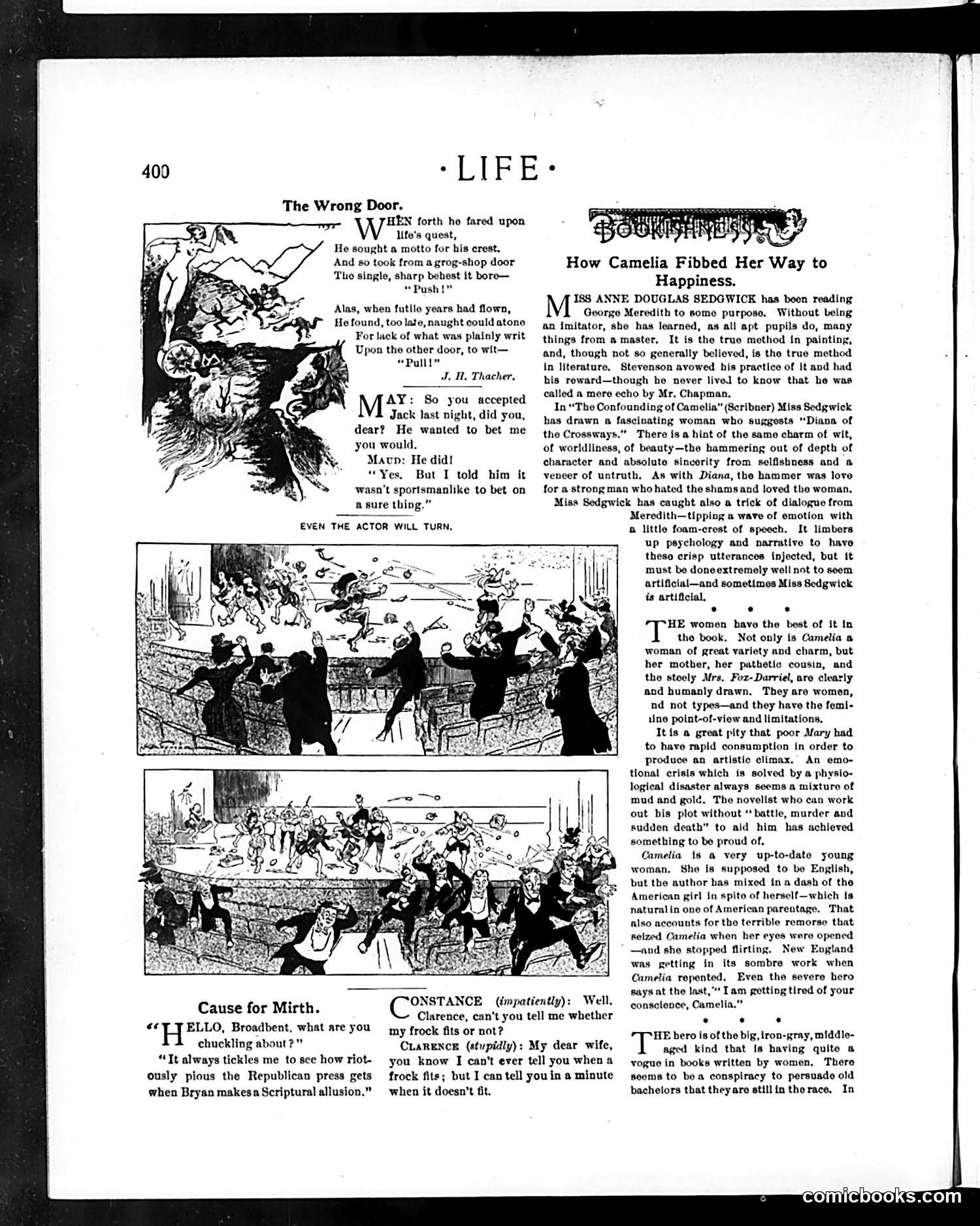
What you’re looking at
This small cartoon presents a domestic debate between **Constance** (impatient) and **Clarence** (stupidly). The joke hinges on a contemporary political reference: Bryan's "Scriptural allusion." The humor targets **William Jennings Bryan**, the three-time presidential candidate known for invoking religious rhetoric in his campaigns. Clarence suggests Bryan's mixing of Scripture with politics is absurd enough to "tickle" even Republican press coverage—implying Bryan's religious appeals are so ridiculous they become unintentionally comic fodder. The cartoon satirizes how Bryan weaponized biblical language in political discourse, treating his rhetoric as inherently laughable rather than persuasive. This reflects early 1900s skepticism toward religiously-inflected populism.
📄 Transcribed text from this page (OCR, searchable)
Machine-transcribed from the original scan — historical spelling and the odd misread are preserved.
“LIFE® The Wrong Door. HEN forth ho fared upon life's quest, He sought a motto for his crest. And 80 took from a grog-shop door Tho single, sharp bebest it boro— “Push!” Alas, when futilo years had flown, He found, too late, naught could atone For luck of what was plainly writ Upon the other door, to wit— “Pulll” J. H. Thacher. AY: So you accepted Jack last night, did you, dear? He wanted to bet me you would, Maun: He did! “Yes, But I told him it wasn't sportsmanlike to bet on a sure thing.” EVEN THE ACTOR WILL TURN, Happiness. 188 ANNE DOUGLAS SEDGWICK has been reading George Meredith to some purpose, Without being an imitator, she has learned, as all apt pupils do, many things from a master. It is the true method In painting, and, though not so generally believed, is the true method in literature, Stevenson avowed his practice of it and had his reward—though he nover lived to know that he was called a mere echo by Mr. Chapman, In “The Confounding of Camelia” (Scribner) Miss Sedgwick has drawn a fascinating woman who suggests “Diana of tho Crossways.” There is a hint of the samo charm of wit, of worldliness, of beauty—tho hammering out of depth of character and absolute sincerity from selfishness and a veneer of untruth, As with Diana, the hammer was love for a strong man who hated the shams and loved the woman, Miss Sedgwick has caught also a trick of dialogue from Meredith—tipping a wave of emotion with @ little foam-crest of speech. It limbers up psychology and narrative to havo theso crisp utterances injected, but it must be doneextremely well not to seem artificial—and sometimes Miss Sedgwick és artificial. * * . HE women havo the best of it in tho book. Not only is Camelia a woman of great variety and charm, but her mother, her pathetic cousin, and the stocly Mrs, Foz-Darriel, aro clearly and humanly drawn, They are women, nd not types—and they havo the femi- ino point-of-view and limitations, It is a great pity that poor Mary had to have rapid consumption in order to produce an artistic climax, An emo- tional crisis which is solved by a physio- logical disaster always seems a mixture of mud and gold. Tho novelist who can work Cause for Mirth. ONSTANCE (impatiently): out bis plot without “battle, murder and sudden death” to aid him has achieved something to be proud of. Camelia 1s a very up-to-date young woman, She Is supposed to be English, but the author has mixed ina dash of the American girl in spito of hersclf—which 1s naturalin one of American parentage. ‘That also accounts for tho terrible remorso that seized Camelia whon her eyes were opened —and she stopped flirting, New Eogland was getting in {ts sombre work when Camelia repented, Even the severe hero says at tho last,’ Iam gotting tired of your Well, consotence, Camelia.” ac ELLO, Broadbent, what are you chuckling about?” “Tt always tickles me to sce how riot- ously pious the Republican press gets when Bryan makesa Scriptural allusion.” Clarence, can’t you tell me whether my frock fits or not? CLARENCE (stupidly): My dear wife, you know I can’t ever tell you when a frock fits; but I can tell you in a minute when it doesn’t fit. * . * HE hero is of the big, iron-gray, middlo- aged kind that Is having quite a vogue in books written by women, Thero seoms to be a conspiracy to persuade old bachelors that theyaro still in therace. In