
A complete issue · 20 pages · 1899
Life — May 4, 1899
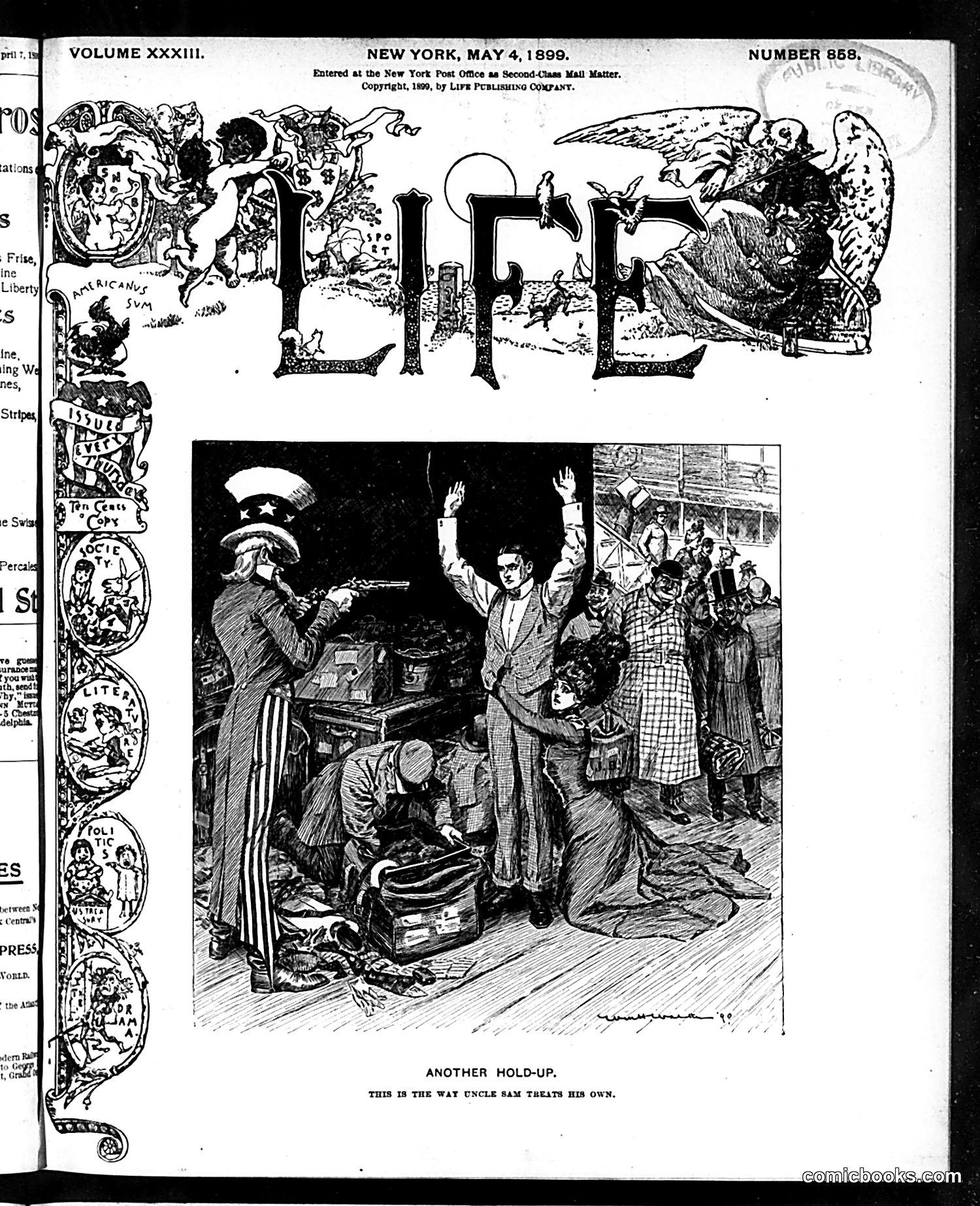
This 1899 *Life* magazine page satirizes American imperialism and economic exploitation. The large illustration depicts Uncle Sam (identifiable by his star-spangled hat) as a robber, holding a gun while civilians surrender their valuables. The caption reads "ANOTHER HOLD-UP. THIS IS THE WAY UNCLE SAM TREATS HIS OWN." The cartoon criticizes U.S. government policies that the artist views as predatory toward American citizens or territories. The "hold-up" metaphor suggests the government is forcibly extracting resources or imposing unfair policies, much like a criminal robbery. This reflects late-1890s debates over American expansionism, taxation, and the treatment of territories acquired after the Spanish-American War (1898). The satire questions whether Uncle Sam's imperial ambitions serve ordinary Americans' interests.
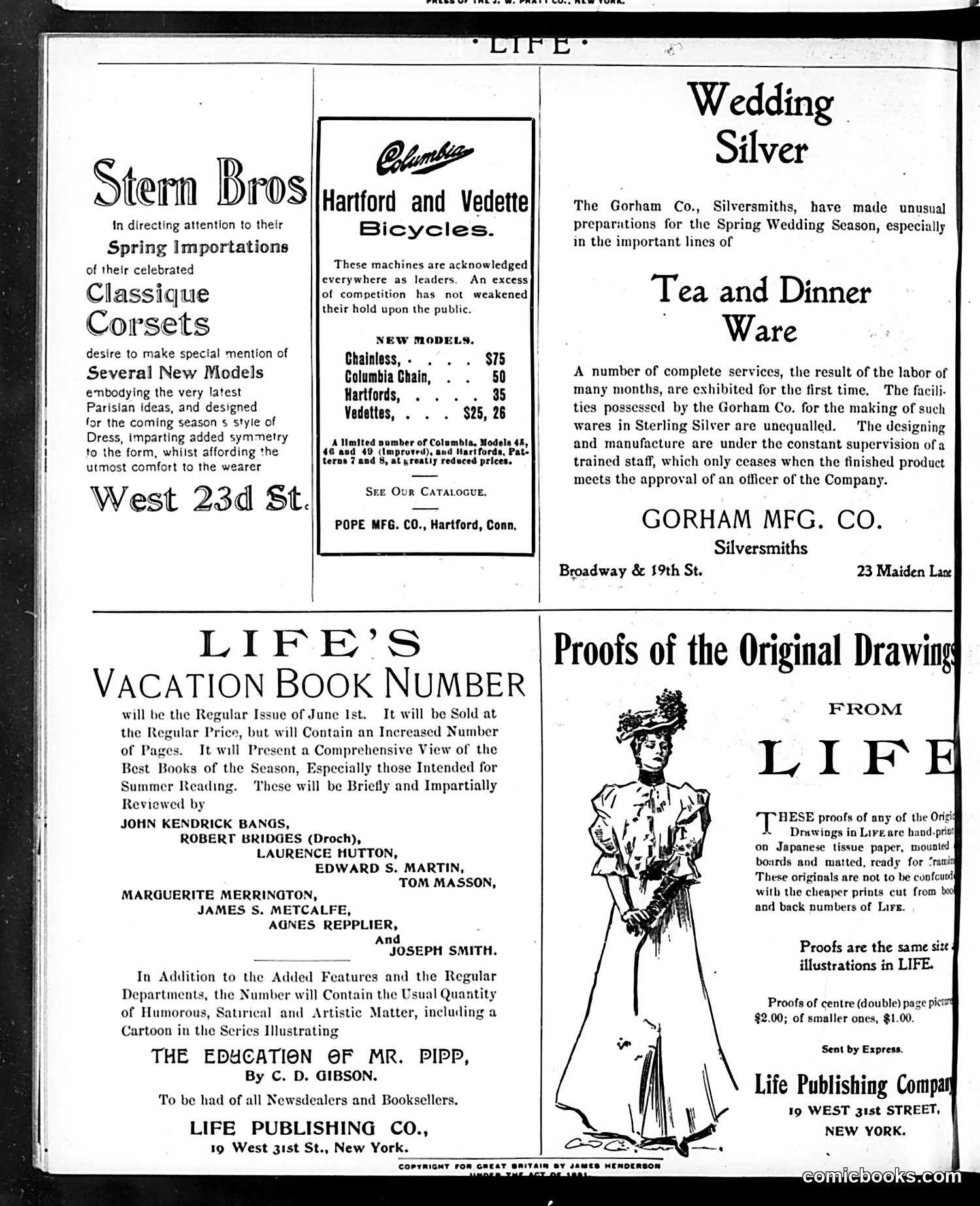
This page is predominantly **advertising and announcements**, not political satire or editorial cartooning. The content includes: - **Stern Bros. corset advertisement** promoting spring fashions on West 23rd Street - **Pope Mfg. Co. bicycle ad** for Hartford and Vedette models - **Gorham Mfg. Co. silversmith announcement** for wedding season tea and dinner ware - **Life Publishing Company notices** about their upcoming Vacation Book issue (June 1st) and an offer of original drawing proofs from Life magazine The only illustration is a **fashion sketch of a woman in period dress** (appears early 1900s), accompanying the silverware advertisement. There is no political cartoon or satirical content on this page. It represents typical early-20th-century Life magazine commercial space mixed with publisher announcements.
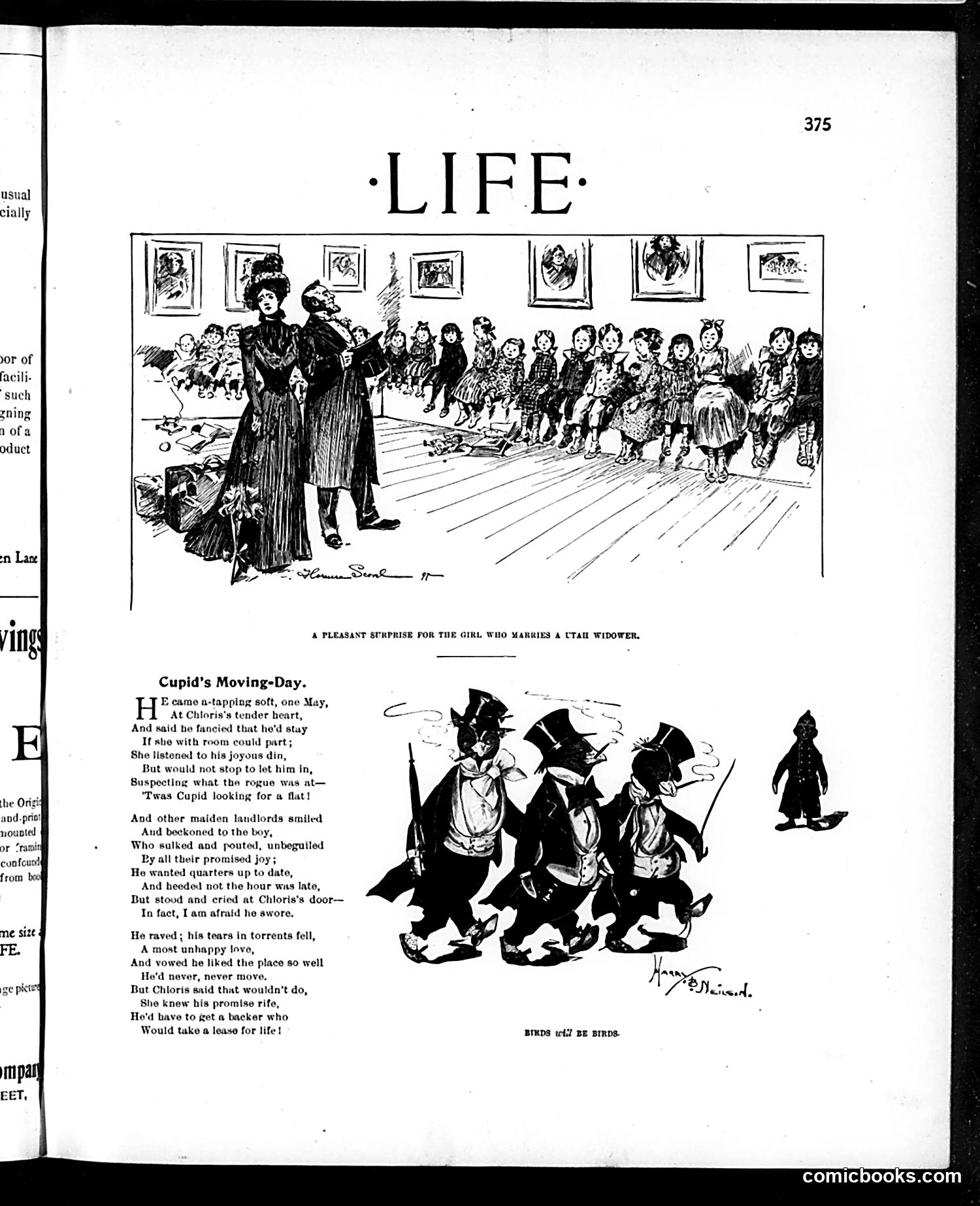
**Top Cartoon:** Shows a woman (possibly a widow, given the caption "A Pleasant Surprise for the Girl Who Marries a Utah Widower") presenting children to an assembled group. The satire targets polygamy in Utah—a practice that was controversial and illegal in most of America during this period. The joke plays on the "surprise" of marrying a man who already has children from previous marriages, treating polygamy as an absurd social condition worthy of ridicule. **"Cupid's Moving-Day" Poem & Illustration:** A narrative poem about Cupid attempting to woo a woman named Chloris, with accompanying silhouette illustrations of figures in motion. The story describes romantic pursuit and rejection, ending with the suggestion that securing a wife requires a business "lease." Both pieces use humor to comment on marriage and courtship customs of the era.
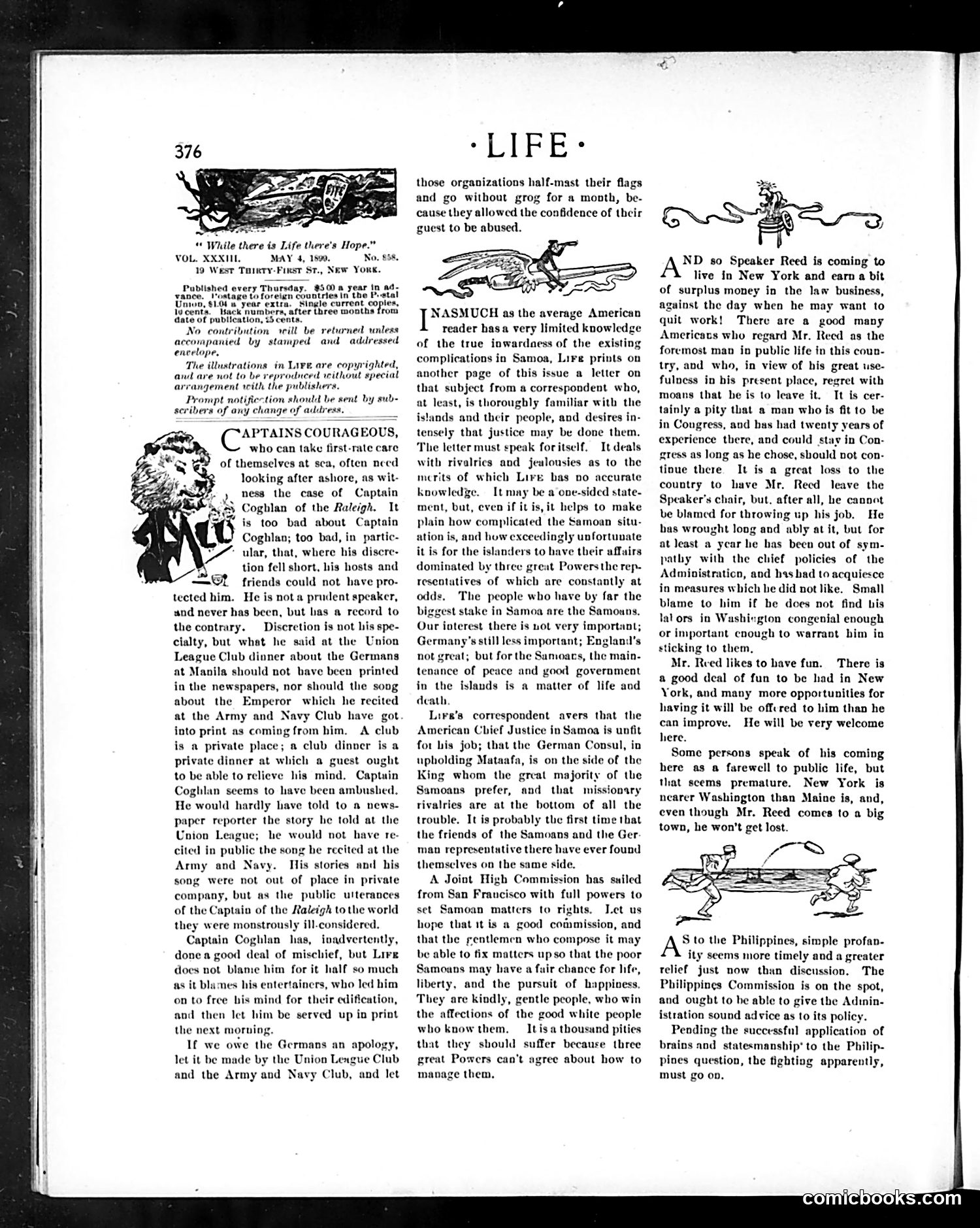
The main article discusses **Captain Coghlan of the USS Raleigh**, who is being criticized for his public statements about German and American naval policy. The text indicates Coghlan made controversial remarks at a Union League Club dinner regarding Germany that were printed in newspapers—apparently without authorization. The satire centers on Coghlan's indiscretion: he's portrayed as having violated protocol by airing sensitive diplomatic matters publicly. The article suggests this was inappropriate for a military officer, though it acknowledges he "seems to have been enthusiastic." The piece also discusses **Samoan colonial politics** and mentions a **Joint High Commission** sailing to address Philippine administration issues—both reflections of American imperial interests circa 1905.
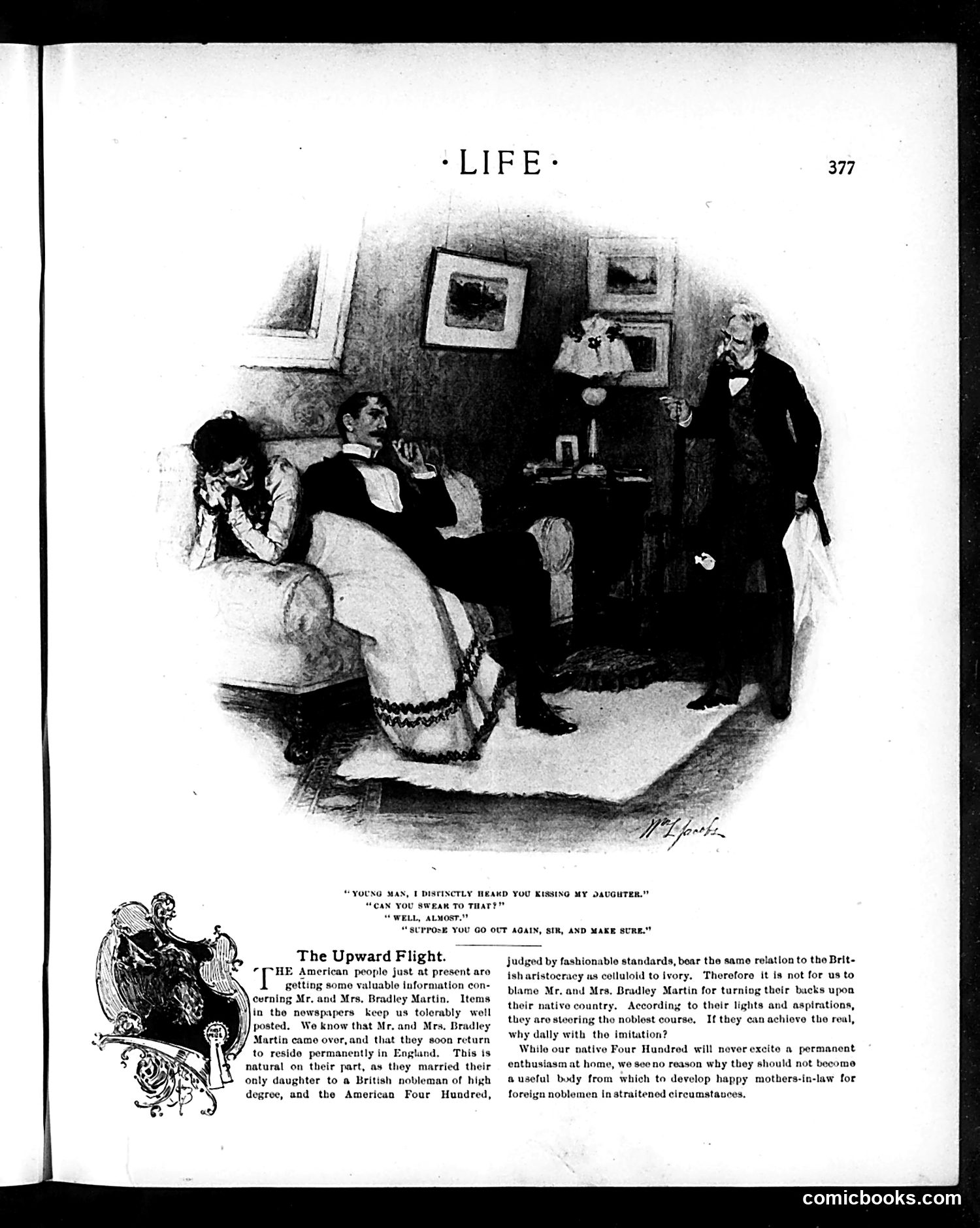
This satirical piece criticizes the Bradley Martin family's social aspirations. The cartoon depicts a domestic scene where a young man is caught kissing the daughter of the house, while the father responds with measured disapproval. The accompanying text explains the satire: American newspapers report that Mr. and Mrs. Bradley Martin are soon relocating permanently to England after marrying their only daughter to "a British nobleman of high degree." The satire mocks this as social climbing—the family seeking to elevate their status through an aristocratic marriage connection. The joke's bite lies in the ironic dialogue: the father says he "distinctly heard" the kissing but will overlook it, telling the young man to leave and "make sure" it doesn't happen again—suggesting the family prioritizes the prestigious marriage arrangement over propriety.
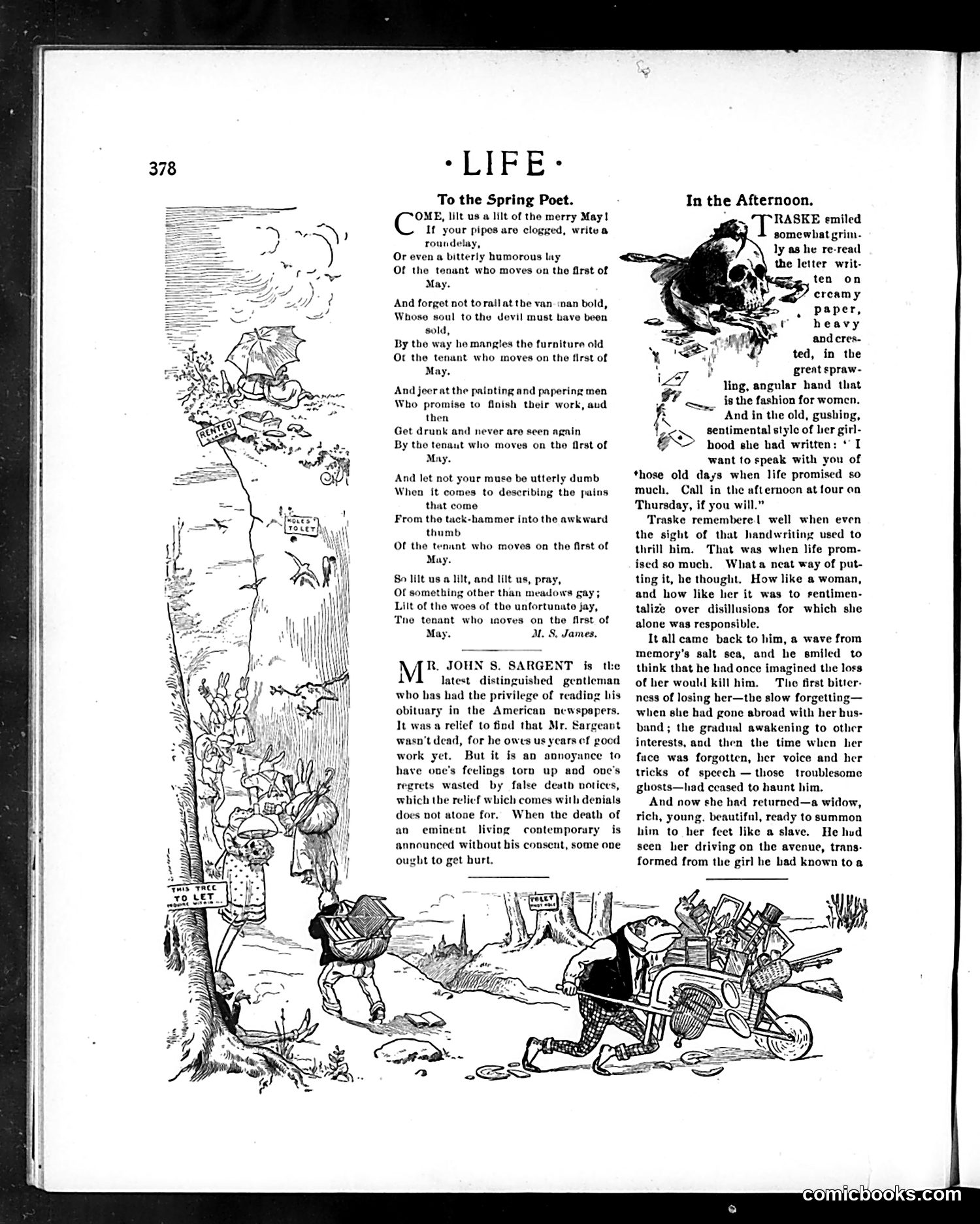
This page contains two distinct pieces: **"To the Spring Poet"** (left): A humorous poem mocking May Day moving day customs, with accompanying cartoon showing chaotic furniture moving and chaos. The satire targets the impractical tradition of tenants relocating on May 1st, with jokes about clogged pipes, drunk movers, and fumbled furniture. **"In the Afternoon"** (right): A sentimental prose piece about a woman reflecting on lost love and youth—specifically remembering a man's handwriting that once thrilled her. It's nostalgic rather than satirical. **MR. JOHN S. SARGENT** (center): An obituary notice for the distinguished gentleman, noting the annoyance of false death notices in newspapers and emphasizing the relief that Sargent's actual death was announced with proper consent. The page blends humor, sentiment, and contemporary social commentary typical of Life magazine's editorial mix.
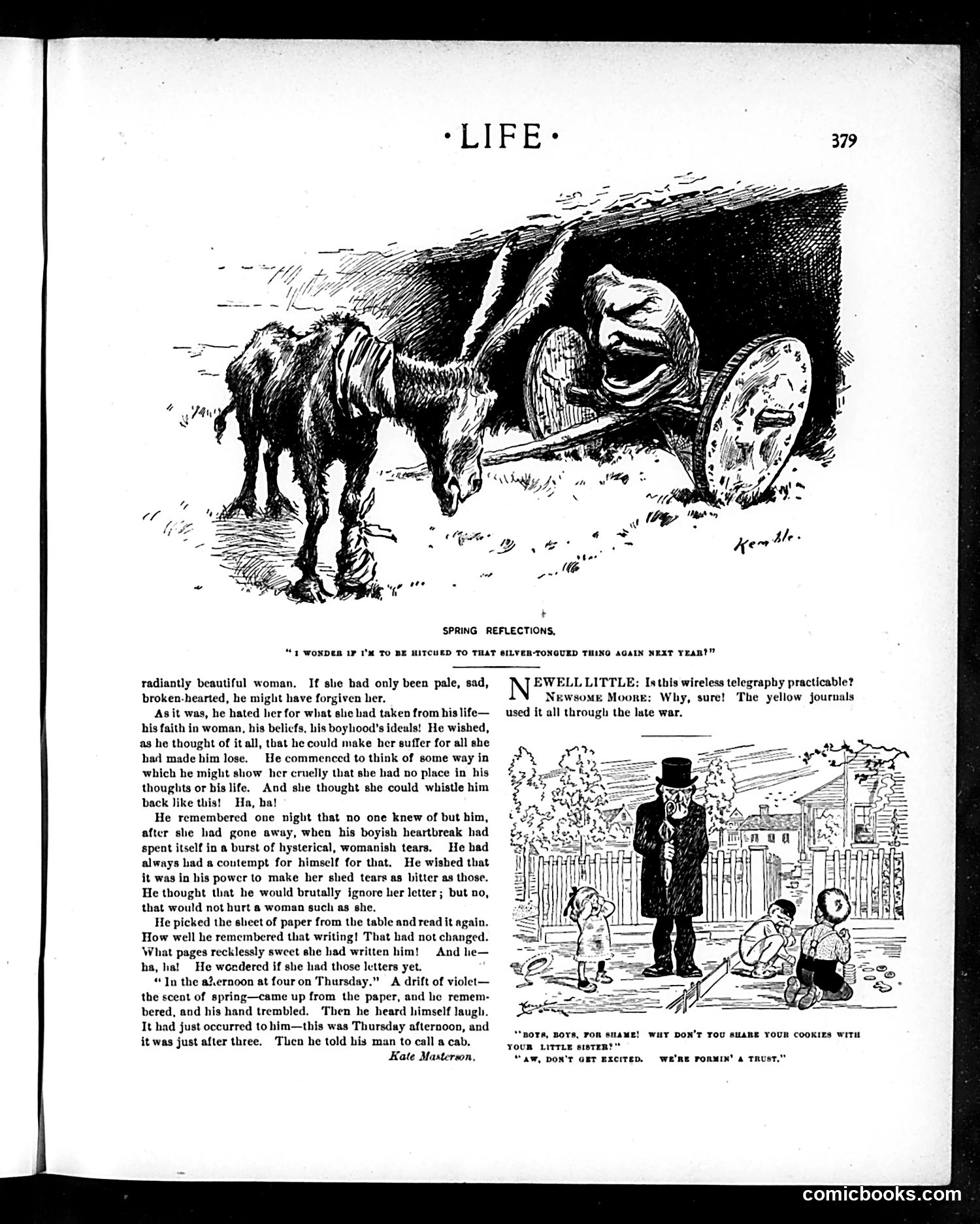
This page contains two distinct cartoons satirizing early 20th-century life: **Top cartoon ("Spring Reflections"):** A goat-drawn cart carries a man who daydreams about being "hitched to that silver-tongued thing again next year"—likely satirizing marriage or romantic entanglement, with the goat serving as a crude counterpart to an idealized romantic partner. **Bottom cartoon:** Shows an adult (possibly a governess or nanny based on the formal dress) with children outdoors. The caption dialogue—"Why don't you share your cookies with your little sister?" and "Aw, don't get excited. We're formin' a trust"—satirizes the contemporary monopoly trust debate by depicting children applying corporate financial strategy to sharing candy, mocking how business consolidation language had permeated popular culture.
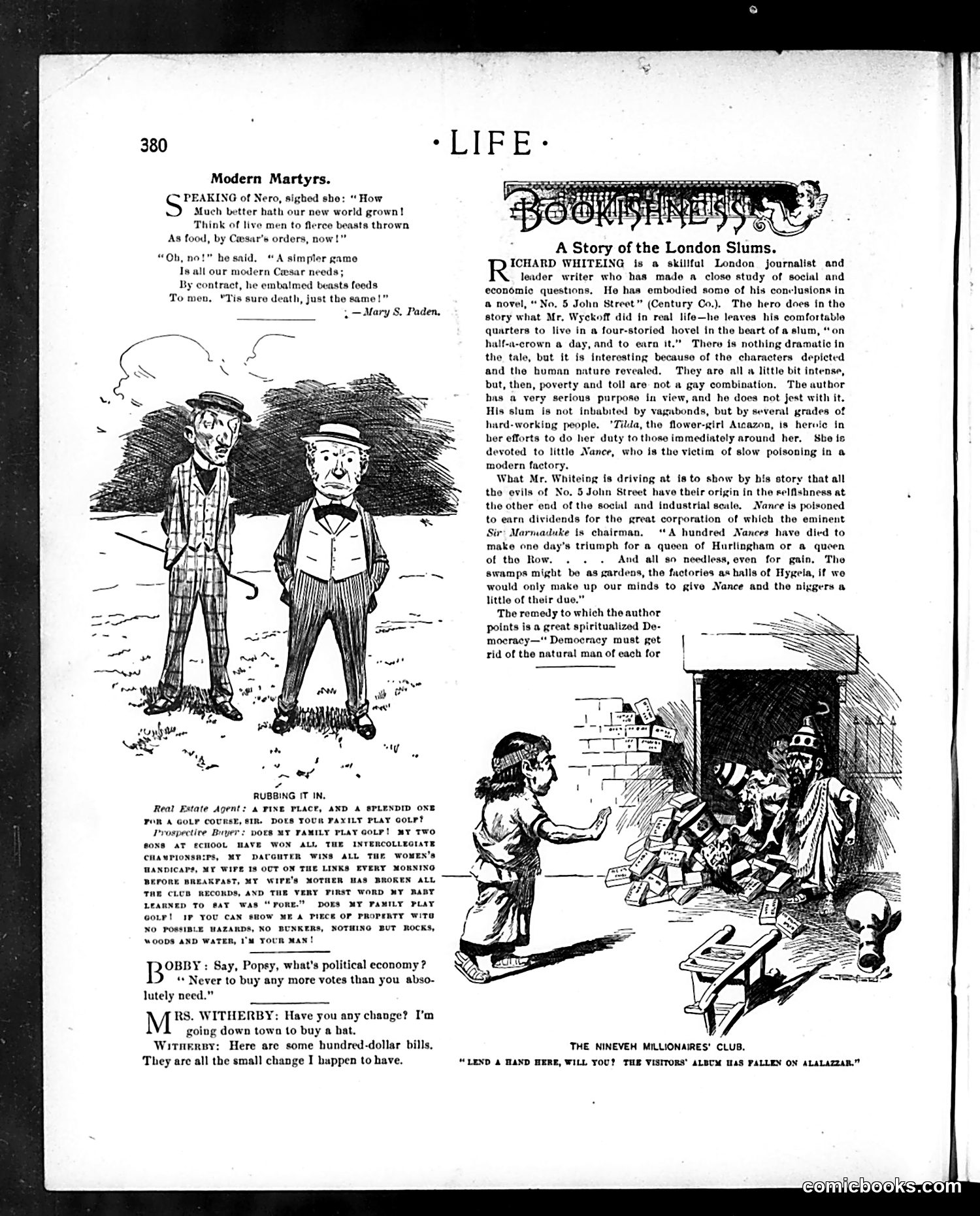
This page contains two distinct satirical pieces: **"Modern Martyrs"** (top left): A poem by Mary S. Paden mocking wealthy men who claim hardship. The accompanying cartoon shows two well-dressed gentlemen complaining about modern life's difficulties—a satirical commentary on wealthy elites exaggerating their troubles. **"A Story of the East End Slums"** (right): A book review of Richard Whiteing's novel about London poverty. The text criticizes the story for depicting slum life, featuring characters like "Nance" poisoned in a factory. The accompanying illustration ("The Nineveh Millionaires' Club") shows the contrast between wealthy club members and desperate poor outside, with the caption sarcastically asking wealthy members to "lend a hand"—mocking their indifference to poverty. Both pieces satirize class inequality and the wealthy's disconnect from working-class suffering.
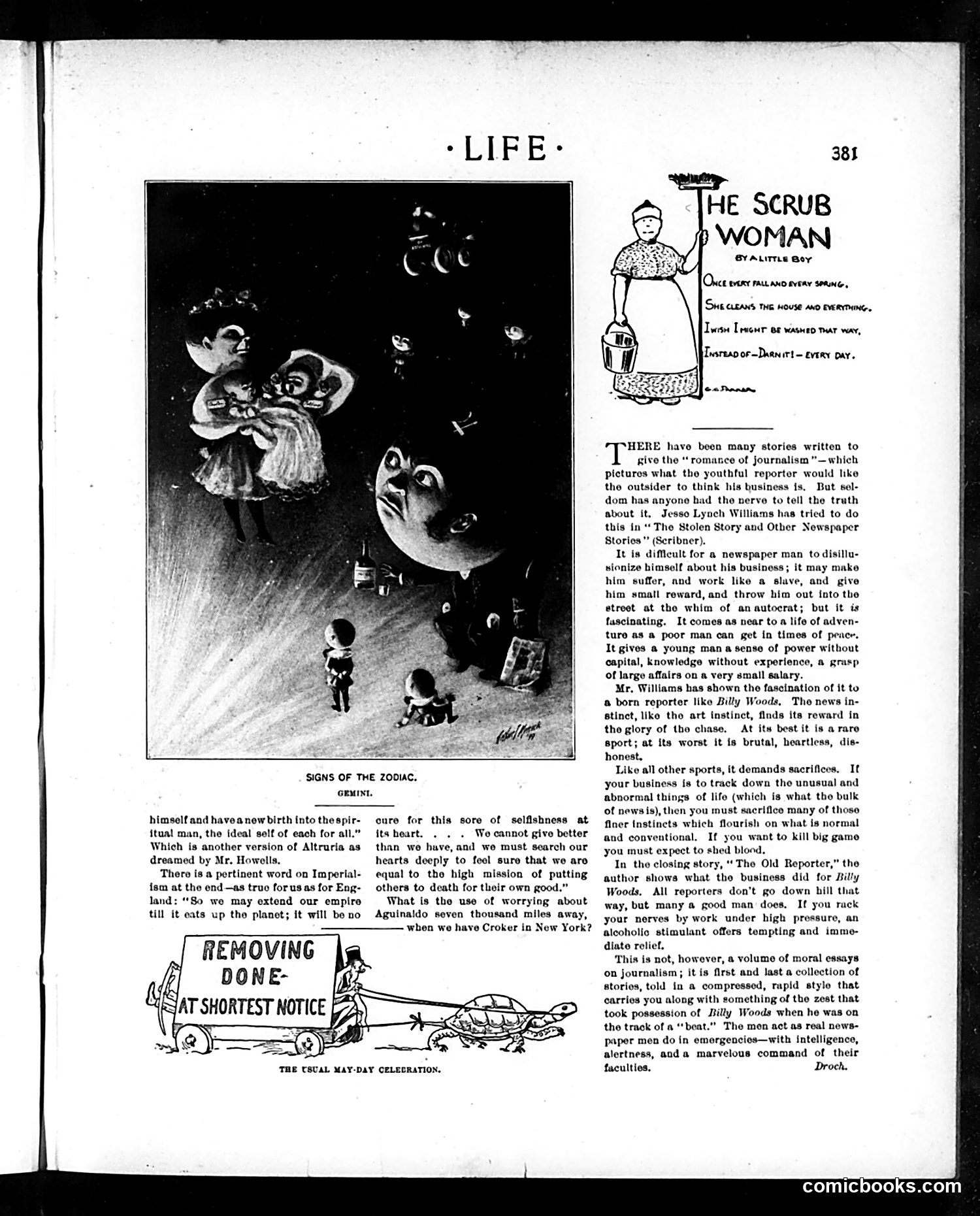
The page features two distinct pieces: **"Signs of the Zodiac: Gemini"** (left illustration) appears to be an astrological satire, though the specific meaning is unclear from the image alone. **"The Scrub Woman"** (right) is a humorous poem by "A Little Boy" celebrating domestic labor, presenting an idealized portrait of a cleaning woman who works tirelessly daily. Below is an advertisement-style cartoon labeled **"The Cruel May-Day Celebration"** showing figures with a cart, likely satirizing May Day labor celebrations or demonstrations—a reference to early 20th-century labor activism that would have been contentious in America. The page also includes a book review discussing Jesse Lynch Williams' journalism stories, praising newspaper reporting as adventurous work despite low pay.
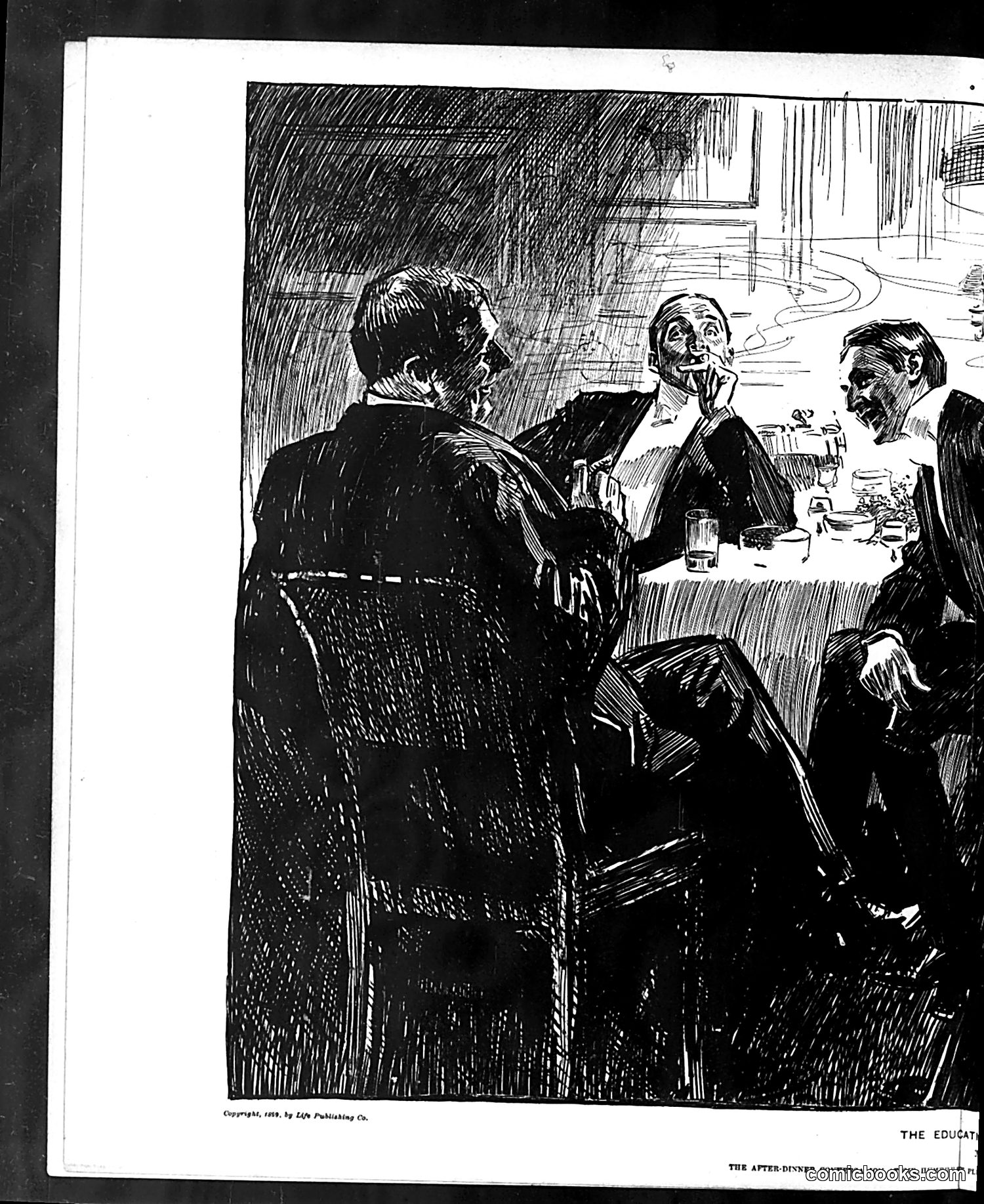
This appears to be a satirical cartoon titled "The Educator" and "The After-Dinner" (titles partially visible). The sketch depicts four men in formal business attire in what appears to be a dining or social setting. One man stands while others are seated at a table with glasses and place settings visible. The cartoon likely satirizes business or political figures of the era engaging in after-dinner conversation or "education"—possibly mocking the pretensions of wealthy industrialists or politicians conducting serious discussions over drinks. The formal dress and interior setting suggest commentary on elite social gatherings. Without clearer identification of the specific figures or clearer text, the precise targets and satirical point remain unclear, though the style suggests early 20th-century social criticism typical of *Life* magazine's editorial cartoons.
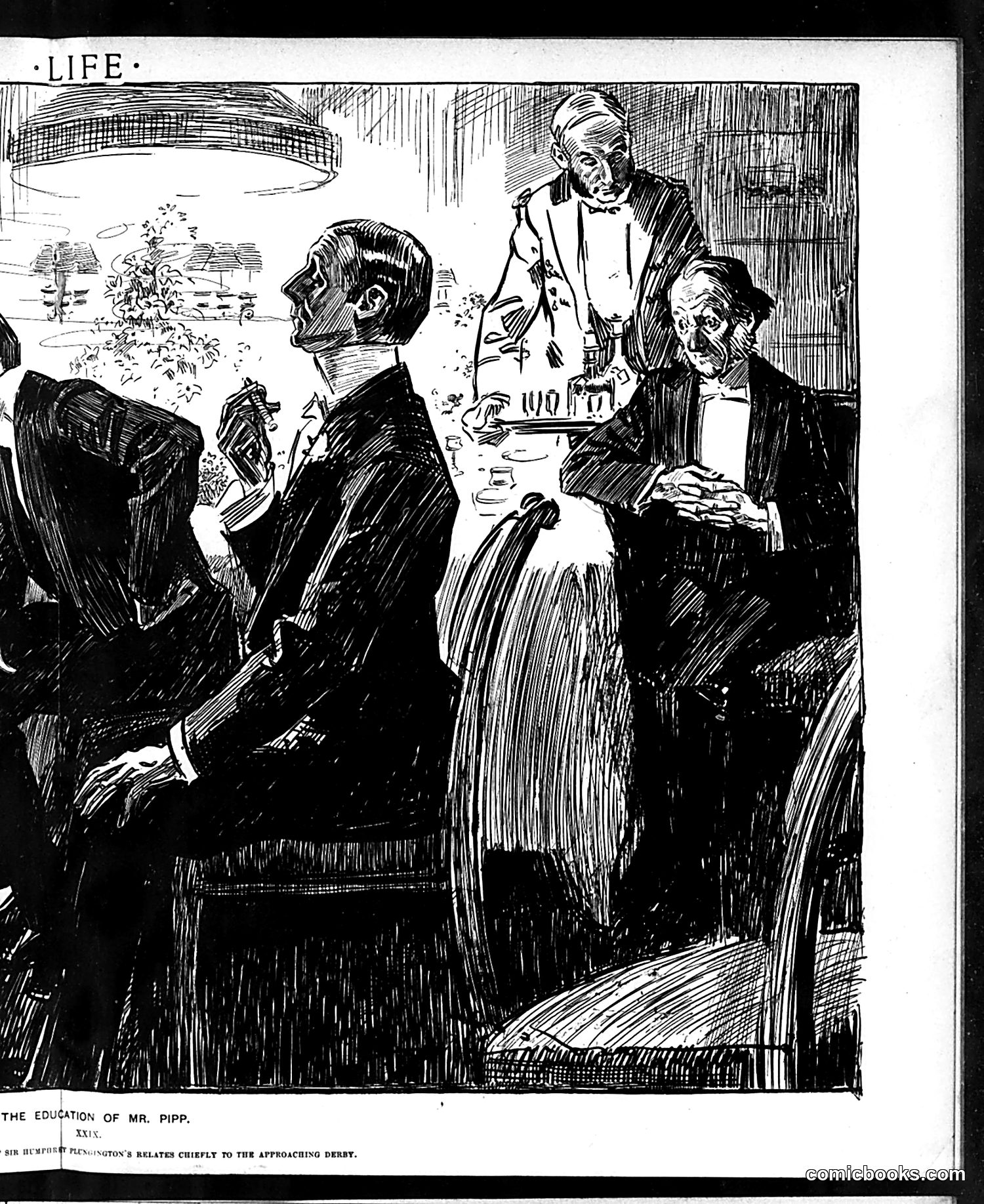
This appears to be a satirical cartoon from *Life* magazine about a character named Mr. Pipp. The caption references "Sir Humphrey Plinkington's relates chiefly to the approaching derby" — suggesting Pipp is being educated about horse racing, specifically regarding an upcoming Derby competition. The scene shows formally-dressed men in what appears to be a dining or social setting, with one figure standing and gesturing while others listen. The style and formal attire suggest this is mocking the pretentious instruction of a naive character about upper-class sporting traditions and betting culture. The satire likely targets either social climbing or gullibility regarding horse racing speculation among the wealthy classes during this era.
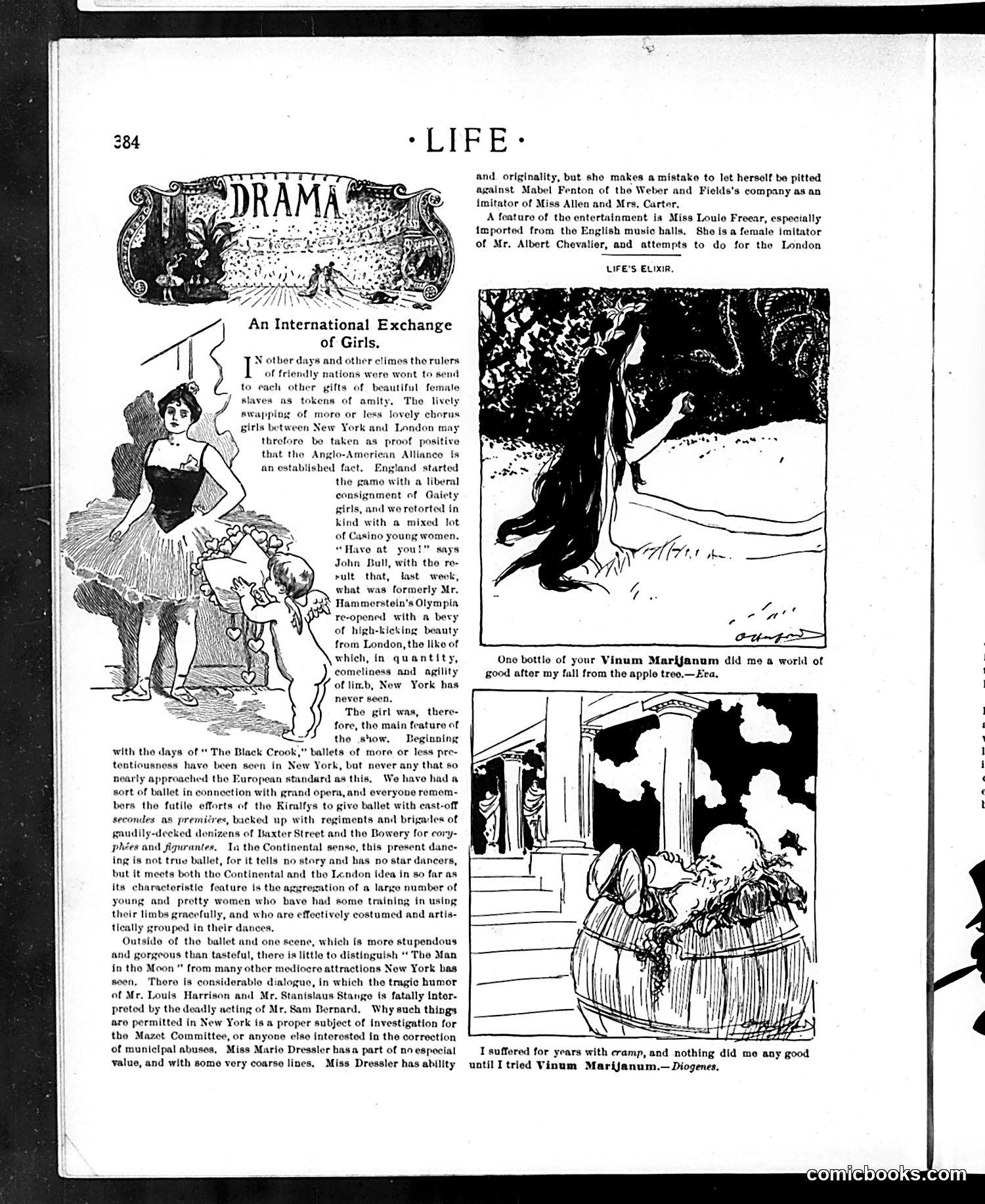
This satirical piece mocks the trend of wealthy American families importing young English women as governesses and companions, framing it as evidence of the "Anglo-American Alliance." The text criticizes this practice as pretentious, suggesting New York society women are imitating European customs without understanding them. The cartoons illustrate the consequences: one shows a woman claiming "Vinum Marijanum" (cannabis wine) cured her cramps, and another depicts a young woman at a window, apparently lonely or distressed. The satire targets both the absurdity of the "exchange" as diplomatic proof and the naivety of Americans adopting foreign fashions—including dangerous substances—without questioning their value or safety. It's social commentary on class pretension and blind Anglophilia.
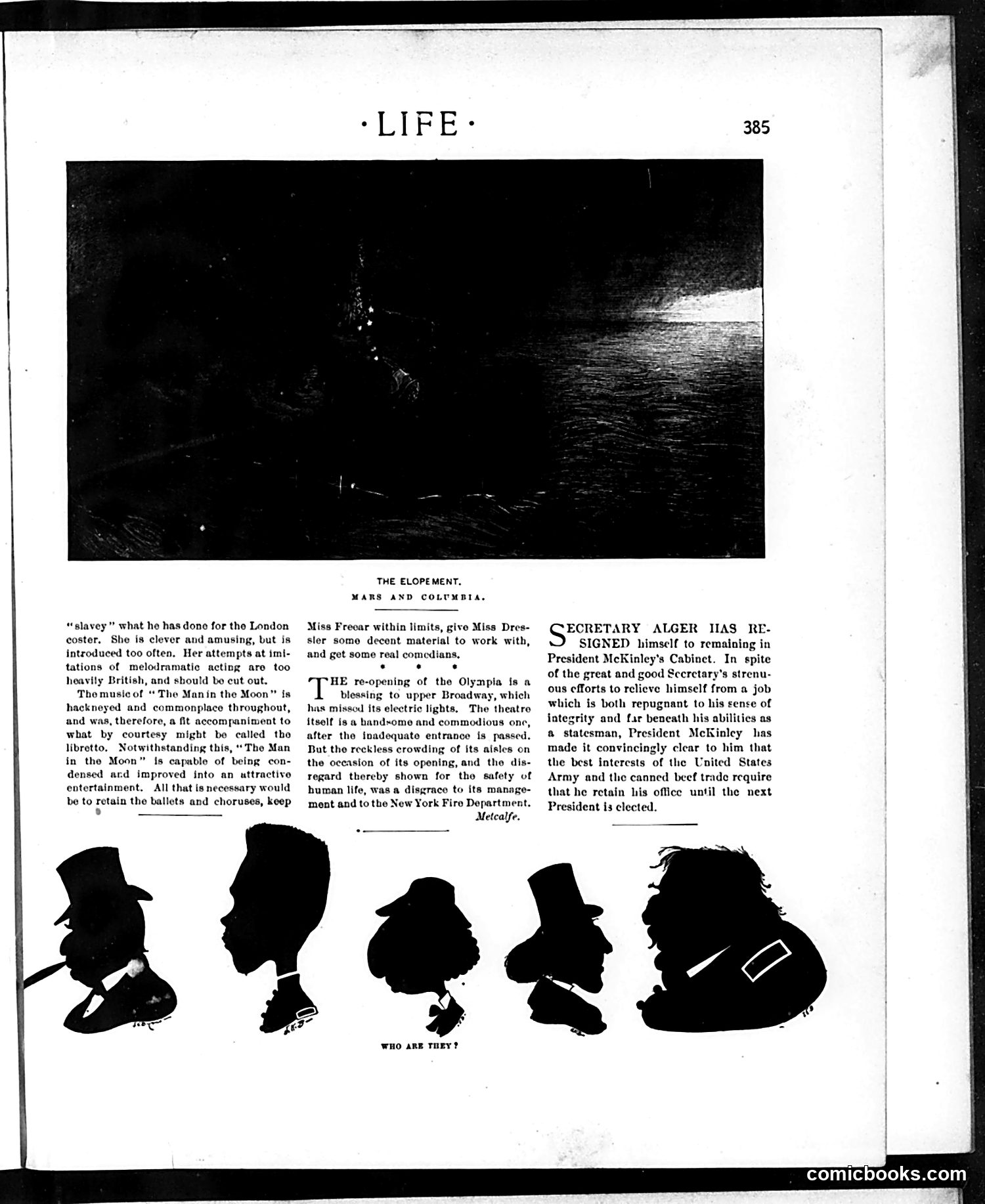
This page contains theater reviews and political satire from Life magazine. The main content discusses Broadway productions ("The Man in the Moon" and the Olympia theater's reopening). The political cartoon at bottom, titled "The Elopement: Mars and Columbia," uses silhouettes labeled "WHO ARE THEY?" to satirize Secretary of War Russell Alger's resignation attempt. The accompanying text explains that despite Alger's efforts to resign from President McKinley's cabinet, McKinley refused to let him leave—ostensibly because military interests and "the canned beef trade" required his retention. This references the Spanish-American War (1898) and its aftermath, when Alger faced criticism over military mismanagement and a beef scandal. The satire mocks both Alger's apparent reluctance to serve and McKinley's insistence on keeping him despite his unfitness. The silhouettes remain unidentified in the image itself.
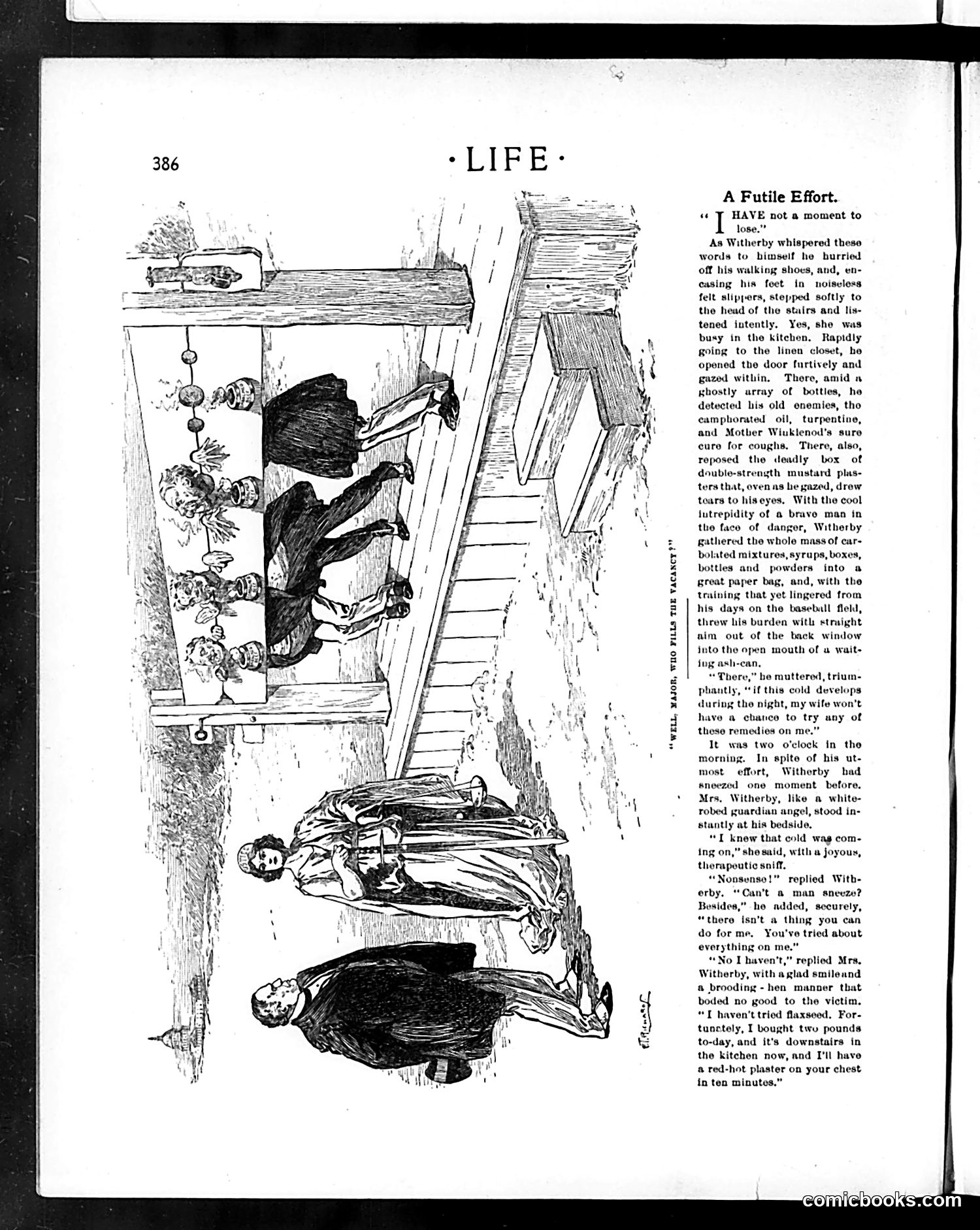
This humorous story satirizes the domestic battle between a husband trying to avoid his wife's home remedies and her unstoppable determination to apply them. **The Setup:** Mr. Witherby discovers his wife's arsenal of Victorian-era cold medicines—camphorated oil, turpentine, mustard plasters, and other noxious treatments—and sneaks them out the window into an ash-can, believing he's escaped her curative clutches. **The Joke:** His effort is literally futile. Within minutes, he sneezes (betraying his cold's existence), and his wife Mrs. Witherby appears "like a guardian angel," triumphantly announcing she has *additional* remedies downstairs—flaxseed and red-hot plasters—ready to deploy. **The Social Satire:** This mocks both the ineffective "patent remedies" of the era and the stereotype of the well-meaning but overbearing wife who weaponizes household medical care. Witherby's defeat is inevitable—she will have her remedies applied, regardless of his protests or deceptions.
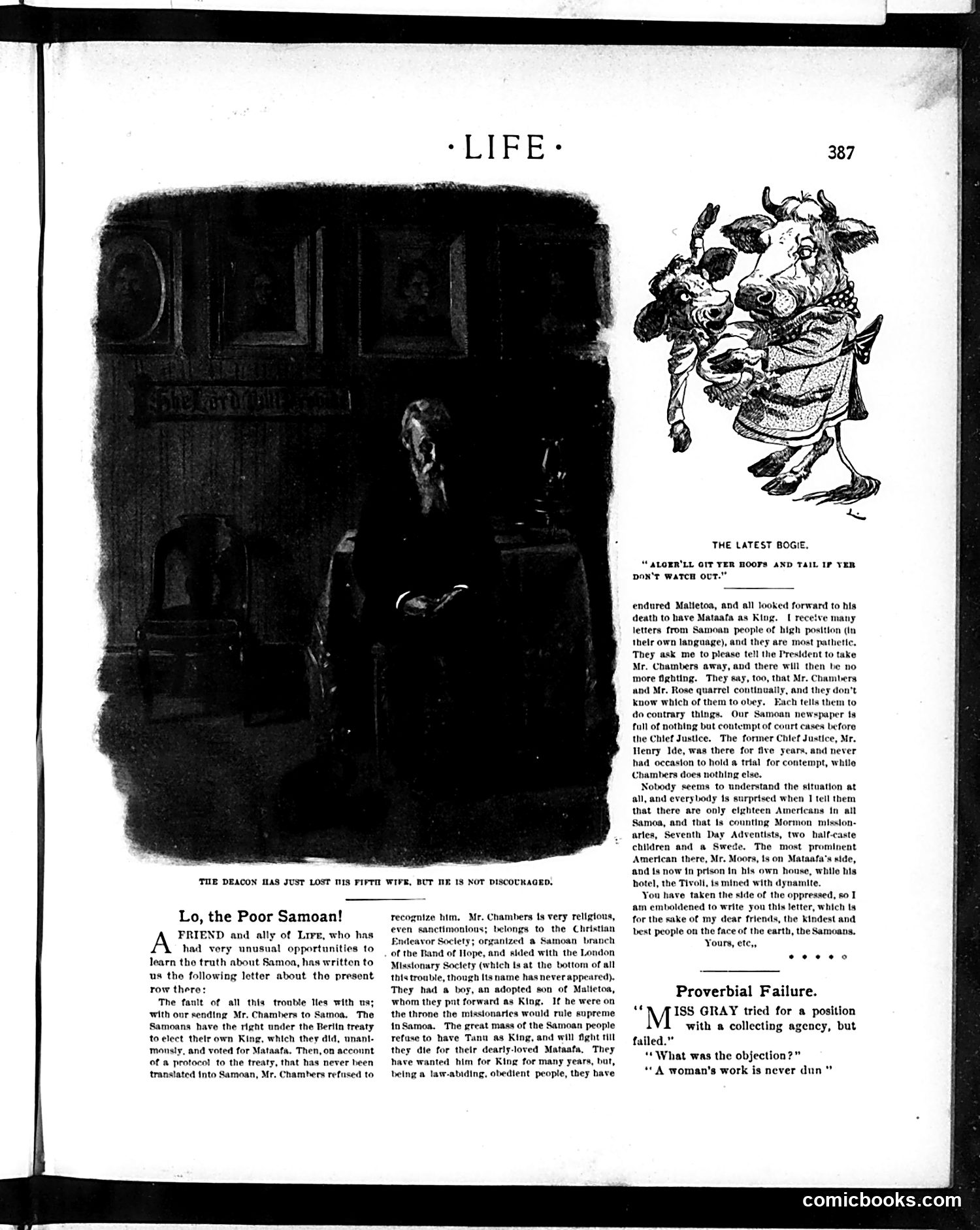
This page contains **satirical political commentary about American intervention in Samoa**, presented through a letter to the editor and accompanying cartoons. ## Main Content: The Samoa Controversy The letter criticizes U.S. diplomat **Mr. Chambers** for refusing to recognize **Mataafa** as King of Samoa—the choice elected by the Samoan people. Instead, Chambers supports a puppet king (**Tanu**), influenced by Christian missionaries seeking political control. The writer argues this interference, not Samoan governance, causes the fighting. The letter emphasizes Samoa's legitimate preference for Mataafa and criticizes Chambers for creating legal turmoil and quarreling with another American official. ## Cartoons **"The Latest Bogie"** (top right): A grotesque figure represents the threat Chambers poses to Samoan autonomy—a menacing foreign force. **"The Deacon Has Just Lost His Fifth Wife"** (bottom): A dark joke suggesting Chambers' repeated failures (the "fifth wife" lost) don't discourage further meddling—satirizing his persistent, unsuccessful interference in Samoa. The page advocates for Samoan self-determination against paternalistic American colonialism.
This is primarily a **humor/anecdote page** from Life magazine, featuring three satirical stories about human nature and social folly. The first story mocks a theatrical feud: an actor's female rival deliberately ruins his costumes by rubbing makeup on his clothing during romantic scenes—petty revenge presented as evidence of women's vindictiveness. The second anecdote portrays Empress Elizabeth of Austria intervening in domestic violence, only to have the abused woman defend her abuser. The joke is the woman's unreasonable loyalty. The third story satirizes **American political corruption and identity**: a newly elected alderman claims credit for winning votes from eight nationalities (Germans, Irish, Polish, English, Italian, French, Greek), but cannot remember the eighth. A bystander suggests "Americans"—the punchline being that the alderman forgot actual American citizens exist, implying immigrant voting blocs were treated as non-American. This reflects turn-of-century anxieties about immigration and urban machine politics. The page is otherwise filled with **period advertisements** and book announcements.
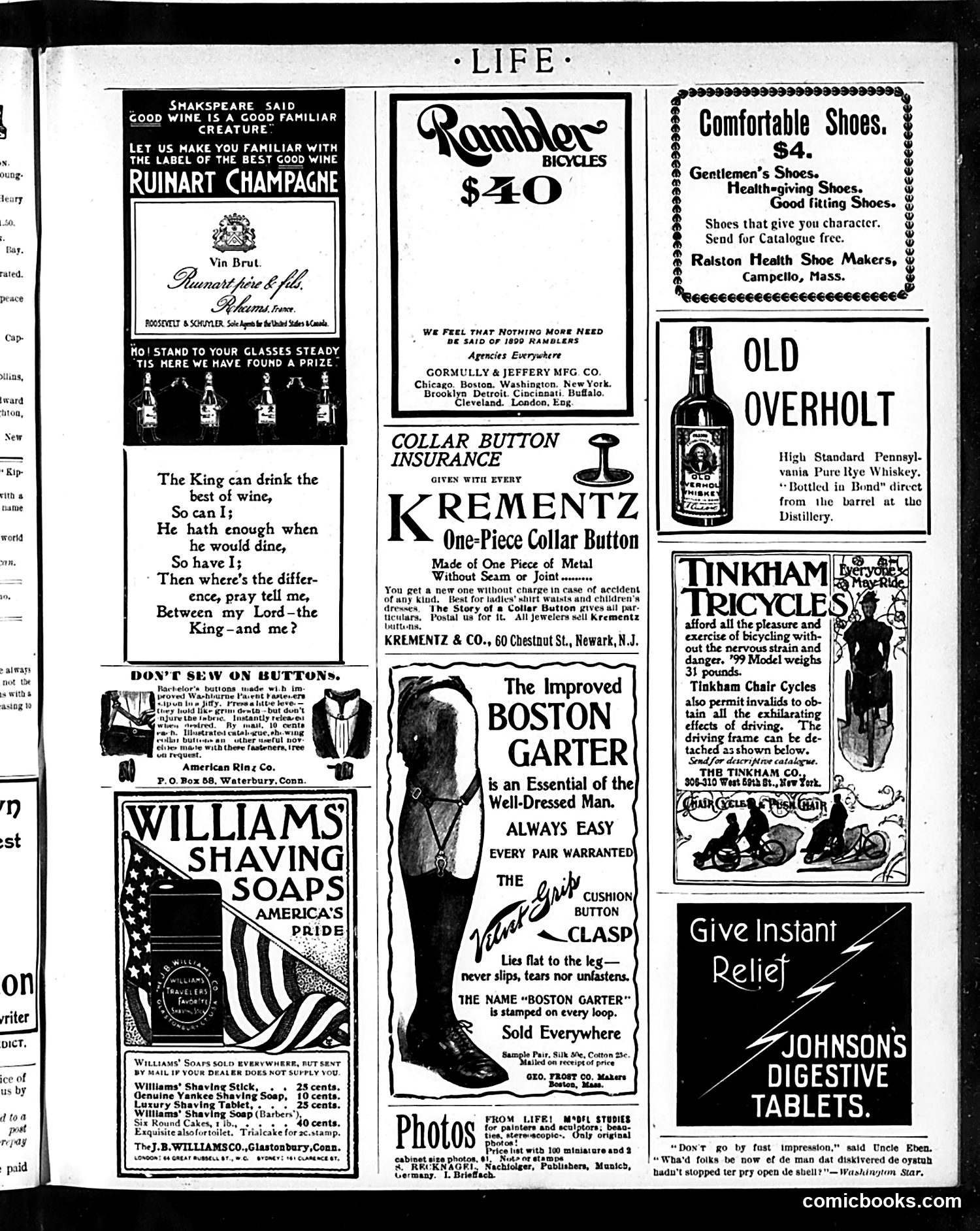
This page is primarily **advertising**, not editorial cartoons. It showcases consumer products from circa 1890s America, with one small satirical poem as the sole editorial content. The poem—"The King can drink the best of wine, / So can I"—is a democratic sentiment suggesting that ordinary people deserve the same luxuries as royalty. It accompanies a Ruinart Champagne advertisement, ironically using egalitarian rhetoric to sell expensive wine. The advertisements themselves reflect late-Victorian consumer culture: collar buttons, garters, bicycles, shaving soaps, shoes, and whiskey. The American Ring Co. ad humorously addresses the mundane problem of sewing buttons with a mechanical solution. One small comic at bottom-right presents a dialect joke attributed to "Uncle Eben" (a stock African American character type), playing on wordplay about oyster shells and discovery—typical of period humor that modern readers would recognize as reflecting racist stereotyping. The page documents what products aspirational middle-class Americans purchased and how they were marketed.
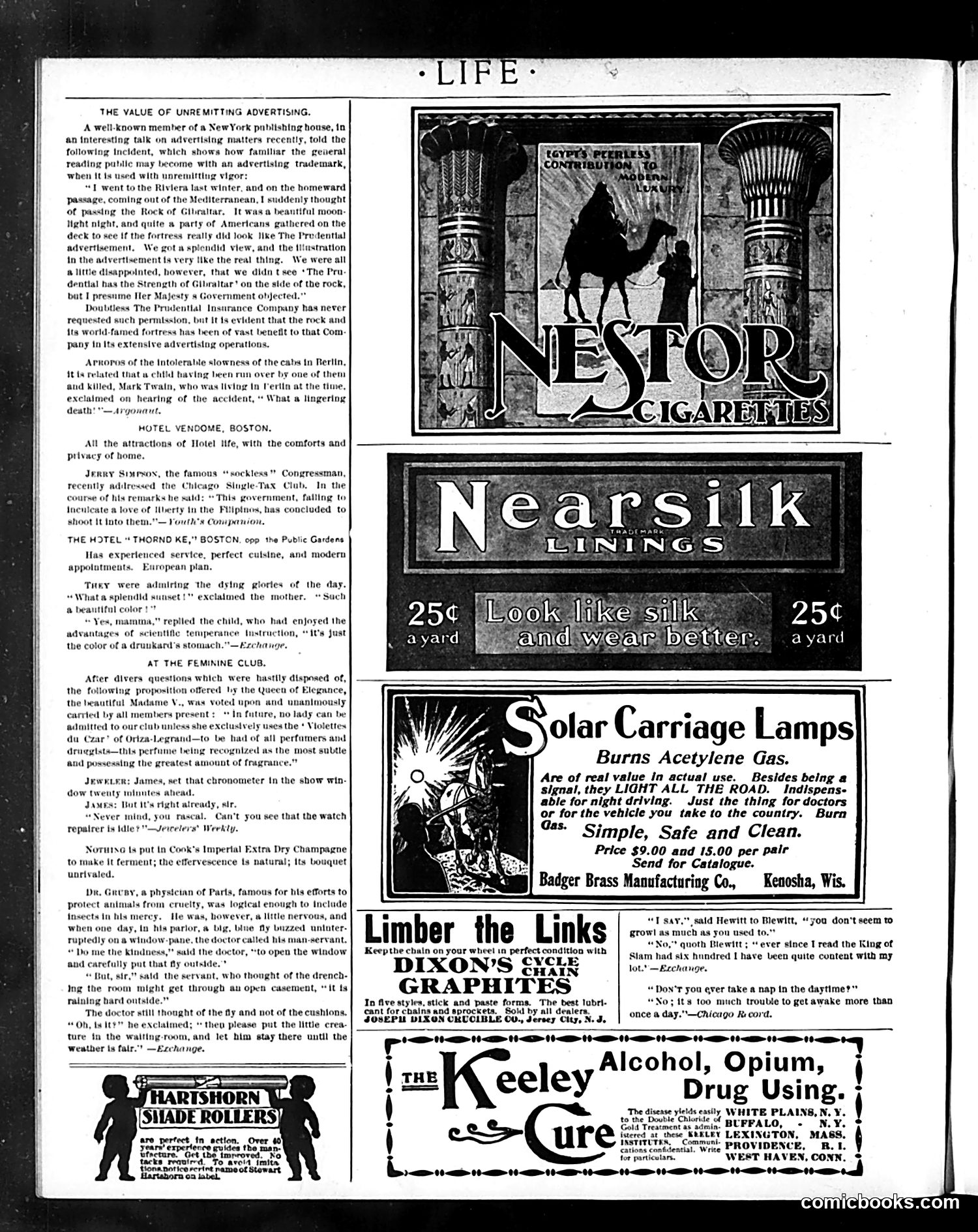
This page is primarily **advertising**, with brief satirical text snippets interspersed. The main content includes ads for Nestor Cigarettes, Nearsilk Linings, Solar Carriage Lamps, Dixon's Cycle Graphites, Hartshorn Shade Rollers, and The Keeley Cure (a treatment for alcohol and drug addiction). The satirical sections are short anecdotes mocking contemporary life: - A story about the Prudential Insurance Company's "Rock of Gibraltar" advertising being so pervasive that travelers expected to see it on the actual rock - A joke about slow Berlin taxis causing a child's death by "lingering" - Congressman Jerry Shimon's quip that the government is "shooting" liberty into Filipinos (likely referencing U.S. colonial policy) - A humorous exchange about a doctor so devoted to animal welfare he risks pneumonia opening a window for a fly The page reflects early 1900s American consumer culture, imperialist attitudes toward the Philippines, and genteel humor aimed at educated readers.
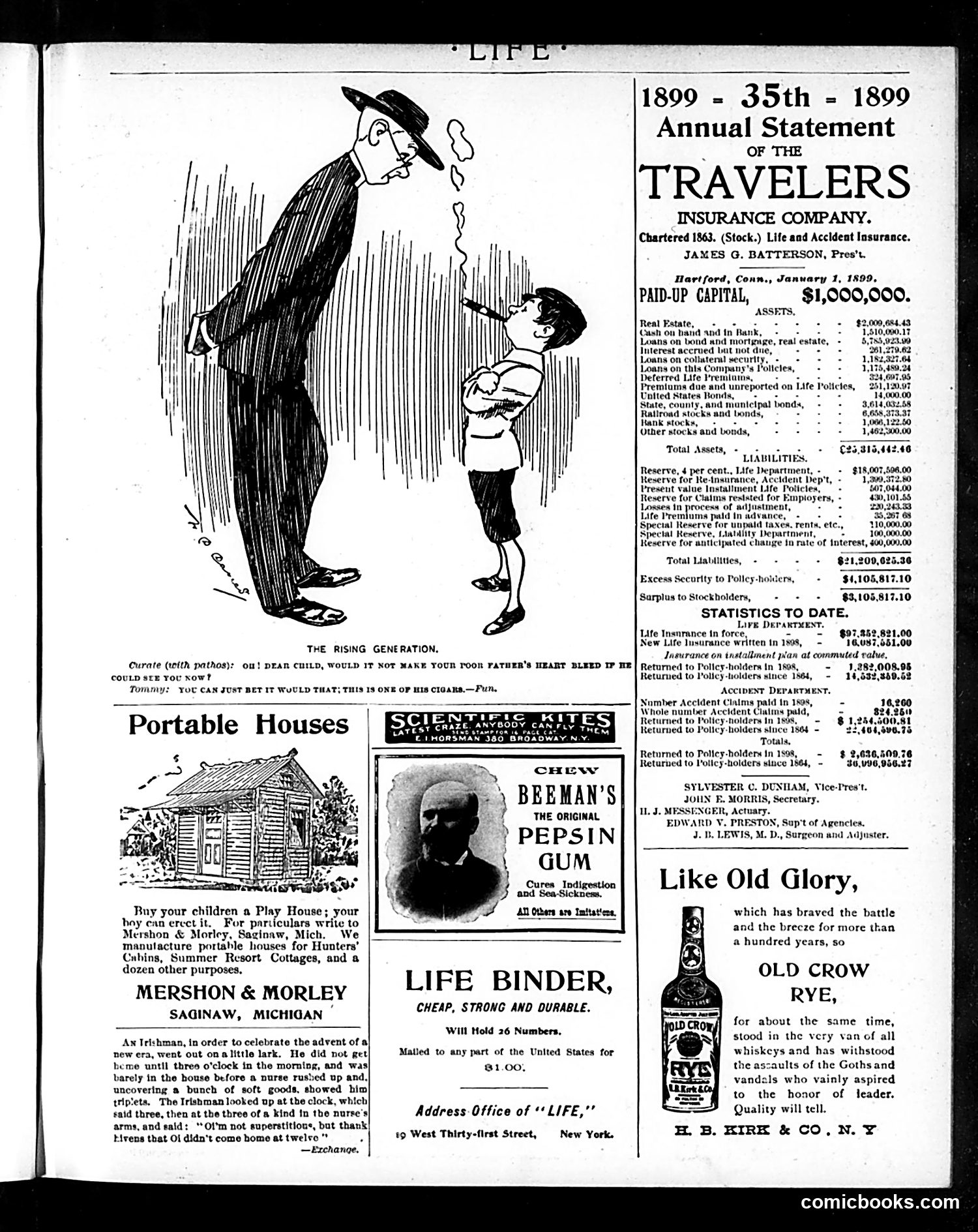
This cartoon satirizes parenting and moral decline in the late 1800s. An adult (likely a father) confronts a young boy about smoking cigars. The child defensively claims he learned the habit from his father—suggesting parental hypocrisy and that adults model bad behavior they forbid children from adopting. The joke's caption emphasizes the irony: the curate (a clergy member, representing moral authority) is shocked the boy would smoke, yet the boy points out his father does the same. The final punchline—"You can just bet it would that; this is one of his cigars"—drives home the critique that parents cannot credibly teach virtue while practicing vice. This reflects period anxieties about moral education and generational decline, a common theme in *Life* magazine's social commentary during the 1890s.
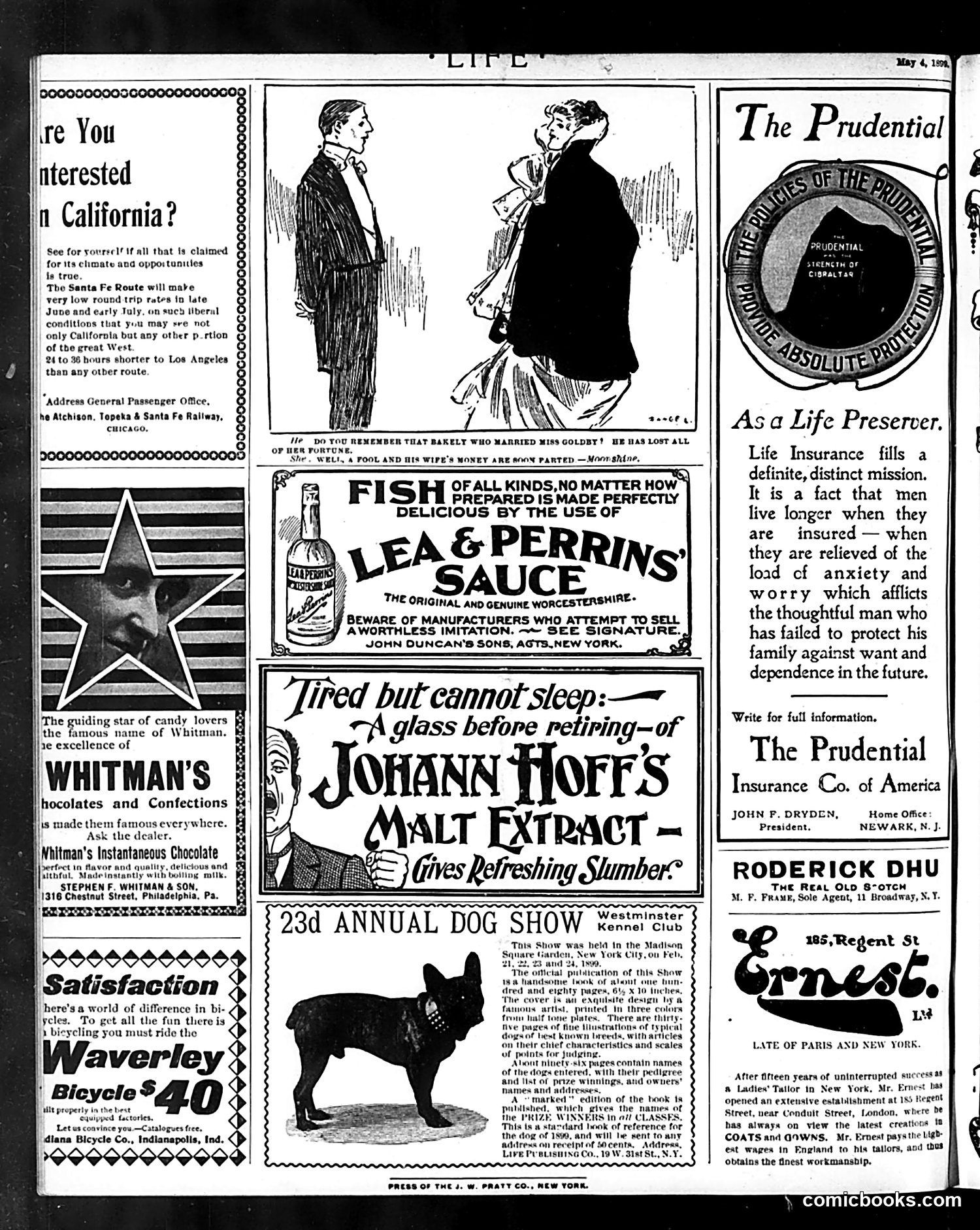
This page is primarily **advertising** with one cartoon. The main cartoon depicts a gentleman speaking to a woman, captioned with a proverb about a foolish man who married Miss Goldie, squandered her fortune, and is now broke—the joke being that his wife's money is "soon parted" from him. The advertisements reflect late-Victorian consumer culture: Whitman's chocolates, Waverley bicycles, Lea & Perrins sauce, Johann Hoff's malt extract (a fatigue remedy), and Prudential Life Insurance. Several ads emphasize anxiety relief and family protection—notably Prudential's pitch that insured men "live longer" by relieving "worry which afflicts the thoughtful man." The Santa Fe Railway ad promotes California tourism. The 23rd Annual Dog Show notice advertises a pedigreed dog registry—reflecting the era's growing interest in dog breeding as a status marker. Overall, this reflects 1890s anxieties about wealth, security, and modern living among the middle and upper classes.