
Life, 1899-05-04 · page 4 of 20
Life — May 4, 1899 — page 4: what you’re looking at
What you’re looking at
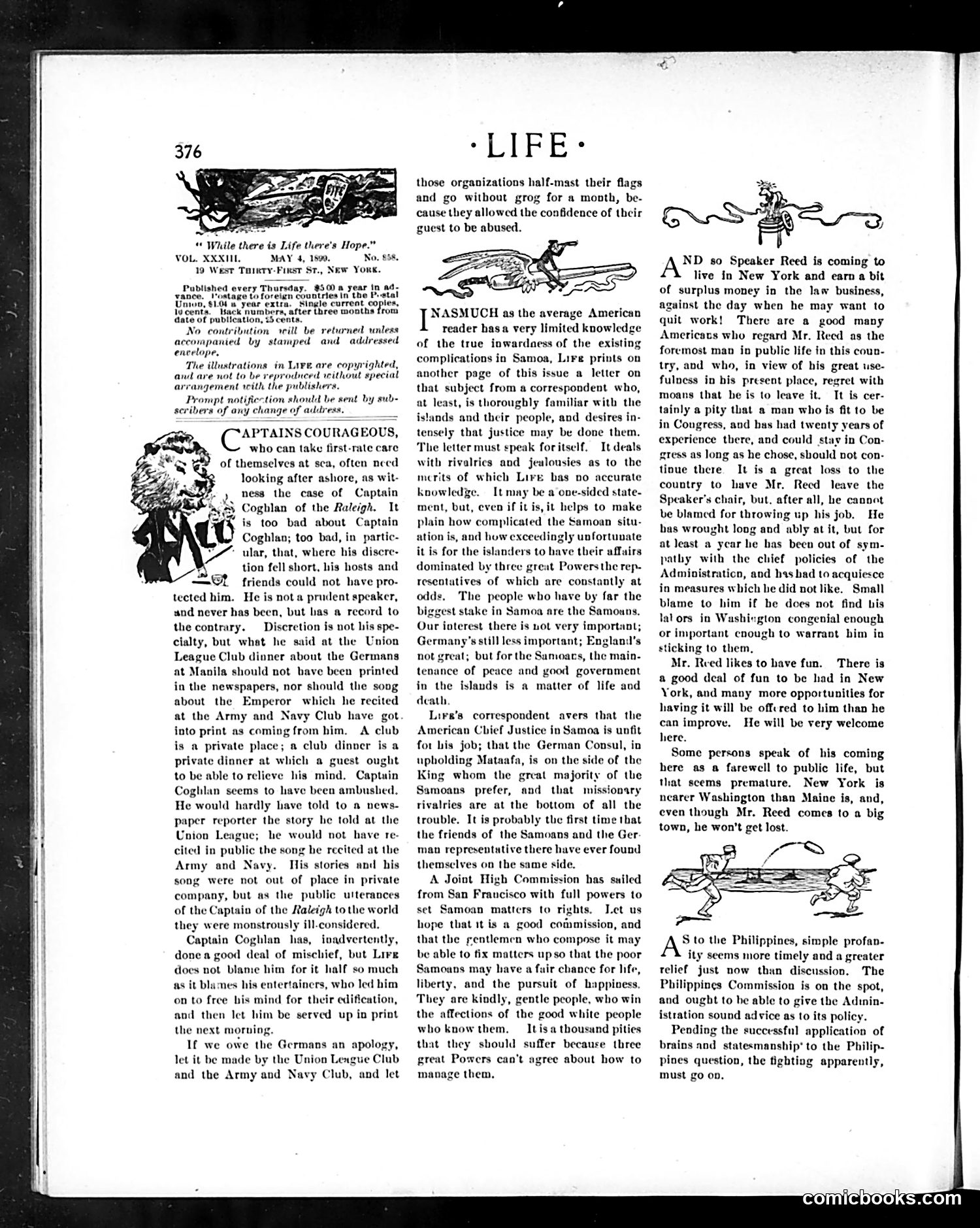
The main article discusses **Captain Coghlan of the USS Raleigh**, who is being criticized for his public statements about German and American naval policy. The text indicates Coghlan made controversial remarks at a Union League Club dinner regarding Germany that were printed in newspapers—apparently without authorization. The satire centers on Coghlan's indiscretion: he's portrayed as having violated protocol by airing sensitive diplomatic matters publicly. The article suggests this was inappropriate for a military officer, though it acknowledges he "seems to have been enthusiastic." The piece also discusses **Samoan colonial politics** and mentions a **Joint High Commission** sailing to address Philippine administration issues—both reflections of American imperial interests circa 1905.
📄 Transcribed text from this page (OCR, searchable)
Machine-transcribed from the original scan — historical spelling and the odd misread are preserved.
y Thursday. #500 a year in ad- pforelen countries in the P-stal ear extra, Single current copies. Ws mbera, after three months from Gato of publication, 5 cents. No contribution vill be returned unless accompanied by stamped and addressed encelope, The illustrations in Live are copyrighted, are not to be reproduced without special ngement with the publishers. Prompt notifiection should be sent by sub- scribers of any change of address. APTAINS COURAGEOUS, who can take first-rate care of themselves at sca, often need looking after ashore, as wit- ness the case of Captain Coghlan of the Raleigh. It is too bad about Captain Coghlan; too bad, in partic. * ular, that, where his discre- tion fell short, his hosts and friends could not have pro- tected him. He is nota prudent speaker, and never has been, but has a record to the contrary. Discretion is not his spe- cialty, but what he said at the Union League Club dinner about the Germans at Manila should not bave been printed in the newspapers, nor should the soog about the Emperor which he recited at the Army and Navy Club have got into print as coming from him. A club is a private place; a club dinner is a private dinner at which a guest ought to be able to relieve his mind. Captain Coghlan seems to have been ambushed. He would hardly have told to a news- paper reporter the story he told at the Union League; he would not have re- cited in public the song be recited at the Army and Navy. His stories and his song were not out of place in private company, but as the public ulterances of the Captain of the Raleigh to the world they were monstrously ill-considered. Captain Coghlan has, inadvertently, done a good deal of mischief, but Lire does not blame him for it half so much as it blames his entertainers, who led him on to free bis mind for their edification, and then let him be served up in print the next morning. If we owe the Germans an apology, let it be made by the Union League Club and the Army and Navy Club, and let LIFE those organizations half-mast their flags and go without grog for a month, be- cause they allowed the confidence of their guest to be abused. sees as the average American reader hasa very limited knowledge of the true inwardaess of the existing complications in Samoa, Lire prints on another page of this issue a letter on that subject from a correspondent who, at least, is thoroughly familiar with the istands and their people, and desires in- tensely that justice may be done them. The letter must speak foritself. It deals with rivalries and jealousies as to the merits of which Lire bas no accurate knowledge. It may be a one-sided state- meat, but, even if itis, it helps to make plain how complicated the Samoan situ- ation is, and how exceedingly unfortunate it is for the islanders to have their affairs dominated by three great Powers the rep- resentatives of which are constantly at odds, The people who have by far the est stake in Samoa are the Samoans. Our interest there is not very important; Germany’s still less important; Englat not great; but for the Samoacs, the main- tenance of peace and good government in the islands is a matter of life aod death. Lire’s correspondent avers that the American Chief Justice in Samoa is unfit fot his job; that the German Consul, in upholding Mataafa, is on the side of the King whom the great majority of the Samoans prefer, and that missionary rivalries are at the bottom of all the trouble. It is probably the first time that the friends of the Samoans and the Ger. man representative there have ever found themselves on the same side. A Joint High Commission has sailed from San Francisco with full powers to set Samoan matters to ts. Let us hope that it is a good commission, and that the gentlemen who compose it may be able to tix matters upso that the poor Samoans may have a fair chance for life, liberty, and the pursuit of happiness. They are kindly, gentle people, who win the affections of the good white people who know them. It isa thousand pities that they should suffer because three great Powers can't agree about how to manage them. AN so Speaker Reed is coming to live in New York and earn a bit of surplus money in the law business, against the day when he may want to quit work! There are a good many Americats who regard Mr. Reed as the foremost man in public life in this coun- try, and who, in view of his great use- fulness in his present place, regret with moans that he is to leave it. It is cer- tainly a pity that a man who is fit to be in Congress, and bas had twenty years of experience there, and could stay in Con- gress as long as he chose, should not con- tinue there It is a great loss to the country to have Mr. Recd leave the Speaker's chair, but, after all, he cannot be blamed for throwing up his job, He bas wrought long and ably at it, but for at least a year he has been out of sym- pathy with the chief policies of the Administraticn, and has had to acquiesce in measures which he did not like. Small blame to him if he does not find bis tators in Washington congenial enough or important enough to warrant bim ia sticking to them, Mr. Reed likes to have fun. There is a good deal of fun to be had in New York, and many more opportunities for having it will be offered to him than he can improve, He will be very welcome here. Some persons speak of his coming here as a farewell to public life, but that seems premature. New York is nearer Washington than Maine is, and, even though Mr. Reed comes to a big town, he won't get lost. p AS to the Philippines, simple profan- ity seems more timely and a greater telief just now than discussion, The Philippines Commission is on the spot, and ought to he able to give the Adinin- istration sound advice as to its policy. Pending the successful application of brains and statesmanship* to the Phi pines question, the fighting apparently, must go on.