
Life, 1899-05-04 · page 6 of 20
Life — May 4, 1899 — page 6: what you’re looking at
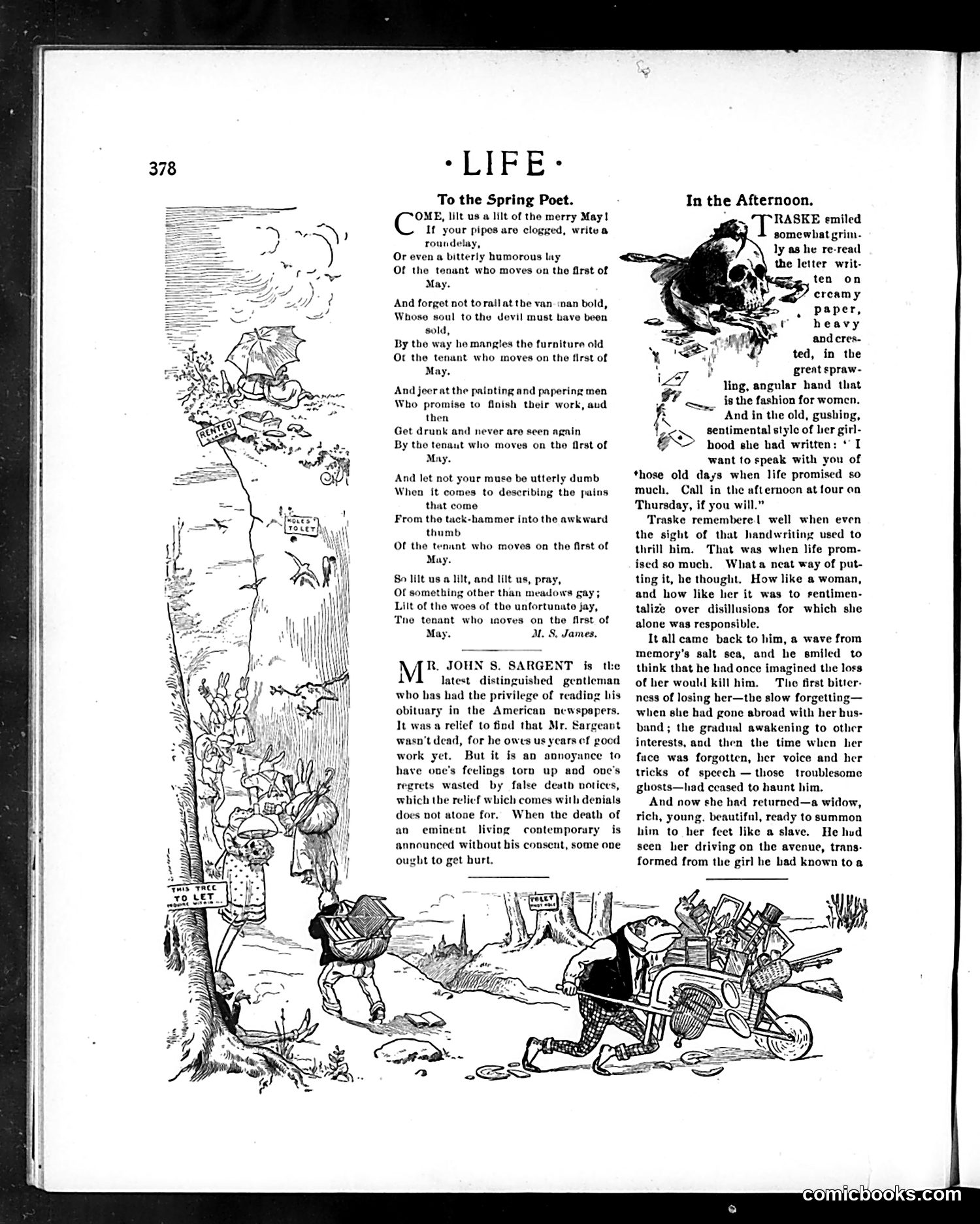
What you’re looking at
This page contains two distinct pieces: **"To the Spring Poet"** (left): A humorous poem mocking May Day moving day customs, with accompanying cartoon showing chaotic furniture moving and chaos. The satire targets the impractical tradition of tenants relocating on May 1st, with jokes about clogged pipes, drunk movers, and fumbled furniture. **"In the Afternoon"** (right): A sentimental prose piece about a woman reflecting on lost love and youth—specifically remembering a man's handwriting that once thrilled her. It's nostalgic rather than satirical. **MR. JOHN S. SARGENT** (center): An obituary notice for the distinguished gentleman, noting the annoyance of false death notices in newspapers and emphasizing the relief that Sargent's actual death was announced with proper consent. The page blends humor, sentiment, and contemporary social commentary typical of Life magazine's editorial mix.
📄 Transcribed text from this page (OCR, searchable)
Machine-transcribed from the original scan — historical spelling and the odd misread are preserved.
“LIFE To the Spring Poet. OME, lilt us a lilt of the merry May! If your pipes are clogged, write a roundelay, Or even a bitterly humorous lay Of the tenant who moves on the first of May. And forget not torailat the van. man bold, Whose soul to the devil must have been sold, By the way he mangles the furniture old Ot the tenant who moves on the first of May. And jeer at the painting and papering men Who promise to finish their work, aud then Get drunk and never are seen again By the tenaut who moves on tho first of May. And let not your muse be utterly dumb When it comes to describing the pains that come From the tack-hammer into the awkward thumb Of the tenant who moves on the first of May. 8o lilt usa lilt, and lilt us, pray, Of something other than meadows gay; Lilt of the woes of the unfortunate jay, The tenant who inoves on the first of M. 8. James, R. JOHN 8. SARGENT is the 1 latest distinguished gentleman who has had the privilege of reading his obituary in the American newspapers. It was a relief to fiod that Mr. Sargeant wasn'tdcad, for he owes us years ef good work yet. But it is an annoyance to have one's feelings torn up and one’s regrets wasted by false death notices, which the relicf which comes with denials does not atone for. When the death of an eminent living contemporary is announced without bis consent, some one ought to get hurt. In the Afternoon. . RASKE emiled somewhat grim. ly as he re-read the letter writ- ten on paper, heavy and cres- ted, in the great spraw- ling, angular hand that _ is the fashion for women, — f And in the old, gushing, N rs \ Sentimental style of her girl- 7 ~— hood she had written: * I want to speak with you of those old days when life promised so much. Call in the afternoon at four on Thursday, if you will.” Traske remembere.| well when even the sight of that handwriting used to thrill him. That was when life prom- ised so much. Whata neat way of put- ting it, he thought, How like a woman, and how like her it was to rentimen- talize over disillusions for which she alone was responsible. Itall came back to him, a wave from memory’s salt sea, and he smiled to think that he had once imagined the loss. of her would kill him. The first bitter- ness of losing her—the slow forgetting— when she had gone abroad with her bus- band; the gradual awakening to other interests, and then the time when her face was forgotten, her voice and her tricks of speech — those troublesome ghosts—had ceased to haunt him. And now she had returned—a widow, rich, young. beautiful, ready to summon him to her feet like a slave. He hud seen her driving on the avenue, trans- formed from the girl he bad known to a