
Life, 1899-05-04 · page 12 of 20
Life — May 4, 1899 — page 12: what you’re looking at
What you’re looking at
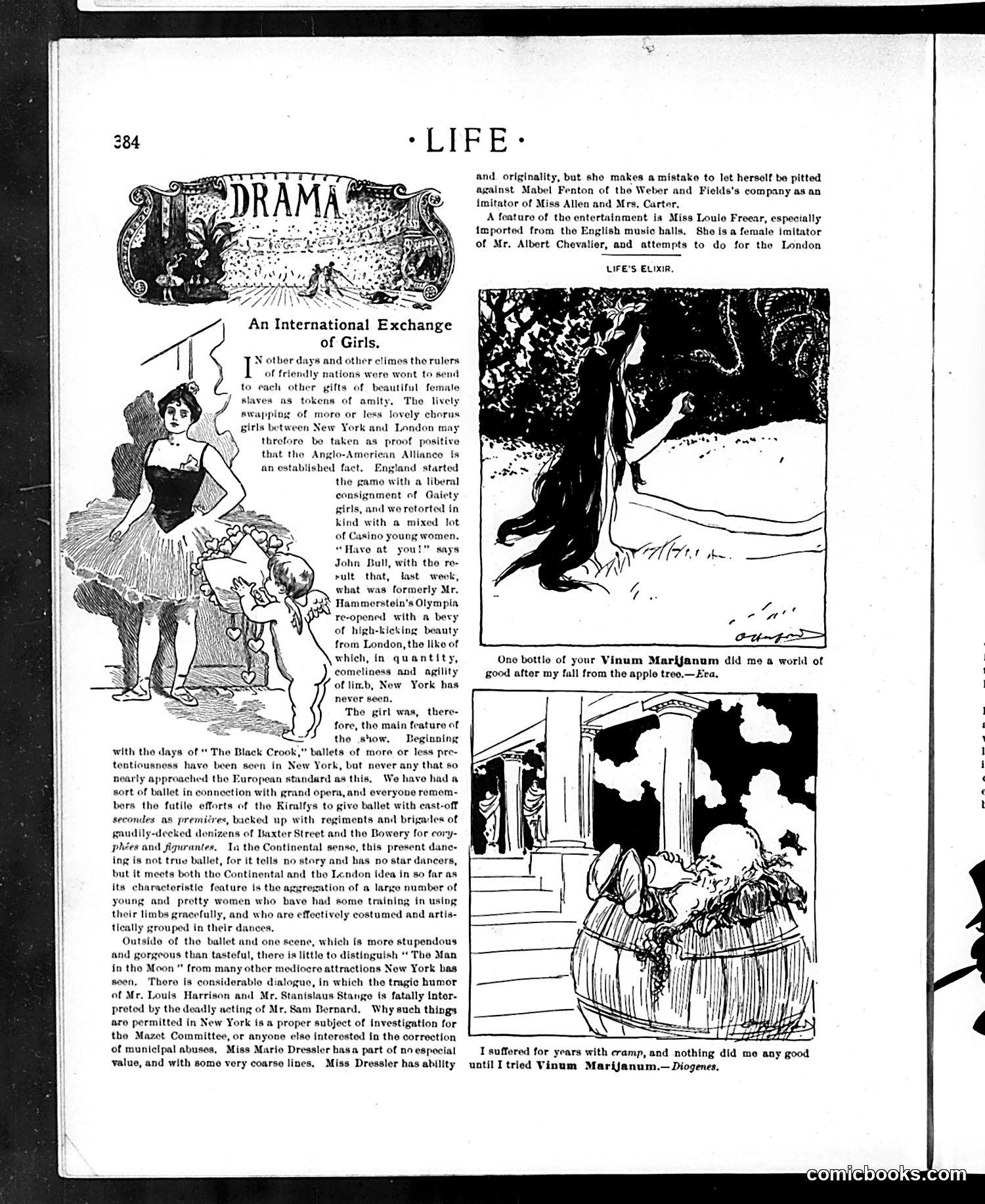
This satirical piece mocks the trend of wealthy American families importing young English women as governesses and companions, framing it as evidence of the "Anglo-American Alliance." The text criticizes this practice as pretentious, suggesting New York society women are imitating European customs without understanding them. The cartoons illustrate the consequences: one shows a woman claiming "Vinum Marijanum" (cannabis wine) cured her cramps, and another depicts a young woman at a window, apparently lonely or distressed. The satire targets both the absurdity of the "exchange" as diplomatic proof and the naivety of Americans adopting foreign fashions—including dangerous substances—without questioning their value or safety. It's social commentary on class pretension and blind Anglophilia.
📄 Transcribed text from this page (OCR, searchable)
Machine-transcribed from the original scan — historical spelling and the odd misread are preserved.
* LIFE An International Exchange of Girls. N otber days and other climes the rulers of friendly nations were wont to send to each other gifts of beautiful female ves as tokens of amity. The lively awapping of moro or less lovely chorus girls between New York and London may threfore be taken as proof positive that the Anglo-American Alliance is an established fact. England started the gamo with a liberal consignment of Gaiety girls, and we retorted in kind with a mixed lot of Casino young women, “Have at you!" says John Bull, with the ro- ult that, last week, what was formerly Mr. Hammerstein's Olympia re-opened with a bevy of high-kicking beauty from London, the like of which, in quantity, comeliness and agility of limb, Now York has never seen, Tho girl was, there- fore, tho main feature of the show. Beginning with tho days of * The Black Crook," ballets of more or less pre- tentiousness have been seen in New York, but never any that so nearly approached tho European standard as this, We have had « sort of ballet in connection with grand opera, and everyone remem- bers the futile efforts of the Kiralfys to give ballet with cast-off secondes as premitres, backed up with regiments and brigales of gaudily-decked ¢ 8 of Baxter Street and the Bowery for cory- phées and figurantes, In the Continental senso, this present danc- ing is not true ballet, for it tells no story and bas no star dancers, but it meets both the Continental and the Lendon idea in 80 far as. its characteristic feature is the aggregation of a large number of young and pretty women who bave had some training in using their limbs gracefully, and who are effectively costumed and artis- tically grouped in their dances, Outside of the ballet and one scene, which is more stupendous and gorgeous than tasteful, there is little to distinguish “ The Man in tho Moon ” from many other mediocre attractions New York has seon, Thoro is considerable dialogue, in which the tragic humor of Mr, Louis Harrison and Mr, Stanislaus Stange {s fatally Intor- proted by the deadly ucting of Mr, Sam Bernard. Why such things aro permitted in New York is a proper subject of investigation for the Mazet Committee, or anyone elso interested in the correction of munictpal abuses, Miss Mario Dressler basa part of no especial value, and with some very coarse lines, Miss Dressler has ability and originality, but sho makes a mistake to lot herself be pitted against Mabel Fenton of the Weber and Fields’s company as an imitator of Miss Allen and Mrs, Carter. A featuro of tho entertainment is Miss Louie Freear, especially imported from the English music halls, Sho is a female imitator of Mr. Albert Chevalier, and attempts to do for the London LIFE'S ELDaR, One bottle of your Vinum Marfjanum did me a world of good after my full from the apple treo.—Era, I suffered for years with cramp, and nothing did mo any good until tried Vinum Marijanum.— Diogenes.