
A complete issue · 20 pages · 1899
Life — March 23, 1899
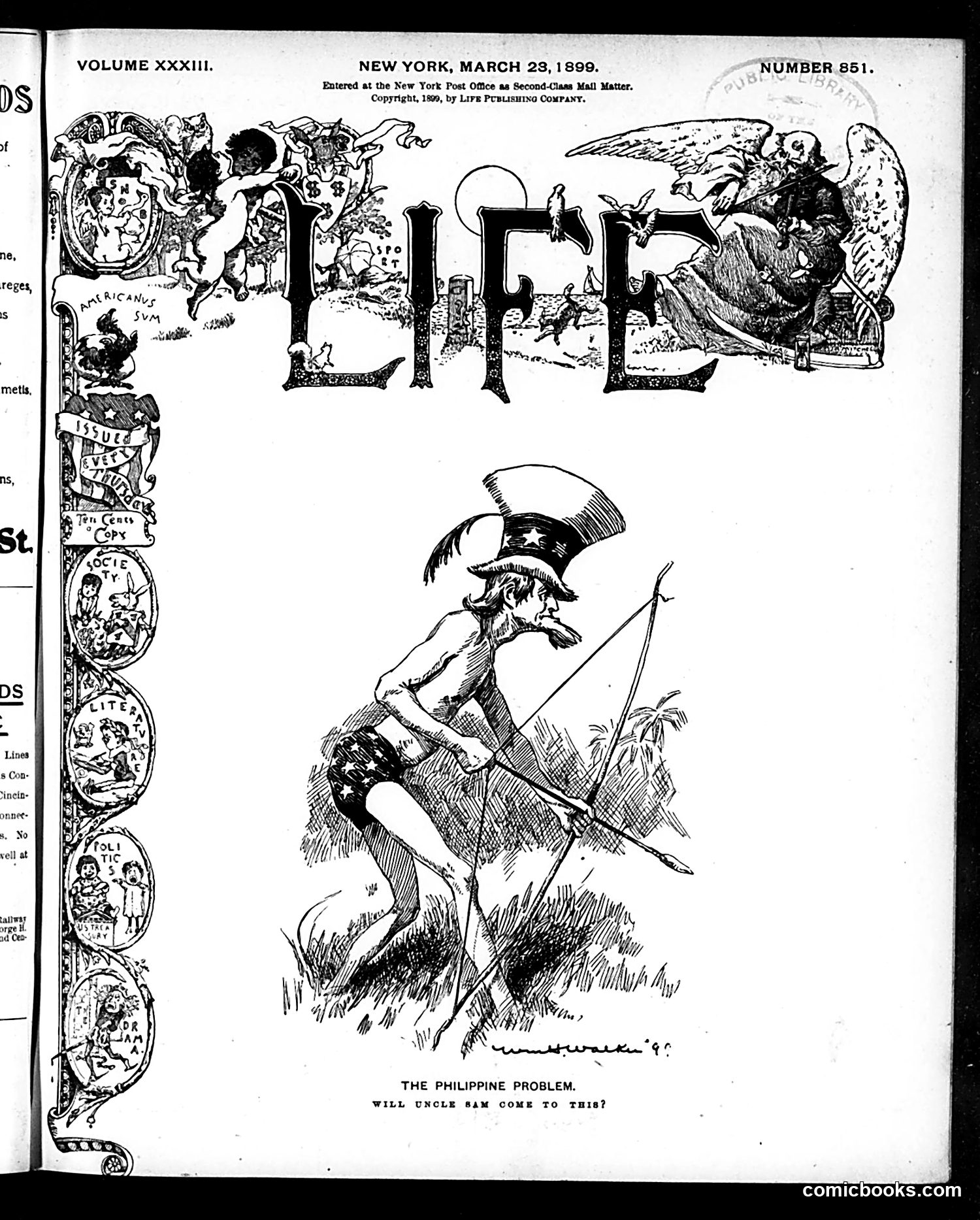
This *Life* magazine cover from March 23, 1899 satirizes American intervention in the Philippines following the Spanish-American War. The central image depicts Uncle Sam—identifiable by his characteristic hat and goatee—struggling with a bow and arrow against an unseen adversary, suggesting America's difficulty managing its new colonial territory. The caption "Will Uncle Sam come to this?" implies skepticism about American capacity to govern the Philippines. The cartoon reflects contemporary debate over American imperialism: whether the U.S. should annex the islands or grant independence to Filipino insurgents resisting colonial rule. The decorative border featuring cherubs and classical scenes reinforces *Life's* satirical tone toward this foreign policy challenge.
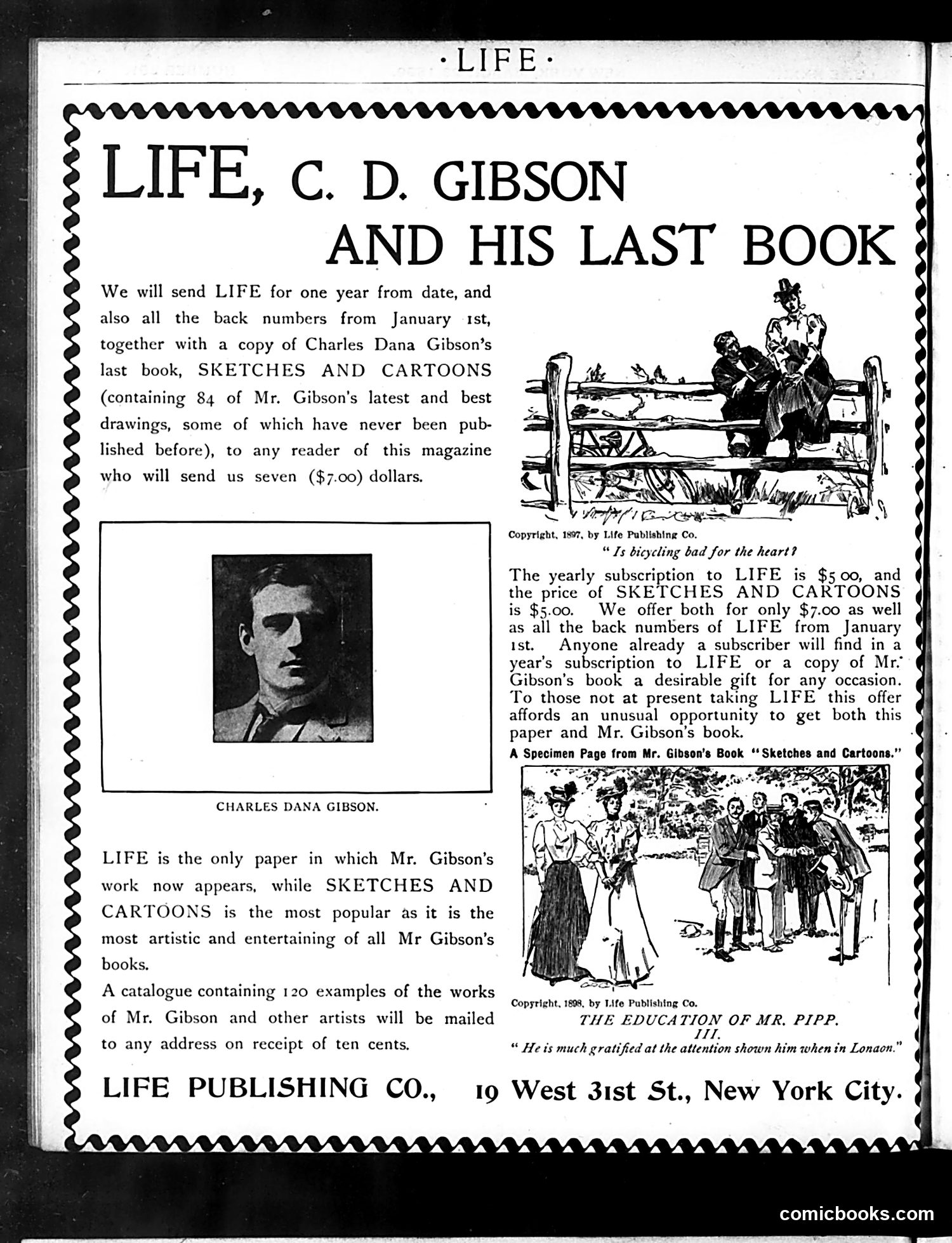
This page is primarily **advertising**, not editorial content. It promotes a subscription offer from Life Publishing Co. for Charles Dana Gibson's work. **The Main Advertisement:** Offers a one-year Life magazine subscription ($7.00) bundled with Gibson's book "Sketches and Cartoons" (84 drawings, some previously unpublished). The text notes Life is "the only paper in which Mr. Gibson's work now appears." **The Cartoons Shown:** Two Gibson drawings illustrate his style—one depicts figures at a fence (captioned "Is bicycling bad for the heart?"), the other shows a social scene titled "The Education of Mr. Pipp" with the caption "He is much gratified at the attention shown him when in London." These exemplify Gibson's genteel, class-conscious humor about American social life and manners.
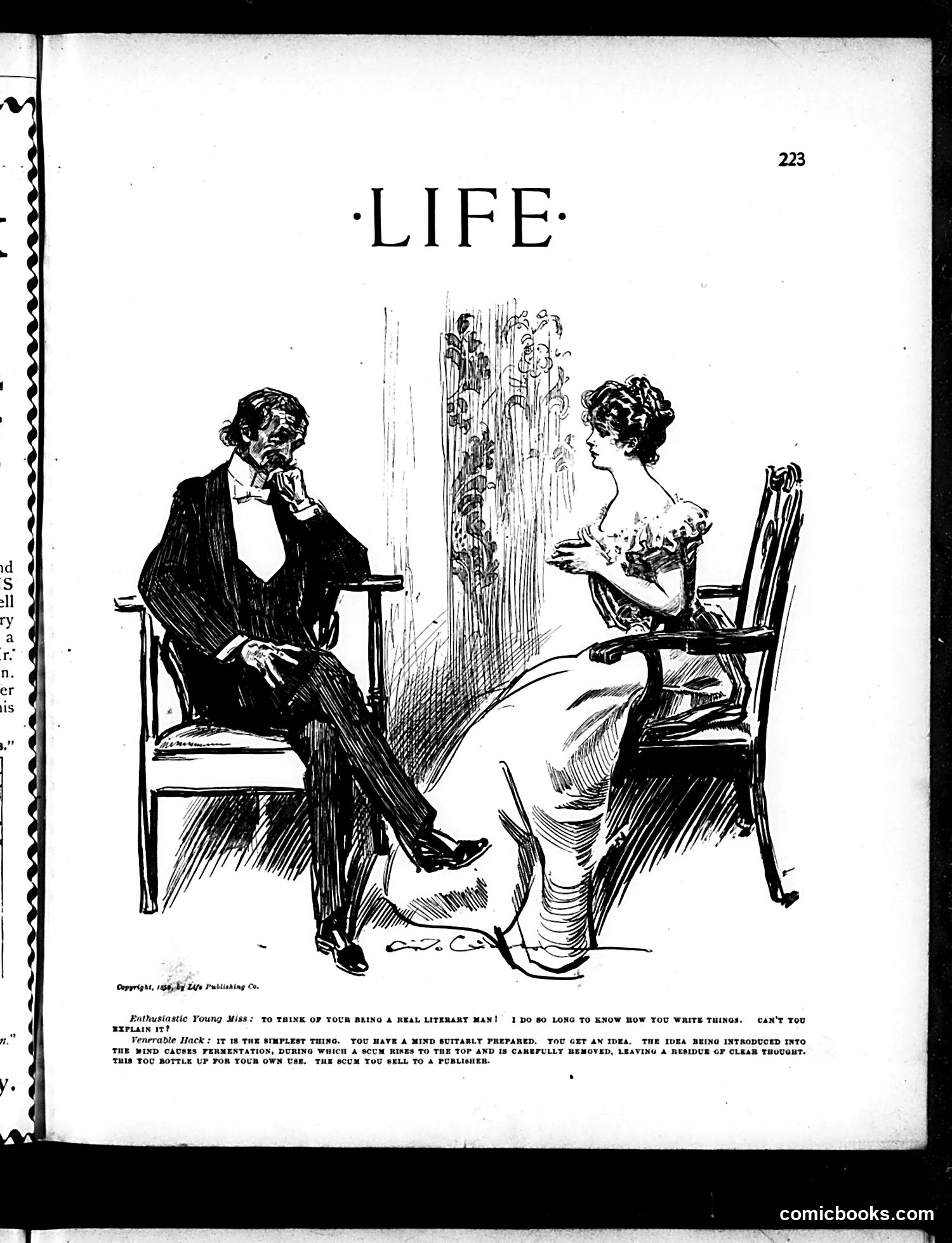
This page satirizes aspiring writers and literary pretension. The sketch shows a man in formal attire, chin resting thoughtfully on his hand, conversing with an elegantly dressed woman. The caption presents a dialogue between "Enthusiastic Young Miss" and "Venerable Hack." The young woman expresses admiration for the man as "a real literary man" and asks how he writes. The "Venerable Hack" responds cynically that writing requires simply having "a mind suitably prepared," getting an idea, introducing it into the mind's "caches of observation," and carefully "removing a residue of clear thought"—before selling it to a publisher. The satire mocks both romantic notions of literary genius and the mechanical, mercenary nature of commercial writing.
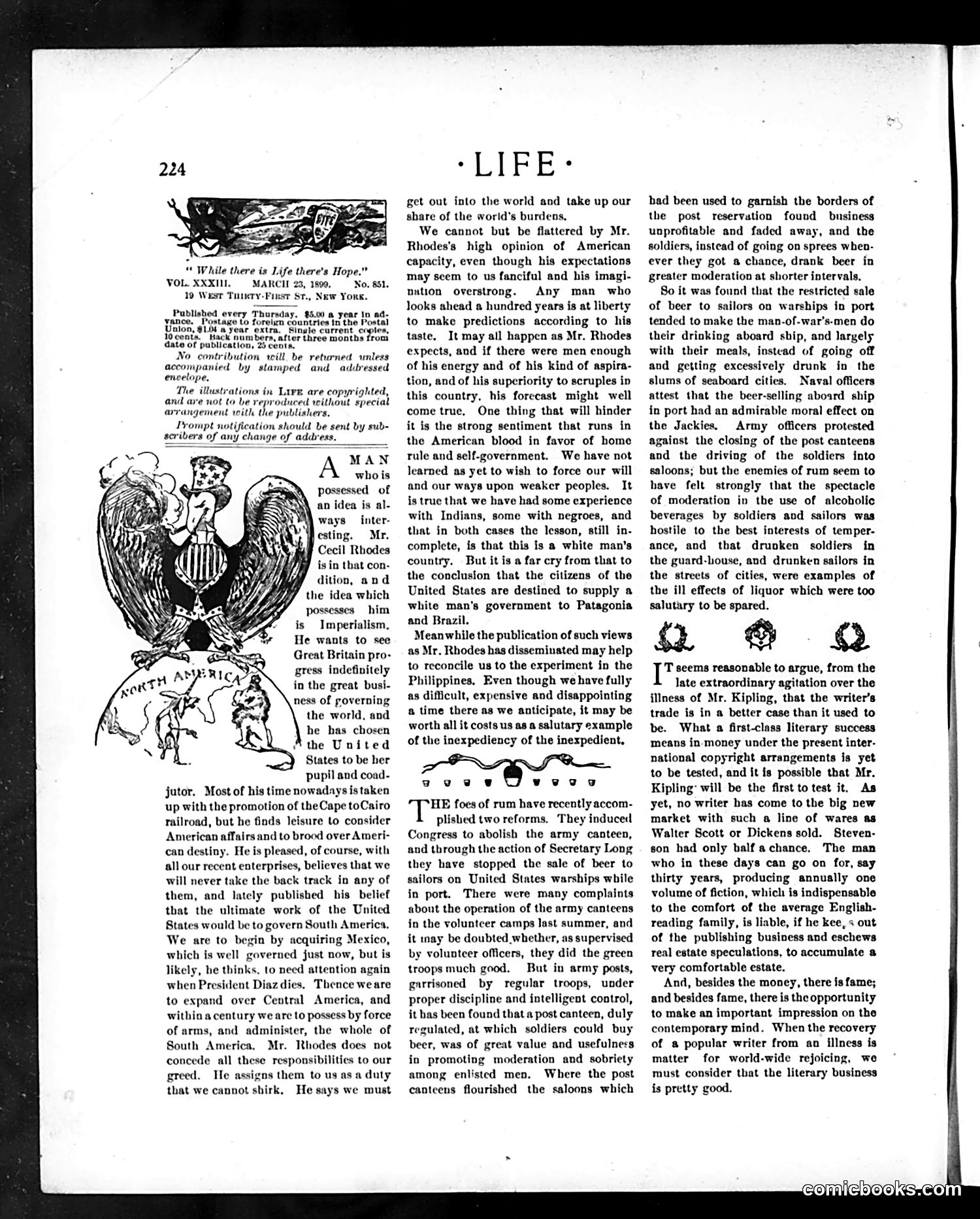
This page features a large political cartoon labeled "NORTH AMERICA" depicting an eagle (symbolizing American imperialism) perched above a map, with smaller figures below representing colonial subjects or conquered peoples. The accompanying editorial discusses Cecil Rhodes and American imperialism, criticizing the notion that the U.S. should impose its government on weaker nations in places like Patagonia and Brazil. The text argues against the idea that Americans are destined to govern other territories, calling such imperialist ambitions inconsistent with American democratic principles. The eagle imagery satirizes American imperial aspirations of the era—likely referencing late-19th-century expansionism and debates over colonial possessions following the Spanish-American War.
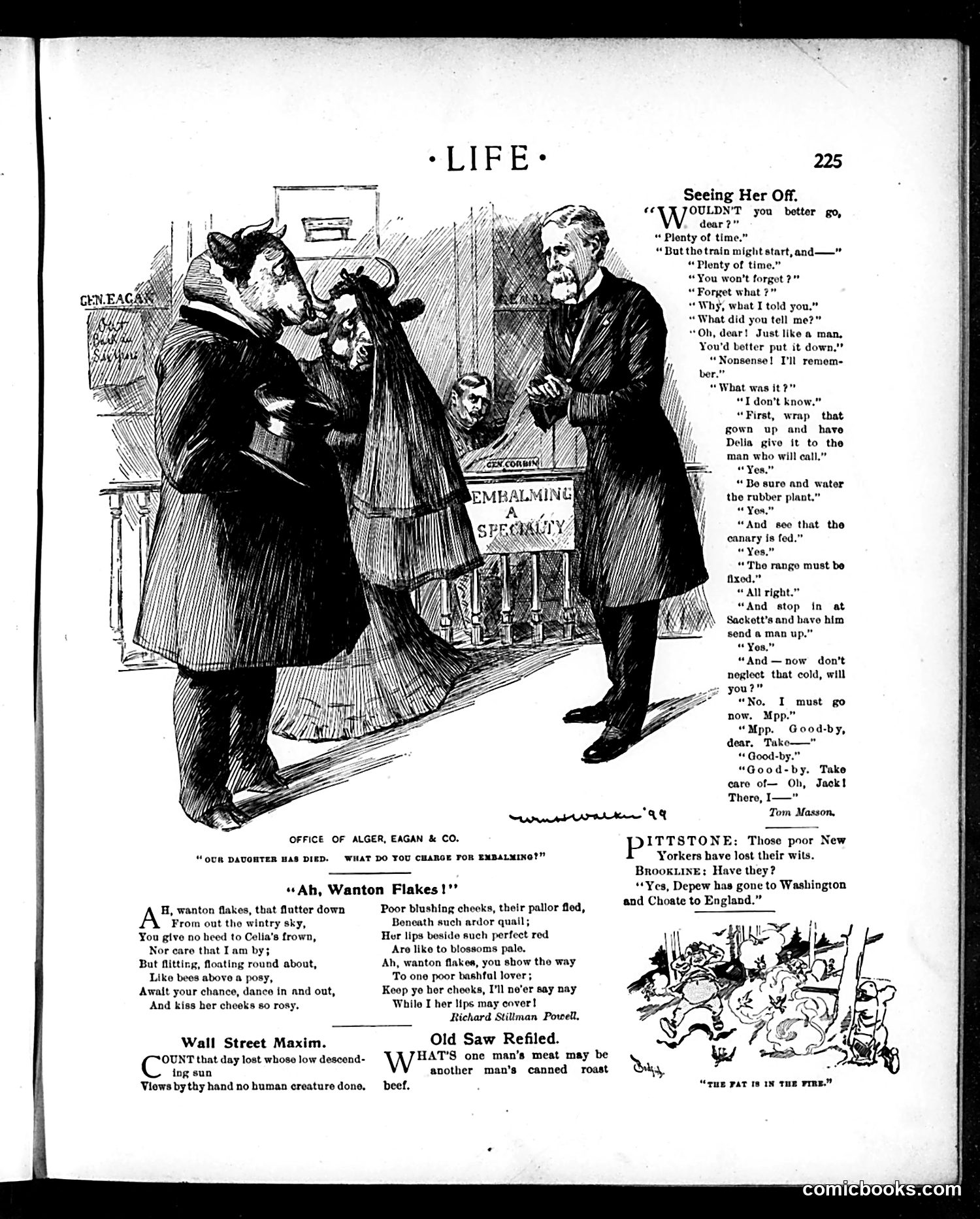
**Main Cartoon: "Seeing Her Off"** This depicts a farewell scene at what appears to be a shipping office ("Alger, Eagan & Co."). A woman in a cape is departing while two men exchange dialogue about her travel arrangements, mentioning Sackett's and sending "a man up." The text references watering "the rubber plant" and ensuring the canary is fed—domestic details suggesting she's leaving temporarily. **Supporting Content:** - **"Ah, Wanton Flakes!"**: A poem satirizing frivolous behavior - **"Wall Street Maxim"**: A cynical one-liner about wealthy people lacking compassion - **"Old Saw Refiled"**: A brief joke about canned meat - **"The Fat is in the Fire"**: A small comic illustration The page mixes domestic humor with social commentary typical of early 20th-century American satirical journalism, though specific historical context for the main cartoon remains unclear.
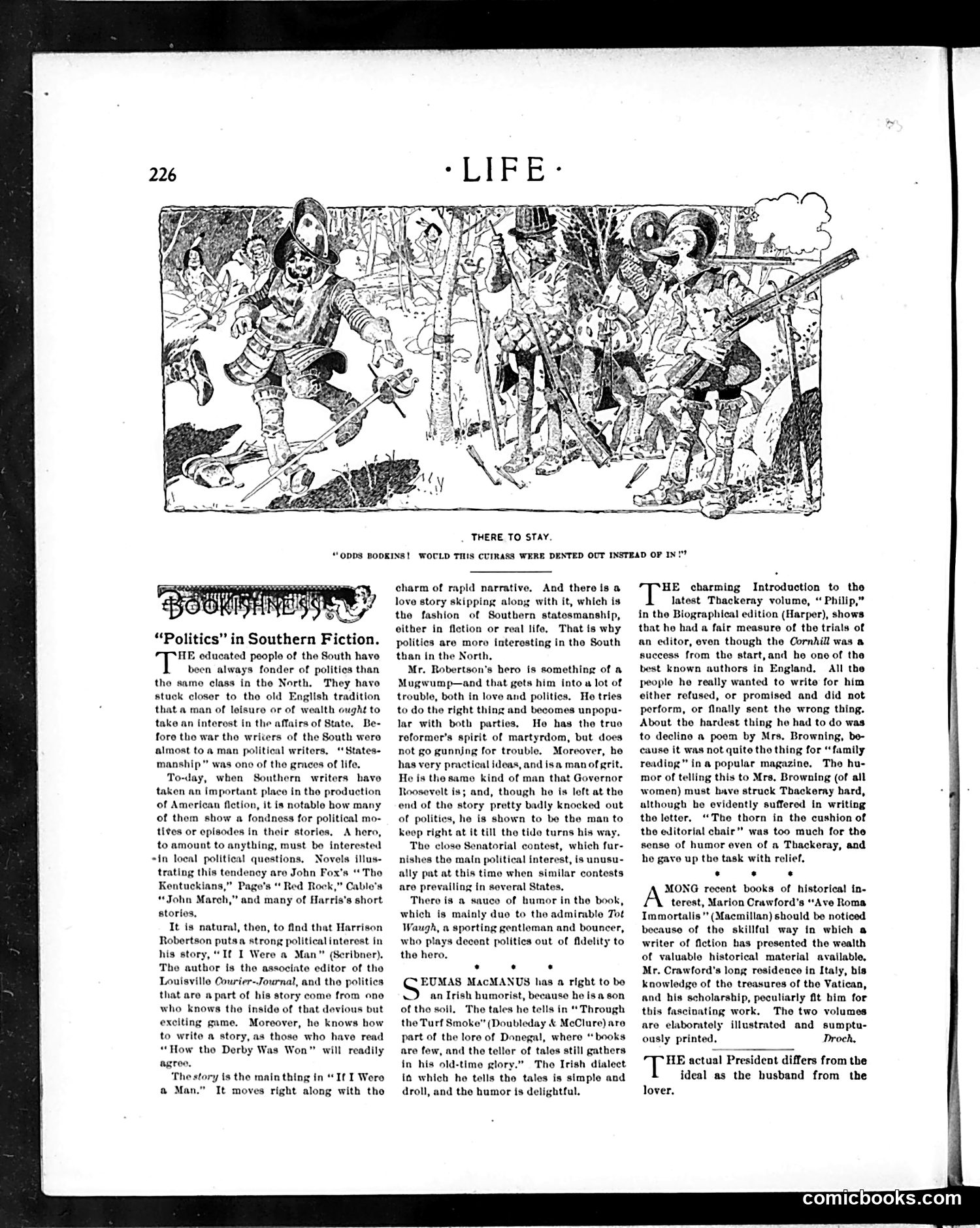
The cartoon's caption reads: "Odds bodkins! Would this cutlass were dented out instead of in it!" This appears to be satirical commentary on Southern political writing, specifically titled "Politics in Southern Fiction." The illustration depicts a chaotic colonial or frontier scene with multiple figures engaged in combat or conflict. The text discusses how educated Southern writers treat politics as more interesting than Northern counterparts, citing Harrison's "If I Were a Man" as an example where political themes drive the narrative. The satire critiques Southern literature's tendency to sensationalize political conflict through dramatic, violent imagery—suggesting that Southern writers inject overblown action and melodrama into political storylines for entertainment value, rather than addressing substantive political issues seriously.
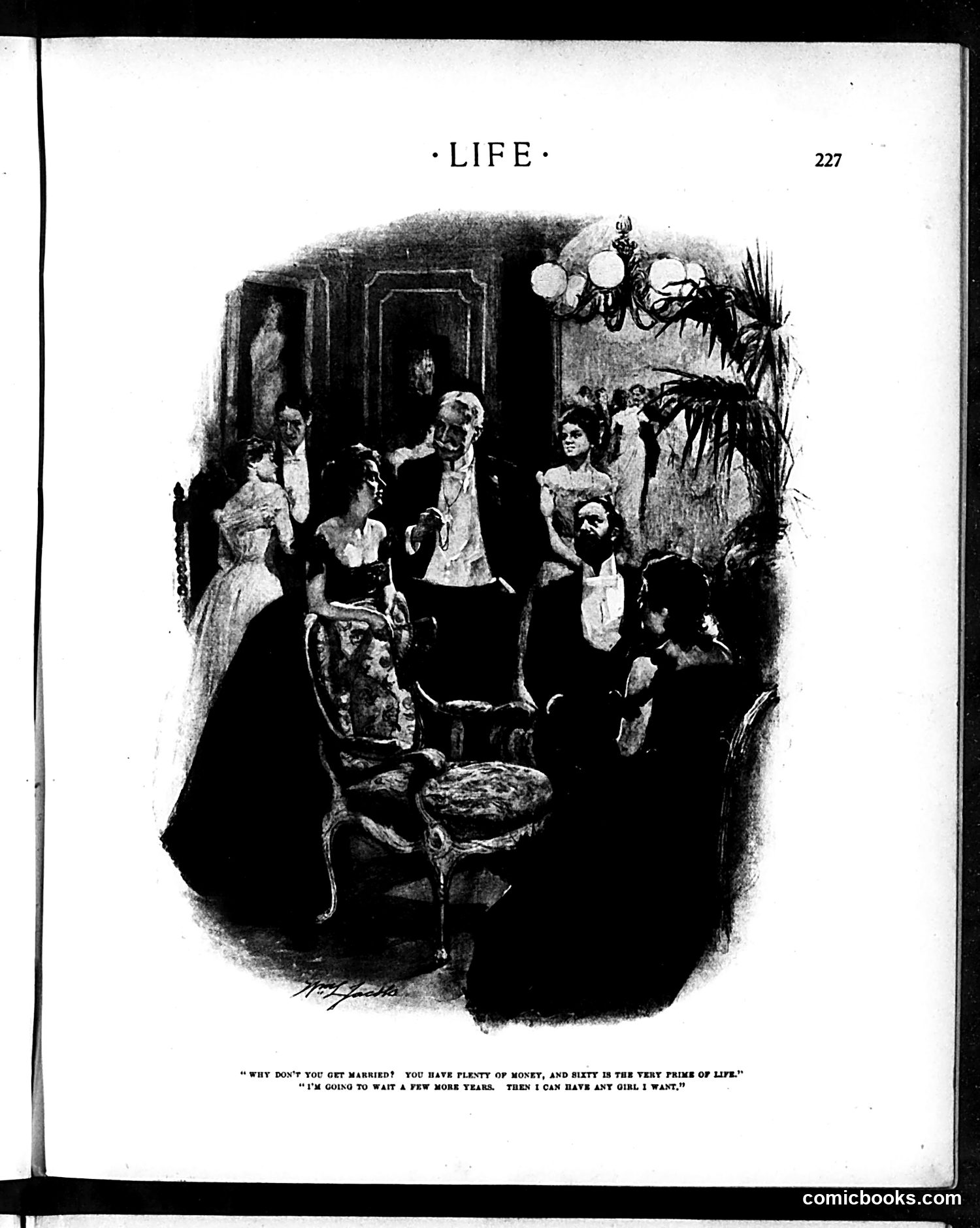
This is a satirical cartoon from *Life* magazine (page 227) depicting a formal social gathering, likely a wealthy household or society event based on the elegant dress and furnishings. The cartoon's humor centers on a marriage proposal dialogue. A man (appearing to be wealthy, given his formal attire) is being questioned why he won't marry. His response—that he's waiting a few more years to accumulate money, then can "have any girl I want"—satirizes the transactional nature of marriage among the wealthy classes. The satire targets how financial status determines marriageability and suggests that money, rather than love or compatibility, drives matrimonial decisions in high society. The joke assumes a cynical view: that women's willingness to marry is primarily motivated by a suitor's wealth. The gathered onlookers' reactions underscore the social commentary on this economic-romantic dynamic.
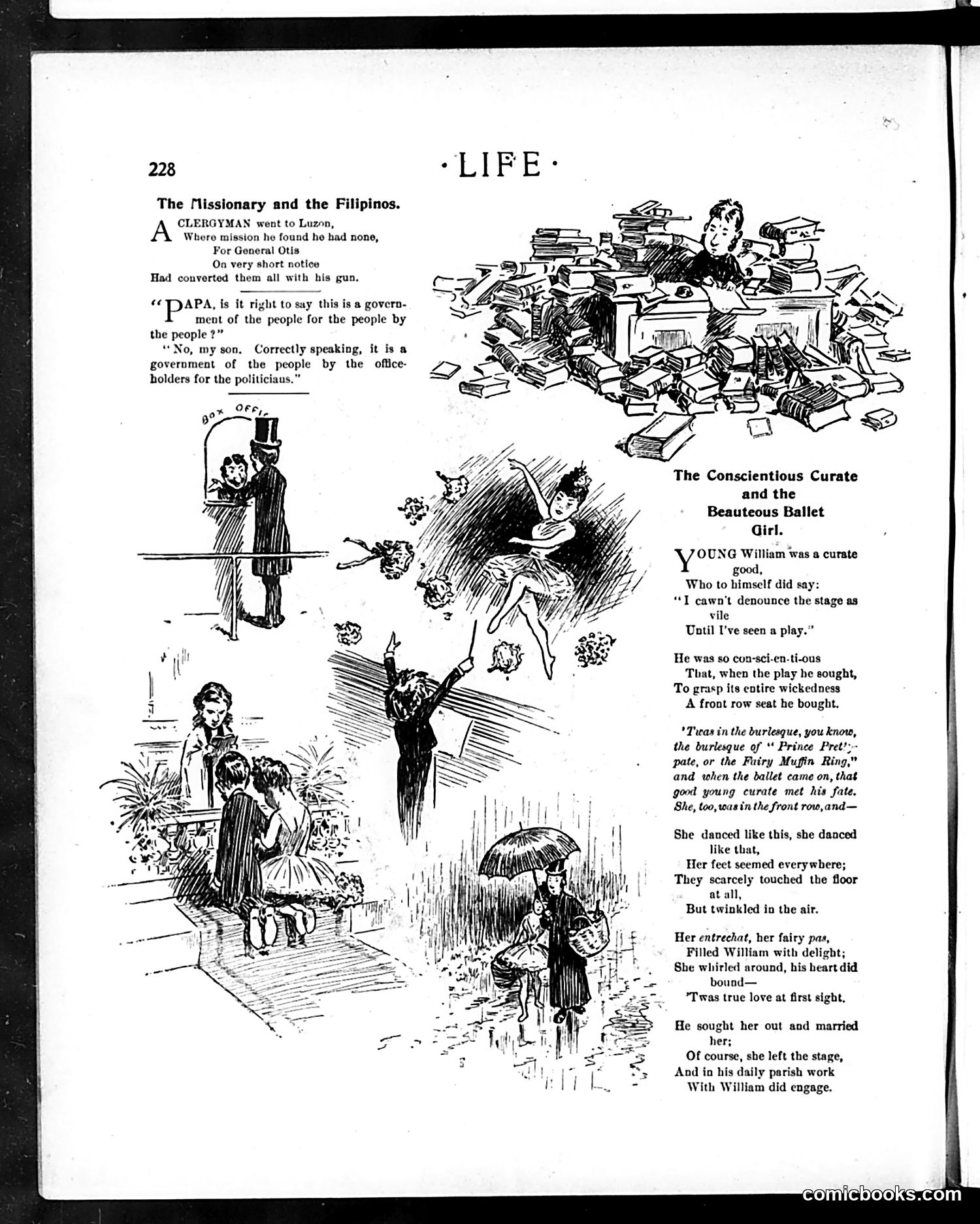
This page contains two distinct satirical pieces: **"The Missionary and the Filipinos"** (top left): A clergyman converting Filipinos "with his gun" satirizes American imperialism in the Philippines. The dialogue mocks the hypocrisy of calling colonial rule a "government of the people by the people"—when it's actually "by the office-holders for the politicians." This references early-1900s American military occupation and forced Christianization of the Philippines. **"The Conscientious Curate and the Beauteous Ballet Girl"** (right): A verse-and-cartoon story about a moral clergyman (William) who attends his first theatrical performance and falls in love with a dancer. She leaves the stage, marries him, and settles into parish life. The satire gently mocks both clerical prudishness about theater and the romantic fantasy of "reforming" performers through marriage.
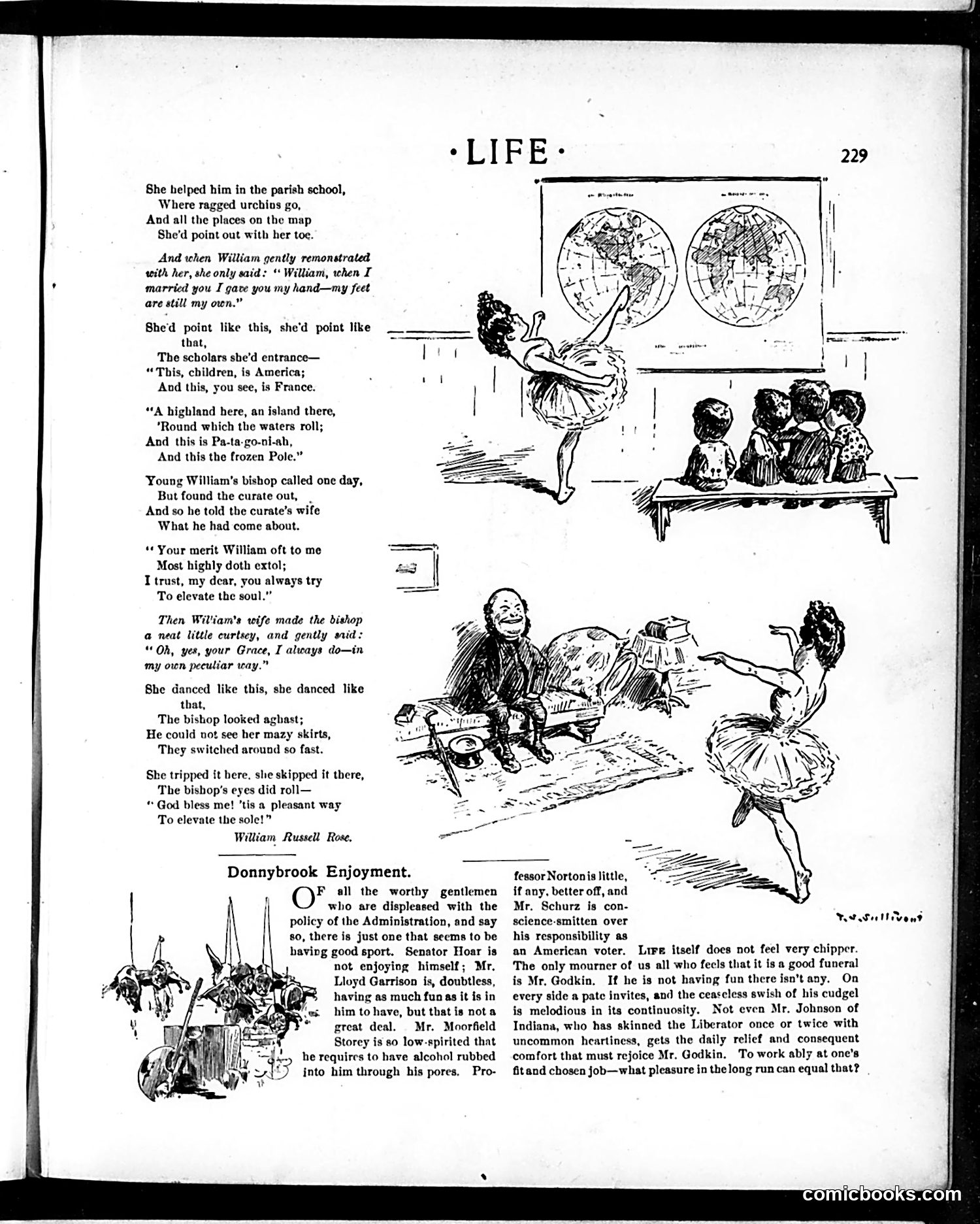
**Top Section:** A narrative poem by William Russell Rose about William, a boy whose schoolteacher wife points out geography to students using globes and maps. The bishop praises William's merit for "elevat[ing] the soul," and his wife dances enthusiastically—the bishop's amused reaction suggests her energetic dancing is both charming and somewhat improper. **Bottom Section ("Donnybrook Enjoyment"):** Political satire mocking Republican senators and officials displeased with the Administration's policies. Named politicians (Hoar, Lloyd Garrison, Moorfield Storey) are portrayed as hypocritical—complaining about poor sportsmanship while themselves lacking integrity. The text criticizes their self-righteous political posturing as insincere partisan complaint. Both sections use humor to critique earnestness and hypocrisy.
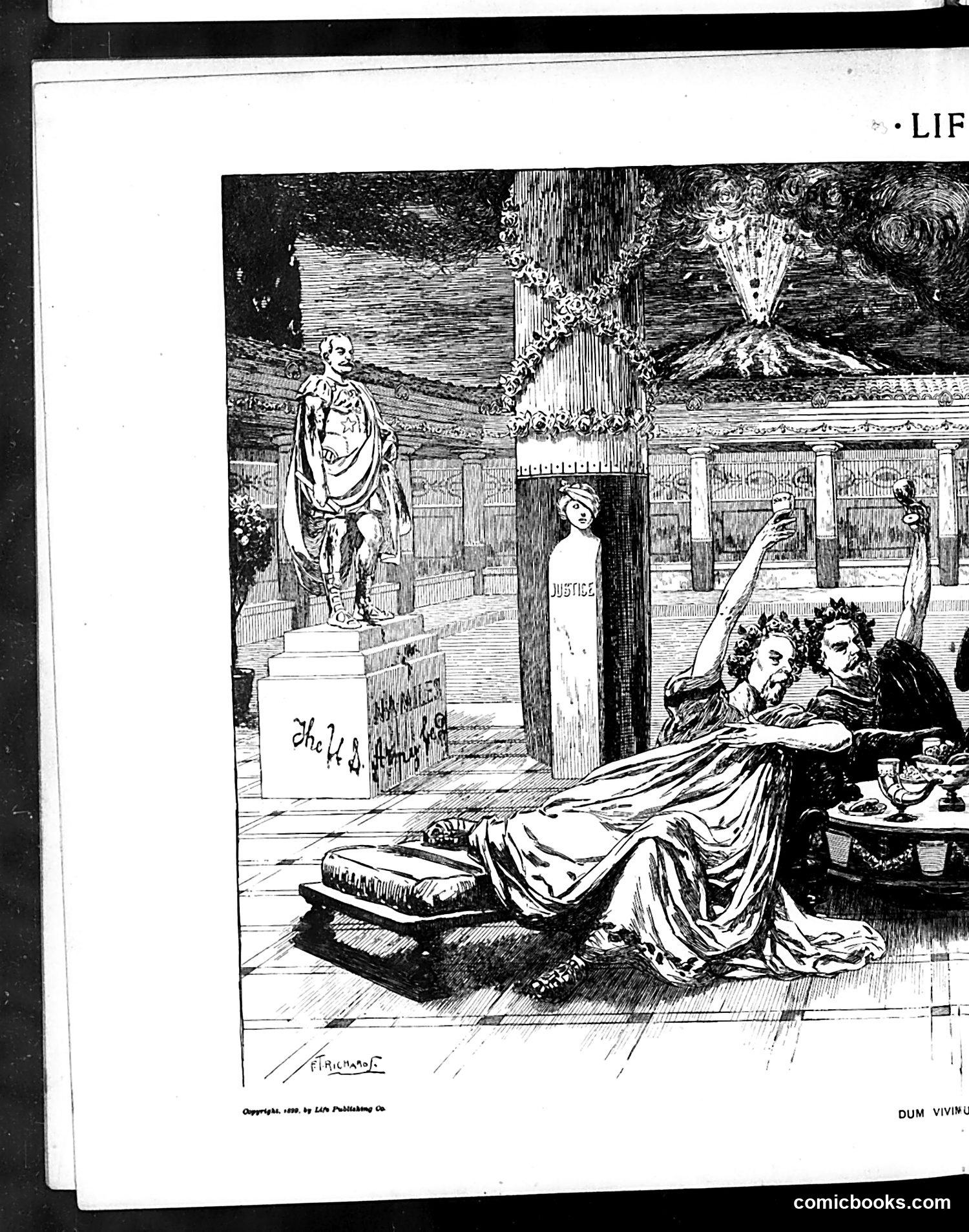
This is a classical allegorical scene depicting a reclining female figure (likely representing a personified concept—possibly Justice, given the word "JUSTICE" visible on a pillar) in an ornate interior. A statue on a pedestal stands in the background. The composition suggests a satirical commentary on the contrast between idealized justice or virtue (the classical statue and allegorical figure) and something else occurring in the scene. The artist's signature appears to be "Finch" or similar. The copyright indicates "Life Publishing Co." Without clearer text or more contextual information from surrounding pages, the specific political or social target remains unclear. This appears to be a classical satire about the gap between noble ideals and lived reality, but the particular historical event or policy being mocked cannot be determined from this image alone.
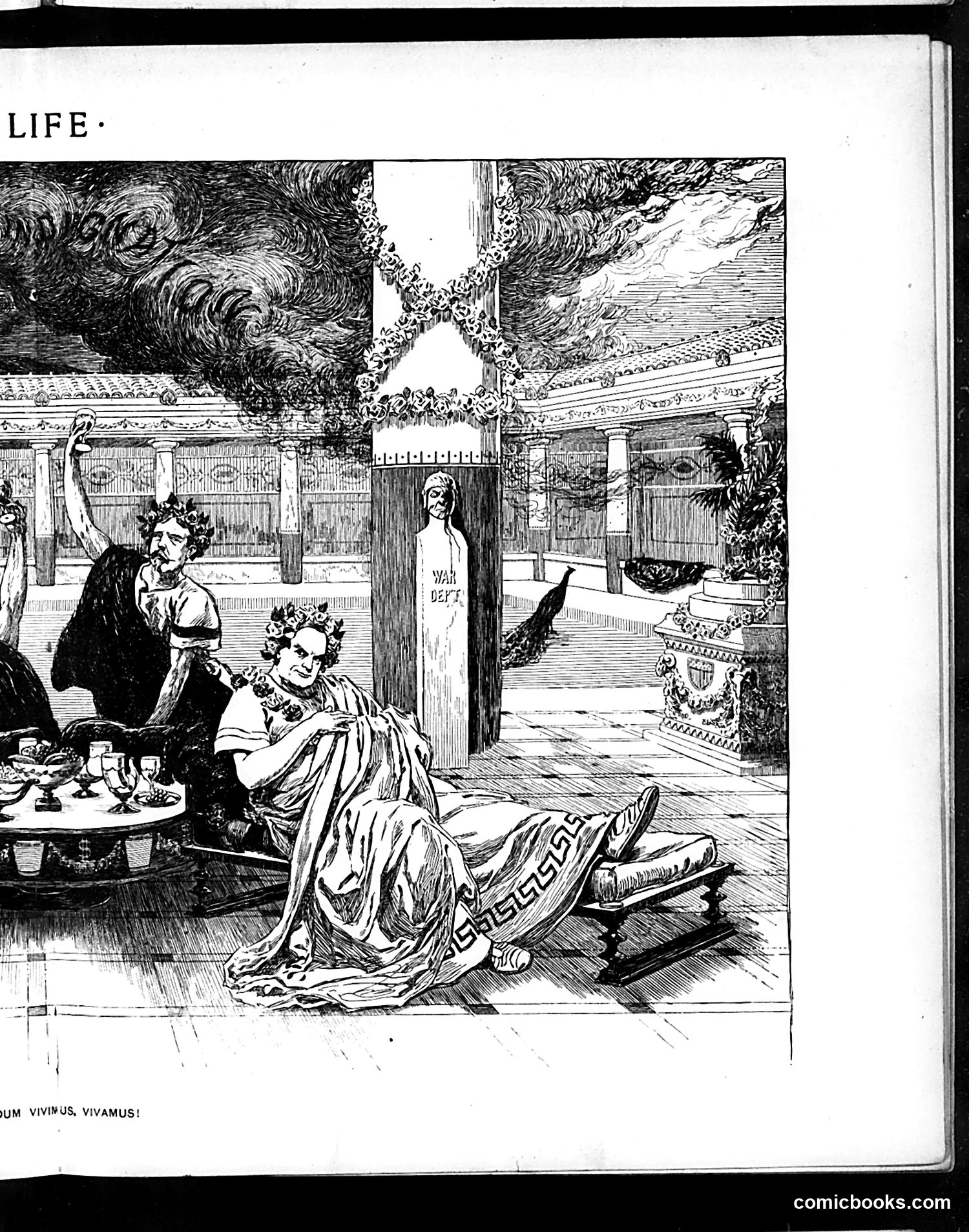
This is a satirical illustration titled "LIFE" showing a luxurious Roman or classical interior scene. A reclining woman in draped clothing reclines prominently in the foreground, while well-dressed figures converse in the background near columns and ornate furnishings. A peacock is visible, and the setting suggests decadent wealth and leisure. The Latin phrase at bottom reads "DUM VIVIUS, VIVAMUS!" ("While we live, let us live!"), a classical expression of hedonism. The satire appears to critique excessive luxury, indulgence, and idleness—likely commenting on wealth disparity or the frivolous lifestyle of the wealthy during the era this *Life* magazine was published. The classical Roman setting emphasizes this comparison between ancient decadence and contemporary American society.
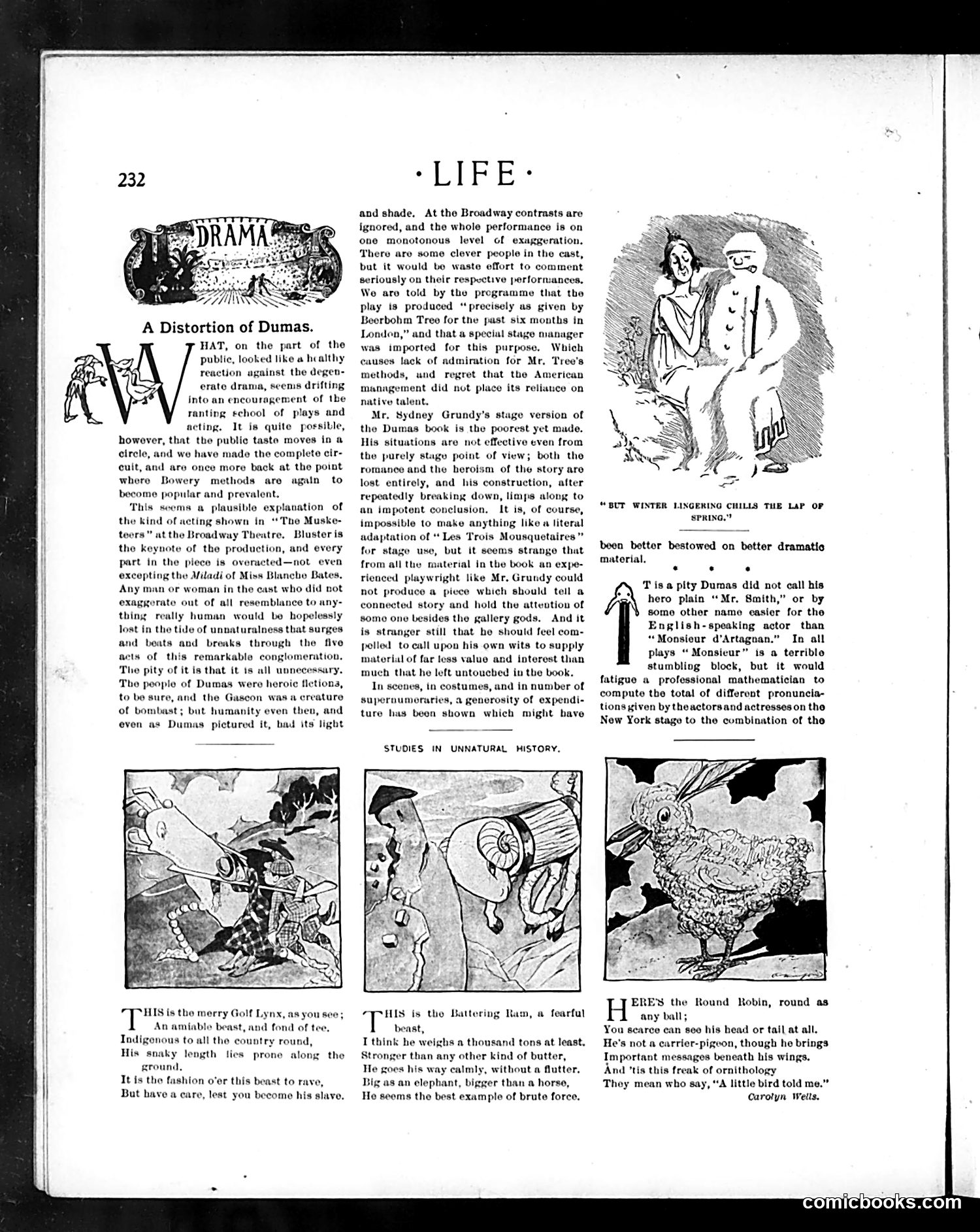
This page contains theater criticism and illustrated animal verses. **Main article:** "A Distortion of Dumas" critiques Sydney Grundy's stage adaptation of Alexandre Dumas's novel. The reviewer argues the play lost the book's effectiveness—the situations feel inert and the story's emotional arc fails. The critic notes American theatrical management relied too heavily on elaborate production methods rather than strong material itself. **"Studies in Unnatural History"** presents three humorous illustrated verses about animals with exaggerated characteristics: a Golf Lynx, a Flattering Ham, and a Round Robin. These appear to be whimsical nature-themed puns rather than political satire. The page exemplifies *Life* magazine's format: sophisticated theater commentary paired with lighthearted illustrated humor.
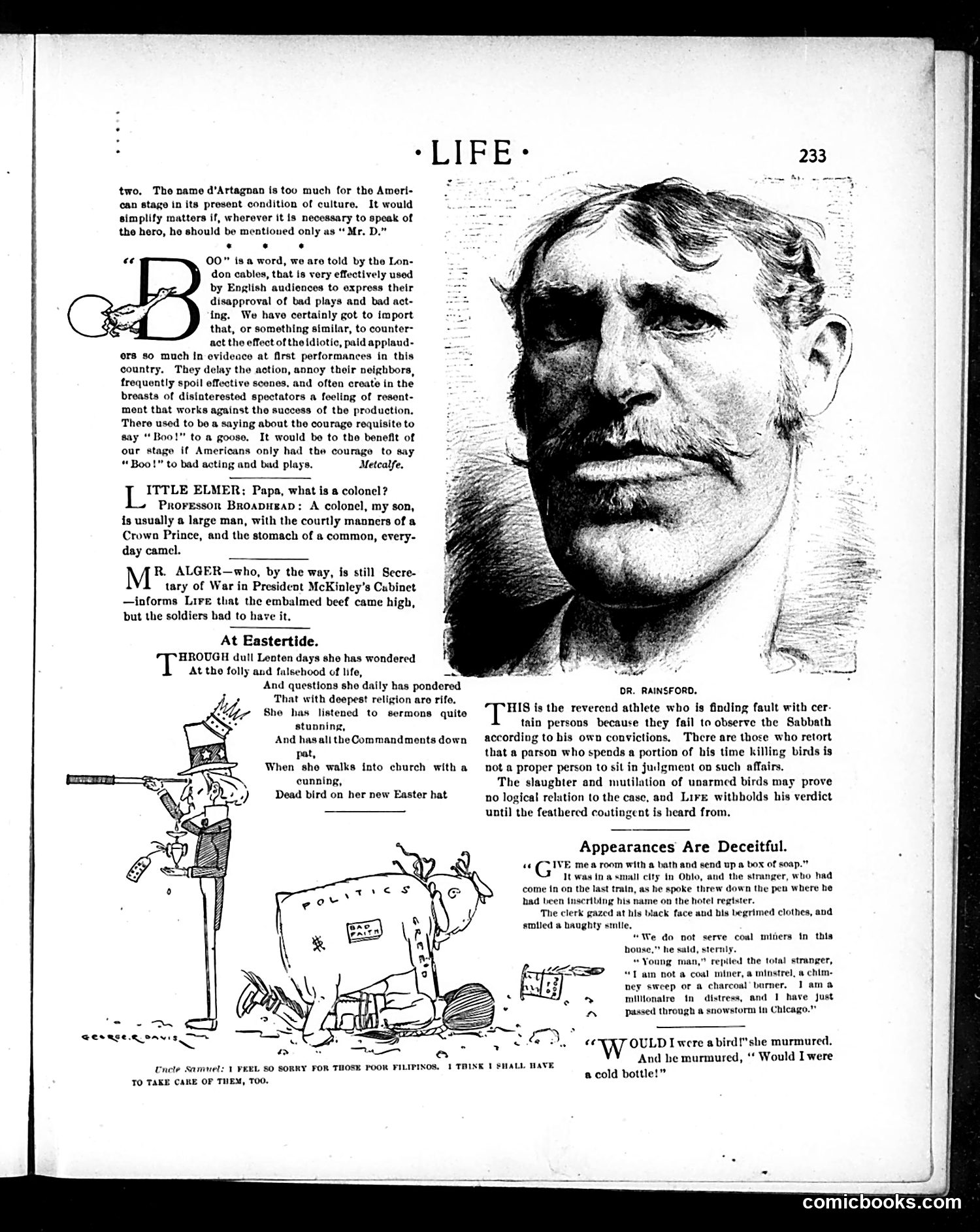
This page contains multiple satirical pieces targeting American cultural and political issues circa McKinley era (early 1900s): **Theater Criticism**: The opening section mocks paid applauders ("claqueurs") who disrupt theater performances, advocating Americans adopt the British practice of booing bad plays. **Colonel Definition**: A joke defining "colonel" as a large man with a Crown Prince's manners and a camel's stomach—likely mocking inflated military ranks. **Secretary Alger**: References Russell Alger, McKinley's Secretary of War, regarding the "embalmed beef" scandal (spoiled meat supplied to soldiers in the Spanish-American War). **Easter Hat Cartoon**: Criticizes women wearing dead birds as Easter hat decoration—fashionable at the time but ethically questionable. **Dr. Rainsford**: A reverend athlete hypocritically judging others' Sabbath observance while himself killing birds. **Hotel Story**: Satirizes racial prejudice and class assumptions—a wealthy Black man traveling incognito is mistaken for a coal miner and refused service.
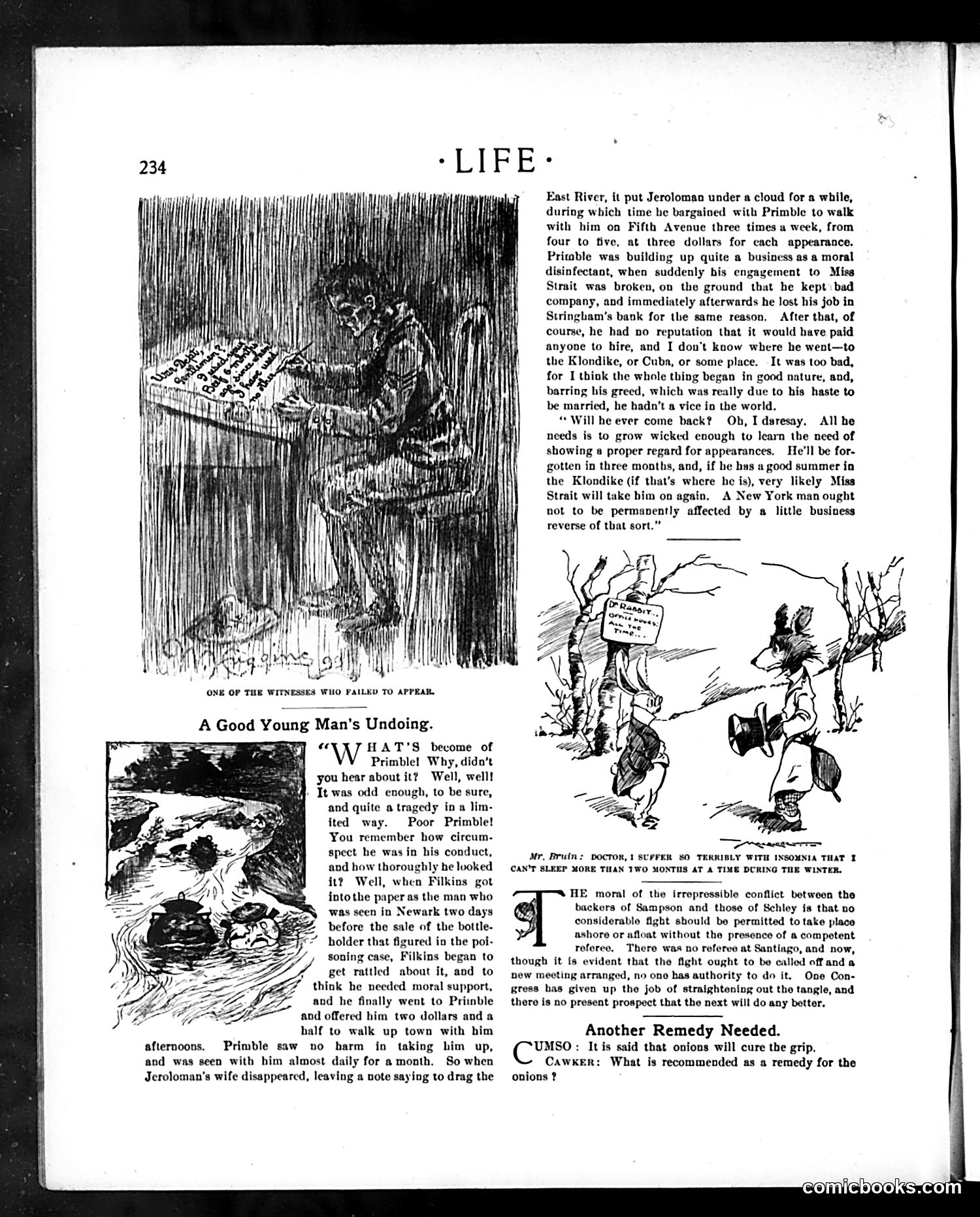
This *Life* magazine page contains satirical commentary on reputation and social standing in Gilded Age New York. **"A Good Young Man's Undoing"** tells how Primble, a morally upright banker, accepts small payments to walk publicly with disreputable men (Filkins and Jeroloman, both connected to scandals). His willingness to associate with them—even for innocent reasons and wages—destroys his reputation. He loses his fiancée Miss Strait and his bank job simply from "keeping bad company." The satire mocks how rigid Victorian social codes punished mere *appearance* of impropriety, not actual wrongdoing. **The Sampson-Schley reference** concerns a real naval dispute over credit for the 1898 Spanish-American War victory, comparing the Congressional inability to resolve it to an unrefereed boxing match. **The final joke** trades on wordplay: if onions cure influenza ("the grip"), what cures the side effects of eating onions? The cartoon labeled "One of the Witnesses Who Failed to Appear" visually reinforces themes of social disgrace and avoidance.
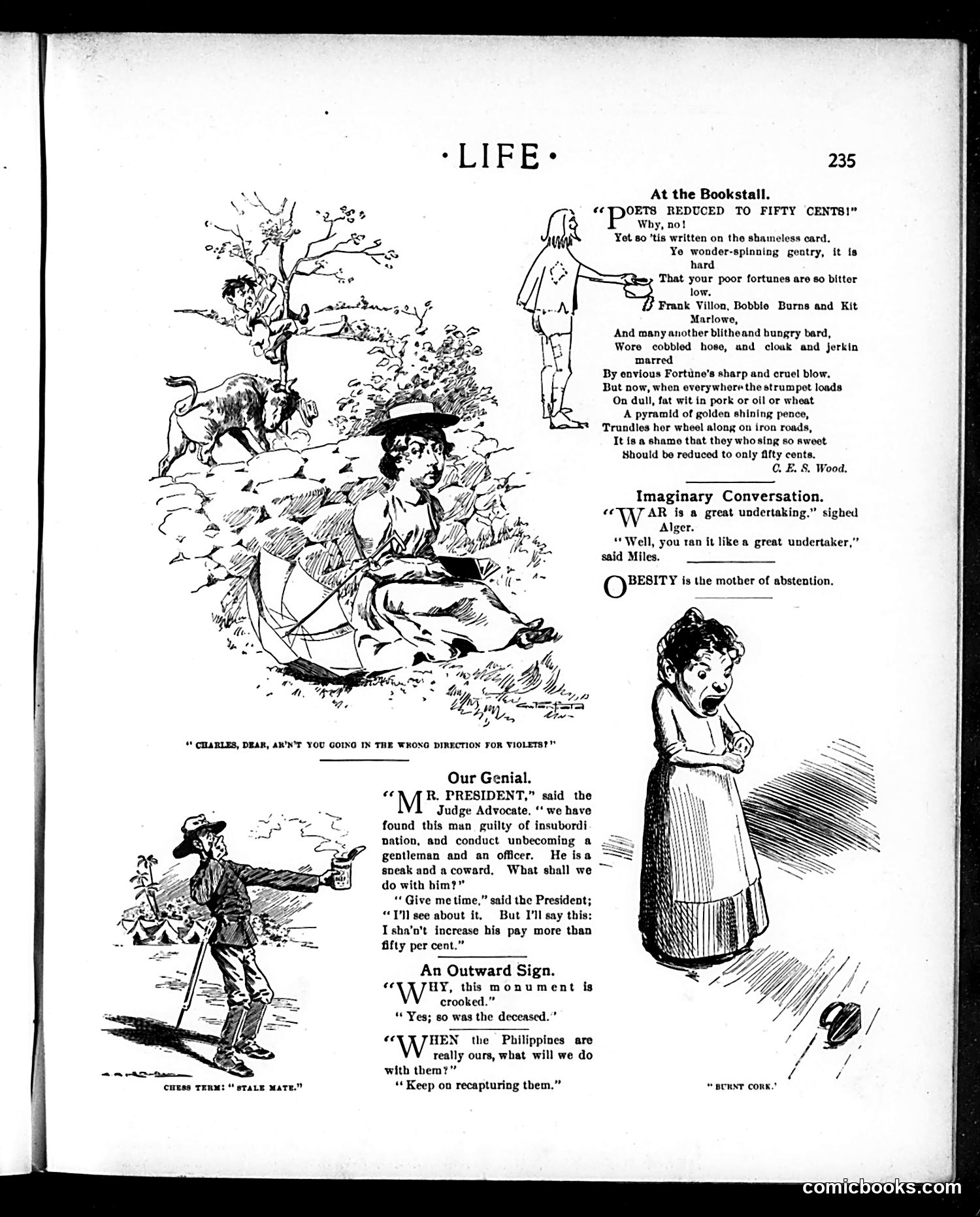
This page contains several satirical pieces mocking late-19th/early-20th century American society and politics. **"Poets Reduced to Fifty Cents"** criticizes the low market value of poetry books at bookstalls, contrasting struggling contemporary poets with historical figures (Villon, Burns, Marlowe) while lamenting that Fortune favors commercial goods ("pork or oil or wheat") over art. **"Imaginary Conversation"** offers a brief joke equating war with undertaking—suggesting military conduct resembles funeral management. **"Our Genial"** depicts a President (appears to be Theodore Roosevelt, given the era) addressing a court-martial. The joke is his dismissive response to a soldier's misconduct: he won't increase punishment beyond a fifty-percent pay raise, treating serious military discipline lightly. **"An Outward Sign"** makes a dark joke about a crooked monument commemorating a crooked deceased person. **"When the Philippines are Really Ours"** satirizes American imperial ambitions, suggesting endless military cycles of conquest and "recapture." The illustrations support these satirical critiques of poverty, military absurdity, and American expansionism.
This page contains humorous anecdotes rather than political cartoons. The main story, "Cat Scissors at Nully," satirizes marital dynamics and domestic hypocrisy of the early 1900s. **The Setup:** A husband returns home drunk after celebrating a holiday. To hide his intoxication from his wife, he takes a loud, splashy bath—paradoxically drawing her attention. When she discovers him, he attempts to seem sober and casual. **The Satire:** The joke mocks both parties. The husband's transparent attempt to deceive his wife through performative cleanliness is obvious to her; her cold, cutting response ("Don't you think [you should] take off your underclothes?") demonstrates wives were aware of such domestic deceptions. **The Social Context:** This reflects turn-of-the-century anxiety about male drinking, marital suspicion, and the unspoken tensions between spouses regarding nighttime absences and alcohol use. The page also includes unrelated teaching anecdotes and advertisements, suggesting this is a miscellaneous content page.
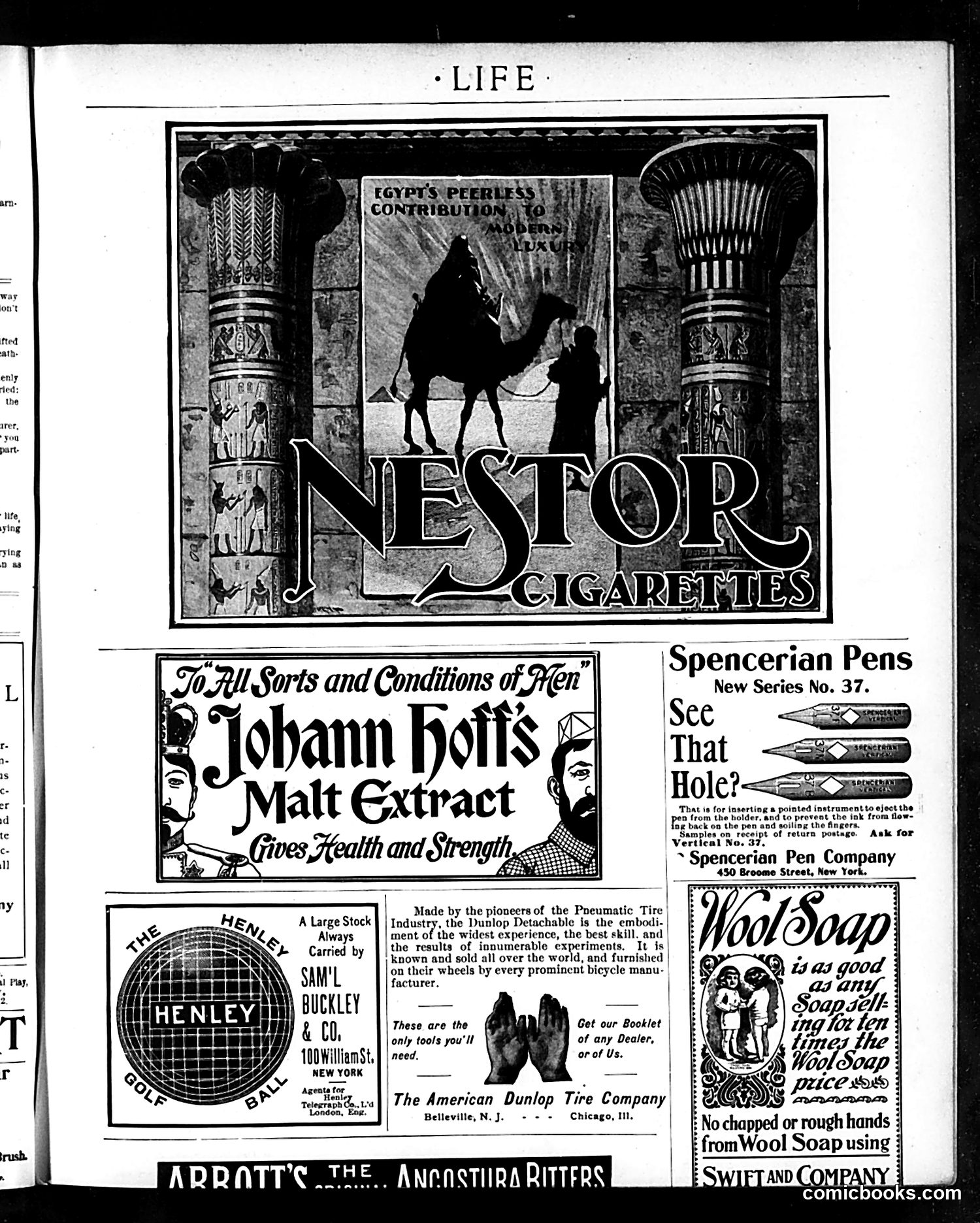
This page is primarily **advertising**, not political satire. The dominant content consists of commercial advertisements from the early 1900s: **Key advertisements visible:** - **Nestor Cigarettes** (top): Features Egyptian imagery with a camel and desert scene—appealing to exotic tastes - **Johann Hoff's Malt Extract**: Promises "Health and Strength" to men of all types - **Spencerian Pens**: Showcases a new pen design with a hole feature - **Henley Golf Ball** (by Sam'l Buckley & Co., New York) - **American Dunlop Tire Company**: Promotes pneumatic bicycle tires as pioneering technology - **Wool Soap** (Swift and Company): Emphasizes gentle cleaning without chapping hands These ads reflect **turn-of-the-century consumer culture**: bicycles were trendy, exotic imports were fashionable, and products promised health benefits (common before modern FDA regulations). The page documents period marketing strategies and product aspirations rather than containing editorial satire.
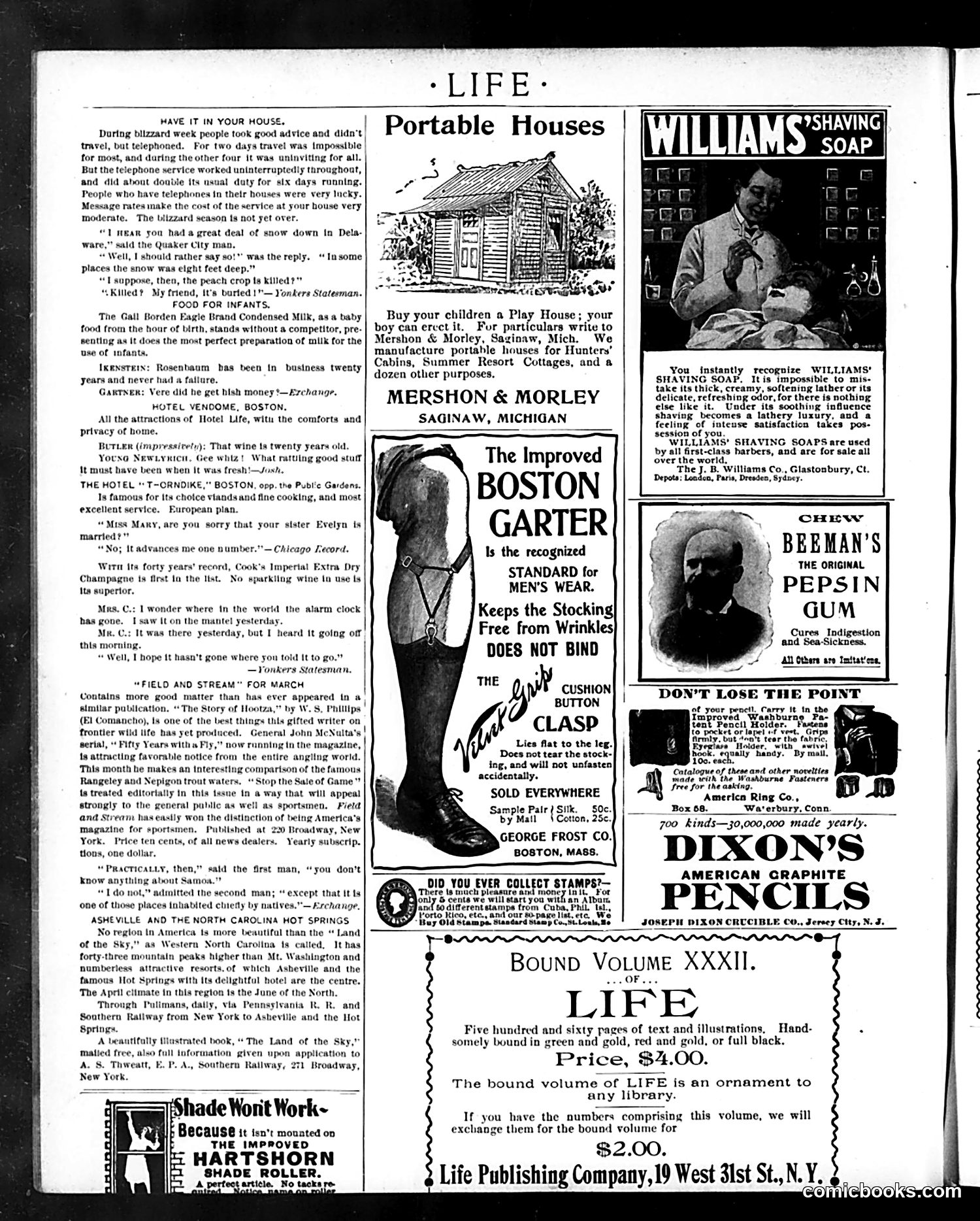
This page is primarily **advertising and miscellaneous content** rather than political cartoons. It contains: **Main Features:** - Advertisements for consumer goods (Williams Shaving Soap, Boston Garter, Beeman's Pepsin Gum, Dixon's Pencils) - Hotel and travel promotions (Boston, Asheville, North Carolina) - A announcement for bound volumes of *Life* magazine itself **Humor/Editorial Content:** The page includes several brief anecdotes and jokes scattered throughout, typical of *Life's* satirical style—including exchanges about snow depth in Delaware, wine aging, and missing alarm clocks. These are gentle, domestic humor rather than political commentary. **Historical Context:** The references to telephone service during blizzards, condensed milk for infants, and the promotion of "portable houses" reflect early 20th-century American consumer culture and technological advancement. **Overall Assessment:** This appears to be a standard advertising/promotional page from *Life* rather than a page showcasing the magazine's satirical editorial cartoons or pointed social commentary.
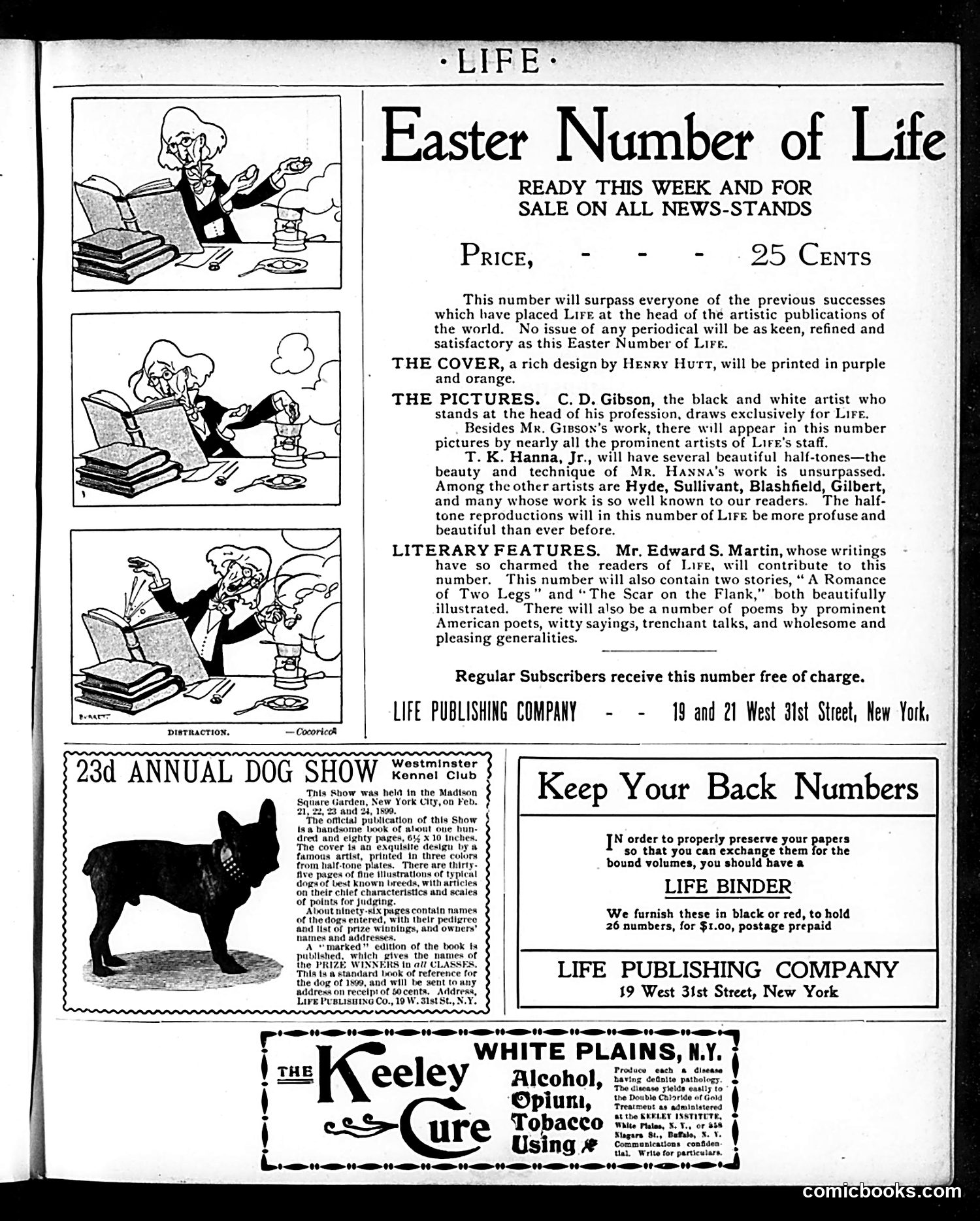
This is primarily an **advertising page** for Life magazine's Easter special issue (25 cents). The three small cartoons on the left show a figure repeatedly consulting papers/documents—likely illustrating "Distraction," as captioned—a visual gag about being overwhelmed by reading material. The page emphasizes the issue's artistic and literary prestige, naming prominent illustrators like **C.D. Gibson** (a famous society cartoonist of the era) and literary contributor **Edward S. Martin**. This appeals to Life's educated, affluent readership. The secondary advertisements include a **23rd Annual Dog Show** catalog and **The Keeley Cure**—a notorious (and fraudulent) treatment claiming to cure alcoholism, opium addiction, and tobacco use. The Keeley Cure's appearance here reflects the era's patent-medicine advertising practices and reveals contemporary anxieties about addiction. The "Life Binder" ad suggests readers collected issues to bind into volumes—a common practice before widespread magazine archiving. Overall, the page reflects early 1900s magazine culture and commercial interests.
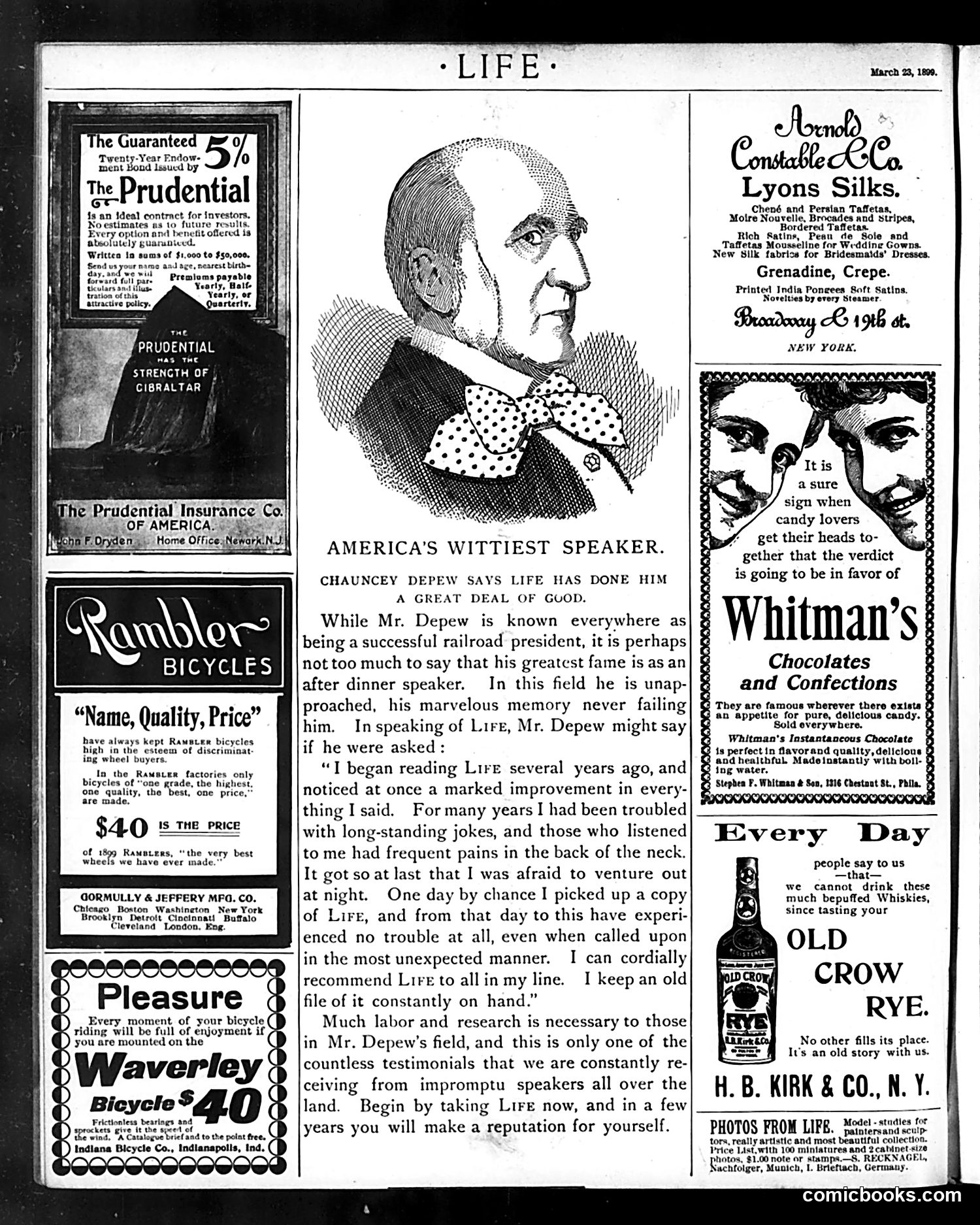
The main feature is a satirical testimonial from **Chauncey Depew**, a prominent railroad president and famous after-dinner speaker, praising *Life* magazine. The joke is a mock medical endorsement: Depew claims *Life* cured his chronic affliction of telling stale, painful jokes that gave audiences "pains in the back of the neck." By reading *Life*, he improved his wit and humor. This is *Life* magazine's self-promotion through celebrity endorsement—a common advertising trope then. The satire targets both Depew's reputation as a compulsive speaker and the absurdity of advertising copy that promises miraculous personal transformation. The page surrounds this with period advertisements (bicycles, chocolates, whiskey, silks), typical for the magazine's revenue model. The caricature portrait shows Depew in profile with exaggerated features characteristic of 1890s editorial cartooning.