
Life, 1899-03-23 · page 12 of 20
Life — March 23, 1899 — page 12: what you’re looking at
What you’re looking at
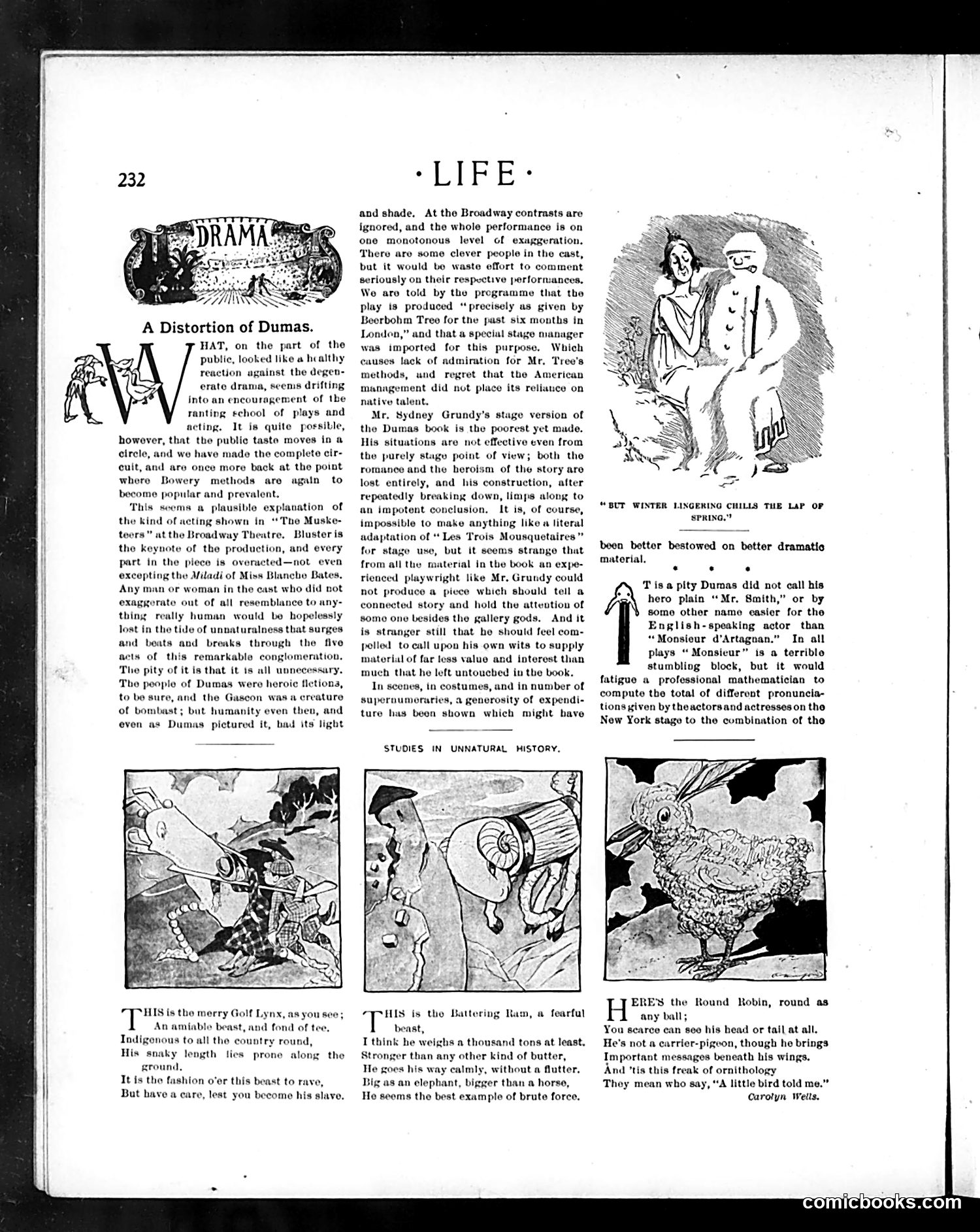
This page contains theater criticism and illustrated animal verses. **Main article:** "A Distortion of Dumas" critiques Sydney Grundy's stage adaptation of Alexandre Dumas's novel. The reviewer argues the play lost the book's effectiveness—the situations feel inert and the story's emotional arc fails. The critic notes American theatrical management relied too heavily on elaborate production methods rather than strong material itself. **"Studies in Unnatural History"** presents three humorous illustrated verses about animals with exaggerated characteristics: a Golf Lynx, a Flattering Ham, and a Round Robin. These appear to be whimsical nature-themed puns rather than political satire. The page exemplifies *Life* magazine's format: sophisticated theater commentary paired with lighthearted illustrated humor.
📄 Transcribed text from this page (OCR, searchable)
Machine-transcribed from the original scan — historical spelling and the odd misread are preserved.
A Distortion of Dumas. HAT, on the part of the public, looked like a healthy reaction against the degen- erate drama, seems drifting into an encouragement of the ranting school of plays and acting, It is quite possible, howover, that the public tasto moves in a and we have made the complete cir- cuit, and are once more back at the point whore Bowery methods are again to become popular and prevalent, This seems a plausible explanation of the kind of acting shown in “The Muske- 9 Broadway Theatre, Bluster is the keynote of the production, and every part in the piece is overacted—not even excepting the Miladi of Miss Blanche Bates. Any man or woman in the cast who did not exaggerate out of all resemblance to uny- thing really human would be hopelessly lost in the tide of unnaturalness that surges and beats and breaks through the five acts of this remarkable conglomeration, ‘The pity of it is that it 18 all unnecessary, Tho pooplo of Dumas were heroic fictions, to be sure, and the Gascon was a creature of bombast; but humanity even then, and even as Dumas pictured it, bad its light HIS is tho merry Golf Lynx, as you se An amiable beast, and fond of Indigenous to all the country round, His snaky length grou It is the fashion o'er this beast to rave, But have a care, lest you become his slave. lies prone along the and shade, At the Broadway contrasts are ignored, and the whole performance is on one monotonous level of exaggeration, ‘There are some clever people in the cast, but it would bo waste effort to comment seriously on their respective performances, Wo aro told by the programme that the play is produced “precisely as given by Beerbohm Tree for the past six months in London,” and that a special stage manager was imported for this purpose. Which causes lack of admiration for Mr, Tree's methods, und regret that the American management did not place its reliauee on native talent. Mr. Sydney Grundy’s stage version of the Dumas book is the poorest yet made. His situations are not effective even from the purely stage point of view; both the romance and the heroism of the story aro lost entirely, and his construction, after repeatedly breaking down, limps along to an impotent conclusion, It is, of course, impossible to make anything like a literal adaptation of “Les Trois Mousquetaires” for stago use, but it seems strange that from all the material in the book an expe- rienced playwright like Mr. Grundy could not produce a piece which should tell a connected story and hold the attention of somo one besides the gallery gods. And it is stranger still that he should feel com- polled to call upon his own wits to supply material of far tess value and interest than much that he left untoucbed in the book. In scenes, in costumes, and in number of supernumoraries, a generosity of expendi- ture has been shown which might bave STUDIES IN UNNATURAL HISTORY. HIS is the Battering Ram, a fearful Treas, T think he weighs a thousand tons at least. Stronger than any other kind of butter, He goes his way calmly, without a flutter, Big as an elephant, bigger than a horso, He seoms the best example of brute force. “BUT WINTER LINGERING CHILLS THE LAP OP SPRING.” boon bottor bestowed on better dramatic matorial. . . . ‘T isa pity Dumas did not call his hero plain “Mr, Smith,” or by somo other namo easier for tho English-speaking actor than “Monsiour d’Artagnan.” In all plays “Monsicur” is a torriblo stumbling block, but it would fatigue a professional mathematician to compute the total of differont pronuncia- tions given by theactorsand actresses on the Now York stago to the combination of the ERE® the Round Robin, round as any ball; You scarce can seo his head or tail at all. He's not a carrier-pigeon, though he brings. Important messages beneath his wings. And ‘tis this freak of ornithology Thoy mean who say, “A little bird told me.” Carolyn Wells.