
Life, 1899-03-23 · page 4 of 20
Life — March 23, 1899 — page 4: what you’re looking at
What you’re looking at
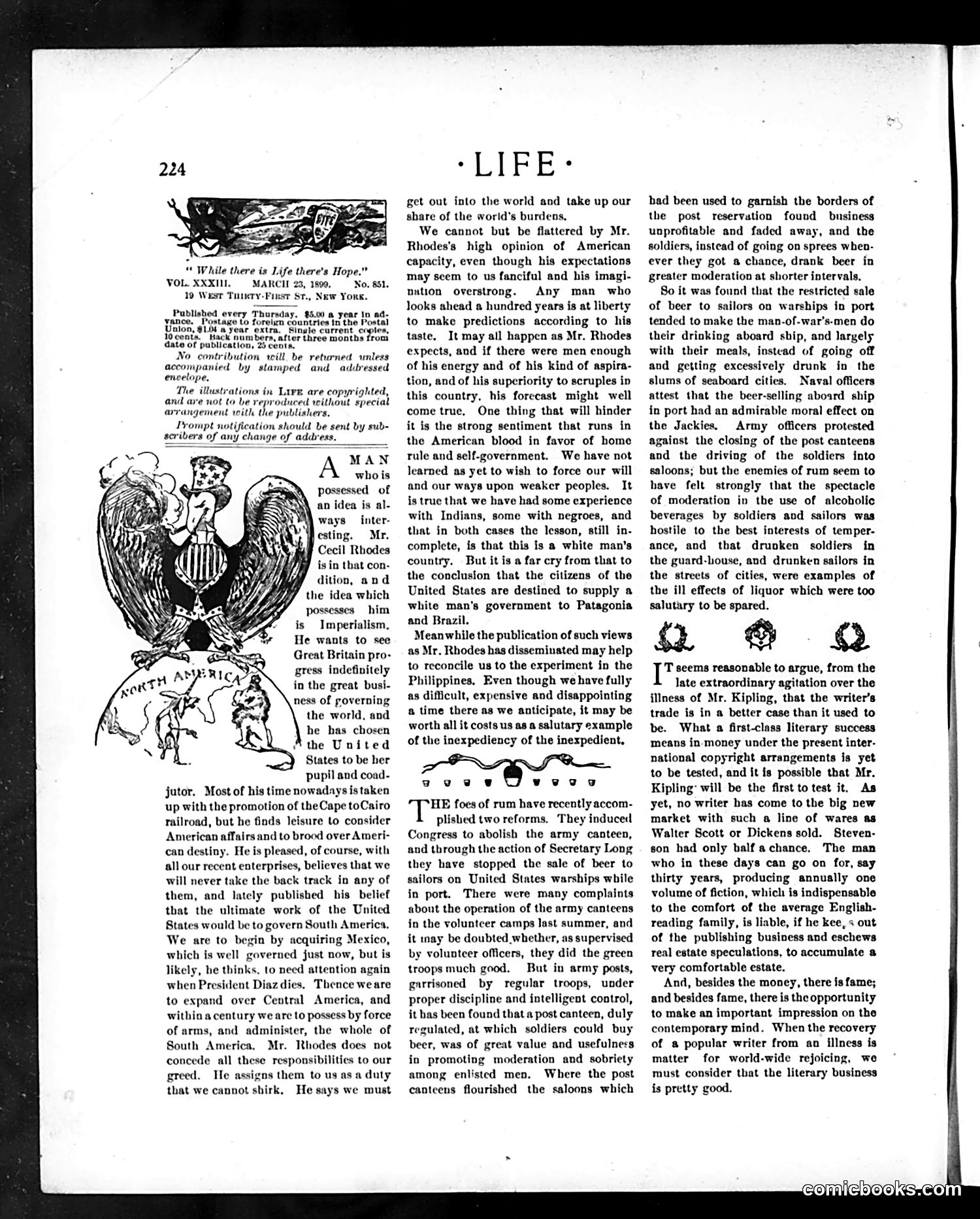
This page features a large political cartoon labeled "NORTH AMERICA" depicting an eagle (symbolizing American imperialism) perched above a map, with smaller figures below representing colonial subjects or conquered peoples. The accompanying editorial discusses Cecil Rhodes and American imperialism, criticizing the notion that the U.S. should impose its government on weaker nations in places like Patagonia and Brazil. The text argues against the idea that Americans are destined to govern other territories, calling such imperialist ambitions inconsistent with American democratic principles. The eagle imagery satirizes American imperial aspirations of the era—likely referencing late-19th-century expansionism and debates over colonial possessions following the Spanish-American War.
📄 Transcribed text from this page (OCR, searchable)
Machine-transcribed from the original scan — historical spelling and the odd misread are preserved.
“ While there is Life there's Hope.” VOL. XXXII. MARCH 23, 1899, No. 851. 19 West Tut’ ust St., New YORK. Published every Thursday. $5.00 a year tn ad- Yance, Postage to forelen countries in the Postal Pnton, $104 a year extra, Single current, copies. JOcents. ‘ack numbers, after three months from date of publication, 2 cents. No contribution will be returned unless accompanied by stamped and addressed envelope. The illustrations in Lave are copyrighted, and are not to be reproduced without special arrangement rwith the publishers. Prompt notification should be sent by sub- scribers of any change of address. MAN who is possessed of an idea is al- ways inter- esting. Mr. Cecil Rhodes is in that con- dition, and the idea which possesses him is Imperialism, He wants to see Great Britain pro- gress indefinitely in the great busi- ness of governing the world, and he has chosen the United States to be her pupil and coad- jutor. Most of his time nowadays istaken up with the promotion of theCape toCairo railroad, but he finds leisure to consider American affairs and to brood over Ameri- can destiny. He is pleased, of course, with all our recent enterprises, believes that we will never take the back track in any of them, and lately published his belief that the ultimate work of the United States would be to govern South America, We are to begin by acquiring Mexico, which is well governed just now, but is likely, he thinks, to need attention again when President Diaz dies. Thence we are to expand over Central America, and within a century we are to possess by force of arms, and administer, the whole of South America, Mr. Rhodes does not concede all these responsibilities to our greed. Te assigns them to us asa duty that we cannot shirk, He says we must. ‘LIFE: get out into the world and take up our share of the world’s burdens, We cannot but be flattered by Mr. Rhodes's high opinion of American capacity, even though his expectations may seem to us fanciful and his imagi- pation overstrong. Any man who looks ahead a hundred years is at liberty to make predictions according to his taste, It may all happen as Mr. Rhodes expects, and if there were men enough of his energy and of his kind of aspira- tion, and of his superiority to scruples in this country, his forecast might well come true, One thing that will hinder it is the strong sentiment that runs in the American blood in favor of home rule and self-government. We have not learned as yet to wish to force our will and our ways upon weaker peoples. It is true that we have had some experience with Indians, some with negroes, and that in both cases the lesson, still in- complete, is that this is a white man’s country. But it is a far cry from that to the conclusion that the citizens of the United States are destined to supply a white man’s government to Patagonia and Brazil. Meanwhile the publication of such views as Mr. Rhodes has disseminated may help to reconcile us to the experiment in the Philippines, Even though we have fully as difficult, expensive and disappointing a time there as we anticipate, it may be worth all it costs us asa salutary example of the inexpediency of the inexpedient, HE foes of rum have recently accom- plished two reforms, They induced Congress to abolish the army canteen, and through the action of Secretary Long they have stopped the sale of beer to sailors on United States warships while in port. There were many complaints about the operation of the army canteens in the voluntcer camps last summer, and it may be doubted whether, as supervised by volunteer officers, they did the green troops much good. But in army posts, garrisoned by regular troops, under proper discipline and intelligent control, it has been found that a post canteen, duly regulated, at which soldiers could buy beer, was of great value and usefulness in promoting moderation and sobriety among enlisted men. Where the post canteens flourished the saloons which had been used to garnish the borders of the post reservation found business unprofitable and faded away, and the soldiers, instead of going on sprees when- ever they got @ chance, drank beer in greater moderation at shorter intervals, So it was found that the restricted sale of beer to sailors on warships in port tended to make the man-of-war's-men do their drioking aboard ship, and largely with their meals, instead of going off and getting excessively drunk in the slums of seaboard cities, Naval officers attest that the beer-selling aboard ship in port had an admirable moral effect on the Jackies, Army officers protested against the closing of the post canteens and the driving of the soldiers into saloons; but the enemies of rum seem to have felt strongly that the spectacle of moderation in the use of alcoholic beverages by soldiers and sailors was hostile to the best interests of temper- ance, and that druoken soldiers in the guard-house, and drunken sailors in the streets of cities, were examples of the ill effects of liquor which were too salutary to be spared. 2 @& Q | fe seems reasonable to argue, from the late extraordinary agitation over the illness of Mr. Kipling, that the writer’s trade is in a better case than it used to be. What a first-class literary success means in money under the present inter- national copyright arrangements is yet to be tested, and it is possible that Mr. Kipling: will be the first to test it, As yet, no writer has come to the big new market with such a line of wares as Walter Scott or Dickens sold. Steven- son had only balf achance. The man who in these days can go on for, say thirty years, producing annually one volume of fiction, which is indispensable to the comfort of the average Engliah- reading family, is liable, if he kee, s out of the publishing business and eschews real estate speculations, to accumulate a very comfortable estate. And, besides the money, there is fame; and besides fame, there is the opportunity to make an important impression on the contemporary mind. When the recovery of a popular writer from an illness is matter for world-wide rejoicing, we must consider that the literary business is pretty good.